The Dicer-RISC Complex and siRNA Pathway: Mechanism, Applications, and Drug Development Frontiers
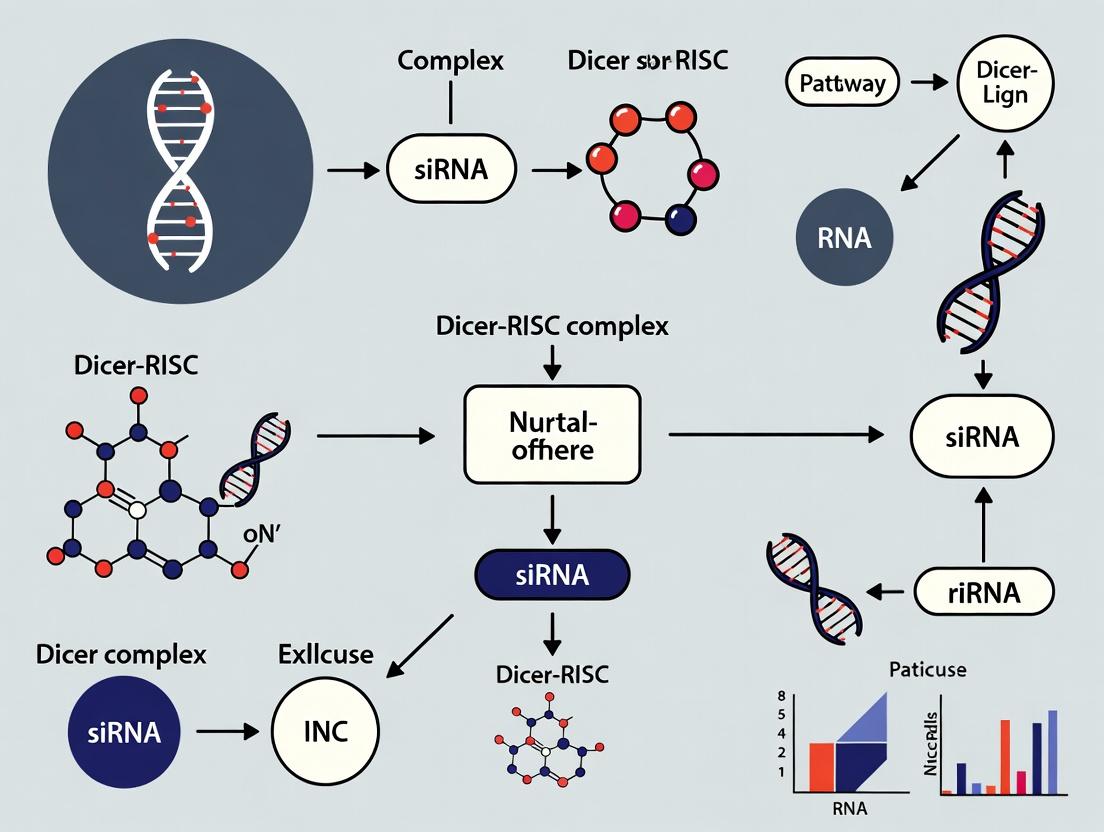
This article provides a comprehensive analysis of the Dicer-RISC-mediated siRNA pathway, a cornerstone of RNA interference (RNAi).
The Dicer-RISC Complex and siRNA Pathway: Mechanism, Applications, and Drug Development Frontiers
Abstract
This article provides a comprehensive analysis of the Dicer-RISC-mediated siRNA pathway, a cornerstone of RNA interference (RNAi). Tailored for researchers and drug development professionals, we explore the foundational biology of Dicer cleavage and RISC assembly, detail cutting-edge methodologies for experimental design and therapeutic application, address common troubleshooting and optimization challenges, and validate findings through comparative analysis with related pathways like miRNA. The review synthesizes current understanding to highlight the pathway's critical role in advancing RNAi-based therapeutics and functional genomics.
Core Machinery Revealed: Deconstructing the Dicer-RISC Complex and siRNA Biogenesis
Introduction Within the broader thesis on the Dicer RISC complex siRNA pathway, a precise molecular definition of its core components is foundational. The canonical initiation of RNA interference (RNAi) in higher eukaryotes is orchestrated by a defined loading complex. This whitepaper provides an in-depth technical dissection of the core players—Dicer, TAR RNA-binding protein (TRBP, also known as TARBP2), and the Argonaute2 (Ago2) assembly—detailing their stoichiometry, interactions, and functional validation protocols.
1. The Core Machinery: Structure and Function The complex nucleates with Dicer, an RNase III family endonuclease responsible for cleaving long double-stranded RNA (dsRNA) or pre-microRNA into ~21-23 nucleotide siRNA or miRNA duplexes. This activity is not isolated; it is coupled to loading through the interaction with TRBP. TRBP, a double-stranded RNA-binding domain (dsRBD) protein, acts as a central platform, stabilizing Dicer and facilitating the handoff of the siRNA duplex to Argonaute2 (Ago2), the catalytic engine of the RNA-induced silencing complex (RISC). The precise assembly of this trimeric (Dicer–TRBP–Ago2) RISC Loading Complex (RLC) is critical for efficient siRNA strand selection and RISC activation.
Table 1: Core Protein Components of the Human RISC Loading Complex
| Protein | Gene | Size (kDa) | Key Domains | Primary Function in RLC |
|---|---|---|---|---|
| Dicer | DICER1 | ~220 | RNase IIIa, RNase IIIb, PAZ, Helicase, dsRBD | dsRNA processing; siRNA generation. |
| TRBP | TARBP2 | ~43 (isoforms) | 3 x dsRBD | Dicer stabilization; siRNA duplex handoff to Ago2. |
| Argonaute2 | AGO2 | ~97 | PAZ, MID, PIWI (slicer activity) | siRNA passenger strand ejection; guide strand retention; target mRNA cleavage. |
2. Quantitative Analysis of Complex Interactions Biophysical and biochemical studies have defined the affinity and stoichiometry of these interactions. The data underscores TRBP's role as the essential dimeric adaptor.
Table 2: Measured Interaction Affinities and Stoichiometries
| Interaction | Method | Kd (Approx.) | Stoichiometry | Key Reference |
|---|---|---|---|---|
| Dicer–TRBP | ITC, SPR | 10-100 nM | 1:2 (Dicer:TRBP dimer) | (Maniataki and Mourelatos, 2005) |
| TRBP–Ago2 | Co-IP, BLI | ~50 nM | 1:1 (per TRBP monomer) | (Tahbaz et al., 2004) |
| siRNA duplex binding (Dicer–TRBP) | EMSA | <10 nM | One duplex per complex | (MacRae et al., 2008) |
3. Experimental Protocols for RLC Analysis 3.1. Protocol: Co-Immunoprecipitation (Co-IP) of the Endogenous RLC
- Objective: To isolate and confirm the native Dicer–TRBP–Ago2 complex from cell lysates.
- Materials: HeLa or HEK293T cells, NP-40 lysis buffer (50 mM Tris-HCl pH 7.4, 150 mM NaCl, 1% NP-40, protease inhibitors), anti-Dicer (or anti-TRBP) antibody, protein A/G magnetic beads, wash buffer (lysis buffer with 0.1% NP-40).
- Method:
- Lyse 5x10^7 cells in 1 mL ice-cold lysis buffer for 30 min. Centrifuge at 16,000g for 15 min at 4°C.
- Pre-clear supernatant with 50 µL bead slurry for 30 min.
- Incubate supernatant with 2-5 µg of specific antibody or IgG control for 2 hours at 4°C.
- Add 50 µL protein A/G beads and incubate for 1 hour.
- Wash beads 4x with 1 mL wash buffer.
- Elute proteins with 2X Laemmli buffer at 95°C for 5 min.
- Analyze by SDS-PAGE and western blot sequentially for Dicer, TRBP, and Ago2.
3.2. Protocol: In Vitro RISC Loading and Slicer Assay
- Objective: To reconstitute RISC activity and demonstrate coupled processing and loading.
- Materials: Purified recombinant human Dicer, TRBP, and Ago2 proteins; 5’-radiolabeled (32P) long dsRNA or synthetic siRNA duplex; target mRNA substrate; reaction buffer (30 mM HEPES pH 7.4, 100 mM KOAc, 2 mM MgOAc, 1 mM DTT).
- Method:
- Dicing/Loading Reaction: Combine 50 nM Dicer, 100 nM TRBP, 100 nM Ago2, and 10 nM radiolabeled dsRNA in reaction buffer. Incubate at 37°C for 60 min.
- Slicer Assay: Add a 5 nM complementary target mRNA (unlabeled). Continue incubation for 30-60 min.
- Analysis: Stop reaction with proteinase K/SDS. Run products on a denaturing 15% urea-PAGE gel. Visualize via phosphorimaging. Successful RLC function yields cleaved ~21-nt siRNA and a corresponding cleaved target mRNA fragment.
4. Visualization of Pathways and Complexes
Diagram 1: The siRNA Pathway from Processing to Target Cleavage
Diagram 2: RISC Loading Complex Molecular Stoichiometry
5. The Scientist's Toolkit: Research Reagent Solutions Table 3: Essential Reagents for Dicer-RISC Complex Research
| Reagent/Catalog Example | Provider (Example) | Function in RLC Studies |
|---|---|---|
| Anti-DICER1 Antibody (clone D38E7) | Cell Signaling Tech | Immunoprecipitation and western blot detection of endogenous Dicer. |
| Recombinant Human Dicer-TRBP Complex | OriGene / Abnova | In vitro reconstitution of the dicing and primary loading steps. |
| Recombinant Human AGO2 (Catalytic Mutant D669A) | Sigma-Aldrich | Trap-RISC assembly studies without cleaving target, for complex capture. |
| Silencer siRNA Labeling Kit (Cy3) | Thermo Fisher | Fluorescently tag siRNA for tracking RISC loading and cellular localization via microscopy/FACS. |
| MISSION TRBP2 (TARBP2) shRNA Plasmid | Sigma-Aldrich | Knockdown TRBP to disrupt endogenous RLC formation and study functional consequences. |
| BLItz System & Anti-GST Biosensors | ForteBio | Perform label-free kinetic analysis (Kd) of protein-protein interactions (e.g., TRBP-Ago2). |
| 5'-32P-radiolabeled dsRNA Substrate | PerkinElmer (custom synthesis) | High-sensitivity detection of dicing and slicer activity in in vitro assays. |
Within the Dicer-RISC complex siRNA pathway, the small interfering RNA (siRNA) lifecycle represents a fundamental biological mechanism for sequence-specific post-transcriptional gene silencing. This process is integral to RNA interference (RNAi), a conserved eukaryotic pathway with profound implications for gene function analysis and therapeutic development. This whitepaper provides an in-depth technical guide to the sequential stages of the siRNA lifecycle, detailing core mechanisms, quantitative dynamics, and essential experimental methodologies.
The Core Pathway: Initiation, Processing, and Effector Complex Assembly
The lifecycle begins with the introduction of long double-stranded RNA (dsRNA) into the cellular milieu. This exogenous or endogenous dsRNA is recognized and cleaved by the RNase III-family enzyme Dicer. Dicer processes the dsRNA into 21-23 nucleotide siRNA duplexes featuring 2-nucleotide 3' overhangs and 5' phosphate groups.
The siRNA duplex is subsequently loaded into the RNA-induced silencing complex (RISC) loading complex, which includes Dicer, TRBP (TAR RNA-binding protein), and Argonaute 2 (Ago2) in mammalian systems. The duplex is unwound, and the passenger (sense) strand is cleaved by Ago2's slicer activity and ejected. The guide (antisense) strand remains bound to Ago2, forming the mature RISC.
The mature RISC uses the guide strand to scan and identify complementary messenger RNA (mRNA) targets via Watson-Crick base pairing. Upon perfect or near-perfect match, Ago2 catalyzes the endonucleolytic cleavage ("slicing") of the target mRNA between nucleotides complementary to positions 10 and 11 of the guide strand. The cleaved mRNA fragments are rapidly degraded by cellular exonucleases, resulting in potent and specific gene silencing.
Table 1: Key Quantitative Parameters in the siRNA Lifecycle
| Parameter | Typical Value/Range | Notes |
|---|---|---|
| siRNA Duplex Length | 21-23 bp | Generated by Dicer processing. |
| 3' Overhang Length | 2 nt | Characteristic of Dicer/RIII products. |
| Guide Strand Thermodynamic Stability | Lower 5' stability favors loading | Asymmetry rule for RISC incorporation. |
| Seed Region (Guide) | nt 2-8 | Critical for target recognition. |
| Cleavage Site (Target mRNA) | Opposite nt 10-11 of guide | Ago2-mediated catalytic cleavage. |
| RISC Half-life (mammalian cells) | ~3-5 days | Dictates duration of silencing effect. |
| Minimal Perfect Pairing for Cleavage | ≥16 nt (including seed) | For efficient Ago2 slicing. |
Diagram 1: The siRNA Lifecycle Core Pathway
Experimental Protocols for Key Pathway Investigations
Protocol 1:In VitroDicer Cleavage Assay
Objective: To analyze the processing of long dsRNA into siRNA duplexes by recombinant Dicer enzyme. Methodology:
- Substrate Preparation: Generate uniformly labeled long dsRNA (100-500 bp) by in vitro transcription using T7 RNA polymerase in the presence of [α-32P] CTP, followed by annealing of complementary strands.
- Reaction Setup: In a 20 µL reaction, combine 1 µg of dsRNA substrate, 1X Dicer reaction buffer (e.g., 20 mM Tris-HCl pH 7.5, 2.5 mM MgCl2, 1 mM DTT), and 1 unit of recombinant human Dicer enzyme.
- Incubation: Incubate at 37°C for 1-4 hours.
- Analysis: Stop the reaction with 2X formamide loading dye. Denature samples at 95°C for 5 minutes and resolve products on a 15% denaturing (8M Urea) polyacrylamide gel (PAGE). Visualize siRNA products (~21-23 nt) by autoradiography or phosphorimaging.
Protocol 2: RISC Loading and Target Cleavage Assay (Cell Lysate)
Objective: To monitor the formation of active RISC and its slicer activity in a cytoplasmic S100 or RISC-deficient lysate system. Methodology:
- Lysate Preparation: Harvest HEK293 cells, wash with PBS, and lyse in hypotonic buffer (10 mM HEPES pH 7.4, 10 mM KCl, 1.5 mM MgCl2, 0.5 mM DTT). Centrifuge at 100,000 x g (S100 fraction) or use commercially available lysate.
- RISC Assembly: In a 50 µL assembly reaction, combine 20 µL of lysate, 1X reaction buffer, 1 mM ATP, 0.2 U/µL RNasin, and 100 nM synthetic siRNA duplex. Pre-incubate at 37°C for 30-60 min to form RISC.
- Target Cleavage: Add a 5'-32P-cap-labeled, complementary mRNA target transcript (10 nM). Continue incubation at 37°C.
- Time-Course Sampling: Remove aliquots (e.g., at 0, 15, 30, 60 min) and quench with proteinase K/SDS buffer.
- Analysis: Purify RNA, resolve products on denaturing PAGE, and quantify the appearance of cleaved 5' and 3' mRNA fragments by phosphorimaging.
Protocol 3: Quantitative Analysis of siRNA-Mediated Silencing in Cell Culture
Objective: To measure the potency and duration of gene silencing using luciferase reporter or endogenous gene assays. Methodology:
- siRNA Transfection: Seed adherent cells (e.g., HeLa) in 24-well plates. At 60-80% confluency, transfect with 1-10 nM siRNA using an appropriate lipid-based transfection reagent (e.g., Lipofectamine RNAiMAX) per manufacturer's protocol.
- Dual-Luciferase Assay (for reporters): Co-transfect a Firefly luciferase reporter plasmid (containing target sequence) and a Renilla luciferase control plasmid. At 24-72 hours post-transfection, lyse cells and measure luminescence using a dual-luciferase assay kit. Normalize Firefly signal to Renilla.
- Endogenous mRNA Quantification (qRT-PCR): At 24-96 hours post-transfection, isolate total RNA (TRIzol). Perform reverse transcription and quantitative PCR (SYBR Green or TaqMan) using primers for the target gene and a housekeeping control (e.g., GAPDH). Calculate fold silencing using the 2^(-ΔΔCt) method.
- Protein Analysis (Western Blot): Harvest protein lysates at 48-96 hours post-transfection. Resolve by SDS-PAGE, transfer to membrane, and probe with antibodies against the target protein and a loading control (e.g., β-actin). Quantify band intensity.
Table 2: Dynamics of siRNA-Mediated Silencing
| Time Point Post-Transfection | Typical mRNA Reduction | Typical Protein Reduction | Notes |
|---|---|---|---|
| 24 hours | 50-80% | 10-40% | mRNA knockdown precedes protein loss. |
| 48 hours | 70-95% | 50-90% | Peak silencing for many targets. |
| 72-96 hours | 60-90% | 70-95% | Protein levels often show maximal knockdown. |
| 5-7 days | 30-70% | 40-80% | Silencing decays as RISC turns over. |
Diagram 2: RISC Assembly and Target Cleavage Mechanism
The Scientist's Toolkit: Key Research Reagent Solutions
Table 3: Essential Reagents for siRNA Pathway Research
| Reagent/Material | Function/Application | Example/Notes |
|---|---|---|
| Recombinant Human Dicer Enzyme | In vitro processing of long dsRNA to siRNA. | Commercial kits for consistent siRNA library generation. |
| Synthetic siRNA Duplexes | Direct introduction of defined siRNAs for RISC studies. | Chemically modified (2'-OMe, PS) for stability. Control: Scrambled sequence. |
| RISC-Competent Cell Lysate (S100) | Cell-free system for RISC loading and slicing assays. | Often prepared from HEK293 or Drosophila S2 cells. |
| In Vitro Transcription Kit (T7/SP6) | Production of labeled or unlabeled dsRNA and mRNA targets. | Incorporation of radiolabeled (32P) or modified nucleotides. |
| RNAiMAX / Lipofectamine 3000 | Lipid-based transfection reagents for efficient siRNA delivery in vitro. | Low cytotoxicity, high efficiency for adherent cells. |
| Dual-Luciferase Reporter Assay System | Quantitative measurement of siRNA-mediated reporter knockdown. | Firefly (experimental) normalized to Renilla (control). |
| TaqMan Gene Expression Assays | Gold-standard qRT-PCR for quantifying endogenous mRNA knockdown. | High specificity using target-specific probe. |
| Anti-Argonaute 2 (Ago2) Antibody | Immunoprecipitation of RISC complexes; Western blot analysis. | Clone 2E12-1C9, 4F9; for RIP-seq, CLIP-seq studies. |
| RNA Oligonucleotide Size Marker (20-30 nt) | Accurate sizing of siRNA products on denaturing PAGE. | Essential for Dicer processing assay validation. |
| RNAse Inhibitor (RNasin) | Prevention of RNA degradation in lysate and reconstituted assays. | Critical for maintaining integrity of siRNA and targets. |
The siRNA lifecycle is a tightly regulated cascade, from Dicer-mediated biogenesis to RISC-mediated target destruction. Each phase presents specific experimental challenges and opportunities for interrogation. Mastery of the protocols for in vitro processing, RISC activity, and cellular silencing quantification is foundational for research aimed at elucidating pathway mechanisms or developing siRNA-based therapeutics. Within the broader thesis of Dicer-RISC pathway research, precise quantification and mechanistic dissection of this lifecycle remain central to advancing both basic science and clinical applications.
Within the broader thesis of Dicer-RISC complex and siRNA pathway research, understanding the precise molecular mechanism of Dicer is fundamental. This RNase III enzyme serves as the gatekeeper of RNA interference, initiating the pathway by processing long double-stranded RNA (dsRNA) or precursor microRNA (pre-miRNA) into short interfering RNAs (siRNAs) or microRNAs (miRNAs). This whitepaper provides an in-depth technical analysis of the structural determinants that enable Dicer to recognize, measure, and cleave its dsRNA substrates with high fidelity.
Structural Architecture of Dicer
Dicer enzymes are large, multi-domain proteins conserved across eukaryotes. The core functional architecture includes:
- Platform-PAZ (Piwi-Argonaute-Zwille) Module: This module acts as a molecular ruler. The PAZ domain specifically binds the 3' overhang (typically 2 nucleotides) of dsRNA ends, anchoring the substrate. The distance from the PAZ domain to the RNase III active sites determines the product length (e.g., ~21-23 nt in humans).
- RNase IIIa and RNase IIIb Domains: These form an intramolecular dimer, with each domain cleaving one strand of the dsRNA. Their catalytic sites are positioned precisely one helical turn apart, generating products with 2-nt 3' overhangs.
- Helicase Domain: Located at the N-terminus in metazoan Dicers, it facilitates ATP-dependent recognition and processing of optimal substrates, particularly those with blunt ends, and may help in displacing bound proteins from dsRNA.
- Dicer dsRNA-Binding Domain (dsRBD): Augments substrate binding and influences cleavage efficiency and fidelity.
- Connector Helix: A flexible linker that allows conformational changes between the Platform-PAZ ruler and the catalytic RNase III domains.
Mechanism of Recognition and Cleavage
The process is a coordinated, stepwise mechanism:
- Initial Substrate Recognition: The helicase domain engages the end of the dsRNA. For pre-miRNA, the terminal loop is recognized, and the 3' overhang is positioned into the PAZ domain pocket.
- Measurement: The dsRNA thread through the enzyme, spanning the fixed distance from the PAZ domain to the RNase III active sites. This enforces product-length uniformity.
- Catalytic Cleavage: The RNase IIIa and IIIb domains, coordinated by a metal ion (typically Mg²⁺ or Mn²⁺), perform hydrolytic cleavage, each cutting one phosphodiester bond. The products are released as siRNA/miRNA duplexes.
Quantitative Data on Dicer Function
Table 1: Key Quantitative Parameters of Human Dicer (DICER1) Activity
| Parameter | Value / Description | Experimental Method |
|---|---|---|
| Product Length | ~21-23 base pairs | Denaturing PAGE analysis of in vitro cleavage products. |
| 3' Overhang | 2 nucleotides | Radiolabeling and terminal analysis. |
| Catalytic Divalent Cation Requirement | Mg²⁺ (optimal) or Mn²⁺; inhibited by Ca²⁺ | Activity assays with varied cation buffers. |
| Processivity | Non-processive; single cleavage event per binding | Single-turnover kinetic assays. |
| Binding Affinity (K_d) for dsRNA | Low nM range (varies with substrate) | Surface Plasmon Resonance (SPR) or Electrophoretic Mobility Shift Assay (EMSA). |
| ATP Dependence | Required for blunt-ended dsRNA; not for pre-miRNA | Activity assays ± ATP/ATPγS. |
Table 2: Comparative Structural Features of Dicer Across Species
| Feature | H. sapiens (DICER1) | G. intestinalis (Dicer-B) | S. pombe (Dcr1) | Functional Implication |
|---|---|---|---|---|
| Helicase Domain | Present | Absent | Present | Substrate selectivity and ATP-dependent translocation. |
| Platform-PAZ | Present | Present | Present | Universal ruler mechanism. |
| Number of dsRBDs | 1 | 2 | 1 | Affects dsRNA binding stability. |
| Overall Domain Architecture | Complex | Simplified | Intermediate | Reflects specialization in miRNA vs. siRNA production. |
Detailed Experimental Protocols
Protocol 1:In VitroDicer Cleavage Assay
Purpose: To analyze Dicer cleavage activity and product length.
- Substrate Preparation: Synthesize or in vitro transcribe a uniform 5'-end radiolabeled (³²P) or fluorescently-labeled dsRNA substrate (50-100 bp).
- Reaction Setup: In a 20 µL volume, combine:
- Purified recombinant Dicer protein (10-100 nM)
- Labeled dsRNA substrate (1-5 nM)
- Reaction Buffer: 20 mM Tris-HCl (pH 7.5), 150 mM NaCl, 2.5 mM MgCl₂, 1 mM DTT.
- Optional: 1 mM ATP for metazoan Dicer with blunt-ended substrates.
- Incubation: Incubate at 37°C for 60 minutes.
- Reaction Termination: Add 2x formamide loading buffer with EDTA.
- Analysis: Denature at 95°C for 5 min, resolve products on a 15-20% denaturing (urea) polyacrylamide gel. Visualize by autoradiography (radioactive) or fluorescence imaging.
Protocol 2: Electrophoretic Mobility Shift Assay (EMSA) for Dicer-RNA Binding
Purpose: To determine binding affinity (K_d) of Dicer for dsRNA.
- Labeled Probe: Prepare end-labeled dsRNA (as in Protocol 1).
- Binding Reactions: In a 10 µL volume, titrate purified Dicer (0.1 nM to 1 µM) against a constant concentration of labeled RNA (0.1 nM) in binding buffer (20 mM HEPES pH 7.4, 50 mM KCl, 1 mM MgCl₂, 0.5 mM DTT, 0.1 mg/mL BSA, 5% glycerol, 10 U/mL RNase inhibitor).
- Incubation: Incubate at 25°C for 30 min.
- Electrophoresis: Load reactions onto a pre-run 6% native polyacrylamide gel (0.5x TBE buffer, 4°C). Run at 100V for 60-90 min.
- Quantification: Image gel. Plot fraction bound vs. Dicer concentration to calculate apparent K_d using a binding isotherm model.
Protocol 3: Crystallography/X-ray Diffraction for Dicer Structure Determination
Purpose: To solve the atomic structure of Dicer or its domains.
- Protein Production: Express and purify a recombinant, stable fragment of Dicer (e.g., Platform-PAZ-RNaseIII) to high homogeneity (>98%).
- Crystallization: Perform high-throughput screening of crystallization conditions using vapor diffusion methods. Optimize hits.
- Cryoprotection & Freezing: Soak crystals in mother liquor supplemented with cryoprotectant (e.g., 25% glycerol). Flash-freeze in liquid nitrogen.
- Data Collection: Collect X-ray diffraction data at a synchrotron beamline.
- Structure Solution: Use molecular replacement (with a related structure as a search model) or experimental phasing (e.g., Se-Met SAD). Iteratively build and refine the model.
Visualization of Pathways and Mechanisms
Title: The Dicer-Initiated siRNA Pathway
Title: Structural Domains of Dicer and Substrate Engagement
The Scientist's Toolkit: Research Reagent Solutions
Table 3: Essential Reagents for Dicer Structural and Functional Studies
| Reagent / Material | Function / Application | Key Considerations |
|---|---|---|
| Recombinant Human Dicer (DICER1) Protein | In vitro cleavage assays, binding studies (EMSA), structural biology. | Full-length vs. catalytic core fragments; activity varies by source (insect cell vs. mammalian expression). |
| Synthetic dsRNA & pre-miRNA Substrates | Defined substrates for mechanistic and kinetic studies. | Uniform length and labeling (5'/3', internal). Include blunt, 2-nt 3' overhang variants. |
| ATPγS (Adenosine 5'-O-[γ-thio]triphosphate) | Non-hydrolyzable ATP analog to test ATP dependence. | Used in cleavage assays to inhibit helicase-driven translocation. |
| Anti-Dicer Antibodies (monoclonal/polyclonal) | Immunoprecipitation (IP), Western Blot, immunofluorescence. | Specificity for different domains (e.g., N-term, RNase III) is critical. |
| RNase III Activity Assay Kits | Fluorescence-based, high-throughput screening of Dicer activity/inhibition. | Useful for drug discovery campaigns targeting Dicer. |
| Dicer Knockout Cell Lines (e.g., DICER1 -/-) | Functional validation of findings in a cellular context. | Enables rescue experiments with wild-type/mutant Dicer. |
| Crystallization Screening Kits (e.g., from Hampton Research) | Initial screening for protein crystal formation. | Sparse matrix screens cover a wide chemical space. |
| Surface Plasmon Resonance (SPR) Chips (e.g., NTA for His-tagged protein) | Real-time, label-free kinetics of Dicer-dsRNA interactions. | Provides on/off rates (kon, koff) and affinity (K_d). |
This whitepaper details the critical, rate-limiting step of RNA-induced silencing complex (RISC) assembly, focusing on the precise molecular handoff of a small interfering RNA (siRNA) duplex from the Dicer complex to an Argonaute (AGO) protein. Within the broader thesis on Dicer-RISC complex biogenesis in the siRNA pathway, this document addresses the central mechanistic question: How is the siRNA product of Dicer processing selectively and efficiently loaded into AGO to form the catalytic RISC core? Understanding this orchestrated transfer is fundamental for therapeutic RNA interference (RNAi) applications, where RISC loading efficiency directly impacts potency and specificity.
The Core Mechanism: A Multi-Step Chaperoned Process
The handoff is not a simple diffusion-driven event but a choreographed process involving several auxiliary proteins that act as loading chaperones.
Key Steps:
- Dicer-AGO Interaction: Dicer, often in complex with double-stranded RNA-binding proteins (dsRBPs) like TARBP2 (TRBP in humans) or PACT, directly interacts with AGO via protein-protein interfaces.
- Duplex Positioning: The siRNA duplex, generated by Dicer's cleavage, remains bound to Dicer and its dsRBP partner. This complex positions the duplex for transfer, with the 5'-phosphate ends of the guide strand critical for recognition.
- Chaperone-Mediated Loading: The Hsc70/Hsp90 chaperone machinery, along with co-chaperones like Hsp40 and Hop, facilitates the conformational opening of AGO, allowing it to accept the RNA duplex. This ATP-dependent step is crucial for efficient RISC loading.
- Strand Selection & Eviction: Within AGO's MID-PIWI domains, thermodynamic asymmetry of the duplex dictates "guide strand" selection (typically the strand with less stable 5' end pairing). The passenger strand is cleaved (in AGO2) or unwound and ejected.
- Mature RISC Formation: The retained guide strand, now in a stable conformation, directs the mature RISC to complementary mRNA targets for silencing.
Table 1: Key Protein Complexes in Human RISC Assembly
| Component | Gene Name(s) | Core Function in Handoff | Essential for Cell Viability? |
|---|---|---|---|
| Dicer | DICER1 | Initiator; processes dsRNA to siRNA, provides platform. | Yes |
| dsRBP Partner | TARBP2, PRKRA | Stabilizes Dicer-siRNA interaction, promotes AGO binding. | Context-dependent |
| Argonaute (Catalytic) | AGO2 | RISC catalytic engine; binds guide, cleaves passenger/target. | Yes |
| Argonaute (Non-catalytic) | AGO1, AGO3, AGO4 | Mediates translational repression/degradation; loaded similarly. | No (redundant) |
| Chaperone: Hsc70 | HSPA8 | ATPase; drives conformational change in AGO for loading. | Yes |
| Chaperone: Hsp90 | HSP90AA1/AB1 | Stabilizes AGO in an "open" state for RNA acceptance. | Yes |
| Co-chaperone: Hop | STIP1 | Adaptor protein linking Hsc70 and Hsp90. | Yes |
Table 2: Energetics and Kinetics of Key Handoff Steps (In Vitro)
| Process Step | Measured Parameter | Approximate Value | Method & Reference |
|---|---|---|---|
| Dicer-TRBP-AGO2 Complex Formation | Kd (AGO2-Dicer-TRBP) | ~50 nM | Surface Plasmon Resonance (Iwasaki et al., 2010) |
| Chaperone-Driven AGO2 Loading | ATP Hydrolysis Rate | ~50 min⁻¹ (per Hsc70) | Coupled Enzymatic Assay (Nykänen et al., 2011) |
| Guide Strand Retention | Fraction of AGO2 with guide strand post-loading | 70-90% | Native Gel Electrophoresis (Khvorova et al., 2003) |
| Passenger Strand Cleavage (AGO2) | Catalytic rate constant (kcat) | ~0.3 min⁻¹ | Single-Turnover Cleavage Assay (Haley & Zamore, 2004) |
Detailed Experimental Protocols
Protocol 4.1:In VitroRISC Loading Assay Using Radiolabeled siRNA
Objective: To reconstitute and quantify the efficiency of siRNA transfer from the Dicer-TRBP complex to AGO2.
Materials:
- Purified recombinant human proteins: Dicer, TRBP, AGO2, Hsc70, Hsp90, Hsp40, Hop.
- ATP regeneration system (ATP, creatine phosphate, creatine kinase).
- Chemically synthesized 21-nt siRNA duplex, guide strand 5'-end labeled with ³²P.
- Nuclease-free buffers (20 mM HEPES-KOH pH 7.4, 100 mM KOAc, 2 mM MgOAc, 0.5 mM DTT).
- Micro Bio-Spin P-30 gel filtration columns.
Methodology:
- Pre-loading Complex Formation: Incubate 50 nM Dicer and 100 nM TRBP with 10 nM radiolabeled siRNA duplex in 1x loading buffer for 15 min at 30°C.
- Chaperone Mix Preparation: Combine 1 µM Hsc70, 1 µM Hsp90, 0.5 µM Hsp40, 0.5 µM Hop, and ATP regeneration system (1 mM ATP, 10 mM CP, 0.2 mg/mL CK).
- Loading Reaction: Add 100 nM AGO2 and the chaperone mix to the pre-loading complex. Incubate at 30°C for 60 min.
- Separation & Quantification: Stop the reaction on ice. Pass the mixture through a P-30 column to remove free ATP/proteins. Eluate is analyzed by native PAGE (6% gel, 0.5x TBE, 4°C). The gel is dried and exposed to a phosphorimager screen. AGO2-bound siRNA (shifted band) is quantified versus free siRNA.
Protocol 4.2: Co-Immunoprecipitation (Co-IP) to Probe Handoff ComplexesIn Vivo
Objective: To capture transient interactions between Dicer, AGO2, and chaperones in mammalian cells.
Materials:
- HEK293T cells.
- Plasmid constructs for FLAG-tagged AGO2 and HA-tagged Dicer.
- Crosslinker: DSP (Dithiobis(succinimidyl propionate)).
- Lysis Buffer: 25 mM Tris-HCl pH 7.4, 150 mM NaCl, 1% NP-40, 1 mM EDTA, 5% glycerol, protease inhibitors, RNase A/T1 mix.
- Anti-FLAG M2 Affinity Gel.
- 3x FLAG peptide for competitive elution.
Methodology:
- Transfection & Crosslinking: Co-transfect cells with FLAG-AGO2 and HA-Dicer plasmids. At 48h post-transfection, treat cells with 1 mM DSP (in DMSO) for 30 min at room temperature. Quench with 20 mM Tris pH 7.5 for 15 min.
- Cell Lysis: Lyse cells in lysis buffer containing RNase to digest RNA bridges, incubating for 30 min on ice.
- Immunoprecipitation: Clarify lysate by centrifugation. Incubate supernatant with pre-washed Anti-FLAG M2 beads for 2h at 4°C.
- Wash & Elution: Wash beads stringently 5x with lysis buffer. Elute bound proteins with 3x FLAG peptide (150 µg/mL) in TBS.
- Analysis: Analyze eluates by SDS-PAGE and western blot using anti-HA (for Dicer), anti-Hsp90, and anti-Hsc70 antibodies. Input lysate serves as control.
Visualizations
Diagram 1: siRNA Handoff Pathway from Dicer to Mature RISC
Diagram 2: Experimental Workflow for In Vitro RISC Loading Assay
The Scientist's Toolkit: Key Research Reagent Solutions
Table 3: Essential Reagents for Studying the Dicer-to-AGO Handoff
| Reagent / Material | Supplier Examples | Function in Research |
|---|---|---|
| Recombinant Human Proteins (Dicer, AGO2, TRBP) | OriGene, BPS Bioscience, in-house expression | Essential for biochemical reconstitution of the handoff process. |
| Hsc70/Hsp90 Chaperone Kit | ENZO Life Sciences, StressMarq | Provides purified, active chaperone complexes for loading assays. |
| Chemically Modified siRNA Duplexes | Dharmacon, Sigma-Aldrich, IDT | To study impact of 5' phosphorylation, 2'-O-methylation, etc., on loading efficiency and strand selection. |
| Crosslinking Reagents (DSP, DSS) | Thermo Fisher Scientific | To capture transient protein-protein interactions in vivo before Co-IP. |
| Anti-AGO2 (Clone 2E12-1C9) mAb | MilliporeSigma | High-specificity antibody for immunoprecipitation of endogenous RISC complexes. |
| Native Gel Electrophoresis System | Bio-Rad, Life Technologies | For separating and visualizing protein-RNA complexes (e.g., AGO2-siRNA vs. free siRNA). |
| Programmable UV Crosslinker (365 nm) | Spectrolinker (XL-1000) | For site-specific crosslinking of RNA to proteins using 4-thio-U-modified siRNAs to map binding sites. |
| Single-Molecule Fluorescence (smFRET) Setup | Custom | To observe real-time conformational changes in AGO during chaperone-driven loading. |
Key Regulatory Factors and Cofactors in Pathway Fidelity
This whitepaper, framed within a broader thesis on Dicer and the RNA-induced silencing complex (RISC) in siRNA pathways, details the critical regulatory factors and cofactors that ensure fidelity in small RNA-mediated gene silencing. We examine the precise molecular checkpoints governing substrate selection, processing, and RISC loading, emphasizing quantitative data and experimental validation.
Fidelity in the siRNA pathway is paramount to prevent off-target effects and ensure accurate post-transcriptional gene silencing. Within the Dicer-RISC pathway, this is governed by a series of protein-protein and protein-RNA interactions, enzymatic activities, and structural proofreading mechanisms. This document dissects these regulatory nodes, providing a technical guide for researchers.
Core Regulatory Complex: Dicer and its Partners
Dicer, a central RNase III enzyme, initiates the pathway but does not operate in isolation. Its activity and specificity are modulated by essential cofactors.
Table 1: Key Regulatory Proteins in Human siRNA Pathway Fidelity
| Factor/Cofactor | Primary Function | Binding Partner | Critical for Fidelity Step | Reported KD (nM) / Affinity |
|---|---|---|---|---|
| Dicer (DICER1) | Cleaves dsRNA to siRNA | TRBP, PACT, dsRNA | Substrate recognition & dicing | N/A (Catalytic) |
| TRBP (TARBP2) | Stabilizes Dicer; recruits Ago2 | Dicer, dsRNA, Ago2 | RISC loading & strand selection | Dicer binding: ~50-100 nM |
| PACT (PRKRA) | Enhances processing fidelity; stress response | Dicer, TRBP | Substrate discrimination | Dicer binding: ~200 nM |
| Ago2 (EIF2C2) | Slicer activity; guides target cleavage | siRNA guide strand, mRNA | Catalytic fidelity & target validation | siRNA binding: <1 nM |
| R2D2 (Drosophila) / TRBP Complex | Asymmetric RISC loading | Dicer, dsRNA end | Strand selection (5' end stability) | N/A |
| SND1 (Tudor-SN) | Dicer cofactor; proofreading | Dicer, RNA | Cleavage of suboptimal substrates | Not fully quantified |
Diagram: Core Dicer-RISC Loading Complex
Title: Dicer Complex Assembly and RISC Loading Pathway
Critical Fidelity Checkpoints: Mechanisms & Experiments
Checkpoint 1: Substrate Recognition and Dicing
Regulatory Factor: Dicer-PACT/TRBP complex. Mechanism: The PAZ domain of Dicer recognizes the 3' overhang of dsRNA. TRBP and PACT binding modulates Dicer's conformation, enhancing its processivity and precision for perfect dsRNA duplexes over imperfect ones.
Experimental Protocol: In Vitro Dicing Assay with Varied Cofactors
- Objective: Measure cleavage efficiency and accuracy of Dicer alone vs. Dicer+cofactor complexes.
- Reagents: Purified recombinant human Dicer, TRBP, PACT; 5' end-labeled dsRNA substrate (e.g., 50bp with 2-nt 3' overhang); reaction buffer (20 mM Tris-HCl pH 7.5, 2.5 mM MgCl₂, 1 mM DTT).
- Method:
- Set up four 25 µL reactions: (1) Dicer alone, (2) Dicer+TRBP (1:1.5 molar ratio), (3) Dicer+PACT (1:1.5), (4) Dicer+TRBP+PACT.
- Pre-incubate protein complexes on ice for 15 min.
- Add 1 nM labeled dsRNA substrate, incubate at 37°C for 60 min.
- Stop reaction with 2x formamide loading buffer.
- Resolve products on a 15% denaturing PAGE gel.
- Visualize and quantify using a phosphorimager. Fidelity is assessed by the precision of 21-23 nt siRNA product generation and absence of miscleaved products.
Checkpoint 2: Strand Selection and RISC Loading
Regulatory Factor: RLC (RISC Loading Complex) – Dicer-TRBP-Ago2. Mechanism: Thermodynamic asymmetry of the siRNA duplex determines "guide" strand selection. The protein complex senses the relative stability of the 5' ends, favoring incorporation of the strand whose 5' end is less stably paired.
Experimental Protocol: Strand Selection Assay (Asymmetry Sensor Assay)
- Objective: Determine which siRNA strand is loaded into Ago2 in the presence of the full RLC.
- Reagents: Reconstituted human RLC (Dicer-TRBP-Ago2); asymmetric siRNA duplex (guide strand 5' end less stable); 5' radiolabel on each strand in separate reactions; anti-Ago2 antibody for immunoprecipitation.
- Method:
- Incubate RLC with 5'-labeled sense OR antisense strand siRNA (separate tubes) in loading buffer (30°C, 60 min).
- Immunoprecipitate RISC complexes using anti-Ago2 magnetic beads.
- Wash beads stringently to remove unbound RNA.
- Elute RNA and analyze by denaturing PAGE.
- Quantify the ratio of labeled sense vs. antisense strand in the Ago2-bound fraction. The guide strand (antisense) should be preferentially enriched (>80%).
Quantitative Data on Strand Selection Fidelity
Table 2: Influence of 5' End Stability on Strand Selection Efficiency
| siRNA Duplex 5' End ΔG (guide/passenger) | Complex Used | Guide Strand Loaded into Ago2 (%) | Relative Silencing Efficacy |
|---|---|---|---|
| -4.2 kcal/mol / -8.7 kcal/mol (Asymmetric) | Dicer-TRBP-Ago2 | 92 ± 3 | 1.0 (Reference) |
| -6.1 kcal/mol / -6.5 kcal/mol (Symmetric) | Dicer-TRBP-Ago2 | 55 ± 7 | 0.3 |
| -4.2 kcal/mol / -8.7 kcal/mol | Ago2 alone | 68 ± 5 | 0.6 |
Diagram: siRNA Strand Selection Fidelity Checkpoint
Title: Strand Selection Prevents Off-Target Effects
The Scientist's Toolkit: Key Research Reagent Solutions
Table 3: Essential Reagents for siRNA Pathway Fidelity Research
| Reagent / Material | Supplier Examples | Critical Function in Research |
|---|---|---|
| Recombinant Human Dicer (full-length) | OriGene, BPS Bioscience | In vitro dicing assays; reconstitution of complexes. |
| Recombinant TRBP & PACT | Abcam, MyBioSource | Study cofactor roles in fidelity and complex formation. |
| Purified Ago2 (Catalytic Core) | Sino Biological, Thermo Fisher | RISC loading and slicer activity assays. |
| Pre-designed siRNA Duplex Libraries (with varied 5' stability) | Dharmacon, IDT | Systematic investigation of strand selection rules. |
| Dicer siRNA Substrate Kit (Fluorescent/Radioactive) | BioVision, Jena Bioscience | Standardized measurement of dicing kinetics and accuracy. |
| Anti-Ago2 (Clone 2E12-1C9) IP-Grade Antibody | Merck Millipore, Abcam | Immunoprecipitation of RISC complexes for strand analysis. |
| Magnetic Protein A/G Beads | Pierce, Cytiva | Isolation of immuno-precipitated complexes. |
| 5' End Labeling Kit ([γ-³²P] ATP or non-radioactive) | PerkinElmer, Vector Laboratories | Trace RNA strands in loading and selection assays. |
| Locked Nucleic Acid (LNA) Modified Probes | Exiqon (Qiagen) | Sensitive detection of mature guide strands by Northern blot. |
| Drosha/DGCR8 Knockout Cell Lines | ATCC, GeneCopoeia | Background-free system to study cytoplasmic Dicer-specific processing. |
Pathway fidelity in the Dicer-RISC siRNA pathway is not inherent to a single enzyme but is an emergent property of a dynamically regulated complex. The concerted action of Dicer, TRBP, PACT, and Ago2 establishes successive checkpoints—from substrate dicing to guide strand selection—that minimize errors. Understanding these factors quantitatively, as outlined in this guide, is crucial for designing high-precision RNAi therapeutics and interpreting functional genomics data. This analysis provides a framework for ongoing research within the broader thesis on the mechanistic underpinnings of the RNAi machinery.
From Bench to Bedside: Experimental & Therapeutic Applications of the siRNA Pathway
Design Principles for Effective Synthetic siRNA and dsRNA Precursors
The therapeutic and research application of RNA interference (RNAi) hinges on the efficient loading of a guide strand into the RNA-induced silencing complex (RISC). This process is initiated by the RNase III enzyme Dicer, which processes double-stranded RNA (dsRNA) precursors into small interfering RNAs (siRNAs). Within the broader thesis on Dicer-RISC complex mechanics, this whitepaper delineates the core design principles for synthetic precursors that maximize yield, specificity, and potency by exploiting the structural and biochemical biases of the human Dicer and Argonaute 2 (Ago2) machinery.
Core Design Principles for Dicer-Substrate siRNA (dsiRNA)
Dicer-substrate siRNAs are 25-27 bp dsRNA molecules with precise terminal modifications to direct asymmetric Dicer cleavage and favor guide strand loading into RISC.
Thermodynamic Asymmetry and Strand Selection
The relative thermodynamic stability of the 5' ends of the siRNA duplex dictates strand selection. Ago2 preferentially loads the strand whose 5' end is less tightly bound (lower ΔG).
Table 1: Impact of 5'-End Stability Differential on Strand Selection Efficiency
| 5'-End Stability Differential (ΔΔG in kcal/mol) | % Guide Strand (Antisense) Loading into RISC | Observed Off-Target Effect (Relative to Perfect) |
|---|---|---|
| ≥ -1.0 (Weaker at Antisense 5' end) | 85-95% | 1.0x |
| -0.5 to 0.5 (Symmetric) | 50-70% | 2.5-3.0x |
| ≤ 1.0 (Stronger at Antisense 5' end) | 20-40% | 5.0x |
Protocol: Measuring Thermodynamic Asymmetry
- Sequence Design: Generate candidate 27mer duplexes with a 2-nt 3' overhang on the antisense strand.
- ΔG Calculation: Use nearest-neighbor parameters (e.g., using the
RNAfoldsoftware from the ViennaRNA Package) to calculate the free energy (ΔG) for the terminal 4-5 base pairs at each 5' end. - ΔΔG Determination: Compute ΔΔG = ΔG(5'-end of sense strand) - ΔG(5'-end of antisense strand). A negative ΔΔG indicates preferred antisense loading.
Terminal and Structural Modifications
- 3' Overhangs: A two-nucleotide (preferably dTdT or UU) 3' overhang on the antisense strand is optimal for Dicer recognition and binding at its PAZ domain.
- Blunt 5' End: The sense strand should have a blunt 5' phosphate, mimicking the natural Dicer cleavage product.
- Chemical Modifications: Site-specific modifications enhance stability and reduce immunogenicity without impairing Dicer processing.
- 2'-O-Methyl (2'-OMe): At positions 1 and 2 of the sense strand to reduce passenger strand loading and off-targets.
- Phosphorothioate (PS): Limited incorporation at terminal linkages to improve nuclease resistance.
- 2'-Fluoro (2'-F): On pyrimidines (C/U) to increase binding affinity and serum stability.
Design of Long dsRNA Precursors for In Vivo Processing
For in vivo applications where sustained silencing is desired, longer dsRNAs (50-500 bp) can be used, relying on endogenous Dicer processing.
Avoiding PKR and Innate Immune Activation
A primary design challenge is evading the protein kinase R (PKR) and RIG-I/MDA5 pathways triggered by long dsRNA.
Table 2: Design Features to Mitigate Immune Sensing of Long dsRNA
| Feature | Design Principle | Rationale |
|---|---|---|
| Length | Keep dsRNA < 30 bp or > 100 bp with modifications. PKR binds optimally to 30-80 bp dsRNA. | Minimizes direct activation of PKR. |
| Nucleotide Modification | Incorporate 2'-OMe or pseudouridine (>20% of residues). | Disrupts Toll-like Receptor 3 (TLR3) and RIG-I/MDA5 recognition while maintaining Dicer activity. |
| Sequence Motifs | Avoid 5'-triphosphate groups; use canonical siRNA sequences. | Prevents RIG-I activation. |
| Delivery Vehicle | Use lipid nanoparticles (LNPs) or polymer-based carriers. | Shields dsRNA from extracellular sensors and facilitates endosomal escape. |
Protocol: Testing Immunostimulatory Profile
- Cell Culture: Seed HEK-293 cells stably expressing a TLR3 or RIG-I reporter construct (e.g., SEAP or luciferase under an IFN-β promoter).
- Transfection: Transfect cells with 100 ng of designed long dsRNA precursor using a standard reagent (e.g., Lipofectamine 3000). Use unmodified in vitro transcribed dsRNA as a positive control and a non-immunogenic siRNA as a negative control.
- Assay: 24 hours post-transfection, harvest cell culture supernatant.
- Detection: Quantify reporter signal (e.g., SEAP with a chromogenic substrate like pNPP, or luciferase with luciferin). Normalize to cell viability (MTT assay). Immunogenic RNAs will yield a >5-fold increase in signal over the negative control.
Experimental Workflow for Evaluating dsRNA Precursor Efficacy
The following diagram outlines a standard validation pipeline.
Diagram Title: siRNA Precursor Development Workflow
The Dicer-RISC Loading Pathway
Understanding the molecular pathway is critical for rational design.
Diagram Title: Dicer-Dependent RISC Loading Pathway
The Scientist's Toolkit: Key Research Reagent Solutions
Table 3: Essential Reagents for dsRNA/siRNA Mechanism and Efficacy Studies
| Reagent / Material | Function / Application |
|---|---|
| Recombinant Human Dicer Enzyme | In vitro cleavage assays to validate processing efficiency and accuracy of designed dsRNA precursors. |
| Ago2-Specific Monoclonal Antibody | For immunoprecipitation (RIP-Chip or CLIP-seq) to analyze guide strand loading efficiency and identify off-target mRNA interactions. |
| Dicer-Substrate siRNA (dsiRNA) Design Software (e.g., IDT's dsiRNA tool, BLOCK-iT RNAi Designer) | Algorithms to incorporate thermodynamic rules, predict off-targets, and design optimal 25-27mer sequences. |
| 2'-OMe, 2'-F, PS Phosphoramidites | Chemical building blocks for solid-phase synthesis of modified RNA strands to enhance stability and specificity. |
| Dual-Luciferase Reporter Assay System (e.g., Promega) | Gold-standard for quantifying siRNA potency and specificity in cell culture by fusing target sequence to a luciferase gene. |
| PKR & RIG-I Reporter Cell Lines | Stable cell lines with inducible luciferase/GFP reporters to quantify innate immune activation by long dsRNA designs. |
| Ionizable Lipid Nanoparticles (LNPs) | Formulation reagents for in vivo delivery of unmodified or modified long dsRNA precursors, enabling systemic administration and endosomal escape. |
This whitepaper provides a technical examination of contemporary delivery systems for oligonucleotide therapeutics, with a specific focus on their application within siRNA-mediated gene silencing via the Dicer-RISC pathway. The discussion is framed by the imperative to achieve efficient cytosolic delivery for functional engagement with the RNA-induced silencing complex (RISC), a core component of thesis research on mechanistic dissection of this pathway. We detail Lipid Nanoparticles (LNPs) and GalNAc conjugates as benchmark technologies, explore emerging modalities, and provide standardized experimental protocols for their evaluation.
The therapeutic potential of siRNA is contingent upon its intracellular entry and subsequent loading into the RISC. The Dicer enzyme facilitates processing of longer dsRNA into siRNA, which is then handed off to RISC for target mRNA cleavage. Exogenously delivered siRNA must bypass extracellular and endosomal barriers to access this cytoplasmic machinery. Delivery technologies are therefore not mere carriers but critical determinants of pharmacological activity, influencing kinetics, biodistribution, and ultimate efficacy.
Core Delivery Platforms: Mechanisms and Applications
Lipid Nanoparticles (LNPs)
LNPs are the leading non-viral delivery platform, comprising ionizable lipids, phospholipids, cholesterol, and PEG-lipids. The ionizable lipid is critical for endosomal escape, becoming protonated in the acidic endosome and forming disruptive non-bilayer structures.
Table 1: Typical LNP Composition and Function
| Component | Typical Mole % | Primary Function |
|---|---|---|
| Ionizable Lipid (e.g., DLin-MC3-DMA) | 35-50 | Encapsulation, endosomal escape |
| Phospholipid (e.g., DSPC) | 10-15 | Structural integrity, bilayer formation |
| Cholesterol | 38-40 | Membrane stability, fluidity modulation |
| PEG-lipid (e.g., DMG-PEG2000) | 1.5-2.5 | Stabilization, reduce opsonization, control size |
Protocol 1: Standardized In Vitro Screening of LNP-siRNA Activity
- LNP Formulation: Prepare LNPs via rapid microfluidic mixing. Combine an ethanolic lipid mixture (ionizable lipid, DSPC, cholesterol, PEG-lipid at molar ratio 50:10:38.5:1.5) with an aqueous siRNA solution (in 25 mM citrate buffer, pH 4.0) at a 3:1 flow rate ratio (aqueous:ethanol) using a staggered herringbone micromixer.
- Dialyzing: Dialyze the formed LNPs against PBS (pH 7.4) for 18-24 hours at 4°C to remove ethanol and adjust buffer.
- Characterization: Measure particle size (target 70-100 nm) and PDI by DLS; determine encapsulation efficiency (>90%) using RiboGreen assay.
- Cell Treatment: Seed target cells (e.g., HepG2) in 96-well plates. Treat with LNP-siRNA at a range of siRNA concentrations (e.g., 0.1-100 nM) in triplicate. Include naked siRNA and scramble siRNA-LNP controls.
- Analysis: Harvest cells 48-72h post-transfection. Quantify mRNA knockdown via RT-qPCR using the ΔΔCt method relative to untreated controls. Assess cell viability via MTT or CellTiter-Glo assay.
GalNAc Conjugates
N-acetylgalactosamine (GalNAc) conjugates enable hepatocyte-specific delivery by binding with high affinity to the asialoglycoprotein receptor (ASGPR), which is highly expressed on hepatocytes.
Table 2: In Vivo Pharmacokinetic Comparison (Single Dose, Rodent)
| Parameter | GalNAc-siRNA Conjugate | LNP-formulated siRNA |
|---|---|---|
| Primary Target | Hepatocytes | Liver (broad; hepatocytes/Kupffer/endothelial) |
| Dosing Route | Subcutaneous | Intravenous |
| Therapeutic Dose | 1-10 mg/kg | 0.1-1 mg/kg |
| Tmax (Liver) | 4-8 hours | 0.5-2 hours |
| Knockdown Onset | 24-48 hours | 4-12 hours |
| Duration of Effect | Weeks to Months | 1-3 weeks |
Protocol 2: In Vivo Evaluation of GalNAc-siRNA Efficacy
- Animal Model: Use C57BL/6 mice (n=5 per group) or relevant disease model.
- Dosing: Administer GalNAc-conjugated siRNA via subcutaneous injection at 3 mg/kg in PBS. Include PBS vehicle and scramble siRNA conjugate control groups.
- Sample Collection: Collect serum samples at pre-dose, 24h, 48h, and weekly intervals. Sacrifice animals at predetermined endpoints (e.g., Day 7, 14, 28) to harvest liver and other tissues.
- Biomarker Analysis: Quantify serum protein biomarkers (e.g., PCSK9, TTR) by ELISA.
- Tissue Analysis: Homogenize liver tissue. Isolate total RNA for target mRNA quantification via RT-qPCR. Perform immunohistochemistry for target protein expression. Assess liver enzyme levels (ALT/AST) in serum for toxicity.
Emerging and Alternative Strategies
- Polymeric Nanoparticles: Cationic or charge-altering polymers (e.g., PBAEs) that complex siRNA and disassemble in response to intracellular cues.
- Peptide-Based Delivery: Cell-penetrating peptides (CPPs) or endosomolytic peptides fused or complexed with siRNA.
- Exosomes & EVs: Native biological vesicles with inherent targeting and low immunogenicity, engineered to carry siRNA.
- Molecular Conjugates Beyond GalNAc: Ligands targeting other receptors (e.g., antibodies, peptides, small molecules) for extrahepatic targeting.
The Scientist's Toolkit: Key Reagents & Materials
Table 3: Essential Research Reagents for siRNA Delivery Studies
| Category | Item/Product Example | Primary Function in Research |
|---|---|---|
| Core Lipids | DLin-MC3-DMA, SM-102, ALC-0315 | Ionizable lipid for LNP formulation and endosomal escape. |
| Helper Lipids | DSPC, DOPE, Cholesterol | Provide structural stability to lipid nanoparticles. |
| PEG-Lipids | DMG-PEG2000, DSG-PEG2000 | Stabilize LNPs during formation, control pharmacokinetics. |
| GalNAc Reagents | Triantennary GalNAc-NHS Ester | Conjugation ligand for hepatocyte-targeted siRNA delivery. |
| siRNA Modifications | 2'-O-Methyl, 2'-F, Phosphorothioate | Enhance nuclease stability, reduce immunogenicity, and improve pharmacokinetics. |
| Encapsulation Assay | Quant-iT RiboGreen RNA Assay | Quantify encapsulated vs. free siRNA in formulated particles. |
| Characterization | Dynamic Light Scattering (DLS) Instrument | Measure particle size (hydrodynamic diameter), PDI, and zeta potential. |
| In Vivo Model | C57BL/6 mice, ASGPR-expressing lines | Standard rodent models for evaluating biodistribution and efficacy. |
| Detection | TaqMan Gene Expression Assays, ELISA Kits | Quantify target mRNA knockdown and protein-level effects. |
The convergence of advanced delivery technologies with a deepening understanding of the Dicer-RISC pathway is propelling siRNA therapeutics into a broad clinical reality. LNPs and GalNAc conjugates represent first-generation solutions with defined strengths—systemic versatility and targeted hepatocyte delivery, respectively. Future research directions must focus on extrahepatic targeting, enhancing endosomal escape efficiency, and developing modular platforms that can be adapted for diverse oligonucleotide payloads. The protocols and frameworks provided herein aim to standardize preclinical evaluation, accelerating the development of next-generation delivery systems.
Leveraging the Pathway for Target Validation and Functional Genomics Screens
Within the broader thesis on the biochemical mechanics of the Dicer-RISC complex in the siRNA pathway, this guide details its direct application to target validation and functional genomics. The canonical RNAi pathway, initiated by exogenous siRNA or endogenous miRNA, provides a powerful, sequence-specific tool for gene knockdown. This process is central to systematically interrogating gene function and establishing the therapeutic relevance of molecular targets. By leveraging the precision of Dicer processing and RISC loading, researchers can design high-throughput screens and validation assays with high specificity, moving from genetic association to causal biology in disease models.
Core Pathway Mechanics for Screening Applications
The efficacy of siRNA-based screens hinges on the fidelity of the cytoplasmic RNAi pathway. Key steps must be optimized to minimize off-target effects and ensure robust, interpretable data.
Table 1: Quantitative Metrics of Key Pathway Components in Human Cells
| Component | Typical Cellular Abundance (molecules/cell) | Critical Function for Screening | Common Perturbation Impact (KD Efficiency %) |
|---|---|---|---|
| Dicer (DICER1) | ~5,000 - 20,000 | Cleaves long dsRNA/pre-miRNA to ~21-23nt siRNAs/miRNAs. | <20% remaining activity drastically reduces siRNA processing. |
| TRBP (TARBP2) | ~50,000 - 100,000 | Stabilizes Dicer; recruits Ago2. | KD reduces RISC loading efficiency by ~60-70%. |
| Ago2 (EIF2C2) | ~100,000 - 250,000 | Catalytic RISC component; mediates target cleavage. | Essential; <10% activity abolishes siRNA-mediated knockdown. |
| Pre-miRNA/siRNA | Variable (transfection dependent) | Substrate for Dicer; guides target selection. | Optimal RISC loading at ~21nt, 2nt 3' overhangs. |
Diagram Title: siRNA Pathway from Delivery to Phenotypic Readout
Experimental Protocols for Functional Genomics Screens
Protocol 2.1: High-Throughput siRNA Screen for Essential Genes
Objective: Identify genes essential for cancer cell proliferation using a pre-arrayed siRNA library targeting the kinome. Reagents: siRNA library (e.g., ON-TARGETplus, Dharmacon), Lipofectamine RNAiMAX (Thermo Fisher), CellTiter-Glo (Promega). Procedure:
- Plate Cells: Seed 500 HeLa cells/well in 384-well plates in 30 µL growth medium. Incubate for 24h.
- Reverse Transfection: Dilute siRNA library stock (25 nM final) and 0.2 µL RNAiMAX in separate Opti-MEM tubes (5 µL each). Combine, incubate 20 min, add 10 µL complex to cells.
- Controls: Include non-targeting siRNA (negative), siRNA against PLK1 (positive lethal), and mock transfection.
- Incubation: Culture cells for 120h.
- Viability Assay: Add 20 µL CellTiter-Glo reagent, shake, incubate 10 min, measure luminescence.
- Data Analysis: Normalize luminescence to plate median. Calculate Z-scores:
(Value - Plate Median) / Plate MAD. Genes with Z-score < -3 are considered essential hits.
Protocol 2.2: Hit Validation via Multiparametric Assay
Objective: Validate primary screen hits using orthogonal siRNAs and additional phenotypic readouts. Procedure:
- Deconvolution: Order 3-4 individual siRNAs per gene from a different vendor (e.g., Silencer Select, Ambion).
- Transfection: Repeat Protocol 2.1 in 96-well format with individual siRNAs (10 nM).
- Multiparametric Readout at 72h:
- Viability: CellTiter-Glo.
- Apoptosis: Caspase-3/7 Glo assay.
- Knockdown Confirmation: Lyse cells directly in plate, proceed to qRT-PCR (see Protocol 2.3).
- Criteria for Validation: ≥2 individual siRNAs must reproduce phenotype & show >70% mRNA knockdown.
Protocol 2.3: Knockdown Efficiency Validation (qRT-PCR)
Objective: Quantify mRNA knockdown following siRNA transfection. Reagents: Cells directly lysed in Buffer RLT (Qiagen), High-Capacity cDNA Reverse Transcription Kit (Applied Biosystems), TaqMan Gene Expression Assays. Procedure:
- Lysis: 72h post-transfection, aspirate medium, add 100 µL Buffer RLT/well (96-well plate). Shake, collect lysate.
- RNA Isolation: Purify using silica-membrane plates (e.g., MagMAX-96, Thermo).
- cDNA Synthesis: Use 200ng total RNA in 20 µL reaction with random primers.
- qPCR: Run 10 µL reactions in triplicate using TaqMan probes for target and housekeeping gene (GAPDH).
- Analysis: Calculate ∆∆Ct. % mRNA remaining = 2^(-∆∆Ct) * 100%.
Research Reagent Solutions Toolkit
Table 2: Essential Reagents for siRNA Pathway-Based Screens
| Reagent Category | Specific Product Examples | Function & Rationale for Use |
|---|---|---|
| Validated siRNA Libraries | ON-TARGETplus (Horizon), Silencer Select (Ambion), siGENOME (Dharmacon) | Pre-designed, chemically modified pools to enhance specificity, reduce off-targets, and ensure robust Dicer/RISC engagement. |
| Transfection Reagents | RNAiMAX (Thermo), DharmaFECT (Horizon), Lipofectamine MessengerMAX (for mRNA) | Optimized lipid formulations for high-efficiency, low-cytotoxicity delivery of siRNA into diverse cell types. |
| Dicer/RISC Component Modulators | Recombinant Dicer enzyme (BioVision), Anti-Ago2 antibodies (Abcam, clone 2E12-1C9), TRBP siRNA | Tools to manipulate the core pathway enzymatically (enhance cleavage) or via knockdown to study screening artifact sources. |
| Knockdown Validation | TaqMan Gene Expression Assays, SYBR Green-based qPCR kits, Anti-target antibodies for WB | Orthogonal confirmation of mRNA/protein knockdown is non-negotiable for hit validation post-screen. |
| Phenotypic Readout Kits | CellTiter-Glo (viability), Caspase-Glo (apoptosis), HCS kits for imaging (e.g., CellMask, MitoTracker) | Robust, homogeneous assays compatible with HTS formats to quantify biological consequences of gene knockdown. |
| Control siRNAs | Non-targeting scrambled siRNA, siRNA targeting PLK1/RPLK1, GAPDH, ESSENTIALS (Horizon) | Critical for normalizing data, determining assay window (positive control), and monitoring transfection efficiency. |
Advanced Applications: Integrating Pathway Biology
Understanding Dicer-RISC kinetics informs sophisticated screening designs. For instance, using Dicer-substrate siRNAs (DsiRNAs), which are 27mers processed by Dicer, can improve potency and duration of effect. Furthermore, CRISPR screening now often uses the same phenotypic readouts established in RNAi screens, with the pathway acting as a comparative benchmark for off-target profiling.
Diagram Title: siRNA Screen Workflow with Integrated Pathway Analysis
Data Analysis and Hit Prioritization Framework
Table 3: Key Statistical and Bioinformatic Tools for Screen Analysis
| Tool/Metric | Application | Interpretation Threshold | ||
|---|---|---|---|---|
| Z-Score / Robust Z-Score | Normalization of plate-based readouts. | Z | > 3 suggests strong phenotype (99.7% confidence). | |
| Strictly Standardized Mean Difference (SSMD) | Quantifying effect size, controlling false positives/negatives. | SSMD < -3 indicates strong inhibition. | ||
| Redundant siRNA Activity (RSA) | Rank-based analysis prioritizing genes hit by multiple siRNAs. | p-value < 0.05; lower false discovery rate. | ||
| Gene Set Enrichment Analysis (GSEA) | Determining if hits cluster in known pathways. | FDR q-val < 0.25 indicates significant enrichment. | ||
| Off-Target Prediction | Using tools like BLAST or Smith-Waterman alignment. | Exclude hits with seed-region matches (<7nt) in 3' UTRs of non-targets. |
Leveraging the biochemical specificity of the Dicer-RISC complex pathway provides a validated and powerful framework for functional genomics and target validation. While CRISPR-based methods have expanded the toolbox, siRNA screening remains indispensable for interrogating gene function in post-mitotic cells, assessing acute knockdown effects, and validating therapeutic targets in vivo. The critical integration of optimized pathway mechanics, robust experimental protocols, and rigorous bioinformatic triage, as detailed herein, ensures the generation of high-fidelity, biologically relevant data essential for advancing drug discovery.
This whitepaper provides an in-depth analysis of the current clinical landscape of small interfering RNA (siRNA) therapeutics, framed within the broader research context of the Dicer and RNA-induced silencing complex (RISC) pathway. The approval of these therapies validates the foundational science of the siRNA pathway, where exogenous double-stranded RNAs are processed by Dicer and loaded into the RISC complex to mediate sequence-specific mRNA degradation. The information herein, sourced from the latest clinical databases, regulatory documents, and primary literature, is intended for researchers, scientists, and drug development professionals engaged in oligonucleotide therapeutics.
The siRNA Pathway: From Bench to Bedside
The therapeutic application of siRNAs is a direct translation of the endogenous RNA interference (RNAi) pathway. The core mechanism involves:
- Cellular Uptake: Delivery of synthetic, chemically modified siRNA duplexes into target cells, often via conjugation to targeting ligands (e.g., GalNAc for hepatocytes).
- Dicer Processing: While most therapeutic siRNAs are designed to be Dicer-substrates (longer dsRNAs) or pre-processed to mimic the Dicer product, understanding Dicer's role is crucial for rational design.
- RISC Loading: The guide strand of the siRNA is loaded into the Argonaute 2 (AGO2) protein within RISC.
- Target Cleavage: The RISC complex binds complementary mRNA sequences via Watson-Crick base pairing, leading to AGO2-mediated cleavage and degradation of the target mRNA, thereby silencing gene expression.
Approved siRNA Therapeutics: Quantitative Analysis
The following table summarizes all siRNA therapeutics approved for clinical use as of the latest data.
Table 1: Approved siRNA Therapeutics and Key Clinical Data
| Generic Name (Trade Name) | Target Gene / Protein | Indication(s) | Key Trial & Outcome (Quantitative) | Year of First Approval | Administration Route |
|---|---|---|---|---|---|
| Patisiran (Onpattro) | Transthyretin (TTR) | Hereditary transthyretin-mediated amyloidosis (hATTR) polyneuropathy | APOLLO Phase 3: mNIS+7 score change from baseline: Patisiran -6.0 vs. Placebo +28.0 (p<0.001) at 18 months. | 2018 (FDA/EMA) | Intravenous (lipid nanoparticle) |
| Givosiran (Givlaari) | Aminolevulinic acid synthase 1 (ALAS1) | Acute hepatic porphyria (AHP) | ENVISION Phase 3: Annualized rate of composite porphyria attacks: Givosiran 3.2 vs. Placebo 12.5 (74% reduction, p<0.001). | 2019 (FDA/EMA) | Subcutaneous (GalNAc conjugate) |
| Lumasiran (Oxlumo) | Hydroxyacid oxidase 1 (HAO1) | Primary hyperoxaluria type 1 (PH1) | ILLUMINATE-A Phase 3: 24-hr urinary oxalate reduction: Lumasiran 65% vs. Placebo 12% (p<0.001) at month 6. | 2020 (FDA/EMA) | Subcutaneous (GalNAc conjugate) |
| Inclisiran (Leqvio) | Proprotein convertase subtilisin/kexin type 9 (PCSK9) | Hypercholesterolemia / Mixed dyslipidemia | ORION-10/11 Phase 3: Time-averaged LDL-C reduction from baseline: ~50% vs. placebo (p<0.001) with biannual dosing. | 2020 (EMA), 2021 (FDA) | Subcutaneous (GalNAc conjugate) |
| Vutrisiran (Amvuttra) | Transthyretin (TTR) | hATTR amyloidosis polyneuropathy | HELIOS-A Phase 3: mNIS+7 score change: Vutrisiran -0.46 vs. external placebo +25.06 (p<0.001) at 9 months. | 2022 (FDA/EMA) | Subcutaneous (GalNAc conjugate) |
| Nedosiran (Rivfloza) | Lactate Dehydrogenase A (LDHA) | Primary hyperoxaluria (Types 1-3) | PHYOX3 Phase 3: 71% (10/14) of PH1 patients reached normal or near-normal 24-hr urinary oxalate at month 6. | 2023 (FDA) | Subcutaneous (GalNAc conjugate) |
Experimental Protocol: Assessing siRNA-Mediated Target KnockdownIn Vivo
This protocol is typical of preclinical studies that underpin the development of the approved therapeutics.
Title: Protocol for Evaluating siRNA Efficacy and Pharmacodynamics in a Murine Model.
Objective: To quantify the in vivo knockdown of a target mRNA in hepatocytes following subcutaneous administration of a GalNAc-conjugated siRNA.
Materials & Reagents:
- Test Article: GalNAc-conjugated siRNA targeting gene of interest.
- Control: Scrambled siRNA-GalNAc conjugate.
- Animals: C57BL/6 mice (n=8 per group).
- Equipment: Real-time PCR system, tissue homogenizer, nanodrop spectrophotometer.
- Key Reagents: TRIzol reagent, cDNA synthesis kit, SYBR Green PCR master mix, primers for target and housekeeping gene (e.g., Gapdh).
Procedure:
- Dosing: Administer a single subcutaneous dose (e.g., 3 mg/kg) of the test or control siRNA to mice.
- Tissue Collection: At predetermined timepoints (e.g., days 3, 7, 14, 21), euthanize animals and harvest liver tissue. Snap-freeze in liquid nitrogen.
- RNA Isolation: Homogenize ~30 mg of liver tissue in 1 mL TRIzol. Isolate total RNA according to the manufacturer's protocol. Determine RNA concentration and purity (A260/A280 ~2.0).
- cDNA Synthesis: Reverse transcribe 1 µg of total RNA using a high-capacity cDNA synthesis kit.
- Quantitative PCR (qPCR): Perform qPCR in triplicate using SYBR Green chemistry. Use gene-specific primers for the target mRNA and the reference gene Gapdh.
- Data Analysis: Calculate relative gene expression using the 2^(-ΔΔCt) method. Normalize target gene Ct values to Gapdh and compare to the control siRNA group. Express results as percent mRNA remaining relative to control.
Visualizing the Therapeutic siRNA Pathway and Workflow
Title: Mechanism of Action of Approved siRNA Therapeutics
Title: In Vivo siRNA Efficacy Testing Workflow
The Scientist's Toolkit: Key Research Reagents
Table 2: Essential Reagents for siRNA Pathway and Therapeutic Research
| Research Reagent / Solution | Function in Experimental Context |
|---|---|
| Chemically Modified siRNA Duplexes | The core therapeutic agent; modifications (2'-OMe, 2'-F, phosphorothioate) enhance stability, reduce immunogenicity, and improve pharmacokinetics. |
| GalNAc Conjugation Reagents | Enables targeted delivery to hepatocytes by binding to the asialoglycoprotein receptor (ASGPR) on the liver cell surface. |
| Lipid Nanoparticle (LNP) Formulation Kits | Provides a delivery vehicle for systemic (especially non-liver) targeting, encapsulating siRNA for protection and facilitating endosomal escape. |
| Dicer Enzyme (Recombinant) | Used in vitro to study processing kinetics of Dicer-substrate siRNAs and to generate RISC-ready fragments from long dsRNA. |
| AGO2 Antibodies (for IP/WB) | Critical for immunoprecipitating the RISC complex to study guide strand loading efficiency or identifying endogenous mRNA targets (CLIP-seq). |
| Dual-Luciferase Reporter Assay Systems | A standard in vitro assay to quantify siRNA efficacy and specificity by fusing the target sequence to a reporter gene (e.g., Firefly luciferase). |
| TRIzol / Guanidinium-Based Reagents | For high-yield, high-purity isolation of total RNA from cells or tissues post-siRNA treatment for downstream qPCR analysis. |
| SYBR Green or TaqMan qPCR Master Mix | To precisely quantify the level of target mRNA knockdown relative to housekeeping genes in treated versus control samples. |
The approved siRNA therapeutics represent the successful clinical translation of fundamental Dicer-RISC pathway biology. Their mechanisms hinge on efficient cellular delivery and precise engagement of the endogenous RNAi machinery. The evolution from LNP-based (patisiran) to simpler, subcutaneously administered GalNAc-conjugated siRNAs marks a significant advance in drug delivery, enabling robust, durable gene silencing in hepatocytes. This landscape continues to evolve, with ongoing research focused on expanding delivery to extra-hepatic tissues, improving potency, and discovering new targets, all rooted in a deep understanding of the core siRNA pathway.
Emerging Applications in Biotechnology and Agri-science
The cornerstone of RNA interference (RNAi) rests upon the precise enzymatic machinery of the Dicer-RISC (RNA-induced silencing complex) pathway. This pathway, responsible for processing double-stranded RNA (dsRNA) into functional small interfering RNAs (siRNAs) and loading them onto the Argonaute protein to guide sequence-specific post-transcriptional gene silencing, has transcended its fundamental biological role. Our broader thesis posits that modular engineering and targeted manipulation of this pathway are the primary drivers for its most impactful emerging applications. This whitepaper details how core research into the Dicer-RISC complex is being leveraged for breakthroughs in therapeutic development and agricultural science.
Core Pathway and Engineering Targets
The canonical pathway involves dsRNA recognition and cleavage by Dicer, facilitated by dsRNA-binding proteins (e.g., TRBP in humans). The resulting ~21-23nt siRNA duplex is transferred to Argonaute 2 (AGO2), the catalytic engine of RISC. The "passenger" strand is ejected, leaving the "guide" strand to direct AGO2 to complementary mRNA targets for cleavage or translational repression.
Diagram 1: Core siRNA Biogenesis & Loading Pathway
Emerging Applications & Quantitative Data
Table 1: Emerging siRNA-Based Therapeutic Modalities (2023-2024)
| Application Area | Therapeutic Target/Strategy | Key Quantitative Metric | Clinical/Development Stage |
|---|---|---|---|
| Metabolic Disease | PCSK9 siRNA for hypercholesterolemia | >50% sustained LDL-C reduction for 6+ months (Phase III) | Approved (Inclisiran) & next-gen in trials |
| Cardiac Fibrosis | siRNA targeting connective tissue growth factor (CTGF) in heart failure | ~80% CTGF mRNA knockdown in cardiac tissue (Preclinical) | Phase I/II trials ongoing |
| Hepatitis B | siRNA cocktails targeting viral transcripts | 2.0+ log10 reduction in HBsAg levels (Phase II) | Multiple candidates in Phase II |
| Neurodegeneration | AGO2-enhanced RISC delivery to CNS for Huntington's/ALS | 60% target knockdown in murine CNS with novel LNP (Preclinical) | Preclinical/Lead Optimization |
| Antiviral (Broad) | siRNA targeting conserved regions of pandemic-potential viruses (e.g., influenza, coronaviruses) | 99% viral titer reduction in human airway epithelium models (Preclinical) | Discovery/Preclinical |
Table 2: Emerging Applications in Agri-science
| Application | Target Organism/Goal | Key Quantitative Metric | Delivery Method & Status |
|---|---|---|---|
| Viral Resistance | RNAi-mediated protection against Citrus Tristeza Virus (CTV) | Near 100% suppression of viral symptoms in transgenic lines | Transgenic rootstock; Commercial deployment |
| Insect Pest Control | Topical dsRNA targeting essential insect genes (e.g., Snf7 in Colorado potato beetle) | >90% mortality in larvae at field application rates (µg/cm² leaf) | Foliar spray formulations; EPA-approved products |
| Nematode Management | Host-Induced Gene Silencing (HIGS) against root-knot nematode effector genes | 70-80% reduction in nematode egg counts in soybean | Transgenic crops; Advanced R&D |
| Trait Engineering | siRNA to silence endogenous genes for beneficial traits (e.g., reduced lignin, allergen suppression) | 85% reduction in allergen protein in peanut models (Preclinical) | CRISPR/Cas-mediated DNA editing to create siRNA loci |
| Weed Management | dsRNA targeting herbicide-resistance genes in weeds (e.g., EPSPS in Palmer amaranth) | 75% resensitization to glyphosate in resistant plants (Greenhouse) | Spray-induced gene silencing (SIGS); Early R&D |
Detailed Experimental Protocols
Protocol 1: In Vitro Dicer Cleavage Assay & RISC Loading Analysis Objective: To characterize the efficiency and fidelity of siRNA generation from a dsRNA substrate and subsequent AGO2 loading.
- Recombinant Protein Purification: Express and purify human Dicer-TRBP complex and AGO2 from HEK293F cells using tandem affinity (Strep-II/FLAG) chromatography.
- dsRNA Substrate Preparation: Synthesize a 100bp dsRNA target using T7 RNA polymerase in vitro transcription from a PCR template, followed by PAGE purification. 5'-end label the sense strand with γ-³²P-ATP.
- Dicer Cleavage Reaction: In a 50 µL reaction, incubate 1 nM radiolabeled dsRNA with 10 nM Dicer-TRBP complex in cleavage buffer (20 mM Tris-HCl pH 7.5, 150 mM KCl, 2.5 mM MgCl₂, 2 mM DTT) at 37°C for 60 min.
- Product Analysis (Part 1): Resolve 10 µL of the reaction on a 15% native PAGE gel. Visualize siRNA products (~21-23bp) via autoradiography. Quantify band intensity to calculate cleavage efficiency.
- RISC Loading Assay: To the remaining 40 µL, add 20 nM purified AGO2 and 1 mM ATP. Incubate at 30°C for 90 min.
- Immunoprecipitation: Add anti-FLAG magnetic beads (AGO2 is FLAG-tagged) to capture the RISC complex. Wash stringently.
- Product Analysis (Part 2): Isplicate RNA from the beads using TRIzol. Analyze via denaturing urea-PAGE and autoradiography. The presence of radiolabeled guide strand confirms successful RISC loading.
Protocol 2: Spray-Induced Gene Silencing (SIGS) for Plant Protection Objective: To silence a target gene in an insect pest via topical application of dsRNA.
- Target Selection & dsRNA Synthesis: Identify an essential pest gene (e.g., vATPase). Design a 200-300bp specific amplicon. Use a T7 High Yield RNA Synthesis Kit to produce sense and antisense strands, anneal them, and treat with DNase I and RNase T1 to remove templates and ssRNA. Purify dsRNA via LiCl precipitation.
- Formulation: Prepare a 1 µg/µL dsRNA solution in a carrier containing 0.01% Silwet L-77 (surfactant) and 0.5% cellulose nanocrystals (protectant).
- Application: Using a fine mist sprayer, uniformly coat the abaxial and adaxial surfaces of plant leaves (e.g., Arabidopsis) until run-off. Include a non-target dsRNA (e.g., GFP) control.
- Insect Bioassay: After 24h, place 10 synchronized 2nd-instar pest larvae on treated leaves. Incubate under standard conditions.
- Phenotypic Quantification: Record larval mortality and weight daily for 5 days. Isolate total RNA from surviving larvae at day 5.
- Efficacy Validation: Perform RT-qPCR on insect RNA using primers for the target gene. Calculate % knockdown relative to control-dsRNA fed insects using the 2^(-ΔΔCt) method.
Visualizing Application Workflows
Diagram 2: siRNA Therapeutic Development Pipeline
Diagram 3: Agri-science RNAi Application Strategies
The Scientist's Toolkit: Key Research Reagent Solutions
Table 3: Essential Reagents for Dicer-RISC & siRNA Application Research
| Reagent/Material | Function & Rationale | Example Vendor/Product |
|---|---|---|
| Recombinant Human Dicer Protein | Catalytic core for in vitro siRNA generation studies; allows controlled assay of cleavage kinetics and fidelity. | Applied Biological Materials (abm), OriGene |
| Anti-AGO2 (2E12-1C9) Monoclonal Antibody | Critical for immunoprecipitation (RISC-IP) to isolate endogenous RISC complexes for downstream sequencing or validation. | MilliporeSigma |
| T7 RiboMAX Express RNAi System | High-yield production of dsRNA for SIGS, insect bioassays, and in vitro studies. | Promega |
| Silencer siRNA Construction Kit | For generating and validating custom siRNA sequences targeting novel genes of interest. | Thermo Fisher Scientific |
| Accell siRNA Delivery Media | Enables high-throughput, transfection-reagent-free siRNA delivery into difficult cell types (e.g., primary neurons, immune cells). | Horizon Discovery |
| Cellulose Nanocrystals (CNC) | Critical formulation component for SIGS; protects dsRNA from environmental degradation and enhances foliar adhesion. | University of Maine Process Development Center, CelluForce |
| GalNAc-Conjugation Reagents | Enables targeted delivery of siRNA to hepatocytes for liver-focused therapeutic research. | BroadPharm, Thermo Fisher |
| Lipid Nanoparticle (LNP) Screening Kits | Pre-formulated lipid mixtures for in vivo screening of siRNA delivery to various tissues beyond the liver. | Precision NanoSystems |
| sRNA-seq Library Prep Kit | For deep sequencing of small RNAs isolated from RISC complexes or treated tissues to profile guide strands and off-target effects. | New England Biolabs (NEBNext) |
| Locked Nucleic Acid (LNA) Spacer & Probes | Enhances specificity and stability of detection probes for in situ hybridization of siRNA or target mRNA in tissues. | Qiagen, Exiqon |
Optimizing RNAi Efficiency: Troubleshooting Off-Target Effects and Delivery Hurdles
Identifying and Mitigating siRNA Off-Target Effects and Immune Activation
The therapeutic promise of small interfering RNA (siRNA) is fundamentally rooted in the endogenous Dicer-RNA-induced silencing complex (RISC) pathway. This core cellular machinery, which processes long double-stranded RNA into functional siRNA and guides sequence-specific mRNA cleavage, is harnessed for targeted gene silencing. However, two major translational challenges arise from the imperfect mimicry of this natural process: off-target effects and unintended immune activation. Off-target effects occur primarily through partial complementarity between the siRNA guide strand and non-cognate mRNAs, leading to unintended gene silencing. Immune activation, predominantly through pattern recognition receptors (PRRs) like Toll-like receptors (TLRs) and RIG-I-like receptors (RLRs), can trigger inflammatory cytokine release. This whitepaper provides an in-depth technical guide to identifying, quantifying, and mitigating these effects, framed within ongoing Dicer-RISC pathway research essential for next-generation siRNA drug development.
Mechanisms and Identification of Off-Target Effects
Off-target silencing is predominantly mediated by the RISC complex. The guide strand can tolerate mismatches, particularly in seed region positions 2-8, leading to Ago2-mediated translational repression or mRNA degradation of unintended transcripts.
Table 1: Primary Mechanisms of siRNA Off-Target Effects
| Mechanism | Description | Key Mediator | Consequence |
|---|---|---|---|
| Seed-Dependent Off-Targeting | Partial complementarity in guide strand positions 2-8 (seed region) to 3' UTRs of non-target mRNAs. | Ago2 (within RISC) | mRNA destabilization & translational repression. |
| Partial 3' Complementarity | Complementarity between the 3' end of the guide strand and non-target mRNA. | RISC Complex | Cleavage if central bulge is small. |
| Passenger Strand Uptake | Incorrect strand selection; the passenger strand is loaded into RISC instead of the guide. | RISC Loading Complex (Dicer-TRBP-Ago2) | Silencing of genes complementary to passenger strand. |
| Saturation of Endogenous miRNA Pathway | High siRNA concentrations compete with endogenous miRNAs for RISC components (e.g., Ago2). | Limiting Ago2 Pool | Global dysregulation of natural miRNA activity. |
Experimental Protocol 1: Genome-Wide Identification of Off-Targets via Transcriptomics
- Objective: To identify all mRNAs differentially expressed following siRNA transfection, beyond the intended target.
- Methodology:
- Cell Treatment: Transfert cells with the siRNA of interest (1-50 nM) using a standard lipid nanoparticle (LNP) or lipid-based transfection reagent. Include a non-targeting siRNA control and a mock transfection control.
- RNA Extraction: At 24h and 48h post-transfection, harvest cells and extract total RNA using a column-based kit with DNase I treatment. Assess RNA integrity (RIN > 8.5).
- Library Preparation & Sequencing: Prepare stranded mRNA-seq libraries. A minimum depth of 30 million paired-end reads per sample is recommended.
- Bioinformatic Analysis:
- Align reads to the reference genome (e.g., STAR aligner).
- Quantify gene expression (e.g., using featureCounts, HTSeq).
- Perform differential expression analysis (e.g., DESeq2, edgeR). Genes with adjusted p-value < 0.05 and |log2 fold change| > 0.5 are candidate off-targets.
- Perform seed sequence analysis: Extract positions 2-8 of the siRNA guide strand and search for complementary sequences in the 3' UTRs of downregulated genes using tools like TargetScan or custom scripts.
Diagram 1: Transcriptomics workflow for off-target identification.
Mechanisms and Detection of Immune Activation
Synthetic siRNAs can be recognized as pathogen-associated molecular patterns (PAMPs) by cytosolic and endosomal PRRs, triggering interferon and inflammatory responses.
Table 2: Primary Immune Sensors for siRNA and Their Triggers
| Immune Sensor | Location | siRNA Trigger Feature | Downstream Signaling |
|---|---|---|---|
| TLR7/TLR8 | Endosome | GU-rich sequences, specific 9-mer motifs | MyD88-dependent induction of NF-κB & IRF7, leading to Type I IFN & pro-inflammatory cytokines. |
| RIG-I (DDX58) | Cytosol | Short (< 100 bp) blunt-ended 5'-triphosphate or 5'-diphosphate dsRNA | MAVS-dependent induction of IRF3 & NF-κB, leading to Type I IFN. |
| MDA5 (IFIH1) | Cytosol | Long dsRNA structures (e.g., Dicer substrate duplexes >30bp) | MAVS-dependent induction of Type I IFN. |
| PKR (EIF2AK2) | Cytosol | Long dsRNA (>30 bp) | Phosphorylation of eIF2α, leading to global translational shutoff. |
| OAS/RNase L | Cytosol | dsRNA | Degradation of cellular and viral RNA. |
Experimental Protocol 2: Profiling siRNA-Induced Immune Activation
- Objective: To quantify cytokine/IFN release and PRR pathway activation.
- Methodology:
- Cell-Based Assay: Use human peripheral blood mononuclear cells (PBMCs) or relevant cell lines (e.g., HEK-Blue hTLR7/8 cells).
- Treatment: Treat cells with siRNA (0.1-100 nM), positive controls (e.g., resiquimod (R848) for TLR7/8, poly(I:C) for RIG-I/MDA5), and negative controls (non-immunostimulatory siRNA).
- Readouts at 6-24h:
- ELISA/MSD: Quantify IFN-α, IFN-β, TNF-α, IL-6, IP-10 in supernatant.
- qPCR: Measure mRNA levels of IFNB1, ISG15, MX1.
- Reporter Assays: Use cells with IFN-stimulated response element (ISRE) or NF-κB luciferase reporters.
- In Vivo Confirmation: Administer siRNA formulation (e.g., LNP) to animal models (e.g., C57BL/6 mice). Collect serum at multiple timepoints (1-48h) and analyze cytokines via multiplex assay.
Diagram 2: Key immune sensing pathways for siRNA.
Mitigation Strategies: From Design to Formulation
Table 3: Strategies to Minimize Off-Target and Immune Effects
| Category | Strategy | Rationale & Implementation | Key Consideration |
|---|---|---|---|
| Rational Design | Seed Region Modification (G-U wobble, 2'-OMe) | Disrupts complementarity to 3' UTRs of off-target mRNAs. Introduce G-U pairs or 2'-O-methyl modifications at positions 2-5 of guide strand. | Can slightly reduce on-target potency. |
| Chemical Modification (2'-OMe, 2'-F, LNA) | Reduces immunogenicity and enhances stability. 2'-OMe modification of uridine and guanosine potently inhibits TLR7/8 activation. | Specific patterns are critical; e.g., 2'-F on pyrimidines is well-tolerated. | |
| Asymmetric Design (Dicer-Substrate siRNA) | 25-27 bp duplex with 2-nt 3' overhang. Favors directional Dicer processing and correct strand loading into RISC. | Requires careful optimization of terminal thermodynamics. | |
| Delivery & Formulation | LNP Optimization | Ionizable LNPs with precise pKa (~6.5) promote endosomal escape, reducing TLR exposure. PEG-lipids modulate pharmacokinetics. | Component ratios (ionizable lipid:helper lipid:cholesterol:PEG) are crucial for efficacy/safety balance. |
| Conjugation (GalNAc) | Targeted delivery to hepatocytes via asialoglycoprotein receptor. Allows very low therapeutic doses (1-10 mg/kg), reducing systemic immune exposure. | Liver-specific; not applicable for extra-hepatic targets. | |
| Therapeutic Approach | Pooled siRNAs | Use a pool of 2-4 siRNAs targeting the same mRNA at lower individual concentrations. Reduces seed-dependent off-targets from any single sequence. | Requires rigorous validation of pooled immunogenicity. |
Experimental Protocol 3: Validating Mitigation via Dual-Luciferase Reporter Assay
- Objective: To quantify seed-dependent off-target silencing of a candidate gene.
- Methodology:
- Reporter Constructs: Clone the 3' UTR of a predicted off-target gene (containing the seed match site) downstream of the Renilla luciferase gene in a dual-luciferase vector (e.g., psiCHECK-2). A mutant 3' UTR with disrupted seed matches serves as control.
- Cell Transfection: Co-transfect HEK293T cells with: (a) the Renilla luciferase reporter plasmid (wild-type or mutant), (b) a Firefly luciferase control plasmid for normalization, and (c) the original or modified siRNA.
- Measurement: At 24h post-transfection, lyse cells and measure Renilla and Firefly luciferase activities using a dual-luciferase assay kit.
- Analysis: Normalize Renilla luminescence to Firefly luminescence. Compare silencing of wild-type vs. mutant reporters to confirm seed-specific effect. Compare original vs. modified siRNA to assess mitigation.
The Scientist's Toolkit: Research Reagent Solutions
Table 4: Essential Reagents for siRNA Off-Target and Immunology Studies
| Reagent Category | Specific Example(s) | Function & Application |
|---|---|---|
| Validated Control siRNAs | Non-targeting siRNA (scrambled sequence), GAPD/TBP siRNA (positive silencing control), TLR7/8 agonist (R848) siRNA (positive immune control). | Essential controls for distinguishing specific from non-specific effects in both silencing and immunogenicity assays. |
| Chemical Modification Kits | 2'-O-Methyl, 2'-Fluoro ribonucleotide phosphoramidites for solid-phase synthesis. | Enables custom synthesis of modified siRNAs to test immune dampening and stability. |
| Immunogenicity Reporter Cells | HEK-Blue hTLR7, hTLR8, or hTLR3 cells; THP-1-Dual (NF-κB/IRF reporter) cells. | Pre-validated cell lines for specifically detecting activation of individual PRR pathways. |
| Cytokine Detection Kits | Multiplex electrochemiluminescence (MSD) IFN-α/β Panel, Luminex cytokine array, ELISA kits for IFN-β, TNF-α, IL-6. | Quantitative, sensitive measurement of immune activation in cell supernatants and serum. |
| Dual-Luciferase Reporter System | psiCHECK-2 Vector, Dual-Glo Luciferase Assay System. | Gold-standard for validating direct miRNA/siRNA targeting of 3' UTRs, including off-target predictions. |
| Ago2-Specific Antibodies | Anti-Ago2 (clone 2D4) for immunoprecipitation (IP), for CLIP-seq. | Critical for experiments to analyze RISC loading and direct RNA targets (e.g., CLIP-seq). |
| In Vivo Delivery Reagents | In vivo-jetPEI, mannose-conjugated polymers, custom ionizable lipids for LNP formulation. | For pre-clinical testing of siRNA pharmacokinetics, biodistribution, and in vivo immune responses. |
| Bioinformatics Tools | TargetScan, miRanda, CLIP-seq data analysis pipelines (e.g., CLIPper, PARalyzer). | Predict potential seed match off-targets and analyze high-throughput RISC-binding data. |
Within the context of Dicer and RISC complex siRNA pathway research, the efficient delivery of functional oligonucleotides to the cytosol represents a critical bottleneck. This whitepaper provides an in-depth technical analysis of contemporary strategies designed to overcome cellular membrane barriers, focusing on quantitative outcomes and detailed protocols pertinent to therapeutic siRNA delivery and mechanistic studies.
The RNA interference (RNAi) pathway, initiated by cytoplasmic Dicer-mediated cleavage of dsRNA and executed by the RNA-induced silencing complex (RISC), is a potent mechanism for gene silencing. However, the clinical translation of siRNA therapeutics hinges on overcoming multiple extracellular and intracellular barriers, including cell membrane penetration, endosomal escape, and RISC loading. This guide details strategies to enhance cytosolic bioavailability, directly feeding into broader thesis research on optimizing the siRNA-Dicer-RISC axis.
Quantitative Analysis of Delivery Strategies
The efficacy of cytosolic delivery strategies is quantified by metrics such as delivery efficiency (% of cells with cytosolic cargo), functional gene knockdown (%), and cytotoxicity.
Table 1: Comparative Performance of Primary Cytosolic Delivery Strategies
| Strategy | Typical Delivery Efficiency (Cell Line) | Functional Knockdown (% Target mRNA) | Key Advantage | Primary Limitation |
|---|---|---|---|---|
| Cationic Liposomes | 70-95% (HeLa) | 60-90% | High nucleic acid loading, scalability | Serum sensitivity, cytotoxicity |
| Polymer Nanoparticles | 50-85% (HEK293) | 40-80% | Tunable chemical structure | Polydispersity, complex synthesis |
| Cell-Penetrating Peptides (CPPs) | 30-70% (Primary Cells) | 20-60% | Low immunogenicity, peptide versatility | Endosomal trapping, unstable complexation |
| Virus-Like Particles | >90% (Suspension Cells) | 70-95% | Exceptional cellular entry efficiency | Immunogenicity, payload size limit |
| Physical Methods (e.g., Electroporation) | >95% (ex vivo) | 80-98% | Direct cytosolic delivery, bypasses endosomes | Not in vivo applicable, high cell mortality |
Table 2: Endosomal Escape Agents and Their Performance
| Escape Agent/Mechanism | Representative Compound | Escape Efficiency (Estimated) | Operational pH | Key Readout |
|---|---|---|---|---|
| Proton Sponge Effect | Polyethylenimine (PEI) | 25-40% | pH 5-6.5 | Lysotracker colocalization decrease |
| Membrane Fusion/Destabilization | DLin-MC3-DMA (Lipid) | 40-60% | pH 5-6 | Galectin-9 recruitment assay (puncta formation) |
| Pore Formation | melittin peptide | 50-70% | pH-independent | Cytosolic fluorescence dequenching assay |
| Photochemical Disruption | phthalocyanines | 60-80% (upon irradiation) | N/A | FRET-based endosomal release assay |
Experimental Protocols for Key Assessments
Protocol 3.1: Quantifying Endosomal Escape via Galectin-9 Recruitment Assay
Principle: Disrupted endosomes expose glycans to cytosolic galectin-9, forming detectable puncta.
- Cell Preparation: Seed HeLa or U2OS cells (50,000/well) in 24-well plates with coverslips 24h prior.
- Transfection: Treat cells with siRNA-nanocarrier complexes (e.g., 50 nM siRNA complexed with cationic lipid nanoparticles (LNPs)).
- Staining: At 4-6h post-transfection, fix cells (4% PFA, 15 min), permeabilize (0.1% Triton X-100, 10 min), and block (5% BSA, 1h).
- Immunofluorescence: Incubate with anti-galectin-9 primary antibody (1:250, 2h), then Alexa Fluor 594 secondary (1:500, 1h). Co-stain nuclei with DAPI.
- Imaging & Analysis: Image using confocal microscopy (>30 cells/condition). Quantify cytosolic galectin-9 puncta (>0.5 µm) per cell using ImageJ.
Protocol 3.2: Direct Cytosolic Delivery Assessment via Dithiothreitol (DTT)-Responsive FRET Probe
Principle: A FRET-siRNA conjugate (Cy3/Cy5) quenched until cytosolic DTT cleaves the disulfide linker.
- Probe Synthesis: Conjugate siRNA with Cy3 (5') and Cy5 (3') via a disulfide linker.
- Treatment: Incubate cells (e.g., HepG2) with the FRET probe delivered via the strategy under test (20 nM equivalent).
- Live-Cell Imaging: At intervals (1, 4, 8, 24h), image using a live-cell confocal system (Ex: 550 nm, Em: 570 nm for Cy3; 670 nm for Cy5).
- Quantification: Calculate FRET ratio (Cy5/Cy3 emission intensity). A decrease indicates disulfide reduction and cytosolic delivery. Compare to a non-reducible linker control.
Visualization of Pathways and Workflows
Diagram 1: siRNA Delivery Pathway to RISC
Diagram 2: Key Endosomal Escape Mechanisms
The Scientist's Toolkit: Research Reagent Solutions
Table 3: Essential Reagents for Cytosolic Delivery & RNAi Research
| Reagent / Material | Primary Function & Application | Example Product / Vendor |
|---|---|---|
| Dicer siRNA (or Dicer-substrate siRNA, DsiRNA) | Longer dsRNA (27mer) optimized for Dicer recognition; used to study/enhance the initial step of the RISC pathway. | IDT DsiRNA, Horizon Discovery |
| Fluorescently Labeled siRNA (Cy3, Cy5, FAM) | Direct visualization of cellular uptake, trafficking, and endosomal escape via microscopy and flow cytometry. | Dharmacon (Horizon), Sigma-Aldrich |
| Endosomal Escape Indicator Probes | Report on endosomal integrity/rupture (e.g., Galectin-9-GFP, pH-sensitive dyes like Lysosensor Green). | Addgene (plasmids), Thermo Fisher |
| Cationic Lipid Transfection Reagents | Form nanoparticles with nucleic acids via electrostatic interaction; benchmark for in vitro delivery (e.g., Lipofectamine). | Lipofectamine 3000 (Thermo Fisher) |
| Polyethylenimine (PEI), Branched | Proton-sponge polymer for endosomal escape; standard for polymeric transfection and mechanistic studies. | Sigma-Aldrich, Polysciences |
| Cell-Penetrating Peptides (CPPs) | Peptide sequences (e.g., TAT, Penetratin) to conjugate with siRNA for alternative uptake pathways. | AnaSpec, Genscript |
| RISC Immunoprecipitation Kit | Isolate the active RISC complex to assess siRNA loading efficiency (e.g., anti-AGO2 antibody-based). | Abcam, Merck-Millipore |
| qRT-PCR Assay for Target mRNA | Gold-standard quantitative readout of functional gene silencing downstream of cytosolic delivery. | TaqMan assays (Thermo Fisher) |
| Cell Viability Assay (MTT, CellTiter-Glo) | Quantify cytotoxicity associated with delivery vehicles, essential for calculating therapeutic index. | Promega, Abcam |
Optimizing Dicer Substrate Design for Improved Potency and Specificity
This whitepaper serves as a technical guide within a broader thesis examining the structural and kinetic determinants of the human RNA interference (RNAi) pathway, focusing on the Dicer–RISC Loading Complex (RLC) interface. The efficacy of therapeutic siRNA hinges on its efficient processing by Dicer, precise RISC loading, and target mRNA cleavage. Traditional 21-mer siRNA duplexes bypass Dicer processing. In contrast, Dicer substrates (DS RNAs)—asymmetric 25-30mer duplexes—are engineered for enhanced, directional Dicer cleavage, promoting more efficient strand selection and loading into the Argonaute 2 (Ago2) protein. Optimizing DS RNA design is therefore a critical lever for improving both the potency (lower effective dose) and specificity (reduced off-target effects) of RNAi-based therapeutics.
Core Design Principles and Quantitative Parameters
Optimal Dicer substrate design balances thermodynamic asymmetry, structural compatibility with Dicer's RNase III domains, and chemical modifications for stability. Key quantitative parameters are summarized below.
Table 1: Quantitative Parameters for Optimized Dicer Substrate Design
| Parameter | Optimal Value/Range | Functional Impact |
|---|---|---|
| Total Length | 25-27 base pairs | Balances Dicer affinity and processing efficiency; longer than canonical 21mers. |
| 3' Overhang Length (Passenger) | 2 nucleotides (preferably dTdT) | Promotes recognition by Dicer's PAZ domain and directional processing. |
| 5' Phosphorylation Status (Guide) | Monophosphate (5'-P) | Essential for efficient RISC loading and Ago2 function. |
| Thermodynamic Stability (ΔG) | Weaker 5' end on passenger strand | Ensures correct guide strand (antisense) loading into RISC. The 5' terminus of the intended guide strand should be less stably paired. |
| Asymmetric Duplex Design | 25/27-mer with 2-nt 3' overhang on both strands, but blunt at the other end. | Creates a defined substrate for Dicer, which cleaves ~22 nt from the blunt end, releasing a canonical 21-mer siRNA. |
| Seed Region (Guide nt 2-8) | Minimize off-target potential via sequence analysis. | Critical for target specificity; mismatches or G-U wobbles here can reduce off-target silencing. |
Detailed Experimental Protocol: Evaluating Dicer Processing Efficiency and RISC Loading
This protocol measures the kinetics of Dicer cleavage and subsequent RISC complex formation in vitro.
A. In Vitro Dicer Cleavage Assay
Objective: To quantify the rate and accuracy of Dicer processing for candidate DS RNA designs. Reagents: Recombinant human Dicer enzyme, candidate DS RNA substrates, reaction buffer (20 mM Tris-HCl pH 8.0, 200 mM NaCl, 2.5 mM MgCl₂), stop solution (95% formamide, 20 mM EDTA), denaturing polyacrylamide gel electrophoresis (PAGE) equipment, SYBR Gold nucleic acid stain. Procedure:
- Assembly: For each DS RNA design, set up a 20 µL reaction containing 1x reaction buffer, 100 nM DS RNA, and 2 nM recombinant Dicer.
- Incubation: Incubate at 37°C. Remove 5 µL aliquots at time points: 0, 5, 15, 30, 60 minutes.
- Reaction Termination: Immediately mix each aliquot with 10 µL of ice-cold stop solution.
- Analysis: Heat samples to 95°C for 3 min, then resolve products on a 15% denaturing PAGE gel. Stain with SYBR Gold and image.
- Quantification: Measure the disappearance of the full-length DS RNA substrate and the appearance of the ~21-bp product band using densitometry. Calculate the first-order rate constant (k) for processing.
B. RISC Loading Efficiency Assay (Co-Immunoprecipitation)
Objective: To assess the efficiency with which the Dicer-generated siRNA is loaded into the Ago2-containing RISC. Reagents: HEK293 cell lysate, anti-Ago2 monoclonal antibody, Protein A/G magnetic beads, candidate DS RNAs, qPCR reagents for target mRNA, control siRNA. Procedure:
- Transfection: Transfect HEK293 cells in a 6-well plate with 10 nM of each DS RNA using a standard lipid-based transfection reagent. Include a positive control (canonical siRNA) and negative control (scrambled sequence).
- Lysis: At 24 hours post-transfection, lyse cells in IP lysis buffer (supplemented with RNase inhibitors).
- Immunoprecipitation (IP): Incubate 500 µg of clarified lysate with 2 µg anti-Ago2 antibody for 2h at 4°C. Add Protein A/G beads and incubate for 1h.
- Washing & Elution: Wash beads stringently. Elute bound RNA using TRIzol LS reagent.
- Analysis: Purify RNA, reverse transcribe, and perform qPCR for the guide strand of the siRNA. A higher guide strand abundance in the Ago2-IP sample indicates more efficient RISC loading.
Key Signaling Pathway and Workflow Visualization
Diagram 1: Dicer Substrate Pathway to Gene Silencing
Diagram 2: DS RNA Optimization Workflow
The Scientist's Toolkit: Essential Research Reagents
Table 2: Key Research Reagent Solutions for Dicer Substrate Studies
| Reagent / Material | Function & Rationale |
|---|---|
| Recombinant Human Dicer (e.g., Dicer-ΔHELICASE) | Catalytic core for in vitro processing assays; allows precise kinetic measurements without cellular complexity. |
| Anti-Ago2 Antibody (for IP) | High-specificity antibody for immunoprecipitating the core RISC component to evaluate loading efficiency. |
| RNase III Family Reaction Buffer | Optimized ionic conditions (Mg²⁺, salt) to maintain Dicer enzymatic activity and fidelity in cleavage assays. |
| 2'-OMe or 2'-F Modified Nucleotides | Chemical modifications incorporated into DS RNA design to enhance nuclease resistance, reduce immunogenicity, and improve pharmacokinetics. |
| Dual-Luciferase Reporter Assay System | Gold-standard for quantifying on-target silencing potency and screening for seed-mediated off-target effects in cells. |
| TRBP and PACT Recombinant Proteins | Dicer co-factors; essential for reconstituting full RLC activity in biochemical assays. |
| Next-Generation Sequencing (NGS) Library Prep Kits | For comprehensive off-target profiling (e.g., CLIP-seq, small RNA-seq) to assess the specificity of optimized designs. |
| Stable Cell Lines Expressing Luciferase-Target Fusions | Provide a consistent, quantifiable system for high-throughput screening of DS RNA potency. |
Addressing Variable Knockdown Efficiency Across Cell Types and Tissues
Within the broader thesis on the Dicer-RISC complex pathway, achieving consistent siRNA-mediated gene knockdown across diverse biological systems remains a paramount translational challenge. This technical guide examines the molecular, cellular, and physiological determinants of variable efficiency and provides standardized protocols and analytical frameworks to diagnose and overcome these barriers in therapeutic and research applications.
The canonical siRNA pathway, initiated by Dicer cleavage and culminating in RISC-mediated target mRNA degradation, is not uniformly efficient. This variability across cell types and tissues directly impacts the reproducibility of functional genomics studies and the efficacy of RNAi-based therapeutics. This guide synthesizes current research to provide a systematic approach for addressing this heterogeneity.
Determinants of Variable Knockdown Efficiency
Molecular & Cellular Factors
Table 1: Core Determinants of siRNA Efficiency and Their Variability
| Determinant | High-Efficiency Profile | Low-Efficiency Profile | Measurable Parameter |
|---|---|---|---|
| Dicer Activity | High expression/activity levels | Low or saturated endogenous miRNA competition | Dicer protein level (WB), in vitro assay |
| RISC Loading/AGO2 | Abundant free AGO2, efficient strand selection | Limited AGO2, inefficient passenger strand ejection | AGO2 IP, RISC assembly assays |
| Target mRNA Turnover | Fast turnover (short half-life) | Slow turnover (long half-life) | Actinomycin-D chase, RNA-seq |
| Intracellular siRNA Stability | Protected from nucleases, efficient endosomal escape | Rapid degradation, trapped in endosomes | FISH, labeled siRNA tracking |
| Cell Cycle/Doubling Time | Rapidly dividing cells | Quiescent or terminally differentiated cells | Population doubling time, Ki67 staining |
Tissue & Physiological Barriers
Delivery vectors exhibit differential tropism. Physiological barriers (e.g., endothelial, extracellular matrix) and nuclease activity in serum or interstitial fluid dramatically alter siRNA bioavailability.
Diagnostic Experimental Workflow
Diagram Title: Systematic Diagnosis of Knockdown Inefficiency
Detailed Experimental Protocols
Protocol 4.1: Quantifying Core RNAi Machinery (qPCR/Western)
Objective: Measure mRNA/protein levels of Dicer, AGO2, TRBP, and PACT across cell types. Steps:
- Lysis: Harvest cells in RIPA buffer (protein) or TRIzol (RNA).
- Analysis:
- Western Blot: 30µg protein/lane, antibodies: anti-Dicer (ab14601), anti-AGO2 (ab186733), anti-β-actin loading control. Quantify band density.
- qPCR: Reverse transcribe 1µg RNA. Use TaqMan assays for DICER1 (Hs00229023m1), AGO2 (Hs01085579m1). Calculate ΔΔCt relative to a reference cell line (e.g., HEK293). Interpretation: >5-fold lower expression suggests a machinery deficit.
Protocol 4.2: Intracellular siRNA Trafficking & RISC Loading Assay
Objective: Track fluorescently-labeled siRNA and quantify its association with RISC. Steps:
- Transfection: Deliver 50nM Cy5-labeled siRNA (e.g., against GAPDH) using a standard lipid transfection reagent.
- Imaging & FACS: At 6h and 24h post-transfection, analyze cells by confocal microscopy (for punctate endosomal vs. diffuse cytoplasmic signal) and quantify mean fluorescence intensity by FACS.
- AGO2 Immunoprecipitation (IP): At 24h, lyse cells in IP buffer. Incubate lysate with anti-AGO2 antibody-conjugated beads.
- RNA Extraction from IP: Isolve RNA from bead complex. Perform qRT-PCR for the siRNA guide strand using a stem-loop primer specific to its sequence. Interpretation: Low Cy5 signal = poor uptake. High Cy5 but low guide strand in AGO2-IP = defective RISC loading.
Protocol 4.3: Target mRNA Half-Life Determination
Objective: Calculate endogenous mRNA decay rate independent of siRNA. Steps:
- Treat Cells: Add Actinomycin D (5µg/mL) to inhibit transcription.
- Time Course: Harvest triplicate samples at T=0, 1, 2, 4, 8 hours post-treatment.
- qPCR Analysis: Quantify target mRNA levels relative to a stable non-coding RNA (e.g., 18S rRNA). Plot log(% mRNA remaining) vs. time.
- Calculate Half-life: Fit curve to one-phase decay model: t1/2 = ln(2)/k (k=decay constant). Interpretation: Long t1/2 (>8h) necessitates higher siRNA concentrations and/or repeat dosing.
Strategic Solutions to Improve Efficiency
Tailoring siRNA Design and Formulation
Table 2: Solution Strategies Based on Diagnosed Limitation
| Limiting Factor | Proposed Solution | Rationale |
|---|---|---|
| Low Dicer/AGO2 | Use pre-formed Dicer-substrate siRNAs (DsiRNAs) or synthetic siRNAs | Bypasses or reduces dependency on limiting endogenous Dicer |
| Poor RISC Loading | Chemically optimize guide strand stability (e.g., 5' phosphate stabilization) | Enhances AGO2 loading fidelity and kinetics |
| Inefficient Uptake | Switch delivery vector (e.g., lipid nanoparticles for primary cells, electroporation for immune cells) | Overcomes cell-specific barriers to internalization |
| Rapid mRNA Turnover | Target upstream regulators or use multiple siRNAs against same target | Increases probability of catching target before regeneration |
Diagram Title: Strategic Decision Tree for Improving Knockdown
The Scientist's Toolkit: Research Reagent Solutions
Table 3: Essential Reagents for Investigating Knockdown Variability
| Reagent/Catalog Example | Function & Application | Key Consideration |
|---|---|---|
| Anti-AGO2 Antibody (e.g., Clone 11A9, Millipore) | Immunoprecipitation of endogenous RISC complex to assess siRNA loading. | Use nuclease-free buffers to co-purify associated RNAs. |
| Dicer Activity Assay Kit (e.g., Abcam ab241095) | In vitro measurement of Dicer enzymatic cleavage rate from cell lysates. | Normalize by total protein; includes positive control substrate. |
| Fluorescently-Labeled siRNA (e.g., Cy5, DY-547) | Direct visualization and quantification of cellular uptake and subcellular trafficking. | Choose 3' or 5' label based on strand; confirm activity vs. unlabeled control. |
| Endocytosis Inhibitors Panel (e.g., Chlorpromazine, Dynasore, EIPA) | Mechanistic dissection of uptake pathway (clathrin, caveolae, macropinocytosis). | Use at non-toxic doses in short pre-treatment pulses. |
| Stable Cell Lines Expressing shRNA against AGO2/Dicer | Genetically deplete RNAi machinery to model "low-efficiency" conditions. | Use inducible (Tet-on/off) systems to avoid compensatory adaptations. |
| TRBP or PACT Expression Plasmids | Overexpress RISC co-factors to rescue loading deficits in primary cells. | Co-transfect with siRNA at optimized molar ratios. |
Addressing variable knockdown efficiency is not a matter of empirical optimization but requires a mechanistic understanding of the Dicer-RISC pathway's intersection with specific cell biology. The diagnostic framework and protocols provided herein empower researchers to systematically identify bottlenecks and implement rational, effective solutions, thereby enhancing the reliability and translational potential of RNAi technology.
Best Practices for Controls and Data Interpretation in siRNA Experiments
Within the broader study of the Dicer-RISC complex siRNA pathway, robust experimental design is paramount. This guide outlines essential controls and data interpretation strategies for siRNA experiments, which are fundamental for elucidating gene function and validating therapeutic targets in RNA interference (RNAi) research.
Critical Controls for siRNA Experiments
Effective siRNA experimentation requires multiple layers of controls to ensure specificity, efficiency, and reliability.
Negative Controls
- Scrambled siRNA: A sequence with no significant homology to any known gene in the target organism. It controls for non-specific effects triggered by the introduction of any small RNA duplex.
- Non-targeting siRNA: Commercially available controls designed using algorithms to ensure no targeting of known genes.
- Vehicle/Transfection Reagent Control: Treated with the transfection reagent alone to identify effects caused by the delivery method.
Positive Controls
- Validated siRNA: An siRNA targeting a ubiquitously expressed essential gene (e.g., GAPDH, ACTB) to confirm transfection efficiency and knockdown protocol success.
- Fluorescently-labeled siRNA: Used to visually monitor transfection efficiency and cellular uptake under a microscope.
Experimental Controls
- Untreated Cells: Cells grown under identical conditions without any treatment.
- Mock-transfected Cells: Cells subjected to the transfection procedure without siRNA.
- Off-Target Controls: Utilize at least two distinct siRNAs targeting non-overlapping regions of the same mRNA. Concordant phenotypes strengthen the conclusion that the effect is due to on-target knockdown.
Key Considerations for the Dicer-RISC Pathway Context
When researching the pathway itself, controls must account for its components.
- Dicer or RISC Complex Knockdown: Experiments investigating downstream siRNA effects may require controls for the integrity of the processing machinery.
- 5’ RACE or Sequencing: To confirm cleavage site specificity and authentic RISC-mediated activity.
Data Interpretation and Validation
Knockdown data must be rigorously validated and quantified.
Table 1: Tiered Validation Strategy for siRNA Knockdown
| Validation Tier | Method | Purpose | Optimal Timepoint |
|---|---|---|---|
| Efficiency | qRT-PCR (mRNA level) | Quantify reduction of target transcript. | 24-48 hours post-transfection |
| Efficiency | Western Blot (protein level) | Confirm functional knockdown at protein level. Critical for phenotypic analysis. | 48-72 hours post-transfection |
| Specificity | Use of Multiple siRNAs | Rule out off-target effects; phenotype should be reproducible. | Consistent across timepoints |
| Specificity | Rescue Experiment | Re-express siRNA-resistant cDNA to reverse phenotype, confirming specificity. | Post-knockdown |
| Phenotypic | Dose-Response | Titrate siRNA concentration; phenotype should correlate with knockdown efficiency. | Variable |
Detailed Protocol: qRT-PCR for Knockdown Validation
Objective: Quantify mRNA levels post-siRNA transfection. Reagents: TRIzol (RNA isolation), DNase I, Reverse Transcriptase, SYBR Green Master Mix, gene-specific primers. Procedure:
- Transfection: Plate cells 24h prior to achieve 50-70% confluency. Transfect with target siRNA and negative control using appropriate reagent (e.g., Lipofectamine RNAiMAX).
- Harvest: At 24-48h post-transfection, lyse cells directly in plate with TRIzol. Isolve total RNA per manufacturer's protocol. Treat with DNase I.
- Reverse Transcription: Use 1 µg total RNA for cDNA synthesis using oligo(dT) or random hexamers.
- qPCR: Prepare reactions with SYBR Green, cDNA, and primers for target gene and 2-3 stable reference genes (e.g., HPRT1, B2M). Run in triplicate.
- Analysis: Calculate ∆∆Ct relative to the negative control transfected sample. Express data as percent knockdown.
Diagram Title: siRNA Experiment Core Workflow & Validation Tiers
The Scientist's Toolkit: Essential Reagents for siRNA Research
Table 2: Key Research Reagent Solutions
| Reagent / Material | Function / Purpose | Example / Note |
|---|---|---|
| Validated siRNA Libraries | Ensure high knockdown efficiency and specificity for target genes. | Commercially available from Dharmacon, Ambion, Qiagen. |
| Non-targeting Control siRNA | Critical negative control for baseline comparison. | Should be used in every experiment. |
| Transfection Reagent (RNAi-specific) | Efficiently deliver siRNA into cells with low cytotoxicity. | Lipofectamine RNAiMAX, DharmaFECT. |
| Fluorescent siRNA (e.g., Cy3-labeled) | Visually assess transfection efficiency and cellular distribution. | Useful for optimizing protocol for new cell lines. |
| Positive Control siRNA | Confirms the transfection and knockdown process is working. | Targets GAPDH, PLK1, or other essential genes. |
| Cell Viability Assay Kit | Measure potential off-target cytotoxic effects of siRNA treatment. | MTT, CellTiter-Glo. |
| RNA Isolation Kit | High-quality RNA for downstream qRT-PCR validation. | Must yield intact, DNA-free RNA. |
| cDNA Synthesis Kit | For reverse transcription prior to qPCR. | Should include RNase inhibitor. |
| qPCR Master Mix with SYBR Green | Quantitative measurement of transcript knockdown. | Requires optimized primer pairs. |
| Antibodies for Western Blot | Validate knockdown at the protein level for the target. | Both target and loading control antibodies needed. |
Pathway Context: Dicer-RISC Loading and siRNA Specificity
Diagram Title: siRNA Pathway from Processing to RISC-Mediated Cleavage
Robust siRNA experiments within Dicer-RISC research demand a comprehensive control strategy encompassing negative, positive, and experimental controls. Data interpretation must rely on multi-tiered validation, primarily at the protein level, and correlation with phenotypic assays. Adherence to these best practices ensures the generation of reliable, reproducible data critical for advancing fundamental RNAi mechanisms and drug discovery efforts.
Validating Specificity: siRNA vs. miRNA Pathways and Alternative Silencing Mechanisms
This whitepaper details the mechanistic divergence of small interfering RNA (siRNA) and microRNA (miRNA) pathways, a critical area of focus within broader thesis research on the Dicer-RISC complex. Understanding these differences is fundamental for designing RNA interference (RNAi)-based therapeutics and interpreting gene regulation data, as the two pathways share core machinery but diverge significantly in origin, processing, and target specificity.
Core Pathway Comparison: Origins and Mechanisms
Table 1: Key Mechanistic Differences Between siRNA and miRNA Pathways
| Feature | siRNA Pathway | miRNA Pathway |
|---|---|---|
| Molecular Origin | Long double-stranded RNA (dsRNA) from exogenous sources (viruses, transposons, experimental introduction) or endogenous transcripts (e.g., convergent transcription). | Endogenous gene-encoded primary miRNA (pri-miRNA) transcripts. |
| Initial Processing | Cytoplasmic cleavage by Dicer. | Nuclear cleavage by Drosha-DGCR8 complex to form pre-miRNA, then exported to cytoplasm. |
| Dicer Role | Binds and cleaves long dsRNA directly into ~21-23 bp siRNA duplexes with 2-nt 3' overhangs. | Binds and cleaves pre-miRNA hairpin into ~22-nt miRNA duplex. |
| Duplex Structure | Perfect or near-perfect complementarity. | Imperfect complementarity, with bulges and mismatches. |
| RISC Loading & Strand Selection | Both strands can be loaded; the guide strand (thermodynamically less stable 5' end) is selected by AGO2. Passenger strand is cleaved and ejected. | One strand (the guide) is preferentially loaded into AGO (often AGO2 for perfect targets, AGO1/3/4 for mismatched). The passenger (miRNA*) is typically degraded. |
| Target Recognition | Perfect or near-perfect base pairing to a single, specific mRNA target. | Imperfect base pairing, primarily to the miRNA "seed region" (nucleotides 2-8), leading to regulation of hundreds of genes. |
| Primary Mode of Action | mRNA cleavage (catalyzed by AGO2's "slicer" activity) leading to direct degradation. | Translational repression and/or mRNA destabilization via recruitment of GW182 proteins and deadenylase complexes. mRNA cleavage occurs only with perfect complementarity. |
| Biological Role | Primarily a defense mechanism against exogenous genetic elements; used experimentally for target-specific gene knockdown. | Endogenous regulation of gene expression, controlling development, differentiation, and homeostasis. |
Detailed Experimental Methodologies
Protocol 3.1: Distinguishing siRNA vs. miRNA Activity via Luciferase Reporter Assay
- Purpose: To determine if a small RNA operates via perfect siRNA-like cleavage or imperfect miRNA-like repression.
- Reagents:
- Reporter Plasmids: (a) Firefly luciferase gene fused to a target sequence perfectly complementary to the small RNA. (b) A control Renilla luciferase plasmid for normalization.
- Small RNA: Synthetic siRNA or miRNA mimic.
- Cell Line: HEK293T or HeLa cells.
- Transfection Reagent: Lipofectamine 3000 or similar.
- Procedure:
- Co-transfect cells with the Firefly luciferase reporter plasmid, the Renilla control plasmid, and the small RNA of interest.
- Harvest cells 24-48 hours post-transfection.
- Perform dual-luciferase assay. Measure Firefly and Renilla luciferase activity.
- Interpretation: A >80% reduction in Firefly signal (normalized to Renilla) indicates siRNA-like cleavage. A 20-60% reduction suggests miRNA-like repression. Use a mutant reporter with bulges in the target site as a negative control.
Protocol 3.2: Analyzing RISC Loading and Strand Selection by Northern Blot
- Purpose: To visualize which strand of a siRNA or miRNA duplex is incorporated into the active RISC complex.
- Reagents:
- Probes: Radioactively or chemically labeled oligonucleotides complementary to both the guide and passenger strands.
- Antibody: Anti-AGO2 antibody for immunoprecipitation.
- Lysis Buffer: Mild non-denaturing lysis buffer (e.g., 25mM Tris-HCl pH7.4, 150mM NaCl, 1% NP-40).
- Procedure:
- Transfect cells with the siRNA/miRNA duplex.
- Lyse cells and perform immunoprecipitation (IP) with anti-AGO2 antibody.
- Isolate RNA from the total lysate (input) and the AGO2-IP fraction.
- Run RNA on a denaturing polyacrylamide gel, transfer to a membrane, and perform Northern blotting using strand-specific probes.
- Interpretation: The guide strand will be enriched in the AGO2-IP fraction. The passenger strand signal will be strong in the input but weak or absent in the AGO2-IP, indicating its ejection/degradation.
Visualization of Pathways and Workflows
Diagram 1: siRNA vs. miRNA Biogenesis and Mechanism
Title: siRNA and miRNA Pathway Divergence
Diagram 2: Experimental Workflow for Luciferase Reporter Assay
Title: Reporter Assay for siRNA vs. miRNA Action
The Scientist's Toolkit: Essential Research Reagents
Table 2: Key Reagent Solutions for siRNA/miRNA Pathway Research
| Reagent/Material | Function/Description | Example Application |
|---|---|---|
| Dicer siRNA/Dicer Knockout Cell Line | Depletes/eliminates Dicer protein to study its necessity in siRNA vs. pre-miRNA processing. | Validating Dicer-dependent steps in experimental RNAi. |
| Anti-AGO2 Antibody (for IP) | Immunoprecipitates the core RISC component to analyze loaded small RNAs or protein partners. | Strand selection analysis (Protocol 3.2), identifying RISC interactome. |
| Dual-Luciferase Reporter Assay System | Provides substrates and buffers for sequential measurement of Firefly and Renilla luciferase activity. | Quantifying target repression vs. cleavage (Protocol 3.1). |
| Chemically Modified siRNA/miRNA Mimics | Enhanced nuclease resistance, reduced immunogenicity, and improved RISC loading efficiency. | In vitro and in vivo therapeutic development and mechanistic studies. |
| Northern Blot Kit for Small RNAs | Specialized reagents for detection of short (~22 nt) RNA species with high specificity. | Validating small RNA expression and processing (Protocol 3.2). |
| Drosha/DGCR8 Expression Vectors or siRNAs | To manipulate the nuclear Microprocessor complex specifically. | Studying miRNA biogenesis independent of the cytoplasmic siRNA pathway. |
| GW182/TNRC6 siRNA or Antibodies | Target key effector proteins for miRNA-mediated repression downstream of AGO. | Discerning between translational repression and mRNA decay mechanisms. |
Within the Dicer/RISC complex siRNA pathway research, achieving phenotypic specificity remains a paramount challenge. This technical guide details a systematic framework for benchmarking siRNA specificity, focusing on the rigorous validation of on-target knockdown while controlling for pervasive confounding effects. It provides current methodologies, data standards, and analytical workflows to deconvolute on-target effects from those triggered by off-target gene silencing, innate immune activation, and saturation of the endogenous RNAi machinery.
The therapeutic promise of siRNA hinges on its precise post-transcriptional gene silencing via the Dicer/RISC pathway. However, phenotypic outcomes can be confounded by multiple factors unrelated to the intended mRNA target. This whitepaper establishes a multi-tiered validation strategy, framing specificity benchmarks as a non-negotiable component of preclinical research and drug development.
Core Confounders in siRNA-Induced Phenotypes
Phenotypic observations following siRNA delivery may result from:
- Seed-Dependent Off-Targeting: miRNA-like regulation of transcripts with complementary 3' UTRs to the siRNA guide strand's positions 2-8.
- Immune Activation: Recognition of siRNA by endosomal TLRs (e.g., TLR3, TLR7/8) or cytosolic sensors (e.g., RIG-I, MDA5), leading to interferon and cytokine release.
- RISC Saturation: Competition of exogenous siRNA for limiting RISC components (e.g., Ago2), disrupting endogenous miRNA function and gene regulation.
- Target-Unrelated Effects: Sequence-specific effects independent of the intended target or the RNAi pathway (e.g., sequence motifs affecting cell viability).
Quantitative Benchmarking Framework
A tiered experimental approach is required to isolate on-target activity.
Tier 1: Validating On-Target Knockdown
Protocol 1.1: qRT-PCR for mRNA Quantification
- Method: 48-72 hours post-transfection, extract total RNA. Perform reverse transcription with oligo-dT or random primers. Use TaqMan assays with probes spanning the siRNA cleavage site or SYBR Green with amplicons <100 bp. Normalize to at least two validated housekeeping genes (e.g., GAPDH, HPRT1).
- Benchmark: >70% knockdown is typically required for robust phenotypic analysis.
Protocol 1.2: Western Blot for Protein Quantification
- Method: Harvest cells 72-96 hours post-transfection. Use high-specificity antibodies and include loading controls (e.g., β-Actin, GAPDH). Densitometric analysis should correlate with mRNA data, considering protein half-life.
Tier 2: Interrogating Off-Target Signatures
Protocol 2.1: Transcriptomic Profiling (RNA-Seq)
- Method: Sequence poly-A RNA from cells treated with target siRNA, a non-targeting control (NTC) siRNA, and a transfection reagent control. Use a minimum of n=3 biological replicates. Align reads to the reference genome and quantify gene expression.
- Analysis: Identify differentially expressed genes (DEGs) (e.g., adj. p-value <0.05, |log2FC|>1). Perform seed sequence analysis (guide strand bases 2-8) against downregulated DEGs using tools like TargetScan.
- Benchmark: The profile of the target siRNA should be dominated by the intended on-target knockdown. Significant off-target gene sets should not phenocopy the observed phenotype.
Tier 3: Controlling for Immunostimulation
Protocol 3.1: Cytokine & Interferon Response PCR Array
- Method: 6-24 hours post-transfection (especially relevant for lipid nanoparticles or in vivo delivery), assay for immune markers (e.g., IFNB1, TNFα, IL6, CXCL10) via qRT-PCR or ELISA. Compare to known immunostimulatory RNA controls (e.g., poly(I:C)).
- Benchmark: Target siRNA should show no significant induction of immune markers compared to NTC.
Tier 4: Assessing RISC Saturation & miRNA Deregulation
Protocol 4.1: Monitoring miRNA Activity
- Method: Co-transfect a Renilla luciferase reporter plasmid containing a perfectly complementary miRNA binding site for an endogenous miRNA (e.g., miR-21). Firefly luciferase serves as control. A reduction in Renilla signal indicates sequestration of RISC/miRNA.
- Benchmark: Target siRNA should cause minimal perturbation of reporter activity compared to NTC and a known RISC-saturating high-dose siRNA control.
Table 1: Specificity Benchmarking Results for Candidate siRNA X against Gene Y
| Benchmark Tier | Assay | Result | Pass/Fail Criteria | Conclusion |
|---|---|---|---|---|
| Tier 1: On-Target | qRT-PCR (mRNA) | 85% knockdown | >70% knockdown | Pass |
| Western Blot (Protein) | 80% reduction | Correlates with mRNA | Pass | |
| Tier 2: Off-Target | RNA-Seq (DEGs) | 12 DEGs (10 down, 2 up) | <50 DEGs; no seed-enriched downregulation | Pass |
| Seed Match Analysis | 2/10 down DEGs had 7-mer seed match | No significant enrichment (p=0.15) | Pass | |
| Tier 3: Immune | IFNβ ELISA | 1.2x over NTC | <2x induction over NTC | Pass |
| CXCL10 qPCR | 1.5x over NTC | <2x induction over NTC | Pass | |
| Tier 4: RISC Saturation | miRNA Activity Reporter | 92% activity retained | >80% activity retained | Pass |
Table 2: Key Research Reagent Solutions Toolkit
| Reagent / Material | Function & Rationale | Critical Quality Attributes |
|---|---|---|
| Validated Non-Targeting Control (NTC) siRNA | Negative control with no known homology to the transcriptome; establishes baseline for confounders. | Chemically identical to active siRNA, lacks significant seed matches, non-immunogenic. |
| Transfection Reagent Control | Controls for effects of the delivery vehicle/carrier alone. | Should match the exact formulation/dose used for siRNA delivery. |
| Positive Control siRNA (e.g., GAPDH, PLK1) | Control for transfection efficiency and RNAi machinery functionality. | Known potent knockdown with minimal off-targets. |
| Immunostimulatory RNA Control (e.g., poly(I:C)) | Positive control for innate immune activation assays. | High-purity, defined length. |
| Silencer Select or Accell Grade siRNA | Chemically modified siRNAs (e.g., 2'-OMe) to reduce off-targeting and immune activation. | Documented modification pattern (e.g., >90% guide strand modification). |
| Dual-Luciferase miRNA Reporter Assay Kit | Quantifies perturbation of endogenous miRNA activity due to RISC saturation. | Sensitive, linear range covering 10-100% activity. |
| Strand-Specific RNA-Seq Library Prep Kit | Enables accurate transcriptome profiling and identification of off-targets. | High complexity, low bias, rRNA depletion. |
Visualization of Pathways and Workflows
Diagram Title: siRNA Specificity Validation Workflow
Diagram Title: Key Confounders in siRNA Phenotype
Establishing causality between siRNA-mediated knockdown and a phenotypic outcome requires a disambiguation strategy. The proposed multi-tiered benchmarking framework—encompassing rigorous on-target validation, transcriptome-wide off-target screening, immune monitoring, and RISC saturation assays—provides a robust template. Integration of these specificity benchmarks into the standard workflow for Dicer/RISC pathway research is essential for generating reliable, interpretable, and therapeutically translatable data.
Comparative Analysis with shRNA and CRISPRi/a for Gene Silencing
This analysis is framed within a comprehensive thesis investigating the molecular dynamics of the Dicer-RISC complex in the siRNA pathway. The core thesis posits that the efficiency and specificity of exogenous gene silencing tools, such as shRNA and CRISPRi/a, are intrinsically governed by their interplay with, or bypass of, this endogenous processing machinery. Understanding these relationships is critical for selecting the optimal tool for functional genomics and therapeutic development.
shRNA (short hairpin RNA)
shRNAs are DNA-encoded RNA molecules with a tight hairpin turn. They are transcribed in the nucleus and exported to the cytoplasm, where they are processed by Dicer, a key enzyme in the thesis's central pathway. Dicer cleavage liberates a siRNA duplex, which is loaded into the RNA-induced silencing complex (RISC). The guide strand directs RISC to complementary mRNA targets for endonucleolytic cleavage (via Ago2) and degradation, resulting in transcript knockdown. This process is directly dependent on the canonical siRNA pathway.
CRISPRi (CRISPR interference)
CRISPRi utilizes a catalytically dead Cas9 (dCas9) fused to a transcriptional repressor domain (e.g., KRAB). The dCas9-KRAB complex is guided by a single-guide RNA (sgRNA) to specific DNA sequences, typically near the transcription start site. It mediates epigenetic silencing by promoting heterochromatin formation, thus inhibiting transcription initiation without altering the DNA sequence. It operates entirely independently of the Dicer-RISC pathway.
CRISPRa (CRISPR activation)
CRISPRa employs a dCas9 fused to transcriptional activator domains (e.g., VPR, p65AD). Guided by an sgRNA to promoter or enhancer regions, it recruits transcriptional machinery to upregulate gene expression. Like CRISPRi, it functions at the DNA level and does not engage the cytoplasmic RNAi machinery.
Quantitative Comparison Table
| Parameter | shRNA | CRISPRi | CRISPRa |
|---|---|---|---|
| Target Level | Cytoplasmic mRNA (Post-transcriptional) | Genomic DNA (Transcriptional) | Genomic DNA (Transcriptional) |
| Core Machinery | Dicer, RISC, Ago2 | dCas9-KRAB, sgRNA | dCas9-Activator, sgRNA |
| Primary Effect | mRNA cleavage & degradation | Transcriptional repression | Transcriptional activation |
| Typical Knockdown Efficiency | 70-95% | 80-99% | N/A (Activation: 2-100x fold) |
| Onset of Action | Hours (requires processing & turnover) | Hours (rapid transcriptional inhibition) | Hours |
| Duration (Transient Transfection) | 5-7 days | 5-7 days | 5-7 days |
| Duration (Stable Integration) | Permanent | Permanent until removed | Permanent until removed |
| Off-Target Effects | Seed-sequence based miRNA-like off-targets (RISC-dependent) | Off-target binding of dCas9; minimal transcriptional effects at mismatch | Similar off-target binding profile as CRISPRi |
| Multiplexing Capacity | Moderate (multiple expression vectors) | High (multiple sgRNAs) | High (multiple sgRNAs) |
| Therapeutic Relevance | Clinical trials (e.g., ALN-ATT, TKM-Ebola) | Pre-clinical for genetic/transcriptional diseases | Pre-clinical for gene activation therapies |
Experimental Protocols
Protocol 1: Lentiviral shRNA Knockdown Experiment
Objective: Achieve stable, long-term gene knockdown in a mammalian cell line.
- Design & Cloning: Design shRNA sequence (19-21 bp stem, TTCAAGAGA loop) against target mRNA. Clone into a lentiviral plasmid under a Pol III (U6) promoter.
- Virus Production: Co-transfect HEK293T cells with the shRNA plasmid and packaging plasmids (psPAX2, pMD2.G). Harvest lentivirus-containing supernatant at 48 and 72 hours.
- Transduction: Incubate target cells with lentiviral supernatant plus polybrene (8 µg/mL). Spinfect at 1000 x g for 30-60 minutes if needed.
- Selection: After 48 hours, apply appropriate antibiotic (e.g., Puromycin, 1-5 µg/mL) for 5-7 days to select transduced cells.
- Validation: Harvest cells 7-10 days post-transduction. Assess knockdown via qRT-PCR (mRNA level) and western blot (protein level).
Protocol 2: CRISPRi/a Pooled Screening Workflow
Objective: Perform a genome-scale loss-of-function (CRISPRi) or gain-of-function (CRISPRa) screen.
- Cell Line Engineering: Generate a stable cell line expressing dCas9-KRAB (for i) or dCas9-VPR (for a) via lentiviral transduction and selection.
- Library Transduction: Transduce the engineered cell line at low MOI (~0.3) with a pooled lentiviral sgRNA library (e.g., Brunello for CRISPRi, Calabrese for CRISPRa) to ensure one sgRNA per cell. Maintain representation of >500 cells per sgRNA.
- Selection & Phenotype Application: Apply puromycin selection. Then, apply the selective pressure (e.g., drug treatment for survival screen, FACS for a marker).
- Genomic DNA Extraction & NGS: Harvest genomic DNA from the pre-selection population and the post-selection population. Amplify the integrated sgRNA sequences via PCR and subject to next-generation sequencing.
- Analysis: Align reads to the library reference. Use MAGeCK or similar algorithms to identify sgRNAs enriched or depleted in the post-selection sample, revealing essential genes or resistance drivers.
Signaling and Workflow Diagrams
Title: shRNA Pathway via Dicer and RISC
Title: CRISPRi/a Mechanism at DNA Level
The Scientist's Toolkit: Research Reagent Solutions
| Reagent / Material | Function / Explanation |
|---|---|
| Lentiviral Packaging Plasmids (psPAX2, pMD2.G) | Second-generation packaging system for producing replication-incompetent lentiviral particles for shRNA or dCas9/sgRNA delivery. |
| Polybrene | A cationic polymer that enhances viral transduction efficiency by neutralizing charge repulsion between virions and the cell membrane. |
| Puromycin Dihydrochloride | A common selection antibiotic for stable cell line generation; kills non-transduced cells lacking the resistance gene. |
| dCas9-KRAB Plasmid | Expresses the catalytically dead Cas9 fused to the Kruppel-associated box (KRAB) repression domain for CRISPRi experiments. |
| dCas9-VPR Plasmid | Expresses dCas9 fused to the VP64-p65-Rta (VPR) tripartite activator for robust gene activation in CRISPRa experiments. |
| Validated shRNA Plasmid Library | Pre-designed, sequence-verified collections of shRNA clones targeting entire genomes or gene families, often in lentiviral backbones. |
| Genome-wide sgRNA Library (e.g., Brunello, Calabrese) | Pooled collections of tens of thousands of sgRNA sequences designed for CRISPR knockout, interference, or activation screens. |
| MAGeCK Software | A computational tool for analyzing CRISPR screen data to identify positively and negatively selected genes from NGS read counts. |
| Dicer siRNA (Control) | siRNA targeting Dicer mRNA; a critical control in thesis-related experiments to confirm the dependence of an shRNA phenotype on the canonical siRNA pathway. |
Assessing Pathway Saturation and Competition with Endogenous RNAi Components
Thesis Context: This whitepaper is framed within a broader thesis investigating the dynamics of the Dicer-RISC complex and the fidelity of the small interfering RNA (siRNA) pathway in mammalian cells. Understanding the competitive landscape and saturation thresholds of endogenous RNAi machinery is critical for the rational design of therapeutic RNAi triggers and for interpreting off-target effects.
The efficacy of exogenous siRNA delivery is contingent upon the availability and activity of core RNA-induced silencing complex (RISC) components, primarily Dicer, TRBP, PACT, Argonaute 2 (AGO2), and the limiting RISC loading complex (RLC). Endogenous microRNAs (miRNAs) constitutively utilize this same machinery. Consequently, introducing high concentrations of synthetic siRNAs can saturate these shared components, leading to:
- Diminished siRNA efficacy due to competition for RISC loading.
- Global miRNA pathway perturbation, resulting in de-repression of miRNA targets and potential cytotoxicity.
- Alteration of cellular gene expression profiles, confounding experimental and therapeutic outcomes.
Quantitative Assessment of Saturation
Key studies have quantified saturation thresholds by titrating siRNA concentrations and measuring both target knockdown and global miRNA activity.
Table 1: Quantitative Metrics of Pathway Saturation
| Parameter Measured | Experimental Readout | Typical Saturation Onset (nM siRNA) | Key Implication |
|---|---|---|---|
| AGO2 Occupancy | Co-immunoprecipitation & sequencing | 10-30 nM | AGO2 becomes limiting; exogenous siRNA displaces endogenous miRNAs. |
| Target Knockdown Efficiency | qRT-PCR of target mRNA | >30-50 nM (context-dependent) | Efficacy plateaus despite increased siRNA dose. |
| Global miRNA Derepression | Transcriptomic profiling (RNA-seq) | 20-50 nM | Widespread de-repression of miRNA targets observed. |
| RISC Loading Kinetics | Northern blot for siRNA strand selection | N/A | High siRNA concentrations promote loading of both guide and passenger strands, reducing specificity. |
Detailed Experimental Protocols
Protocol: Quantifying AGO2 Saturation by RIP-seq
Objective: To determine the proportion of AGO2 protein bound by exogenous siRNA versus endogenous miRNAs. Procedure:
- Cell Transfection: Transfect cells (e.g., HeLa or HEK293) with a titrated dose (e.g., 1, 10, 50, 100 nM) of a defined siRNA using a lipid-based reagent.
- Cell Lysis: At 24 hours post-transfection, lyse cells in polysome lysis buffer (PLB) supplemented with RNase inhibitors.
- Immunoprecipitation: Incubate lysate with anti-AGO2 antibody-coated magnetic beads. Use IgG as a control.
- RNA Isolation: Recover bead-bound RNA using Trizol-LS reagent.
- Library Prep & Sequencing: Construct small RNA sequencing libraries from input lysate and AGO2-IP samples.
- Data Analysis: Map reads to the reference genome and miRNA database. Calculate the percentage of total AGO2-bound reads aligning to the transfected siRNA sequence at each dose.
Protocol: Functional Assay for miRNA Pathway Inhibition
Objective: To assess functional saturation by measuring de-repression of a validated miRNA reporter. Procedure:
- Reporter Cell Line: Use a stable cell line expressing a luciferase reporter gene with perfect complementary sites for a constitutive miRNA (e.g., miR-21) in its 3'UTR.
- Co-transfection: Co-transfect the reporter cells with increasing doses of a non-targeting siRNA and a constant dose of a Renilla luciferase control plasmid.
- Measurement: At 48 hours, perform a dual-luciferase assay. Normalize firefly luciferase signal (miRNA reporter) to Renilla signal.
- Analysis: Increased firefly luminescence indicates miRNA pathway saturation and functional de-repression. Plot normalized luminescence versus siRNA dose to generate a saturation curve.
Signaling Pathway and Workflow Diagrams
Diagram Title: Competitive Saturation of the RNAi Machinery.
Diagram Title: Dual-Pronged Saturation Assay Workflow.
The Scientist's Toolkit: Research Reagent Solutions
Table 2: Essential Reagents for Saturation Studies
| Reagent/Material | Function & Rationale | Example/Format |
|---|---|---|
| Anti-AGO2 Antibody (for IP) | High-specificity antibody for immunoprecipitating the core RISC component to analyze its RNA cargo. | Monoclonal antibody (e.g., clone 2E12-1C9), protein A/G magnetic beads. |
| Validated miRNA Reporter Cell Line | Functional biosensor for endogenous miRNA activity. Saturation is indicated by reporter de-repression. | Stable line with luciferase gene under control of miRNA target sites. |
| Chemically Defined siRNA | Precision tool for titration. Should be highly purified, with known modification pattern (e.g., 2'-OMe) to reduce immune sensing. | HPLC-purified, 19-21 bp duplex with defined overhangs. |
| Small RNA-seq Library Prep Kit | Enables quantification of all small RNAs bound to AGO2 or in total lysate, critical for saturation analysis. | Kits with optimized adapters for low-input, small RNA (e.g., NEBNext). |
| Dicer/AGO2 Knockdown/Out Cell Lines | Controls to validate specificity of observations and dissect contribution of individual pathway components. | CRISPR/Cas9-generated knockout or stable shRNA knockdown lines. |
| Non-Targeting Control siRNA | Essential negative control to distinguish sequence-specific effects from general pathway saturation effects. | Scrambled sequence with no known mRNA targets, same modification pattern as active siRNA. |
Within the broader thesis of Dicer-RISC complex siRNA pathway research, understanding the evolutionary conservation of this pathway is paramount. The RNA interference (RNAi) machinery, centered on Dicer and Argonaute proteins, represents an ancient antiviral defense and gene regulatory mechanism. Its core components are remarkably conserved across metazoans, plants, and fungi, making comparative studies in model organisms a powerful tool for elucidating fundamental mechanisms with direct relevance to human biology and therapeutic development.
Core Pathway Components and Their Conservation
The siRNA pathway initiates with long double-stranded RNA (dsRNA), which is processed by Dicer, a member of the RNase III family, into short interfering RNAs (siRNAs) of ~21-23 nucleotides. These siRNAs are loaded into the RNA-induced silencing complex (RISC), where an Argonaute (Ago) protein uses the guide strand to cleave complementary target mRNAs.
Table 1: Conservation of Core siRNA Pathway Proteins Across Model Organisms
| Organism | Dicer Homolog(s) | Argonaute Homolog(s) | dsRNA-Binding Protein | Key Organism-Specific Notes |
|---|---|---|---|---|
| H. sapiens | DICER1 | AGO1, AGO2, AGO3, AGO4 | TRBP, PACT | AGO2 is the sole "slicer" with endonuclease activity. |
| M. musculus | Dicer1 | Ago1, Ago2, Ago3, Ago4 | Tarbp2, PACT | Pathway highly analogous to human; primary mammalian model. |
| D. melanogaster | Dcr-2 | Ago2 | R2D2 | Dcr-2/R2D2 heterodimer initiates siRNA loading; specialized for antiviral defense. |
| C. elegans | DCR-1 | RDE-1, ALG-1/2, ERGO-1 | RDE-4, RDE-10 | Multiple Dicer-related helicases (DRHs) aid processing; distinct Argonaute clades for siRNA vs. miRNA. |
| D. rerio | Dicer | Ago1, Ago2, Ago3, Ago4 | Tarbp2a/b | Duplicated genes due to whole-genome duplication; used for studying developmental roles. |
| A. thaliana | DCL1, DCL2, DCL3, DCL4 | AGO1, AGO2, AGO4, AGO7 | DRB1, DRB2, DRB3, DRB4, DRB5 | Four Dicer-like (DCL) proteins with specialized functions; DCL4 produces 21-nt siRNAs. |
| S. pombe | Dcr1 | Ago1 | N/A | Critical for heterochromatin formation via RNAi; involves RDRC complex for siRNA amplification. |
Diagram Title: Core siRNA Pathway from dsRNA to Target Cleavage
Key Experimental Protocols for Comparative Analysis
Protocol 1: In Vitro Dicer Cleavage Assay Across Species
Purpose: To compare the enzymatic activity and specificity of Dicer proteins purified from different model organisms. Methodology:
- Protein Purification: Express and purify recombinant, tagged Dicer proteins (e.g., human DICER1, fly Dcr-2, worm DCR-1) using HEK293T, Sf9, or E. coli expression systems followed by affinity chromatography.
- Substrate Preparation: Synthesize uniform 100-500 bp dsRNA substrates with 5' 32P-radiolabel or fluorescent dye label.
- Reaction Setup:
- Prepare 20 µL reactions containing: 20 nM dsRNA substrate, 10-100 nM purified Dicer, 20 mM Tris-HCl (pH 7.5), 2 mM MgCl2, 1 mM DTT, 1 mM ATP, 20 units RNase inhibitor.
- Incubate at 37°C (or species-optimal temperature) for 0, 15, 30, 60, 120 minutes.
- Analysis: Stop reactions with 2X formamide loading buffer. Resolve products on a 15% denaturing urea-PAGE gel. Visualize by phosphorimaging or fluorescence scanning. Analyze product length distribution.
Protocol 2: RISC Loading and Target Cleavage Assay
Purpose: To assess the functional reconstitution of RISC using components from different organisms. Methodology:
- Component Assembly: Purify core RISC components: Dicer, Argonaute, and dsRBP (e.g., human: DICER1, AGO2, TRBP; fly: Dcr-2, Ago2, R2D2).
- siRNA Preparation: Use synthetic 21-nt siRNA duplex with 5' phosphate on the guide strand.
- In Vitro RISC Loading:
- Incubate siRNA duplex (10 nM) with recombinant Dicer/dsRBP complex (50 nM), Ago protein (50 nM), and ATP (1 mM) in loading buffer (30 mM HEPES-KOH pH 7.4, 100 mM KOAc, 2 mM MgOAc, 1 mM DTT) for 1 hour at 30°C.
- Target Cleavage Assay:
- Add a 5' 32P-labeled, complementary RNA target oligonucleotide (1 nM) to the loading reaction.
- Incubate for 1 hour at 37°C.
- Stop with proteinase K/SDS treatment. Analyze cleavage products on a 15% denaturing urea-PAGE gel.
Protocol 3: Cross-Species Complementation in C. elegans
Purpose: To test functional conservation by expressing heterologous Dicer or Ago genes in C. elegans mutant backgrounds. Methodology:
- Strains: Use null mutants (e.g., dcr-1(ok247), rde-1(ne219)).
- Transgene Construction: Clone the coding sequence of the heterologous gene (e.g., human DICER1, fly Ago2) into a C. elegans expression vector driven by a ubiquitous promoter (e.g., eft-3).
- Transformation: Generate transgenic lines by germline microinjection with the expression construct and a co-injection marker.
- Phenotypic Rescue Assay:
- RNAi Sensitivity Test: Feed transgenic L4 larvae with HT115(DE3) E. coli expressing dsRNA targeting an essential gene (e.g., pos-1). Score progeny for embryonic lethality.
- Antiviral Defense: Infect worms with Orsay virus and quantify viral RNA levels by qRT-PCR.
- Biochemical Validation: Perform small RNA sequencing from transgenic lines to confirm restoration of siRNA populations.
The Scientist's Toolkit: Key Research Reagent Solutions
Table 2: Essential Reagents for Comparative siRNA Pathway Studies
| Reagent/Category | Example Product/Supplier | Function in Research |
|---|---|---|
| Recombinant Dicer Proteins | Human DICER1 (BPS Bioscience), Drosophila Dcr-2 (in-house purification common) | For in vitro cleavage assays, structural studies, and biochemical reconstitution of the pathway's first step. |
| Recombinant Argonaute Proteins | Human AGO2 (Origene), S. pombe Ago1 (Abcam) | Essential for RISC loading and slicer activity assays. Catalytically dead mutants (e.g., D597A/D669A in hAGO2) are key controls. |
| dsRNA Substrates | Dharmacon AccuTarget dsRNA, in vitro transcription using T7 RiboMAX | Defined-length dsRNA for Dicer activity assays. Fluorescent/radiolabeled versions enable sensitive detection. |
| Synthetic siRNA Duplexes | Horizon Discovery (siTOOLs), Integrated DNA Technologies (IDT) | Chemically synthesized, HPLC-purified 21-nt duplexes for RISC loading assays. 5' phosphorylation is critical. |
| Anti-Dicer/Anti-Ago Antibodies | Anti-Dicer (Abcam, ab14601), Anti-AGO1/2/3 (Cell Signaling, 5293S) | For immunoprecipitation (IP), Western blot, and localization studies across species. Cross-reactivity must be validated. |
| Small RNA Sequencing Kits | Illumina Small RNA-Seq Library Prep, QIAseq miRNA Library Kit | Profiling of endogenous siRNA populations in different organisms and mutant backgrounds. |
| RNAi Knockdown Reagents (Cell-Based) | MISSION esiRNAs (Sigma-Aldrich), Lipofectamine RNAiMAX (Thermo Fisher) | Functional studies in mammalian cells; used to knock down pathway components to assess conservation of function. |
| In Vivo Model Organism Strains | C. elegans: dcr-1, rde-1 mutants (CGC), Drosophila: Dcr-2, Ago2 mutants (Bloomington DSC) | Genetic null backgrounds essential for complementation and functional rescue experiments. |
Evolutionary Insights from Comparative Data
Analysis of the components and mechanisms reveals a conserved core with lineage-specific adaptations. The fundamental RNase III and PIWI domains in Dicer and Argonaute, respectively, are universal. Key variations include:
- Gene Duplication & Specialization: Plants and vertebrates exhibit multiple Dicer and Ago paralogs with sub-functionalization (e.g., Arabidopsis DCLs, human AGOs).
- Accessory Proteins: dsRNA-binding partners (TRBP, R2D2, RDE-4) are not orthologous but fulfill analogous roles in stabilizing Dicer and facilitating RISC loading, representing convergent evolution of function.
- Amplification Loops: RNA-dependent RNA polymerases (RdRPs) are present in plants, worms, and fungi, allowing siRNA amplification, but are absent in insects and vertebrates.
Diagram Title: Evolutionary Conservation and Divergence of the siRNA Pathway
Implications for Therapeutic Development
The deep evolutionary conservation validates model organisms for:
- Target Identification: Genetic screens in C. elegans or Drosophila can identify novel, conserved pathway components.
- Mechanistic Toxicology: Understanding off-target effects and saturation of the endogenous pathway (shared across eukaryotes) is critical for siRNA drug safety.
- Delivery Insights: Studying systemic RNAi in C. elegans (e.g., SID-1 channel) informs nanoparticle design for mammalian siRNA delivery.
- Antiviral Strategies: The pathway's ancestral role in antiviral defense (evident in insects) inspires design of RNAi-based antivirals in humans.
Conclusion
The Dicer-RISC siRNA pathway represents a paradigm of precise post-transcriptional gene regulation, with profound implications for basic research and translational medicine. Mastering its foundational mechanics enables robust experimental design, while addressing methodological and optimization challenges is crucial for reliable data and effective therapeutic development. Comparative validation underscores its unique specificity compared to related RNAi mechanisms. Future directions will focus on refining delivery platforms for broader tissue targeting, engineering next-generation Dicer substrates with enhanced properties, and integrating siRNA therapeutics with other modalities for complex diseases. Continued elucidation of pathway regulation will further unlock its potential, solidifying its role as an indispensable tool in the biomedical arsenal.