Spectrophotometry for DNA and RNA Analysis: A Complete Guide to Concentration, Purity, and Best Practices
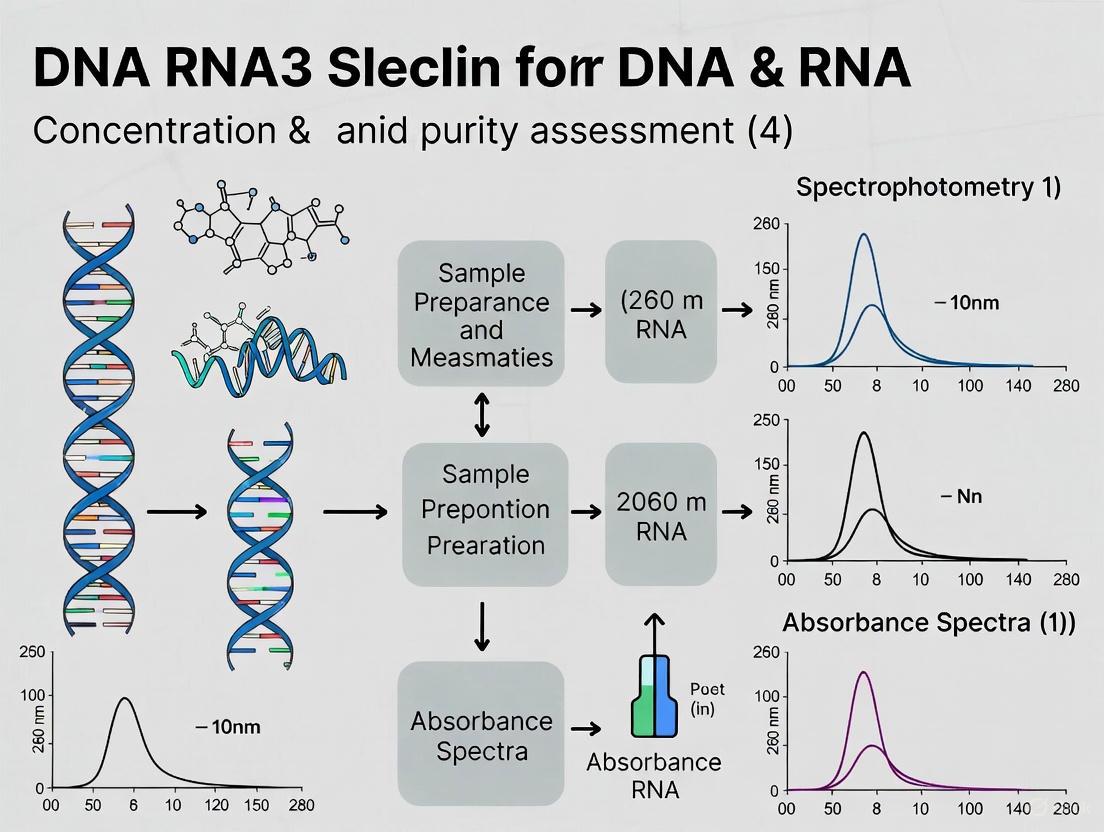
This article provides a comprehensive guide for researchers and drug development professionals on using UV-Vis spectrophotometry for the quantification and purity assessment of DNA and RNA.
Spectrophotometry for DNA and RNA Analysis: A Complete Guide to Concentration, Purity, and Best Practices
Abstract
This article provides a comprehensive guide for researchers and drug development professionals on using UV-Vis spectrophotometry for the quantification and purity assessment of DNA and RNA. It covers foundational principles, from the Beer-Lambert law to the significance of A260/A280 ratios, and delivers detailed, step-by-step protocols for reliable measurement. The content further addresses common troubleshooting scenarios, explores method validation parameters, and offers a comparative analysis with fluorometry to guide instrument selection. By synthesizing methodological guidance with quality control and advanced application insights, this resource aims to empower scientists to generate accurate, reproducible nucleic acid data crucial for downstream molecular biology techniques.
The Principles of Spectrophotometry: Mastering Nucleic Acid Absorbance Fundamentals
In molecular biology and pharmaceutical development, the accurate quantification of nucleic acids is a foundational step that directly influences the success of downstream applications, from basic PCR to cutting-edge mRNA vaccine production. At the heart of many quantification workflows lies the Beer-Lambert Law, a principle of spectroscopy that enables researchers to determine the concentration of molecules in solution. This law describes the linear relationship between the absorbance of light and the concentration of an absorbing substance. For DNA and RNA analysis, this translates to using absorbance at 260 nm to calculate nucleic acid concentration, a method valued for its simplicity and rapidity. However, the reliance on this principle also introduces specific limitations concerning sensitivity, specificity, and susceptibility to contaminants. This guide provides an objective comparison of quantification techniques rooted in the Beer-Lambert Law against modern fluorescence-based alternatives, supported by experimental data and detailed protocols to inform the choices of researchers and drug development professionals.
The Fundamental Principle: The Beer-Lambert Law
The Beer-Lambert Law (also known as Beer's Law) is a fundamental principle in spectrophotometry that provides the mathematical basis for quantifying the concentration of a substance in a solution [1]. It states that the absorbance (A) of light by a solution is directly proportional to the concentration (c) of the absorbing species and the path length (l) the light takes through the solution [2] [1].
The law is expressed by the equation: A = ε * c * l
Where:
- A is the measured absorbance (no units).
- ε is the molar absorptivity or extinction coefficient (L·mol⁻¹·cm⁻¹), a constant that indicates how strongly a specific chemical species absorbs light at a particular wavelength [1].
- c is the concentration of the solution (mol/L).
- l is the path length of the cuvette or measurement vessel (cm) [1].
In practical terms for nucleic acid quantification, this equation is rearranged to solve for concentration. The extinction coefficient (ε) is well-established for nucleic acids, allowing instruments to calculate concentration directly from the absorbance reading at 260 nm [3]. An absorbance of 1.0 at 260 nm corresponds to approximately 50 µg/mL for double-stranded DNA, 33 µg/mL for single-stranded DNA, and 40 µg/mL for RNA [3] [4].
Application in RNA and DNA Quantification
UV spectrophotometry, powered by the Beer-Lambert Law, is a cornerstone technique for the initial assessment of nucleic acid samples.
- Concentration Measurement: The concentration of a DNA or RNA sample is directly determined by measuring its absorbance at 260 nm (A260) and applying the Beer-Lambert law [2] [4]. This simple calculation allows researchers to swiftly determine if a sample meets the concentration requirements for their next experiment.
- Purity Assessment: Spectrophotometers also measure absorbance at other wavelengths to assess sample purity through key ratios [2] [5] [6]:
- A260/A280 Ratio: This ratio assesses protein contamination. Pure DNA typically has a ratio of ~1.8, while pure RNA has a ratio of ~2.0 [2] [5]. Significantly lower ratios suggest residual protein, as proteins absorb light strongly at 280 nm due to aromatic amino acids [6].
- A260/A230 Ratio: This ratio assesses contamination from salts, solvents, or organic compounds like guanidine thiocyanate or phenol, which absorb at 230 nm [2] [5]. A ratio of >1.8 is generally considered acceptable for pure nucleic acids [2].
The following diagram illustrates the core workflow and decision points for using this principle in nucleic acid analysis.
Comparative Analysis: Spectrophotometry vs. Fluorometry
While UV spectrophotometry is a versatile workhorse, fluorometry has emerged as a powerful alternative, especially for sensitive or demanding applications. The table below provides a direct, data-driven comparison of these two core techniques.
| Evaluation Criteria | UV Spectrophotometry | Fluorometry |
|---|---|---|
| Core Principle | Beer-Lambert Law (light absorption) [2] [7] | Fluorescence emission from dye-bound nucleic acids [2] [5] |
| Specificity | Low; cannot distinguish between DNA, RNA, or free nucleotides [2] [7] | High; dyes can be specific for dsDNA, ssDNA, or RNA [2] [7] |
| Sensitivity Range | 2-2000 ng/µL (dsDNA) [7] | 0.01-100 ng/µL (dsDNA) [7] |
| Purity Assessment | Direct via A260/A280 and A260/A230 ratios [2] [6] | Indirect; requires sample dilution which can dilute contaminants [7] |
| Key Advantage | Simple, rapid, and cost-effective; provides direct purity assessment [2] [7] | Superior sensitivity and specificity; ideal for low-concentration samples [2] [5] [7] |
| Main Limitation | Susceptible to interference from common contaminants [2] [6] | Requires specific, often expensive, fluorescent dyes [2] [7] |
| Ideal Use Case | Initial quality control of pure, concentrated samples [2] [7] | Quantifying low-abundance samples, NGS library prep, RNA/DNA mixtures [2] [7] |
Experimental Insight: The limitations of spectrophotometry are pronounced in modern therapeutics. A 2024 study highlighted that modified nucleosides (e.g., pseudouridine (Ψ) in mRNA vaccines) alter the spectrophotometric properties of RNA, leading to significant underestimation of concentration when using the standard Beer-Lambert calculation [8]. This necessitates advanced tools like the mRNACalc web server for accurate dosing, which is critical for clinical efficacy and safety [8].
Essential Research Reagent Solutions
The consistent execution of nucleic acid quantification relies on a suite of specific reagents and instruments. The following table catalogs key materials and their functions in standard experimental workflows.
| Reagent/Instrument | Function in Quantification |
|---|---|
| Microvolume Spectrophotometer (e.g., NanoDrop) | Measures absorbance of tiny sample volumes (1-2 µL) without a cuvette, calculating concentration and purity ratios [6]. |
| Fluorometer | Excites fluorescent dyes bound to nucleic acids and measures the emitted light for highly sensitive and specific quantification [5] [7]. |
| Fluorescent Dyes (e.g., PicoGreen, RiboGreen) | Bind selectively to specific nucleic acid types (dsDNA or RNA), enabling sensitive detection in fluorometry [5]. |
| TE Buffer (pH 8.0) | A slightly alkaline elution/buffer that provides stable pH for accurate and reproducible A260/A280 ratios [4]. |
| DNase or RNase Enzymes | Treat samples to remove contaminating DNA (from RNA preps) or RNA (from DNA preps) for accurate, specific quantification [4]. |
| Agilent 2100 Bioanalyzer | Performs capillary electrophoresis to provide detailed information on RNA integrity and concentration, beyond simple absorbance [4]. |
Detailed Experimental Protocol for Spectrophotometric RNA Quantification
This protocol outlines a standardized method for quantifying RNA using a microvolume spectrophotometer, incorporating best practices to mitigate common issues.
Materials and Reagents
- Purified RNA sample
- Nuclease-free water or TE buffer (10 mM Tris-HCl, 1 mM EDTA, pH 8.0)
- RNase-free microtubes
- Microvolume UV-Vis spectrophotometer (e.g., Thermo Scientific NanoDrop)
- Lint-free wipes for cleaning the instrument pedestal
Step-by-Step Procedure
- Instrument Preparation: Power on the spectrophotometer and its associated software. Initialize the nucleic acid quantification application.
- Blank Measurement: Using a lint-free wipe, thoroughly clean the upper and lower measurement pedestals. Pipette 1-2 µL of the chosen blank solution (nuclease-free water or TE buffer) onto the lower pedestal. Close the arm and execute the "Blank" measurement. Clean the pedestals after the measurement [6] [4].
- Sample Measurement: Clean the pedestals again. Pipette 1-2 µL of the RNA sample onto the lower pedestal. Close the arm and initiate the sample measurement. The instrument will display the absorbance spectrum and calculate the concentration and purity ratios automatically.
- Data Recording and Interpretation: Record the sample concentration (in ng/µL), the A260/A280 ratio, and the A260/A230 ratio. Clean the pedestals thoroughly before the next sample. For reliability, it is recommended to perform at least two technical replicates per sample [6].
- Troubleshooting and Optimization:
- Low A260/A280 Ratio (<1.8): Indicates protein contamination. Consider additional purification steps, such as phenol-chloroform extraction [2] [4].
- Low A260/A230 Ratio (<1.8): Suggests contamination with salts or organic compounds (e.g., guanidine thiocyanate, ethanol). Perform an additional precipitation and wash step with 70% ethanol [2] [6].
- Abnormal Spectral Peak: A peak shifted toward 270 nm may indicate phenol contamination [6].
- pH Sensitivity: For consistent A260/A280 ratios, always use a slightly alkaline buffer like TE (pH 8.0) instead of water, which can have an acidic pH and artificially depress the ratio [4].
The Beer-Lambert Law remains an indispensable principle for the initial quantification and purity assessment of nucleic acids, offering unparalleled speed and simplicity. However, a comparative analysis clearly shows that its utility is best leveraged in conjunction with other techniques. For high-concentration, pure samples, spectrophotometry provides a complete and rapid assessment. In contrast, for sensitive applications, complex sample matrices, or the precise quantification of modified RNAs used in modern therapeutics, fluorometry's superior specificity and sensitivity make it the indispensable tool. A robust quantification strategy often employs both methods: spectrophotometry for an initial quality check and fluorometry for final, precise measurement before critical downstream applications. This dual approach ensures the accuracy and reproducibility required for successful research and drug development.
The accurate quantification of nucleic acids is a cornerstone of molecular biology, with spectrophotometric absorbance at 260 nm serving as the fundamental principle for concentration determination. This guide details the photophysical properties of DNA and RNA that dictate this specific absorbance maximum, objectively compares spectrophotometric and fluorometric quantification technologies, and provides validated experimental protocols for researchers. Supporting data on instrument performance, purity assessments, and troubleshooting guidelines are synthesized to inform method selection for downstream applications in drug development and biomedical research.
The interaction of nucleic acids with ultraviolet (UV) light provides the basis for one of the most routinely performed measurements in molecular biology laboratories. The nitrogenous bases—adenine, guanine, cytosine, thymine, and uracil—that comprise DNA and RNA exhibit strong absorption of UV light due to their complex, conjugated ring structures [9]. These aromatic heterocycles undergo π→π* electronic transitions when exposed to UV radiation, with maximal absorption occurring at a characteristic wavelength of 260 nanometers (nm) [6] [9]. This specific photophysical property enables researchers to non-destructively determine nucleic acid concentration in solution using the Beer-Lambert law, which relates the absorbance of light to the concentration of the absorbing molecule [10] [9].
The consistent absorption maximum at 260 nm across different nucleic acid types and sources makes it a critical parameter for quantification. According to the Beer-Lambert law, A = εlc, where A is absorbance, ε is the molar absorptivity coefficient, l is the path length, and c is concentration [9]. For double-stranded DNA (dsDNA), an absorbance of 1.0 at 260 nm corresponds to approximately 50 μg/mL, while for RNA, the equivalent absorbance corresponds to 40 μg/mL [11] [12]. These conversion factors are standardized across the field, allowing for consistent concentration calculations regardless of the specific spectrophotometer instrument used.
Fundamental Principles of 260 nm Absorbance
Molecular Basis of UV Absorption
The exceptional absorbance of nucleic acids at 260 nm stems from the resonant structures of their purine (adenine, guanine) and pyrimidine (cytosine, thymine, uracil) bases. The delocalized π-electron systems within these heterocyclic rings can be excited to higher energy states by photons of specific energy, corresponding to the UV range of the electromagnetic spectrum. Each base has a slightly different absorption profile, but collectively they create the characteristic peak at 260 nm that is exploited for quantification purposes [9]. This property is so fundamental that it enables detection of nucleic acids at concentrations as low as 2-5 ng/μL in microvolume spectrophotometers [10].
Beer-Lambert Law and Concentration Calculations
The relationship between absorbance and nucleic acid concentration follows the Beer-Lambert law, expressed as A = εlc, where A is the measured absorbance, ε is the wavelength-dependent molar absorptivity coefficient, l is the path length through which light travels, and c is the molar concentration of the analyte [10] [9]. For practical laboratory applications, this is simplified to concentration calculations using established conversion factors:
- dsDNA concentration (μg/mL) = A260 × dilution factor × 50 μg/mL [12] [13]
- RNA concentration (μg/mL) = A260 × dilution factor × 40 μg/mL [12]
For accurate quantification, absorbance readings at 260 nm should fall between 0.1 and 1.0, which represents the linear range for most instruments [11] [13]. Samples falling outside this range should be diluted or concentrated accordingly to ensure measurement accuracy.
Comparative Analysis of Quantification Methods
Spectrophotometry vs. Fluorometry: Technical Comparison
While both methods quantify nucleic acids, they differ significantly in their underlying principles, sensitivity, and applications. The table below summarizes the key differences:
Table 1: Comparison of UV Spectrophotometry and Fluorometry for Nucleic Acid Quantification
| Parameter | UV Spectrophotometry | Fluorometry |
|---|---|---|
| Principle | Measures intrinsic absorbance of bases at 260 nm [10] | Measures fluorescence from dyes that selectively bind nucleic acids [10] |
| Sensitivity | 1-2 ng/μL (NanoDrop) [10] | 0.005-0.05 ng/μL (Qubit) [10] |
| Specificity | Low; cannot distinguish between DNA and RNA [10] [12] | High; dyes can be specific for dsDNA, ssDNA, or RNA [10] [13] |
| Purity Information | Provides A260/A280 and A260/A230 ratios [10] | No purity information [10] |
| Sample Prep | Simple; no additional reagents [10] | Requires fluorescent dyes and standards [10] |
| Cost & Throughput | Lower cost per sample; high throughput [10] | Higher cost per sample; medium throughput [10] |
Instrument Performance Comparison
Different instruments offer varying performance characteristics for nucleic acid quantification. The following table compares detection limits and sample requirements across common platforms:
Table 2: Instrument Detection Limits and Sample Requirements
| Instrument | Method | Lower Detection Limit (dsDNA) | Sample Volume | Throughput |
|---|---|---|---|---|
| NanoDrop Ultra | UV Spectrophotometry | 1.0 ng/μL (pedestal) [10] | 1 μL [10] | Single sample [10] |
| NanoDrop Eight | UV Spectrophotometry | 2.0 ng/μL [10] | 1 μL [10] | 8 samples [10] |
| NanoDrop Ultra FL | Fluorometry | 0.05 ng/μL [10] | 1-10 μL [10] | Single sample [10] |
| Qubit 4 | Fluorometry | 0.005 ng/μL [10] | 1-20 μL [10] | Single sample [10] |
| Multiplate Readers | Both | Varies by format and assay [10] | As little as 2 μL [10] | 16-384 samples [10] |
Experimental Protocols for Absorbance Measurement
Standard Spectrophotometric Quantification Protocol
Materials Required:
- Purified DNA or RNA sample
- Spectrophotometer (e.g., NanoDrop, DeNovix) or UV-transparent cuvettes
- Appropriate blank solution (same as sample buffer, typically TE buffer or nuclease-free water)
- Micropipettes and tips
Procedure:
- Blank Measurement: Dispense 1-2 μL of the blank solution (the buffer used to elute or dilute the sample) onto the measurement pedestal or into a cuvette. Initiate the blank measurement [12] [6].
- Sample Measurement: Wipe the pedestal clean and apply 1-2 μL of the nucleic acid sample. For cuvette-based systems, dilute the sample appropriately to ensure A260 readings fall between 0.1-1.0 [13].
- Data Recording: Record the A260 value for concentration calculation and the A260/A280 and A260/A230 ratios for purity assessment [13] [14].
- Concentration Calculation: Calculate nucleic acid concentration using the appropriate conversion factor (50 μg/mL for dsDNA, 40 μg/mL for RNA per 1 A260 unit) multiplied by any dilution factor [12] [13].
Validation Parameters:
- Linearity: Correlation coefficients should be R ≥ 0.9950 across the working range [15].
- Precision: Coefficient of variation (% CV) should be ≤2% for repeatability and reproducibility [15].
- Trueness: Bias values should be lower than Z-test with 95% confidence level, with recovery percentages within 100% ± 5% [15].
Method Validation and Quality Control
For rigorous scientific research and regulated environments, method validation should include:
- Linearity Assessment: Performed through calibration curves generated by serial dilution of Standard Reference Material DNA (e.g., NIST SRM 2372) [15].
- Limit of Detection (LOD) and Quantification (LOQ) Determination: Calculated from multiple measurements of blank samples [15].
- Precision Evaluation: Under both repeatability and reproducibility conditions using multiple DNA concentrations [15].
- Stability Testing: DNA samples typically show stability for 60 days at 2-4°C [15].
Purity Assessment and Contaminant Detection
Interpretation of Absorbance Ratios
The table below outlines expected purity ratios and deviations indicating contamination:
Table 3: Nucleic Acid Purity Ratios and Interpretation
| Ratio | Ideal Value | Low Value Indicates | High Value Indicates |
|---|---|---|---|
| A260/A280 | ~1.8 (DNA) [16] [14] ~2.0 (RNA) [14] | Protein or phenol contamination [16] [14] | RNA contamination in DNA samples [16] |
| A260/A230 | 2.0-2.2 [16] [14] | Organic compounds (phenol, guanidine), chaotropic salts, or carbohydrates [16] [12] [14] | - |
Contaminant Identification via Spectral Analysis
Different contaminants exhibit characteristic absorbance profiles that can be identified through full-spectrum analysis (220-350 nm):
- Protein Contamination: Shows increased absorbance at 280 nm due to aromatic amino acids (tryptophan, tyrosine), depressing the A260/A280 ratio [6].
- Phenol Contamination: Absorbs strongly at ~270 nm, potentially shifting the absorption peak from 260 nm toward 270 nm [6].
- Guanidine Salts: Exhibit strong absorbance around 230 nm, significantly depressing the A260/A230 ratio even at low concentrations (as low as 10 μM) [6].
- Carbohydrate Contamination: Appears as elevated absorbance at 230 nm, lowering the A260/A230 ratio [16].
Research Reagent Solutions and Materials
Table 4: Essential Materials for Nucleic Acid Quantification
| Item | Function/Application |
|---|---|
| NanoDrop Spectrophotometer | Microvolume nucleic acid quantification requiring only 1-2 μL sample [10] [6] |
| Qubit Fluorometer | Highly specific DNA or RNA quantification using fluorescent dyes [10] |
| UV-Transparent Cuvettes | Absorbance measurement in traditional spectrophotometers [12] |
| Quant-iT PicoGreen dsDNA Assay | Fluorometric quantification specifically for double-stranded DNA [16] [13] |
| TE Buffer (10 mM Tris-Cl, pH 8.5) | Optimal DNA dilution and storage buffer for stable absorbance readings [11] [6] |
| Nuclease-Free Water | RNA dilution and blank measurements [12] |
Troubleshooting and Technical Considerations
Common Issues and Solutions
- Low A260/A280 Ratio (<1.8): Indicates protein contamination. Solution: Repeat purification using phenol:chloroform extraction or commercial cleanup kits [16] [9].
- Low A260/A230 Ratio (<2.0): Suggests carryover of purification reagents (guanidine, phenol, salts). Solution: Ethanol precipitation with additional wash steps or use of commercial cleanup kits [16] [6].
- Inconsistent Readings: Can result from improper blanking, air bubbles, or insufficient sample cleaning. Solution: Ensure consistent blank measurement using the same buffer as samples, take multiple readings, and clean pedestals between measurements [6].
- pH Sensitivity: Absorbance ratios are pH-dependent. Acidic solutions may under-represent the A260/A280 ratio by 0.2-0.3, while basic solutions may over-represent it. Solution: Use buffered solutions (e.g., TE buffer) rather than water for consistent measurements [16] [14].
Method Selection Guidelines
- For High-Purity, Concentrated Samples: UV spectrophotometry provides rapid, comprehensive data including purity assessment [10] [13].
- For Low-Abundance Samples or Specific Quantification: Fluorometry offers superior sensitivity and specificity [10] [13].
- For Integrity Assessment: Agarose gel electrophoresis complements absorbance data by visualizing DNA size and degradation [16] [13].
- For Sequence-Specific Quantification: qPCR provides the highest specificity and sensitivity for particular targets [12] [17].
The characteristic absorbance of nucleic acids at 260 nm remains a fundamental property exploited across molecular biology for reliable quantification. While UV spectrophotometry provides a rapid, straightforward method for concentration determination and purity assessment, researchers must understand its limitations regarding sensitivity and specificity. Fluorometric methods complement spectrophotometry when working with dilute samples or when distinguishing between DNA and RNA is essential. By selecting the appropriate quantification method based on sample characteristics and downstream applications, and by rigorously validating measurement protocols, researchers can ensure the accuracy and reproducibility essential for successful experimental outcomes in drug development and biomedical research.
Accurate assessment of nucleic acid concentration and purity is a foundational step in molecular biology. The spectrophotometric purity ratios A260/A280 and A260/230 serve as critical, initial indicators of sample quality, alerting researchers to the presence of contaminants that can compromise expensive and time-consuming downstream applications [5] [16] [2]. This guide delves into the interpretation of these ratios, provides standardized experimental protocols, and compares spectrophotometry with other quantification technologies.
The Fundamentals of Nucleic Acid Purity Assessment
Core Principles of Spectrophotometry
Spectrophotometric quantification of nucleic acids is based on the Beer-Lambert law, which states that the absorbance of light by a solution is directly proportional to the concentration of the absorbing substance [5] [2]. The aromatic rings in the nitrogenous bases of DNA and RNA absorb ultraviolet (UV) light most strongly at a wavelength of 260 nm [5] [2]. This intrinsic property allows scientists to calculate nucleic acid concentration by measuring the absorbance at this wavelength.
The assessment of purity relies on calculating ratios of absorbance at different wavelengths. This controls for overall concentration and identifies common contaminants that absorb light at characteristic wavelengths other than 260 nm. The two most critical ratios for routine analysis are the A260/A280 ratio, which primarily indicates protein or phenol contamination, and the A260/A230 ratio, which signals the presence of salts or organic compounds [5] [14].
The Critical Distinction Between DNA and RNA
While both DNA and RNA are nucleic acids, their differing chemical structures lead to different ideal purity ratios [5]. RNA contains a ribose sugar with a hydroxyl group at the 2' carbon position, making it more chemically reactive and less stable than DNA. Furthermore, RNA uses uracil instead of thymine. These differences affect how the molecules interact with UV light, resulting in different benchmark values for a "pure" sample [5] [2]. It is therefore essential to know whether you are quantifying DNA or RNA before interpreting the results.
Interpreting A260/A280 and A260/230 Ratios
The following table provides a clear reference for interpreting the purity ratios of DNA and RNA samples.
Table 1: Interpretation of Nucleic Acid Purity Ratios
| Ratio | Ideal Value (DNA) | Ideal Value (RNA) | Low Ratio Indicates | High Ratio Indicates |
|---|---|---|---|---|
| A260/A280 | ~1.8 [5] [16] | ~2.0 [5] [14] [2] | Protein or phenolic contamination [5] [14] | Possible RNA contamination in DNA samples [5] |
| A260/A230 | 2.0 - 2.2 [14] [16] | 2.0 - 2.2 [14] | Contamination by salts, carbohydrates, guanidine, EDTA, or phenol [5] [14] [16] | May result from a dirty blank measurement [5] |
Troubleshooting Abnormal Ratios
Deviations from the ideal ratios are common and knowing their potential causes is key to rectifying sample quality issues.
- Abnormal A260/A280: A ratio significantly lower than 1.8 for DNA or 2.0 for RNA is a strong indicator of protein contamination, a frequent carryover from the extraction process [5] [14]. Acidic or basic solutions can also skew this ratio; acidic solutions may under-represent the ratio by 0.2–0.3, while basic solutions can over-represent it [14] [16].
- Abnormal A260/A230: A low A260/230 ratio is a valuable red flag for the presence of common laboratory contaminants such as guanidine salts (used in many extraction kits), EDTA, carbohydrates, or Triton-based buffers [14] [16] [2]. The impact of these contaminants is more pronounced in dilute samples, as the contaminant's absorbance makes up a larger portion of the total signal [2].
Standardized Experimental Protocol for Accurate Measurement
Consistency in methodology is paramount for obtaining reliable and reproducible purity ratios.
Workflow for Spectrophotometric Analysis
The diagram below outlines the key steps for proper sample measurement and data interpretation.
Detailed Methodology
- Instrument Blanking: Always use the same elution buffer in which your nucleic acids are suspended (e.g., Tris-HCl, TE buffer) as the blank [5] [16]. Using water can lead to inaccurate ratios due to differences in pH and ionic strength [16].
- Sample Measurement: Pipette 1-2 µL of the sample onto the measurement pedestal for microvolume instruments, or load the solution into a quartz cuvette. Ensure the sample covers the light path completely.
- Data Collection: The instrument will measure the absorbance at 230 nm, 260 nm, and 280 nm. Most modern spectrophotometers automatically calculate the sample concentration (using the A260 reading) and the A260/A280 and A260/230 ratios.
- Concentration Range: For reliable absorbance readings, ensure the A260 value falls within the instrument's linear range, typically between 0.1 and 1.0 [16]. Samples that are too concentrated should be diluted with the same elution buffer and re-measured.
Essential Research Reagent Solutions
Table 2: Key Reagents for Nucleic Acid Quantification and Quality Control
| Item | Function/Description |
|---|---|
| UV-Transparent Elution Buffer (e.g., Tris-EDTA, Tris-HCl) | A low-salt buffer at neutral pH used to suspend nucleic acids, ensuring accurate spectrophotometric measurements and stable ratios [16]. |
| Fluorometric Dyes (e.g., PicoGreen for dsDNA, RiboGreen for RNA) | Dyes that bind specifically to nucleic acids, enabling highly sensitive and specific quantification, free from interference from common contaminants [5] [16]. |
| Agarose Gel | A matrix used in electrophoresis to visually assess nucleic acid integrity and confirm the presence of high-molecular-weight DNA or intact rRNA bands [5] [16]. |
| Standard Reference Materials | Certified materials with known absorbance values used to check the photometric and wavelength accuracy of spectrophotometers [18]. |
Comparative Analysis of Quantification Technologies
While UV spectrophotometry is ubiquitous for its speed and simplicity, it is one of several tools available for quality control. The table below compares its performance against other common methods.
Table 3: Comparison of Nucleic Acid Quantification and Quality Assessment Methods
| Method | Key Principle | Advantages | Limitations |
|---|---|---|---|
| UV-Vis Spectrophotometry | Measures absorbance of UV light at 260 nm [5] | Simple, quick, non-destructive, provides purity ratios (A260/A280, A260/230) [5] [2] | Non-specific (cannot differentiate DNA/RNA); sensitive to contaminants; less reliable for very low or high concentrations [5] [2] |
| Fluorometry | Fluorescent dyes (e.g., PicoGreen, RiboGreen) bind specifically to nucleic acids [5] | Highly specific and sensitive; not affected by common contaminants; ideal for low-concentration samples [5] [16] [2] | Requires specific dyes and calibration; cannot provide purity ratios for salts/organics; results depend on standard curve [5] |
| Agarose Gel Electrophoresis | Separates nucleic acids by size using an electric field [5] [16] | Low-cost; visual assessment of integrity and degradation; confirms high molecular weight [5] [16] | Semi-quantitative at best; time-consuming and labor-intensive; not effective for very small fragments [5] |
| Capillary Electrophoresis (e.g., TapeStation, Bioanalyzer) | Separates nucleic acids by size in a capillary [5] [19] | High accuracy; provides an integrity number (e.g., RINe, DIN); suitable for high-throughput [5] [19] | Expensive instrumentation; requires specialized chips/reagents; higher per-sample cost [5] |
The Integrated Workflow for Comprehensive Quality Control
For critical downstream applications like next-generation sequencing (NGS) or quantitative PCR (qPCR), relying on a single method is insufficient. A robust, multi-technique approach is recommended.
- Step 1: Rapid Assessment: Use UV spectrophotometry for an initial check of concentration and to screen for protein or salt contamination via A260/A280 and A260/230 ratios [5] [2].
- Step 2: Specific Quantification: For precise quantification, especially with low-yield samples or those with abnormal ratios, use a fluorometric assay [16]. This provides a contaminant-resistant concentration value.
- Step 3: Integrity Verification: Finally, assess sample integrity using capillary electrophoresis (providing a numerical RINe or DIN score) or agarose gel electrophoresis to confirm the nucleic acids are not degraded [19] [16] [2]. A sample with good purity ratios but a poor integrity number is still unsuitable for many applications.
In conclusion, mastering the interpretation of A260/A280 and A260/230 ratios is an essential skill for any researcher working with nucleic acids. While spectrophotometry is an powerful first-line tool, it is most effective when used as part of an integrated quality control strategy that includes fluorometry and integrity analysis, ensuring that your samples are of sufficient quality to yield reliable and reproducible scientific data.
The accurate quantification of nucleic acids is a cornerstone procedure in molecular biology, essential for the success of downstream applications from quantitative PCR (qPCR) to next-generation sequencing (NGS) [5]. For decades, this fundamental task was performed using traditional cuvette-based spectrophotometers, which required relatively large sample volumes and often involved time-consuming dilutions. The advent of microvolume spectrophotometry has revolutionized this process, enabling researchers to obtain rapid concentration and purity measurements from just 1-2 µL of sample [20] [21]. This guide traces the instrumental evolution from traditional cuvettes to modern systems, with a focused comparison on leading microvolume platforms. We will objectively compare the performance of traditional systems against modern microvolume alternatives, providing experimental data and detailed methodologies to frame their capabilities within the context of DNA and RNA concentration and purity assessment for research and drug development.
Traditional Cuvette-Based Spectrophotometry
Principles and Limitations
Traditional UV-Vis spectrophotometry operates on the Beer-Lambert Law, which states that the absorbance of light by a solution is directly proportional to the concentration of the absorbing species and the path length of the light through the solution [5]. In cuvette-based systems, this path length is fixed, typically at 10 mm (1 cm).
- Sample Volume Requirements: These systems traditionally require large sample volumes, often ranging from 50 µL to 1 mL, depending on the cuvette type [20]. This presented a significant bottleneck for samples with limited yield, such as those from needle biopsies or laser-capture microdissection.
- Dilution Necessity: The broad dynamic range of nucleic acid concentrations often necessitates sample dilution to fall within the instrument's linear range, introducing additional steps and potential for error.
- Consumables Dependency: The requirement for cuvettes adds ongoing consumable costs and introduces risks associated with cuvette cleanliness and handling.
The limitations of traditional systems, particularly for low-volume or high-concentration samples, created a clear need for a more efficient and sample-conserving technology.
The Microvolume Revolution
Core Technological Innovation
Microvolume spectrophotometers, pioneered by systems like the NanoDrop, overcame the limitations of cuvettes through a novel sample retention system [20]. This technology leverages fiber optics and natural surface tension properties to capture and retain a small droplet of sample (0.5-2 µL) between two optical surfaces, forming a liquid column without the need for traditional containment apparatus [20]. A key advancement is the use of shorter, automatically adjusted path lengths (e.g., 0.03–1.0 mm), which prevent signal saturation and allow for the measurement of highly concentrated samples without dilution [20] [22]. This innovation dramatically expands the dynamic range of measurable concentrations.
Workflow and Practical Advantages
The microvolume workflow is significantly streamlined. A user simply dispenses a 1-2 µL droplet onto the measurement pedestal, lowers the arm, and initiates measurement, with results displayed in seconds [23]. This process eliminates the need for cuvettes and dilutions, saving both time and precious sample material. The integrated software automatically calculates nucleic acid concentration using pre-programmed algorithms and provides key purity ratios (A260/A280 and A260/A230), enabling rapid assessment of sample quality [20] [5].
Diagram 1: A generalized workflow for microvolume spectrophotometer measurement, illustrating the rapid and simple process.
Comparative Performance Analysis: Microvolume Systems
Technical Specifications of Leading Platforms
The microvolume spectrophotometer market includes several key players, primarily Thermo Fisher Scientific with its NanoDrop line, DeNovix with the DS-11 Series, and Blue-Ray Biotech with the EzDrop series. The table below summarizes the key specifications for a direct comparison.
Table 1: Technical specification comparison of leading microvolume UV-Vis spectrophotometers.
| Feature | NanoDrop One | NanoDrop 2000 | DeNovix DS-11 Series | EzDrop 1000 |
|---|---|---|---|---|
| Minimum Sample Volume | 1–2 µL [21] | 1–2 µL [24] | 1 µL (approx.) [22] | 1 µL [24] |
| dsDNA Dynamic Range | 0.2–27,500 ng/µL (pedestal) [21] [23] | 2–15,000 ng/µL [23] | Information Missing | Up to 20,000 ng/µL [24] |
| Wavelength Range | 190–850 nm [21] | 190–850 nm (from context) | Information Missing | 190–1000 nm [24] |
| Pathlength Control | Auto-adjusting (0.03–1.0 mm) [22] | Fixed short path | SmartPath technology (starts at 0.5mm) [22] | Low pathlength design [24] |
| Key Technology | Acclaro Sample Intelligence [21] | Standard microvolume | Bridge Testing verification [22] | Wide wavelength range [24] |
| Fluorometer Option | No (separate fluorometer models) [22] | No | Yes, integrated (on select models) [22] | Not specified |
Experimental Data on Accuracy and Precision
Objective performance comparisons often rely on measuring serially diluted samples of known concentration to assess accuracy and repeating measurements on a single sample to determine precision (reproducibility).
- Accuracy Comparison: A study comparing the EzDrop 1000, NanoDrop One, and NanoDrop 2000 using a two-fold serial dilution of a known-concentration salmon sperm DNA sample demonstrated a high degree of accuracy across all platforms. The correlation coefficients (R²) for the measured versus expected concentrations were above 0.99 for all instruments, indicating that their readings closely matched the true concentration of the analyte [24].
- Precision Comparison: A direct precision test between the EzDrop 1000 and the DS-11 involved measuring the same sample (at 2,500 ng/µL and 312 ng/µL) three times each. The reported results showed that the EzDrop 1000 exhibited a more stable Coefficient of Variation (CV value) across these replicates, suggesting better reproducibility under the tested conditions [24].
These experimental findings indicate that while newer instruments like the EzDrop and DS-11 are strong competitors, established models like the NanoDrop maintain a high standard of analytical accuracy.
Essential Protocols for Quantification and Quality Assessment
Protocol 1: Direct Absorbance Measurement with a Microvolume Spectrophotometer
This protocol is adapted from established methodologies for instruments like the NanoDrop 2000c and is universally applicable to similar microvolume systems [20].
- System Initialization: Power on the instrument and computer. Launch the associated software and select the "Nucleic Acid" application.
- Pedestal Cleaning: Pipette 2–3 µL of clean deionized water onto the lower optical pedestal. Close and then open the lever arm. Thoroughly wipe both the upper and lower optical surfaces with a clean, dry, lint-free lab wipe to remove any residue [20].
- Blank Measurement: Dispense 1–2 µL of the buffer used to suspend your sample (e.g., TE buffer or nuclease-free water) onto the center of the lower pedestal. Close the lever arm and select "Blank" in the software. Once the measurement is complete, lift the arm and wipe both surfaces clean [20] [23].
- Sample Measurement: Choose the appropriate constant for your sample type in the software (e.g., "dsDNA" for double-stranded DNA, which uses a factor of 50) [20]. Dispense 1–2 µL of your nucleic acid sample onto the lower pedestal. Close the lever arm and select "Measure." The software will automatically display the concentration (in ng/µL) and calculate the A260/A280 and A260/A230 purity ratios.
- Post-Measurement Cleaning: After the measurement, lift the arm and thoroughly wipe both optical surfaces clean with a lint-free wipe before proceeding to the next sample.
Protocol 2: High-Sensitivity Quantitation via Fluorescence
For samples too dilute for accurate UV absorbance measurement (e.g., below 2 ng/µL), a fluorescence-based method using a dye like PicoGreen is recommended [20] [21]. This protocol can be performed on a dedicated microvolume fluorospectrometer.
- Reagent Preparation: Equilibrate the PicoGreen kit reagents and all samples to room temperature. Prepare a 1X TE buffer by diluting a 20X stock with nuclease-free water. Prepare the PicoGreen working solution according to the manufacturer's protocol. Keep all fluorescent reagents in amber or foil-wrapped tubes to protect from light [20].
- Standard and Sample Preparation: Prepare serially diluted dsDNA standards in nuclease-free tubes at 2x the final desired concentration. Aliquot 5 µL of each standard and 5 µL of each unknown sample into labeled, light-safe tubes. Add an equal volume (5 µL) of the PicoGreen working solution to each tube, mixing gently by pipetting. Incubate at room temperature for 5 minutes [20].
- Instrument Measurement: Clean the pedestal surfaces with deionized water and a lint-free wipe. In the fluorospectrometer software, select the "Nucleic Acids" application and the "PicoGreen-dsDNA" option. Blank the instrument using 2 µL of 1X TE buffer. Measure 2 µL of the reference solution (1X TE + PicoGreen working solution) and then all standards to build a standard curve. Finally, measure each of your unknown samples. The software will automatically determine sample concentrations based on the standard curve [20].
Diagram 2: A decision workflow to guide the choice between absorbance and fluorescence quantification methods based on sample properties.
Data Interpretation and Purity Ratios
Regardless of the instrument, interpreting the results correctly is critical.
- Purity Ratios: The A260/A280 ratio assesses protein contamination. Pure DNA typically has a ratio of ~1.8, while pure RNA is ~2.0 [5] [23]. The A260/A230 ratio assesses contamination by salts, EDTA, or carbohydrates; a value for a "pure" nucleic acid is commonly in the range of 1.8–2.2 [20] [5]. Significantly lower values indicate contamination that may inhibit downstream applications.
- Spectral Analysis: Always examine the spectral curve. A typical pure nucleic acid sample has a smooth peak at 260 nm. Abnormal shoulders or shifts in the curve can indicate the presence of contaminants like phenol (around 270 nm) or guanidine (peak near 230 nm) [20].
Table 2: The Scientist's Toolkit: Essential Reagent Solutions for Nucleic Acid Quantification.
| Reagent/Solution | Function/Description | Application Notes |
|---|---|---|
| TE Buffer (Tris-EDTA) | A common suspension buffer for nucleic acids; provides a stable pH, while EDTA inhibits nucleases. | Often used for long-term storage of DNA. Its absorbance should be considered when used as a blank. |
| Nuclease-free Water | Purified water certified to be free of nucleases, preventing degradation of RNA and DNA samples. | The most common blanking solution for samples suspended in water. Ideal for downstream enzymatic applications. |
| PicoGreen Assay | A fluorescent dye that binds specifically to double-stranded DNA (dsDNA), enabling high-sensitivity quantification. | Used for fluorometric protocols. Highly specific and sensitive for low-concentration dsDNA samples (1 pg/µL to 1,000 ng/µL) [20] [21]. |
| RiboGreen Assay | A fluorescent dye for quantifying RNA in the presence of DNA, or for total nucleic acid quantification. | Used for fluorometric protocols. Provides high sensitivity for RNA quantification [5]. |
| Pedestal Cleaning Solution | Deionized water is standard; specific reconditioning compounds are available for stubborn contaminants. | Essential for preventing cross-contamination. Detergents and isopropyl alcohol are not recommended as they can uncondition the pedestal surface [20]. |
| Lint-free Lab Wipes | For cleaning and drying the optical pedestals between measurements. | Critical for maintaining optical clarity and preventing scratches. Lint from standard wipes can interfere with measurements [20]. |
The transition from traditional cuvette-based spectrophotometers to modern microvolume systems represents a significant leap forward in efficiency and practicality for life science research. These instruments conserve precious samples, accelerate workflows, and provide a broad dynamic range that often eliminates the need for dilutions. As the experimental data shows, current market leaders like the NanoDrop One, DeNovix DS-11, and EzDrop 1000 all deliver high accuracy, with distinctions often lying in specific features like integrated fluorometry, proprietary sample intelligence software, or unique pathlength technologies.
For researchers and drug development professionals, the choice of instrument will depend on specific application needs, required throughput, and budget. However, the underlying microvolume technology has unequivocally become the standard for nucleic acid quantification and quality assessment, enabling greater confidence and success in downstream molecular applications.
Ultraviolet (UV) spectrophotometry remains a foundational technique in molecular biology for the rapid assessment of nucleic acid concentration and purity. This method leverages the intrinsic property of DNA and RNA bases to absorb light at a specific wavelength (260 nm), allowing researchers to quantify genetic material without additional labels or reagents. For scientists and drug development professionals, understanding the expected values for pure preparations is critical for downstream applications ranging from routine PCR to cutting-edge sequencing technologies. The accuracy of these spectrophotometric measurements directly influences experimental success, as impurities or incorrect quantification can compromise enzymatic reactions, skew results, and waste valuable resources [25] [26].
This guide provides a definitive comparison of the expected absorbance ratios and conversion factors for DNA and RNA, supported by experimental data and detailed protocols. Within the broader context of spectrophotometry research, we objectively examine the performance of different measurement approaches, from traditional cuvette-based systems to modern microplate readers and specialized instruments like the NanoDrop. The guidelines presented here are synthesized from manufacturer specifications, peer-reviewed validation studies, and established laboratory manuals to create an authoritative reference for life science researchers [26] [15] [27].
Fundamental Conversion Factors and Molecular Weights
Key Conversion Factors for Concentration Calculation
The concentration of nucleic acids in a solution is calculated using established conversion factors based on their absorbance at 260 nm. These factors represent the concentration (in µg/mL) that produces an absorbance of 1.0 in a 1-cm pathlength cuvette. The table below summarizes the standard conversion factors for different nucleic acid types.
Table 1: Standard conversion factors for nucleic acid quantification using A260 measurements.
| Nucleic Acid Type | Conversion Factor (µg/mL per 1 A260 unit) | Notes and Conditions |
|---|---|---|
| Double-stranded DNA (dsDNA) | 50 µg/mL | Standard for dsDNA in high-salt buffers [26] [28]. |
| Single-stranded DNA (ssDNA) | 37 µg/mL | Applicable for oligonucleotides and denatured DNA [26]. |
| RNA | 40 µg/mL | Standard for most RNA transcripts [26]. |
It is crucial to note that these conversion factors are dependent on the solvent's ionic strength. DNA dissolved in deionized water has approximately 15% lower absorbance than in TE buffer (10 mM Tris-HCl, 1 mM EDTA, pH 7.4) and 23% lower absorbance than in TE buffer with saline (TES). Consequently, the effective conversion factor for dsDNA can vary from 38 µg/mL in water to 50 µg/mL in TES [27]. This underscores the importance of using the same diluent for both blanks and samples and being consistent with buffer conditions when comparing results.
Nucleotide Molecular Weights
For precise calculations, especially when working with synthetic oligonucleotides or when molar concentration is required, the molecular weights of individual nucleotides are essential. The following table provides the exact molecular weights for ribonucleotide and deoxyribonucleotide mono- and triphosphates.
Table 2: Molecular weights of nucleotides used for exact calculation of nucleic acid molecular weights [29].
| Nucleotide | Molecular Weight (g/mol) |
|---|---|
| Ribonucleotide Monophosphates (Avg. MW = 339.5) | |
| AMP | 347.2 |
| CMP | 323.2 |
| GMP | 363.2 |
| UMP | 324.2 |
| Deoxyribonucleotide Monophosphates (Avg. MW = 327.0) | |
| dAMP | 331.2 |
| dCMP | 307.2 |
| dGMP | 347.2 |
| dTMP | 322.2 |
The molecular weight of a single-stranded oligonucleotide can be calculated precisely using the formula: M.W. = (An x 313.2) + (Tn x 304.2) + (Cn x 289.2) + (Gn x 329.2) + 79.0, where An, Tn, Cn, and Gn are the number of each respective nucleotide, and 79.0 accounts for the 5' monophosphate [29].
Defining Purity: Expected Absorbance Ratios
The purity of nucleic acid preparations is assessed using absorbance ratios, which help identify common contaminants that can inhibit downstream enzymatic reactions.
Standard Absorbance Ratios for DNA and RNA
Table 3: Expected absorbance ratios for pure DNA and RNA and interpretations of deviations [30] [26] [15].
| Absorbance Ratio | Expected Value for Pure DNA | Expected Value for Pure RNA | Indication of Deviation |
|---|---|---|---|
| A260/A280 | ~1.8 | ~2.0 | Lower ratio: Potential protein or phenol contamination. Higher ratio (DNA): Indicates RNA contamination. |
| A260/A230 | 2.0 – 2.2 | 2.0 – 2.2 | Lower ratio: Contamination by chaotropic salts, carbohydrates, phenol, or EDTA. |
These ratios are a cornerstone of nucleic acid QC. A study validating NanoDrop quantification confirmed that pure DNA from standard reference material (NIST SRM 2372) consistently yields these expected ratios, establishing the method's reliability for microvolume measurements [15]. Furthermore, in DNA storage research, these ratios are critical for monitoring the integrity of retrieved DNA, ensuring that the dehydration/rehydration process does not introduce contaminants [25].
Experimental Protocols for Accurate Measurement
Validated DNA Quantification Protocol Using a Microvolume Spectrophotometer
The following protocol, adapted from a peer-reviewed validation study, ensures accurate and reproducible DNA quantification [15].
- Instrument Calibration: Initialize the spectrophotometer (e.g., NanoDrop 2000) according to the manufacturer's instructions. Use the same solvent for the blank as the sample diluent (e.g., nuclease-free water or TE buffer).
- Sample Preparation: Dilute samples if necessary to fall within the instrument's linear range. For the NanoDrop, 1-2 µL is sufficient. For microplate readers, use a larger volume (250-300 µL) to maximize the optical pathlength and sensitivity [27].
- Measurement: Wipe the sampling pedestals clean. Apply 1 µL of blank solution to take the baseline measurement. Carefully clean the surface and apply 1 µL of sample for measurement. Perform technical replicates for reliability (n=3 is standard).
- Data Analysis: Record the concentration (in ng/µL) calculated from the A260 value and the purity ratios (A260/A280 and A260/A230). The method validation demonstrated linearity with correlation coefficients of R ≥ 0.9950 and a precision of ≤2% coefficient of variation (CV) [15].
Workflow for Nucleic Acid Quality Control
The following diagram illustrates the logical workflow and decision-making process for assessing nucleic acid quality using spectrophotometry.
Diagram 1: A logical workflow for interpreting nucleic acid concentration and purity metrics from UV spectrophotometry. Deviations from expected values flag potential contaminants that may require further sample purification.
The Scientist's Toolkit: Essential Research Reagents and Equipment
Table 4: Key equipment and reagents required for spectrophotometric analysis of nucleic acids.
| Item | Function / Application | Example Specifications / Notes |
|---|---|---|
| Microvolume Spectrophotometer | Measures concentration and purity of 1-2 µL samples. | E.g., Thermo Scientific NanoDrop 2000. Validated for DNA quantification with high precision (% CV ≤ 2) [15]. |
| UV-Transparent Microplate | Holds samples for higher-throughput analysis in a plate reader. | E.g., Corning #3635 or Greiner #655801. Essential for microplate readers; background OD must be accounted for [27]. |
| Fluorometer (Qubit) | Provides highly specific quantification of dsDNA mass, unaffected by contaminants. | Recommended for accurate quantification before library preparation for sequencing [26]. |
| Nuclease-Free Water | Primary diluent for blanks and samples. | Minimizes interference. Using a consistent diluent is critical for accuracy [25] [27]. |
| Standard Reference Material DNA | Validates instrument and method performance. | E.g., NIST SRM 2372. Used in method validation to establish trueness [15]. |
| Bioanalyzer / Femto Pulse System | Assesses size distribution and integrity of nucleic acids. | Critical for verifying fragment size for Next-Generation Sequencing (NGS) applications [26]. |
Comparative Performance of Measurement Techniques
While UV absorbance is ubiquitous, it is one of several methods for nucleic acid quantification. The table below compares its performance with other common techniques.
Table 5: Comparison of nucleic acid quantification and quality control methods.
| Method | Principle | Key Advantages | Key Limitations |
|---|---|---|---|
| UV Absorbance (NanoDrop, cuvette) | Measures absorbance at 260 nm. | Fast, simple, provides purity ratios (A260/280, A260/230), requires minimal sample [15]. | Lower sensitivity; non-specific (cannot distinguish between DNA, RNA, free nucleotides); affected by chemical contaminants [26] [28]. |
| Fluorometry (Qubit) | Fluorescent dye binding specifically to dsDNA/RNA. | Highly specific for target nucleic acid, insensitive to contaminants, very sensitive [26]. | Requires standard curve; does not provide purity information; more expensive per sample. |
| Capillary Electrophoresis (Bioanalyzer, TapeStation) | Electrokinetic separation of nucleic acids by size. | Provides detailed information on size distribution and integrity (RIN/DIN) [30] [26]. | Higher cost, more complex operation, longer analysis time. |
The choice of method depends on the application. For routine checks of concentration and purity where some RNA or salt contamination is not a concern, UV absorbance is sufficient. However, for critical applications like next-generation sequencing library preparation, a combination of methods is strongly recommended: Qubit for accurate mass quantification, NanoDrop for purity screening, and Bioanalyzer for size and integrity assessment [26]. This multi-faceted QC approach ensures optimal performance in downstream enzymatic steps and maximizes sequencing success.
Advanced Considerations and Data Interpretation
Impact of Sample Characteristics
The accuracy of UV spectrophotometry can be compromised by several factors. The presence of particulate matter or air bubbles in the sample is a common cause of spurious absorbance readings. It is therefore essential to use particle-free solutions and to centrifuge samples if necessary [27]. Furthermore, the homogeneity of the sample is critical, especially for high molecular weight DNA preparations, which can be viscous and unevenly distributed, leading to inaccurate quantification [26].
As highlighted in the workflow diagram, deviations from expected purity ratios provide diagnostic power:
- An A260/A280 ratio below 1.7-1.8 for DNA often indicates contamination by proteins or phenol, which absorb strongly at 280 nm [26] [28].
- A significantly low A260/A230 ratio is a common indicator of contamination by chaotropic salts, carbohydrates, or EDTA, which absorb around 230 nm [26] [15].
- For DNA samples, an A260/A280 ratio significantly above 1.8 suggests the presence of RNA, which has a higher expected ratio [26].
Method Validation and Quality Assurance
For diagnostic service laboratories, validating the DNA quantification method is a requirement of good laboratory practices. A comprehensive validation of the NanoDrop method demonstrated excellent linearity (R ≥ 0.9950) and precision (% CV ≤ 2). The study also confirmed trueness, showing bias values lower than the Z-test with a 95% confidence level and a recovery percentage within the acceptable range of 100% ± 5% [15]. This level of validation ensures that measurements are not only precise but also accurate, forming a reliable basis for downstream molecular analyses.
From Theory to Bench: A Step-by-Step Protocol for Accurate DNA/RNA Measurement
In molecular biology research, the accuracy of DNA and RNA analysis is fundamentally rooted in the preliminary steps of sample preparation. Spectrophotometry, a cornerstone technique for quantifying nucleic acid concentration and assessing purity, is entirely dependent on the integrity of the sample presented to it. Buffer composition and dilution techniques are not merely supportive steps but are critical determinants of experimental success, influencing everything from nucleic acid stability to the accuracy of absorbance readings. This guide explores the foundational principles and optimized protocols that ensure sample preparation meets the rigorous demands of modern drug development and scientific research.
The Impact of Buffer Composition on Nucleic Acid Integrity
The buffer environment is crucial for stabilizing nucleic acids, facilitating their binding to purification matrices, and preventing degradation. Its specific chemical composition can significantly impact the yield, purity, and subsequent analytical results.
Key Buffer Components and Their Functions
- Polyethylene Glycol (PEG): This neutral, water-soluble polymer creates a macromolecular crowding environment. This crowding increases the effective concentration of DNA molecules, promoting their aggregation and precipitation onto solid surfaces, such as nanoparticles used in extraction protocols [31].
- Salt Concentration (e.g., NaCl): Ions in the buffer modulate the electrostatic interactions between the negatively charged phosphate backbone of nucleic acids and positively charged surfaces. At low ionic strengths, electrostatic attraction is strong, facilitating binding. Higher salt concentrations introduce a shielding effect that can neutralize these attractive forces, potentially reducing adsorption efficiency [31].
- pH: The pH level influences the charge states of the functional groups on both the nucleic acids and the binding matrix. Optimizing the pH ensures maximum electrostatic interaction; for instance, a pH of 4 was found optimal for DNA binding to polyethyleneimine-coated iron oxide nanoparticles (PEI-IONPs) [31].
- Buffering Agents (e.g., Histidine, Tris, Citrate): These agents maintain a stable pH, which is vital for nucleic acid stability. Recent advances show that mildly acidic, histidine-containing buffers can markedly improve the room-temperature stability of siRNA-lipid nanoparticles (LNPs) by mitigating lipid oxidation and preventing the formation of RNA-lipid adducts [32].
Experimental Data: Buffer Optimization for DNA Extraction
A 2024 study systematically optimized the binding buffer for DNA extraction using PEI-IONPs. The results below demonstrate how buffer components directly affect DNA recovery metrics [31].
Table 1: Impact of Binding Buffer Composition on DNA Yield and Purity Using PEI-IONPs
| PEG-6000 Concentration | NaCl Concentration | pH | DNA Concentration (ng/μL) | A260/A280 Purity Ratio |
|---|---|---|---|---|
| 30% | 0 M | 4 | 34.0 ± 1.2 | 1.81 |
| 20% | 0 M | 4 | 29.5 ± 0.9 | 1.78 |
| 30% | 0.5 M | 4 | 25.1 ± 1.5 | 1.70 |
| 30% | 0 M | 7 | 20.3 ± 0.7 | 1.65 |
This data underscores that an optimized buffer consisting of 30% PEG-6000, 0M NaCl, and pH 4 yielded the highest DNA concentration and optimal purity, highlighting the delicate balance required between components [31].
Dilution Methodologies for Accurate Spectrophotometry
Precise dilution is fundamental for obtaining analyte concentrations within the detectable range of a spectrophotometer. The two primary methods, serial and independent dilution, offer different advantages and potential pitfalls.
Serial vs. Independent Dilution: A Comparative Analysis
- Serial Dilution: This process involves sequentially diluting a solution multiple times, using the diluted material from one step to prepare the next. It is efficient and conserves precious samples. However, a key drawback is that any error in an early dilution step is systematically propagated through the entire series, compromising the entire calibration curve [33] [34].
- Independent Dilution: In this method, each standard or sample is prepared by making a separate dilution directly from a single, concentrated stock solution. The primary advantage is that an error in preparing one standard does not affect the accuracy of the others. A noted disadvantage is that it can require large volumes of stock solution and solvent, and using different micropipette volumes for different standards can introduce a "kink" in the calibration curve due to varying volumetric errors [34].
Table 2: Comparison of Serial and Independent Dilution Methods
| Feature | Serial Dilution | Independent Dilution |
|---|---|---|
| Principle | Step-wise dilution from the previous, less concentrated solution | Each standard is diluted directly from a single stock solution |
| Pros | Efficient use of stock solution and materials | Errors are isolated and not propagated; mistakes are more evident |
| Cons | Errors are compounded throughout the series | Can be wasteful of solvent and stock; may introduce volumetric kinks |
| Best Used For | Creating a logarithmic concentration gradient; when sample is limited | Preparing a small number of standards; when using a single micropipette volume |
Best Practices for Accurate Dilutions
- Use a Single Micropipette: Where possible, use one microsyringe or micropipette for a dilution series to avoid inconsistencies in void volume and calibration between different instruments [34].
- Maintain Solvent Consistency: The stock solution should be in the same solvent as the final standards to prevent bias from varying solvent concentrations in the absorbance reading [34].
- Check-Weigh Volumes: For the highest accuracy, particularly at very low concentrations (ng/μL or pg/μL), check-weighing the masses of the added solute and solvent can correct for inaccuracies in volumetric measurements [34].
Integrated Workflow: From Sample to Reliable Spectrophotometric Data
The following diagram illustrates a robust workflow that integrates optimized buffer use and precise dilution to ensure the integrity of nucleic acid analysis via spectrophotometry.
Essential Reagents and Materials for Nucleic Acid Workflows
A well-equipped lab relies on specific reagents and kits tailored for different sample types and downstream applications.
Table 3: Research Reagent Solutions for Nucleic Acid Extraction and Analysis
| Reagent / Kit | Primary Function | Common Applications |
|---|---|---|
| PEI-IONP Binding Buffer [31] | Optimized buffer (30% PEG, 0M NaCl, pH 4) for high-efficiency DNA binding to magnetic nanoparticles | DNA extraction from biological fluids (e.g., blood) for diagnostics and genomics. |
| Phenol-Chloroform Reagents [35] [36] | Organic extraction to separate DNA, RNA, and proteins into different phases. | Traditional, cost-effective nucleic acid isolation; often used for challenging samples. |
| Silica-Based Kits [35] | Bind nucleic acids under high-salt conditions; elute under low-salt conditions. | Plasmid, genomic DNA, and RNA purification via spin columns or high-throughput plates. |
| Magnetic Bead Kits [35] | Paramagnetic beads bind nucleic acids for magnetic separation and washing. | Automated, high-throughput DNA/RNA extraction (e.g., MagMAX kits). |
| TRIzol Reagent [36] | Monophasic solution of phenol and guanidine isothiocyanate for effective cell lysis. | Simultaneous isolation of RNA, DNA, and proteins from a single sample. |
Detailed Experimental Protocols
Protocol 1: Optimized DNA Extraction Using PEI-IONPs
This protocol, adapted from recent research, is designed for maximum DNA recovery from biological fluids like blood [31].
- Synthesis of PEI-IONPs: Iron oxide nanoparticles are synthesized via co-precipitation of Fe(II) and Fe(III) salts in an alkaline medium under an inert atmosphere, with cetyltrimethylammonium bromide (CTAB) as a stabilizer. The particles are then functionalized by coating with branched polyethyleneimine (PEI, 25 kDa) [31].
- Sample Lysis: Mix the biological sample (e.g., blood) with a lysis buffer containing a detergent (e.g., Triton X-100) and Proteinase K to disrupt cells and degrade proteins.
- DNA Binding: Add the PEI-IONPs to the lysate along with the optimized binding buffer (30% PEG-6000, 0M NaCl, pH 4). Incubate with agitation to allow DNA to bind to the nanoparticles via electrostatic interactions [31].
- Magnetic Separation: Place the tube on a strong magnet. The nanoparticles (with bound DNA) will be attracted to the magnet. Carefully remove and discard the supernatant.
- Washing: Resuspend the pellet in a wash buffer (often ethanol-based) to remove impurities. Repeat the magnetic separation and supernatant removal.
- Elution: Resuspend the nanoparticle pellet in a low-salt buffer (e.g., Tris-EDTA) or nuclease-free water at room temperature. The change in ionic strength and pH releases the pure DNA, which is then separated from the nanoparticles via magnetic separation [31].
Protocol 2: Accurate Dilution for Spectrophotometric Calibration
This protocol outlines best practices for preparing standards, crucial for building a reliable calibration curve.
- Planning: Determine the required concentration range for your standards. Plan the dilution scheme, aiming to use a single, appropriately sized micropipette for all transfers to minimize volumetric error [34].
- Preparation: Allow all solutions (stock and solvent) to reach room temperature. Ensure all volumetric flasks or tubes are clean.
- Independent Dilution Method:
- For each standard, pipette a precise volume of the stock solution directly into a volumetric flask.
- Dilute to the mark with the appropriate solvent (the same as the stock's solvent). Mix thoroughly [34].
- Serial Dilution Method:
- Prepare the first standard by diluting the stock solution.
- Take a precise volume from this first dilution to prepare the second standard.
- Continue this process sequentially to create the entire concentration series [33].
- Blank Preparation: Prepare a blank solution containing only the solvent used to dissolve the analyte. This blank is essential for calibrating the spectrophotometer to zero absorbance before measuring standards and unknowns [37].
The journey to reliable and reproducible spectrophotometric data in nucleic acid research is paved with meticulous attention to sample preparation. As demonstrated, the choice of buffer components like PEG, NaCl, and pH can dramatically influence DNA binding efficiency and purity. Furthermore, the selection between serial and independent dilution strategies involves a critical trade-off between efficiency and error control. By integrating optimized buffers and rigorous dilution practices into a standardized workflow, researchers can significantly enhance the accuracy of DNA and RNA quantification, thereby ensuring the success of downstream applications in molecular biology, clinical diagnostics, and drug development.
In spectrophotometric analysis for nucleic acid research, the process of "blanking" the instrument is a critical foundational step. A blank is an analyte-free sample, typically the solvent in which the nucleic acid is dissolved, used to calibrate the spectrophotometer and establish a baseline absorbance reading. The primary function of the blank is to account for the absorbance contributed by the cuvette, the solvent, and any reagents present, thereby ensuring that the subsequent sample measurement reflects only the absorbance of the DNA or RNA itself. Proper blanking is indispensable for obtaining accurate and reproducible concentration and purity measurements, which are crucial for the success of downstream molecular applications such as PCR, sequencing, and cloning [38].
This article provides a detailed, step-by-step workflow for blanking and sample measurement, objectively comparing the performance of single beam and double beam spectrophotometers. The protocols and data presented are framed within the context of DNA and RNA concentration and purity assessment, a common requirement in biopharmaceutical and academic research settings.
Single Beam vs. Double Beam Spectrophotometers: A Technical Comparison
The fundamental difference between single and double beam spectrophotometers lies in their optical layouts, which directly impacts the blanking workflow and data stability.
- Single Beam Design: A single beam instrument utilizes one light path. The blank measurement is taken first by placing the blank solution in the light path. The instrument is calibrated to this reference, and the sample is then measured separately. This design measures the ratio of the incident beam energy to the transmitted beam energy by taking sequential readings [39] [40].
- Double Beam Design: A double beam instrument splits the incident light into two beams: one passes through the sample and the other simultaneously passes through the blank reference. The detector then records the ratio of the two beams in real-time [39] [40].
The table below summarizes the key performance differences relevant to nucleic acid quantification:
Table 1: Comparison of Single Beam and Double Beam Spectrophotometers
| Feature | Single Beam Spectrophotometer | Double Beam Spectrophotometer |
|---|---|---|
| Optical Path | Single path; sequential measurement of blank and sample [40] | Two paths; simultaneous measurement of blank and sample [39] |
| Blanking Workflow | Requires manual calibration with blank before sample measurement [40] | Real-time, continuous correction against the blank during sample measurement [39] |
| Correction for Instability | Does not compensate for drift in lamp intensity or electronics between blank and sample readings [40] | Actively corrects for fluctuations in lamp intensity, stray light, and electronic noise [39] [40] |
| Typical Sensitivity | Higher light throughput due to fewer optical components [39] [40] | Slightly reduced light throughput due to the beam splitter [39] |
| Typical Stability & Reliability | Lower; susceptible to drift after initial blanking [40] | Higher; provides more stable and reliable absorbance readings [39] [40] |
| Cost | Generally more cost-effective [39] | Higher cost due to more complex optics [39] |
The following diagram illustrates the operational workflows of both instruments, highlighting how the blank is integrated into the measurement process.
Detailed Experimental Protocols
Standard Operating Procedure: Blanking and Sample Measurement
This protocol is applicable to both cuvette-based and microvolume spectrophotometers. The example assumes the use of a Tris-EDTA (TE) buffer, a common solvent for nucleic acids.
Step-by-Step Workflow:
- Power On and Initialize: Turn on the spectrophotometer and allow the lamp to warm up for the time specified by the manufacturer (typically 15-30 minutes) to ensure stable light output [41].
- Select Application: On the instrument's software, select the "Nucleic Acid" application. For DNA, choose the "dsDNA" option.
- Clean the Measurement Surface:
- For cuvette instruments: Use a lint-free lab wipe to clean the exterior of a spectrophotometer-grade quartz cuvette.
- For microvolume instruments: Pipette 1-2 µL of deionized water onto the lower measurement pedestal. Lower the arm, then raise it and wipe both pedestals thoroughly with a dry, lint-free lab wipe [41] [42].
- Load the Blank:
- Pipette the blank solution (e.g., TE buffer) into a clean cuvette or directly onto the measurement pedestal. The volume must be sufficient to form a stable liquid column (microvolume) or fill the cuvette.
- Ensure no air bubbles are present, as they can scatter light and cause inaccurate readings.
- Perform the Blank Measurement:
- Insert the cuvette into the compartment or close the arm on the microvolume pedestal.
- Execute the "Blank," "Zero," or "Reference" command in the software. The instrument will measure the absorbance of the blank and set it as the baseline, effectively subtracting its contribution from subsequent sample readings [38] [42].
- Clean the System: After blanking, remove the blank solution. For cuvettes, rinse thoroughly with deionized water. For microvolume systems, wipe the pedestals clean with a lint-free wipe.
- Load and Measure the Sample:
- Pipette your nucleic acid sample into a clean cuvette or onto the cleaned pedestal.
- Initiate the measurement. The instrument will display the absorbance values at the selected wavelengths (e.g., A260, A280, A230).
- For microvolume systems, clean the pedestals immediately after measurement to prevent sample carryover [42].
- Data Recording: Record the concentration (calculated from A260) and the purity ratios (A260/A280 and A260/A230). The software typically calculates these values automatically.
Essential Research Reagent Solutions
The following table details key reagents and materials required for accurate spectrophotometric analysis of nucleic acids.
Table 2: Essential Research Reagent Solutions for Nucleic Acid Quantification
| Reagent/Material | Function & Importance |
|---|---|
| High-Purity Solvent (e.g., TE Buffer, Nuclease-free Water) | Serves as the blank solution and diluent for nucleic acid samples. Its high purity ensures low background absorbance, which is critical for accurate baseline calibration [38]. |
| Spectrophotometer Cuvettes | Specialized quartz cuvettes are transparent to UV light and are used to hold samples in traditional spectrophotometers. Their optical quality is vital for measurement accuracy [38]. |
| Lint-Free Laboratory Wipes | Essential for cleaning cuvette exteriors and microvolume pedestals without leaving fibers, which can scatter light and introduce significant errors [42]. |
| Certified DNA/RNA Standards | Solutions with known concentrations are used for periodic validation and quality control of the spectrophotometer to ensure the instrument is providing accurate readings over time. |
Data Interpretation and Quality Control
Assessing Nucleic Acid Purity and Concentration
Following measurement, the absorbance data is used to determine the concentration and purity of the nucleic acid sample.
- Concentration: The concentration of double-stranded DNA is calculated using the formula: Concentration (µg/mL) = A260 reading × 50 (dilution factor). For RNA, the conversion factor is 40 [42].
- Purity Ratios: The ratios of absorbance at different wavelengths indicate the presence of common contaminants.
- A260/A280 Ratio: This is the primary indicator of protein contamination. Pure DNA typically has a ratio of ~1.8, while pure RNA has a ratio of ~2.0. A ratio significantly lower than expected suggests contamination with proteins or phenol [14] [42].
- A260/A230 Ratio: This is a secondary indicator of contamination by organic compounds such as chaotropic salts (e.g., guanidine thiocyanate), phenol, or EDTA. A pure sample generally has a ratio in the range of 2.0–2.2. A low A260/A230 ratio indicates the presence of such contaminants [14].
Table 3: Interpretation of Nucleic Acid Absorbance Ratios and Concentrations
| Parameter | Ideal Value (DNA) | Ideal Value (RNA) | Deviation & Probable Cause |
|---|---|---|---|
| A260/A280 Ratio | ~1.8 [14] | ~2.0 [14] | Low Value (<1.6-1.8): Protein or phenol contamination [14] [41]. High Value (>2.0-2.2): RNA contamination in DNA samples, or degradation of RNA [41]. |
| A260/A230 Ratio | 2.0 - 2.2 [14] | 2.0 - 2.2 [14] | Low Value (<2.0): Contamination with salts, EDTA, carbohydrates, or residual phenol [14] [42]. |
| Concentration Calculation | A260 × 50 µg/mL × Dilution Factor [42] | A260 × 40 µg/mL × Dilution Factor [42] | Inaccurate Concentration: Improper blanking, use of incorrect conversion factor, or significant contamination affecting A260 absorbance. |
Instrument Selection Guide for Specific Research Needs
The choice between a single beam and a double beam instrument depends on the specific requirements of the research project.
- Choose a Single Beam Spectrophotometer if: Your primary concern is cost-effectiveness and you are measuring high-concentration samples where extreme precision and drift correction are less critical. Their high sensitivity also makes them suitable for applications requiring detection of very low light signals [39] [40].
- Choose a Double Beam Spectrophotometer if: Your work requires high stability and reliability, especially for kinetic studies, spectrum scanning, or when analyzing many samples in sequence. Its real-time correction against a blank is invaluable for obtaining consistent data over long periods, making it the preferred choice for rigorous quantitative analysis in drug development and quality control [39] [40].
In conclusion, a meticulous blanking protocol is non-negotiable for high-quality spectrophotometric analysis of nucleic acids. While single beam instruments offer simplicity and sensitivity, the inherent stability and real-time correction of double beam spectrophotometers often provide superior reliability for critical research and development applications.
In the field of molecular biology, the accurate assessment of nucleic acid concentration and purity is a critical first step for downstream applications in research and drug development. Spectrophotometry serves as a foundational technique for this rapid, non-destructive analysis. This guide objectively compares the primary spectrophotometric methods—UV Absorbance, fluorescence, and agarose gel electrophoresis—for quantifying DNA and RNA, providing the experimental protocols and data calculations essential for reliable results.
Method Comparison: Accuracy, Applications, and Limitations
The following table summarizes the core characteristics of the three main methods for nucleic acid quantitation.
| Method | Principle | Typical Output | Key Applications | Advantages | Disadvantages |
|---|---|---|---|---|---|
| UV Absorbance [13] [43] [11] | Measures absorbance of UV light at 260 nm; concentration calculated via Lambert-Beer Law. | Concentration (µg/mL); Purity ratios (A260/A280, A260/A230) [13] [44]. | Routine quantification of pure DNA/RNA samples; Purity assessment [13] [44]. | Fast, simple, requires only a spectrophotometer; Provides purity information [13]. | Overestimates concentration if contaminants (e.g., protein, RNA) are present; Less sensitive than fluorescence [13] [44]. |
| Fluorescence [13] [44] | Uses dyes that fluoresce upon binding to specific nucleic acid types (e.g., dsDNA). | Concentration based on a standard curve (ng/µL). | Quantifying low-concentration samples; Specific quantitation of dsDNA, ssDNA, or RNA [13] [44]. | Highly sensitive and specific; Less affected by contaminants like salts or protein [13] [44]. | Requires specific dyes and a fluorometer; More time-consuming; Requires standards for a calibration curve [13]. |
| Agarose Gel Electrophoresis [13] | Separates DNA by size in an electric field; intensity of staining compared to a standard. | Semi-quantitative concentration estimate; Visual integrity check. | Estimating concentration and confirming nucleic acid integrity/size [13]. | Provides information on integrity and size; Relatively inexpensive equipment [13]. | Semi-quantitative and less accurate; Time-consuming; Requires DNA staining (often with mutagenic dyes) [13]. |
Experimental Protocols and Data Calculation
UV Absorbance Spectrophotometry
This is the most common method for determining both the concentration and purity of nucleic acid samples.
- Blank the Instrument: Use the same buffer in which the nucleic acid is dissolved (e.g., TE buffer, nuclease-free water).
- Measure Absorbance: Pipette the sample into a UV-transparent cuvette or a microvolume pedestal. Record the absorbance values at 230 nm, 260 nm, 280 nm, and 320 nm.
- Data Calculation: Apply the following formulas to determine concentration and purity.
- DNA Concentration (µg/mL):
(A260 - A320) × Dilution Factor × 50 µg/mLNote: For pure ssDNA, use 33 µg/mL per A260 unit; for oligonucleotides, use 20-30 µg/mL [11]. - RNA Concentration (µg/mL):
(A260 - A320) × Dilution Factor × 40 µg/mL - Purity Ratios:
- A260/A280:
(A260 - A320) / (A280 - A320) - A260/A230:
(A260 - A320) / (A230 - A320)
- A260/A280:
Interpretation of Purity Ratios
The table below provides guidelines for interpreting the purity ratios.
| Nucleic Acid | Ideal A260/A280 | Ideal A260/A230 | Indication of Low Ratio |
|---|---|---|---|
| Pure DNA | 1.8 - 2.0 [13] [11] | > 1.5 [13] | A260/A280 < 1.8: Protein contamination [13] [11]. A260/A230 < 1.5: Salt or organic solvent carryover (e.g., guanidine, phenol) [13]. |
| Pure RNA | 1.9 - 2.1 [44] | 2.0 - 2.2 [44] | A260/A280 < 1.9: Protein contamination. A260/A230 < 2.0: Contaminants such as salts [44]. |
Fluorescence-Based Quantitation
This method is preferred for sensitive and specific quantification, especially for low-concentration samples.
- Prepare a Standard Curve: Using a DNA or RNA standard of known concentration (e.g., 0 µg/mL, 100 µg/mL, 250 µg/mL), prepare a dilution series.
- Add Dye: Mix each standard and the unknown sample(s) with a fluorescent nucleic acid-binding dye (e.g., PicoGreen for dsDNA, RiboGreen for RNA).
- Measure Fluorescence: Using a fluorometer, measure the fluorescence of the standards and unknowns at the appropriate excitation/emission wavelengths for the dye.
- Data Calculation: Generate a standard curve from the known standards and use it to calculate the concentration of the unknown samples based on their fluorescence readings.
Agarose Gel Electrophoresis
This method provides a semi-quantitative estimate and is excellent for assessing sample integrity.
- Prepare Gel: Cast an agarose gel (typically 0.8%-1.2%) with an intercalating dye (e.g., SYBR Safe or ethidium bromide).
- Load and Run: Load the DNA sample alongside a quantitative DNA mass ladder (standard). Apply an electric field to separate the DNA fragments by size.
- Visualize and Analyze: Visualize the gel under UV light. Compare the fluorescence intensity of the sample band to the bands of the known standards to estimate concentration.
Workflow and Decision Pathway
The following diagram illustrates the logical process for selecting the appropriate quantification method based on sample quality and application requirements.
Essential Research Reagent Solutions
The table below lists key materials and reagents required for the experiments described in this guide.
| Item | Function / Application |
|---|---|
| UV/Vis Spectrophotometer | Instrument for measuring absorbance of light by a sample; used for UV absorbance method [13] [45] [46]. |
| Fluorometer | Instrument for measuring the intensity of fluorescence from dyes; used for fluorescence-based quantitation [13] [46]. |
| Nucleic Acid-Binding Dyes(e.g., PicoGreen, RiboGreen) | Fluorescent dyes that selectively bind to specific nucleic acid types (dsDNA, RNA) for highly specific and sensitive detection [13] [44]. |
| Cuvettes / Microvolume Plates | Sample holders for spectrophotometers and fluorometers; can be UV-transparent for absorbance measurements [13] [46]. |
| Agarose & Electrophoresis System | Matrix and equipment for separating DNA/RNA fragments by size via gel electrophoresis [13]. |
| DNA/RNA Standards | Solutions of known concentration used to generate calibration curves for fluorescence methods or as mass ladders for gel electrophoresis [13]. |
| TE Buffer or Nuclease-Free Water | A common buffer (10 mM Tris-HCl, 1 mM EDTA, pH 8.0) for diluting and storing nucleic acids; also used as a blank in spectrophotometry [13]. |
The choice of method for determining nucleic acid concentration and purity depends on the requirements for speed, accuracy, sensitivity, and the information needed about sample integrity. UV absorbance remains the go-to for quick, routine assessments of pure samples, while fluorescence is superior for sensitive and specific quantification. Agarose gel electrophoresis provides a complementary technique for verifying integrity. By understanding the protocols, calculations, and limitations of each method, researchers can ensure the generation of high-quality, reproducible data foundational to successful scientific and drug development outcomes.
In molecular biology, the success of sophisticated techniques like PCR, cloning, and Next-Generation Sequencing (NGS) depends fundamentally on the quality of the starting nucleic acid material. Spectrophotometry serves as an essential first-line quality control tool, enabling researchers to accurately assess both the concentration and purity of DNA and RNA samples before committing significant resources to downstream applications. This technique operates on the Beer-Lambert Law, which quantitatively relates the absorption of light to the properties of the material through which the light is traveling, allowing for precise concentration determination of nucleic acids in solution [47] [48].
The principle is straightforward: DNA and RNA contain heterocyclic rings in their nucleotides that absorb ultraviolet (UV) light maximally at 260 nm [48]. By measuring absorbance at this wavelength, scientists can calculate nucleic acid concentration using extinction coefficients (50 ng·cm/µL for dsDNA, 40 ng·cm/µL for RNA) [48]. Furthermore, the presence of common contaminants can be detected by examining absorbance ratios at 260/280 nm (for protein/phenol contamination) and 260/230 nm (for organic compound contamination) [14]. This dual capability makes spectrophotometry an indispensable technique in any molecular biology laboratory, providing critical data to inform experimental decisions and prevent workflow failures.
Performance Comparison: Spectrophotometry Versus Alternative Quantitation Methods
While spectrophotometry is widely used, researchers have several methodological options for nucleic acid quantitation. Understanding the strengths and limitations of each approach is crucial for selecting the most appropriate technique for specific applications.
Table 1: Comparison of Nucleic Acid Quantitation Methods
| Method | Principle | Sensitivity | Specificity | Detects Contaminants? | Best Use Cases |
|---|---|---|---|---|---|
| Spectrophotometry | UV absorbance at 260 nm [48] | Moderate (2-15,000 ng/µL theoretical dynamic range for NanoDrop) [48] | Low - cannot discriminate between dsDNA, ssDNA, RNA, free nucleotides [48] | Yes - via A260/A280 and A260/230 ratios [14] | Initial quality control, purity assessment, large-scale sample processing |
| Fluorometry | Fluorescence emission from dye binding [48] | High - picogram levels [48] | High - dyes can be specific to dsDNA, ssDNA, or RNA [48] | No - specific to target nucleic acid [48] | Low-concentration samples, quantifying amplifiable material, samples with contaminating nucleic acids |
| qPCR | Enzymatic amplification with fluorescent detection [48] | Very High - picogram quantities [48] | Very High - sequence-specific [48] | No - only measures amplifiable templates [48] | Absolute quantification, gene expression studies, degraded sample analysis |
Spectrophotometry provides the unique advantage of detecting common contaminants through purity ratios. Ideal A260/A280 ratios are approximately 1.8 for DNA and 2.0 for RNA, while significant deviations suggest potential contamination [14]. The A260/230 ratio is used to indicate the presence of unwanted organic compounds such as Trizol, phenol, Guanidine HCL, and guanidine thiocyanate, with generally acceptable ratios in the range of 2.0–2.2 [14]. These purity metrics make spectrophotometry particularly valuable for initial quality control assessment, as contaminants can inhibit enzymes used in downstream applications like reverse transcription or adapter ligation [49].
Spectrophotometry in Next-Generation Sequencing Workflows
The Critical Importance of Upstream QC in NGS
In NGS workflows, attention often focuses on the sequencing technology itself, but success is largely determined at the initial quality control stage. Inaccurate quantification or contaminants in the input material can negatively affect library construction efficiency, compromise read coverage, and reduce the number of genes detected [49]. This is particularly critical when working with high-value or limited biological samples, where even minor errors can lead to compromised data, wasted resources, and the need for costly repetition [49].
Spectrophotometry provides essential verification of nucleic acid integrity before library preparation. Sample degradation, which can result in biased transcript detection or incomplete genome coverage, can be identified through abnormal spectral characteristics [49]. The presence of residual solvents (e.g., phenol, ethanol) or protein contamination, detectable through aberrant A260/A280 and A260/230 ratios, can inhibit enzymes used during library preparation steps [49]. Establishing clear standard operating procedures with defined acceptance criteria for these ratios provides an objective basis for pass/fail decisions before samples progress to expensive downstream processing [49].
Experimental Protocol: NGS Sample QC
Materials and Equipment:
- UV-Vis spectrophotometer (e.g., Thermo Scientific NanoDrop, Implen NanoPhotometer) [49] [25]
- Nuclease-free water
- Appropriate pipettes and tips
- Sample tubes
Procedure:
- Blank the instrument using the same solution used for sample suspension (typically nuclease-free water or TE buffer).
- Apply 1-2 µL of sample to the measurement surface and perform the absorbance scan.
- Record the absorbance values at 230 nm, 260 nm, and 280 nm.
- Calculate sample concentration using the appropriate extinction coefficient (40 ng·cm/µL for RNA, 50 ng·cm/µL for dsDNA).
- Calculate purity ratios: A260/A280 and A260/230.
- Evaluate the spectral profile from 220 nm to 350 nm for unusual characteristics.
Acceptance Criteria for NGS:
- DNA: A260/A280 ≈ 1.8–2.0 [49]
- RNA: A260/A280 ≈ 1.9–2.1 [49]
- A260/230 ratios typically >2.0 [14]
- Distinct 260 nm peak with minimal background absorbance
NGS Workflow with Spectrophotometric QC
Spectrophotometry in PCR and Cloning Applications
Ensuring Amplification Success
In PCR and cloning workflows, accurate template quantification is essential for successful amplification and transformation. Spectrophotometry helps researchers avoid common pitfalls by ensuring optimal template-to-reagent ratios. Real-time PCR reactions require a delicate balance of nucleic acid template, primers, probes, and other master mix components [48]. Accurate nucleic acid quantitation ensures linear amplification of target amplicons while minimizing concatamers, primer dimers, and other non-specific artifacts [48].
For gene expression applications, where the gene of interest must be normalized to one or more reference genes, spectrophotometry provides a reliable method to ensure that equal amounts of reference and sample are run in parallel [48]. Similarly, for techniques using cDNA, problems with reproducibility can be attributed to variation in the amount of RNA used in the reverse transcription step [48]. Spectrophotometric quantification before cDNA synthesis helps maintain consistency across experiments.
Experimental Protocol: PCR Template Quantification
Materials and Equipment:
- UV-Vis spectrophotometer with microvolume capability
- TE buffer (10 mM Tris-HCl, 1 mM EDTA, pH 8.0)
- PCR-grade water
- Template DNA (genomic DNA, plasmid, or cDNA)
Procedure:
- Blank the spectrophotometer with an appropriate solution (TE buffer or water).
- Apply 1-2 µL of template DNA to the measurement surface.
- Record the concentration from the A260 measurement.
- Check A260/A280 ratio (ideal range: 1.8-2.0).
- Check A260/A230 ratio (ideal: >2.0).
- If purity ratios are outside acceptable ranges, consider purification or dilution strategies.
Troubleshooting Common Issues:
- Low A260/A280 ratio (<1.8): indicates protein contamination - consider additional purification
- Low A260/A230 ratio (<2.0): indicates organic compound contamination - consider ethanol precipitation
- Abnormal spectral shape: may indicate sample degradation or significant contaminant presence
Spectrophotometry in Cloning and Viral Quasispecies Studies
Advanced Applications in Genetic Analysis
In specialized cloning applications such as viral quasispecies analysis, the quality of starting material directly impacts the ability to detect rare variants. While next-generation sequencing (NGS) methods like ultradeep pyrosequencing (UDPS) have largely replaced traditional clone-based sequencing (CBS) for comprehensive variant detection, spectrophotometry remains essential for initial quality assessment of the viral nucleic acids [50].
Research comparing these approaches has demonstrated that UDPS detected an average of 16.2 ± 1.4 amino acid substitutions per sample within the hepatitis B virus reverse transcriptase region, significantly more than the 9.7 ± 1.1 substitutions detected by traditional CBS [50]. This enhanced sensitivity for low-abundance variants stems from the massively parallel sequencing capability of NGS, which can generate hundreds of thousands of clonal sequence reads [50]. However, regardless of the sequencing method employed, spectrophotometric quality control of the initial viral RNA/DNA ensures that poor sample quality does not compromise the detection of these clinically significant viral variants.
Table 2: Clone-Based Sequencing vs. Next-Generation Sequencing for Viral Quasispecies Analysis
| Parameter | Clone-Based Sequencing (CBS) | Next-Generation Sequencing (NGS/UDPS) |
|---|---|---|
| Sequencing Depth | Typically <100 clones per sample [50] | Hundreds of thousands of reads [50] |
| Sensitivity for Low-Abundance Variants | Limited | High - can detect rare variants [50] |
| Amino Acid Substitutions Detected | 9.7 ± 1.1 per sample [50] | 16.2 ± 1.4 per sample [50] |
| Labor Intensity | High - time-consuming and laborious [50] | Lower - automated processing [50] |
| QC Requirements | High - depends on pure template for cloning | Critical - complex libraries require quality input |
Experimental Protocol: Viral Nucleic Acid QC for Quasispecies Studies
Materials and Equipment:
- UV-Vis spectrophotometer
- Viral RNA/DNA extraction kit
- Nuclease-free water
- Protective equipment for handling viral samples
Procedure:
- Extract viral nucleic acids from serum or tissue samples using appropriate methods.
- Blank spectrophotometer with nuclease-free water or elution buffer.
- Measure absorbance spectrum from 220 nm to 350 nm.
- Calculate concentration based on A260 measurement.
- Assess purity using A260/A280 and A260/230 ratios.
- Verify distinct peak at 260 nm with minimal background absorbance.
Special Considerations:
- For viral RNA, ensure A260/A280 ratio is approximately 2.0
- Low ratios may indicate protein contamination from viral capsids
- Sample degradation can bias variant detection toward more abundant species
- Sufficient concentration is needed for library preparation (>100,000 IU/mL for HBV studies) [50]
Spectrophotometric QC Decision Workflow
Essential Research Reagent Solutions
Table 3: Key Reagents and Materials for Spectrophotometric Nucleic Acid Analysis
| Reagent/Equipment | Function | Application Notes |
|---|---|---|
| UV-Vis Spectrophotometer | Measures absorbance at specific wavelengths [47] | Microvolume capability conserves precious samples; wavelength accuracy critical for purity ratios [14] |
| Nuclease-Free Water | Blank solution and sample dilution [25] | Essential for reducing background contamination in sensitive applications |
| TE Buffer (10 mM Tris-HCl, 1 mM EDTA, pH 8.0) | DNA suspension and storage | EDTA inhibits nucleases; Tris maintains stable pH |
| Fluorometric Assay Kits | Specific quantitation of amplifiable nucleic acids [48] | Complementary to spectrophotometry; specific for dsDNA, ssDNA, or RNA |
| Nucleic Acid Purification Kits | Remove contaminants affecting purity ratios | Address protein (low A260/A280) or organic solvent (low A260/230) contamination |
| Quartz Cuvettes | Hold samples for traditional spectrophotometers | Required for UV transparency; proper cleaning critical |
Spectrophotometry remains an indispensable tool in molecular biology workflows, providing the critical first assessment of nucleic acid quality that underpins successful downstream applications. While alternative methods like fluorometry and qPCR offer advantages in specific scenarios—particularly when extreme sensitivity or specificity is required—the unique ability of spectrophotometry to simultaneously assess both concentration and purity makes it the cornerstone technique for initial quality control [48].
The experimental protocols and comparative data presented in this guide demonstrate that proper spectrophotometric assessment directly contributes to the success of PCR, cloning, and NGS workflows. By integrating rigorous spectrophotometric quality control checkpoints throughout experimental designs, researchers can significantly enhance the reliability and reproducibility of their molecular analyses while minimizing costly reagent waste and workflow failures. As molecular techniques continue to evolve in complexity and sensitivity, the fundamental role of spectrophotometry in ensuring sample quality remains as relevant as ever.
In the fields of molecular biology and drug development, the accurate assessment of nucleic acid concentration and purity is a foundational step that underpins the success of downstream applications. This guide explores two advanced analytical themes: the first is the precise assessment of dye incorporation in novel, eco-friendly dyeing technologies relevant to biomarker development, and the second is the expansion into broader spectrum analysis techniques, including Raman spectroscopy and mass spectrometry, which are revolutionizing pharmaceutical analysis. The integration of artificial intelligence (AI) is refining these techniques, enhancing their accuracy, efficiency, and application scope in biopharmaceutical research [51]. This article provides a comparative analysis of these advanced methodologies, supported by experimental data and detailed protocols, to serve the needs of researchers and scientists engaged in cutting-edge diagnostic and therapeutic development.
Comparative Analysis of Spectrophotometric and Advanced Spectral Techniques
The following tables compare the core performance metrics of traditional spectrophotometry with newer spectral techniques, as well as a direct comparison of advanced analysis methods.
Table 1: Performance Comparison of Spectrophotometry vs. Advanced Spectral Techniques for Nucleic Acid and Dye Analysis
| Feature | Traditional Spectrophotometry | AI-Enhanced Raman Spectroscopy [51] | Mass Spectrometry (MAM) [52] |
|---|---|---|---|
| Primary Application | Dye quantification, nucleic acid concentration/purity (A260/A280) | Drug structure, impurity detection, biomolecule interactions | Multi-attribute method (MAM) for protein drugs |
| Key Measured Metrics | Absorbance, concentration, purity ratios | Molecular structure, component identification, spatial mapping | Product variants, glycosylation, oxidation, deamidation |
| Quantitative Precision | High for pure samples | Enhanced by AI for complex, noisy data | High resolution and mass accuracy |
| Throughput | High | High with automated AI pattern recognition | Moderate to High |
| Key Advantage | Low-cost, facile operation | Non-destructive, high sensitivity, biomolecular interaction data | Single-method replacement for multiple release tests |
| Key Limitation | Susceptible to buffer/solvent interference | "Black box" AI models require interpretability efforts | Complex sample prep and GMP validation |
Table 2: Comparison of Advanced Spectrum Analysis Techniques
| Technique | Principle | Key Applications in Pharma/Bio | Instrumentation Examples |
|---|---|---|---|
| Real-Time Spectrum Analysis (RTSA) [53] | Captures and analyzes transient RF signals in real-time | Monitoring complex RF environments in 5G/IoT-enabled lab equipment | Portable, Benchtop, Handheld Analyzers (Keysight, Rohde & Schwarz) |
| Optical Spectrum Analysis [54] | Measures wavelength and power of optical light | Fiber-optic network monitoring for data transmission systems | Benchtop, Portable OSA (Yokogawa, Anritsu, Keysight) |
| AI-Powered Raman Spectroscopy [51] | Molecular vibration analysis enhanced with deep learning | Drug development, impurity detection, clinical diagnostics | Raman Spectrometers with CNN, LSTM, Transformer models |
Experimental Protocols for Advanced Assessment
Protocol: Spectrophotometric Analysis of Monooxygenase Activity with Extraction
This improved protocol, adapted for enzyme activity relevant to biocatalysis in drug synthesis, demonstrates how a simple extraction step can stabilize a dye product for quantitative analysis [55].
- 1. Principle: A monooxygenase enzyme hydroxylates naphthalene. The products (1-naphthol and 2-naphthol) are coupled with a dye precursor to form a colored complex. An extraction step solubilizes and stabilizes the dye for quantitation.
- 2. Reagents:
- Enzyme preparation (e.g., Toluene-4-monooxygenase from Pseudomonas mendocina KR-1)
- Substrate: Naphthalene solution
- Assay buffer (as specified for the enzyme)
- Dye precursor solution
- Extraction solvent (e.g., butyl acetate or dichloromethane)
- 3. Procedure:
- Reaction: Incubate the enzyme with the naphthalene substrate in a suitable buffer at the optimal temperature and pH.
- Dye Coupling: Stop the reaction and add the dye precursor to couple with the naphthol products.
- Extraction: Add a volume of extraction solvent, vortex vigorously, and allow phases to separate.
- Measurement: Transfer the upper organic layer (containing the solubilized dye) to a cuvette.
- Spectrophotometric Analysis: Measure the absorbance across the relevant wavelength range (e.g., 400-700 nm).
- Spectral Deconvolution: Use software to deconvolute the absorption spectrum to independently quantify the two regioisomeric products (1-naphthol and 2-naphthol), based on their distinct spectral signatures [55].
- 4. Data Analysis: Quantitate enzyme activity using the Beer-Lambert law with the molar absorptivity of the dye product. Regioisomer ratios are determined from the deconvoluted spectral data.
Protocol: Optimizing eDNA Extraction for Target-to-Total DNA Ratio
This framework is crucial for maximizing the detection of rare nucleic acid targets, such as specific RNA biomarkers, in a background of complex environmental or biological samples [56].
- 1. Principle: Maximize the ratio of target DNA to total DNA to improve detection probability for rare targets (e.g., pathogen DNA in a host background) by optimizing filtration and extraction.
- 2. Reagents & Materials:
- Water sample
- Filtration apparatus
- Filter membranes (e.g., 1 µm and 5 µm pore size)
- DNA preservation solution (e.g., Longmire's buffer, ethanol)
- DNA extraction kits (e.g., DNeasy PowerWater Kit) and Phenol-Chloroform-Isoamyl alcohol
- qPCR/ddPCR reagents for target detection
- 3. Procedure:
- Sample Collection: Collect water samples, ensuring homogeneity if processing replicates.
- Filtration: Filter different volumes (e.g., 1 L and 3 L) of water through filters of different pore sizes (e.g., 1 µm and 5 µm).
- Preservation: Preserve the filter membranes immediately.
- DNA Extraction: Extract DNA from the filters using different methods (e.g., commercial kits vs. phenol-chloroform).
- Quantification:
- Measure Total DNA yield using a fluorometric method (e.g., Qubit).
- Measure Target DNA concentration using a targeted assay (e.g., qPCR or ddPCR).
- 4. Data Analysis:
- Calculate the target-to-total DNA ratio for each method combination.
- The optimal protocol is the one that maximizes this ratio, not necessarily the one that yields the most total DNA. For vertebrate targets, larger pore sizes (5 µm) and larger water volumes (3 L) often maximize this ratio by reducing co-extraction of abundant microbial DNA [56].
Workflow Visualization
The following diagram illustrates the logical decision-making process for selecting an appropriate spectral analysis technique based on research goals and sample type.
The Scientist's Toolkit: Essential Research Reagent Solutions
Table 3: Key Reagents and Materials for Spectrophotometric and Spectral Analysis
| Item | Function/Application |
|---|---|
| TRIzol-Absolute Ethanol | An RNA isolation method shown to yield high total RNA concentration, crucial for downstream RNA analysis in pest control or biomarker research [57]. |
| Phenol-Chloroform-Isoamyl Alcohol | A DNA extraction method known to maximize total DNA yield, though it may not always optimize the target-to-total DNA ratio for rare targets [56]. |
| Commercial DNA/RNA Kits | Provide standardized, often automated, nucleic acid extraction with good consistency, though yields may vary [56]. |
| Naphthalene & Dye Precursor | Substrate and coupling agent for the quantitative spectrophotometric assay of monooxygenase enzyme activity [55]. |
| Fluorometric DNA/RNA Quantification Kits | Accurately measure total nucleic acid concentration without interference from contaminants, unlike absorbance methods. |
| qPCR/ddPCR Reagents | Enable ultra-sensitive, target-specific detection and quantification of nucleic acids (e.g., for specific RNA biomarkers) [56]. |
| Stable Isotope-Labeled Analogs | Used as internal standards in mass spectrometry for the absolute quantitation of drugs and metabolites in biological fluids [52]. |
The landscape of analytical techniques for assessing dye incorporation and conducting spectrum analysis is expanding rapidly, driven by innovation and cross-disciplinary application. While improved spectrophotometric methods continue to offer robust, low-cost solutions for quantitative enzyme and dye analysis, advanced techniques like AI-powered Raman spectroscopy and multi-attribute mass spectrometry are setting new standards for precision and comprehensiveness in drug development. Furthermore, methodological frameworks from environmental DNA research provide invaluable strategies for optimizing the detection of rare nucleic acid targets. For the modern researcher, the critical task is to align the analytical question with the most appropriate technique, leveraging the strengths of each method to ensure accurate, reliable, and meaningful data that accelerates scientific discovery.
Solving Common Problems: A Troubleshooting Guide for Purity and Accuracy Issues
In molecular biology, the spectrophotometric A260/A280 ratio serves as a primary diagnostic tool for assessing nucleic acid purity. This ratio compares absorbance at 260 nm (where nucleic acids peak) to absorbance at 280 nm (where proteins peak), providing a rapid assessment of potential protein contamination in DNA or RNA samples [14]. Ideal A260/A280 ratios are approximately 1.8 for DNA and 2.0 for RNA [14]. Significant deviations below these values indicate protein contamination that can compromise downstream applications including PCR, sequencing, and other molecular analyses. This guide explores the identification, troubleshooting, and resolution of protein contamination through comparative methodological analysis.
Experimental Data: Comparative Performance of Extraction Methods
Different DNA extraction approaches yield varying levels of protein contamination as reflected in A260/A280 ratios. Research comparing extraction methods for microbial DNA from urine provides insightful quantitative comparisons [58].
Table 1: DNA Yield and Purity Across Extraction Protocols
| Extraction Protocol | DNA Concentration (ng/μL) | A260/A280 Ratio | A260/230 Ratio |
|---|---|---|---|
| Standard Protocol (SP) | 175.73 ± 331.75 | 1.28 ± 0.54 | 1.36 ± 0.64 |
| Water Dilution Protocol (WDP) | 78.34 ± 173.95 | 1.53 ± 0.32 | 1.87 ± 1.57 |
| Chelation-Assisted Protocol (CAP) | 62.89 ± 145.85 | 1.37 ± 0.53 | 1.16 ± 0.93 |
Data adapted from Booysen et al. (2025) [58]. Values represent mean ± standard deviation.
The Water Dilution Protocol (WDP) demonstrated significantly superior A260/A280 ratios compared to the Standard Protocol (SP), indicating more effective protein contamination control despite lower overall DNA yield [58]. This trade-off between quantity and purity must be considered when selecting extraction methods for downstream applications requiring high-purity DNA.
Instrumentation and Methodology: Comparative Analytical Approaches
Accurate detection of protein contamination requires understanding the capabilities and limitations of available analytical instrumentation.
Table 2: Comparison of Nucleic Acid Quantification Methods
| Method | Principle | Protein Contamination Detection | Key Limitations |
|---|---|---|---|
| UV Spectrophotometry (NanoDrop) | Absorbance at 260 nm | A260/A280 ratio | Overestimates DNA concentration; affected by multiple contaminants [59] [60] |
| Fluorometry (Qubit) | DNA-binding dyes | Not detectable | Does not measure purity; specific to dsDNA concentration [59] [60] |
| qPCR | Amplification efficiency | Indirect inference | Does not directly measure contaminants; target-specific [60] |
UV spectrophotometry remains the primary method for detecting protein contamination despite its limitations [60]. Studies consistently demonstrate that NanoDrop tends to overestimate DNA concentration compared to fluorometric methods, particularly in contaminated samples [59] [61]. For critical applications, a combined approach using both spectrophotometry (for purity assessment) and fluorometry (for accurate DNA quantification) is recommended [59].
Figure 1: Decision Pathway for Addressing Low A260/A280 Ratios
Experimental Protocols: Mitigation Strategies for Protein Contamination
Protocol 1: Phenol-Chloroform Extraction for Protein Removal
This traditional method effectively separates proteins from nucleic acids through phase separation.
Procedure:
- Add equal volume of phenol:chloroform:isoamyl alcohol (25:24:1) to the aqueous DNA sample
- Mix thoroughly by vortexing for 30 seconds
- Centrifuge at 12,000 × g for 5 minutes at room temperature
- Carefully transfer the upper aqueous phase to a new tube
- Add equal volume of chloroform to remove residual phenol
- Mix and centrifuge as before
- Transfer aqueous phase and precipitate DNA with ethanol or isopropanol
- Wash pellet with 70% ethanol and resuspend in TE buffer or nuclease-free water
Mechanism: Proteins partition into the organic phase or interface while nucleic acids remain in the aqueous phase [14].
Protocol 2: Silica-Based Column Cleanup
This approach utilizes selective binding of nucleic acids to silica membranes in the presence of specific salts.
Procedure:
- Adjust sample conditions with binding buffer (typically containing chaotropic salts)
- Load onto silica membrane column
- Centrifuge to bind nucleic acids to membrane
- Wash with ethanol-based buffer to remove contaminants
- Elute with low-salt buffer (TE or water) or the elution buffer provided with the kit [58]
Mechanism: Chaotropic salts denature and remove proteins while facilitating nucleic acid binding to silica [58].
Protocol 3: Modified Extraction with Dilution (Water Dilution Protocol)
Pre-dilution of samples before extraction can improve purity by reducing contaminant concentration.
Procedure:
- Dilute urine samples with 4 mL UltraPure Distilled Water prior to extraction [58]
- Add Urine Conditioning Buffer according to manufacturer guidelines
- Continue with standard extraction protocol
- Assess purity via spectrophotometry
Performance: This approach achieved A260/A280 ratios of 1.53 ± 0.32 compared to 1.28 ± 0.54 for standard protocols [58].
The Scientist's Toolkit: Essential Research Reagent Solutions
Table 3: Key Reagents for Addressing Protein Contamination
| Reagent/Kit | Primary Function | Mechanism of Action |
|---|---|---|
| Phenol:Chloroform:Isoamyl Alcohol (25:24:1) | Protein removal | Denatures and partitions proteins to organic phase [14] |
| Quick-DNA Urine Kit | Nucleic acid extraction | Silica-based binding with contaminant removal [58] |
| Tris-EDTA (TE) Buffer | DNA storage and elution | Maintains pH and chelates nucleases; ideal for resuspension [14] |
| Proteinase K | Protein digestion | Serine protease that degrades proteins during lysis [58] |
| Ethanol (70-100%) | Nucleic acid precipitation/washing | Dehydrates nucleic acids for binding or precipitation |
Methodological Comparison: Spectrophotometry vs. Fluorometry
The choice between quantification methods significantly impacts protein contamination detection capabilities.
Figure 2: Method Comparison for Contamination Detection
Spectrophotometry provides direct detection of protein contamination through A260/A280 ratios but may overestimate DNA concentration in contaminated samples [59] [60]. One study found DNA concentrations measured by NanoDrop consistently exceeded those from Qubit across surgical, biopsy, and cell block specimens [61]. Fluorometry offers superior quantification specificity for dsDNA but cannot detect protein contaminants [59] [60].
Technical Considerations and Limitations
Multiple factors beyond protein contamination can influence A260/A280 ratios, requiring careful experimental interpretation:
- pH Sensitivity: Acidic conditions may under-represent 260/280 ratios by 0.2–0.3, while basic solutions may over-represent ratios by similar margins [14]
- Instrument Variance: Differences up to 0.4 in 260/280 ratios may occur between instruments due to wavelength accuracy variations [14]
- Sample Type Challenges: Processed food matrices and other complex samples present particular difficulties for accurate purity assessment [60]
Addressing low A260/A280 ratios requires both preventive strategies during extraction and remedial cleanup approaches. The Water Dilution Protocol exemplifies how simple modifications can significantly enhance DNA purity, achieving A260/A280 ratios of 1.53 compared to 1.28 for standard protocols [58]. For researchers requiring both accurate quantification and purity assessment, a combined approach utilizing fluorometry for concentration determination and spectrophotometry for contamination screening provides the most comprehensive solution [59] [61]. Method selection should be guided by downstream application requirements, with high-sensitivity techniques like PCR and NGS often necessitating the superior purity offered by optimized extraction and cleanup protocols.
A low A260/230 ratio is a common indicator of salt or organic solvent contamination in nucleic acid samples, which can severely inhibit downstream enzymatic applications such as PCR and sequencing. This guide compares proven remediation strategies, providing a clear framework for diagnosing the issue and selecting the most effective purification method to restore sample purity.
Understanding the Problem: Diagnosing Low A260/230 Ratios
The A260/230 ratio is a key spectrophotometric metric for nucleic acid purity. An ideal ratio falls between 2.0 and 2.2. Significantly lower values indicate contamination, each with distinct causes and implications for downstream processes.
| Contaminant Type | Common Sources | Typical A260/230 Ratio | Primary Risk for Downstream Applications |
|---|---|---|---|
| Guanidine Salts | Binding buffers from silica-column kits [62] | ~0.03 - 0.1 [62] | Inhibits enzymatic activity [62] |
| EDTA | Elution buffers (e.g., TE) or kit wash buffers [62] | Low | Chelates magnesium, essential for polymerase function [63] |
| Agarose Residues | Incomplete dissolution of gel slice during gel extraction [64] [62] | Low | Can interfere with sample loading and reaction kinetics |
| Carbohydrates | Co-precipitation with RNA from plant tissues [65] [66] | Low | Can co-purify and inhibit enzymatic reactions [65] |
Comparative Analysis of Remediation Strategies
The optimal method for cleaning up your sample depends on the initial purification method, the type of contaminant, and the required throughput. The table below compares the effectiveness, pros, and cons of four standard approaches.
| Method | Mechanism of Action | Best for Contaminant Type | Typical Yield Recovery | Pros | Cons |
|---|---|---|---|---|---|
| Ethanol Precipitation | Differential solubility; salts remain soluble while nucleic acids precipitate in ethanol. | Salts, EDTA [62] | High (if pellet is not washed aggressively) | Inexpensive, uses common lab reagents [63] | Time-consuming, may not remove all organics [62] |
| Silica Column Re-Purification | Chaotropic salts enable nucleic acid binding to silica; contaminants are washed away [63]. | Guanidine salts, carbohydrates, solvents [62] | ~80% [62] | Effective and reliable, high purity [64] | Cost of additional kit, buffer retention possible [64] |
| Magnetic Bead Cleanup | Nucleic acids bind to paramagnetic particles in high-salt; magnets capture beads during washes [63]. | Salts, enzymes, proteins | High | Amenable to automation, scalable for high-throughput [67] | Requires specialized equipment (magnet) |
| Ammonium Acetate Precipitation | Salts out carbohydrates, keeping them soluble while nucleic acids precipitate. | Agarose residues, oligosaccharides [62] | Moderate | Specific removal of problematic carbohydrates [62] | More protocol-specific than standard ethanol precipitation |
Decision Workflow for Remediation Strategy
The following diagram outlines a systematic approach to selecting the best cleanup method based on your specific contamination scenario.
Detailed Experimental Protocols
Protocol 1: Silica Column Re-Purification
This is often the most robust and reliable method for removing a wide range of contaminants [62].
- Adjust Binding Conditions: To the contaminated DNA sample, add 3-5 volumes of the kit's binding buffer (e.g., QG buffer or similar). Mix thoroughly by vortexing. This buffer contains a chaotropic salt (e.g., guanidine hydrochloride) which is essential for nucleic acid binding to the silica membrane [63].
- Bind to Column: Apply the mixture to a silica spin column and incubate at room temperature for 1-2 minutes.
- Centrifuge: Centrifuge at ≥16,000 × g for 1 minute to bind the DNA. Discard the flow-through [64].
- Wash: Add the provided wash buffer (e.g., PE buffer, which is often an ethanol-based solution) to the column. Centrifuge for 1 minute and discard the flow-through [64] [62]. Critical Step: Repeat this wash step a second time to ensure complete salt removal [62].
- Dry Column: Centrifuge the empty column for an additional minute to remove residual ethanol [64].
- Elute: Apply a pre-warmed (50°C) low-ionic-strength elution buffer (e.g., TE buffer or nuclease-free water with pH 7-8.5) directly to the center of the silica membrane. Incubate at room temperature for 1-5 minutes before centrifuging to elute the pure DNA [64].
Protocol 2: Ethanol Precipitation with Extensive Washing
A solution-based method effective for salt and EDTA carryover [62] [63].
- Precipitate: To the aqueous DNA sample, add 0.1 volumes of 3M sodium acetate (pH 5.2) and 2-2.5 volumes of ice-cold 100% ethanol. Mix well and incubate at -20°C for 30 minutes to overnight.
- Pellet DNA: Centrifuge at >12,000 × g for 15-30 minutes at 4°C. Carefully decard the supernatant without disturbing the pellet.
- Wash: Add 500 µL of ice-cold 70% ethanol to the pellet. Vortex briefly or flick the tube to dislodge the pellet, then centrifuge again for 5-10 minutes. Carefully decard the supernatant. Critical Step: Repeat this 70% ethanol wash a second time to thoroughly desalt the pellet [62].
- Dry: Air-dry the pellet for 5-15 minutes at room temperature to evaporate all residual ethanol. Do not over-dry, as this can make the pellet difficult to resuspend.
- Resuspend: Resuspend the purified DNA in an appropriate volume of nuclease-free water or TE buffer.
The Scientist's Toolkit: Essential Reagents for Remediation
| Reagent / Kit | Primary Function in Cleanup | Key Consideration |
|---|---|---|
| Silica Spin Columns (e.g., PCR Clean-up kits) | Binds DNA in high-salt; elutes in low-salt for effective desalting [62] [63]. | Ensure binding buffer is added in correct volume ratio to sample. |
| Binding Buffer (e.g., QG Buffer) | Contains chaotropic salts to enable DNA binding to silica matrix [63]. | Proprietary formulation; essential for kit function. |
| Wash Buffer (e.g., PE Buffer) | Ethanol-based solution removes salts and other contaminants from silica membrane [64] [62]. | Ensure ethanol is added if required. A second wash is crucial [62]. |
| 100% Anhydrous Ethanol | Used for precipitation and washing of nucleic acid pellets [63]. | Must be 100% anhydrous; denatured alcohol can carry over non-evaporating contaminants [62]. |
| 3M Sodium Acetate (pH 5.2) | Provides counter-ions for efficient ethanol precipitation of DNA [63]. | pH is critical for optimal DNA recovery. |
| Ammonium Acetate | Used in precipitation to keep polysaccharides soluble while nucleic acids pellet [62]. | Method of choice for removing carbohydrate contaminants. |
| Nuclease-Free Water (pH 7-8.5) | Low-ionic-strength solution for eluting DNA from silica columns or resuspending pellets [64]. | Check pH; acidic water (e.g., some Milli-Q water) can degrade DNA and harm elution efficiency [64]. |
Discussion and Best Practices for Prevention
Successful remediation requires accurate quantification post-cleanup. Fluorometric methods (e.g., Qubit) are highly specific for nucleic acids and are recommended for accurate concentration measurement after purity issues are resolved [10] [67]. Spectrophotometers like the NanoDrop are invaluable for assessing purity ratios but can overestimate concentration in the presence of contaminants [10] [62]. Always inspect the spectral scan for a characteristic nucleic acid peak at 260 nm and the absence of aberrant shoulders that indicate residual contamination [62].
Preventing low A260/230 ratios is more efficient than remediation. Key preventative measures include: performing a second wash with the ethanol-based wash buffer during silica-column protocols [62]; ensuring a final spin of the empty column to eliminate all residual ethanol [64]; and using a pre-warmed, pH-appropriate elution buffer to maximize DNA recovery in a sufficient volume, avoiding the need for evaporation and concentration that can co-concentrate contaminants [64].
The accurate assessment of nucleic acid concentration and purity represents a fundamental step in molecular biology workflows, with downstream applications—including sequencing, PCR, and cloning—heavily dependent on these initial quality control measures. However, researchers frequently encounter significant sample limitations, particularly when working with precious biopsies, single-cell isolates, or ancient DNA specimens where material is irreplaceable and available in minute quantities. These constraints demand analytical techniques capable of delivering precise results from low-concentration and low-volume samples without compromising data integrity.
Traditional spectrophotometric methods requiring cuvettes and substantial sample volumes (often 50-100 µL) present considerable challenges for such limited samples. This comparison guide examines the performance of modern spectrophotometric alternatives specifically designed to overcome these limitations, focusing on microvolume spectrophotometry and fluorometry as principal solutions. By objectively evaluating these technologies against conventional approaches, this analysis provides researchers with evidence-based guidance for selecting appropriate methodologies when working with constrained sample resources, ensuring reliable DNA and RNA quantification and purity assessment even under the most restrictive conditions.
Technical Comparison of Methodologies
Method Fundamentals and Operational Principles
Microvolume Spectrophotometry operates on the same fundamental principle as conventional spectrophotometry—the Beer-Lambert law, which establishes that the absorbance of light by a solution is proportional to the concentration of the absorbing substance and the path length light travels through the solution [68]. However, microvolume systems employ sophisticated surface tension properties to create a liquid sample column between two measurement pedestals without the need for cuvettes, dramatically reducing the required sample volume to 0.5-2 µL [69]. These instruments typically utilize a xenon flash lamp that requires no preheating time and can capture full ultraviolet-visible spectrum data (220-1000 nm) in seconds, enabling simultaneous quantification and purity assessment [70] [69]. The automated path length adjustment in instruments like the NanoBio300 allows for a wider dynamic concentration range without manual dilution by automatically optimizing the light path (0.25mm, 0.5mm, or 1mm) based on sample concentration [69].
Fluorometry employs a fundamentally different detection mechanism based on fluorescent dye molecules that intercalate specifically with nucleic acids. When excited by light at a specific wavelength, these bound dyes emit light at a longer wavelength, with fluorescence intensity directly proportional to nucleic acid concentration in the sample [42]. Unlike spectrophotometry, which measures direct light absorption, fluorometry detects emitted light signal, providing inherently greater sensitivity for detecting low concentrations. However, this method requires sample preparation with specialized fluorescent dyes (e.g., PicoGreen for dsDNA, RiboGreen for RNA) and the creation of a standard curve for quantification [42]. This additional procedural complexity is offset by significantly enhanced sensitivity for dilute samples and specific binding that reduces interference from common contaminants.
Traditional Spectrophotometry with cuvettes represents the conventional approach, requiring samples to be contained within cuvettes with standard path lengths of 10mm and typical sample volumes of 50-100 µL [42]. These systems may utilize either single-beam or double-beam configurations, with the latter offering improved accuracy through simultaneous reference and sample measurements [68]. While providing reliable data for concentrated, abundant samples, this methodology faces inherent limitations with precious, low-volume samples due to its substantial volume requirements and inability to measure highly concentrated samples without manual dilution.
Comparative Performance Data Analysis
Table 1: Technical Comparison of Nucleic Acid Quantification Methods
| Parameter | Microvolume Spectrophotometry | Fluorometry | Traditional Spectrophotometry (Cuvette-based) |
|---|---|---|---|
| Minimum Sample Volume | 0.5-2 µL [42] [69] | 1-20 µL (assay-dependent) [42] | 50-100 µL (pathlength-dependent) [42] |
| DNA Concentration Range | 2-15,000 ng/µL (with automatic pathlength adjustment) [69] | 0.1-1000 ng/µL (PicoGreen assay) [42] | 1-50 ng/µL (optimal for 10mm path) [42] |
| Sample Purity Assessment | Full spectrum (A260/A280, A260/A230) [14] [41] | Not available [42] | Full spectrum (A260/A280, A260/A230) [14] |
| Measurement Speed | 3-10 seconds per sample [41] [69] | 10-30 minutes (including assay preparation) [42] | 30-60 seconds per sample [42] |
| Sample Recovery | Typically >80% (recoverable after measurement) [41] | None (consumed in assay) [42] | Typically >90% (recoverable from cuvette) [42] |
| Contaminant Detection | Protein (A280), phenol/organics (A230), solvent peaks [14] [41] | Not applicable | Protein (A280), phenol/organics (A230), solvent peaks [14] |
| Nucleic Acid Specificity | Lower (detects all absorbing species) [14] | Higher (dye binding specificity) [42] | Lower (detects all absorbing species) [14] |
Table 2: Performance Characteristics for Different Sample Scenarios
| Sample Scenario | Recommended Method | Key Advantages | Data Quality Indicators |
|---|---|---|---|
| Precious/Low-volume Samples (<5 µL available) | Microvolume Spectrophotometry | Minimal volume requirement (0.5-2 µL), sample recovery [42] [69] | CV <2% for concentration; Accurate purity ratios [41] |
| Low-concentration Samples (<5 ng/µL) | Fluorometry | High sensitivity, specific binding reduces contaminants interference [42] | Linear response (R² >0.99) to 0.1 ng/µL; Specific for target nucleic acid [42] |
| Routine QC with Abundant Sample | Traditional Spectrophotometry | Cost-effective, established protocols, purity assessment [42] [68] | A260/A280: 1.8-2.0 (DNA), 2.0-2.2 (RNA); A260/A230: 2.0-2.2 [14] [41] |
| High-throughput Screening | Microvolume Spectrophotometry | Rapid measurement (3-10 sec/sample), automated workflows [41] [69] | 96-well format capability; High reproducibility (CV <1.5%) [70] |
| Impurity Detection | Microvolume or Traditional Spectrophotometry | Full spectral scan (220-1000 nm) identifies contaminants [14] [41] | Identifies protein (low A260/A280), phenol/salt (low A260/A230) [14] |
Experimental Protocols for Constrained Samples
Microvolume Spectrophotometry Protocol for Low-volume Samples
Materials Required:
- Microvolume spectrophotometer (e.g., DeNovix DS-11, EzDrop 1000, NanoBio300, or SpectraMax QuickDrop)
- High-quality pipettes and certified tips (0.5-10 µL range)
- Lint-free laboratory wipes
- Purified water for blanking and cleaning
- Sample buffer for blank measurement (typically TE buffer or nuclease-free water)
Step-by-Step Procedure:
- Instrument Initialization: Power on the microvolume spectrophotometer and allow the system to initialize. Ensure the measurement pedestals are clean and free of debris.
- Blank Measurement: Pipette 0.5-2 µL of the appropriate blank solution (the buffer in which samples are dissolved) onto the lower measurement pedestal. Close the pedestal arm to form a liquid column and initiate the blank measurement. This establishes the baseline for subsequent sample measurements [41] [42].
- Sample Measurement: Wipe the pedestals thoroughly with a lint-free wipe. Apply 0.5-2 µL of sample to the lower pedestal, close the arm, and initiate measurement. The instrument will automatically determine concentration at A260 and calculate purity ratios (A260/A280 and A260/A230) [41].
- Data Recording: Record the concentration, purity ratios, and spectral profile. Note any irregularities in the spectrum that may indicate contamination.
- Post-measurement Sample Recovery: Raise the pedestal arm and carefully recover the sample using a pipette if needed for downstream applications.
- Cleaning: Thoroughly clean pedestals between samples using lint-free wipes moistened with purified water to prevent cross-contamination.
Quality Control Considerations:
- Perform replicate measurements (n≥3) for statistical reliability when working with limited samples.
- Verify instrument calibration monthly using certified standards.
- Monitor the blank measurement absorbance values; significant deviations may indicate contaminated buffer or dirty pedestals.
- For highly concentrated samples, the automatic path length adjustment feature present in advanced instruments will ensure readings remain within the optimal absorbance range (0.1-2.0 AU) without requiring manual dilution [69].
Fluorometric Protocol for Low-concentration Nucleic Acid Samples
Materials Required:
- Fluorometer (e.g., Qubit, Quantifluor) or microplate reader with fluorescence capability
- Appropriate assay kit (e.g., Qubit dsDNA HS Assay, PicoGreen)
- Assay tubes or microplates
- Pipettes and tips
- Standards provided with the kit
Step-by-Step Procedure:
- Working Solution Preparation: Prepare the fluorescent working solution according to kit instructions by diluting the fluorescent dye in the provided buffer. Protect from light as dyes are typically light-sensitive.
- Standard Curve Setup: Pipette known concentrations of standards into separate assay tubes or plate wells. Add the appropriate volume of working solution to each standard. The standard curve should bracket the expected concentration range of unknown samples [42].
- Sample Preparation: Add samples to assay tubes or plate wells. Use the same volume as standards for consistency. Add working solution to each sample.
- Incubation: Incubate reactions according to kit specifications (typically 5-15 minutes) while protecting from light.
- Measurement: Place tubes or plates in the instrument and measure fluorescence using appropriate excitation/emission filters (e.g., ~480/530 nm for PicoGreen).
- Data Analysis: The instrument software will generate a standard curve and interpolate sample concentrations. Alternatively, create a standard curve manually by plotting fluorescence intensity versus standard concentrations and determine sample concentrations from the linear regression.
Quality Control Considerations:
- Always include standards with each assay run to account for inter-assay variability.
- Ensure samples fall within the linear range of the standard curve; dilute concentrated samples if necessary.
- Run appropriate controls to detect potential contamination or interference.
- Note that fluorometric assays are specific to the target molecule (e.g., dsDNA) and will not detect contaminants or provide purity ratios [42].
Workflow Visualization and Technical Schematics
Diagram 1: Nucleic Acid QC Decision Framework for Limited Samples
Essential Research Reagent Solutions
Table 3: Essential Research Reagents and Materials for Limited Sample Analysis
| Reagent/Material | Function/Application | Key Considerations for Limited Samples |
|---|---|---|
| TE Buffer (10 mM Tris-HCl, 1 mM EDTA, pH 8.0) | Optimal suspension buffer for nucleic acids; maintains pH stability, inhibits nucleases [42] | EDTA concentration affects A260/230 ratios; low-EDTA or EDTA-free alternatives recommended for fluorometry |
| Nuclease-Free Water | Diluent for samples and standards; prevents nucleic acid degradation | Certified nuclease-free status critical for preserving sample integrity; low UV absorbance preferred |
| Fluorescent Nucleic Acid Stains (PicoGreen, Qubit assays) | Selective binding to nucleic acids for fluorometric quantification | High specificity reduces contaminant interference; different assays available for dsDNA, ssDNA, RNA |
| Certified Nucleic Acid Standards | Calibration references for spectrophotometers and standard curves for fluorometry | Essential for method validation and ensuring measurement accuracy across instruments |
| UV-Transparent Microplates | Sample containment for high-throughput spectrophotometric or fluorometric analysis | Selection depends on measurement mode (UV-transparent for absorbance, black-walled for fluorescence) |
| Quality Control Markers (DNA/RNA ladders, integrity standards) | Verification of instrument performance and protocol validity | Regular use detects performance drift; essential for cross-platform data comparability |
Comparative Analysis and Strategic Implementation
Method Selection Guidance Based on Experimental Constraints
The comparative data reveals distinct performance advantages for each methodology under specific sample constraints. Microvolume spectrophotometry demonstrates clear superiority for low-volume scenarios, requiring only 0.5-2 µL while providing comprehensive concentration and purity data in seconds [42] [69]. This technology's automatic path length adjustment addresses the historical challenge of measuring highly concentrated samples without manual dilution, significantly expanding the dynamic range to 2-15,000 ng/µL [69]. The preservation of sample integrity post-measurement represents another critical advantage for precious, irreplaceable samples destined for downstream applications.
Fluorometry remains the unequivocal choice for low-concentration nucleic acid detection, offering sensitivity up to 0.1 ng/μL—approximately 100-fold greater than traditional spectrophotometry [42]. The specificity afforded by selective dye binding eliminates interference from common contaminants that compromise spectrophotometric accuracy. However, this specificity comes at the cost of purity assessment capability and introduces additional procedural complexity through required assay preparation. For studies focusing exclusively on quantification of specific nucleic acid types in complex mixtures, this trade-off favors fluorometry.
Traditional spectrophotometry maintains relevance in well-resourced laboratories processing abundant samples where purity assessment remains paramount. The established protocols, lower operational costs (no reagent consumption), and comprehensive spectral data for impurity identification justify its continued implementation in routine quality control workflows [42] [68]. However, for the evolving needs of modern molecular biology—increasingly characterized by sample-limited scenarios—its practical utility diminishes against more specialized alternatives.
Technological Advancements Addressing Historical Limitations
Recent instrumentation advances have substantially addressed traditional limitations in sample-limited analysis. Modern microvolume systems like the EzDrop 1000 and NanoBio300 incorporate nano hydrophobic coatings on sample pedestals, enhancing measurement reproducibility by stabilizing microvolume liquid columns [41] [69]. The transition from traditional deuterium and tungsten lamps to xenon flash lamp sources eliminates preheating requirements, supporting immediate instrument availability for time-sensitive applications while extending operational lifespan [69].
Spectrometer-based systems now capture full UV-vis spectra (220-1000 nm) in under one second, enabling unprecedented throughput without sacrificing data comprehensiveness [70]. This technological evolution represents a significant advancement over monochromator-based systems that require sequential wavelength measurement, dramatically reducing the time investment for multi-wavelength purity assessment. The integration of automated data analysis protocols with predefined purity alerts further streamlines workflow efficiency, minimizing subjective interpretation while standardizing quality thresholds across experiments [14].
For the pharmaceutical development and clinical research professionals addressing the core thesis of this guide, these technological advancements translate to enhanced decision-making confidence when characterizing limited nucleic acid samples. The implementation of appropriate methodologies based on specific sample constraints ensures the generation of reliable, reproducible data fundamental to successful downstream applications and ultimately, robust research outcomes.
Mitigating Spectral Interference and the Effects of Common Contaminants like Phenol
In the field of molecular biology, the accurate spectrophotometric assessment of nucleic acid concentration and purity is a critical step that can determine the success of downstream applications, from routine PCR to advanced next-generation sequencing (NGS). However, this process is frequently compromised by spectral interference from various contaminants, with phenol representing a particularly common and problematic agent. Phenol, a key component in many traditional nucleic acid extraction protocols, can persist through purification and significantly skew absorbance measurements. This guide provides a systematic comparison of spectrophotometry against alternative quantification methods, evaluates the impact of phenolic interference, and presents validated protocols to ensure data integrity in DNA and RNA research.
The Contaminant Challenge: Phenol and Spectral Interference
Phenol and phenolic compounds are prevalent in laboratory settings due to their use in classical nucleic acid extraction methods, such as phenol-chloroform isolation. These compounds exhibit strong UV absorbance within the 260-280 nm range—the very wavelengths used to quantify nucleic acids and assess protein contamination [71]. This overlapping absorbance profile leads to several issues:
- Overestimated Nucleic Acid Concentration: The additional absorbance from phenol at 260 nm causes inflated calculations of DNA or RNA quantity.
- Distorted Purity Ratios: The A260/A280 ratio, a standard indicator of protein contamination, becomes unreliable, potentially masking true sample purity issues.
- Downstream Application Failure: Inaccurate quantification can lead to using incorrect amounts of nucleic acid in subsequent experiments, resulting in PCR failures, inefficient library preparations for NGS, and wasted precious samples.
The interference mechanism is straightforward: the spectrophotometer measures the total absorbance at a given wavelength without distinguishing between the contributions of different molecules. When a contaminant like phenol absorbs light in the same region as the analyte of interest, the resulting spectrum is a composite, leading to erroneous interpretations [27].
Comparative Performance: Spectrophotometry vs. Fluorometry
While UV spectrophotometry is a ubiquitous and cost-effective method for nucleic acid quantification, fluorometric methods have gained prominence for their superior specificity, especially in complex sample types. The table below summarizes a direct comparison using real-world data from clinical samples:
Table 1: Performance Comparison of NanoDrop Spectrophotometry and Qubit Fluorometry
| Feature | NanoDrop Spectrophotometry | Qubit Fluorometry |
|---|---|---|
| Measurement Principle | UV Absorbance at 260 nm [72] | Fluorometric dye binding [72] |
| Typical DNA Concentration (Surgical Specimens) | Tendency for higher absolute values [72] | Lower, more specific absolute values [72] |
| Specificity for Nucleic Acids | Low; measures all UV-absorbing substances (e.g., phenol, protein) [72] [27] | High; dye binds specifically to DNA or RNA [72] |
| Success Rate of DNA-based Genomic Tests | Reliable for PCR-based tests when used for quantification [72] | ~96% success even with samples below detection limit [72] |
| Success Rate of NGS (DNA Panel) | N/A | 77.8% with suboptimal samples [72] |
| Success Rate of NGS (RNA Panel) | N/A | 91.5% with suboptimal samples [72] |
| Ideal Use Case | Initial, rapid quality check; pure samples | Clinical samples; FFPE tissues; critical quantitation for sensitive assays [72] [73] |
This data, derived from a study of 585 surgical specimens, clearly demonstrates that while NanoDrop tends to report higher concentrations due to non-specific detection, the success rates of downstream genomic tests remain high when samples are quantified with this method [72]. Fluorometry, however, provides a more specific and reliable quantification for challenging samples, making it the preferred choice for clinical NGS workflows where sample input is often limited and of variable quality.
Experimental Protocols for Mitigation and Accurate Quantification
Protocol 1: Standardized Nucleic Acid Quantification and Purity Assessment via Spectrophotometry
This protocol is adapted from methodologies used in comparative genomic studies [72] and technical application notes [27].
1. Materials and Reagents:
- UV-transparent microplate or cuvettes (e.g., Corning #3635) [27]
- Spectrophotometer with UV capability (e.g., NanoDrop, SpectraMax)
- Nuclease-free water or TE buffer (10 mM Tris-HCl, 1 mM EDTA, pH 7.4-8.0)
- Filtered dilution buffers to remove particulates [27]
2. Procedure:
- Blank Instrument: Use the same dilution buffer that your samples are suspended in (e.g., nuclease-free water or TE).
- Prepare Sample: Dilute a small aliquot (1-2 µL) of the nucleic acid sample in the appropriate buffer. For microplate readers, use a larger volume (e.g., 50-300 µL) to ensure a sufficient pathlength [27].
- Measure Absorbance: Record absorbance values at 230 nm, 260 nm, and 280 nm.
- Data Analysis:
- Concentration: DNA conc. (ng/µL) = A260 × 50 × Dilution Factor. RNA conc. (ng/µL) = A260 × 40 × Dilution Factor.
- Purity Ratios: Calculate A260/A280 and A260/A230 ratios. Ideal ranges are 1.8-2.0 for A260/A280 and >2.0 for A260/A230.
3. Troubleshooting:
- If A260/A280 is low (<1.7), consider protein or phenol contamination.
- If A260/A230 is low (<1.8), consider contamination with chaotropic salts, carbohydrates, or phenol.
Protocol 2: Salting-Out Assisted Liquid Phase Microextraction (SA-LPME) for Phenol Removal
This protocol is inspired by methods developed for the precise determination of phenol in other matrices [71], adapted here for cleaning nucleic acid samples.
1. Materials and Reagents:
- 2-Phenoxyethanol (PE): Acts as the extraction solvent [71].
- 4-Aminoaphenazone (4-AAP): Derivatization agent that reacts with phenol [71] [74].
- Potassium Hexacyanoferrate: Oxidizing agent for the derivatization reaction [71].
- Sodium Chloride (NaCl): Salt used to induce phase separation [71].
- Carbonate Buffer (pH 10.0): Provides optimal alkaline conditions for the reaction [71].
2. Procedure:
- To the aqueous nucleic acid sample, add the following in order with mixing: 50 µL of carbonate buffer (pH 10), 80 µL of 1% w/v 4-AAP, and 65 µL of 10% w/v potassium hexacyanoferrate [71].
- Add 0.7 g of NaCl per 10 mL of sample to induce the "salting-out" effect, which promotes the formation of a fine emulsion [71].
- Add a small, controlled volume of 2-phenoxyethanol as the extraction solvent. The solution will become cloudy.
- Centrifuge the mixture to separate the phases. The resulting antipyrine dye from the phenol reaction will be extracted into the organic PE phase.
- Carefully collect the aqueous phase, which now contains your nucleic acids with reduced phenol contamination.
- The aqueous sample can now be re-measured via spectrophotometry for accurate quantification.
This workflow diagrams the two key protocols for handling samples with potential phenol contamination:
The Scientist's Toolkit: Essential Research Reagents
The following table lists key reagents mentioned in the experimental protocols, along with their critical functions in nucleic acid quantification and contaminant mitigation.
Table 2: Key Research Reagent Solutions for Nucleic Acid Analysis and Phenol Mitigation
| Reagent / Kit | Function / Application | Key Characteristic |
|---|---|---|
| Qubit Assay Kits (Thermo Fisher) | Fluorometric quantification of DNA or RNA [72] | High specificity; unaffected by common contaminants like phenol [72] |
| RNeasy Mini Kit / QIAamp DNA Kit (Qiagen) | Solid-phase extraction of RNA and DNA from tissues [72] | Provides high-quality nucleic acids with minimal organic contaminant carryover |
| 4-Aminoaphenazone (4-AAP) | Derivatization of phenolic compounds for detection/removal [71] [74] | Reacts with phenol under alkaline conditions to form a colored complex [71] |
| 2-Phenoxyethanol (PE) | Extraction solvent in SA-LPME [71] | Effective for phase separation in salting-out microextraction techniques [71] |
| UV-Transparent Microplates | Low-volume absorbance measurement [27] | Minimal background absorbance at 260/280 nm for accurate readings [27] |
Navigating the challenges of spectral interference is paramount for robust and reproducible research in genomics and drug development. While UV spectrophotometry remains a valuable first-line tool for its speed and cost-effectiveness, this comparison underscores the critical importance of method selection based on sample quality and application needs. Fluorometry offers clear advantages for sensitive samples and critical assays like NGS. For researchers committed to spectrophotometry, the provided experimental protocols, particularly the SA-LPME cleanup, offer a practical pathway to mitigate the confounding effects of phenol and other contaminants. By understanding the limitations of each technology and implementing rigorous validation and cleanup procedures, scientists can ensure the integrity of their nucleic acid quantitation and the success of their downstream experiments.
In the field of molecular biology research, the accurate assessment of nucleic acid concentration and purity is not merely a preliminary step but a critical determinant of downstream experimental success. Spectrophotometry has emerged as the most widely used method for determining the concentration and purity of DNA and RNA due to its ease of use, rapid analysis, and cost-effectiveness [60]. The technique measures the absorbance of ultraviolet (UV) light by nucleic acids at specific wavelengths, with maximum absorption occurring at 260 nm [75] [76]. Purity assessment typically involves calculating ratios of absorbance at different wavelengths, notably 260/280 nm for protein contamination and 260/230 nm for chemical contaminants [60].
However, the apparent simplicity of spectrophotometry belies the sophisticated optimization required to generate reliable data. Two factors fundamentally influence measurement accuracy: the chemical environment of the sample, particularly solvent pH, and the instrumental precision ensured through proper calibration. The broader thesis of this work posits that neglecting these foundational elements compromises data integrity, potentially leading to erroneous conclusions in research and development pipelines. For researchers, scientists, and drug development professionals, understanding and controlling these variables is not optional but essential for producing valid, reproducible results in applications ranging from basic PCR to next-generation sequencing and diagnostic assay development [76].
This guide objectively examines the impact of solvent pH and instrument calibration on spectrophotometric data quality, providing experimental evidence and comparative analyses against alternative methodologies. By synthesizing current research and presenting structured experimental data, we aim to equip practitioners with the knowledge to optimize their spectrophotometric protocols for superior analytical outcomes.
The Critical Role of Solvent pH in Spectrophotometric Analysis
Fundamental Principles of pH-Dependent Absorbance
The spectrophotometric quantification of nucleic acids relies on the Beer-Lambert law, which correlates the absorbance of light to the concentration of the absorbing species. However, this relationship is profoundly influenced by the chemical environment, particularly pH, which can alter the protonation states of chromophores and auxochromes in nucleic acids and associated dyes [77]. Auxochromes are functional groups that modify the absorption spectra of chromophores; when attached to a chromophoric system, they can shift absorption wavelengths and intensities. In acidic solutions, amino groups (-H₂N) in molecules like sulphamethoxazole and trimethoprim are replaced by -⁺NH₃ groups, which are considerably less efficient as auxochromes, resulting in a hypsochromic shift (blue shift) and reduced absorption intensity [77].
Experimental evidence consistently demonstrates that fluctuating pH levels induce significant spectral shifts, particularly in the 200-258 nm wavelength range [77]. These shifts directly impact concentration calculations and purity assessments, as they alter the extinction coefficients used in quantitative determinations. For routine spectrophotometric analyses, maintaining a stable pH within an optimal range is therefore not a minor detail but a fundamental requirement for methodological rigor.
Experimental Determination of Optimal pH Ranges
A systematic investigation into the effect of pH on UV assessment of compounds provides compelling data on optimal working conditions. Researchers prepared aqueous solutions of drugs and their binary mixtures buffered with Sodium Acetate-Acetic Acid buffer across pH ranges of 2-7, scanning them between 200-300 nm on zero order and first-order derivative settings [77]. The results revealed striking spectral changes with pH variation, especially between 200-240 nm, with spectra converging only from approximately 260 nm onward.
Table 1: Impact of pH on Absorbance Fluctuations at Constant Drug Concentration (10μg/ml)
| pH Range | Absorbance Stability | Spectral Characteristics |
|---|---|---|
| 2.0-3.5 | Significant fluctuations | Pronounced hypsochromic shifts |
| 4.0-5.0 | Minimal fluctuations | Stable maximum absorbance |
| 5.0-7.0 | Significant fluctuations | Unreliable spectral shapes |
The experimental data conclusively demonstrated that absorbance remained virtually unchanged between pH 4 and 5, while significant variations occurred at higher and lower pH values [77]. This pH optimum represents the sweet spot where protonation states remain stable, ensuring consistent light absorption characteristics critical for accurate quantification.
Implications for Nucleic Acid Quantification
While the aforementioned study focused on pharmaceutical compounds, the principles directly translate to nucleic acid analysis. The nitrogenous bases in DNA and RNA contain auxochromic groups similarly susceptible to pH-induced electronic changes. Furthermore, many contemporary spectrophotometric applications involve dye-binding assays where pH-sensitive fluorescent dyes interact with nucleic acids. The documented pH dependence underscores the necessity of buffering samples appropriately rather than using pure water, which can exhibit variable pH, thereby introducing uncontrolled experimental variables.
Figure 1: Relationship between pH and spectrophotometric quantification, illustrating how pH changes affect molecular properties and ultimately concentration calculations.
Instrument Calibration: Ensuring Measurement Precision and Accuracy
The Metrological Foundation of Reliable Spectrophotometry
Calibration forms the metrological foundation of reliable spectrophotometric measurements, establishing the relationship between instrument response and known reference values. In scientific and industrial contexts, calibration is defined as the operation that, under specified conditions, establishes the relationship between values indicated by a measuring instrument and corresponding values realized by reference standards [78]. Regular calibration addresses inevitable instrument drift caused by factors including natural aging, frequent use, mechanical or electrical shocks, transportation, and temperature fluctuations [78].
The consequences of inadequate calibration extend beyond minor inaccuracies to potentially invalidate entire datasets. In one inter-laboratory comparison assessing seawater pH measurements across more than 60 institutions, laboratory-specific mean errors in spectrophotometric pH measurements ranged from -0.04 to 0.04, with significant variability in consensus among laboratories [79]. This lack of agreement underscores how uncalibrated or improperly calibrated instruments introduce systematic errors that compromise data comparability across studies and institutions.
Strategic Optimization of Calibration Protocols
Calibration optimization enhances overall measurement strategy to meet specific reliability targets while maximizing resource efficiency. Rather than adhering to rigid, potentially outdated calibration schedules, evidence-based optimization employs several strategic approaches:
- Instrumentation Classification: Categorizing tools based on function, performance, and operational criticality rather than treating all equipment as equally critical [78]. High-use devices integral to core operations may require more frequent calibration than supporting instruments.
- Data-Driven Interval Planning: Utilizing historical performance data rather than predetermined schedules to determine calibration timing [78]. Engineers can identify which tools need more frequent alignment by analyzing past trends, thereby saving time and resources.
- Risk-Based Assessment: Evaluating whether the estimated risk of instrument drift is proportional to its effects on business operations [78]. This approach recognizes that not all measurements require the same uncertainty thresholds.
- Workload Consideration: Aligning calibration schedules with operational cycles to maintain productivity during high-use periods [78].
Table 2: Calibration Optimization Strategies and Their Impact on Measurement Quality
| Strategy | Implementation Approach | Impact on Data Quality |
|---|---|---|
| Instrument Classification | Tiered system based on application criticality | Focuses resources on highest-impact instruments |
| Data-Driven Intervals | Analysis of historical performance trends | Prevents unnecessary calibrations while addressing actual drift |
| Reliability Modeling | Modified gamma, random walk, mortality drift models | Accounts for uncertainty growth patterns |
| Risk Assessment | Evaluation of operational impact of instrument drift | Aligns calibration rigor with consequence of failure |
| Workload Assessment | Scheduling around production cycles | Maintains instrument availability during critical periods |
The Critical Role of Accredited Calibration Services
The quality of calibration services directly influences measurement outcomes. Accredited laboratories operating under international standards such as ISO 17025 provide assurance that calibrations conform to national and international measurement standards [78]. While unaccredited labs may offer lower costs, the quality differential can introduce significant measurement uncertainties. As noted in one analysis, "An accurate, professional and accredited calibration is the bedrock that ensures reliable and repeatable results" [80]. The documentation provided through accredited calibration—including before-and-after measurement data and recommended recalibration dates—fosters accountability and provides crucial traceability for regulatory compliance and quality audits [78].
Comparative Analysis of Nucleic Acid Quantification Methods
Methodological Landscape and Performance Characteristics
While spectrophotometry remains predominant for nucleic acid quantification due to its convenience, researchers have several methodological alternatives at their disposal, each with distinct advantages, limitations, and optimal application contexts [60] [75] [76]. Understanding this methodological landscape is essential for selecting the most appropriate technique for specific experimental needs and for contextualizing spectrophotometric data within its inherent constraints.
Table 3: Comprehensive Comparison of Nucleic Acid Quantification Methods
| Method | Sensitivity Range | Key Advantages | Principal Limitations | Optimal Application Context |
|---|---|---|---|---|
| UV-Vis Spectrophotometry | 2-5 ng/μL | Rapid, simple, no special reagents required, assesses sample purity via absorbance ratios | Cannot distinguish between DNA and RNA, susceptible to chemical contaminants, overestimates concentration with impurities | Medium to high concentration pure samples, rapid quality assessment [60] [76] |
| Fluorometry | 0.1-0.5 ng/μL | High sensitivity, distinguishes between DNA and RNA, minimal contaminant interference | Requires standard curve, higher reagent cost, does not measure DNA purity | Low concentration samples, NGS library quantification [60] [75] [76] |
| qPCR | <0.1 ng/μL | Extremely high sensitivity, sequence specificity, detects amplifiable DNA | Expensive equipment and reagents, time-consuming, technically complex | Extremely low concentrations, specific sequence detection, FFPE samples [60] [76] |
| Gel Electrophoresis | 1-5 ng/band | Visualizes size and integrity, inexpensive equipment | Semi-quantitative, low sensitivity, uses toxic dyes | Nucleic acid integrity check, PCR product verification [76] |
| Capillary Electrophoresis | 0.1-0.5 ng/μL | High throughput, automated, simultaneous size and concentration analysis | Expensive equipment, complex sample preparation | Large-scale sample analysis, NGS library quantification [76] |
Empirical Evidence of Method-Specific Biases
Comparative studies reveal systematic differences in performance characteristics across quantification methods. Spectrophotometry consistently demonstrates a tendency to overestimate DNA concentration due to interference from co-extracted chemicals that also absorb UV light at 260 nm [60]. These contaminants may include proteins, phenols, chaotropic salts, and other compounds common in nucleic acid extraction protocols. Conversely, fluorometry may underestimate DNA concentration, particularly in the presence of salts or with degraded DNA, though it remains unaffected by contaminating proteins or RNA [60].
The methodological biases carry practical implications for experimental outcomes. In processed food analysis, where extracting sufficient amplifiable DNA is challenging, spectrophotometric overestimation can lead to using suboptimal DNA template amounts in subsequent PCR reactions, potentially compromising detection sensitivity [60]. Similarly, in next-generation sequencing applications, inaccurate quantification can yield suboptimal library densities, reducing sequencing efficiency and data quality [76].
Figure 2: Decision workflow for selecting appropriate nucleic acid quantification methods based on sample characteristics and research objectives.
Experimental Protocols for Assessing and Optimizing Spectrophotometric Performance
Protocol for Determining pH Optima in Spectrophotometric Assays
Objective: To establish the optimal pH range for spectrophotometric analysis of a given compound or nucleic acid sample.
Materials:
- Target analyte (DNA, RNA, or specific molecular compound)
- Buffer system with adjustable pH (e.g., Sodium Acetate-Acetic Acid buffer)
- UV-Vis spectrophotometer with scanning capability
- Matched quartz cuvettes (typically 1-cm pathlength)
- pH meter with calibration standards
Methodology:
- Prepare stock solutions of the target analyte at known concentrations.
- Create a series of buffer solutions across the pH range of interest (e.g., pH 2-7).
- Dilute aliquots of the stock solution in each buffer to achieve identical final analyte concentrations across pH conditions.
- Scan each sample across the relevant wavelength range (200-300 nm for nucleic acids).
- Record absorbance values at characteristic wavelengths (e.g., 260 nm for DNA, 280 nm for protein).
- Plot absorbance versus pH at these wavelengths to identify plateaus of maximum stability.
Data Interpretation: The optimal pH range corresponds to the region where absorbance remains constant despite pH variation, indicating stable electronic states of the chromophores [77]. For many applications, this occurs between pH 4-5, though analyte-specific verification is recommended.
Protocol for Assessing and Correcting Spectrophotometric Impurities
Objective: To quantify and correct for the contribution of colored impurities in spectrophotometric measurements.
Materials:
- Purified and unpurified forms of the target analyte or indicator
- Appropriate solvent system
- UV-Vis spectrophotometer
- Cuvettes with defined pathlength
Methodology:
- Prepare solutions of purified and unpurified material at identical concentrations.
- Measure absorbance spectra for both solutions across relevant wavelengths.
- Identify wavelength-specific contributions from impurities by comparing spectra.
- Calculate correction factors (e.g., 434Aimp for meta-cresol purple) specific to each lot of unpurified material [79].
- Apply these correction factors to future measurements made with the same lot of material.
Validation: The efficacy of impurity correction should be validated by comparing corrected values from unpurified materials against measurements obtained with purified materials across a range of concentrations [79].
Essential Research Reagent Solutions for Optimized Spectrophotometry
Table 4: Key Research Reagents for Spectrophotometric Analysis
| Reagent/Kit | Function | Application Context |
|---|---|---|
| Sodium Acetate-Acetic Acid Buffer | Provides stable pH environment (4-5) | Maintaining optimal pH for consistent spectrophotometric measurements [77] |
| Calf Thymus DNA | Standard reference material for quantification | Calibration curve generation, method validation [60] |
| Purified Meta-Cresol Purple | High-purity pH-sensitive indicator | High-precision spectrophotometric pH measurements in seawater studies [79] |
| QIAzol Lysis Reagent | Phenol and guanidine thiocyanate-based lysis | Efficient homogenization of fatty tissues for RNA extraction [81] |
| RLT Buffer | Guanidine isothiocyanate-based lysis buffer | Cell lysis and RNA binding to silica membranes, particularly for liver and muscle tissues [81] |
| PicoGreen/SYBR Green | Fluorescent nucleic acid binding dyes | Fluorometric quantification of double-stranded DNA [75] [76] |
The experimental data and comparative analyses presented in this guide substantiate a clear scientific conclusion: both solvent pH and instrument calibration are non-negotiable factors in generating reliable spectrophotometric data for nucleic acid quantification. The optimal pH range of 4-5 provides electronic stability for chromophoric systems, while systematic calibration protocols ensure instrumental precision across time and between laboratories [77] [78].
For the research scientist, these considerations translate to practical imperatives: always buffer nucleic acid samples rather than using pure water, regularly validate instrument performance against standards, and select quantification methods appropriate to the specific experimental context and required precision. As methodological advancements continue, particularly in fields requiring extreme sensitivity like single-cell analysis and liquid biopsy, the fundamental principles of chemical optimization and metrological rigor will remain essential for scientific progress [76].
In the broader thesis of spectrophotometry for DNA and RNA assessment, this work establishes that what might be considered preliminary steps—sample buffering and instrument calibration—are in fact central determinants of data quality rather than peripheral concerns. By mastering these foundational elements, researchers and drug development professionals can ensure that their spectrophotometric data provides a reliable foundation for downstream analyses and consequential scientific conclusions.
Beyond Basics: Method Validation and Choosing the Right Quantification Tool
In the field of nucleic acid research, the accuracy of DNA and RNA concentration and purity measurements is foundational to the success of downstream applications such as PCR, cloning, and next-generation sequencing. Method validation—specifically the assessment of linearity, precision, and trueness—is therefore not merely a regulatory formality but a critical practice to ensure data integrity and experimental reproducibility. This guide objectively compares the performance of prevalent spectrophotometric methods against alternative techniques, providing a framework for researchers to validate their analytical workflows with supporting experimental data.
Core Concepts in Method Validation
For any analytical method used in spectrophotometry, understanding its performance characteristics is achieved through specific validation parameters:
- Linearity refers to the ability of a method to obtain results that are directly proportional to the concentration of the analyte within a given range. It defines the dynamic range within which quantification is accurate.
- Precision describes the closeness of agreement between a series of measurements obtained from multiple sampling of the same homogeneous sample. It is typically expressed as the coefficient of variation (CV) or relative standard deviation (RSD).
- Trueness reflects the closeness of agreement between the average value obtained from a large series of test results and an accepted reference value. It indicates the freedom from systematic error, often assessed through recovery experiments.
Experimental Protocols for Validation
The following section details standard experimental procedures for evaluating the key parameters of a spectrophotometric method for nucleic acid analysis.
Protocol for Assessing Linearity and Range
This protocol evaluates the instrument's response across a range of analyte concentrations.
- Objective: To determine the linear range of the spectrophotometric method for DNA or RNA quantification and establish the limits of quantification.
- Materials: Purified DNA (e.g., λ-DNA) or RNA, nuclease-free water, micro-volume spectrophotometer (e.g., DeNovix DS-11, EzDrop 1000), and sterile microtubes.
- Method:
- Prepare a stock solution of DNA with a known concentration, verified by a traceable method if possible.
- Serially dilute the stock solution with nuclease-free water to create a series of samples covering a broad concentration range (e.g., from 0.5 ng/µL to 500 ng/µL). Use dilution factors that result in at least 5-7 concentration levels.
- Measure the absorbance at 260 nm (A260) for each dilution in triplicate.
- Plot the measured A260 values against the expected concentrations.
- Perform linear regression analysis on the data. The coefficient of determination (R²) is a key indicator of linearity, with a value ≥ 0.99 generally considered acceptable.
- Data Interpretation: The linear range is the interval over which the response is proportional to concentration and the R² value meets the acceptance criterion. The upper limit is often indicated by signal saturation, while the lower limit is defined by the limit of quantification (LOQ).
Protocol for Assessing Precision
This protocol tests the repeatability of measurements under identical conditions.
- Objective: To determine the intra-assay precision (repeatability) of the spectrophotometric method.
- Materials: A single homogeneous sample of DNA or RNA at a concentration within the linear range, a micro-volume spectrophotometer.
- Method:
- Aliquot the same homogeneous sample into at least 10 separate replicates.
- Measure the concentration of each aliquot sequentially using the same instrument and operator.
- Calculate the mean concentration and the standard deviation (SD).
- Compute the coefficient of variation (CV) using the formula: CV (%) = (SD / Mean) × 100.
- Data Interpretation: A lower CV value indicates higher precision. For nucleic acid quantification, a CV of less than 5% is typically considered acceptable for repeatability [82].
Workflow for Method Validation
The following diagram illustrates the logical sequence of a comprehensive method validation process.
Comparative Performance Data
The table below summarizes the typical performance characteristics of common nucleic acid quantification methods, based on published studies and technical data.
Table 1: Comparison of Nucleic Acid Quantification Methods
| Method | Principle | Linear Range | Precision (CV) | Key Strengths | Key Limitations |
|---|---|---|---|---|---|
| UV-Vis Spectrophotometry | Absorbance at 260 nm [5] | ~2-3000 ng/µL (instrument-dependent) | < 5% [82] | Fast, simple, provides purity ratios (A260/A280, A260/A230) [41] [5] | Non-specific; measures all nucleotides; inaccurate with contaminants [5] |
| Fluorometry | Fluorescence of dye-bound nucleic acids [5] | Wide range, from pg/µL to µg/µL | Very High | Highly specific and sensitive; unaffected by contaminants like free nucleotides [5] | Requires specific dyes; more complex preparation; results depend on calibration [5] |
| Capillary Electrophoresis | Separation by size/charge with UV detection [41] [5] | Varies | High | "Gold standard" for integrity; provides sizing and quantification [41] [5] | Expensive instrumentation; not for concentration only [5] |
Table 2: Example Purity Assessment and Interpretation for UV-Vis Spectrophotometry
| Purity Ratio | Target Value | Significance of Deviation |
|---|---|---|
| A260/A280 | ~1.8 (DNA), ~2.0 (RNA) [5] | Low Ratio: Suggests protein or phenol contamination [41] [5]. High DNA Ratio: May indicate RNA contamination [5]. |
| A260/A230 | ~2.0 [5] | Low Ratio: Suggests contamination by salts, carbohydrates, or organic solvents (e.g., guanidine, ethanol) [5]. |
The Scientist's Toolkit: Essential Research Reagents and Materials
Successful validation and application of spectrophotometric methods require specific reagents and materials. The following table details key items and their functions.
Table 3: Essential Research Reagent Solutions for Nucleic Acid QC
| Item | Function in Experiment |
|---|---|
| Nuclease-free Water | The standard diluent for nucleic acid samples; ensures no enzymatic degradation or interference during measurement [5]. |
| Certified Reference Materials | Pure DNA or RNA standards with known concentrations; essential for establishing calibration curves and assessing trueness and linearity. |
| Fluorescent Dyes (e.g., PicoGreen, RiboGreen) | Dyes that bind specifically to dsDNA or RNA, enabling highly sensitive and specific quantification via fluorometry, free from interference from contaminants [5]. |
| Cuvettes & Micro-Volume Plates | Sample holders for spectrophotometers. Micro-volume systems require only 1-2 µL, conserving precious samples [41]. |
| Ethanol & Cleaning Solutions | Used to clean the sample holder (e.g., pedestal of a micro-volume spectrophotometer) between measurements to prevent carryover contamination and ensure accuracy [41]. |
Rigorous method validation is the cornerstone of reliable nucleic acid research. Data demonstrates that while UV-Vis spectrophotometry is a rapid and accessible tool for assessing concentration and purity, its limitations in specificity and sensitivity must be acknowledged. For critical applications requiring the highest accuracy, or when working with low-abundance or contaminated samples, fluorometry provides a superior alternative. The choice of method should be guided by the specific requirements of the downstream application, and validation studies must be performed to establish the reliability of the chosen technique within its intended context. By systematically assessing linearity, precision, and trueness, researchers can ensure their data is robust, reproducible, and scientifically defensible.
This guide provides an objective comparison of the performance of spectrophotometry and fluorometry, with a specific focus on the quantification of nucleic acids (DNA and RNA) and assessment of sample purity. The critical parameters of sensitivity and specificity are examined through underlying principles, experimental data, and standardized protocols. The analysis is contextualized within life science research and drug development, where accurate sample quantification is a prerequisite for downstream applications such as next-generation sequencing, PCR, and transfection.
In DNA and RNA concentration and purity assessment research, the selection of an appropriate quantification method is foundational to experimental success. Ultraviolet-visible (UV-Vis) spectrophotometry and fluorometry represent two primary optical technologies employed for this purpose, yet they operate on distinct physical principles and offer complementary analytical capabilities [10]. Spectrophotometry is a versatile technique for measuring the absorption of light by a sample, while fluorometry detects the light emitted by fluorescent molecules after excitation. The broader thesis of optimizing nucleic acid analysis requires a clear understanding of the performance trade-offs between these methods, particularly regarding their sensitivity—the ability to detect low analyte concentrations—and specificity—the ability to distinguish the target analyte from contaminants or other sample components [83] [84]. This guide provides a comparative analysis based on experimental data to inform method selection by researchers, scientists, and drug development professionals.
Fundamental Principles and Instrumentation
The fundamental differences in how spectrophotometers and fluorometers operate directly account for their varying performance in sensitivity and specificity.
Spectrophotometry
A spectrophotometer measures the amount of light a sample absorbs at specific wavelengths [83] [85]. The instrument directs a beam of light through the sample, and a detector quantifies the intensity of the transmitted light. The absorbance is then calculated and is directly proportional to the concentration of the analyte in the solution, as described by the Beer-Lambert Law (A = εcl, where A is absorbance, ε is the molar absorptivity, c is concentration, and l is the path length) [10] [68]. Nucleic acids have a characteristic absorption peak at or near 260 nm [10]. Standard UV-Vis spectrophotometers are equipped with a broad-spectrum light source, a monochromator to select specific wavelengths, a sample holder, and a detector [86].
Fluorometry
A fluorometer, in contrast, measures the light emitted by a sample. The process involves three key steps: absorption (excitation), non-radiative dissipation, and emission [86]. The instrument shines high-energy light at a specific excitation wavelength onto the sample, which causes fluorescent molecules (fluorophores) to enter an excited state. As these molecules return to their ground state, they emit light at a longer, lower-energy wavelength [83] [87]. A detector, positioned at an angle (often 90°) to the excitation light path to minimize background interference, measures the intensity of this emitted light [85]. The emitted light intensity is directly proportional to the concentration of the fluorescent compound [87]. For nucleic acid quantification, the sample must first be mixed with a fluorescent dye that binds selectively to DNA or RNA [10] [88].
Figure 1: A workflow diagram to guide the selection between spectrophotometry and fluorometry based on analytical needs.
Comparative Performance: Sensitivity and Specificity
The operational principles translate into significant differences in key performance metrics, as summarized in the table below.
Table 1: Performance comparison between spectrophotometry and fluorometry for nucleic acid analysis.
| Performance Metric | Spectrophotometry | Fluorometry |
|---|---|---|
| Fundamental Principle | Measures absorbed light [83] [85] | Measures emitted fluorescence [83] [85] |
| Typical Sensitivity (dsDNA) | 1–2 ng/µL [10] | 0.005–0.05 ng/µL (5–50 pg/µL) [10] [87] |
| Reported Sensitivity Gain | (Baseline) | 10–1000 times higher than spectrophotometry [84] [88] |
| Specificity | Low; cannot distinguish between DNA, RNA, free nucleotides, or some contaminants [10] | High; specific to the fluorescent dye used (e.g., dyes selective for dsDNA) [10] [88] |
| Dynamic Range | Broad (e.g., 1–27,500 ng/µL) [10] | Varies with assay but can be wide (e.g., 0.0005–4000 ng/µL) [10] [87] [88] |
| Purity Information | Yes; provides A260/A280 and A260/A230 ratios [10] | No; contaminants that do not affect fluorescence are not detected [10] |
| Sample Preparation | Minimal; typically requires only dilution [10] [85] | More complex; requires addition of fluorescent dye and incubation [10] [85] |
Analysis of Sensitivity
Fluorometry demonstrates a clear and substantial sensitivity advantage over spectrophotometry. The sensitivity of fluorometry is reported to be 10 to 1000 times higher than that of absorbance-based methods [84] [88]. In practical terms, while a modern microvolume spectrophotometer might have a lower detection limit of around 1–2 ng/µL for dsDNA, fluorometers can reliably detect concentrations as low as 0.005 ng/µL (5 pg/µL) or even less [10] [87]. This dramatic difference exists because a fluorometer measures the fluorescence signal above a theoretically zero background, whereas a spectrophotometer measures a small difference between two large light intensities (incident and transmitted light), which is more susceptible to instrumental noise [89] [84].
Analysis of Specificity
Fluorometry also provides superior specificity for target analytes. Spectrophotometric measurement of nucleic acids at 260 nm is non-specific; it detects any molecule that absorbs at that wavelength, including RNA, free nucleotides, and single-stranded DNA, alongside the target double-stranded DNA (dsDNA). This can lead to overestimation of the target's concentration [10]. In contrast, fluorometric assays use dyes that are highly specific for a particular analyte. For example, certain dyes exhibit a massive fluorescence enhancement only when intercalated with dsDNA, while others can be selected for RNA or proteins [10] [87] [88]. This specificity allows for accurate quantification of the target molecule even in the presence of contaminants that would confound a spectrophotometric reading, such as free nucleotides or buffer salts [10].
Experimental Protocols for Nucleic Acid Quantification
To contextualize the performance data, below are standard operating procedures for quantifying DNA using both techniques.
Protocol: Spectrophotometric DNA Quantification
This protocol is used for determining the concentration and purity of DNA samples by measuring absorbance [10].
- Instrument Calibration: Blank the spectrophotometer using the same buffer in which the DNA is dissolved.
- Sample Loading: Wipe the instrument's sample pedestals clean. Pipette 1–2 µL of the DNA sample onto the lower pedestal and close the arm.
- Measurement: Initiate the measurement from the software or touchscreen. The instrument will measure the absorbance across a spectrum.
- Data Analysis:
- Concentration: The instrument software automatically calculates the nucleic acid concentration using the absorbance at 260 nm (A260) and the Beer-Lambert law.
- Purity: Assess sample purity by reviewing the A260/A280 and A260/A230 ratios. Pure DNA typically has an A260/A280 ratio of ~1.8 and an A260/A230 ratio of >2.0.
Protocol: Fluorometric DNA Quantitation (using dsDNA dye)
This protocol is used for highly specific and sensitive quantification of dsDNA and requires a fluorescent dye [10] [87] [88].
- Assay Preparation: Prepare a working solution by diluting the fluorescent dsDNA dye in the specified assay buffer.
- Standard Curve Generation: Add the working solution to a series of tubes containing known concentrations of standard dsDNA (e.g., 0, 1, 10, 100, 1000 ng/µL).
- Sample Preparation: Add the same working solution to tubes containing unknown DNA samples.
- Incubation: Incubate all tubes (standards and unknowns) at room temperature for 2–5 minutes, protected from light.
- Measurement: Load each tube into the fluorometer and take the measurement. The instrument records the fluorescence intensity in Relative Fluorescence Units (RFU).
- Data Analysis: The fluorometer's software plots the RFU of the standards against their known concentrations to generate a standard curve. The concentration of the unknown samples is interpolated from this curve.
Essential Research Reagent Solutions
The following table details key reagents and materials required for the featured quantification experiments.
Table 2: Key research reagents and materials for spectrophotometric and fluorometric nucleic acid quantification.
| Item Name | Function/Description | Application Context |
|---|---|---|
| Fluorescent dsDNA Dye | Binds specifically to double-stranded DNA, exhibiting a large fluorescence enhancement upon binding [87] [88]. | Essential for fluorometric quantification of dsDNA; provides high specificity and sensitivity. |
| Nucleic Acid Standards | Solutions of DNA (e.g., λ phage DNA) or RNA with precisely known concentrations [10]. | Used to generate a standard curve for fluorometric analysis, enabling accurate concentration interpolation for unknown samples. |
| Assay Buffer | A specialized buffer solution provided with the fluorescent dye kit. | Serves as the dilution medium for the dye and standards, ensuring optimal binding conditions and fluorescence signal. |
| Microvolume Pipettes & Tips | For accurate and precise handling of small liquid volumes (0.5-20 µL). | Critical for both spectrophotometric (microvolume mode) and fluorometric measurements to ensure data accuracy and sample conservation. |
| Optically Clear Tubes/Cuvettes | Tubes or cuvettes designed for fluorescence measurements with low background signal. | Used in fluorometers to hold samples; their low autofluorescence prevents interference with the sample's signal. |
The choice between spectrophotometry and fluorometry is not a matter of which instrument is superior, but rather which is more appropriate for the specific analytical requirement.
Use Spectrophotometry when the analysis requires purity assessment (A260/A280 and A260/A230 ratios), the sample is of moderate to high concentration, the analyte is not fluorescent, and when workflow simplicity, speed, and cost-effectiveness are priorities [83] [10] [85]. It is an excellent tool for initial sample quality control.
Use Fluorometry when the application demands high sensitivity for trace-level detection, high specificity for a particular analyte (e.g., dsDNA in a mix of nucleic acids), or when quantifying samples in the presence of contaminants that absorb UV light [10] [87] [88]. It is the preferred method for validating sample concentration prior to sensitive, quota-based downstream applications like next-generation sequencing or PCR.
In conclusion, within the broader thesis of nucleic acid research, spectrophotometry and fluorometry serve as complementary techniques. A robust analytical workflow often employs spectrophotometry for initial purity and concentration screening, followed by fluorometry for precise, specific, and sensitive quantification to ensure downstream experimental success. Understanding their relative strengths in sensitivity and specificity empowers researchers to make informed decisions that enhance the reliability and reproducibility of their scientific data.
In the landscape of nucleic acid quantification for research and drug development, researchers must navigate a series of methodological choices. This guide provides an objective comparison of the performance of UV-Vis spectrophotometry against alternative techniques, specifically fluorometry and real-time quantitative PCR (qPCR). Framed within the broader context of DNA and RNA concentration and purity assessment, we delineate the specific scenarios where spectrophotometry is the optimal tool, focusing on its unparalleled capacity for direct purity assessment and rapid analysis. Supported by experimental data and detailed protocols, this guide empowers scientists to make informed, evidence-based decisions for their molecular workflows.
Spectrophotometry is a foundational analytical technique that measures the amount of light a substance absorbs at specific wavelengths [68]. Its application in quantifying nucleic acids is governed by the Beer-Lambert Law, which establishes a linear relationship between light absorbance and the concentration of the absorbing species in a solution [68] [90]. In life sciences, it is a cornerstone technique for the initial assessment of nucleic acid samples, providing critical data on both concentration and purity in a single, rapid measurement [68] [60]. While newer, more sensitive methods have emerged, spectrophotometry remains an indispensable first-line tool in academic, clinical, and industrial settings, from basic molecular biology to high-throughput drug discovery [68] [91].
Comparative Analysis of Quantification Methods
To understand the position of spectrophotometry, it is essential to compare its performance and capabilities against other common quantification techniques.
Principles and Key Differentiators
The core differentiators between these methods lie in their mechanism of detection, what they actually measure, and their susceptibility to interference.
- UV-Vis Spectrophotometry: Measures the absorbance of ultraviolet light at 260 nm by the purine and pyrimidine bases in nucleic acids [90] [7]. This is a direct physical measurement that does not require additional reagents. It also measures absorbance at other wavelengths (e.g., 280 nm and 230 nm) to calculate purity ratios [60] [59].
- Fluorometry: Relies on the binding of fluorescent dyes (e.g., PicoGreen, Qubit assays) that specifically intercalate with double-stranded DNA [7] [92]. The fluorescence intensity, which is proportional to concentration, is measured upon excitation. This is an indirect measurement that depends on the dye-binding reaction.
- Real-Time Quantitative PCR (qPCR): Quantifies the amplifiable fraction of DNA by monitoring the amplification of a specific target sequence during PCR cycles [60] [92]. It does not measure total DNA but rather the amplifiability of a specific locus.
Performance Comparison Table
The following table summarizes the objective performance characteristics of these three primary methods, based on aggregated experimental data [60] [7] [92].
| Feature | UV-Vis Spectrophotometry | Fluorometry | qPCR |
|---|---|---|---|
| Detection Principle | Absorbance of UV light | Fluorescence of DNA-bound dyes | Amplification of specific sequence |
| Sample Throughput | Very High (seconds per sample) | Medium (requires incubation) | Low (hours per run) |
| Purity Assessment (A260/A280 & A260/A230) | Yes, direct measurement | No | No |
| Typical dsDNA Sensitivity | 2–50 ng/µL [7] | 0.1–100 pg/µL [7] [92] | Varies, extremely high for target |
| Specificity for dsDNA | Low (also detects ssDNA, RNA, free nucleotides) | High | Extremely High |
| Cost & Ease of Use | Low cost; simple, no reagents | Moderate cost; requires dye kits | High cost; complex assay design |
| Key Advantage | Speed and purity analysis | Sensitivity and specificity for dsDNA | Functional, target-specific data |
| Key Limitation | Overestimates concentration if contaminated [60] [59] | Does not assess purity; dye cost | Complex, expensive, not for total DNA |
Experimental Data on Quantification Discrepancies
Independent comparative studies consistently highlight the context-dependent performance of these methods. A 2022 study compared spectrophotometric (NanoDrop) and fluorometric (Qubit, AccuGreen) methods across seven DNA samples analyzed by three different analysts [59]. The study concluded that for most samples, results between analysts were consistent. However, a key finding was that spectrophotometry tended to overestimate DNA concentration compared to fluorometric methods, particularly with complex samples like fish DNA [59]. This overestimation is a well-documented phenomenon attributed to the non-specific nature of UV absorbance, where any molecule that absorbs at 260 nm (including RNA, free nucleotides, or certain chemical contaminants) will contribute to the perceived DNA concentration [60].
Another study focusing on DNA extracted from processed foods reinforced this finding, noting that chemical residues from extraction reagents can significantly interfere with spectrophotometric measurements, leading to inflated concentration values and unreliable purity ratios [60]. Consequently, the study advised that for samples where amplifiability is critical, spectrophotometry alone may not be sufficient if the extracted DNA is of poor quality [60].
When to Choose Spectrophotometry: Advantages in Detail
The data clearly indicates that spectrophotometry is not always the best tool, but it excels in specific, common scenarios.
Advantage 1: Direct Purity Assessment
The unique advantage of spectrophotometry is its ability to provide immediate data on sample purity through absorbance ratio analysis.
- A260/A280 Ratio: This ratio indicates protein contamination. A value of ~1.8 is accepted for pure DNA, while ~2.0 is accepted for pure RNA. Significant deviation suggests contamination that could inhibit downstream enzymatic reactions [60] [59].
- A260/A230 Ratio: This ratio indicates contamination by organic compounds (e.g., phenol, guanidine) or salts. A value of 2.0-2.2 is generally considered clean, and lower ratios signal the presence of interferents [60].
No other common quantification method provides this holistic purity screening. Fluorometry, while highly specific for dsDNA, will not alert the researcher to the presence of proteins or salts that could ruin a subsequent PCR or sequencing library preparation [7].
Advantage 2: Unmatched Speed and Workflow Efficiency
Spectrophotometry is remarkably fast. Modern microvolume spectrophotometers can measure a sample in seconds without the need for any sample preparation, dilutions, or reagents [68] [7] [92]. This makes it ideal for:
- Routine Quality Control: Quickly checking nucleic acid extracts after purification.
- High-Throughput Environments: The non-destructive nature of the measurement allows for the sample to be recovered and used in downstream applications [68]. This aligns with the needs of high-throughput screening (HTS) in pharmaceutical and biotechnology industries, where speed and simplicity are paramount [91] [93].
Ideal Use Cases for Spectrophotometry
Based on its advantages, spectrophotometry is the preferred choice when:
- The sample is presumed pure and concentrated (e.g., post-purification elution from a spin column).
- A rapid, initial assessment of concentration and purity is needed before committing to more sensitive or specific assays.
- The workflow involves high-throughput sample processing and requires a balance of speed, cost, and information yield [68] [91].
- Sample volume is not a limiting factor, and the concentration is within the robust detection range (typically >2 ng/µL).
Experimental Protocols for Method Comparison
For researchers seeking to validate their quantification methods, here are summarized protocols from the cited literature.
Protocol: Spectrophotometric Quantification with a Microvolume Instrument
This protocol is adapted from common procedures for instruments like the Thermo Scientific NanoDrop or DeNovix DS-11 [60] [59].
- Instrument Initialization: Initialize the instrument using the supplied software. Use nuclease-free water or the appropriate buffer as a blank to establish a baseline.
- Sample Measurement: Pipette 1-2 µL of the blank onto the measurement pedestal and perform the blank measurement. Wipe clean.
- Data Acquisition: Pipette 1-2 µL of the nucleic acid sample onto the pedestal. Measure the absorbance. The instrument software will automatically calculate concentrations based on absorbance at 260 nm and display the A260/A280 and A260/230 ratios.
- Sample Recovery: After measurement, the sample can be pipetted back into its original tube for downstream use.
Protocol: Fluorometric Quantification with a dsDNA-Specific Dye
This protocol is adapted from the Qubit and AccuGreen assay procedures [59].
- Working Solution Preparation: Prepare the assay working solution by diluting the fluorescent dye in the provided assay buffer at the specified ratio.
- Standard Curve Setup: Pipette working solution into separate tubes and add a known amount of the standard DNA at different concentrations (e.g., 0 ng/µL, 10 ng/µL, 100 ng/µL) to generate a standard curve.
- Sample Preparation: For unknown samples, add a small aliquot (typically 1-10 µL) of the sample to the working solution. The total volume is usually 200 µL.
- Incubation and Reading: Incubate the samples at room temperature for 2-5 minutes, protected from light. Read the samples in the fluorometer, which will report the concentration based on the generated standard curve.
Decision Workflow and Research Reagent Solutions
Nucleic Acid Quantification Decision Workflow
The following diagram illustrates the logical process for choosing the most appropriate quantification method based on sample characteristics and research goals.
Research Reagent Solutions
This table details key equipment and reagents essential for implementing the quantification methods discussed.
| Item Name | Function/Description | Example Use Case |
|---|---|---|
| Microvolume UV-Vis Spectrophotometer (e.g., NanoDrop, DeNovix DS-11) | Measures absorbance of 1-2 µL sample drops; calculates concentration and purity ratios automatically. | Rapid QC of DNA/RNA after extraction [60] [59]. |
| Fluorometer (e.g., Qubit, EzCube) | Dedicated instrument that excites fluorescent dyes and measures emission intensity for quantification. | Accurate dsDNA quantification for NGS library preparation [7]. |
| dsDNA HS Assay Kits (e.g., Qubit, AccuGreen) | Kits containing a dsDNA-specific fluorescent dye, standards, and buffer for preparing samples. | Quantifying precious or low-concentration samples without overestimation [59]. |
| 96-/384-Well Microtiter Plates | Standard plates for high-throughput assay setups. | Enabling microwell spectrophotometric assays for drug quality control [91]. |
| qPCR Instrument & Reagents | Thermocycler with fluorescence detection capabilities and master mixes containing DNA polymerase, dNTPs, and buffers. | Determining the concentration of amplifiable DNA for a specific gene target [60] [92]. |
Spectrophotometry maintains a vital and distinct role in the scientist's toolkit for nucleic acid analysis. Its strengths are not in absolute sensitivity or specificity, but in its unique combination of speed, cost-effectiveness, and the ability to provide direct purity assessment. For routine analysis of pure samples and in high-throughput environments where workflow efficiency is critical, it remains the undisputed best choice. However, the modern researcher must be aware of its limitations. The most robust analytical strategy, particularly for complex or precious samples, often involves a complementary approach: using spectrophotometry for an initial, rapid purity and concentration check, followed by fluorometry for a precise, dsDNA-specific concentration measurement before critical downstream applications. This two-tiered method leverages the distinct advantages of each technique to ensure both the quality and quantity of nucleic acid samples, thereby safeguarding the integrity of research and development outcomes.
Accurate nucleic acid quantification is a critical prerequisite for downstream applications in molecular biology, including next-generation sequencing (NGS), PCR, transfection, and cloning [94]. The success of these techniques often hinges on using a precise target nucleic acid concentration, and inaccurate quantification can introduce variability, compromise results, and waste precious samples [94]. Within the context of broader research on spectrophotometry for DNA and RNA concentration and purity assessment, this guide examines the specific scenarios where fluorometry demonstrates superior performance. While UV-Vis spectrophotometry serves as a versatile workhorse for initial sample assessment, fluorometry excels in two key areas: quantifying trace amounts of nucleic acids and selectively distinguishing between different types of DNA and RNA [7]. This article will objectively compare these two primary optical methods, supported by experimental data and protocols, to guide researchers in selecting the optimal tool for their specific application.
Core Principles: Spectrophotometry vs. Fluorometry
The fundamental difference between these two techniques lies in what they measure. Spectrophotometry measures the absorption of light by a sample, while fluorometry measures the emission of light from a sample [85].
The Principle of UV-Vis Spectrophotometry
Spectrophotometers quantify nucleic acids by leveraging their inherent property to absorb ultraviolet light at a specific wavelength of 260 nm [10] [94]. The amount of light absorbed is proportional to the concentration of the nucleic acid, as defined by the Beer-Lambert law (A = εcl) [10] [94]. A key advantage of this method is its ability to provide information on sample purity by calculating the ratios of absorbances at different wavelengths (e.g., A260/A280 and A260/A230), which can indicate contamination from proteins or chemicals [10] [94]. However, a significant limitation is its lack of specificity; it cannot distinguish between DNA, RNA, or free nucleotides, and it is susceptible to overestimation from any contaminant that also absorbs at 260 nm [61] [7].
The Principle of Fluorometry
Fluorometry, in contrast, is based on the phenomenon of fluorescence [95]. The process involves three stages:
- Excitation: A fluorescent dye binds specifically to the target molecule (e.g., dsDNA) and absorbs light of a specific wavelength (hνEX).
- Excited-State Lifetime: The dye enters a transient excited state (S1).
- Emission: The dye returns to its ground state, emitting light of a longer, lower-energy wavelength (hνEM), which is detected by the fluorometer [95].
The emitted light is directly proportional to the amount of bound dye, and thus, the concentration of the target molecule. Because the dyes are highly specific—emitting a signal only when bound to their target—this method is selective for dsDNA, ssDNA, or RNA, even in the presence of other nucleic acids or common contaminants [96] [7]. The following diagram illustrates this core principle and its application in a fluorometer.
Performance Comparison: Sensitivity, Specificity, and Workflow
The underlying principles of spectrophotometry and fluorometry translate into distinct practical performances. The following table summarizes the key differences, highlighting fluorometry's advantages in sensitive and selective applications.
Table 1: Key differences between spectrophotometry and fluorometry for nucleic acid quantification.
| Feature | Spectrophotometry (UV-Vis) | Fluorometry |
|---|---|---|
| Measurement Principle | Absorbance of UV light [85] | Emission of fluorescent light [85] |
| Sensitivity | Moderate (ng/µL range) [7] | High (pg/µL range) [7] |
| Selectivity | Low; cannot distinguish between dsDNA, ssDNA, and RNA [7] | High; specific dyes allow differentiation [96] [7] |
| Purity Information | Yes; provides A260/A280 and A260/A230 ratios [10] [94] | No; does not measure contaminants [97] [10] |
| Sample Preparation | Simple; no reagents or preparation needed [97] | Requires fluorescent dyes and sample incubation [97] |
| Impact of Contaminants | Susceptible to overestimation from impurities (e.g., proteins, salts) [94] | Accurate despite nucleic acid contaminants; dyes are selective for target [96] [10] |
| Ideal Use Case | Initial assessment of pure, concentrated samples [7] | Quantifying trace amounts or distinguishing nucleic acid types [7] |
Quantitative Performance Data
Independent research and manufacturer specifications consistently demonstrate the sensitivity gap between the two methods. For instance, the EzDrop Spectrophotometer has a dsDNA detection range of 2 - 20,000 ng/µL, whereas the EzCube Fluorometer can detect dsDNA at concentrations as low as 0.01 ng/µL (10 pg/µL) [7]. Similarly, Thermo Fisher's Qubit Fluorometer, using its dsDNA High Sensitivity (HS) Assay, has a linear detection range of 0.2–100 ng, making it orders of magnitude more sensitive than UV absorbance for dilute samples [96].
Supporting Experimental Evidence
Evidence from Clinical Genomics
A 2021 study published in Medicina provides compelling real-world evidence for the utility of fluorometric quantification in demanding clinical settings. The research compared quantification methods using 585 surgical, 278 biopsy, and 82 cell block specimens of lung cancer used for genetic tests, including NGS [61].
The study found that DNA concentrations measured by NanoDrop (spectrophotometry) were consistently higher than those from Qubit (fluorometry), indicating a potential for overestimation with UV absorbance [61]. Crucially, they evaluated the success rate of genomic tests when using samples with DNA concentrations below the detection limit of the Qubit Fluorometer. Despite the low concentration, DNA-based genomic tests, including Cycleave PCR and fragment PCR, had a success rate of approximately 96% [61]. This finding indicates that PCR-based methods like NGS can still be successful with low-quantity samples, and it is worth performing the sequencing, especially when re-biopsy is not an option [61].
A Recommended Workflow for Next-Generation Sequencing
The reliability of fluorometric quantification for modern applications is underscored by its endorsement in specialized workflows. A 2013 study in PLoS ONE concluded that "the ideal workflow to quantify DNA from histopathological samples as suitable for NGS is to first assess the presence of contaminants in the sample with NanoDrop, and subsequently use Qubit to quantify the dsDNA" [96]. This hybrid protocol leverages the strengths of both instruments: the purity assessment of spectrophotometry and the accurate, specific quantification of fluorometry. The workflow is summarized below.
The Scientist's Toolkit: Essential Reagent Solutions
The following table details key reagents and materials essential for conducting fluorometric quantification, a core component of the experiments cited above.
Table 2: Key research reagent solutions for fluorometric quantification.
| Item | Function | Examples & Specificity |
|---|---|---|
| Fluorometer | Instrument that provides the excitation light and detects the emitted fluorescence. | Benchtop (Qubit 4, Qubit Flex), portable, and handheld models [98]. |
| Fluorescent Assay Kits | Dyes that bind specifically to a target molecule and emit fluorescence. | Qubit dsDNA HS/BR Assay, Qubit RNA HS Assay [96]. Dyes are selective for dsDNA, ssDNA, RNA, or protein [96] [10]. |
| Assay Tubes/Strips | Specialized, clear containers that hold the sample-dye mixture for measurement. | Qubit assay tubes or 8-tube strips compatible with the specific fluorometer [10]. |
| Nucleic Acid Standards | Solutions of known concentration used to generate a calibration curve. | Standards provided with the assay kit; specific to the target molecule (e.g., dsDNA standard) [96] [94]. |
The choice between spectrophotometry and fluorometry is not a matter of one being universally superior, but rather of selecting the right tool for the specific research context.
- Choose UV-Vis Spectrophotometry when you need a quick, simple initial assessment of relatively pure and concentrated nucleic acid samples, and when information about sample purity (e.g., protein or chemical contamination) is the primary requirement [7] [94].
- Choose Fluorometry when your work involves:
- Trace Quantification: Measuring very low concentrations or dilute samples (in the pg/µL range) [7].
- Selective Typing: Accurately distinguishing and quantifying specific nucleic acid types (e.g., dsDNA vs. RNA) in a mixed sample [96] [7].
- Critical Downstream Applications: Preparing libraries for NGS, performing qPCR, or any application where accurate input concentration is vital for success, particularly with challenging samples like FFPE extracts [61] [96].
For the most rigorous quality control, a combined workflow using both techniques is often the most effective strategy. This approach leverages the purity analysis of spectrophotometry and the sensitive, specific quantification of fluorometry to ensure the highest quality data from valuable samples [96].
In molecular biology research and diagnostic applications, accurate nucleic acid quantification is a critical first step for ensuring the success of downstream processes such as PCR, sequencing, and genomic analysis [76]. The quality control (QC) pipeline relies on precise DNA and RNA concentration measurements to optimize experimental conditions, evaluate sample quality, and guarantee reproducible results [76]. While numerous quantification methods exist, spectrophotometry and fluorometry have emerged as the most commonly used techniques in routine laboratory practice [76].
This guide objectively compares the performance of spectrophotometric and fluorometric methods within QC pipelines, focusing on their complementary strengths and limitations. By integrating data from multiple scientific studies, we provide evidence-based recommendations for leveraging these techniques to enhance the reliability of nucleic acid quantification in research and drug development settings.
Technical Principles and Mechanisms
Fundamental Measurement Principles
Spectrophotometry operates on the principle of light absorption, specifically measuring how much ultraviolet (UV) light a sample absorbs at 260 nm [85] [11]. This measurement is based on the Beer-Lambert Law, which establishes a relationship between absorbance and analyte concentration [85]. Nucleic acids (dsDNA, ssDNA, and RNA) demonstrate characteristic absorption at this wavelength, enabling concentration calculation using established conversion factors where 1 A260 unit equals approximately 50 μg/mL for dsDNA [11]. Spectrophotometers additionally assess sample purity through absorbance ratios at 260/280 nm (for protein contamination) and 260/230 nm (for organic compound contamination) [15] [60].
Fluorometry relies on the detection of fluorescence emission rather than light absorption [85]. This technique utilizes fluorescent dyes that selectively bind to specific nucleic acid types (e.g., dsDNA, RNA) [76]. When excited by light at a specific wavelength, these bound dyes emit light at a different wavelength, with fluorescence intensity being directly proportional to the concentration of the target nucleic acid present in the sample [85]. This binding specificity allows fluorometers to distinguish between DNA and RNA and to selectively quantify specific nucleic acid types even in mixed samples [76].
Visualization of Technical Principles
The following diagram illustrates the fundamental differences in operating principles between spectrophotometry and fluorometry:
Comparative Performance Analysis
Quantitative Method Comparison
Multiple independent studies have systematically compared the performance of spectrophotometric and fluorometric quantification methods across various sample types and conditions. The table below summarizes key experimental findings:
Table 1: Comparative Performance of Spectrophotometry and Fluorometry in DNA Quantification
| Study & Sample Type | Spectrophotometric Concentration (mean) | Fluorometric Concentration (mean) | Discrepancy Pattern | Key Findings |
|---|---|---|---|---|
| FNAC Smears [99] | 119.9 ng/μL | 3.3 ng/μL | Spectrophotometry > Fluorometry | Fluorometry data showed DNA from FNAC smears was higher than core biopsy (3.3 ng/μL vs 1.9 ng/μL) |
| FFPE Blocks [99] | 69.9 ng/μL | 1.9 ng/μL | Spectrophotometry > Fluorometry | Statistically significant difference between methods; fluorometry more accurate for fragmented DNA |
| Whole Blood [99] | 29.76 ng/μL | 10.99 ng/μL | Spectrophotometry > Fluorometry | Blood samples showed less variation than FFPE/FNAC samples |
| Processed Foods [60] | Variable overestimation | Closer to qPCR values | Spectrophotometry > Fluorometry | Chemical interference from extraction reagents caused overestimation in spectrophotometry |
| Control DNA Samples [59] | ~10 ng/μL (expected) | ~10 ng/μL (expected) | Method-dependent variation | Fish DNA showed spectrophotometric overestimation; other samples showed minimal differences |
| Frozen Surgical Specimens [61] | Higher absolute values | Lower absolute values | Spectrophotometry > Fluorometry | Success rate of DNA-based genomic tests remained high (~96%) even with low concentrations |
Sensitivity and Specificity Profiles
The fundamental differences in measurement principles translate into distinct operational characteristics for each technique:
Table 2: Technical Specifications and Performance Characteristics
| Parameter | Spectrophotometry | Fluorometry |
|---|---|---|
| Measurement Principle | Absorbance at 260 nm [85] [11] | Fluorescence emission [85] |
| Sensitivity Range | 2-5 ng/μL [76] | 0.1-0.5 ng/μL [76] |
| DNA/RNA Discrimination | No (measures all nucleic acids) [76] [59] | Yes (dye-specific binding) [76] |
| Purity Assessment | Yes (260/280 & 260/230 ratios) [15] [60] | No (requires additional methods) [60] |
| Contaminant Interference | High susceptibility [76] [60] | Low susceptibility [76] [85] |
| Sample Volume | 1-2 μL (microvolume systems) [15] [100] | Varies by system [100] |
| Cost & Complexity | Generally affordable, simple operation [85] | More expensive, requires specialized training [85] |
Experimental Protocols and Methodologies
Standard Spectrophotometric Quantification Protocol
Based on validated methodologies from multiple studies [99] [15], the standard protocol for spectrophotometric DNA quantification includes:
Instrument Calibration: Blank the spectrophotometer using the same buffer solution used for DNA elution (typically TE buffer or nuclease-free water) [15].
Sample Measurement:
Data Collection:
- Record absorbance at 260 nm for concentration calculation (A260 × 50 × dilution factor = μg/mL dsDNA) [11]
- Calculate 260/280 nm ratio for protein contamination assessment (pure DNA: 1.8-2.0) [60] [11]
- Calculate 260/230 nm ratio for organic compound contamination assessment (acceptable range: 1.8-2.2) [60]
Quality Assessment: Flag samples with abnormal ratios for further purification or use alternative quantification methods [60].
This methodology was validated in a 2020 study that demonstrated linear correlation coefficients of R ≥ 0.9950 and precision values of ≤2% CV for spectrophotometric DNA quantification using Standard Reference Material (NIST SRM 2372) [15].
Standard Fluorometric Quantification Protocol
The fluorometric quantification protocol, as implemented in multiple comparative studies [99] [59], involves:
Standard Curve Preparation:
- Prepare serial dilutions of standard DNA provided with the quantification kit
- Include a blank sample (nuclease-free water or buffer) [15]
Sample-Dye Incubation:
- Prepare working solution by diluting fluorescent dye in the appropriate buffer
- Mix sample with working solution according to manufacturer's recommended ratios
- Incubate mixture for 2-5 minutes protected from light to allow dye binding
Fluorescence Measurement:
Concentration Calculation:
- Generate standard curve from reference standards
- Interpolate sample concentration from the standard curve
- Apply appropriate dilution factors for final concentration calculation
This protocol was utilized in a 2021 study comparing DNA yield from FNAC smears, FFPE sections, and peripheral blood, demonstrating fluorometry's superior accuracy for fragmented DNA samples [99].
Integrated QC Workflow
The following workflow diagram illustrates how spectrophotometry and fluorometry can be strategically integrated within a comprehensive quality control pipeline:
Research Reagent Solutions
Successful implementation of integrated quantification approaches requires specific reagents and instrumentation. The following table details essential materials and their functions:
Table 3: Essential Research Reagents and Instruments for Nucleic Acid Quantification
| Category | Specific Product/Instrument | Function & Application |
|---|---|---|
| Spectrophotometers | NanoDrop Spectrophotometers [99] [61] | Microvolume nucleic acid quantification with purity assessment |
| QIAxpert UV/VIS Spectrophotometer [99] | Automated spectrophotometric analysis with quality control | |
| DeNovix DS-11 Series [100] | Combined spectrophotometer/fluorometer systems | |
| Fluorometers | Qubit Fluorometer [99] [61] | Highly specific dsDNA/RNA quantification with fluorescent assays |
| Quantus Fluorometer [99] | Fluorometric quantification with DNA-binding dyes | |
| DeNovix Fluorometers [100] | Multi-channel fluorescence detection systems | |
| Fluorescence Assays | Qubit dsDNA HS/BR Assay Kits [59] [100] | High-sensitivity and broad-range DNA quantification |
| AccuGreen/AccuClear Kits [59] | Alternative fluorescent DNA binding assays | |
| PicoGreen Assay [59] | Sensitive detection of double-stranded DNA | |
| Extraction Kits | QIAamp DNA FFPE Tissue Kit [99] | DNA extraction from formalin-fixed paraffin-embedded samples |
| QIAamp DNA Mini Kit [61] | Genomic DNA extraction from various sample types | |
| DNeasy Blood and Tissue Kit [99] | Specialized DNA extraction from blood and tissues | |
| Reference Materials | NIST SRM 2372 [15] | Standard reference DNA for method validation |
| Calf Thymus DNA [60] | Control DNA for standardization and calibration |
Application-Specific Recommendations
Sample-Type Specific Considerations
Different sample types present unique challenges for nucleic acid quantification, requiring strategic method selection:
FFPE and Degraded DNA Samples: For formalin-fixed paraffin-embedded tissues or other samples with potentially fragmented DNA, fluorometry provides more reliable quantification [99] [76]. A 2021 study demonstrated that DNA estimation by fluorometry is more accurate and precise than spectrophotometry in FFPE samples, with spectrophotometry significantly overestimating DNA concentration (69.9 ng/μL vs 1.9 ng/μL by fluorometry) [99]. For critical applications with FFPE samples, qPCR may be the most reliable method as it can specifically detect intact, amplifiable nucleic acid fragments [76].
Low-Concentration Samples: For samples with limited DNA concentration such as cell-free DNA, liquid biopsies, or single-cell analyses, fluorometry offers superior sensitivity down to 0.1-0.5 ng/μL compared to 2-5 ng/μL for standard spectrophotometry [76]. The Qubit fluorometer, for instance, can detect concentrations as low as 10 pg/μL [59].
Processed Food and Complex Matrices: For samples with potential chemical contaminants or complex matrices like processed foods, spectrophotometry tends to overestimate DNA concentration due to interference from co-extracted chemicals that also absorb at 260 nm [60]. Fluorometry provides more accurate quantification in these scenarios, with measurements closer to qPCR values [60].
NGS Library Quantification: For next-generation sequencing applications, fluorometry or qPCR are recommended [61] [76]. While fluorometry provides accurate total DNA concentration, qPCR can specifically detect library molecules with adapters, making it particularly valuable for assessing functional library concentration [76].
Strategic Implementation in QC Pipelines
Based on comparative performance data, an integrated approach to nucleic acid quantification maximizes reliability while minimizing resource expenditure:
Initial Screening Phase: Implement spectrophotometry for all incoming samples to assess both concentration and purity through 260/280 and 260/230 ratios [99] [60]. This identifies samples with potential contaminants that may interfere with downstream applications.
Critical Quantification Phase: Employ fluorometry for samples that will proceed to sensitive downstream applications (NGS, qPCR, etc.) or those with special considerations (low concentration, degraded DNA, complex matrices) [99] [61].
Troubleshooting Phase: When spectrophotometric and fluorometric results show significant discrepancies, investigate potential causes including sample degradation, contaminant interference, or inappropriate method selection [60] [59].
This integrated approach balances efficiency with accuracy, leveraging the strengths of both technologies while mitigating their individual limitations.
Spectrophotometry and fluorometry offer complementary capabilities for nucleic acid quantification within quality control pipelines. Spectrophotometry provides rapid assessment of both concentration and purity, making it ideal for initial sample screening, while fluorometry delivers superior specificity and sensitivity for accurate quantification of challenging sample types. The strategic integration of both methods, following the workflow and recommendations outlined in this guide, enables researchers to maximize data reliability while optimizing resource utilization in molecular biology research and diagnostic applications.
As molecular techniques continue to evolve toward more sensitive applications and more challenging sample types, the complementary relationship between these quantification methods will remain essential for ensuring the quality and reproducibility of genomic science.
Conclusion
Spectrophotometry remains an indispensable, versatile tool for the initial assessment of nucleic acid concentration and purity, providing a critical first pass in quality control for molecular biology and drug development. A firm grasp of its foundational principles, coupled with rigorous methodological execution and proactive troubleshooting, is paramount for generating reliable data. While its limitations in sensitivity and specificity for complex samples are acknowledged, these are effectively addressed by complementary techniques like fluorometry. The ongoing integration of validated spectrophotometric methods with emerging technologies ensures its continued vital role in advancing the reproducibility and success of downstream biomedical and clinical applications, from diagnostic assay development to next-generation sequencing.
References
- 1. Beer-Lambert Law: Principles and Applications - CSIR NET ... [https://www.letstalkacademy.com/beer-lambert-law-principles-and-applications/]
- 2. RNA quantification and quality control methods [https://www.qiagen.com/us/knowledge-and-support/knowledge-hub/bench-guide/rna/rna-analysis/quantification-and-analysis-of-rna]
- 3. How Measurement of Concentration and Purity of Nucleic ... [https://bitesizebio.com/13532/how-measurement-of-concentration-and-purity-of-nucleic-acids-works/]
- 4. Quantitating RNA | Thermo Fisher Scientific - US [https://www.thermofisher.com/us/en/home/references/ambion-tech-support/rna-isolation/tech-notes/quantitating-rna.html]
- 5. A Guide to DNA and RNA Quantification and Quality [https://www.technologynetworks.com/genomics/articles/a-guide-to-dna-and-rna-quantification-and-quality-392900]
- 6. What's in Your Tube?: A Quick Guide to Measuring DNA by ... [https://blog.addgene.org/whats-in-your-tube-a-quick-guide-to-measuring-dna-by-spectrophotometry]
- 7. Choosing the Right Tool for DNA/RNA Quantification [https://www.blue-raybio.com/en/blog/Spectrophotometers-vs-Fluorometers-Choosing-the-Right-Tool-for-DNARNA-Quantification]
- 8. MRNACalc: An accurate RNA quantification tool in the era ... [https://pmc.ncbi.nlm.nih.gov/articles/PMC11166867/]
- 9. Assessing Nucleic Acid Purity Via Absorption Spectroscopy [https://info.gbiosciences.com/blog/different-types-of-3d-cell-cultures-0-0]
- 10. DNA and RNA Quantification | Thermo Fisher Scientific - ES [https://www.thermofisher.com/us/en/home/life-science/dna-rna-purification-analysis/nucleic-acid-quantitation.html]
- 11. Spectrophotometric measurement of DNA concentration [https://www.qiagen.com/us/knowledge-and-support/knowledge-hub/bench-guide/dna/analysing-dna/spectrophotometric-measurement-of-dna-concentration]
- 12. How to Quantify DNA and RNA [https://www.mpbio.com/bs/how-to-quantify-dna-and-rna?srsltid=AfmBOorMCNGfXw6uWMsJbIJF-Fnkfx_YDmRNpXqWt2Z6LFglCo4PU3Ri]
- 13. How do I determine the concentration, yield and purity of ... [https://www.promega.com/resources/pubhub/enotes/how-do-i-determine-the-concentration-yield-and-purity-of-a-dna-sample/]
- 14. Purity Ratios | Nucleic Acid Ratios | Technical Note 130 [https://www.denovix.com/tn-130-purity-ratios-explained/]
- 15. Quantification of DNA through the NanoDrop Spectrophotometer [https://pmc.ncbi.nlm.nih.gov/articles/PMC7719535/]
- 16. DNA Source Selection for Downstream Applications Based ... [https://pmc.ncbi.nlm.nih.gov/articles/PMC4991598/]
- 17. DNA extract characterization process for microbial detection ... [https://pmc.ncbi.nlm.nih.gov/articles/PMC3599793/]
- 18. An Accurate Spectrophotometer for Measuring the ... [https://pmc.ncbi.nlm.nih.gov/articles/PMC6716049/]
- 19. A Comparative Study of Three Nucleic Acid Integrity Assay ... [https://pubmed.ncbi.nlm.nih.gov/36735544/]
- 20. NanoDrop Microvolume Quantitation of Nucleic Acids - PMC [https://pmc.ncbi.nlm.nih.gov/articles/PMC3346308/]
- 21. NanoDrop Microvolume Spectrophotometers and ... [https://www.thermofisher.com/us/en/home/industrial/spectroscopy-elemental-isotope-analysis/molecular-spectroscopy/uv-vis-spectrophotometry/instruments/nanodrop/instruments.html]
- 22. DeNovix DS-11 vs. Thermo Fisher NanoDrop [https://www.denovix.com/nanodrop-one-vs-ds-11-series-comparing-microvolume-performance/]
- 23. The Nanodrop Spectrophotometer: Quantification Made Easy [https://bitesizebio.com/25329/nanodrop-spectrophotometer-pros-and-cons-2/]
- 24. EzDrop vs NanoDrop™ One / NanoDrop™ 2000 and DS-11 [https://www.blue-raybio.com/en/blog/EzDrop-vs-NanoDrop-One-NanoDrop-2000-and-DS-11-Performance-Comparison-among-Micro-Volume-UVVis-Spectrophotometers]
- 25. UV-Vis Spectrophotometric Analysis of DNA Retrieval for ... [https://www.mdpi.com/2076-0825/10/10/246]
- 26. Input DNA/RNA QC [https://nanoporetech.com/document/input-dna-rna-qc]
- 27. DNA and RNA absorbance measurements using ... [https://www.moleculardevices.com/en/assets/app-note/br/dna-and-rna-absorbance-measurements-using-spectramax-microplate-readers]
- 28. UV absorbance DNA quantitation [https://www.bmglabtech.com/en/application-notes/uv-absorbance-dna-quantitation/]
- 29. DNA and RNA Molecular Weights and Conversions [https://www.thermofisher.com/us/en/home/references/ambion-tech-support/rna-tools-and-calculators/dna-and-rna-molecular-weights-and-conversions.html]
- 30. A comparison of five methods to maximize RNA and DNA ... [https://pmc.ncbi.nlm.nih.gov/articles/PMC11073010/]
- 31. Optimization of Binding Buffer Composition (Polyethylene ... [https://pmc.ncbi.nlm.nih.gov/articles/PMC11656329/]
- 32. Buffer optimization of siRNA-lipid nanoparticles mitigates ... [https://www.nature.com/articles/s41467-025-63651-4]
- 33. 9: Dilutions and Spectrophotometry [https://bio.libretexts.org/Courses/Irvine_Valley_College/Biotechnology%3A_Basic_Lab_Techniques_(BIOT_173_LAB_MANUAL)/09%3A_Dilutions_and_Spectrophotometry]
- 34. Dilutions for accurate calibration curve - best practices? [http://www.chromforum.org/viewtopic.php?t=32911]
- 35. DNA and RNA Extraction and Purification [https://www.thermofisher.com/us/en/home/life-science/dna-rna-purification-analysis.html]
- 36. Optimization of genomic DNA and total RNA extraction ... [https://bmcmethods.biomedcentral.com/articles/10.1186/s44330-025-00038-3]
- 37. How to Do Spectrophotometric Analysis [https://www.wikihow.com/Do-Spectrophotometric-Analysis]
- 38. The Blank in Photometry [https://www.eppendorf.com/au-en/beyond-science/method-applications/cell-biology/the-blank-in-photometry/]
- 39. Single Beam vs. Double Beam Spectrophotometer [https://www.hunterlab.com/blog/single-beam-vs-double-beam-spectrophotometer/]
- 40. Benefits of Double Beam over Single Beam UV- Visible ... [https://lab-training.com/benefits-double-beam-single-beam-uv-visible-spectrophotometers/]
- 41. Comprehensive Nucleic Acid Quality Control-Total ... [https://www.blue-raybio.com/en/blog/Comprehensive-Nucleic-Acid-Quality-Control-Total-Solutions-for-Molecular-Experiment-Issues]
- 42. DNA quantification methods - INTEGRA Biosciences [https://www.integra-biosciences.com/united-states/en/blog/article/dna-quantification]
- 43. Absorbance Measurements – the Quick Way to Determine ... [https://www.eppendorf.com/us-en/lab-academy/lab-solutions/other/absorbance-measurements-the-quick-way-to-determine-sample-concentration/]
- 44. Guidelines for RNA Quantitation [https://www.neb.com/en-us/tools-and-resources/usage-guidelines/guidelines-for-rna-quantitation?srsltid=AfmBOoo6YpQet2V-As2NJD94xZPqAGDS4NEFCi76CcpQ99xRYGwvY3_r]
- 45. Using Spectrophotometer To Determine Concentration (UV ... [https://pro-analytics.net/using-spectrophotometer-to-determine-concentration/?srsltid=AfmBOooPZA6BT5Btkz82wln_Iw9KMFKVoSecDXcUh1io2HoeUHT1thrJ]
- 46. Spectrophotometers: A Comparison Guide [https://www.denovix.com/spectrophotometers-a-comparison-guide/]
- 47. Shining a Light on Spectrophotometry: Principles, Practices ... [https://sperdirect.com/blogs/news/shining-a-light-on-spectrophotometry-principles-practices-and-real-world-applications?srsltid=AfmBOoqbD2uDqJwbGjlCAjQZ5bdPK5DA07qA4qmCuUz0wS3wsql5F3al]
- 48. Choosing the Right Method for Nucleic Acid Quantitation [https://ch.promega.com/resources/pubhub/choosing-the-right-method-for-nucleic-acid-quantitation/]
- 49. Insights | Implen - Leaders In UV/Vis Spectroscopy Workflow [https://www.implen.de/workflow-insights/]
- 50. Comparison of Next-Generation Sequencing and Clone ... [https://pmc.ncbi.nlm.nih.gov/articles/PMC3838070/]
- 51. AI-Powered Raman Spectroscopy Signals New Era for ... [https://www.spectroscopyonline.com/view/ai-powered-raman-spectroscopy-signals-new-era-for-drug-development-and-disease-diagnosis]
- 52. Mass spectrometry applications for drug discovery and ... [https://www.europeanpharmaceuticalreview.com/article/142944/established-and-new-mass-spectrometry-applications-to-drug-discovery-and-development/2/]
- 53. Real Time Spectrum Analysis Market Size 2025 to 2034 [https://www.precedenceresearch.com/real-time-spectrum-analysis-market]
- 54. Demand for Optical Spectrum Analyzer in USA [https://www.futuremarketinsights.com/reports/united-states-optical-spectrum-analyzer-market]
- 55. An Improved Spectrophotometric Method for Toluene-4- ... [https://pubmed.ncbi.nlm.nih.gov/36593585/]
- 56. Optimizing target-to-total DNA ratio in eDNA studies [https://pmc.ncbi.nlm.nih.gov/articles/PMC12579850/]
- 57. Evaluation of RNA isolation techniques for enhanced ... [https://pubmed.ncbi.nlm.nih.gov/40970954/]
- 58. Optimizing extraction of microbial DNA from urine [https://pmc.ncbi.nlm.nih.gov/articles/PMC12058534/]
- 59. Performance of Spectrophotometric and Fluorometric DNA ... [https://www.mdpi.com/2673-4532/3/3/25]
- 60. The suitability of using spectrophotometry to determine ... [https://www.sciencedirect.com/science/article/abs/pii/S0889157522003076]
- 61. A Real-World Use of Genomic Tests - PMC - PubMed Central [https://pmc.ncbi.nlm.nih.gov/articles/PMC8709233/]
- 62. Tech Clinic #2: Gel Extraction - Avoid/Rescue a Bad 260/ ... [https://bitesizebio.com/2058/gel-extraction-how-to-avoid-or-rescue-a-bad-260230-ratio/]
- 63. DNA Purification | DNA Extraction Methods [https://www.promega.com/resources/guides/nucleic-acid-analysis/dna-purification/]
- 64. Essential Tips for Successful DNA Gel Extraction [https://www.neb.com/en-us/nebinspired-blog/essential-tips-for-successful-dna-gel-extraction?srsltid=AfmBOoqvznuUjffh6qYgOPPtUXsn_riKSx6hcq4tcAX9IdC7w1mqiEbY]
- 65. Optimized SDS-Based Protocol for High-Quality RNA ... [https://www.mdpi.com/2409-9279/8/1/21]
- 66. An optimized RNA extraction protocol for polyphenol and ... [https://link.springer.com/article/10.1007/s44372-025-00338-6]
- 67. DNA Extraction: Methods for WGS, Long-Read & Targeted ... [https://www.cd-genomics.com/resource-dna-extraction-wgs-vs-longread-vs-targeted.html]
- 68. Spectrophotometry: Uses, Advantages & Applications [https://lifesciences.danaher.com/us/en/library/spectrophotometry.html]
- 69. Spectrophotometer: Precision In Tiny Sample Detection [https://www.optosky.net/Spectrophotometer-Precision-In-Tiny-Sample-Detection.html]
- 70. Monochromator vs. Spectrometer [https://www.bmglabtech.com/en/blog/difference-between-a-spectrometer-and-a-monochromator/]
- 71. Spectrophotometric determination of phenol impurity in ... [https://pmc.ncbi.nlm.nih.gov/articles/PMC10918212/]
- 72. A Real-World Use of Genomic Tests [https://www.mdpi.com/1648-9144/57/12/1375]
- 73. Systematic comparison of quantity and quality of RNA ... [https://translational-medicine.biomedcentral.com/articles/10.1186/s12967-024-05890-5]
- 74. NEMI Method Summary - 420.1 [https://www.nemi.gov/methods/method_summary/5264/]
- 75. 5 Different DNA Quantification Methods to Consider [https://www.denovix.com/5-different-dna-quantification-methods-to-consider/]
- 76. Nucleic Acid Quantification Methods: A Comprehensive ... [https://www.blue-raybio.com/en/blog/Nucleic-Acid-Quantification-Methods-A-Comprehensive-Guide]
- 77. The optimum pH for the derivative spectrophotometric ... [https://pmc.ncbi.nlm.nih.gov/articles/PMC2141575/]
- 78. The Connection Between Optimization & Calibration [https://micronpa.com/blog/optimization-calibration-connected/]
- 79. Achieving accurate spectrophotometric pH measurements ... [https://www.sciencedirect.com/science/article/abs/pii/S0304420317300452]
- 80. Using Calibration to Optimize Performance in Crucial ... [https://www.keysight.com/us/en/assets/7018-04987/article-reprints/5992-1138.pdf]
- 81. Optimization of RNA extraction methods from human ... [https://www.nature.com/articles/s41598-021-00355-x]
- 82. Comparison between titrimetric and spectrophotometric ... [https://www.sciencedirect.com/science/article/abs/pii/S0308814616320635]
- 83. Spectrophotometer vs Fluorometer: How They Differ [https://www.drawellanalytical.com/spectrophotometers-and-fluorometers-how-they-differ/]
- 84. Fluorometry - an overview [https://www.sciencedirect.com/topics/medicine-and-dentistry/fluorometry]
- 85. Spectrophotometers vs. Fluorometers [https://aelabgroup.com/spectrophotometer-vs-fluorometer/]
- 86. Fluorometer vs. Spectrophotometer [https://kalstein.eu/fluorometer-vs-spectrophotometer/?lang=en]
- 87. The Working Principle of a Fluorometer [https://www.denovix.com/the-working-principle-of-a-fluorometer/]
- 88. DNA & RNA Quantification via Fluorometric Analysis [https://www.denovix.com/dna-rna-quantification-fluorometric-analysis/]
- 89. Spectrometer Sensitivity [https://www.ossila.com/pages/spectrometer-sensitivity]
- 90. Shining a Light on Spectrophotometry: Principles, Practices ... [https://sperdirect.com/blogs/news/shining-a-light-on-spectrophotometry-principles-practices-and-real-world-applications?srsltid=AfmBOoq1rmrIKxSZVjgPXIALrYpKbzaSWvsB6wH9vSBKchE2ZiLXsDaU]
- 91. Development and Validation of Green and High ... [https://pubmed.ncbi.nlm.nih.gov/37241961/]
- 92. Choosing the Best DNA Quantification Method [https://www.denovix.com/choosing-the-best-dna-quantification-method/]
- 93. High Throughput Screening - an overview [https://www.sciencedirect.com/topics/chemistry/high-throughput-screening]
- 94. DNA and RNA Quantification [https://www.sigmaaldrich.com/US/en/technical-documents/technical-article/genomics/dna-and-rna-purification/dna-rna-quantification?srsltid=AfmBOoq1sz3nd69APNyL2eiHaqBwPCWDX-4Etp7zk7SEkwiyZTvm2pky]
- 95. Fluorescence Fundamentals | Thermo Fisher Scientific - US [https://www.thermofisher.com/us/en/home/references/molecular-probes-the-handbook/introduction-to-fluorescence-techniques.html]
- 96. Qubit Fluorometric Quantification System Features [https://www.thermofisher.com/us/en/home/industrial/spectroscopy-elemental-isotope-analysis/molecular-spectroscopy/fluorometers/qubit/features.html]
- 97. Fluorometer-high-detection-sensitivity-wide ... [https://www.innovabiomed.com/fluorometer-high-detection-sensitivity-wide-detection-range-short-detection-time-specificity.html]
- 98. Fluorometer : Principles, Types, Applications, and ... [https://aelabgroup.com/fluorometer-principles-types-applications-fluorescence-measurement/]
- 99. Comparison of Fluorometric and UV Spectrophotometric ... [https://pmc.ncbi.nlm.nih.gov/articles/PMC8672151/]
- 100. Fluorometer Spectrophotometer | Compact ... [https://www.denovix.com/products/ds-11-fx-spectrophotometer-fluorometer/]