Nucleic Acid Interactions: From Molecular Mechanisms to Precision Diagnostics and Therapeutics
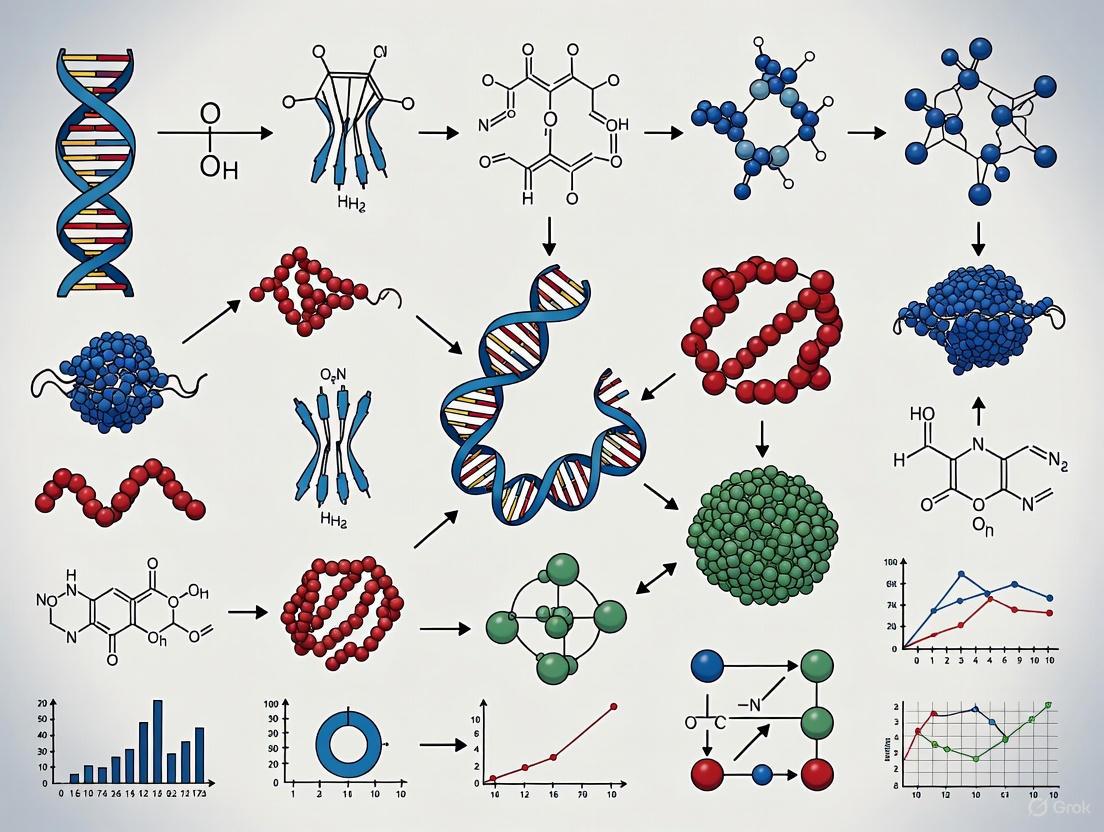
This comprehensive review explores the multifaceted realm of nucleic acid interactions with proteins and small molecules, a field central to molecular biology and drug discovery.
Nucleic Acid Interactions: From Molecular Mechanisms to Precision Diagnostics and Therapeutics
Abstract
This comprehensive review explores the multifaceted realm of nucleic acid interactions with proteins and small molecules, a field central to molecular biology and drug discovery. We first establish the foundational principles, detailing the structural and energetic basis of these interactions, from hydrogen bonding to base stacking. The article then surveys cutting-edge methodological advances, including the development of nucleic acid-protein hybrid nanostructures for biosensing and revolutionary deep learning tools like RoseTTAFoldNA for complex structure prediction. Practical guidance is provided for troubleshooting common experimental and computational challenges. Finally, we present a rigorous framework for validating these interactions, highlighting critical databases and comparative analysis techniques. This resource is tailored for researchers and drug development professionals, bridging fundamental science with clinical and industrial applications in precision medicine.
The Molecular Language of Life: Decoding Fundamental Nucleic Acid Interaction Mechanisms
The Structural and Energetic Basis of Protein-Nucleic Acid Recognition
Protein-nucleic acid interactions are fundamental to cellular life, governing processes including transcriptional regulation, DNA replication and repair, and RNA processing and translation. Understanding the precise molecular mechanisms that underpin these interactions—how proteins recognize specific DNA or RNA sequences among a vast excess of non-target nucleic acids—remains a central challenge in molecular biology. This in-depth technical guide synthesizes current research to detail the structural features and energetic principles that determine specificity in protein-nucleic acid recognition. The discussion is framed within a broader thesis on nucleic acid interactions, providing researchers, scientists, and drug development professionals with a detailed analysis of the field's current state, including both established paradigms and cutting-edge computational advances. We summarize quantitative data on binding affinities and method performance, provide detailed experimental and computational protocols, and visualize key concepts to create a comprehensive resource for the scientific community.
Structural Determinants of Recognition
The recognition of nucleic acids by proteins is achieved through a combination of direct readout and indirect readout mechanisms [1]. Direct readout involves specific molecular contacts—hydrogen bonds, electrostatic interactions, and van der Waals forces—between amino acid side chains and the edges of nucleic acid bases in the major and minor grooves [1] [2]. Indirect readout involves the recognition of sequence-dependent DNA or RNA conformation and deformability, where the energetic cost required to deform the nucleic acid to the protein-bound conformation contributes to binding specificity [1].
The zinc finger protein Zif268 provides a classic model system for studying these principles. Structural analyses have revealed that residues at four key positions (-1, 2, 3, and 6, relative to the start of the α-helix) within each finger make most contacts with the DNA [3]. Phage display experiments with variants randomized at these positions have identified mutants that bind novel DNA sequences, yet high-resolution crystal structures show these complexes maintain remarkable structural similarity, suggesting subtle dynamic and energetic modulations dictate specificity rather than large conformational changes [3].
Molecular dynamics (MD) simulations of different Zif268-DNA complexes reveal that even in the absence of major structural rearrangements, the energy landscape for DNA binding is populated by dynamically different states [3]. Analysis of these simulations shows a clear anti-correlation between protein flexibility and dissociation constant (K~d~); more flexible Zif268 variants exhibit lower K~d~ values (higher affinity), suggesting that conformational adaptability favors the selection of specific DNA sequences from a large pool of possibilities [3].
Energetic Evaluation of Interactions
Quantitative evaluation of protein-nucleic acid binding energetics is essential for predicting affinity and specificity. Several computational approaches have been developed, which can be broadly categorized into molecular mechanics and knowledge-based potentials.
Knowledge-Based Potentials
Knowledge-based potentials derive interaction energies from the statistical analysis of atom-atom or residue-nucleotide contact frequencies in experimentally solved structures [1] [2]. Different derivation methods include the quasichemical approximation, the DFIRE potential, and the μ potential [1]. A key advance has been the development of potentials that consider multi-body interactions and the local environment. For instance, one effective potential evaluates interactions between protein residues and DNA tri-nucleotides, explicitly accounting for distance-dependent two-body, three-body, and four-body interactions [2]. This approach successfully predicted binding affinities for zinc finger protein-DNA complexes with a correlation coefficient of 0.950 to experimental data and identified native transcription factor binding motifs with high accuracy (79.4% success) in a benchmark test [2].
Table 1: Comparison of Knowledge-Based Potential Derivation Methods
| Potential Type | Reference State | Molecular Representation | Key Features |
|---|---|---|---|
| Quasichemical [1] | Random shuffling of atoms | Protein and DNA heavy atoms | Simple; assumes zero-energy when contacts match random expectation |
| DFIRE [1] | Sufficiently distant atoms have no interaction | Protein and DNA heavy atoms | Normalizes contact counts by bin volume; accounts for finite-size effect |
| μ Potential [1] | Mean energy is zero for each distance bin | Protein and DNA heavy atoms | Generalization of topological Gō potential |
| Residue-Triplet [2] | Uniform density | Protein residues & DNA tri-nucleotides | Captures DNA deformation & local environment; multi-body interactions |
MD Simulations and Dynamics Analysis
MD simulations provide a dynamic view of interactions. A standard protocol for analyzing protein-nucleic acid complexes involves:
- System Preparation: Starting from an experimental structure (e.g., PDB entry), the complex is solvated in an explicit water box (e.g., TIP3P water model) with added ions to neutralize the system and achieve physiological salt concentration [3].
- Simulation Run: Multiple independent simulation replicates (e.g., 3x per complex) are performed using a molecular dynamics package (e.g., GROMACS, AMBER) with an appropriate force field (e.g., AMBER99). Each simulation typically runs for tens of nanoseconds (e.g., 60 ns per replicate) at constant temperature and pressure [3].
- Trajectory Analysis:
- Root Mean Square Deviation (RMSD): Monitors structural stability relative to the initial crystal structure [3].
- Root Mean Square Fluctuation (RMSF): Measures per-residue flexibility. The sum of RMSF values can serve as a global flexibility parameter [3].
- Essential Dynamics (ED): Identifies collective motions by projecting the trajectory onto the principal eigenvectors of the covariance matrix of residue displacements [3].
- Energetic Network Analysis: Maps residue-residue energetic couplings and how they change in response to sequence variations [3].
- Conformational Entropy Estimation: Calculated using approximations such as the Schlitter method [3].
Table 2: Key Parameters from MD Analysis of Zif268-DNA Complexes [3]
| Complex (PDB ID) | Protein Variant | Target DNA Sequence | Experimental K~d~ (nM) | Calculated Global Flexibility (∑RMSF, nm) | Calculated Protein Conformational Entropy (J/mol·K) |
|---|---|---|---|---|---|
| 1A1F | DSNR | 5'-GCGTGGGCG-3' | 2.5 | ~3.6 | ~5600 |
| 1A1G | DSNR | 5'-GCGTCGGCG-3' | 25 | ~3.2 | ~5200 |
| 1A1I | RADR | 5'-TCGAGTACT-3' | 3.5 | ~4.0 | ~5800 |
| 1A1J | RADR | 5'-TCGTGTACT-3' | 4.5 | ~3.8 | ~5700 |
| 1A1K | RADR | 5'-TCGAGGACT-3' | 40 | ~3.5 | ~5400 |
The data in Table 2 illustrates the correlation between higher protein flexibility, higher conformational entropy, and lower K~d~ (higher affinity) within protein variant families [3].
Advanced Computational Prediction Methods
Recent breakthroughs in machine learning have dramatically improved our ability to predict protein-nucleic acid complex structures from sequence alone.
RoseTTAFoldNA
RoseTTAFoldNA is an end-to-end deep learning network that generalizes the three-track (1D-sequence, 2D-distance, 3D-coordinate) architecture of RoseTTAFold to model nucleic acids and their protein complexes [4].
- Input Representation: The 1D track was expanded from 22 protein tokens to 32 tokens, adding representations for the four DNA nucleotides, four RNA nucleotides, and unknown DNA/RNA. The 2D track models interactions between all pairs of amino acids and nucleotides. The 3D track represents each nucleotide with a coordinate frame (P, OP1, OP2 atoms) and 10 torsion angles [4].
- Training Data: The network was trained on a mixed set of protein monomers, protein complexes, RNA monomers, RNA dimers, protein-RNA, and protein-DNA complexes from the PDB, with a 60:40 ratio of protein-only to nucleic-acid-containing structures. Physical information (Lennard-Jones and hydrogen-bonding energies) was incorporated into the loss function during fine-tuning [4].
- Performance: On a benchmark set of monomeric protein-nucleic acid complexes, RoseTTAFoldNA achieved an average lDDT (local Distance Difference Test) of 0.73. Notably, for predictions made with high confidence (interface pAE < 10), 81% had acceptable or better interfaces by CAPRI criteria. This performance extends to complexes with no detectable sequence similarity to training examples [4].
PaRPI for RNA-Protein Interactions
For predicting RNA-binding protein (RBP) interactions, the PaRPI (RBP-aware interaction prediction) model represents a significant advance. It uses a bidirectional selection model, integrating that the RBP selects RNA and the RNA reciprocally selects the RBP [5].
- Architecture: PaRPI uses ESM-2 to generate protein sequence representations and a BERT model on k-mer encoded RNA sequences combined with graph neural networks (GNNs) that incorporate RNA secondary structure features (e.g., from icSHAPE and RNAplfold) [5].
- Training and Performance: Trained on ensemble cell line-specific datasets from K562, HepG2, HEK293, and others, PaRPI outperformed state-of-the-art methods on 209 out of 261 RBP datasets, demonstrating robust generalization and the ability to predict interactions for novel RBPs and RNAs [5].
Experimental Techniques for Studying Interactions
FRET-FLIM for Visualizing Protein-RNA Interactions in situ
Fluorescence Resonance Energy Transfer combined with Fluorescence Lifetime Imaging Microscopy (FRET-FLIM) allows direct detection and spatial mapping of protein-RNA interactions inside living cells [6].
- Protocol:
- Labeling: The RNA-binding protein (e.g., PTB, Raver1) is tagged with a yellow fluorescent protein (YFP/Venus) as the FRET donor.
- Staining: Cellular RNA is stained with SytoxOrange, a nucleic acid dye that acts as the FRET acceptor.
- Microscopy & Measurement: The fluorescence lifetime of the donor (YFP) is measured by FLIM. A decrease in the donor's fluorescence lifetime indicates FRET occurrence and thus proximity (<10 nm) between the protein and RNA.
- Specificity Controls: Treatments with RNase A and DNase I are used to confirm that the FRET signal originates from protein-RNA interactions. RNase treatment should abolish the lifetime decrease, while DNase treatment should not [6].
Table 3: The Scientist's Toolkit: Key Research Reagents and Methods
| Reagent / Method | Function in Protein-Nucleic Acid Research |
|---|---|
| Explicit Solvent MD Simulations [3] | Models atomistic dynamics and energetics of complexes in physiological conditions. |
| Knowledge-Based Potentials [1] [2] | Scoring functions derived from structural databases to predict binding affinity and specificity. |
| FRET-FLIM [6] | Visualizes and quantifies protein-RNA interactions in living cells. |
| RoseTTAFoldNA [4] | End-to-end deep learning method for predicting 3D structures of protein-DNA/RNA complexes. |
| PaRPI [5] | Deep learning model for predicting RNA-protein binding sites bidirectionally. |
| Zinc Finger Phage Display [3] | Discovers protein variants with altered DNA-binding specificities. |
| CLIP-seq / eCLIP [5] | High-throughput mapping of in vivo RBP binding sites on RNA. |
| RNase & DNase Treatment [6] | Control experiments to determine nucleic acid type involved in an interaction. |
Workflow for Structure Prediction and Evaluation
The following diagram illustrates a generalized workflow for applying tools like RoseTTAFoldNA to predict and evaluate a protein-nucleic acid complex, integrating computational and experimental validation.
Figure 1: Workflow for Predicting and Evaluating Complex Structures
The structural and energetic basis of protein-nucleic acid recognition is a rapidly advancing field moving from a static, contact-centric view to a dynamic and integrated understanding. Key principles include the interplay between direct readout via specific atomic contacts and indirect readout via sequence-dependent deformability, coupled with the role of internal protein dynamics and conformational ensembles in facilitating specificity. The emergence of sophisticated deep learning models like RoseTTAFoldNA for structure prediction and PaRPI for interaction site mapping, validated by experimental biophysics and cell biology techniques, provides researchers with an powerful toolkit. These advances pave the way for the rational design of novel nucleic acid-binding proteins and therapeutics that target specific genomic loci or RNA sequences, holding significant promise for drug development and synthetic biology applications.
While the Watson-Crick model of hydrogen-bonded base pairs forms the cornerstone of molecular biology, the complete understanding of nucleic acid interactions requires equal consideration of base stacking and other non-covalent forces. This whitepaper examines how coaxial base stacking between adjacent nucleotides and diverse non-covalent interactions collectively govern nucleic acid structure, stability, and function. Through quantitative analysis of individual base stacking energies and examination of protein-nucleic acid recognition mechanisms, we provide researchers and drug development professionals with foundational insights and methodologies critical for advancing biomolecular engineering, therapeutic development, and structural biology research. The integration of these fundamental forces enables the sophisticated functionality of nucleic acids in both biological systems and biotechnology applications.
The canonical Watson-Crick base pairing model, while fundamental to understanding DNA double helix formation, represents only one component of the complex interplay of forces that determine nucleic acid structure and function. Base stacking interactions, characterized by the coaxial arrangement of aromatic nucleobases, and various non-covalent forces including electrostatic interactions, hydrogen bonding, and van der Waals forces, collectively confer stability, specificity, and functional versatility to nucleic acids [7] [8]. These interactions play critical roles in diverse biological processes ranging from DNA replication and repair to gene regulation and chromatin organization [9] [10].
For researchers and drug development professionals, understanding these forces provides essential insights for designing targeted therapeutics, developing molecular diagnostics, and engineering nucleic acid-based nanomaterials. This technical guide examines the quantitative energetics of base stacking, explores the multifaceted nature of non-covalent interactions in nucleic acid systems, and presents experimental methodologies for investigating these fundamental forces within the broader context of nucleic acid interactions with proteins and small molecules.
Quantitative Analysis of Base Stacking Interactions
Fundamental Principles of Base Stacking
Base stacking refers to the energetically favorable arrangement of adjacent nucleobases in nucleic acids, primarily stabilized by dispersion forces and modulated by electrostatic components that influence optimal base orientation [7]. Unlike Watson-Crick base pairing, which involves specific hydrogen-bonding patterns between complementary bases, stacking interactions occur between adjacent bases in the same nucleic acid strand and between stacked base pairs in double-stranded DNA. The aromatic character of nucleobases enables π-orbital overlap, while permanent dipole moments and polarizability contribute to the overall stacking energetics [7] [11].
The interior of canonical double-stranded DNA is composed primarily of these hydrophobic, aromatic nucleobases forming stacked arrays, with the charged phosphate backbone positioned externally to participate in solvation and molecular interactions [11]. This arrangement creates a core of stacking interactions that significantly contributes to duplex stability and provides a pathway for charge transfer through the π-electron system [9].
Experimental Quantification of Individual Base Stacking Energies
Recent advances in single-molecule technologies have enabled precise measurement of individual base stacking energies, moving beyond earlier approaches that could only measure paired stacking interactions. Using Centrifuge Force Microscopy (CFM), researchers have quantified the stacking energies between individual base combinations under physiological conditions [8].
The following table presents experimentally determined individual base stacking energies measured through high-throughput single-molecule experiments:
Table 1: Experimentally determined individual base stacking energies
| Base Combination | Stacking Energy (kcal/mol) |
|---|---|
| G|A | -2.3 ± 0.2 |
| G|G | -2.0 ± 0.1 |
| A|A | -1.7 ± 0.1 |
| A|C | -1.5 ± 0.1 |
| G|T | -1.4 ± 0.1 |
| G|C | -1.3 ± 0.1 |
| A|T | -1.2 ± 0.1 |
| T|T | -0.8 ± 0.1 |
| C|C | -0.7 ± 0.1 |
| C|T | -0.5 ± 0.1 |
Key findings from these quantitative measurements include:
- Purine-purine stacking (G|A, G|G, A|A) demonstrates the greatest stability, consistent with their larger aromatic surface areas
- Pyrimidine-pyrimidine stacking (C|T, C|C, T|T) shows the weakest interactions
- Hybrid stacking energies fall between these extremes, with purine-pyrimidine combinations exhibiting intermediate stability
- Modifications including phosphorylation, methylation, and RNA nucleotides had negligible effects on stacking energies, while bulky fluorophore modifications significantly reduced stacking interactions [8]
These quantitative energy measurements provide researchers with essential parameters for predicting nucleic acid stability, designing DNA nanostructures, and understanding the biophysical basis of nucleic acid function.
Non-Covalent Forces in Nucleic Acid Interactions
Diversity of Non-Covalent Interaction Mechanisms
Beyond base stacking, nucleic acids participate in a complex array of non-covalent interactions that mediate their biological functions and molecular recognition. The primary non-covalent interaction mechanisms include:
Table 2: Non-covalent forces in nucleic acid interactions
| Interaction Type | Strength Range | Biological Role | Molecular Basis |
|---|---|---|---|
| Electrostatic | Highly variable | Non-specific protein-DNA binding; Counterion condensation | Attraction between negatively charged phosphate backbone and positively charged ions/protein residues |
| Hydrogen Bonding | 1-5 kcal/mol | Specific sequence recognition; Base pairing | Directional interactions between hydrogen bond donors and acceptors |
| van der Waals | 0.5-1 kcal/mol | Shape complementarity; Interface packing | Transient dipole-induced dipole interactions |
| Hydrophobic | Variable | Base stacking; Interface formation | Entropically driven exclusion from aqueous environment |
| π-Interactions | 0.5-2 kcal/mol | Protein-aromatic residue binding; Small molecule intercalation | Cation-π, π-π, and polar-π interactions |
Protein-Nucleic Acid Interactions
Protein-DNA interactions represent a biologically critical manifestation of these non-covalent forces, playing vital roles in gene regulation, DNA replication, repair, and chromosomal organization [9] [10]. The binding forces between proteins and DNA incorporate both electrostatic components (primarily between positively charged protein residues and the negatively charged DNA backbone) and sequence-specific contributions derived from van der Waals contacts, hydrogen bonding, and steric complementarity [10].
Recent research has identified an additional statistical interaction potential between proteins and DNA molecules, where DNA sequences with repeated homogeneous segments (e.g., poly-dA:dT or poly-dC:dG tracts) exhibit stronger protein binding affinity compared to more heterogeneous sequences due to entropic effects [10]. This statistical potential provides an attractive force of approximately 2-3 kcal/mol per protein, significantly influencing genomic binding distributions.
The recognition of consensus sequences by proteins depends substantially on the entanglement of π-electrons between DNA nucleotides and protein amino acids, creating an electronic dimension to the interaction landscape [9]. Furthermore, proteins can induce mechanical deformations in DNA through twisting, stretching, and bending, which in turn influences subsequent protein binding and function—a dynamic interplay crucial for cellular processes [9].
Figure 1: Diversity of forces governing protein-DNA interactions and their biological consequences
Experimental Methodologies
Single-Molecule Techniques for Measuring Base Stacking
The Centrifuge Force Microscope (CFM) has emerged as a powerful high-throughput technique for quantifying individual base stacking energies at the single-molecule level [8]. This approach combines centrifugation and microscopy to enable parallel force-clamp experiments on thousands of individual molecular tethers.
Experimental Protocol: CFM Base Stacking Measurement
DNA Construct Design: Engineered DNA constructs containing identical short central duplexes (8 bp) with varying terminal base stacking interactions
Sample Preparation:
- Self-assembly of 7249 nt M13 genomic ssDNA with complementary tiling oligonucleotides
- Formation of double-stranded DNA with terminal double-biotin for surface coupling
- Incorporation of programmable overhanging ends comprising half of the central duplex
Surface Functionalization:
- Attachment of one DNA construct to cover glass via biotin-streptavidin interaction
- Attachment of pairing DNA construct to microspheres (1-3 μm diameter) similarly functionalized
Measurement Procedure:
- Microspheres brought into contact with cover glass within reaction chamber to allow tether formation
- Application of controlled force (5-20 pN) via centrifugation
- Video microscopy imaging at 1 frame per second during centrifugation
- Tracking of individual tether dissociation events
Data Analysis:
- Single-exponential fitting to dissociation curves to determine off-rates
- Application of Bell-Evans model to extract force-free energy differences
- Statistical analysis from thousands of single-molecule events
Figure 2: CFM workflow for base stacking energy quantification
Biophysical Methods for Studying Non-Covalent Interactions
Various biophysical techniques provide complementary approaches for investigating non-covalent nucleic acid interactions:
UV-Visible Spectroscopy: Monitoring changes in absorption spectra upon small molecule-DNA binding provides information on complex formation and stability [12].
Fluorescence Spectroscopy: Emission quenching or enhancement upon binding allows determination of binding constants and modes [12].
Circular Dichroism (CD) Spectroscopy: Conformational changes in DNA structure upon ligand binding can be detected through alterations in CD spectra [12].
Isothermal Titration Calorimetry (ITC): Direct measurement of binding thermodynamics provides enthalpy and entropy contributions to complex formation [12].
Viscosity Measurements: Hydrodynamic changes in DNA solutions help distinguish between intercalative and groove-binding modes [12].
The Scientist's Toolkit: Essential Research Reagents and Materials
Table 3: Essential research reagents for studying base stacking and non-covalent forces
| Reagent/Material | Function/Application | Example Use Cases |
|---|---|---|
| M13 Genomic ssDNA | Scaffold for DNA construct assembly | CFM experiments measuring base stacking energies [8] |
| Biotinylated Oligonucleotides | Surface immobilization of DNA constructs | Single-molecule tethering for force measurements [8] |
| Streptavidin-Coated Surfaces | Attachment platform for biotinylated DNA | Functionalization of cover glasses and microspheres [8] |
| Fluorescent Nucleotide Analogs | Probing local environment and interactions | Stacking energy measurements with modified bases [8] |
| Intercalating Dyes | Detection of double-stranded DNA | Ethidium bromide, SYBR Green for binding studies [12] |
| Groove-Binding Molecules | Specific recognition of DNA grooves | Netropsin, DAPI for binding mode studies [12] |
Implications for Drug Discovery and Biotechnology
The quantitative understanding of base stacking and non-covalent forces enables strategic advances in pharmaceutical development and biotechnology:
Rational Drug Design: Knowledge of individual base stacking energies informs the development of small molecules that target specific nucleic acid sequences through intercalation or groove binding, with applications in anticancer and antimicrobial therapies [8]. The ability to predict how modifications affect stacking interactions facilitates optimization of drug-DNA binding specificity and affinity.
DNA Nanotechnology: Base stacking interactions critically influence the stability and assembly of DNA nanostructures, including DNA polyhedra, crystals, and liquid crystals [8]. Designs relying on blunt-end stacking interactions benefit directly from quantitative energy parameters for individual base combinations.
Therapeutic Development: Small molecules targeting DNA or RNA rely on stacking interactions to disrupt disease processes including cancers, viral infections, and neurological disorders [8]. Understanding these interactions enables more effective targeting of G-quadruplexes in telomeres and other functionally significant nucleic acid structures.
Biosensor Design: Nucleic acids serve as versatile biomolecules in electrochemical biosensors for protein detection [9]. Optimizing base stacking in probe design enhances sensor stability and specificity.
Base stacking and non-covalent forces represent fundamental determinants of nucleic acid structure and function that extend far beyond the Watson-Crick paradigm. The quantitative experimental data now available for individual base stacking energies provides researchers with essential parameters for predictive modeling and design. The integration of these forces with hydrogen bonding and electrostatic interactions creates a sophisticated recognition system that governs protein-DNA interactions, chromatin organization, and gene regulatory mechanisms.
For drug development professionals, these insights enable more targeted approaches to therapeutic intervention in DNA- and RNA-mediated processes. For researchers in biotechnology, understanding these forces facilitates the engineering of nucleic acid nanostructures with precisely controlled stability and assembly properties. As single-molecule methodologies continue to advance and computational models incorporate these quantitative parameters, our ability to manipulate nucleic acids for research and therapeutic applications will continue to grow exponentially.
The continuing investigation of base stacking and non-covalent forces promises to reveal new dimensions of nucleic acid interactions, further expanding our understanding of biological information processing and opening new frontiers in biomolecular engineering.
Interactions between proteins and nucleic acids (NAs) are fundamental to countless biological processes, including genome replication, gene expression regulation, transcription, splicing, and protein translation [13]. These interactions form a complex "interactome" that is crucial for cellular function, and its dysregulation is implicated in numerous diseases, such as cancer, cardiovascular, and neurodegenerative disorders [13]. Understanding the landscape of the nucleic acid interactome—encompassing both sequence-specific recognition and non-specific binding—is therefore a central goal in fundamental biology and therapeutic development [13]. This whitepaper provides an in-depth analysis of the current state of research, focusing on the computational and experimental methodologies driving the field forward, the challenges posed by the unique properties of nucleic acids, and the emerging tools available to researchers.
The Computational Prediction Challenge
The prediction of protein-NA complex structures represents one of the major unresolved challenges in structural biology [13]. This knowledge gap stems from a critical shortfall in experimental data; the number of protein-NA complex structures in the PDB is dramatically smaller than that of proteins alone, and the available complexes lack diversity [13]. For instance, the approximately 6,500 experimentally resolved protein-RNA complexes encompass only a few short, highly folded RNA families like tRNAs and riboswitches [13].
Deep learning methods that revolutionized protein structure prediction, such as AlphaFold (AF) and RoseTTAFold, have been extended to model nucleic acids. Table 1 summarizes the key deep learning approaches for predicting protein-NA complexes. However, as evidenced by the recent CASP16 assessment, these generalized models have not yet met expectations, often failing to outperform traditional approaches that incorporate human expertise and template-based modeling [13]. AlphaFold3 (AF3), for example, reportedly achieves a success rate of only 38% for a test set of 25 protein-RNA complexes with low homology to known templates [13].
Table 1: Deep Learning Approaches for Protein-NA Complex Prediction
| Method | Architecture | Reported Performance | Key Strengths | Key Limitations |
|---|---|---|---|---|
| AlphaFold3 (AF3) [13] | MSA-conditioned diffusion with transformer | 38% success on low-homology protein-RNA test set; Avg. TM-score 0.381 [13] | Broad molecular context (proteins, NA, ligands) | Template memorization; modest accuracy beyond training set |
| RoseTTAFoldNA (RFNA) [13] | 3-track network (sequence, geometry, coordinates) with SE(3)-transformer | Outperformed by AF3 on protein-RNA benchmarks [13] | Extended to broad molecular context | Poor modeling of local base-pair networks |
| HelixFold3 [13] | Adapted from AlphaFold3 | Used in top-performing CASP methods [13] | Broad molecular context | Does not outperform AlphaFold3 |
| Boltz Series [13] | Adapted from AlphaFold3 | Benchmarked on standard datasets [13] | Broad context; developments for affinity prediction | Does not outperform AlphaFold3 |
The limited success of these methods can be attributed to fundamental biophysical differences between proteins and nucleic acids. Key challenges include [13]:
- Hierarchical Structure: NA structure is more hierarchically organized, with base composition determining secondary structure, which in turn constrains the 3D fold.
- Electrostatic Backbone: The highly negatively charged phosphate backbone, coupled with base-stacking interactions, drives folding and stability in an ion-dependent manner.
- Conformational Flexibility: The NA backbone has 6 rotatable bonds per nucleotide (vs. 2 per amino acid), leading to a vast conformational space and inherent flexibility, especially in single-stranded regions. This makes modeling complexes involving ssRNA-binding motifs or aptamers particularly difficult [13].
Methodologies for Interactome Analysis and DBP Design
Evaluation of Molecular Interactomes
Systems biology approaches rely on large-scale molecular networks, or "interactomes," to understand biological systems. A recent evaluation of 45 human interactomes revealed that large composite networks like HumanNet, STRING, and FunCoup are most effective for identifying disease genes, while smaller, curated networks like DIP, Reactome, and SIGNOR perform better for interaction prediction [14]. However, significant gaps and biases persist in interactome coverage. There is a strong skew toward highly studied, highly expressed, and highly conserved genes, while non-coding RNAs, pseudogenes, and tissue-specific genes are substantially underrepresented [14]. This bias will inevitably be reflected in any analysis performed using these networks.
Computational Design of Sequence-Specific DNA-Binding Proteins
A landmark advance in the field is the development of a computational pipeline for the de novo design of sequence-specific DNA-binding proteins (DBPs). This method overcomes the limitations of reprogramming natural DBPs and creates small, compact proteins that can recognize arbitrary target sequences [15]. The design strategy, which employs a rigid body docking approach called RIFdock, is outlined in the workflow below.
The key innovations of this pipeline address three core challenges in DBP design [15]:
- Precise Scaffold Positioning: Using a library of small helix-turn-helix (HTH) scaffolds derived from metagenomic data and AF2 predictions, the method seeks docks that form main-chain hydrogen bonds with DNA phosphate oxygens to achieve precise placement.
- Specific Base Recognition: Sequence design is performed using Rosetta or LigandMPNN, with an emphasis on forming bidentate hydrogen-bonding arrangements between side chains and DNA bases, which are frequent in native complexes.
- Side-Chain Preorganization: To ensure precise geometric placement, designs are selected for high preorganization of interface side chains, achieved through side chain-side chain hydrogen bonding and assessed using the Rosetta RotamerBoltzmann calculation.
This methodology has successfully generated DBPs for five distinct DNA targets with nanomolar affinity, closely matching the computational models' specificity. A crystal structure of a designed DBP–target site complex confirmed its close agreement with the design model, and the designed DBPs functioned in both E. coli and mammalian cells to regulate transcription [15].
Experimental Protocols for DBP Validation
The following protocol details the key experimental steps for validating computationally designed DBPs.
Protocol: Yeast Display and Cell Sorting for DBP Screening [15]
Objective: To screen and select designed DBPs for binding to a specific target DNA sequence.
Materials:
- Yeast strain: EBY100 S. cerevisiae.
- Induction Media: SG-CAA media for induction of protein expression on the yeast surface.
- Fluorescently Labeled DNA: Target and non-target dsDNA sequences labeled with biotin or another suitable tag.
- Detection Antibodies: Primary antibody against a C-terminal epitope tag (e.g., c-myc) and a fluorescently labeled secondary antibody.
- Magnetic Beads: Streptavidin-coated magnetic beads for initial enrichment.
- Flow Cytometer: For analysis and sorting of yeast cells.
Procedure:
- Library Transformation: Transform the library of designed DBP genes into the EBY100 yeast strain, ensuring the constructs are fused to a surface display protein (e.g., Aga2p) and contain a C-terminal epitope tag.
- Protein Expression: Induce protein expression by transferring yeast cells from glucose-containing media (Tryptone–Yeast extract–Glucose media) to SG-CAA induction media. Incubate for 24-48 hours at a defined temperature (e.g., 20°C) with shaking.
- Magnetic Bead Enrichment: a. Incubate induced yeast cells with biotinylated target dsDNA. b. Use streptavidin-coated magnetic beads to capture and enrich yeast cells displaying DBPs that bind the target DNA. c. Elute bound yeast cells and culture them to expand the population.
- Fluorescence-Activated Cell Sorting (FACS): a. Label the induced yeast library with two fluorescent markers: - Label 1: A primary antibody against the C-terminal epitope tag, followed by a fluorescent secondary antibody. This labels all yeast cells expressing a full-length DBP (expression signal). - Label 2: A fluorescently labeled streptavidin to detect binding of the biotinylated target DNA (binding signal). b. Use FACS to isolate a population of yeast cells that are double-positive for both expression and binding signals. This selects for cells displaying DBPs that are both well-expressed and bind the target DNA. c. For specificity screening, repeat the FACS process using non-target (off-target) DNA sequences. Select cells that bind the target DNA but show minimal binding to the off-target DNA.
- Characterization: Israte plasmid DNA from sorted yeast populations, sequence the DBP genes, and characterize the binding affinity and specificity of purified proteins using techniques like fluorescence polarization (FP) or surface plasmon resonance (SPR).
The Scientist's Toolkit: Research Reagent Solutions
Table 2: Essential Research Reagents for Nucleic Acid Interactome Studies
| Research Reagent | Function & Application |
|---|---|
| AlphaFold3 & RoseTTAFoldNA [13] | Deep learning servers for predicting the 3D structures of protein-nucleic acid complexes. |
| LigandMPNN [15] | Deep learning-based protein sequence design tool, extended to handle protein-DNA interfaces for designing new binders. |
| RIFdock [15] | Computational docking tool for generating de novo protein scaffolds docked against target molecules, including DNA. |
| Yeast Display System (e.g., EBY100) [15] | A platform for displaying designed DBPs on the surface of yeast, enabling high-throughput screening and affinity maturation via FACS. |
| Streptavidin-Coated Magnetic Beads [15] | Used for rapid enrichment and pulldown of biotinylated nucleic acids bound by their protein partners. |
| Biotinylated dsDNA Probes [15] | Target molecules for binding assays; the biotin tag allows for detection with streptavidin-fluorophores or capture on streptavidin-coated beads. |
| Anti-c-myc Antibody [15] | A common epitope tag antibody used in conjunction with yeast display to confirm surface expression of designed proteins. |
The field of nucleic acid interactome research is at a pivotal juncture. While the challenges of predicting and designing protein-NA interactions are significant—driven by data scarcity and the unique geometric, physicochemical, and evolutionary properties of nucleic acids—innovative computational and experimental methodologies are emerging [13]. The successful de novo computational design of sequence-specific DBPs marks a paradigm shift, demonstrating that it is possible to create small, functional proteins that target specific DNA sequences with high affinity and specificity [15]. As interactome networks become more comprehensive and less biased, and as deep learning models continue to evolve, the integration of these tools will undoubtedly accelerate the discovery of biologically meaningful regulatory signals and pave the way for novel therapeutic strategies targeting the nucleic acid interactome.
Deoxyribonucleic acid (DNA) is a primary intracellular target for therapeutic interventions in diseases characterized by uncontrolled cellular division, such as cancer [16] [17]. The predictable structure of double-stranded DNA, with its major and minor grooves, provides distinct binding sites for small molecules to modulate critical processes including replication and transcription [18]. Among the most significant classes of DNA-targeting agents are groove binders, intercalators, and alkylating agents, each characterized by unique molecular interactions and functional outcomes [16]. These compounds can disrupt DNA function either temporarily through non-covalent interactions or permanently through covalent adduct formation, leading to the inhibition of cancer cell growth and eventual cell death [16] [18].
Understanding the precise mechanisms of these interactions is fundamental to rational drug design, enabling the development of novel therapeutics with enhanced efficacy and reduced side effects [19] [20]. This review provides a comprehensive technical overview of these three major classes of DNA-binding small molecules, detailing their mechanisms, structure-activity relationships, and experimental approaches for characterizing their interactions within the context of modern nucleic acid research.
Groove Binders
Minor groove binders (MGBs) are typically crescent-shaped molecules that fit into the minor groove of double-helical DNA, displacing the spine of hydration [16] [18]. These compounds are often cationic and possess aromatic rings connected by bonds with rotational freedom, allowing them to adopt a conformation that matches the curvature of the groove [16]. Their binding is stabilized through a combination of hydrogen bonding, van der Waals interactions, and electrostatic forces with the negatively charged phosphodiester backbone [16] [17].
Natural Products and Synthetic Analogs
Distamycin and netropsin are natural products that serve as prototype MGBs [16]. Distamycin contains three N-methylpyrrole rings (PyPyPy), while netropsin has two (PyPy) [16]. These molecules exhibit a strong preference for AT-rich regions in the minor groove, largely because the 2-amino group of guanine presents steric hindrance, preventing binding to GC-rich sequences [16]. The terminal amidine group, being basic, facilitates attraction to the DNA backbone [16].
Efforts to enhance sequence specificity and binding affinity have led to the development of synthetic analogs:
- Lexitropsins: Semisynthetic dimers and trimers of distamycin and netropsin designed to recognize longer DNA sequences (up to 10 base pairs or more) [16]. Some lexitropsins incorporate imidazole (Im) rings alongside pyrrole rings, which enables recognition of GC base pairs [16].
- Dervan Polyamides: These "hairpin" oligomeric molecules containing pyrrole and imidazole ring systems bind side-by-side in the minor groove with high affinity and sequence specificity [16]. They can be synthesized using solid-phase methods and represent a powerful tool for antisense/antigene therapeutics [16].
Broader Classes of MGBs
Beyond pyrrole-based systems, other structural classes exhibit groove-binding properties:
- Di-Aryl Amidine-like Derivatives: This class includes diamidines, guanidines, and isoureas [17]. Compounds such as pentamidine, furamidine, and berenil have been used clinically to treat trypanosomal infections [17]. Their DNA binding is often enthalpy-driven, involving hydrogen bonds and van der Waals interactions with the groove [17].
- s-Triazine-Isatin Hybrids: Novel synthetic hybrids have demonstrated strong DNA-binding affinity through groove-binding modes [21]. For instance, compound 7f exhibited a high binding constant (Kb = 9.51 × 10⁵ M⁻¹) and a spontaneous binding process (ΔG = -34.1 kJ mol⁻¹), as confirmed by molecular docking in AT-rich regions [21].
Table 1: Representative Minor Groove Binders and Their Properties
| Compound Name | Type | Structural Features | Sequence Preference | Primary Applications/Effects |
|---|---|---|---|---|
| Distamycin [16] | Natural Product | Three N-methylpyrrole rings | AT-rich | Lead compound for anticancer drug design |
| Netropsin [16] | Natural Product | Two N-methylpyrrole rings | AT-rich | Antiviral activity; active against Gram-positive and Gram-negative bacteria |
| Lexitropsins [16] | Synthetic Analog | Oligomers of pyrrole/imidazole | Extended sequences (>10 bp) | Molecular biology tools; antisense/antigene therapeutic potential |
| Dervan Polyamides [16] | Synthetic | Hairpin polyamides (Pyrrole/Imidazole) | High specificity, can target GC | Potential for genetic regulation and therapy |
| Pentamidine [17] | Synthetic Di-Amidine | Aromatic diamidine | AT-rich | Antiparasitic (trypanosomiasis) |
| s-Triazine-Isatin 7f [21] | Synthetic Hybrid | Triazine-isatin core with phenoxy linkers | AT-rich (predicted) | Promising anticancer agent in development |
Intercalators
Intercalators are planar, aromatic, or heteroaromatic molecules that slide between adjacent DNA base pairs, sandwiching themselves within the double helix [16]. This insertion causes structural distortions in the DNA, including elongation of the duplex by approximately 3.4 Å per bound drug molecule and unwinding of the helix [16] [22]. A primary mechanism of their cytotoxicity is the interference with topoisomerase enzymes, particularly topoisomerase II, leading to the stabilization of lethal ternary complexes (DNA-drug-enzyme) that prevent the resealing of DNA strand breaks and halt replication [16] [22].
Major Classes of Intercalators
- Acridines: Derived from the aniline dye industry, acridines such as proflavine and amsacrine have been used as antibacterial and antileukemic agents, respectively [16]. Their amino groups facilitate ionic interactions with DNA phosphates, while the planar ring system intercalates between bases [16]. The drug C-1305, a triazoloacridinone derivative, is a topoisomerase II inhibitor that also demonstrates unique microtubule-stabilizing activity [22].
- Anthracyclines: Doxorubicin (adriamycin) and daunorubicin are prominent anticancer antibiotics isolated from Streptomyces strains [16] [22]. Despite a minimal structural difference (a single hydroxyl group), they exhibit different activity profiles: daunorubicin is primarily effective against leukemias, while doxorubicin has a broader spectrum against solid tumors [16]. Their mechanism is complex, involving DNA intercalation via hydrogen bonds with GC base pairs, topoisomerase II inhibition, free radical generation, and induction of DNA strand breaks [22].
- Other Intercalating Agents: Actinomycins (e.g., dactinomycin) are polypeptide antibiotics that employ a dual mechanism: their phenoxazone ring intercalates at G·C sites, while the pentapeptide side chains bind to the minor groove, forming an exceptionally stable complex [16]. Quinoline derivatives, such as amsacrine, amonafide, and TAS-103, represent an important class of synthetic intercalators with potent antitumor activity and topoisomerase inhibitory effects [20].
Table 2: Representative DNA Intercalators and Their Properties
| Compound Name | Class | Key Structural Features | Primary Molecular Target | Therapeutic Use |
|---|---|---|---|---|
| Proflavine [16] | Acridine | Planar acridine ring with amino groups | DNA duplex | Historical use as an antibacterial |
| Amsacrine [16] [20] | Acridine | Acridine ring with anilino side chain | DNA, Topoisomerase II | Treatment of leukemia |
| Doxorubicin [16] [22] | Anthracycline | Tetracyclic aglycone with amino sugar | DNA, Topoisomerase II | Broad-spectrum anticancer agent |
| Daunorubicin [16] | Anthracycline | Similar to doxorubicin, lacks one hydroxyl | DNA, Topoisomerase II | Acute leukemias |
| Dactinomycin [16] | Polypeptide | Phenoxazone ring with peptide chains | G·C base pairs | Antitumor antibiotic |
| 2-Styrylquinoline 3h [20] | Quinoline | Stilbene-linked quinoline with carboxamide | DNA, Topoisomerase II | Potent cytotoxic agent under investigation |
Alkylating Agents
Alkylating agents are strongly electrophilic compounds that form covalent bonds with nucleophilic centers on DNA bases, creating irreversible adducts that inhibit transcription and translation [16] [22]. The most reactive sites are the N(7) of guanine and the N(3) of adenine, which are exposed in the grooves of the DNA duplex [16]. These agents can function via SN1 or SN2 mechanisms and often lead to intra-strand or inter-strand cross-links, which are particularly damaging as they prevent DNA strand separation and replication [16].
Classes of Alkylators
- Nitrogen Mustards: The prototype mechlorethamine was the first modern cancer chemotherapeutic, used for Hodgkin's disease [16]. These compounds cyclize to form reactive aziridinium ions that attack DNA bases. Substitution with aryl groups (e.g., chlorambucil) enhances stability and oral bioavailability [16].
- Platinum Complexes: Cisplatin, carboplatin, and oxaliplatin are cornerstone chemotherapeutics [16]. Upon hydrolysis, they form potent electrophiles that establish covalent Pt(II)-N bonds with guanine and adenine bases, forming intra- and inter-strand crosslinks that trigger cell death [16]. The trans isomer is therapeutically inactive, underscoring the importance of stereochemistry [16]. Newer classes, such as polynuclear platinum complexes (e.g., BBR 3464), form long-range crosslinks and have reached clinical trials [16].
- Other Alkylators: Ethyleneimines (aziridines) are pre-formed aziridines that require at least two reactive groups for antitumor activity [16]. Methanesulfonates like busulfan alkylate guanine at N(7), primarily forming intra-strand cross-links [16]. Natural product alkylators such as mitomycin C and the minor groove alkylator CC-1065 also form covalent DNA adducts [18] [17].
Table 3: Representative DNA Alkylating Agents and Their Properties
| Compound Name | Class | Mechanism of Alkylation | Type of DNA Damage | Clinical Applications |
|---|---|---|---|---|
| Mechlorethamine [16] | Nitrogen Mustard | Forms aziridinium ion | Inter-strand cross-links | Hodgkin's disease |
| Chlorambucil [16] | Nitrogen Mustard | Aryl-substituted mustard | Cross-links | Various cancers (more stable than mechlorethamine) |
| Cisplatin [16] | Platinum Complex | Covalent Pt-DNA bonds | Intra- & inter-strand cross-links | Testicular, ovarian, bladder cancers |
| Oxaliplatin [16] | Platinum Complex | Covalent Pt-DNA bonds | Intra- & inter-strand cross-links | Colorectal cancer |
| Busulfan [16] | Methanesulfonate | Alkylates guanine N7 | Intra-strand cross-links | Chronic myeloid leukemia |
| BBR 3464 [16] | Polynuclear Platinum | Trivalent platinum complex | Long-range cross-links | Phase II trials (investigational) |
Experimental Methods for Characterizing Interactions
A critical step in developing DNA-targeted drugs is the detailed characterization of their binding properties, including affinity, specificity, and kinetics [22] [23]. A wide array of biophysical techniques is employed for this purpose.
Spectroscopic Techniques
- UV-Visible Absorption Spectroscopy: This is a fundamental tool for studying drug-DNA interactions [21]. Changes in the absorption spectrum of a compound (hypochromism/hyperchromism) and shifts in the wavelength maximum (bathochromic or hypsochromic shifts) upon DNA addition indicate binding. Data can be analyzed using the Benesi-Hildebrand equation to determine the binding constant (Kb) [21].
- Fluorescence Spectroscopy: Techniques such as Fluorescence Intercalator Displacement (FID) assays are used to determine binding affinity and mode [17]. A fluorescent dye (e.g., ethidium bromide) bound to DNA is displaced by a test compound, resulting in a decrease in fluorescence [17].
- Circular Dichroism (CD): CD spectroscopy detects changes in the chiral environment of DNA upon ligand binding, providing information on conformational changes in the DNA helix [20].
Immobilized Binder Light-Based Sensors
- Bio-Layer Interferometry (BLI): BLI measures molecular interactions in real-time using a fiber-optic biosensor tip [23]. One binding partner (ligand, e.g., his-tagged protein) is immobilized on the tip, and the other (analyte) is in solution. Binding-induced changes in the interference pattern of white light are monitored to calculate association (Kon) and dissociation (Koff) rate constants, and the equilibrium dissociation constant (Kd) [23]. It requires minimal sample purification and allows for the analysis of crude mixtures [23].
- Surface Plasmon Resonance (SPR): Similar to BLI, SPR immobilizes a ligand on a sensor chip and flows an analyte over it [23]. Binding is measured in real-time as a change in the refractive index at the sensor surface. SPR is highly sensitive and can be adapted for high-throughput analysis [23].
Other Key Methods
- Viscosity Measurements: Intercalation increases the length of DNA, leading to a significant increase in the viscosity of a DNA solution. Groove binders typically cause little to no change in viscosity, helping to distinguish between binding modes [20].
- Thermal Denaturation Studies: Ligand binding often stabilizes the DNA duplex, increasing its melting temperature (Tm). The magnitude of ΔTm can provide insights into binding affinity and mode [17].
- Molecular Docking and Dynamics Simulations: Computational methods predict the binding pose and energy of a ligand within DNA grooves or intercalation sites, providing atomistic insights into interaction mechanisms [20] [21].
The following workflow diagram illustrates the decision process for selecting appropriate characterization techniques based on the research goal:
The Scientist's Toolkit: Essential Research Reagents and Materials
Table 4: Key Reagents and Materials for DNA Interaction Studies
| Reagent/Material | Typical Specification/Example | Primary Function in Experiments |
|---|---|---|
| Calf Thymus DNA (ctDNA) [20] | Highly polymerized, type I | A standard, widely available source of double-stranded DNA for binding studies. |
| Salmon Sperm DNA (SS-DNA) [21] | Highly polymerized, sodium salt | Cost-effective DNA model for initial UV-vis and fluorescence binding assays. |
| Tris-HCl Buffer [20] | 10-50 mM, pH 7.4 | Maintains physiological pH during in vitro experiments. |
| Ethidium Bromide (EtBr) [20] [17] | ~95% purity | Fluorescent intercalator dye used as a probe in FID assays and gel staining. |
| Potassium Phosphate Buffer [20] | 10 mM, pH 7.4 | Provides a well-defined ionic strength environment for spectroscopic studies. |
| BLI Biosensor Tips [23] | e.g., Ni-NTA, Streptavidin coated | Immobilize his-tagged or biotinylated ligands (DNA or protein) for kinetic analysis. |
| DMSO (anhydrous) [20] | ≥99.9% purity | Common solvent for stock solutions of hydrophobic small molecules. |
Groove binders, intercalators, and alkylating agents represent three foundational pillars of DNA-targeted small molecule interventions. Each class employs a distinct molecular strategy to disrupt DNA function, ranging from reversible, shape-fitting recognition to irreversible covalent modification. The continued evolution of these agents—from natural products like distamycin and doxorubicin to rationally designed polyamides and polynuclear platinum complexes—highlights the dynamic interplay between understanding nucleic acid biochemistry and advancing therapeutic design. Robust experimental methodologies, from classic spectroscopic techniques to advanced label-free biosensors, are indispensable for deciphering the nuances of these interactions. As research progresses, the integration of these mechanistic insights with emerging therapeutic modalities, such as the combination of alkylating agents with antimicrobial peptides, promises to yield the next generation of more precise and effective anticancer and antimicrobial drugs [22] [24].
The vertebrate innate immune system employs a sophisticated strategy to detect infections by recognizing foreign nucleic acids, a fundamental class of pathogen-associated molecular patterns (PAMPs). This defense mechanism is predicated on the ability of host cells to distinguish between "self" and "non-self" RNA or DNA, a conserved and crucial function for antiviral defense [25]. The presence of nucleic acids in abnormal cellular compartments or possessing unusual structural features is a hallmark of microbial infection, triggering a potent immune response [25] [26]. Cells express an array of sentinel proteins known as pattern recognition receptors (PRRs), which are specialized in binding to foreign RNA or DNA and activating the host immune response [25]. The strategic importance of this system lies in its role as the dominant antiviral defense pathway in vertebrates, initiating responses that include the production of type I interferons (IFN), the expression of antiviral effector proteins, and in some cases, the induction of programmed cell death to limit viral spread [26].
This whitepaper examines the core mechanisms of foreign nucleic acid recognition, detailing the major classes of sensors, their signaling pathways, and the experimental approaches driving discovery in this field. Furthermore, it explores the dynamic "arms race" between host immune strategies and viral evasion tactics, highlighting the therapeutic implications of this critical interaction.
Core Sensing Mechanisms and Signaling Pathways
The host employs a multi-compartmental sensing system, utilizing different PRR families localized in various cellular compartments to maximize the detection of invading pathogens.
Table 1: Major Classes of Nucleic Acid Sensors and Their Characteristics
| Sensor Class | Prototypical Members | Ligands (PAMPs) | Subcellular Localization | Adaptor Protein | Key Signaling Effectors |
|---|---|---|---|---|---|
| RLRs (RIG-I-like Receptors) | RIG-I, MDA5 [25] [27] | Short dsRNA with 5' triphosphate (RIG-I), long dsRNA (MDA5) [25] [28] | Cytosolic | MAVS [25] [28] | TBK1, IRF3, NF-κB |
| * cytosolic DNA Sensors* | cGAS [25] [28] | Cytosolic dsDNA [25] [28] | Cytosolic | STING [28] | TBK1, IRF3 |
| Endosomal TLRs (Toll-like Receptors) | TLR3, TLR7/8, TLR9 [29] | dsRNA (TLR3), ssRNA (TLR7/8), CpG DNA (TLR9) [29] | Endosomal membrane | TRIF (TLR3), MyD88 (TLR7/8/9) [29] | IRF3/7, NF-κB |
| Other Cytosolic Sensors | SAMD9 [28], ZBP1 [25], PKR [25] | dsDNA & dsRNA (SAMD9) [28], Z-form NA (ZBP1) [25], dsRNA (PKR) [25] | Cytosolic | MAVS (SAMD9) [28] | TBK1, IRF3, eIF2α (PKR) |
Key Cytosolic RNA Sensors
The RIG-I-like receptor (RLR) family is central to cytosolic antiviral immunity. RIG-I is activated by short double-stranded RNA (dsRNA) or single-stranded RNA bearing a 5'-triphosphate, a molecular pattern absent from mature host cytoplasmic RNAs [25] [26]. MDA5, in contrast, senses long dsRNA structures [28]. Upon ligand binding, both receptors undergo a conformational change and oligomerize, recruiting the common adaptor protein MAVS (Mitochondrial Antiviral-Signaling protein) on the mitochondrial membrane [25] [27]. This nucleates the formation of a large signaling complex that activates the kinases TBK1 and IKKε, which in turn phosphorylate the transcription factors IRF3 and IRF7. Simultaneously, the NF-κB pathway is activated. These factors translocate to the nucleus to drive the expression of type I and III interferons and pro-inflammatory cytokines [25].
Key Cytosolic DNA Sensors
The cyclic GMP-AMP synthase (cGAS) is a primary sensor for cytosolic double-stranded DNA (dsDNA) [25] [28]. Upon binding DNA, cGAS undergoes a conformational shift and catalyzes the synthesis of the second messenger 2'3'-cGAMP. This molecule binds to and activates the endoplasmic reticulum-resident adaptor protein STING (Stimulator of Interferon Genes) [28]. Activated STING traffics from the ER and serves as a platform for TBK1 activation, leading to IRF3 phosphorylation and the induction of interferon-stimulated genes (ISGs) [28]. Recent research has identified SAMD9 as a sensor capable of binding both cytosolic dsDNA and dsRNA, initiating IFN signaling through the MAVS-TBK1-IRF3 axis, representing a versatile and broad-spectrum antiviral sensing mechanism [28].
Endosomal Nucleic Acid Sensors
Toll-like receptors (TLRs) 3, 7, 8, and 9 are localized within endosomal membranes, where they survey the content of internalized vesicles. TLR3 recognizes dsRNA, while TLR7 and TLR8 sense single-stranded RNA (ssRNA); TLR9 is activated by unmethylated CpG DNA [29]. Their localization prevents aberrant activation by self-nucleic acids, which are largely confined to the nucleus and cytoplasm. TLR3 signals via the adaptor TRIF, whereas TLR7, TLR8, and TLR9 use MyD88, ultimately leading to the activation of NF-κB and IRF transcription factors to induce inflammatory cytokines and type I IFN, respectively [29].
Discriminating Self from Non-Self
A critical challenge for the immune system is to robustly detect pathogen-derived nucleic acids while ignoring abundant self-nucleic acids. This discrimination is achieved through a multi-layered, fail-safe system [26]:
- Compartmentalization: The sequestration of PRRs in specific compartments is a fundamental strategy. Cytosolic DNA is a potent PAMP, whereas nuclear and mitochondrial DNA is immunologically inert under normal conditions [25]. Similarly, endosomal TLRs primarily encounter internalized foreign nucleic acids, not self-nucleic acids confined to the nucleus and cytosol [29].
- Structural and Chemical Features: The immune system exploits biochemical differences. Many viral RNAs retain a 5'-triphosphate, which is removed or modified in host mRNAs [25]. Certain DNA structures, like Z-form DNA, are recognized as immunogenic [25].
- Nucleic Acid Modifications: Host nucleic acids carry distinct chemical modifications that serve as "self" markers. For instance, adenosine-to-inosine (A-to-I) editing by ADAR1 disrupts RNA duplexes, limiting their recognition by dsRNA sensors like MDA5 and PKR [25]. The addition of N6-methyladenosine (m6A) modifications can also suppress innate immune recognition of endogenous RNAs [25].
- Nucleolytic Degradation: A network of nucleases degrades self-nucleic acids that might otherwise trigger immunity. RNase T2 regulates TLR3/7/8 activation in endosomes, while DNase II degrades DNA in the endosomal compartment [29]. Deficiencies in these nucleases can lead to autoimmune or autoinflammatory diseases [29].
Advanced Concepts: Biomolecular Condensates in Innate Immunity
Recent studies have revealed that the formation of non-membrane-bound organelles, known as biomolecular condensates, is a conserved mechanism regulating the activation of innate immune responses [30] [25] [31]. These nucleic acid-protein condensates form through multivalent interactions between PRRs and their nucleic acid ligands, creating compartments with a high local concentration of signaling components [30] [25].
For example, cytoplasmic DNA and cGAS can form co-condensates that promote the recognition of mislocalized DNA [25]. Similarly, dsRNA can co-assemble with sensors like PKR and OAS3 into structures termed dsRNA-induced foci (dRIFs) [25]. The formation of these condensates can enhance signaling efficiency and play a role in determining the specificity of the immune response [30] [25]. Furthermore, general ribonucleoprotein (RNP) granules, such as stress granules, can influence the formation of dsRNA or the cellular response to foreign nucleic acids [30]. Both hosts and pathogens have evolved mechanisms to promote or antagonize the condensation of PRR-nucleic acid complexes, representing a new frontier in the host-pathogen arms race [25].
Viral Evasion Strategies
Viruses have evolved a remarkable array of countermeasures to evade nucleic acid sensing, reflecting the intense selective pressure of this immune strategy [27]. These evasion tactics mirror the host's discrimination mechanisms:
- Sequestration and Hiding: Many viruses, particularly dsDNA viruses like herpesviruses, replicate in viral "factories" that are physically shielded from host sensors. RNA viruses may hide their replication within specialized membranous compartments [27].
- Molecular Mimicry and Modification: Viruses encode enzymes that modify their nucleic acids to appear "self-like." This includes adding 5' caps to their RNA to mimic host mRNA, or incorporating m6A modifications to evade detection by dsRNA sensors [25] [27].
- Direct Antagonism: A common strategy is the production of viral proteins that directly inhibit or degrade host sensors and signaling components. For instance, the rotavirus-encoded non-structural protein NSP1 targets the sensor SAMD9 for proteasomal degradation [28]. Other viral proteases can cleave essential signaling proteins like MAVS [27].
Experimental Approaches and Methodologies
Research in nucleic acid sensing relies on a suite of well-established molecular and cell biology techniques to identify sensors, delineate pathways, and characterize interactions.
Table 2: Key Research Reagents and Experimental Tools
| Research Tool / Reagent | Function / Utility | Example Application |
|---|---|---|
| Synthetic Nucleic Acid Analogs (e.g., poly(I:C), poly(dA:dT), HT-DNA) [28] | Mimic viral dsRNA or dsDNA to selectively stimulate specific PRR pathways in controlled experiments. | Transfection into cells to activate MDA5/TLR3 (poly(I:C)) or cGAS (poly(dA:dT)) and measure downstream responses [28]. |
| CRISPR/Cas9 Gene Knockout | Enables the generation of clonal cell lines deficient in specific PRRs or signaling components. | Creation of RIG-I KO, MDA5 KO, MAVS KO, and SAMD9 KO cells to establish the specific contribution of a sensor to a given immune response [28]. |
| Gene Overexpression | Testing the sufficiency of a protein to activate a signaling pathway. | Overexpression of SAMD9 to assess its ability to induce IFNs and ISGs independently of other sensors [28]. |
| ELISA & qRT-PCR | Quantifying the output of immune signaling pathways (protein and mRNA levels, respectively). | Measuring secretion of IFN-λ and CCL5 by ELISA, and induction of IFNL3, MX1 mRNA by qRT-PCR after stimulation [28]. |
| Immunoblotting (Western Blot) | Detecting protein expression, phosphorylation, and cleavage. | Confirming IRF3 phosphorylation or assessing loss of sensor protein in KO cells [28]. |
| Immunofluorescence & Microscopy | Visualizing subcellular localization and formation of macromolecular structures. | Observing IRF3 nuclear translocation or the formation of condensates like dRIFs and stress granules [25]. |
Detailed Protocol: Establishing a Novel Cytosolic Sensor
The following methodology, derived from a recent study identifying SAMD9 as a broad-spectrum sensor, outlines a comprehensive approach for characterizing a putative nucleic acid sensor [28].
1. Affinity Screening and Biochemical Validation:
- Objective: To identify proteins that bind directly to immunostimulatory nucleic acids.
- Procedure: Cytoplasmic extracts are incubated with immobilized synthetic dsDNA (e.g., poly(dA:dT)) or dsRNA (e.g., poly(I:C)) ligands. After washing, bound proteins are eluted and identified via mass spectrometry. Candidate hits are then validated using techniques like Electrophoretic Mobility Shift Assay (EMSA) or Surface Plasmon Resonance (SPR) to confirm direct, specific binding and determine affinity constants [28].
2. Functional Assessment via Gain-of-Function:
- Objective: To determine if the candidate sensor can activate innate immune signaling when overexpressed.
- Procedure: The candidate gene (e.g., SAMD9) is cloned into an expression vector and transfected into a suitable cell line (e.g., A549, HEK293). Control cells receive an empty vector.
- Downstream Analysis:
- Transcriptomics: RNA-sequencing (RNA-seq) is performed to compare global transcriptomes, identifying upregulation of IFN and ISG pathways.
- qRT-PCR: Quantitative measurement of IFNB1, IFNL1, CXCL10, and ISG15 mRNA levels confirms induction.
- ELISA: Measurement of secreted IFN and cytokine (e.g., CCL5) proteins in the cell culture supernatant.
- Pathway Dependency: Signaling is tested in CRISPR-engineered MAVS KO, TBK1 KO, or STING KO backgrounds, or using specific pharmacological inhibitors (e.g., TBK1 inhibitor BX-795), to map the required pathway [28].
3. Functional Assessment via Loss-of-Function:
- Objective: To establish the physiological requirement of the endogenous sensor for responding to foreign nucleic acids.
- Procedure: CRISPR/Cas9 is used to generate knockout clonal cell lines for the candidate sensor (e.g., SAMD9 KO). These lines, alongside wild-type controls, are stimulated by transfection with various PAMPs (poly(I:C), poly(dA:dT), HT-DNA).
- Downstream Analysis: The induction of IFN and cytokines is measured by qRT-PCR and ELISA. A significant reduction in the immune response in KO cells, particularly in combination with KO of other known sensors (e.g., RIG-I, MDA5), demonstrates the unique and non-redundant role of the candidate [28].
4. Physiological Relevance in Viral Infection:
- Objective: To validate the sensor's role during authentic pathogen challenge.
- Procedure: Wild-type and sensor KO cells are infected with dsDNA (e.g., herpesvirus) and dsRNA (e.g., rotavirus, reovirus) viruses.
- Downstream Analysis:
- Viral Replication: Quantification of viral load by plaque assay or qPCR.
- Host Response: Measurement of IFN and cytokine production.
- In Vivo Correlation: Use of animal models (e.g., Samd9l KO mice) to assess susceptibility to infection and disease severity [28].
Visualizing Signaling Pathways and Experimental Workflows
The following diagrams, generated using Graphviz DOT language, illustrate the core signaling pathways and a key experimental workflow described in this whitepaper.
Cytosolic Nucleic Acid Sensing Pathways
Sensor Validation Experimental Workflow
The strategy of recognizing foreign nucleic acids represents a cornerstone of innate immunity. The system's sophistication lies in its multi-layered discrimination based on localization, structure, and modification, its deployment of diverse and redundant sensor families, and its regulation through dynamic mechanisms like biomolecular condensation. Understanding these interactions provides a fertile ground for therapeutic innovation.
In oncology, agonists for cytosolic nucleic acid sensors are being developed to "cold" tumors "hot" by stimulating innate and adaptive anti-tumor immunity [29]. In vaccinology, the strategic modification of mRNA vaccines (e.g., using N1-methyl-pseudouridine) reduces their inherent immunogenicity, allowing for higher and more sustained antigen production [25]. Conversely, antiviral therapeutics may target viral evasion proteins or boost the activity of specific host sensors. Furthermore, treating autoimmune diseases involves developing inhibitors against overactive nucleic acid sensors (e.g., cGAS, STING) to suppress aberrant IFN responses, as seen in Aicardi Goutières syndrome and systemic lupus erythematosus [25] [29]. Continued research into the molecular details of this ongoing "arms race" will undoubtedly yield novel strategies to combat infectious, neoplastic, and autoimmune diseases.
Advanced Tools and Applications: From Biosensing to Rational Drug Design
Nucleic Acid-Protein Hybrid Nanostructures for Passive and Active Biosensing
The convergence of nucleic acid nanotechnology with protein engineering has created a powerful paradigm for advanced biosensing. Nucleic acid-protein hybrid nanostructures leverage the complementary strengths of both biomolecules: the unparalleled programmability and predictable self-assembly of DNA/RNA with the diverse functional capabilities of proteins, including catalytic activity, specific molecular recognition, and complex allosteric regulation [32] [33]. This synergy enables the creation of sophisticated biosensing platforms that overcome limitations inherent to systems based on a single type of biomolecule. Within the broader context of nucleic acid interaction research, these hybrid structures represent a shift from merely observing interactions to actively engineering and controlling them for diagnostic purposes. They serve as foundational elements for a new generation of biosensors capable of detecting biomarkers with exceptional sensitivity and specificity, thereby addressing critical challenges in clinical diagnostics, environmental monitoring, and food safety [34] [32].
The fundamental appeal of nucleic acids in nanotechnology lies in their molecular recognition properties, governed by predictable Watson-Crick base pairing, which allows for the rational design of complex one-, two-, and three-dimensional structures [32]. Proteins, in contrast, contribute a vast repertoire of functions evolved over millennia, such as precise catalytic activity (enzymes), tight and specific binding (antibodies, receptors), and mechanical functions (structural proteins) [33]. By integrating these two distinct molecular languages, researchers construct hybrid nanostructures that are not only structurally defined but also functionally dynamic and responsive. These systems can be engineered for both passive biosensing, where the structure acts as a static scaffold for analyte recognition, and active biosensing, where the sensing event triggers a dynamic structural reorganization or catalytic cascade to amplify the signal [35] [32].
Structural Designs and Assembly Strategies
The architectural forms of nucleic acid-protein hybrid nanostructures are as diverse as their functions, ranging from simple conjugates to complex three-dimensional frameworks. These designs can be systematically categorized based on their structural dimensionality and the primary role of the nucleic acid component.
Table 1: Fundamental Structural Designs in Nucleic Acid-Protein Hybrid Nanostructures
| Structural Design | Description | Key Features | Primary Applications |
|---|---|---|---|
| 1D and 2D Scaffolds | Nucleic acid origami or tiles used as a spatial template for precise protein arrangement [35]. | Precise control over inter-protein distance and orientation. | Assembly of enzymatic cascades, study of multivalent interactions [35]. |
| 3D Cages and Containers | Hollow nucleic acid nanostructures (e.g., cages, origami boxes) that encapsulate protein cargo [35]. | Protects proteins from degradation; allows for triggered release via environmental stimuli. | Targeted drug delivery, controlled release of enzymes, stabilization of proteins for structural studies [35]. |
| Tetrahedral DNA Nanostructures (TDNs) | Rigid, 3D pyramidal scaffolds formed by self-assembly of four oligonucleotides [36] [34]. | Well-defined spatial control over probe presentation; reduces non-specific adsorption; enhances stability and cellular uptake [36] [34]. | Versatile platform for immobilizing antibodies, aptamers, and enzymes for electrochemical and optical sensing [36] [34]. |
| Protein-Centric Frameworks | Proteins serve as structural hubs to organize DNA strands, often through covalent conjugation or engineered interfaces [33]. | Leverages protein symmetry and diversity; can simplify assembly and reduce costs. | Creating periodic nanostructures, polymers, and functional networks [33]. |
The assembly of these hybrid nanostructures relies on two principal methodologies: covalent conjugation and non-covalent co-assembly [33]. Covalent strategies involve creating stable chemical bonds between nucleic acids and proteins, often using reactive groups introduced onto both molecules. This approach yields stable and well-defined conjugates. In contrast, non-covalent assembly exploits natural affinities, such as the strong interaction between biotin and streptavidin or engineered interactions like those between DNA aptamers and their protein targets [35] [33]. This method benefits from reversibility and tunability, facilitating the creation of more dynamic and responsive systems.
Figure 1: Assembly pathways for creating nucleic acid-protein hybrid nanostructures, showing the convergence of nucleic acid and protein preparation into final functional biosensors.
Experimental Protocols for Biosensing Applications
The development of robust biosensing platforms using hybrid nanostructures requires meticulous experimental protocols. The following sections detail methodologies for constructing a TDN-based electrochemical sensor and a dynamic active biosensing system.
Protocol 1: Construction of a Tetrahedral DNA Nanostructure (TDN)-Based Electrochemical Biosensor
This protocol is adapted from studies demonstrating the use of TDNs for sensitive detection of targets like methylated DNA and circulating tumor DNA (ctDNA) [36] [34].
1. Design and Synthesis of TDNs:
- Design: Design four single-stranded DNA (ssDNA) oligonucleotides (typically 40-60 bases each). Each strand is divided into three complementary domains that hybridize with domains on the other strands to form the six edges of a tetrahedron. Computational tools are recommended to verify structure and minimize unwanted secondary structures [36].
- Synthesis: Mix the four oligonucleotides in equimolar ratios in a buffer containing TMg (Tris-HCl, MgCl₂). Heat the mixture to 95°C for 5-10 minutes and then rapidly cool it on ice to facilitate proper self-assembly [36] [34].
2. Functionalization of the TDN:
- During synthesis, one vertex of the TDN is extended with a sequence-specific capture probe (e.g., a ssDNA sequence complementary to a target nucleic acid or an aptamer for a protein target). Alternatively, the vertex can be modified with an amino or thiol group for subsequent conjugation to antibodies or enzymes [34].
3. Surface Modification and Sensor Assembly:
- Electrode Preparation: Clean a gold electrode surface with piranha solution and rinse thoroughly.
- Immobilization: Incubate the cleaned electrode with the pre-assembled, functionalized TDN solution. The thiol groups present at the other three vertices of the TDN will chemisorb onto the gold surface, creating a dense, oriented monolayer of TDNs. This upright orientation minimizes nonspecific adsorption and maximizes probe accessibility [36] [34].
4. Target Detection and Signal Transduction:
- Hybridization: Introduce the sample containing the target (e.g., ctDNA) to the functionalized electrode. The target binds to the capture probe on the TDN.
- Signal Amplification & Readout: Employ a signaling strategy. For electrochemical detection, this could involve:
- A redox reporter (e.g., methylene blue) attached to a signaling probe.
- Enzymatic amplification (e.g., Horseradish Peroxidase - HRP) conjugated to a detection element, which catalyzes a reaction with a substrate like TMB (3,3',5,5'-Tetramethylbenzidine), generating an electrochemical current [34].
- Coupling with isothermal amplification techniques like HCR (Hybridization Chain Reaction) to further enhance the signal [34].
Protocol 2: Assembly of an Active Biosensor with Signal Amplification
Active biosensors often integrate catalytic functions, such as those provided by the CRISPR/Cas system, for unparalleled sensitivity [37].
1. Target Pre-amplification (Isothermal Amplification):
- Recombinase Polymerase Amplification (RPA): For nucleic acid targets, perform RPA at 37-42°C for 15-30 minutes. The reaction includes primers targeting the gene of interest, recombinase enzymes, and nucleotides [37].
- Loop-Mediated Isothermal Amplification (LAMP): As an alternative, perform LAMP at 60-65°C for 30-60 minutes. This method uses 4-6 primers for high specificity [37].
2. CRISPR/Cas-Based Detection and Trans-Cleavage:
- Guide RNA (gRNA) Design: Design a gRNA sequence that is complementary to the amplified target DNA.
- Activation of Cas Protein: Mix the RPA or LAMP amplicon with the Cas protein (e.g., Cas12a) and its gRNA. Upon recognizing the target sequence, the Cas12a/gRNA complex becomes activated.
- Signal Generation: The activated Cas12a complex exhibits collateral "trans-cleavage" activity, nonspecifically cleaving a reporter molecule (e.g., a ssDNA probe labeled with a fluorophore-quencher pair). Cleavage separates the fluorophore from the quencher, producing a fluorescent signal [37].
3. Readout:
- Measure the fluorescence intensity in real-time or at the endpoint. This signal is proportional to the amount of initial target. This system can be combined with lateral flow tests (LFTs) for equipment-free visual detection [37].
Figure 2: Active biosensing workflow combining isothermal pre-amplification with CRISPR/Cas12a-mediated trans-cleavage for ultrasensitive fluorescence detection.
The Scientist's Toolkit: Essential Research Reagents
Successful construction and application of hybrid biosensors depend on a suite of specialized reagents and materials. The following table catalogs key components referenced in the search results.
Table 2: Essential Reagents for Nucleic Acid-Protein Hybrid Biosensor Development
| Reagent / Material | Function / Description | Example Use Cases |
|---|---|---|
| Tetrahedral DNA Nanostructure (TDN) | A rigid, 3D scaffold for precise presentation of capture probes at the sensor interface [36] [34]. | Enhancing specificity and reducing nonspecific adsorption in electrochemical sensors for nucleic acids and proteins [36]. |
| CRISPR/Cas System (e.g., Cas12a) | A programmable nuclease that provides specific target recognition and nonspecific trans-cleavage activity for signal amplification [37]. | Ultrasensitive detection of nucleic acid targets following isothermal amplification (e.g., RPA, LAMP) [37]. |
| Bst DNA Polymerase | A polymerase with strong strand displacement activity, essential for isothermal amplification methods like LAMP [37]. | Amplifying target DNA sequences at a constant temperature (∼60°C) without thermal cycling [37]. |
| Recombinase Polymerase (RPA) | Enzyme kit for isothermal amplification at low temperatures (37-42°C), enabling rapid target amplification [37]. | Quick, equipment-light amplification of target sequences prior to CRISPR/Cas detection [37]. |
| Thiol-Modified DNA | Allows for covalent attachment of DNA nanostructures to gold electrode surfaces via gold-thiol chemistry [36]. | Immobilizing TDNs and other DNA structures onto electrochemical biosensors [36]. |
| Streptavidin-Conjugated Magnetic Beads | Solid support for immobilizing biotin-labeled DNA or proteins, enabling separation and concentration of targets [38] [34]. | Isolating DNA-binding proteins or purifying biotinylated amplification products in pull-down assays [38]. |
| Horseradish Peroxidase (HRP) | An enzyme used in enzymatic signal amplification, catalyzing a colorimetric or electrochemical reaction [34]. | Generating a measurable signal in ELISA and electrochemical biosensors via TMB substrate turnover [34]. |
| Lateral Flow Test (LFT) Strips | A membrane-based platform for simple, equipment-free visual detection of labeled analytes [37]. | Detecting biotin- and fluorescein-labeled amplicons from RPA or LAMP reactions [37]. |
Quantitative Performance of Hybrid Biosensing Platforms
The performance of biosensors is quantitatively evaluated by metrics such as Limit of Detection (LOD) and dynamic range. The following table summarizes the capabilities of various hybrid nanostructure-based biosensors as reported in the literature.
Table 3: Performance Metrics of Selected Nucleic Acid-Protein Hybrid Biosensors
| Target Analyte | Biosensing Platform | Detection Method | Limit of Detection (LOD) | Detection Range | Ref. |
|---|---|---|---|---|---|
| Methylated DNA | TDN + HCR + DNAzyme | Electrochemical | 0.93 aM (attomolar) | 1 aM – 100 nM | [34] |
| COVID-19 DNA | TDN + PEI-Ru@Ti3C2@AuNPs | Electrochemiluminescence (ECL) | 7.8 aM | 10 aM – 10 pM | [34] |
| Circulating Tumor DNA (ctDNA) | TDN on Red Blood Cell Mimic | Electrochemical | 0.66 fM (femtomolar) | 1 fM – 100 pM | [34] |
| p53 Gene | TDN + Enzyme Cascade (GOx/HRP) | Electrochemical | 3 fM | 0.01 pM – 10 nM | [34] |
| Erwinia amylovora (Bacteria) | RPA + CRISPR/Cas12a | Fluorescence / LFT | ~100 CFU/mL | - | [37] |
| Metal Ions (Hg²⁺, Ag⁺, Pb²⁺) | TDN-functionalized Microarray | Optical | - | - (Detection in 5 min) | [34] |
Nucleic acid-protein hybrid nanostructures represent a transformative approach to biosensing, effectively merging the structural precision of DNA nanotechnology with the rich functional diversity of proteins. As detailed in this guide, these hybrids enable both passive detection through optimized surface engineering and active sensing via dynamic, often catalytic, signal amplification. The quantitative data showcases the potential for attomolar sensitivity, which is critical for detecting low-abundance biomarkers in complex clinical samples.
Future development in this field will likely focus on increasing complexity and integration. Key challenges include improving the in vivo stability of these nanostructures in biological fluids, scaling up production for clinical use, and further multiplexing capabilities to detect numerous biomarkers simultaneously from a single sample [32] [33]. The integration of artificial intelligence for sensor design and data analysis, along with advances in point-of-care form factors, will push these sophisticated tools from research laboratories into mainstream diagnostic applications, ultimately enabling earlier disease detection and highly tailored therapeutic interventions [39]. The continued synergy between nucleic acid and protein nanotechnology promises to unlock even more powerful and versatile biosensing systems.
The prediction of biomolecular structures has been fundamentally transformed by deep learning. While accurately determining the structure of a single protein could previously take years of laboratory work, tools like RoseTTAFold can now compute a protein structure in as little as ten minutes on a single gaming computer [40]. This revolution began with accurate single-protein prediction but has since expanded to address a more complex challenge: predicting the joint structures of proteins interacting with nucleic acids (DNA and RNA), small molecules, and ions. These interactions represent one of the most fundamental yet challenging areas in structural biology, essential for understanding gene regulation, transcriptional control, and cellular signaling.
The recent development of specialized deep learning architectures, particularly RoseTTAFoldNA (RFNA) and AlphaFold 3 (AF3), marks a significant milestone in tackling this challenge. These systems move beyond single-protein prediction to model complex biomolecular interactions with unprecedented accuracy. Within the context of nucleic acid interaction research, these tools provide new avenues to decipher recognition mechanisms and binding modes underlying essential processes such as genome replication, gene expression, transcription, splicing, and protein translation [13]. This whitepaper provides an in-depth technical examination of these architectures, their methodologies, performance characteristics, and practical applications for researchers and drug development professionals working at the intersection of structural biology and nucleic acid research.
Architectural Breakdown: Core Methodologies Compared
RoseTTAFoldNA: A Three-Track Neural Network for Complex Assembly
RoseTTAFoldNA emerged as one of the first deep learning methods specifically designed for protein-nucleic acid complex prediction. It builds upon the original RoseTTAFold architecture, which was a "three-track" neural network that simultaneously considers patterns in protein sequences, how a protein's amino acids interact, and the protein's possible three-dimensional structure [40]. In this architecture, one-, two-, and three-dimensional information flows back and forth, allowing the network to collectively reason about the relationship between a protein's chemical parts and its folded structure.
RFNA extends this framework through a 3-track neural network operating on protein and nucleic acid multiple sequence alignments (MSA), geometry, and 3D coordinates, stacked with an SE(3)-equivariant transformer for refinement [13]. The SE(3)-equivariance ensures that the network's predictions are consistent with the laws of physics, meaning they transform correctly under rotation and translation in 3D space. This architectural choice is particularly important for modeling nucleic acids, which often exhibit specific geometric constraints in their interactions with proteins.
AlphaFold 3: Diffusion-Based Architecture for Broad Biomolecular Space
AlphaFold 3 represents a substantial evolution from its predecessor, moving from a specialized protein structure predictor to a general-purpose biomolecular complex modeling system. The key architectural innovation in AF3 is the replacement of AlphaFold 2's Evoformer and structure module with two new components: the Pairformer and a diffusion module [41] [42].
The Pairformer significantly reduces the computational burden of multiple sequence alignment processing compared to AF2's Evoformer. It operates only on the pair representation and single representation, with the MSA representation not retained—all information must pass through the pair representation [41] [42]. This design makes the system more efficient and scalable for large complexes.
The diffusion module represents the most radical departure from previous approaches. It operates directly on raw atom coordinates without rotational frames, torsion angles, or equivariant processing [41]. Inspired by diffusion models in image generation, this module is trained to receive "noised" atomic coordinates and predict the true coordinates. This task requires the network to learn protein structure at multiple scales: denoising at small noise emphasizes local stereochemistry, while denoising at high noise emphasizes large-scale structure. This approach eliminates the need for specialized stereochemical violation penalties during training while naturally handling the full complexity of general ligands and nucleic acids.
Table 1: Core Architectural Comparison Between RoseTTAFoldNA and AlphaFold 3
| Feature | RoseTTAFoldNA | AlphaFold 3 |
|---|---|---|
| Core Architecture | 3-track network (sequences, geometry, 3D coordinates) | Pairformer with diffusion-based refinement |
| MSA Processing | Extensive use of protein and NA multiple sequence alignments | Simplified MSA embedding with pair-weighted averaging |
| Structure Generation | SE(3)-equivariant transformer | Diffusion module operating on raw atom coordinates |
| Input Capabilities | Proteins, nucleic acids | Proteins, nucleic acids, small molecules, ions, modified residues |
| Equivariance | Strict SE(3) equivariance | Data augmentation instead of strict equivariance |
| Training Data | Experimental structures from PDB | Experimental structures enhanced with AF-Multimer distillation |
The Challenge of Nucleic Acid Flexibility
Both RFNA and AF3 must contend with fundamental differences between proteins and nucleic acids that make modeling their interactions particularly challenging. Nucleic acids display specific properties that distinguish them from proteins [13]:
- Hierarchical Organization: While proteins' amino acid composition directly influences physicochemical properties and 3D geometry, nucleic acids exhibit more hierarchical structural organization where base composition primarily determines secondary structure (2D base-pairing patterns), which in turn constrains the overall 3D fold.
- Backbone Flexibility: The phosphate backbone of nucleic acids is much more flexible than the protein backbone, with 6 rotatable bonds per nucleotide versus only 2 per amino acid. This greatly increases the conformational space, particularly for single-stranded regions.
- Electrostatic Dependencies: RNA structure and dynamics often critically depend on solution conditions, including ion valence and ionic strength, adding another layer of complexity to prediction [13].
These differences explain why protein-nucleic acid complex prediction remains challenging even with advanced deep learning approaches. The flexibility is most pronounced for complexes containing single-stranded RNA regions, such as those mediated by ssRNA-binding motifs or involving RNA aptamers. RoseTTAFoldNA could obtain a correct model of the interface for only 1 out of 7 such test cases, with the authors highlighting the high flexibility of ssRNA as a major limitation [13].
Performance Analysis: Quantitative Assessment on Biomolecular Complexes
Benchmarking Results and Limitations
Independent benchmarking studies reveal distinct performance characteristics for both systems. In the comprehensive CASP16 assessment, deep learning-based methods for protein-NA interaction structure prediction failed to outperform more traditional approaches that incorporated human expertise [13]. The AF3 server was ranked 16th and 13th overall for protein-NA interface and hybrid complex prediction in CASP16, with all better-performing predictors either directly using or adapting AF and RFNA architectures with expert manual intervention, deeper sequence search combined with Language Model embeddings, better template identification, and refinement with classical docking or molecular dynamics simulations [13].
Focusing specifically on protein-RNA complexes, the AlphaFold3 team reported a success rate of 38% for a test set of 25 complexes with low homology to known template structures, compared to 19% for RoseTTAFoldNA [13]. A comprehensive benchmarking study on over a hundred protein-RNA complexes further confirmed these results: AF3 outperforms RF2NA but its predictive accuracy remains modest, with an average TM-score of 0.381 [13]. Both systems struggle with modeling protein-RNA complexes beyond their training set and in capturing non-canonical contacts and cooperative interactions.
Table 2: Performance Metrics on Protein-Nucleic Acid Complex Prediction
| Metric | RoseTTAFoldNA | AlphaFold 3 | Notes |
|---|---|---|---|
| Success Rate (Low Homology) | 19% | 38% | 25 complex test set with low homology to templates [13] |
| Average TM-score | Lower than AF3 | 0.381 | Benchmark on >100 protein-RNA complexes [13] |
| CASP16 Ranking | Not specified | 16th (interface), 13th (hybrid) | Based on iDDT and i-iDDT scores [13] |
| ssRNA Interface Prediction | 1/7 cases correct | Not specified | High flexibility of ssRNA major limitation [13] |
| Unusual NA Structure Handling | Not specified | Struggles with uncommon motifs | Performs best on common structures from training data [43] |
Specific Weaknesses and Error Patterns
Recent research has identified specific scenarios where these models underperform. AlphaFold 3 tends to perform best when predicting more common structures but struggles with less common motifs [43]. For instance, when predicting RNA structures coordinated to metal ions, AF3 suggested tighter bends than experimental evidence supported in some cases, likely because the tighter bends found with divalent ions are more common in RNA complexes and thus better represented in the training data [43].
The systems also demonstrate limitations with mutation effects. When asked to predict structures of sequences that change dramatically with a single mutation, AlphaFold 3 struggled to accurately capture the structural consequences [43]. This has significant implications for researchers studying the effects of single-nucleotide polymorphisms or engineered mutations in functional nucleic acids.
Both systems face challenges with conformational diversity. They typically predict single, static conformations representing the most thermodynamically stable state, fundamentally missing the dynamic nature of biological systems where proteins and nucleic acids often exist in multiple conformational states [44]. This limitation is particularly problematic for intrinsically disordered proteins and regions, which comprise approximately 30-40% of the human proteome and play crucial roles in cellular processes and disease states [44].
Experimental Protocols and Methodologies
Standard Workflow for Complex Structure Prediction
A standardized experimental protocol for predicting protein-nucleic acid complexes using these tools involves several critical steps:
Step 1: Input Preparation
- For protein sequences: provide amino acid sequences in standard one-letter code
- For nucleic acids: provide DNA or RNA sequences with appropriate nucleotide codes
- For modified residues or ligands: provide SMILES strings or equivalent representations
- Specify any known post-translational modifications or covalent adjustments
Step 2: Multiple Sequence Alignment Generation
- For RoseTTAFoldNA: generate comprehensive MSAs for both protein and nucleic acid components using tools like HHblits or Jackhmmer
- For AlphaFold 3: the system handles MSA generation internally with simplified processing
- For both systems: consider the evolutionary depth and diversity of available sequences, as this significantly impacts accuracy
Step 3: Model Configuration and Execution
- Select appropriate model version (RFNA vs. AF3) based on target complex composition
- Configure computational resources: AF3 typically requires significant GPU memory (approximately 30% less than AF2 for equivalent complexes) [42]
- Execute multiple independent runs (typically 5) to assess prediction consistency
Step 4: Output Analysis and Validation
- Examine confidence metrics: pLDDT for residue-level confidence, pTM for overall structure, ipTM for interface quality, and PAE for positional errors
- Compare multiple predictions for consistency
- Validate against known experimental data if available
- Identify low-confidence regions for potential refinement
Refinement Strategies for Challenging Targets
For targets with low confidence metrics or biologically implausible features, several refinement strategies can improve results:
Molecular Dynamics Refinement: Use short MD simulations to relax strained bonds, angles, or steric clashes in predicted structures. This is particularly valuable for flexible regions and interface residues.
Template-Based Hybrid Approaches: Integrate experimental data from related structures as constraints during prediction. This can be especially helpful for nucleic acid components with conserved structural motifs.
Ensemble Methods: For highly flexible systems, consider using ensemble approaches like the FiveFold methodology that combines predictions from five complementary algorithms (AlphaFold2, RoseTTAFold, OmegaFold, ESMFold, and EMBER3D) to model conformational diversity [44]. This approach explicitly acknowledges and models inherent conformational diversity through its Protein Folding Shape Code and Protein Folding Variation Matrix.
Experimental Data Integration: Incorporate sparse experimental data such as NMR chemical shifts, cross-linking mass spectrometry distances, or cryo-EM density maps as constraints during structure generation or refinement.
Diagram 1: Workflow for protein-nucleic acid complex prediction, highlighting key stages from input preparation through refinement.
Table 3: Key Research Reagents and Computational Resources for Biomolecular Complex Prediction
| Resource Category | Specific Tools | Function and Application |
|---|---|---|
| Structure Prediction Servers | AlphaFold Server (alphafoldserver.com), RoseTTAFold Web Server | Web-based interfaces for structure prediction without local installation |
| Standalone Software | Local installations of AF3 (via GitHub), RoseTTAFoldNA | For processing sensitive data or batch predictions |
| Benchmarking Datasets | CASP16 targets, RNAGym benchmarks, Ludaic-Elofsson dataset | Standardized datasets for method validation and comparison |
| Analysis and Visualization | PyMOL, ChimeraX, UCSF Chimera | Structure visualization, analysis, and figure generation |
| Molecular Dynamics | GROMACS, AMBER, NAMD | Structure refinement and dynamics simulation |
| Specialized Nucleic Acid Tools | RNAcomposer, SimRNA, FARFAR2 | RNA-specific structure prediction and refinement |
| Data Integration Platforms | PDB (Protein Data Bank), RCSB, EMDB | Access to experimental structures for comparison and validation |
Signaling Pathways and Logical Relationships in Prediction Systems
The architectural frameworks of both RoseTTAFoldNA and AlphaFold 3 can be understood as sophisticated information processing pathways where different types of data are integrated and refined through sequential operations.
Diagram 2: Comparative architecture pathways for RoseTTAFoldNA and AlphaFold 3, showing divergent approaches after initial representation learning.
Applications in Drug Discovery and Nucleic Acid Research
Practical Applications and Case Studies
The application of these tools in pharmaceutical research and nucleic acid biochemistry has already yielded significant insights:
Viral Protein Targeting: Researchers have successfully used structure prediction tools to target conserved viral proteins. In one study, computational modeling identified a druggable pocket in the NS1 protein of Influenza A viruses that is conserved across sequence variants, enabling the development of universal therapeutic compounds [45].
SARS-CoV-2 Variant Analysis: Protein structure prediction algorithms combined with molecular docking have been used to investigate how mutations in SARS-CoV-2's Receptor-Binding Domain affect interactions with the human ACE-2 receptor. The trRosetta algorithm successfully predicted structures for different naturally occurring variants, guiding experimental validation of key mutations [45].
HIV-1 Capsid Studies: Computational models of the HIV-1 capsid protein across different clades have revealed subtype-specific differences in nuclear import mechanisms, providing insights for antiviral drug development [45].
Plant Science Applications: AF3 has been used to predict structures of plant-specific proteins involved in stress responses, signaling pathways, and immune responses, particularly focusing on proteins like small heat shock proteins that enhance heat and salt tolerance in crops [42].
Addressing the "Undruggable" Proteome
These tools are particularly valuable for expanding the druggable proteome. Approximately 80% of human proteins remain "undruggable" by conventional methods, mainly because many challenging targets, including transcription factors, protein-protein interaction interfaces, and intrinsically disordered proteins, require therapeutic strategies that account for conformational flexibility and transient binding sites [44]. The ability to model multiple conformational states simultaneously positions ensemble methods as potentially transformative tools for enabling precision medicine approaches [44].
Emerging Trends and Methodological Evolution
The field of biomolecular complex prediction continues to evolve rapidly, with several promising directions emerging:
Ensemble and Multi-Method Approaches: Methods like FiveFold that combine predictions from multiple algorithms demonstrate the value of consensus-building approaches for capturing conformational diversity and improving accuracy [44].
Integration with Experimental Data: Future systems will likely better integrate sparse experimental data as constraints during structure prediction rather than just for validation.
Handling Dynamics and Flexibility: Improved modeling of flexible regions, particularly single-stranded nucleic acids and intrinsically disordered regions, remains a priority for method development.
Expanded Biomolecular Scope: Future iterations will likely improve capabilities for predicting modifications, unusual chemistries, and larger assemblies.
RoseTTAFoldNA and AlphaFold 3 represent significant milestones in the journey toward accurate prediction of protein-nucleic acid complexes. While their architectural approaches differ substantially—with RoseTTAFoldNA employing a three-track network with SE(3)-equivariant refinement and AlphaFold 3 utilizing a Pairformer with diffusion-based coordinate generation—both systems have demonstrated capabilities that far exceed previous specialized tools. Nevertheless, important limitations remain, particularly regarding nucleic acid flexibility, conformational diversity, and performance on novel motifs not well-represented in training data.
For researchers and drug development professionals, these tools now offer practical solutions for generating structural hypotheses, guiding experimental design, and identifying potential binding sites. However, their predictions must be interpreted with awareness of their limitations and in conjunction with experimental validation where possible. As the field continues to advance, the integration of these deep learning methods with traditional biophysical approaches and emerging experimental techniques will likely provide the most powerful framework for unraveling the complex interplay between proteins and nucleic acids in cellular function and dysfunction.
Molecular dynamics (MD) simulations have emerged as an indispensable tool in computational structural biology, providing atomistic insight into the kinetics, thermodynamics, and conformational changes underlying molecular recognition processes. These simulations enable researchers to transcend the static pictures offered by crystallography and observe biomolecular systems in motion, revealing dynamic behaviors critical to function. Within the context of nucleic acid research, MD simulations have been particularly instrumental in elucidating complex phenomena such as coupled binding-bending-folding in protein-DNA interactions, where dramatic conformational changes occur during binding events [46]. Unlike static structural models, MD simulations account for the intrinsic flexibility of both nucleic acids and proteins, as well as the entropic contributions to binding, thereby providing a more comprehensive understanding of the forces driving molecular recognition [47].
The fundamental strength of MD lies in its ability to simulate the time-dependent evolution of a molecular system by numerically solving Newton's equations of motion for all atoms. This approach captures the conformational dynamics essential for understanding how nucleic acids and their binding partners sample various structural states, navigate energy landscapes, and undergo transitions between functional configurations. For instance, simulations have been crucial in rationalizing the intrinsic flexibility of DNA and identifying the sequence of binding events, triggers for conformational motion, and detailed mechanisms for numerous DNA-binding proteins [46]. This dynamic information is vital for bridging the gap between structural biology and functional understanding, particularly for processes involving large-scale conformational rearrangements that occur on microsecond to millisecond timescales, such as DNA bending and protein folding upon binding [46].
Methodological Approaches in MD Simulations
System Setup and Simulation Protocols
The reliability of MD simulations depends critically on appropriate system setup and simulation parameters. A typical MD workflow begins with constructing the initial system configuration, often derived from experimental structures (e.g., X-ray crystallography or NMR). The system is then solvated in an explicit water model, ions are added to achieve physiological concentration and neutralize charge, and the entire assembly is energy-minimized to remove steric clashes. Following minimization, the system undergoes gradual heating to the target temperature (e.g., 310 K for biological systems) and equilibration under constant temperature and pressure conditions to achieve proper density and stable energy distributions.
Production simulations are then conducted with integration time steps typically ranging from 1-2 femtoseconds, allowing trajectory data to be saved at regular intervals (e.g., every 100 picoseconds) for subsequent analysis. For nucleic acid systems specifically, particular attention must be paid to the force field selection, with modern nucleic acid force fields incorporating improvements to backbone and glycosidic torsion parameters to more accurately represent the complex conformational landscape of DNA and RNA. Recent advances in both algorithms and computing hardware, particularly GPU acceleration, have enabled simulations to reach biologically relevant timescales, allowing researchers to observe rare events and achieve proper sampling of conformational ensembles [47] [46].
Enhanced Sampling Techniques
For many biological processes involving nucleic acids, the timescales of interest (e.g., duplex formation, protein binding) may exceed what is practically achievable through conventional MD simulations. Enhanced sampling methods have been developed to address this challenge by accelerating the exploration of configuration space while maintaining thermodynamic accuracy. These techniques include metadynamics, which applies a history-dependent bias potential to discourage the system from revisiting previously sampled states; umbrella sampling, which constrains the system along a predetermined reaction coordinate; and replica-exchange molecular dynamics, which runs multiple simulations at different temperatures and exchanges configurations between them to overcome energy barriers.
The application of these methods to nucleic acid systems has provided unprecedented insights into processes such as hybridization, dehybridization, and strand displacement. For example, a recent study investigating the thermodynamics and kinetics of DNA and RNA dinucleotide dehybridization utilized temperature-jump infrared spectroscopy coupled with MD simulations to reveal timescales for dissociation ranging from 0.2–40 μs, depending on the template and temperature [48]. The study further identified that dinucleotide hybridization and dehybridization involve a significant free energy barrier with characteristics resembling that of canonical oligonucleotides, highlighting the complexity of even short nucleic acid interactions [48].
Convergence and Reproducibility
A critical aspect of MD simulations that is often overlooked is the demonstration of convergence and reproducibility. Without proper convergence analysis, simulation results may reflect limited sampling rather than true system properties. The reliability and reproducibility of MD simulations can be enhanced by following established guidelines, including performing multiple independent simulations starting from different configurations, conducting time-course analyses to detect lack of convergence, and providing sufficient methodological detail to enable reproduction of the simulations [49].
Communications Biology has formalized these requirements into a checklist that includes verification of simulation convergence through at least three independent replicates with statistical analysis, justification of method choices (force fields, sampling techniques), and deposition of simulation parameters and input files in public repositories [49]. For nucleic acid simulations specifically, convergence should be assessed not only for global structural properties but also for local interactions such as hydrogen bonding, base pairing, and ion binding patterns that are crucial for nucleic acid stability and function.
Table 1: Key Simulation Parameters for Nucleic Acid Systems
| Parameter Category | Recommended Settings | Rationale |
|---|---|---|
| Force Field | OL3 for DNA, OL3 for RNA | Optimized for nucleic acid conformational energetics |
| Water Model | TIP3P, OPC | Consistent with force field parametrization |
| Time Step | 2 fs (with hydrogen mass repartitioning) | Balance between accuracy and efficiency |
| Temperature Control | Langevin dynamics or Nosé-Hoover thermostat | Stable temperature maintenance |
| Pressure Control | Parrinello-Rahman barostat | Isotropic or semi-isotropic for periodic boundary conditions |
| Non-bonded Cutoff | 9-12 Å with PME for electrostatics | Accurate treatment of long-range interactions |
| Simulation Length | Multiple replicates of ≥100 ns | Dependent on system size and process of interest |
| Ion Concentration | 0.15 M NaCl or KCl | Physiological relevance |
Analysis of MD Trajectories
Structural Alignment and Root-Mean-Square Deviation
The analysis of MD trajectories begins with proper structural alignment to remove global translation and rotation, enabling meaningful comparison of conformational changes. Alignment is typically performed by fitting trajectories to a reference structure (often the initial frame) using the protein backbone or specific structural domains as reference points. For nucleic acid-protein complexes, the protein component is frequently used as the alignment reference to facilitate observation of ligand binding/unbinding events or DNA/RNA conformational changes relative to a fixed protein framework [47].
Following alignment, the root-mean-square deviation (RMSD) serves as a fundamental metric for quantifying structural changes over time. The RMSD measures the deviation of atom positions compared to a reference structure and is calculated according to the formula:
[RMSD(v,w) = \sqrt{ \frac{1}{n} \sum{i=1}^n \|vi - w_i\|² }]
where (v) and (w) represent coordinate vectors for the structure of interest and reference, respectively [47]. RMSD analysis applied to different components of a nucleic acid-protein complex (e.g., protein backbone, nucleic acid, ligand) can reveal which elements undergo significant conformational changes and when the system reaches structural equilibrium. For nucleic acids, RMSD can identify transitions between different helical forms, bending, and global structural rearrangements.
Root-Mean-Square Fluctuation and Flexibility
While RMSD provides a global measure of structural deviation, root-mean-square fluctuation (RMSF) offers a per-residue perspective on flexibility by quantifying the deviation of individual atoms from their average positions. RMSF is particularly valuable for identifying flexible regions in nucleic acids and proteins that may be important for function, such as loop regions in proteins or single-stranded overhangs in nucleic acids. In DNA-binding proteins, RMSF can reveal DNA-binding interfaces and allosteric regions that exhibit correlated motions with nucleic acid elements. For nucleic acids themselves, RMSF analysis can highlight bases with unusual mobility, backbone flexibility at specific positions, and regions undergoing conformational transitions.
Hydrogen Bond Analysis
Hydrogen bonds represent crucial interactions stabilizing nucleic acid structures and their complexes with proteins. MD simulations enable detailed analysis of hydrogen bond occupancy, lifetime, and geometry throughout the simulation trajectory. The geometric criteria for identifying hydrogen bonds typically include a distance threshold between donor and acceptor atoms (commonly ≤3.0 Å) and an angle threshold between donor-hydrogen-acceptor atoms (commonly ≥120°) [47].
For nucleic acid systems, both canonical Watson-Crick base pairing and non-canonical hydrogen bonding patterns can be monitored, providing insights into base pair stability, mismatches, and protein-nucleic acid recognition specificity. The strength of hydrogen bonds can be estimated by analyzing angles and distances between donor, hydrogen, and acceptor atoms, with smaller distances and angles closer to 180° indicating stronger bonds [47]. Specialized tools such as MDAnalysis implement automated hydrogen bond detection with configurable geometric criteria, enabling systematic analysis of these critical interactions throughout simulation trajectories [47].
Table 2: Key Metrics for Analyzing Nucleic Acid MD Trajectories
| Analysis Type | Key Metrics | Biological Insight |
|---|---|---|
| Structural Stability | RMSD (global and by component) | System equilibration, conformational changes |
| Residue Flexibility | RMSF (per residue) | Flexible regions, binding interfaces, allosteric sites |
| Hydrogen Bonding | Occupancy, distance, angle | Interaction stability, specific recognition patterns |
| Nucleic Acid Structure | Base pair parameters, backbone torsions | Helical deformations, transitions between forms |
| Solvation & Ions | Radial distribution functions, coordination numbers | Hydration patterns, ion binding sites |
| Energetics | Interaction energies, MM/PBSA | Binding affinity, energy contributions |
Visualization and Interpretation
Effective visualization of MD trajectories is essential for interpreting complex structural dynamics and communicating findings. Modern visualization tools such as NGL View and VMD enable animated representation of trajectories, allowing researchers to directly observe conformational changes, binding events, and structural fluctuations [47]. For nucleic acid systems, specialized representations can highlight key features such as base pairing, groove dimensions, and protein-binding interfaces.
When presenting simulation results, it is crucial to supplement visualizations with quantitative analysis to ensure that selected snapshots are truly representative of the behavior observed throughout the trajectory [49]. For instance, a visualization of DNA bending should be correlated with quantitative measures such as bend angles, while representations of protein-DNA recognition should be supported by hydrogen bond occupancy data and interaction energy calculations.
Workflow for MD Trajectory Analysis
Research Tools and Reagents
Successful MD simulations require both specialized software tools and carefully parameterized molecular systems. The following table outlines essential components of the "Scientist's Toolkit" for conducting and analyzing MD simulations of nucleic acid systems.
Table 3: Essential Research Reagent Solutions for Nucleic Acid MD Simulations
| Tool Category | Specific Examples | Function and Application |
|---|---|---|
| Simulation Software | GROMACS, AMBER, NAMD | MD simulation engines with optimized algorithms for biomolecular systems |
| Analysis Packages | MDAnalysis, cpptraj, MDTraj | Trajectory analysis, geometric calculations, property extraction |
| Visualization Tools | NGL View, VMD, PyMol | Interactive visualization, animation, figure generation |
| Force Fields | AMBER DNA/RNA force fields, CHARMM36 | Potential energy functions for nucleic acids, proteins, lipids |
| Solvation Models | TIP3P, TIP4P, OPC, SPC/E | Water models representing explicit solvent environment |
| Enhanced Sampling | PLUMED, Colvars | Implementation of advanced sampling algorithms |
| Nucleic Acid Builders | NAFlex, make-na, 3D-DART | Construction of nucleic acid structures with specific sequences |
Molecular dynamics simulations provide a powerful computational microscope for investigating the structural dynamics, thermodynamics, and kinetics of nucleic acids and their complexes. By capturing the time-dependent behavior of these systems at atomic resolution, MD simulations complement experimental approaches and offer unique insights into the molecular mechanisms underlying biological function. As force fields continue to improve and computational resources expand, MD simulations will play an increasingly central role in nucleic acid research, from fundamental biophysical studies to applications in drug design and nanotechnology. The rigorous application of the methods and analyses described in this guide will ensure that researchers can extract meaningful, reliable biological insights from their simulations, advancing our understanding of nucleic acid structure and function.
Computer-Aided Drug Discovery (CADD) for Targeting 'Undruggable' Interfaces
The realm of drug discovery has long been constrained by the "undruggable" paradigm—biological targets that lack well-defined binding pockets or exhibit high conformational flexibility, making them resistant to conventional small-molecule therapeutics. Among the most challenging targets are proteins involved in nucleic acid interactions, including transcription factors, RNA-binding proteins, and DNA repair complexes [50]. These targets govern fundamental cellular processes such as gene regulation, DNA replication, and RNA metabolism, positioning them at the center of numerous disease pathways including cancer, genetic disorders, and viral infections [50]. Historically, the flat, extended, and dynamic interfaces characteristic of protein-nucleic acid interactions and protein-protein interactions (PPIs) have posed insurmountable challenges for traditional drug design approaches [51].
The emergence of sophisticated computer-aided drug discovery (CADD) technologies is fundamentally reshaping this landscape. By integrating computational power with structural biology, researchers can now confront targets once considered intractable. Recent advances include the application of generative AI to design binders for intrinsically disordered proteins and regions (IDPs/IDRs) [52], the rational modulation of nucleic acid-binding proteins using multi-strategy computational frameworks [50] [53], and the development of specialized screening libraries for PPI interfaces [51]. These approaches are expanding the druggable genome and opening unprecedented opportunities for therapeutic intervention in diseases driven by dysregulated nucleic acid metabolism and function. This technical guide examines the core computational strategies, methodologies, and practical implementations enabling researchers to target these elusive interfaces within the context of nucleic acid research.
The Challenge of 'Undruggable' Interfaces in Nucleic Acid Biology
'Undruggable' targets in nucleic acid biology share several defining characteristics that render them resistant to conventional small-molecule approaches. Intrinsically disordered proteins and regions (IDPs/IDRs), which constitute nearly half of the human proteome, lack consistent three-dimensional structures and exhibit high conformational flexibility [52]. These molecules are particularly prevalent in nucleic acid-associated processes such as transcriptional regulation, stress responses, and cellular signaling, yet their dynamic nature has made them exceptionally challenging to target with traditional methods [52].
The molecular interfaces involved in protein-nucleic acid interactions typically present broad, flat, and electrostatically charged surfaces that lack deep hydrophobic pockets suitable for small-molecule binding [50]. Similarly, protein-protein interactions (PPIs) central to nucleic acid complexes often involve large, shallow interfaces with buried surface areas of 1,500-3,000 Ų, making them difficult to disrupt with conventional drug-like compounds [51]. These challenging targets include transcription factors that regulate gene expression, RNA-binding proteins that control splicing and translation, DNA repair complexes that maintain genomic integrity, and viral proteins that hijack cellular nucleic acid machinery [50].
Table 1: Key Classes of 'Undruggable' Targets in Nucleic Acid Biology
| Target Class | Structural Challenges | Biological Functions | Disease Associations |
|---|---|---|---|
| Transcription Factors | DNA-binding domains with shallow grooves; protein-protein interaction interfaces | Gene regulation; transcriptional activation | Cancer, autoimmune disorders, inflammatory diseases |
| RNA-Binding Proteins | Dynamic RNA-binding domains; intrinsically disordered regions | mRNA splicing, stability, and translation | Neurological disorders, cancer, metabolic diseases |
| DNA Repair Proteins | Large, multi-protein interfaces; enzyme-DNA complexes | Genomic integrity maintenance; DNA damage response | Cancer predisposition syndromes, accelerated aging |
| Viral Nucleic Acid Machinery | Unique structural features; host factor interaction interfaces | Viral replication, integration, assembly | HIV, hepatitis, emerging viral pathogens |
Computational Framework for Targeting 'Undruggable' Interfaces
CADD approaches for challenging targets employ a multi-strategic framework that moves beyond conventional lock-and-key binding models. Four primary computational strategies have emerged as particularly effective for modulating undruggable interfaces in nucleic acid biology.
Direct Binding Disruption
This approach focuses on identifying or designing small molecules that directly compete with natural binding partners at the interface. Advanced molecular dynamics simulations enable researchers to model the flexible nature of these interfaces and identify transient pockets that emerge during conformational changes [54]. Virtual screening of ultra-large chemical libraries against these dynamic structures can pinpoint fragments or compounds with preferential affinity for the target interface [54] [55]. For instance, MDM2-p53 interaction inhibitors have been successfully developed using receptor-based virtual screening approaches that target structural pockets within this critical regulatory complex [51].
Stabilization of Specific Complexes
Rather than disrupting interactions, this strategy aims to stabilize specific protein complexes or conformations using small molecules [50]. Computational stabilizer design involves identifying compounds that bind at interface regions to enhance protein-complex formation, potentially locking targets in inactive or active states [51]. This approach has shown promise for transcription factors and other allosteric regulators where complex stabilization can modulate downstream signaling pathways [50] [51]. AI-driven algorithms are increasingly being employed to predict the effects of stabilizers on complex formation and function [51].
Targeted Protein Degradation
For targets where inhibition or stabilization proves challenging, proteolysis-targeting chimeras (PROTACs) and related degradation technologies offer an alternative strategy [50]. Computational methods support the design of these bifunctional molecules that recruit target proteins to cellular degradation machinery. Recent advances include DeepTernary, a deep learning method for rapid and accurate prediction of PROTAC-induced ternary complex structures, which is crucial for rational degradation design [55].
Allosteric Modulation
Allosteric modulators target topologically distinct sites rather than the primary functional interface, inducing conformational changes that indirectly affect function [50] [54]. CADD platforms can identify allosteric pockets through molecular dynamics simulations and network analysis of residue correlations [54]. This approach is particularly valuable for ion channels, membrane proteins, and other targets where orthosteric sites are inaccessible or poorly defined [53].
Diagram 1: Allosteric modulation mechanism.
Core CADD Methodologies and Technical Protocols
Molecular Dynamics Simulations for Flexible Interfaces
Molecular dynamics (MD) simulations provide unprecedented insights into the dynamic behavior of undruggable targets, capturing atomic-level movements and conformational changes critical for understanding their function and druggability.
Technical Protocol: Enhanced Sampling for Transient Pocket Identification
System Preparation:
- Obtain initial coordinates from experimental structures or homology models
- Parameterize ionizable lipids and nucleic acids using constant pH molecular dynamics (CpHMD) models to accurately represent environment-dependent protonation states [56]
- Solvate the system in explicit water models and add counterions to achieve physiological ionic strength
Equilibration Phase:
- Apply positional restraints to heavy atoms and gradually release them during multi-stage equilibration
- Conduct equilibration in NPT ensemble (constant number of particles, pressure, and temperature) to achieve stable density and proper solvation
Production Simulation:
- Run unrestrained MD simulations for hundreds of nanoseconds to microseconds, depending on system size and timescales of relevant motions
- Employ enhanced sampling techniques such as metadynamics or replica exchange MD to improve conformational sampling efficiency [56]
Trajectory Analysis:
- Identify transient pockets using geometric criteria (e.g., FPOCKET) and monitor their occupancy throughout simulations
- Calculate contact maps and interaction networks to characterize interface stability and dynamics
- Perform principal component analysis to identify collective motions and essential dynamics
The application of MD simulations has been instrumental in studying lipid nanoparticles (LNPs) for nucleic acid delivery, providing molecular insights into cargo encapsulation, particle stability, and endosomal escape mechanisms [56]. Constant pH molecular dynamics (CpHMD) models have proven particularly valuable for modeling ionizable lipids in LNPs, accurately reproducing pH-dependent structures and protonation states with mean average errors of 0.5 pKa units [56].
AI-Driven Binder Design for Disordered Targets
Generative AI approaches have revolutionized the design of binders for intrinsically disordered targets, as demonstrated by recent breakthroughs from the Baker laboratory [52].
Technical Protocol: RFdiffusion-Based Binder Design
Target Definition:
- Input disordered target sequence or structural ensemble
- Define secondary structure propensity and conformational preferences if available
- Specify desired binding interface regions based on evolutionary conservation or functional data
Conditional Generation:
- Apply RFdiffusion neural network conditioned on target structural features
- Generate backbone scaffolds with complementary geometry to target interface
- Optimize side-chain conformations using Rosetta or AlphaFold for sequence placement
Affinity Optimization:
- Screen generated designs for structural complementarity and interface quality
- Rank designs by predicted binding energy and interface buried surface area
- Iterate through multiple generations of design and selection
Experimental Validation:
- Express top-ranking designs recombinantly
- Characterize binding affinity using surface plasmon resonance or isothermal titration calorimetry
- Validate functional effects in cellular assays (e.g., pain signaling blockade for dynorphin binders) [52]
This protocol has yielded high-affinity binders (3-100 nM) for challenging targets including amylin, C-peptide, and the pathogenic prion core, with demonstrated functional efficacy in disrupting toxic aggregates and blocking signaling pathways [52].
Table 2: Performance Metrics of AI-Designed Protein Binders Against Disordered Targets
| Target Protein | Designed Binder | Binding Affinity | Functional Efficacy | Secondary Structure Propensity |
|---|---|---|---|---|
| Dynorphin | logos-designed binder | Not specified | Blocked pain signaling in human cells | Minimal regular structure |
| Amylin | RFdiffusion-designed binder | 3-100 nM | Dissolved amyloid fibrils linked to type 2 diabetes | Some helical propensity |
| Pathogenic Prion | RFdiffusion-designed binder | High affinity | Disabled prion seeds in cellular tests | Mixed structure |
| IL-2 Receptor γ-chain | RFdiffusion-designed binder | Nanomolar range | Not specified | Strand and helical elements |
Virtual Screening and Library Design for PPIs
Specialized virtual screening approaches are essential for targeting the unique structural features of PPI interfaces involved in nucleic acid biology.
Technical Protocol: Structure-Based PPI Inhibitor Screening
Library Preparation:
- Curate PPI-focused screening libraries with compounds enriched in interface-like properties (e.g., larger surface area, specific pharmacophores)
- Life Chemicals' PPI Machine Learning Method Library contains over 6,500 structurally diverse compounds selected using decision tree methods [51]
- Prepare fragment libraries (e.g., 11,100 compounds in Life Chemicals PPI Fragment Library) for fragment-based approaches
Docking Setup:
- Define binding site based on interface hot spots identified through computational alanine scanning or evolutionary analysis
- Use flexible docking protocols that allow side-chain mobility in key interface residues
- Employ consensus scoring functions to improve hit identification
Post-Docking Analysis:
- Cluster poses based on binding modes and interaction patterns
- Filter hits based on interface complementarity and hot spot engagement
- Prioritize compounds with favorable physicochemical properties for PPI targets
This approach has successfully identified inhibitors for challenging targets including RAS, Bcl-2, and MDM2-p53 interaction, demonstrating the power of customized computational screening for undruggable interfaces [51].
Diagram 2: CADD workflow for undruggable targets.
Specialized Computational Approaches for Nucleic Acid Targets
Targeting Protein-Nucleic Acid Interactions
Computational methods for targeting protein-nucleic acid interactions must address the unique challenges posed by these interfaces, including their highly charged surfaces and sequence-specific recognition patterns. Four key strategies have emerged as particularly promising [50]:
- Direct disruption of binding interfaces using small molecules that compete with DNA or RNA binding
- Stabilization of specific complexes or conformations to modulate functional outcomes
- Targeted degradation of interaction partners using PROTACs and molecular glues
- Allosteric modulation of nucleic acid-binding domains through distal sites
Recent advances in structural prediction with AlphaFold2 and related tools have dramatically improved the accuracy of protein-nucleic acid complex modeling, enabling more reliable virtual screening and structure-based design [55]. The integration of machine learning with molecular docking has further enhanced the prediction of binding modes and affinities for these challenging targets [51].
Lipid Nanoparticle Optimization for Nucleic Acid Delivery
Computational approaches play an increasingly important role in optimizing lipid nanoparticles (LNPs) for nucleic acid delivery, addressing the multi-scale complexity of these systems [56].
Technical Protocol: Multiscale LNP Modeling
All-Atom Molecular Dynamics:
- Model molecular interactions between ionizable lipids, helper lipids, and nucleic acid cargo
- Simulate protonation state dynamics using constant pH MD (CpHMD) to capture environment-dependent behavior [56]
- Analyze lipid-RNA interactions and encapsulation efficiency
Coarse-Grained Simulations:
- Scale up to full LNP systems using Martini or other coarse-grained force fields
- Simulate self-assembly processes and particle morphology
- Model interactions with endosomal membranes and fusion events
Computational Fluid Dynamics:
- Simulate LNP production processes using microfluidic mixing devices
- Optimize parameters for reproducible nanoparticle formation
- Predict particle size distributions and encapsulation characteristics
This integrated modeling approach provides molecular insights into LNP behavior across multiple length and time scales, enabling rational design of next-generation formulations for nucleic acid therapeutics [56].
The Scientist's Toolkit: Research Reagent Solutions
Table 3: Essential Research Reagents and Computational Tools for Targeting Undruggable Interfaces
| Tool/Reagent | Specifications | Research Application | Key Features |
|---|---|---|---|
| PPI-Focused Compound Libraries | 6,500+ screening compounds selected by decision tree method [51] | Virtual and experimental screening for PPI inhibitors | Structurally diverse compounds pre-filtered for PPI interface compatibility |
| PPI Fragment Library | 11,100 fragment-like compounds [51] | Fragment-based drug discovery for PPIs | Low molecular weight fragments for hotspot identification |
| Specialized MD Software | GROMACS, NAMD, AMBER with constant pH capabilities [56] | Molecular dynamics of flexible interfaces | Accurate modeling of protonation states in lipid nanoparticles and membrane environments |
| AI-Based Binder Design Tools | RFdiffusion, logos assembly [52] | De novo protein binder design | Generation of high-affinity binders to disordered targets |
| Constant pH MD (CpHMD) | Scalable CpHMD models for ionizable lipids [56] | LNP formulation optimization | Models environment-dependent protonation states (MAE = 0.5 pKa units) |
| Specialized Screening Libraries | MDM2-p53, RAS, Bcl-2 targeted libraries [51] | Targeting specific undruggable oncoproteins | Compounds pre-selected for specific challenging targets |
Implementation Roadmap and Best Practices
Successful implementation of CADD approaches for undruggable targets requires a systematic and integrated strategy. The following roadmap outlines key stages and considerations for research programs targeting challenging interfaces in nucleic acid biology.
Phase 1: Target Assessment and Characterization Begin with comprehensive bioinformatic analysis to identify interface hot spots, conserved residues, and allosteric networks. Utilize molecular dynamics simulations to characterize flexibility and identify transient binding pockets. Implement constant pH molecular dynamics for targets involving ionizable groups or pH-dependent behavior [56].
Phase 2: Computational Screening and Design Apply multiple complementary approaches in parallel, including virtual screening of specialized compound libraries [51], AI-driven binder design for disordered regions [52], and fragment-based methods for challenging PPIs. Leverage consensus scoring and machine learning prioritization to improve hit rates.
Phase 3: Experimental Integration and Validation Establish iterative feedback loops between computational predictions and experimental validation. Use experimental results to refine computational models and improve prediction accuracy. Implement multi-parametric optimization balancing binding affinity, specificity, and drug-like properties.
Critical Success Factors:
- Begin with accurate structural models from experimental data or high-quality predictions
- Validate computational predictions through experimental assays at each stage
- Employ multi-step filtering to prioritize candidates with the highest potential
- Document and automate workflows to ensure reproducibility
- Seek expert research consultation for interpreting complex data and guiding rational design [54]
The field of computer-aided drug discovery is undergoing a revolutionary transformation, moving from the characterization of well-behaved enzymatic active sites to the targeting of dynamic, flexible, and previously intractable interfaces central to nucleic acid biology. The integration of advanced molecular dynamics simulations, artificial intelligence, specialized screening libraries, and multiscale modeling approaches has created a powerful toolkit for confronting undruggable targets [52] [54] [56].
As these computational methodologies continue to evolve, several emerging trends promise to further expand the boundaries of druggability. The rapid advancement of generative AI models for protein design and small-molecule optimization will enable more sophisticated targeting strategies [52] [55]. Improvements in multiscale simulation methodologies will bridge gaps between atomic-level interactions and cellular-level phenotypes [56]. The growing availability of high-quality experimental data for machine learning training will enhance prediction accuracy and reliability [56] [55].
For researchers targeting undruggable interfaces in nucleic acid research, the strategic integration of these computational approaches with experimental validation represents the most promising path forward. By leveraging the specialized tools, protocols, and frameworks outlined in this technical guide, scientists can systematically confront targets once considered beyond reach, opening new therapeutic possibilities for diseases driven by dysregulated nucleic acid metabolism and function. The era of undruggable targets is giving way to a new paradigm of precision intervention at the most fundamental levels of cellular regulation.
Harnessing Interactions in Precision Diagnostics and Therapeutic Development
The precise molecular interactions between nucleic acids and proteins form the foundational framework of cellular function, governing gene expression, regulation, and metabolic fate. Recent technological revolutions have transformed our understanding of these interactions, enabling researchers to move from descriptive observation to predictive modeling and therapeutic intervention. This whitepaper provides a comprehensive technical guide to the current state of protein-nucleic acid interaction research, with a specific focus on its application to precision diagnostics and therapeutic development. The field has evolved from basic characterization of binding events to sophisticated manipulation of these interactions for treating previously intractable diseases, driven by advances in structural biology, deep learning methodologies, and novel delivery technologies [57] [58]. This paradigm shift now allows scientists to target the underlying genetic causes of disease rather than merely managing symptoms, representing a fundamental transformation in therapeutic development.
The clinical validation of this approach is exemplified by the success of nucleic acid therapeutics, including mRNA vaccines and antisense oligonucleotides, which have demonstrated the profound potential of targeting genetic sequences with high specificity [58]. Concurrently, diagnostic platforms have leveraged these same principles to develop highly sensitive detection methods for genetic markers. This document systematically reviews the key therapeutic platforms, experimental methodologies, computational resources, and diagnostic applications that constitute the modern toolkit for harnessing protein-nucleic acid interactions, providing researchers and drug development professionals with both theoretical background and practical experimental guidance.
Nucleic Acid-Based Therapeutic Platforms
The therapeutic targeting of protein-nucleic acid interactions has emerged as a powerful strategy for treating genetic diseases, cancers, and viral infections. These platforms can be broadly categorized into several classes, each with distinct mechanisms of action and therapeutic applications.
Table 1: Major Nucleic Acid Therapeutic Platforms
| Platform | Mechanism of Action | Key Modifications | Example Therapeutics |
|---|---|---|---|
| Antisense Oligonucleotides (ASOs) | Bind to target RNA via Watson-Crick base pairing, modulating splicing, translation, or triggering degradation [58] | Phosphorothioate backbone, 2′-MOE, LNA, cEt [58] | Nusinersen (Spinraza), Inotersen (Tegsedi) [58] |
| siRNA Conjugates | Utilize RNA interference pathway to degrade complementary mRNA targets [58] | GalNAc conjugation for hepatic targeting, extensive 2′-modifications [58] | Givosiran (Oxlumo), Lumasiran (Oxlumo) |
| mRNA Therapeutics | Encode therapeutic proteins for in vivo production [59] | Modified nucleosides, 5′ cap analogs, optimized UTRs, poly-A tail [59] | SARS-CoV-2 mRNA vaccines |
| Gene Editing Systems | Precisely modify genomic sequences to correct pathogenic mutations [58] | CRISPR-Cas systems, base editors, prime editors | Casgevy (exa-cel) |
These platforms share a common dependency on understanding and exploiting the fundamental principles of nucleic acid recognition. For instance, the clinical success of antisense oligonucleotides depends critically on their ability to discriminate between closely related sequences and resist nuclease degradation, achieved through strategic chemical modifications including phosphorothioate backbones and 2′-sugar modifications such as 2′-MOE (2′-O-methoxyethyl) and LNA (locked nucleic acid) [58]. The emergence of ligand-conjugated systems, particularly GalNAc-siRNA conjugates, has demonstrated the critical importance of delivery strategies in realizing the therapeutic potential of nucleic acid drugs by enabling efficient hepatic uptake through asialoglycoprotein receptor-mediated endocytosis [58].
Beyond these established platforms, emerging strategies are focusing on directly targeting the interface between proteins and nucleic acids. These include direct disruption of binding interfaces, stabilization of specific complexes or conformations, targeted degradation of interaction partners, and allosteric modulation [50]. This expansion of the druggable genome is particularly relevant for transcription factors and RNA-binding proteins that have traditionally been considered "undruggable" targets.
Quantitative Analysis of Protein-Nucleic Acid Interactions
Robust quantitative assessment of binding affinity and specificity is essential for both basic research and therapeutic development. This section details key methodologies for characterizing these interactions, with a focus on fluorescence-based approaches that provide alternatives to traditional radiolabeling techniques.
Fluorescence Electrophoretic Mobility Shift Assay (F-EMSA)
The Electrophoretic Mobility Shift Assay (EMSA) is a cornerstone technique for visualizing protein-nucleic acid interactions. The fluorescence-based variant (F-EMSA) replaces radioactive labels with fluorophores, offering enhanced safety and reduced regulatory burden while maintaining high sensitivity [60].
Protocol: 5′-End Labeling of DNA/RNA Oligonucleotides
- Phosphorothioate Transfer: Incubate oligonucleotide with T4 Polynucleotide Kinase (PNK) and 5′-O-(3-thio) adenosine triphosphate (ATPγS) in provided buffer for 30 minutes at 37°C. This transfers the γ-phosphorothioate group to the 5′-hydroxyl of the probe [60].
- Ethanol Precipitation: Purify the oligonucleotide by adding 2.5 volumes of ethanol and 0.1 volumes of 3M sodium acetate (pH 5.2). Incubate at -20°C for 1 hour, then centrifuge at 13,000 × g for 15 minutes. Remove supernatant and wash pellet with 70% ethanol [60].
- Fluorophore Conjugation: Resuspend pellet in HEPES (pH 7.4)-buffered water and react with 5-iodoacetamidofluorescein (5-IAF) for 12 hours at room temperature in the dark to create a covalent adduct between the oligonucleotide and fluorophore [60].
- Purification: Remove unreacted dye by ethanol precipitation followed by size exclusion chromatography using spin columns [60].
- Quality Assessment: Determine labeling efficiency by measuring absorbance at 491 nm (fluorescein) and 260 nm (nucleic acid), typically achieving 80-95% labeling efficiency. Verify purity by analytical denaturing polyacrylamide gel electrophoresis [60].
F-EMSA Binding Protocol
- Binding Reactions: Prepare equilibration reactions containing fixed concentration of fluorescently labeled probe (typically 1-10 nM) and varying concentrations of protein in appropriate binding buffer. Include necessary controls (no protein, nonspecific competitor) [60].
- Electrophoresis: Resolve reactions on non-denaturing polyacrylamide gel (typically 6-8%) in low ionic strength buffer (0.5× TBE) at 4°C to maintain complex stability [60].
- Visualization and Quantification: Image gels directly using a fluorescence scanner or imager capable of detecting the specific fluorophore. Quantify band intensities to determine fraction bound versus free probe [60].
- Data Analysis: Fit data to appropriate binding model (e.g., Hill equation) to determine apparent equilibrium dissociation constant (Kd) [60].
Fluorescence Polarization (FP)
Fluorescence Polarization provides a homogeneous, solution-based method for quantifying binding interactions without separation steps, making it ideal for high-throughput screening applications.
FP Binding Protocol
- Sample Preparation: Prepare serial dilutions of protein in binding buffer matching that used for F-EMSA [60].
- Measurement Setup: Aliquot fixed concentration of fluorescent probe (typically 1-10 nM) into wells containing protein dilutions. Include controls for background fluorescence and free probe [60].
- Equilibration and Reading: Incubate plates in the dark for 30-60 minutes to reach equilibrium. Measure polarization values using a fluorescence plate reader with appropriate filters [60].
- Data Analysis: Plot polarization values versus protein concentration and fit to binding isotherm to determine Kd values. The same samples used for FP can subsequently be analyzed by F-EMSA for validation [60].
Diagram 1: Probe labeling workflow for F-EMSA/FP assays.
Table 2: Comparison of Quantitative Binding Assays
| Parameter | F-EMSA | Fluorescence Polarization | Traditional EMSA (32P) |
|---|---|---|---|
| Detection Method | Fluorescence imaging | Polarization measurement | Phosphorimaging |
| Sample Throughput | Medium | High | Low-Medium |
| Quantitative Accuracy | High | High | High |
| Separation Required | Yes | No | Yes |
| Safety Considerations | Minimal (fluorescent dyes) | Minimal (fluorescent dyes) | Significant (radioactivity) |
| Key Applications | Binding affinity, stoichiometry, complex stability | High-throughput screening, rapid Kd determination | Traditional standard, sensitive detection |
The exponential growth in structural data for protein-nucleic acid complexes has necessitated the development of specialized databases and analytical tools. These resources enable researchers to move beyond individual structures to identify general principles governing molecular recognition.
DNAproDB: A Specialized Structural Database
DNAproDB serves as a comprehensive resource for analyzing protein-DNA complexes, providing both a curated database and analytical pipeline for structural interrogation [61].
Key Features:
- Automated Processing: Weekly updates of new protein-DNA complex structures from the Protein Data Bank with automated feature extraction [61].
- Interactive Analysis Tools: Customizable visualization of structural features including DNA conformation, protein contacts, and interaction geometries [61].
- User Structure Processing: Capacity to upload and analyze experimental or simulated structures using the same pipeline applied to database entries [61].
- Advanced Search Capabilities: Query structures based on DNA structural parameters, protein sequence motifs, or interface characteristics [61].
Cytoscape for Network Analysis
Cytoscape provides an open-source platform for visualizing and analyzing biomolecular interaction networks, enabling integration of protein-nucleic acid interaction data with other functional genomics datasets [62].
Key Applications:
- Network Visualization: Project interaction data onto cellular pathways to identify key regulatory nodes and network properties [62].
- Data Integration: Combine protein-nucleic acid interaction data with gene expression, genetic interactions, and functional annotations [62].
- Modular Analysis: Identify clusters and functional modules within large-scale interaction networks using apps like NetworkAnalyzer [62].
- Pathway Analysis: Visualize and analyze curated pathways from resources like WikiPathways, Reactome, and KEGG [62].
Table 3: Essential Research Reagents for Studying Protein-Nucleic Acid Interactions
| Reagent/Resource | Function/Application | Key Features |
|---|---|---|
| Fluorophore-Labeled Oligonucleotides | Quantitative binding assays (F-EMSA, FP) [60] | 5′- or 3′-end labeling; minimal perturbation of binding |
| Chemical Modification Kits | Introducing modified bases for enhanced stability and specificity [58] | Phosphoramidite chemistry for LNA, 2′-MOE, etc. |
| T4 Polynucleotide Kinase (PNK) | 5′-end labeling with ATPγS for fluorophore conjugation [60] | Specific transfer of phosphorothioate groups |
| DNAproDB | Structural analysis of protein-DNA complexes [61] | Automated feature extraction; interactive visualization |
| Cytoscape | Network analysis and visualization [62] | Integration of diverse data types; extensible app ecosystem |
| GalNAc Conjugation Reagents | Hepatic targeting of oligonucleotide therapeutics [58] | Asialoglycoprotein receptor-mediated uptake |
| Lipid Nanoparticle Formulations | In vivo delivery of nucleic acid therapeutics [58] | Protection from nucleases; enhanced cellular uptake |
Experimental Design: Integrating Methodologies for Comprehensive Analysis
Strategic integration of multiple experimental approaches provides a more complete understanding of protein-nucleic acid interactions than any single methodology. This section outlines a workflow for comprehensive characterization.
Diagram 2: Integrated workflow for protein-nucleic acid interaction analysis.
Integrated Workflow Protocol:
- Computational Pre-screening: Utilize DNAproDB to identify structural homologs and conserved interaction motifs. Perform sequence analysis to identify potential binding sites and regulatory elements [61].
- Structural Characterization: Determine high-resolution structures of complexes using X-ray crystallography or cryo-EM. For challenging targets, employ computational modeling approaches integrated with experimental constraints [57].
- Quantitative Binding Analysis: Implement parallel F-EMSA and FP assays to determine binding affinity and specificity under varying conditions (pH, ionic strength, competing ligands) [60].
- Functional Validation: Employ high-throughput reporter assays to assess the functional consequences of binding in cellular contexts [57]. Validate specificity through mutagenesis of both protein and nucleic acid components.
- Network Integration: Incorporate interaction data into broader regulatory networks using Cytoscape, connecting specific binding events to cellular pathways and phenotypes [62].
- Therapeutic Development: For promising targets, proceed to rational design of intervention strategies using appropriate platforms (ASOs, small molecules, gene editing) based on the specific molecular mechanism [50].
Diagnostic Applications and Future Directions
The precise molecular recognition inherent to protein-nucleic acid interactions provides the foundation for next-generation diagnostic platforms. These applications leverage the inherent specificity of these interactions to detect disease biomarkers with unprecedented sensitivity.
Emerging Diagnostic Platforms:
- CRISPR-Based Diagnostics: Utilizing the sequence-specific recognition properties of Cas proteins for pathogen detection and genetic variant identification [58].
- Protein-Binding DNA Aptamers: Synthetic oligonucleotides selected for specific binding to protein targets, functioning as recognition elements in biosensors [63].
- Liquid Biopsy Technologies: Detection of cell-free nucleic acids complexed with proteins as cancer and metabolic disease biomarkers [64].
The field continues to evolve rapidly, with several emerging trends shaping future development. Advanced deep learning methodologies are increasingly complementing traditional biophysical approaches in understanding molecular recognition and complex formation [57]. There is growing emphasis on targeting the conformational heterogeneity that orchestrates critical processes like DNA synthesis and repair [57]. Furthermore, the integration of evolutionary perspectives is providing new insights into how interactions between early life peptides and RNA emerged and evolved, informing the design of synthetic nucleic acid systems [57].
The convergence of these technological advances—in delivery, computational prediction, structural analysis, and therapeutic targeting—heralds a new era in precision medicine where interventions can be designed to specifically modulate the fundamental interactions governing cellular function. This integrated approach, leveraging both established methodologies and emerging innovations, provides a robust framework for developing the next generation of diagnostics and therapeutics targeting protein-nucleic acid interactions.
Navigating Experimental and Computational Challenges: A Troubleshooting Guide
Optimizing Assay Conditions for Protein-Nucleic Acid Interaction Studies
Protein-nucleic acid interactions represent a fundamental class of biological mechanisms underlying critical cellular processes including genome replication and protection, gene expression regulation, transcription, splicing, protein translation, and immune responses [13]. The precise characterization of these interactions is therefore paramount for both basic research and therapeutic development, particularly as protein-RNA interaction networks have emerged as promising therapeutic targets for numerous diseases including cancer, cardiovascular disorders, and neurodegenerative conditions [13]. Despite their biological and clinical significance, our structural and mechanistic understanding of protein-nucleic acid complexes has lagged considerably behind that of protein-protein complexes, largely due to unique biophysical challenges intrinsic to nucleic acids [13].
This technical guide provides a comprehensive framework for optimizing assay conditions to study protein-nucleic acid interactions, with emphasis on addressing the distinctive properties of nucleic acids that complicate their experimental characterization. We integrate traditional biophysical approaches with cutting-edge computational methodologies that have recently transformed this field, yet still face significant limitations in predicting complex formation, especially for highly flexible nucleic acid structures [13] [65]. Within the broader context of nucleic acid interaction research, this guide aims to equip researchers with both fundamental principles and advanced strategies for obtaining reliable, reproducible data across diverse experimental paradigms.
Fundamental Challenges in Protein-Nucleic Acid Interaction Studies
Structural and Biophysical Properties of Nucleic Acids
Nucleic acids exhibit distinctive structural properties that present unique experimental challenges compared to proteins. These challenges must be thoughtfully addressed through assay optimization to ensure data reliability.
First, nucleic acids display a hierarchical structural organization where base composition primarily determines secondary structure (base-pairing patterns), which in turn constrains the overall three-dimensional fold [13]. This hierarchical organization differs significantly from proteins, where amino acid composition more directly influences physicochemical properties, 3D geometry, and solubility.
Second, the phosphate backbone of nucleic acids is highly negatively charged and works in concert with base stacking interactions to drive folding and stability [13]. RNA molecules in particular are highly soluble in salty water and demonstrate significant dynamics in solution, with structures and dynamics that often critically depend on solution valence and ionic strength [13].
Perhaps most challengingly, the nucleic acid backbone is substantially more flexible than the protein backbone, with 6 rotatable bonds per nucleotide versus only 2 per amino acid [13]. This dramatically increases the conformational space available to nucleic acids, particularly RNA molecules that often contain single-stranded regions. This inherent flexibility enables functional conformational switching but complicates structural studies [13] [65].
Limitations in Current Predictive Methods
Recent advances in deep learning have revolutionized protein structure prediction, but their extension to protein-nucleic acid complexes has proven more challenging. Methods like RoseTTAFoldNA (RFNA) and AlphaFold3 (AF3) represent significant steps forward but still exhibit important limitations [13] [65].
The performance gap is particularly pronounced for complexes involving single-stranded RNA regions, such as those mediated by ssRNA-binding motifs or involving RNA aptamers [13]. RoseTTAFoldNA achieved correct interface models for only 1 out of 7 such test cases, with authors highlighting ssRNA flexibility as a major limitation [13]. Furthermore, the induced-fit effect generated by proteins often produces ssRNA conformations that differ from those observed in free ssRNA, exacerbating structural data scarcity challenges [13].
Table 1: Performance Comparison of Deep Learning Methods for Protein-Nucleic Acid Complex Prediction
| Method | Key Features | Reported Accuracy | Major Limitations |
|---|---|---|---|
| AlphaFold3 [13] | MSA-conditioned standard diffusion with transformer | 38% success rate for protein-RNA complexes without templates | Memorization; poor performance beyond training set |
| RoseTTAFoldNA [13] [65] | Three-track network (sequence, geometry, coordinates) | 19% success rate for protein-RNA complexes without templates | Poor modeling of local base-pair networks; struggles with ssRNA |
| HelixFold3 [13] | Adapted from AlphaFold3 | Does not outperform AlphaFold3 | Limited improvements over baseline |
| IDEA Model [66] | Interpretable biophysical energy model | Pearson correlation 0.67-0.79 for MAX TF-DNA binding | Requires adaptation for different protein families |
Computational Approaches and Optimization Strategies
Integrative Computational-Experimental Frameworks
The CAAMO (Computer-Aided Aptamer Modeling and Optimization) framework represents an innovative approach that integrates computational techniques with experimental validation to accelerate the development of aptamer-based RNA therapeutics [67]. This method addresses the challenge of accurately determining binding modes for RNA aptamers composed of tens of nucleotides with complex topological structures, where huge conformational spaces hinder structure-based design.
The CAAMO framework consists of four integrated phases:
- Constructing an aptamer conformational ensemble using multiple RNA 3D structure prediction methods
- Identifying appropriate aptamer binding modes through conformational selection docking, induced-fit dynamic simulation, and binding energy-guided filtration
- Optimizing aptamer sequence through in silico mutagenesis with free energy perturbation calculations
- Experimental validation of designed aptamer candidates [67]
This approach has demonstrated remarkable success, with approximately 83% (5 out of 6) of computationally designed candidate aptamers experimentally confirmed to have improved binding affinities compared to the original sequence [67].
De Novo Design of Sequence-Specific DNA-Binding Proteins
Recent breakthroughs have enabled computational design of novel sequence-specific DNA-binding proteins (DBPs) through approaches that address three fundamental challenges: positioning protein scaffolds for base contacts, recognizing specific DNA bases, and achieving precise geometric side-chain placement [15].
The design strategy employs several innovative components:
- Scaffold Library Generation: Using metagenome sequence data and AlphaFold2 structure prediction to create a library of ~26,000 helix-turn-helix (HTH) DNA-binding domains sampling diverse helix orientations and loop geometries [15]
- RIFdock Sampling: Extension of the rotamer interaction field (RIF) approach to protein-DNA interactions, comprehensively sampling disembodied side-chain interactions with nucleotide base atoms in the major groove [15]
- Sequence Design: Using either Rosetta-based design or LigandMPNN to generate amino acid sequences based on protein backbone coordinates and DNA atom interactions [15]
- Preorganization Assessment: Selecting designs with highly preorganized interface side chains through side chain-side chain hydrogen bonding assessed via Rosetta RotamerBoltzmann calculations [15]
This pipeline has successfully generated small DBPs (<65 amino acids) recognizing short specific target sequences with mid-nanomolar to high-nanomolar affinities, functioning in both E. coli and mammalian cells to regulate transcription [15].
Experimental Methodologies and Optimization Protocols
Western Blot Optimization for Low-Abundance Nucleic Acid-Binding Proteins
The detection of low-abundance proteins involved in nucleic acid interactions requires meticulous optimization of Western blot protocols. A recent systematic investigation for detecting tissue factor (TF) in low-expressing cells identified critical factors affecting sensitivity [68].
Table 2: Key Optimization Parameters for Western Blot Detection of Low-Abundance Proteins
| Parameter | Optimization Strategy | Impact on Sensitivity |
|---|---|---|
| Blocking Conditions | Evaluation of different blocking buffers | Reduced background, improved signal-to-noise ratio |
| Primary Antibody Selection | Comparison of polyclonal vs. monoclonal; vendor evaluation | Critical for specificity; clone EPR22548-240 (Abcam) performed best |
| Detection Method | Enhanced chemiluminescence vs. fluorescence | Signal amplification crucial for low-abundance targets |
| Secondary Antibody | Species-specific conjugates | Optimal dilution reduces non-specific binding |
| Sample Preparation | Inclusion of protease/phosphatase inhibitors | Preserves protein integrity and modification states |
The study demonstrated that researchers must consider each step in Western blotting when establishing methods for detecting low-abundance antigens, with antibody selection proving particularly crucial [68]. For TF detection, the rabbit monoclonal anti-human TF antibody (ab252918, clone EPR22548-240 from Abcam) outperformed both polyclonal and other monoclonal alternatives in assessing TF in low-expressing cell lines [68].
RNA Aptamer-Based Purification of Ribonucleoproteins
RNA aptamers serve as powerful tools for purifying and analyzing in vivo assembled ribonucleoproteins (RNPs), enabling investigation of composition, structure, and functional mechanisms [69]. This approach involves inserting an RNA aptamer into the RNA component of an RNP, enabling high-affinity, specific binding to a ligand for effective affinity chromatography purification [69].
Critical considerations for optimization include:
- Aptamer Selection: Choosing aptamers based on properties of both the aptamer and its ligand
- Tag Placement: Positioning to avoid disruption of RNP assembly or function
- Binding Conditions: Optimizing buffer composition, ionic strength, and washing stringency
- Elution Strategy: Specific competitive elution vs. non-specific conditions
This method has successfully identified heterogeneous RNP populations forming around a single RNA and characterized intermediates in complex RNP formation such as the ribosome [69].
Research Reagent Solutions for Protein-Nucleic Acid Interaction Studies
Table 3: Essential Research Reagents for Protein-Nucleic Acid Interaction Studies
| Reagent Category | Specific Examples | Function and Application |
|---|---|---|
| Primary Antibodies | Rabbit monoclonal anti-TF (ab252918) [68] | Detection of low-abundance DNA-binding proteins in Western blot |
| RNA Aptamers | RBD-PB6-Ta (SARS-CoV-2 RBD binder) [67] | Purification of RNPs; therapeutic targeting |
| Programmable Nucleases | mtDNA-targeted Platinum TALENs [70] | Mitochondrial DNA manipulation; heteroplasmy modification |
| Computational Tools | RoseTTAFoldNA, AlphaFold3, IDEA model [13] [65] [66] | Prediction of complex structures; binding affinity calculations |
| Sequence Design Software | LigandMPNN, Rosetta [15] | De novo design of DNA-binding proteins |
Emerging Technologies and Future Directions
Integrative Modeling of Flexible Complexes
Current limitations in predicting complexes with single-stranded nucleic acids have driven development of specialized methods to build ssRNA conformations directly on protein surfaces based on fragment docking and assembly approaches [13]. These methods acknowledge the critical importance of representing conformational heterogeneity and dynamics rather than single static structures.
Promising directions include:
- Ensemble-Based Approaches: Representing multiple coexisting conformations
- Integrative Structural Biology: Combining computational predictions with experimental data from multiple sources
- Enhanced Sampling Algorithms: More efficient exploration of conformational spaces
- Multi-Scale Modeling: Bridging from atomic to mesoscopic scales
High-Throughput Profiling and Data Integration
The integration of high-throughput profiling data with structural predictions represents a powerful emerging approach [13]. Methods like the IDEA (Interpretable protein-DNA Energy Associative) model demonstrate how experimental binding data can significantly enhance predictive accuracy when combined with structural information [66].
For the MAX transcription factor, integrating SELEX-seq data improved correlation with experimental MITOMI measurements from 0.67 to 0.79 (Pearson correlation coefficient) [66]. This integration of diverse data types addresses limitations in both purely computational and purely experimental approaches.
Optimizing assay conditions for protein-nucleic acid interaction studies requires thoughtful consideration of the unique biophysical properties that distinguish nucleic acids from proteins, particularly their hierarchical organization, electrostatic characteristics, and pronounced flexibility. Successful strategies increasingly integrate computational and experimental approaches, leveraging the complementary strengths of each methodology. As deep learning methods continue to evolve and experimental techniques become more sophisticated, the field moves closer to comprehensive understanding and predictive capability for this fundamental class of biological interactions. The optimized protocols and frameworks presented here provide researchers with robust methodologies for advancing both basic science and therapeutic applications in this rapidly developing field.
Addressing Low Signal and Specificity in Proximity Ligation Assays (PLA)
Proximity Ligation Assay (PLA) represents a powerful technological platform that converts protein recognition events into amplifiable DNA signals, enabling exceptional sensitivity for detecting proteins, protein-protein interactions (PPIs), and post-translational modifications (PTMs) in their native cellular context [71]. Despite its significant advantages over traditional methods like ELISA, co-immunoprecipitation, and FRET, researchers frequently encounter challenges with low signal intensity and insufficient specificity when implementing PLA techniques [71] [72]. These limitations become particularly problematic when studying endogenous proteins at low abundance, transient interactions, or when attempting to distinguish closely related protein isoforms in complex biological samples. This technical guide addresses these critical performance parameters within the broader context of nucleic acid-protein interaction research, providing evidence-based strategies to optimize PLA for demanding applications in basic research and drug development.
Foundational Principles of PLA Technology
PLA operates on the principle of proximity-dependent DNA ligation, where target recognition is converted into an amplifiable nucleic acid signal [71]. The fundamental mechanism requires two oligonucleotide-conjugated antibodies binding to target epitopes within close proximity (generally less than 40 nanometers) [71] [73]. This spatial arrangement enables ligation of the attached oligonucleotides, creating a new DNA molecule that serves as a template for signal amplification via either rolling circle amplification (RCA) for in situ PLA or polymerase chain reaction (PCR) for solution-phase PLA [71]. The requirement for dual recognition and spatial proximity provides an inherent specificity advantage over traditional immunoassays, while the nucleic acid amplification component delivers exceptional sensitivity capable of detecting low-abundance biomarkers that are critical for early disease diagnosis and monitoring [71] [74].
The core PLA principle has been adapted into two major modalities addressing different scientific questions:
- In situ PLA (isPLA): Preserves spatial information in fixed cells and tissues, enabling visualization and subcellular localization of PPIs and PTMs [71] [75].
- Solution-phase PLA: Enables highly sensitive, high-throughput quantification of protein concentrations in biological fluids for clinical proteomics and biomarker discovery [71] [74].
The following diagram illustrates the fundamental workflow and decision points in a PLA experiment:
Strategic Antibody Selection and Validation
Antibody Quality and Specificity Requirements
The foundation of successful PLA lies in antibody performance. Unlike standard immunohistochemistry where single antibodies are used, PLA requires two specific antibodies recognizing different epitopes on the target protein or complex, with both performing optimally under identical conditions [72]. Key considerations include:
Specificity Validation: Antibodies must be rigorously validated for target specificity using knockout controls, siRNA silencing, or relevant negative control tissues [76] [72]. For detecting protein aggregates, such as α-synuclein in Parkinson's disease research, conformation-specific antibodies like MJF-14 provide enhanced specificity for pathological forms over native proteins [76].
Epitope Separation: Target epitopes must be sufficiently distant to allow simultaneous antibody binding yet close enough to maintain the <40nm proximity requirement [71] [73]. For single-protein detection, this requires antibodies recognizing non-overlapping epitopes.
Species Compatibility: Commercially available PLA probes typically recognize primary antibodies from rabbit, mouse, or goat hosts [72] [77]. For other species, custom probe generation using Probemaker kits is necessary, though more expensive [77].
Antibody Titration and Optimization
Proper antibody titration is crucial for balancing signal intensity with specificity. High antibody concentrations can cause non-specific background and merging of distinct fluorescent spots, complicating quantification [72]. Conversely, insufficient antibody leads to weak signal and false negatives. A systematic titration approach should:
- Determine optimal dilution for each antibody individually using standard immunofluorescence [72].
- Test antibody pairs together in PLA to identify ideal working concentrations that maximize signal-to-noise ratio.
- Consider using aggregate-specific antibodies (e.g., MJF-14 for α-synuclein) to preferentially detect pathological forms over native proteins, as demonstrated by the significantly enhanced specificity in detecting non-inclusion α-synuclein pathology compared to total α-synuclein antibodies like syn211 [76].
Table 1: Antibody Selection Criteria for Optimal PLA Performance
| Parameter | Recommendation | Impact on Signal/Specificity |
|---|---|---|
| Antibody Validation | Confirm specificity with knockout controls or siRNA | Eliminates false positives from non-specific binding |
| Antibody Host | Rabbit, mouse, or goat for commercial probes | Enables proper probe binding; other species require custom probes |
| Epitope Distance | <40nm between epitopes | Maintains proximity requirement while allowing dual binding |
| Titration | Systematic dilution series for each antibody pair | Optimizes signal-to-noise ratio and prevents spot merging |
| Aggregate-Specific Antibodies | MJF-14 for α-synuclein and similar for other targets | Enhances detection of pathological forms over native proteins |
Experimental Design and Control Strategies
Comprehensive Control Setup
Implementing appropriate controls is essential for validating PLA results and troubleshooting specificity issues. The table below outlines essential control experiments for rigorous PLA interpretation:
Table 2: Essential Control Experiments for PLA Validation
| Control Type | Implementation | Expected Outcome | Purpose |
|---|---|---|---|
| Technical Negative | Omit ligase from reaction [76] | No PLA signal | Confirms signal dependence on ligation |
| Single Antibody Control | Use only one primary antibody [72] | Minimal background signal | Detects non-specific probe binding |
| Biological Negative | Knockout cells/tissues or siRNA silencing [72] | Significant signal reduction | Confirms target specificity |
| Isotype Control | Non-specific IgG matched to primary antibody [72] | Minimal signal | Controls for Fc receptor binding |
| Positive Control | Antibodies against known interacting proteins [72] | Strong, localized signal | Validates experimental conditions |
Normalization Strategies for Quantitative Analysis
Accurate quantification of PLA signals requires appropriate normalization to account for morphological changes, particularly in tissue samples. Research on gastric fundus smooth muscles demonstrates that during contractile responses, cellular cross-sectional areas change significantly, necessitating normalization to avoid artifactual results [75]. Effective normalization approaches include:
- Internal Protein Reference: Using single-protein PLA with two antibodies against different epitopes of a reference protein (e.g., LC20/LC20 PLA for smooth muscle myosin light chain) that doesn't change during experimental treatments [75].
- Cellular Area Normalization: Normalizing PLA signals to cellular cross-sectional areas when studying tissues that undergo morphological changes [75].
- Spike-in Controls: For solution-phase PLA, adding known quantities of standard proteins (e.g., GFP, APC) enables normalization across samples and panels [74].
Technical Optimization of PLA Protocol
Critical Steps for Enhanced Performance
Several technical aspects of the PLA protocol significantly impact signal strength and specificity:
Fixation and Permeabilization: Optimize fixation method (e.g., methanol vs. paraformaldehyde) and permeabilization conditions (e.g., Triton X-100 concentration) to balance antigen preservation with accessibility [72]. Over-fixation can mask epitopes, while insufficient fixation compromises morphology.
Blocking Conditions: Use customized blocking buffers rather than generic solutions to reduce non-specific binding. A recipe that works well as both blocking agent and antibody diluent is recommended for consistency [72].
Ligation Efficiency: Ensure proper ligation buffer composition and enzyme activity. The ligation step is crucial for specificity, as it only occurs when probes are in close proximity [71] [77].
Amplification Time: Optimize rolling circle amplification time to prevent over-amplification, which causes spot merging and complicates quantification [76] [72]. The MJF-14 PLA demonstrated that not only the number but also the brightness and area of PLA particles can distinguish between conditions, with coalescing particles indicating multiple amplification products in close vicinity [76].
Detection and Quantification Methods
Advanced detection and analysis methods significantly enhance PLA reliability:
Image Analysis Algorithms: Automated tools like Andy's Algorithms for FIJI enable standardized, high-throughput quantification of PLA signals while reducing cognitive bias [78]. These pipelines can distinguish true positive signals from background based on size, intensity, and morphology parameters.
Threshold Setting: Establish objective thresholds for counting true positive PLA spots using size exclusion parameters to filter out improperly sized particles [75] [78].
Multiplex Detection: For solution-phase PLA, microfluidic high-capacity qPCR in nanoliter volumes enables multiplexed detection of multiple analytes with sub-picomolar sensitivity [74].
The following diagram illustrates the molecular detection process in PLA that enables this sensitivity:
The Scientist's Toolkit: Essential Research Reagents
Successful implementation of PLA requires specific reagents and tools. The following table details key components for establishing robust PLA experiments:
Table 3: Essential Research Reagents for Proximity Ligation Assays
| Reagent/Tool | Function | Implementation Example |
|---|---|---|
| PLA Probes (PLUS/MINUS) | Oligonucleotide-conjugated secondary antibodies | Commercial probes (Sigma-Aldrich Duolink) recognize primary antibodies from different species [72] [79] |
| Ligase | Joins oligonucleotides when probes are in proximity | T4 DNA ligase creates circular DNA template for RCA [71] [72] |
| Polymerase | Amplifies DNA signal | Φ29 polymerase for RCA; Taq polymerase for solution-phase PCR [71] [72] |
| Connector Oligonucleotides | Hybridize to PLA probes enabling ligation | 40-mer oligonucleotides with central universal sequence and flanking primer sites [74] |
| Fluorescent Detection Oligos | Hybridize to amplified product for visualization | Fluorophore-labeled oligonucleotides (Green, Orange, Red, Far Red) for microscopy [72] [79] |
| Image Analysis Software | Quantifies PLA signals | Andy's Algorithms for FIJI, BlobFinder, or Duolink ImageTool [75] [78] |
| Custom Probemaker Kit | Generates PLA probes for uncommon antibody species | Enables conjugation of PLUS/MINUS oligonucleotides to any antibody [72] [79] |
Advanced Applications and Future Directions
The continuous evolution of PLA technology addresses emerging challenges in protein detection and quantification. Recent advances include:
High-Throughput Formats: Automated, multiplexed homogeneous PLA enables profiling of 74 putative biomarkers simultaneously from just 1μL of plasma, dramatically increasing throughput for biomarker discovery and validation [74].
Enhanced Specificity Probes: The development of conformation-specific PLA, such as the MJF-14 assay for α-synuclein aggregates, provides unprecedented specificity for pathological protein forms in neurodegenerative disease research [76]. This approach detects early non-inclusion pathology preceding conventional Lewy body formation in Parkinson's disease.
Integration with Advanced Readouts: Combining PLA with electron microscopy, flow cytometry, and brightfield detection expands application possibilities across research and diagnostic platforms [76] [79].
Machine Learning Quantification: Automated segmentation and quantification of chromogenic PLA using machine-learning algorithms enable large-scale, unbiased analysis of protein interactions in complex tissues [76].
In conclusion, addressing low signal and specificity in PLA requires a systematic approach encompassing rigorous antibody validation, appropriate experimental controls, technical optimization, and advanced detection methodologies. When properly implemented, PLA provides unparalleled sensitivity and specificity for studying protein interactions and modifications, bridging the gap between fundamental molecular biology research and clinical diagnostic applications. The continuous refinement of PLA protocols and reagents will further enhance its utility in nucleic acid-protein interaction research, particularly for detecting low-abundance targets and transient interactions that are fundamental to understanding disease mechanisms and developing targeted therapeutics.
Overcoming Limitations in Predicting Flexible Subunits and Glancing Contacts
The prediction of protein-nucleic acid complexes represents a frontier in structural biology, with profound implications for understanding gene regulation, drug design, and cellular function. Despite significant advances in protein structure prediction through machine learning methods like AlphaFold and RoseTTAFold, the accurate modeling of complexes involving proteins and nucleic acids (DNA or RNA) remains challenging. This challenge is particularly acute for systems featuring highly flexible subunits and interactions characterized by glancing contacts—transient, weak, or dynamic interfaces that defy conventional prediction approaches [65]. These limitations obstruct a complete understanding of critical biological processes, from transcriptional regulation to RNA-mediated catalysis.
The inherent flexibility of nucleic acids, especially in single-stranded regions or complex tertiary structures, coupled with the dynamic nature of many protein-DNA and protein-RNA interfaces, creates a prediction landscape where traditional rigid-body docking often fails [80] [65]. This technical guide examines current methodologies, identifies their failure modes, and presents integrated computational and experimental strategies to overcome these limitations within the broader context of nucleic acid interaction research.
Core Challenges in Protein-Nucleic Acid Complex Prediction
The Flexibility Problem
Biomolecular flexibility is not merely a complication—it is a fundamental functional property. Nucleic acids exhibit significant conformational flexibility, which enables them to adopt various shapes during interactions with protein partners. This flexibility is quantified experimentally through B-factors (Debye-Waller factors), which measure the mean displacement of atoms from their equilibrium positions due to thermal motion [81]. Traditional network models like Gaussian Network Models (GNM) and Anisotropic Network Models (ANM) often fail to capture the multiscale nature of this flexibility, particularly in large or complex biomolecular systems where interactions occur across multiple spatial scales [81].
For proteins, flexibility is crucial for functions like folding and molecular interactions, while for nucleic acids, flexibility enables packing and specific interactions with proteins [81]. The difficulty in predicting the structure of flexible subunits stems from several factors:
- Multidomain proteins with flexible linkers
- Large RNAs (>100 nucleotides) with complex tertiary structures
- Small single-stranded nucleic acids with high conformational freedom
- Intrinsically disordered regions in protein sequences
The Glancing Contact Problem
Glancing contacts represent another significant challenge in protein-nucleic acid complex prediction. These interfaces are characterized by:
- Minimal surface area engagement between partners
- Heavily distorted nucleic acid geometries
- Transient interaction interfaces with rapid on-off kinetics
- Sequence-neutral contacts with limited specificity
Current assessment metrics, such as the fraction of native contacts (FNAT), often fail to properly evaluate these glancing interactions, leading to false negatives in prediction quality assessment [65]. In cases where RoseTTAFoldNA fails to produce accurate predictions, the most common failure mode involves complexes with only glancing contacts or heavily distorted DNAs, suggesting limited training data in these regimes [65].
Computational Advances and Methodologies
Machine Learning Approaches
RoseTTAFoldNA represents a significant advancement in the prediction of protein-nucleic acid complexes. This machine learning approach extends the original RoseTTAFold three-track architecture to handle nucleic acids in addition to proteins [65]. Key innovations include:
- Extended tokenization: Addition of 10 new tokens representing DNA nucleotides, RNA nucleotides, and unknown variants to the original 22 amino acid tokens
- Generalized interaction modeling: The 2D track models interactions between nucleic acid bases and between bases and amino acids
- Advanced coordinate representation: The 3D track represents nucleotides using a coordinate frame describing phosphate group position and orientation, plus 10 torsion angles for building complete nucleotides
The network, comprising 36 three-track layers and 4 refinement layers with 67 million total parameters, was trained on a mixture of protein monomers, protein complexes, RNA monomers, RNA dimers, protein-RNA complexes, and protein-DNA complexes, with a 60/40 ratio of protein-only to NA-containing structures [65].
Table 1: Performance Metrics of RoseTTAFoldNA on Protein-Nucleic Acid Complexes
| Complex Type | Average lDDT | Models with lDDT >0.8 | Models with FNAT >0.5 | High Confidence Predictions |
|---|---|---|---|---|
| Monomeric Protein-NA | 0.73 | 29% | 45% | 38% |
| Multisubunit Protein-NA | 0.72 | 30% | N/A | Similar to monomeric |
| No Sequence Homologs | 0.68 | 24% | 42% | 24% |
Despite these advances, RoseTTAFoldNA struggles with certain challenging cases. When subunit predictions are accurate, the most common failure mode is for the model to identify either the correct binding orientation or the correct interface residues, but not both [65].
Topological and Multiscale Approaches
Persistent Sheaf Laplacian (PSL) framework addresses flexibility prediction through an innovative integration of multiscale analysis, algebraic topology, combinatoric Laplacians, and sheaf theory [81]. Unlike traditional persistent homology methods that generate global information, PSL produces local, atom-specific features suitable for flexibility analysis like B-factor prediction.
The PSL approach demonstrates remarkable performance improvements over established methods:
- 21% improvement in Pearson correlation coefficient for B-factor prediction compared to Gaussian Network Models (GNM)
- Consistent outperformance of multiscale FRI (mFRI) on diverse datasets including protein-RNA and nucleic-acid-only structures
- Robust modeling of complex biomolecular interactions across multiple scales
Table 2: Comparison of Flexibility Prediction Methods for Protein-Nucleic Acid Complexes
| Method | Theoretical Basis | Multiscale Capability | Localization | Performance on Nucleic Acids |
|---|---|---|---|---|
| GNM | Elastic Network Model | Limited (single cutoff) | Global | Moderate |
| ANM | Elastic Network Model | Limited (single cutoff) | Global | Moderate |
| mFRI | Flexibility-Rigidity Index | Good (multiple kernels) | Local | Good |
| PSL | Sheaf Theory + Topological Data Analysis | Excellent | Local | Excellent |
The multiscale nature of PSL is particularly advantageous for protein-nucleic acid complexes, where amino acid residues and nucleotides operate at different length scales, and interactions span a wide range of distances [81].
Integrated Experimental-Computational Workflows
Structure Determination Pipeline for lncRNA-Protein Complexes
Long non-coding RNAs (lncRNAs) present particular challenges due to their low sequence conservation, structural heterogeneity, and flexible nature. An integrated structural discovery (ISD) strategy has been developed to overcome these limitations [80].
This workflow integrates experimental and computational approaches:
- Identification of binding partners through pulldown assays followed by mass spectrometry
- Interaction mapping using cross-linking techniques
- Binding affinity quantification through biophysical methods like SPR or ITC
- Computational docking using programs like HADDOCK and P3DOCK
- Hybrid modeling combining low-resolution EM data with computational predictions
- Dynamic characterization through MD simulations and PSL analysis
- Functional validation through mutational studies and functional assays
Experimental Validation Protocols
Cross-linking Mass Spectrometry (CL-MS) for Interface Mapping
- Reagents: DSSO or DSBU (amine-reactive cross-linkers), trypsin/Lys-C for digestion, LC-MS/MS system
- Procedure: Incubate protein-nucleic acid complex with cross-linker (0.1-1 mM, 30 min, room temperature), quench with ammonium bicarbonate, digest with trypsin (1:50 enzyme:substrate, 37°C, overnight), analyze by LC-MS/MS
- Data Analysis: Identify cross-linked peptides using specialized software (e.g., XlinkX, plink), map interaction interfaces from cross-link distances
Surface Plasmon Resonance (SPR) for Binding Affinity Measurements
- Reagents: CMS sensor chip, amine-coupling reagents (EDC/NHS), running buffer (HEPES with low ionic strength)
- Immobilization: Dilute nucleic acid to 10 μg/mL in sodium acetate buffer (pH 5.0), inject over activated CMS chip surface to achieve 100-500 RU immobilization level
- Kinetic Measurements: Inject protein samples at concentrations from 1 nM to 1 μM, flow rate 30 μL/min, contact time 2 min, dissociation time 5 min
- Data Analysis: Fit sensograms to 1:1 binding model to determine ka, kd, and KD
Cryo-Electron Microscopy for Complex Visualization
- Sample Preparation: Apply 3 μL of complex at 0.1-0.5 mg/mL to glow-discharged grids, blot (3-5 sec, 100% humidity), plunge-freeze in liquid ethane
- Data Collection: Collect 1,000-2,000 micrographs at 200 keV with defocus range -1.5 to -2.5 μm
- Processing: Motion correction, CTF estimation, particle picking (50,000-100,000 particles), 2D classification, ab initio reconstruction, heterogeneous refinement
- Model Building: Fit computational models into density, flexible fitting with MD, validation against cross-linking data
Research Reagent Solutions
Table 3: Essential Research Reagents for Protein-Nucleic Acid Interaction Studies
| Reagent/Category | Specific Examples | Function/Application |
|---|---|---|
| Cross-linking Reagents | DSSO, DSBU, formaldehyde | Stabilize transient interactions for MS analysis |
| Chromatography Media | Ni-NTA, streptavidin beads, antibody resins | Affinity purification of complexes |
| Proteolytic Enzymes | Trypsin, Lys-C, Glu-C | Protein digestion for mass spectrometry |
| Stable Isotope Labels | 13C/15N-labeled nucleotides, SILAC amino acids | Quantitative proteomics and NMR studies |
| Cryo-EM Reagents | Graphene oxide grids, gold grids, fiducial markers | Sample support for high-resolution EM |
| Computational Databases | RBP2GO, RNA Bricks, NPIDB, NAIRDB | Reference data for modeling and validation |
| Structure Prediction Tools | RoseTTAFoldNA, HADDOCK, P3DOCK, DRPScore | Computational modeling of complexes |
Discussion and Future Directions
The prediction of protein-nucleic acid complexes with flexible subunits and glancing contacts remains a challenging but rapidly advancing field. The integration of machine learning approaches like RoseTTAFoldNA with topological methods like PSL and experimental validation pipelines represents a powerful strategy to overcome current limitations.
Future advancements will likely come from several directions:
- Increased structural data for protein-nucleic acid complexes to address training data limitations
- Improved force fields that better capture nucleic acid flexibility and protein-nucleic acid interactions
- Hybrid methods that combine machine learning with physical constraints for more accurate predictions
- Time-resolved techniques that capture the dynamics of these interactions rather than static snapshots
As these methods mature, they will enhance our ability to understand fundamental biological processes, design novel nucleic acid therapeutics, and develop targeted interventions for diseases involving dysregulated protein-nucleic acid interactions. The ongoing development of specialized databases such as EXPRESSO for multi-omics of 3D genome structure and NAIRDB for Fourier transform infrared data of nucleic acids will further support these advances [82].
For researchers tackling these challenges, the most productive approach involves an integrated strategy that combines multiple computational methods with targeted experimental validation, particularly for regions of high flexibility or transient interactions that remain difficult to predict accurately.
Managing Computational Workflows for Large Complexes and Free Energy Calculations
The investigation of nucleic acid interactions with proteins and other molecules represents a frontier in structural biology and drug discovery. Understanding these complexes is crucial for elucidating fundamental biological processes and developing novel therapeutics. Computational workflows for free energy calculations provide powerful tools for quantifying these interactions, but managing these workflows for large, complex molecular systems presents significant technical challenges. This whitepaper provides an in-depth technical guide to managing these workflows within the context of nucleic acid research, addressing both theoretical foundations and practical implementation for researchers and drug development professionals.
The binding affinity between a protein and a nucleic acid, quantified as the binding free energy (ΔGb), is a fundamental metric in biophysical characterization. This relationship is formally expressed as ΔGb° = -RT ln(K_a C°), where R is the gas constant, T is the temperature, and C° is the standard-state concentration (1 mol/L) [83]. Accurately calculating this parameter for large complexes requires sophisticated approaches that balance computational expense with physical accuracy.
Core Methodologies in Free Energy Calculations
Free energy calculations for biomolecular complexes primarily fall into two categories: alchemical transformations and path-based methods. Each offers distinct advantages and limitations for studying nucleic acid complexes.
Alchemical Transformation Methods
Alchemical methods, including Free Energy Perturbation (FEP) and Thermodynamic Integration (TI), compute free energy differences by sampling non-physical pathways between states using a coupling parameter (λ). The hybrid Hamiltonian is defined as a linear interpolation: V(q;λ) = (1-λ)VA(q) + λVB(q), where 0 ≤ λ ≤ 1 [83].
In TI, the free energy difference is obtained by integrating the derivative along λ: ΔGAB = ∫⟨∂Vλ/∂λ⟩_λ dλ from λ=0 to λ=1 [83].
For FEP, the free energy difference is computed as: ΔGAB = -β^(-1) ln⟨exp(-βΔVAB)⟩A^eq, where β = 1/kB T [83].
These methods are extensively used for Relative Binding Free Energy (RBFE) calculations in lead optimization, where they predict the affinity differences between similar compounds [84]. For nucleic acid complexes, this enables efficient optimization of small molecules targeting specific DNA or RNA structures.
Table 1: Comparison of Alchemical Free Energy Approaches
| Method | Key Application | Theoretical Basis | Limitations for Large Complexes |
|---|---|---|---|
| Relative Binding Free Energy (RBFE) | Lead optimization for congeneric series [84] | Thermodynamic cycle comparing ligand pairs | Limited to ~10-atom changes; requires structural similarity [84] |
| Absolute Binding Free Energy (ABFE) | Diverse compound screening [85] | Double Decoupling Method (DDM) | Computationally expensive (~1000 GPU hours for 10 ligands) [84] |
| Thermodynamic Integration (TI) | Both RBFE and ABFE [83] | Numerical integration of ∂V/∂λ | Sensitive to λ spacing; slow convergence in flexible systems [83] |
Path-Based Methods
Path-based or geometrical methods differ fundamentally from alchemical approaches by simulating physical binding pathways along collective variables (CVs). These methods can provide both binding free energies and mechanistic insights into the binding process [83].
A particularly powerful approach for complex systems involves Path Collective Variables (PCVs), which describe system evolution relative to a predefined pathway. PCVs include S(x), measuring progression along the pathway, and Z(x), quantifying orthogonal deviations [83]. These are defined as: S(x) = ∑ i * e^(-λ∥x-xi∥^2) / ∑ e^(-λ∥x-xi∥^2) Z(x) = -λ^(-1) ln∑ e^(-λ∥x-xi∥^2) where p is the number of reference configurations, λ is a smoothness parameter, and ∥x-xi∥^2 is the distance between the instantaneous configuration and the ith pathway structure [83].
For nucleic acid complexes, which often involve large-scale conformational changes, path-based methods can capture coupled binding and folding events that are inaccessible to alchemical methods.
Workflow Management for Large Complexes
Automated Workflow Architectures
Managing computational workflows for large nucleic acid complexes requires automated, reproducible pipelines. Recent innovations include semiautomatic protocols based on MetaDynamics simulations and bidirectional path-based nonequilibrium simulations, which allow straightforward parallelization and significantly reduce time-to-solution [83].
An automated Python workflow for Absolute Binding Free Energy calculations using the Double Decoupling Method with implicit solvent has demonstrated particular utility for large systems [85]. This approach eliminates explicit solvent degrees of freedom, enhances conformational sampling efficiency, and avoids technical challenges associated with periodic boundary conditions and charge artifacts.
Table 2: Critical Workflow Components for Nucleic Acid Complexes
| Workflow Component | Function | Implementation Example |
|---|---|---|
| Enhanced Sampling | Accelerates rare events | MetaDynamics, PCVs [83] |
| Solvation Handling | Manages water interactions | Implicit GB model, GCNCMC [85] [84] |
| Conformational Restraints | Controls sampling space | Boresch restraints, harmonic distance restraints [85] |
| Force Field Refinement | Improves physical accuracy | QM-derived torsions, OpenFF [84] |
| Lambda Scheduling | Optimizes alchemical pathway | Automated window selection [84] |
The following workflow diagram illustrates a modern automated approach for absolute binding free energy calculations:
Diagram Title: Automated ABFE Workflow
Special Considerations for Nucleic Acid Complexes
Protein-nucleic acid complexes present unique challenges due to their elongated structures, high charge density, and mechanical properties. DNA's electronic properties, influenced by π-electron cores in base stacking, create a one-dimensional pathway for electronic charge transport that can be modeled using tight-binding Hamiltonian approaches [86]. These electronic characteristics directly influence interaction energies and must be accounted for in force field development.
The mechanical behavior of nucleic acids, including twisting and stretching in response to protein binding, further complicates free energy calculations [86]. These conformational changes can be addressed through path-based methods with appropriate collective variables that capture both structural and electronic changes.
Advanced Integrative Approaches
Machine Learning Enhancement
Machine learning (ML) techniques have become powerful tools for analyzing complex trajectory data from molecular dynamics simulations. For large complexes, ML methods including logistic regression, random forest, and multilayer perceptron can identify critical residues and interactions that contribute most to binding affinity [87].
A particularly promising approach is the FEP-assisted Machine Learning (FEPaML) strategy, which employs Bayesian optimization to iteratively refine knowledge-based predictions with physics-based evaluations [88]. This hybrid approach has demonstrated excellent predictive precision (exceeding 0.9) with relatively few FEP samplings, making it ideal for high-throughput screening of interactions with nucleic acid targets.
Active Learning Frameworks
Active learning approaches combine the accuracy of FEP with the speed of ligand-based methods like 3D-QSAR. In this framework, FEP calculations on a subset of compounds inform QSAR predictions for larger compound libraries, with iterative refinement of the model based on newly calculated FEP data [84]. This strategy is particularly valuable for exploring diverse chemical space in early-stage discovery targeting nucleic acid complexes.
Practical Implementation Protocols
Protocol for Relative Binding Free Energy Calculations
This protocol is optimized for comparing analogous compounds binding to nucleic acid targets:
- System Preparation: Prepare protein-nucleic acid complex structures with explicit solvation. For membrane-associated targets, include appropriate membrane models [84].
- Ligand Parameterization: Generate force field parameters using Open Force Field approaches with QM refinement for problematic torsions [84].
- Perturbation Map Design: Define transformation network with automatic lambda window selection to minimize GPU waste [84].
- Hydration Optimization: Ensure consistent hydration using GCNCMC or 3D-RISM to identify and fill underhydrated regions [84].
- Production Simulation: Run simulations with appropriate lambda spacing, extending simulation times for charge-changing perturbations [84].
- Analysis and Validation: Calculate ΔΔG values using thermodynamic integration or BAR, checking for hysteresis between forward and reverse transformations.
Protocol for Absolute Binding Free Energy with Implicit Solvent
This protocol uses the double decoupling method with implicit solvent for efficient calculation on diverse compounds:
- End-State Preparation: Conduct exhaustive conformational sampling of bound and unbound states using temperature REMD [85].
- Conformational Restraint Application: Apply harmonic distance restraints between atoms within 6Å [85].
- Vacuum Decoupling: Perform MD simulations in vacuum with conformational restraints, gradually zeroing ligand partial charges [85].
- Implicit Solvent Recoupling: Introduce GB implicit solvent with orientational restraints (Boresch restraints) [85].
- Restraint Removal: Gradually remove conformational and orientational restraints through a series of MD simulations [85].
- Free Energy Calculation: Compute ΔG_bind by summing free energy changes across all states in the thermodynamic cycle [85].
Protocol for Path-Based Binding Analysis
This protocol is ideal for capturing mechanistic details of binding to nucleic acid targets:
- Pathway Definition: Generate initial binding pathway using targeted MD or sampling methods [83].
- Collective Variable Selection: Define Path Collective Variables (S(x) and Z(x)) based on the reference pathway [83].
- Enhanced Sampling: Apply MetaDynamics or nonequilibrium simulations to enhance sampling along PCVs [83].
- Potential of Mean Force Calculation: Compute PMF along the binding coordinate using weighted histogram analysis or nonequilibrium estimators [83].
- Pathway Analysis: Identify intermediate states and energy barriers along the binding pathway.
Table 3: Research Reagent Solutions for Nucleic Acid Free Energy Calculations
| Tool/Resource | Type | Function | Application Context |
|---|---|---|---|
| MDAnalysisData [89] | Data repository | Provides benchmark MD trajectories | Testing, learning, and benchmarking workflows |
| PLIP 2025 [90] | Analysis tool | Detects non-covalent interactions in structures | Profiling protein-nucleic acid interaction patterns |
| Open Force Field [84] | Force field | Improved parameters for ligands | Accurate description of small molecule nucleic acid binders |
| TapRoom Database [85] | Benchmark set | Host-guest complexes for validation | Testing ABFE methods before nucleic acid applications |
| AmberTools GB Models [85] | Implicit solvent | Generalized Born solvation model | Faster sampling in ABFE calculations |
Managing computational workflows for large complexes and free energy calculations requires integrated strategies that address the unique challenges of nucleic acid systems. By combining advanced sampling techniques, automated workflows, machine learning enhancement, and specialized protocols for nucleic acid characteristics, researchers can obtain accurate binding affinities for these biologically crucial complexes. As these methods continue to evolve, they will play an increasingly important role in understanding nucleic acid biology and developing novel therapeutics that target these fundamental cellular components.
Best Practices for Sample Processing, Antibody Titration, and Data Acquisition
In the field of molecular research, particularly in the study of nucleic acid interactions with proteins and other biomolecules, flow cytometry has emerged as an indispensable tool for multiparametric analysis at the single-cell level. This technical guide outlines comprehensive best practices for sample processing, antibody titration, and data acquisition within the context of advanced biological research. The precision offered by flow cytometry enables researchers to dissect complex molecular interactions, quantify biomarker expression, and characterize cellular subtypes with exceptional resolution [91]. As the demand for high-dimensional data increases, proper technical execution becomes paramount for generating reproducible and biologically relevant results. This whitepaper serves as a detailed resource for researchers, scientists, and drug development professionals seeking to optimize their flow cytometry workflows for nucleic acid and protein interaction studies, with particular emphasis on applications in immunophenotyping, biomarker discovery, and therapeutic antibody development [92] [93].
Sample Processing Fundamentals
Proper sample processing forms the critical foundation for reliable flow cytometry data. The integrity of your final data is directly dependent on the care taken during these initial steps.
Cell Isolation and Preparation: Effective sample processing begins with gentle yet efficient cell isolation techniques that maintain cellular viability and surface epitopes. For nucleic acid-protein interaction studies, particularly in immune cell profiling, preservation of native cellular states is essential. Tissues should be processed rapidly after collection using mechanical dissociation or enzymatic methods appropriate for the tissue type. Blood samples typically require red blood cell lysis or density gradient centrifugation to isolate peripheral blood mononuclear cells (PBMCs). All processing steps should be performed with sterile techniques and cold buffers to minimize cellular activation and degradation [91] [93].
Fixation and Permeabilization: When intracellular targets such as nucleic acid-binding proteins or transcription factors are of interest, appropriate fixation and permeabilization are required. Crosslinking fixatives like paraformaldehyde preserve structural integrity while alcohol-based permeabilization methods provide access to intracellular epitopes. The fixation time and concentration must be optimized for different protein targets to avoid epitope masking while ensuring sufficient architecture preservation. For studies examining nucleic acid interactions directly, specific permeabilization protocols that preserve both RNA-DNA complexes and protein antigenicity may be necessary [91].
Sample Storage Considerations: While immediate processing is ideal, practical constraints often necessitate sample storage. Fixed cells can typically be stored at 4°C for several days before analysis, while cryopreservation is preferred for long-term storage of viable cells. Controlled-rate freezing and proper cryoprotectants are essential to maintain cell viability and antigen integrity. Once thawed, cells should be rested in culture medium before staining to recover from freeze-thaw stress and restore native membrane properties [91].
Table 1: Sample Processing Methods for Different Sample Types
| Sample Type | Processing Method | Key Considerations | Optimal Storage Conditions |
|---|---|---|---|
| Peripheral Blood | Density gradient centrifugation; RBC lysis | Maintain leukocyte population ratios; Prevent platelet aggregation | PBMCs: Liquid N₂ after controlled-rate freezing |
| Tissue Biopsies | Mechanical dissociation; Enzymatic digestion | Optimize time/temperature to minimize stress; Filter through mesh to remove clumps | Single-cell suspension: 4°C in buffer for <24h |
| Bone Marrow | Density gradient centrifugation; RBC lysis | High lipid content; Fragile blast populations; Often low cell numbers | Similar to peripheral blood with careful freezing protocols |
| Cultured Cells | Enzymatic detachment (trypsin/Accutase); Mechanical scraping | Preserve surface markers during detachment; Confirm viability after procedure | Viable freezing in culture medium with DMSO |
Antibody Titration and Panel Design
Antibody Titration Protocols
Precise antibody titration is arguably the most critical factor in obtaining high-quality flow cytometry data. Using antibodies at optimal concentrations maximizes signal-to-noise ratio by reducing non-specific binding while ensuring sufficient fluorescence intensity for detection.
Titration Methodology: Perform serial dilutions of each antibody conjugate in staining buffer, typically using a 2-fold or 3-fold dilution series across 5-8 test points. Use a consistent number of cells (usually 0.5-1×10⁶) per titration test, maintaining consistent staining volume, time, and temperature conditions. Include a negative control (unstained cells) and a fluorescence minus one (FMO) control for proper gating reference. After staining and washing, analyze the cells immediately on the flow cytometer using the same instrument settings that will be employed in the final experiment [94].
Data Analysis for Optimal Concentration: The optimal antibody concentration is determined by calculating the staining index (SI) for each dilution: SI = (Median Positive - Median Negative) / (2 × SD Negative). The peak staining index identifies the antibody concentration that provides the best separation between positive and negative populations. Alternatively, some researchers select the concentration just below where the median fluorescence intensity (MFI) plateaus, as higher concentrations may increase background without improving specific signal [94].
Validation and Documentation: Once optimal concentrations are determined, document all titration data including lot numbers, expiration dates, and specific instrument settings. Re-titrate when using a new antibody lot, when changing critical reagents in staining buffer, or when implementing major instrument maintenance that affects laser power or detector sensitivity [91] [94].
Multi-Color Panel Design
Modern flow cytometry panels increasingly employ 6-color or higher configurations, allowing comprehensive analysis of complex cellular populations in limited sample volumes [93]. Effective panel design requires strategic planning to minimize spectral overlap while ensuring biological relevance.
Fluorochrome Selection Principles: Assign the brightest fluorochromes to markers expressed at low levels or having low antibody binding capacity. Conversely, dimmer fluorochromes can be paired with highly expressed antigens. The most common error in panel design is underestimating the importance of this brightness-to-expression matching [94].
Spectral Overlap Management: Utilize fluorescence spillover spreading matrix (SSM) tools to visualize and manage spectral overlap across your chosen fluorochrome combination. Spreadsheet-based calculators or commercial software can predict potential compensation issues before purchasing reagents. When possible, select fluorochromes with minimal spillover into adjacent detectors, particularly for markers that will be analyzed together in downstream Boolean gating strategies [94].
Experimental Validation: Before committing to a large experiment, validate your panel with control samples including single-color stains for compensation setup, FMO controls for gating boundaries, and biological controls representing expected positive and negative populations. For complex panels exceeding 10 colors, consider using commercial calibration particles or antibody capture beads for initial setup, followed by biological validation [91] [94].
Table 2: Fluorochrome Selection Guide Based on Antigen Expression
| Antigen Expression Level | Recommended Fluorochromes | Avoid | Application Notes |
|---|---|---|---|
| Low Density | PE, APC, Brilliant Violet 421 | FITC, PE-Cy5 | Requires high laser power and detector sensitivity |
| Intermediate | PerCP-Cy5.5, PE-Cy7, APC-Cy7 | Tandem dyes near expiration | Stable tandem dyes acceptable |
| High Density | FITC, Alexa Fluor 488, PerCP | Fluorochromes causing detector saturation | May require reduced voltage or antibody concentration |
| Very High Density | FITC, Biotin with secondary detection | Brightest fluorochromes | Risk of detector saturation; reduce antibody concentration |
The following diagram illustrates the workflow for systematic antibody titration and validation:
Data Acquisition Standards
Instrument Setup and Quality Control
Consistent instrument performance is fundamental to reproducible flow cytometry data, particularly in longitudinal studies of nucleic acid-protein interactions where subtle expression changes may have biological significance.
Daily Quality Control Procedures: Perform daily startup and quality control using standardized fluorescent particles to assess laser power, detector sensitivity, and fluidic stability. Document key parameters including laser delays, baseline photomultiplier tube (PMT) voltages, and background values. For systems with multiple lasers, verify temporal alignment using particles with known fluorescence across laser lines. Establish and monitor coefficient of variation (CV) values for critical parameters to detect early signs of instrument performance degradation [91].
Fluidics System Optimization: The fluidic system employs hydrodynamic focusing to precisely position cells within the center of the laser beam for uniform illumination [91]. Maintain consistent sheath pressure and sample flow rates throughout acquisition. For high-resolution measurements, use lower flow rates (typically <200 cells/μL) to minimize coefficient of variation and ensure each cell receives identical laser illumination. Higher flow rates may be acceptable for rare population analysis but typically result in increased background noise and wider CVs [91].
Compensation Controls: Single-stain controls are essential for calculating spectral spillover compensation in multicolor panels. Use compensation particles or biological cells with uniform antigen expression that matches the positive population in experimental samples. Ensure the fluorescence intensity of single-stain controls is similar to that expected in experimental samples, as compensation values are intensity-dependent. For tandem dyes, which are particularly prone to degradation and batch variation, include fresh single-stain controls in every experiment [91].
Acquisition Parameters and Experimental Considerations
Strategic planning of acquisition parameters ensures efficient data collection while preserving sample integrity and analytical flexibility.
Voltage and Gain Settings: Establish PMT voltages using biological controls rather than beads alone, as the spectral properties of biological samples differ significantly from calibration particles. Set voltages so that negative populations are on-scale while the brightest populations remain uncompromised by detector saturation. Once established for a given panel, document these settings as standard protocols for reproducible data collection across multiple sessions and operators [91].
Gating Strategy Implementation: Establish a sequential gating hierarchy during acquisition to monitor sample quality in real-time. Begin with forward scatter area versus height to exclude doublets, followed by side scatter versus forward scatter to identify populations of interest, and finally viability dye exclusion to focus on live cells. For intracellular targets, include a permeabilization control marker when possible. This real-time assessment allows for troubleshooting during acquisition rather than after experimental completion [91] [95].
Data Collection Standards: Collect a minimum of 10,000 events for the population of interest to ensure statistical relevance, with significantly higher event counts (1,000,000+). For rare event analysis, save all data in standard format (FCS 3.1 or later) with complete metadata embedded in the file. Implement consistent naming conventions that include experiment identifier, sample number, stain type, and date to facilitate data management and analysis [91].
Table 3: Data Acquisition Settings for Different Applications
| Application | Recommended Flow Rate | Minimum Events to Acquire | Critical QC Parameters | Optimal Sample Concentration |
|---|---|---|---|---|
| Rare Population Analysis | Low (<100 cells/μL) | 1,000,000+ total events | Laser stability; Carryover between samples | High viability (>95%) |
| High-Throughput Screening | Medium-High (500-1000 cells/μL) | 50,000-100,000 per sample | Well-to-well carryover assessment; Clog detection | Consistent concentration across plates |
| Cell Cycle/DNA Content | Very Low (<50 cells/μL) | 20,000 target population | CV of DNA content peaks; Doublet discrimination | Single cell suspension critical |
| Functional Assays (Calcium flux) | High for temporal resolution | Dependent on kinetic parameters | Time recording accuracy; Stable baseline acquisition | Appropriate loading controls |
The Scientist's Toolkit: Research Reagent Solutions
The following table details essential materials and reagents used in flow cytometry workflows for nucleic acid and protein interaction studies.
Table 4: Essential Research Reagents for Flow Cytometry
| Reagent Category | Specific Examples | Primary Function | Application Notes |
|---|---|---|---|
| Display Technologies | Phage display, Yeast display, Ribosome display | High-throughput screening of antibody libraries [92] | Ribosome display allows library sizes up to 10¹⁵ without transformation [92] |
| Binding Characterization | BLI (Bio-Layer Interferometry), SPR (Surface Plasmon Resonance) | Label-free kinetic analysis of antigen-antibody interactions [92] | BLI suitable for crude samples; SPR highly sensitive [92] |
| High-Sensitivity Detection | Single-Molecule Counting (SMC) | Detect individual antibody-antigen complexes [92] | Sub-pg/mL sensitivity; faster read times than ELISA [92] |
| Cell Staining Reagents | Viability dyes (PI, 7-AAD, Live/Dead fixable stains), Fc receptor blockers | Distinguish live/dead cells; reduce non-specific antibody binding | Critical for accurate immunophenotyping of fixed samples |
| Signal Amplification | Tyramide signal amplification, Secondary antibody conjugates | Enhance detection sensitivity for low-abundance targets | Can increase background; requires careful optimization |
| Compensation Controls | Anti-mouse Ig κ/negative control particles, ArC amine reactive beads | Generate consistent single-color controls for compensation | More reproducible than biological cells for setup |
Advanced Applications in Nucleic Acid-Protein Research
Flow cytometry techniques continue to evolve, enabling increasingly sophisticated analysis of nucleic acid-protein interactions with implications for basic research and therapeutic development.
Single-Molecule Sensitivity Applications: Techniques achieving single-molecule sensitivity are revolutionizing biomarker analysis in liquid biopsy applications [96]. Methods such as digital PCR and BEAMing enable detection and quantification of rare nucleic acid variants with variant allele frequencies as low as 0.01% [96]. These approaches partition samples such that some compartments contain single molecules, allowing for precise quantification using Poisson statistics. This level of sensitivity is particularly valuable for analyzing circulating tumor DNA (ctDNA) in cancer patients with early-stage disease where biomarker concentration is minimal [96].
Machine Learning Integration: The integration of high-throughput experimentation and machine learning is transforming data-driven antibody engineering [92]. Machine learning models, including protein language models, can predict and optimize various antibody properties including affinity, specificity, stability, and manufacturability [92] [97]. These approaches employ extensive datasets comprising antibody sequences, structures, and functional properties to train predictive models that enable rational design rather than empirical screening [92].
Multiparametric Analysis for Drug Discovery: In pharmaceutical development, flow cytometry enables comprehensive characterization of therapeutic antibody candidates against nucleic acid-protein complexes. The technology provides critical data on binding specificity, epitope mapping, and functional effects on cellular processes. When combined with display technologies and high-throughput screening, flow cytometry accelerates the identification of lead candidates with optimal therapeutic profiles [92].
The following diagram illustrates the integrated workflow from sample processing to data acquisition:
Comprehensive implementation of best practices in sample processing, antibody titration, and data acquisition establishes a robust foundation for high-quality flow cytometry data in nucleic acid-protein interaction research. The methodologies detailed in this technical guide provide researchers with standardized approaches that enhance reproducibility, sensitivity, and biological relevance of their findings. As flow cytometry continues to evolve toward higher parameter configurations and more sophisticated applications, adherence to these fundamental principles becomes increasingly important for generating meaningful scientific insights. Through meticulous attention to each step of the workflow—from initial sample handling through final data acquisition—researchers can maximize the potential of this powerful technology to advance our understanding of complex molecular interactions and accelerate therapeutic development pipelines.
Benchmarking and Validation: Ensuring Accuracy in Prediction and Detection
The accurate prediction of biomolecular structures, particularly complexes involving nucleic acids and proteins, is a cornerstone of modern structural biology and drug discovery. Computational models have made remarkable strides, yet their utility depends entirely on robust, objective validation. Within the specific context of nucleic acid-protein interactions, which are critical for understanding gene regulation and designing novel therapeutics, traditional global metrics often fall short due to inherent molecular flexibility and complex binding interfaces. This technical guide provides an in-depth examination of three essential validation methodologies: the local Distance Difference Test (lDDT), which assesses local structural accuracy without global superposition; the Predicted Aligned Error (PAE), which estimates positional confidence across a structure; and the Critical Assessment of Predicted Interactions (CAPRI) criteria, the community standard for evaluating protein complexes. Framed within nucleic acid interaction research, this document serves as a comprehensive resource for researchers, scientists, and drug development professionals requiring rigorous validation of their computational models.
Core Metric 1: Local Distance Difference Test (lDDT)
Definition and Theoretical Foundation
The Local Distance Difference Test (lDDT) is a superposition-free metric for evaluating the local accuracy of biomolecular structures. Unlike global measures such as Root-Mean-Square Deviation (RMSD), which can be disproportionately affected by domain movements, lDDT evaluates the preservation of local atomic environments [98]. It is a reference-based metric that considers all heavy atoms, making it particularly sensitive to the correctness of side-chain packing and local backbone geometry, which are crucial for accurately modeling functional sites like nucleic acid-binding pockets.
Mathematical Formulation and Calculation Workflow
The lDDT score is calculated through a series of steps designed to compare local distance patterns [98]:
- Reference Distance Set: For a given reference structure, all pairs of non-bonded atoms (i.e., atoms from different residues) within a cutoff distance (default: 15 Å) are identified. This set of local distances is denoted as
L. - Distance Comparison: For each distance in
Lbetween two atoms in the reference structure, the corresponding distance is measured in the model structure. A distance is considered "preserved" if the difference between the model and reference distances is below a set of predefined thresholds. - Threshold Averaging: The fraction of preserved distances is calculated separately for four distance thresholds (0.5 Å, 1 Å, 2 Å, and 4 Å). The final lDDT score is the average of these four fractions.
- Stereochemical Checks: The calculation can incorporate checks for stereochemical plausibility, penalizing models with unrealistic bond lengths or angles.
lDDT is also capable of using multiple reference structures simultaneously, a valuable feature when evaluating predictions against an ensemble of NMR models or multiple conformational states [98].
Application in Nucleic Acid-Protein Complexes
lDDT has become a standard tool in community-wide assessments like CAPRI for evaluating predicted complexes, including those involving nucleic acids [99] [65]. Its superposition-free nature makes it ideal for complexes where large-scale domain movements or flexible nucleic acid loops are present. For example, in evaluating models of telomerase reverse transcriptase complexes, lDDT effectively identifies inaccuracies in flexible terminal regions and deviations in RNA tertiary structure, even when the global arrangement is approximately correct [65].
The diagram below illustrates the workflow for calculating the lDDT score.
Core Metric 2: Predicted Aligned Error (PAE)
Definition and Interpretation
The Predicted Aligned Error (PAE) is a confidence metric output by deep learning-based structure prediction systems like AlphaFold and RoseTTAFoldNA. The PAE plot represents a position-wise, internal self-assessment of a model's quality [65]. Specifically, the PAE value between two residues i and j is the predicted RMSD (in Ångströms) of the residue j after optimally superposing the model onto the reference structure using only residue i and its neighbors. In essence, it estimates how much error is expected in the relative position of residue j when the model is aligned based on residue i.
Role in Model Confidence Estimation
PAE is instrumental for:
- Identifying Domain Movements: It can reveal flexible linkers and hinge regions between well-defined domains.
- Assessing Interface Quality: Low PAE values between interacting chains (e.g., a protein and an RNA molecule) indicate high confidence in the predicted binding mode. In RoseTTAFoldNA, the mean interface PAE is used to filter high-confidence models, a majority of which then prove to have acceptable or better interfaces by CAPRI standards [65].
- Validating Quaternary Assembly: For multimeric complexes, PAE helps distinguish correct chain register and relative orientation from incorrect ones.
Practical Workflow for PAE Analysis in Complexes
A typical workflow for using PAE to validate a nucleic acid-protein complex involves:
- Generate the PAE plot from the structure prediction tool (e.g., AlphaFold-Multimer, RoseTTAFoldNA).
- Inspect the Intra-chain Regions: Look for large, contiguous blocks of low PAE (blue in typical color schemes), which indicate high-confidence, rigid domains.
- Analyze the Inter-chain Interface: Focus on the off-diagonal blocks representing interactions between the protein chain(s) and the nucleic acid chain(s). Low PAE values in this region signal high confidence in the predicted interface geometry.
- Correlate with Structural Features: Cross-reference low-PAE interfaces with biochemically plausible interactions, such as hydrogen bonds, salt bridges, and base stacking.
The following diagram outlines the logic a researcher uses to interpret a PAE plot.
Core Metric 3: CAPRI Criteria
The Critical Assessment of Predicted Interactions (CAPRI) is a community-wide, blind experiment that has been the primary catalyst for advancing and evaluating protein docking and complex modeling methods since 2001 [99] [100]. CAPRI provides a standardized framework for assessing the quality of predicted models of macromolecular complexes against an unpublished experimental reference structure. This framework has been extended to evaluate complexes involving peptides, nucleic acids, and oligosaccharides [99] [101].
Detailed Explanation of CAPRI Metrics
The CAPRI evaluation relies on a combination of metrics that assess both the geometric fidelity and the biological plausibility of an interface. The primary metrics are calculated after designating the larger component as the "receptor" (R) and the smaller as the "ligand" (L) [99] [100].
Table 1: Core CAPRI Metrics for Model Quality Assessment
| Metric | Full Name | Calculation Description | Interpretation |
|---|---|---|---|
| fnat | Fraction of native contacts | Number of inter-molecular residue-residue contacts in the model found in the reference, divided by the total number in the reference. A contact is typically defined as any two heavy atoms within 5 Å. | Measures the completeness of the predicted interface (higher is better, range 0-1). |
| i-RMSD | Interface RMSD | RMSD calculated on the backbone atoms (N, Cα, C, O) of all interface residues after optimal superposition of the interface. | Measures the precision of the atomic details at the interface (lower is better). |
| L-RMSD | Ligand RMSD | RMSD of the ligand's backbone atoms after optimal superposition of the receptor. | Measures the overall placement of the ligand relative to the receptor (lower is better). |
These metrics are complemented by other parameters like the steric clash count and the MM-score (a variant of TM-score for complexes) to provide a holistic assessment [99].
CAPRI Quality Classification and Application Protocol
Models are classified into four quality categories based on a combination of the above metrics [99] [100]. This classification provides an intuitive summary of model utility.
Table 2: CAPRI Model Quality Classification Criteria
| Quality Category | fnat | i-RMSD | L-RMSD | Typical Use Case |
|---|---|---|---|---|
| High | ≥ 0.5 | ≤ 1.0 Å | – | Suitable for detailed mechanistic analysis and drug design. |
| Medium | ≥ 0.3 | ≤ 2.0 Å | – | Useful for accurate mutagenesis experiments and functional studies. |
| Acceptable | ≥ 0.1 | ≤ 4.0 Å | – | Can identify binding epitopes and guide low-resolution experiments. |
| Incorrect | < 0.1 | > 4.0 Å | – | Not reliable for any structural inference. |
Note: The CAPRI classification uses the better of i-RMSD or L-RMSD for categorization [99].
The standard protocol for evaluating a set of models using CAPRI criteria, as implemented in tools like CAPRI-Q, involves the following steps [99]:
- Input Preparation: Prepare the reference structure and the model structures in PDB format.
- Chain Matching: Automatically match chains between model and reference using sequence alignment (e.g., EMBOSS Needleman-Wunsch).
- Interface Definition: Define interface residues in the reference structure based on a distance cutoff (e.g., heavy atoms within 5 Å across the interface).
- Metric Calculation:
- Superpose the receptor of the model onto the receptor of the reference.
- Calculate L-RMSD on the ligand's backbone atoms.
- Calculate i-RMSD on the backbone atoms of the defined interface residues.
- Calculate fnat by comparing inter-chain contacts.
- Classification and Output: Classify each model based on Table 2 and output a comprehensive report.
This section details key computational tools and resources essential for conducting and validating research on nucleic acid-protein interactions.
Table 3: Essential Resources for Model Validation and Docking
| Resource Name | Type | Primary Function | Relevance to Field |
|---|---|---|---|
| CAPRI-Q [99] [101] | Standalone & Web Tool | Applies CAPRI metrics (fnat, i-RMSD, L-RMSD) and others (DockQ, lDDT) to classify model quality. | Critical for standardized assessment of predicted nucleic acid-protein complexes. |
| RoseTTAFoldNA [65] | Deep Learning Model | End-to-end prediction of 3D structures for protein-DNA and protein-RNA complexes from sequence. | State-of-the-art method for generating models of nucleic acid-protein complexes. |
| DOCKGROUND [99] [101] | Benchmarking Database | A regularly updated resource of protein complexes for docking software testing and development. | Provides benchmark sets for method development and comparison. |
| lDDT [98] | Standalone & Web Tool | Calculates the local Distance Difference Test, a superposition-free model quality score. | Validates local atomic-level accuracy, crucial for flexible nucleic acid complexes. |
| AutoDock Vina | Docking Software | Performs molecular docking of small molecules (e.g., ligands, pollutants) into protein/nucleic acid binding sites. | Used in toxicology studies, e.g., docking phthalates into key protein targets [102]. |
Integrated Validation Protocol for Nucleic Acid-Protein Complexes
Validating a computational model of a nucleic acid-protein complex requires an integrated approach, leveraging the strengths of all previously discussed metrics. The following workflow is recommended:
- Initial Quality Check: Use the model's self-assessment metrics. For deep learning models, this involves inspecting the PAE plot to verify low error at the predicted interface and confirm the integrity of individual domains [65].
- Global and Local Scoring: Calculate the lDDT score for the entire complex and specifically for the interface regions. An lDDT > 0.7 generally indicates a good model, with values > 0.8 being high quality [65].
- CAPRI-based Interface Evaluation: Run a CAPRI-Q analysis against an experimental reference structure (if available). Aim for at least an "Acceptable" model (fnat ≥ 0.1, i-RMSD ≤ 4.0 Å) to have confidence in the general binding region, and "Medium" or "High" quality for detailed analysis [99] [100].
- Stereochemical and Energetic Plausibility: Finally, use tools like MolProbity to check for steric clashes, poor rotamers, and other stereochemical outliers. For models generated with physical energy terms, check the interaction energies for plausibility.
This multi-faceted protocol ensures that models are not only statistically accurate but also biologically and physically plausible, providing a solid foundation for subsequent experimental validation and functional interpretation in nucleic acid-protein interaction research.
The study of nucleic acid-protein interactions is foundational to understanding cellular processes, from gene regulation to disease mechanisms [103]. In this context, Affinity Purification-Mass Spectrometry (AP-MS), Chromatin Immunoprecipitation followed by sequencing (ChIP-Seq), and modern high-throughput screens represent powerful but fundamentally different approaches to mapping these complex interactions. AP-MS identifies protein complexes that interact directly or indirectly with a target protein, ChIP-Seq maps the genomic binding sites of DNA-associated proteins, and high-throughput functional screens can systematically probe the phenotypic consequences of these interactions.
Individually, each technique provides a valuable but incomplete picture. True systems-level understanding emerges only from the strategic integration of these complementary datasets. This guide provides a detailed technical framework for cross-referencing these methodologies, enabling researchers to build more comprehensive models of nucleic acid-protein interactomes. The principles are framed within the broader thesis that life's information is encoded not only in nucleic acid sequences but also in their structures, dynamics, and interactions with other molecules [103].
Core Techniques and Their Quantitative Outputs
Each core technique generates distinct data types that require specific analytical approaches for effective integration.
Table 1: Core Techniques for Studying Nucleic Acid-Protein Interactions
| Technique | Primary Biological Question | Key Quantitative Outputs | Inherent Limitations |
|---|---|---|---|
| AP-MS | What proteins are bound directly or indirectly to a target protein of interest? | - Prey abundance (spectral counts, intensity)- Statistical confidence scores (e.g., SAINT, MiST)- Fold-change over control (e.g., FC-B, FC-C) | - Cannot distinguish direct from indirect interactions- May miss transient or weak complexes- Context-dependent (e.g., cell type, lysis conditions) |
| ChIP-Seq | Where in the genome does a specific protein (e.g., transcription factor, histone variant) bind? | - Peak coordinates (genomic location)- Peak height/score (binding strength) | - Requires high-quality, specific antibodies- Resolution limited by fragmentation size |
| High-Throughput Screens | What is the functional consequence of perturbing a gene/protein on a phenotype of interest? | - Z-score, p-value (phenotypic strength) | - False positives from off-target effects |
The Emergence of Next-Generation Proteomics
Recent technological advancements are pushing the boundaries of throughput and multiplexing in protein analysis. The nELISA platform, for example, exemplifies this progress by combining a DNA-mediated, bead-based sandwich immunoassay with advanced multicolor bead barcoding [104]. This approach allows for the quantitative profiling of hundreds of proteins simultaneously across thousands of samples. In one demonstration, a 191-plex inflammation panel was used to profile cytokine responses in 7,392 peripheral blood mononuclear cell samples, generating approximately 1.4 million protein measurements [104]. Such platforms, which achieve sub-picogram-per-milliliter sensitivity across seven orders of magnitude, are becoming increasingly compatible with high-throughput screening workflows, providing a rich proteomic layer for cross-referencing with genetic and genomic data [104].
An Integrated Framework for Data Cross-Referentation
Strategic cross-referencing transforms individual datasets into a cohesive biological narrative. The following diagram illustrates a robust workflow for integrating AP-MS, ChIP-Seq, and high-throughput screening data.
Integrated Workflow for Multi-Omic Data Cross-Referencing
Key Integration Strategies
The workflow enables several powerful analytical strategies:
- Physical-Functional Overlap Analysis: Identify proteins found in both AP-MS complexes and as hits in genetic screens. This strong correlation often points to core, non-redundant complex components whose disruption has functional consequences. For example, a transcription factor complex identified by AP-MS whose subunits are also hits in a screen for transcriptional activation likely represents a validated functional unit.
- Spatial-Consequence Mapping: Cross-reference ChIP-Seq binding sites with genes whose perturbation causes a phenotypic change in a high-throughput screen. If a transcription factor binds the promoter of a gene that is also a hit in a CRISPR screen for the same pathway, this suggests a direct regulatory relationship that is critical for the phenotype.
- Network-Based Integration: Combine all three data types into a unified network model. In such a model, proteins (nodes) are connected by edges representing different evidence: AP-MS interactions (physical association), shared genomic targets (ChIP-Seq co-localization), or similar phenotypic profiles (functional linkage). This multi-layered network often reveals key regulator proteins that act as hubs, connecting multiple complexes and functions.
Experimental Protocols for Key Methodologies
Affinity Purification-Mass Spectrometry (AP-MS)
AP-MS is a powerful method for characterizing protein-protein interactions, and its reliability depends heavily on rigorous controls and quantitative analysis.
Table 2: Essential Research Reagents for AP-MS
| Reagent / Material | Function / Description | Critical Considerations |
|---|---|---|
| Cell Line with Tagged Bait | Stably or transiently expresses the protein of interest (bait) fused to an affinity tag (e.g., GFP, FLAG, HA). | Select a tag that minimizes steric hindrance; use endogenous promoter systems where possible to maintain physiological expression levels. |
| Control Cell Line | Expresses the affinity tag alone ("tag-only") or an unrelated protein. Serves as the essential negative control to identify nonspecific binders. | The genetic background should be identical to the bait cell line. The use of multiple negative controls increases statistical confidence. |
| Lysis Buffer | A detergent-based buffer (e.g., containing 0.1-1% NP-40 or Triton X-100) that solubilizes proteins while preserving native interactions. | Must be optimized for each bait protein; inclusion of protease and phosphatase inhibitors is critical to maintain complex integrity. |
| Affinity Resin | Beads coated with an antibody or other binding molecule specific to the affinity tag (e.g., GFP-Trap, anti-FLAG M2 agarose). | High specificity and binding capacity are essential. Pre-clearing the lysate with bare beads can reduce nonspecific background. |
| Crosslinker (Optional) | A reversible chemical crosslinker like DSP (dithiobis(succinimidyl propionate)) can stabilize transient interactions during lysis. | Crosslinking concentration and time must be titrated to balance interaction preservation with epitope masking. |
| Mass Spectrometer | High-resolution instrument (e.g., Q-Exactive, Orbitrap series) for identifying and quantifying co-purified proteins. | Label-free quantification (LFQ) or isobaric tagging (TMT/iTRAQ) methods are standard for comparing bait and control samples. |
Detailed Protocol:
- Cell Lysis and Clarification: Lyse approximately 1-5 x 10^7 cells in 1 mL of ice-cold lysis buffer for 30 minutes. Centrifuge at high speed (e.g., 16,000 x g for 15 min at 4°C) to remove insoluble debris.
- Affinity Purification: Incubate the clarified lysate with the affinity resin for 1-2 hours at 4°C with gentle agitation. A sample of the input lysate should be saved for later normalization.
- Washing: Pellet the beads and wash extensively (e.g., 4-5 times with 10-20 bead volumes of lysis buffer) to remove nonspecifically bound proteins. A final wash with a low-salt or no-detergent buffer can further reduce background.
- Elution and Digestion: Proteins can be eluted using a competitive peptide (e.g., FLAG peptide) or by directly denaturing the beads in SDS-PAGE buffer. More commonly, proteins are digested on-bead into peptides using trypsin for subsequent MS analysis.
- Mass Spectrometry Analysis: Peptides are separated by liquid chromatography and analyzed by tandem MS. Data-dependent acquisition is standard, but data-independent acquisition (DIA/SWATH) can provide more comprehensive and reproducible quantification.
Chromatin Immunoprecipitation followed by Sequencing (ChIP-Seq)
ChIP-Seq maps the genomic binding landscape of DNA-associated proteins, with success heavily reliant on antibody specificity and library preparation quality.
Table 3: Essential Research Reagents for ChIP-Seq
| Reagent / Material | Function / Description | Critical Considerations |
|---|---|---|
| Crosslinking Agent | Formaldehyde is standard for fixing proteins to DNA. | Optimization of crosslinking time is critical; over-crosslinking can mask epitopes and reduce chromatin shearing efficiency. |
| Antibody for Target Protein | A highly specific antibody that recognizes the protein of interest under ChIP conditions. | This is the single most critical reagent. Use ChIP-grade or ChIP-seq-validated antibodies whenever possible. |
| Protein A/G Magnetic Beads | Used to immunoprecipitate the antibody-bound chromatin complexes. | Magnetic beads simplify washing steps and reduce background compared to agarose beads. |
| Sonication Device | For fragmenting crosslinked chromatin to sizes of 200-500 bp. | Either focused ultrasonicator (Covaris) or bath sonicator (Bioruptor) can be used. Efficiency should be checked by agarose gel electrophoresis. |
| Library Preparation Kit | For preparing the immunoprecipitated DNA for next-generation sequencing. | Kits from major suppliers (NEB, Illumina) are robust. Include size selection steps to ensure uniform fragment sequencing. |
| High-Sensitivity DNA Assay | For quantifying the low amounts of DNA recovered from ChIP (e.g., Qubit dsDNA HS Assay). | Avoid spectrophotometric methods (NanoDrop) as they are inaccurate for low-concentration samples and contaminated with RNA. |
Detailed Protocol:
- Crosslinking: Add formaldehyde directly to cell culture media to a final concentration of 1% and incubate for 8-12 minutes at room temperature. Quench the reaction with glycine.
- Chromatin Preparation and Shearing: Lyse cells and isolate nuclei. Resuspend nuclei in sonication buffer and shear chromatin using a sonicator. The goal is fragments between 200-500 bp.
- Immunoprecipitation: Pre-clear the sheared chromatin with beads to reduce nonspecific binding. Incubate the chromatin with the target-specific antibody overnight at 4°C. Add Protein A/G beads the next day and incubate for 2 hours.
- Washing and Elution: Wash beads sequentially with low-salt, high-salt, and LiCl wash buffers, followed by a TE buffer wash. Elute the protein-DNA complexes from the beads using an elution buffer (e.g., containing 1% SDS).
- Reverse Crosslinking and DNA Purification: Reverse crosslinks by incubating at 65°C for several hours (or overnight). Treat with RNase A and Proteinase K, then purify the DNA using a spin column or phenol-chloroform extraction.
- Library Preparation and Sequencing: Prepare a sequencing library from the purified ChIP DNA following a standard kit protocol. Sequence on an appropriate platform (e.g., Illumina) to a depth of 20-50 million reads, depending on the size of the genome and the expected number of binding sites.
Data Analysis and Computational Integration
Primary Data Analysis
Each dataset requires specialized bioinformatic processing before integration.
- AP-MS Data Analysis: Process raw MS files with search engines (MaxQuant, Proteome Discoverer) against the appropriate protein sequence database. Subsequent statistical analysis with tools like SAINT or CRAPome assigns probability scores to each potential interaction by comparing prey abundance in bait purifications versus negative controls.
- ChIP-Seq Data Analysis: Align sequenced reads to the reference genome using tools like BWA or Bowtie2. Call significant peaks (enrichment regions) using algorithms such as MACS2. Functional annotation of peaks (e.g., associating with nearby genes or specific genomic features) is performed with tools like ChIPseeker.
- High-Throughput Screen Analysis: Raw read counts from CRISPR or RNAi screens are normalized, and gene-level fitness scores or p-values are calculated using robust algorithms (MAGeCK, cellHTS2). Hits are typically defined by a combination of statistical significance and effect size (e.g., FDR < 5% and |log2 fold-change| > 1).
Cross-Referencing and Visualization
The cross-referencing of these complex datasets is a conceptual and computational challenge. Effective visualization is not merely a final presentation step but a critical analytical tool that shapes how data is interpreted. Research shows that design elements of data visualizations—such as color palette and information arrangement—strongly influence viewers' assumptions about the source and trustworthiness of the information [105]. Therefore, applying design principles that enhance clarity and minimize unintended social signaling is crucial for rigorous science.
The following diagram outlines the logical relationships used when correlating data from different experimental sources to build evidence for specific biological conclusions.
Logical Correlations for Data Integration
To make these integrated insights accessible, adhere to key visualization principles. Ensure sufficient color contrast between foreground elements (like text and symbols) and their background. For standard text, a minimum contrast ratio of 4.5:1 is recommended, while large text should have at least a 3:1 ratio [106] [107] [108]. This is not just a technical guideline; it ensures that all members of your research team, including those with low vision or color vision deficiencies, can accurately interpret the data. Furthermore, strive for immediate clarity, designing visualizations that can be understood in under 10 seconds [109], and honest representation by using proportional scales and clearly labeled axes to faithfully convey the underlying data without distortion [109].
The study of nucleic acid interactions with proteins and other molecules represents a cornerstone of molecular biology, with profound implications for understanding gene expression, developing novel therapeutics, and advancing synthetic biology. Within this research landscape, the strategic utilization of public databases has emerged as a critical competency for modern researchers. This technical guide provides an in-depth framework for leveraging two essential resources: the Nucleic Acids Research (NAR) family of curated databases and the Protein Data Bank (PDB). Specifically, we focus on their application in benchmarking studies essential for validating computational models, refining experimental approaches, and ensuring scientific reproducibility. The integration of these resources enables researchers to establish robust benchmarks that accelerate innovation in nucleic acid research while maintaining rigorous standards of evidence.
Database Fundamentals for Nucleic Acid Research
The Protein Data Bank (PDB) Structural Repository
The Protein Data Bank serves as the global repository for three-dimensional structural data of biological macromolecules, with particular relevance for nucleic acid researchers. As of 2025, the PDB contains over 200,000 structures, with nucleic acid-containing structures representing a significant subset. The database provides comprehensive metadata for each entry, including experimental parameters, structural features, and biological context. For instance, entry 265D presents a 2.01 Å resolution DNA structure solved via X-ray diffraction [110], while 1MJI offers detailed RNA-protein interactions within the bacterial ribosomal protein L5/5S rRNA complex at 2.50 Å resolution [111]. Another exemplary entry, 2PY9, captures protein-RNA interactions involving the KH1 domain from human poly(C)-binding protein-2 at 2.56 Å resolution [112]. These structures provide atomic-level insights into molecular recognition patterns that form the basis for benchmarking studies.
The PDB's utility extends beyond simple structural retrieval through its sophisticated search capabilities and integration with complementary databases. Researchers can filter structures by experimental method (X-ray diffraction, NMR, cryo-EM), resolution, organism, nucleic acid type, and specific binding partners. Each entry is associated with validation reports that assess structural quality, making it possible to curate benchmark sets meeting specific quality thresholds. The recent addition of advanced features such as 3D structure viewing, sequence-based searching, and phylogenetic analysis tools has further enhanced its value for comparative studies.
NAR Curated Database Collection
The Nucleic Acids Research journal maintains a specialized collection of curated databases that complement the structural information available in the PDB. Recently expanded with the launch of NAR Molecular Medicine, this ecosystem addresses the growing intersection of nucleic acid biology, therapeutics, and molecular disease mechanisms [113]. The NAR database collection encompasses several categories essential for comprehensive benchmarking:
- Sequence databases containing annotated nucleic acid sequences with functional elements
- Structure databases offering specialized classifications of nucleic acid motifs
- Interaction databases cataloging protein-nucleic acid complexes
- Disease databases linking genetic variations to pathological states
- Therapeutic databases focusing on nucleic acid-based drugs and targets
The strategic value of the NAR databases lies in their expert curation, regular updates, and domain-specific organization. Unlike automatically generated repositories, NAR databases incorporate manual annotation, quality control, and consistent classification schemas that facilitate the assembly of reliable benchmark datasets. The newly introduced NAR Molecular Medicine specifically addresses mechanisms where nucleic acids underlie disease pathologies, providing clinically relevant data for benchmarking diagnostic and therapeutic applications [113].
Benchmarking Frameworks for Nucleic Acid Interactions
Established Benchmarking Initiatives
Recent research has seen the emergence of specialized benchmarking frameworks designed to address specific challenges in nucleic acid interaction studies. The RNAscope benchmark represents a comprehensive framework comprising 1,253 experiments that systematically evaluate RNA language models across structure prediction, interaction classification, and function characterization tasks [114]. This benchmark addresses key limitations in prior evaluation methodologies by encompassing diverse subtasks of varying complexity and enabling systematic model comparison with consistent architectural modules.
Similarly, the ProNASet benchmark provides a standardized dataset of 100 experimentally resolved protein-nucleic acid complex structures alongside a multidimensional evaluation framework employing root mean square deviation (RMSD), TM-score, and local distance difference test (LDDT) metrics [115]. This resource has revealed significant performance gaps between computational methods, with physically driven docking methods like HDOCK_NT achieving a 74.5% success rate compared to only 34.0% for the best-performing deep learning method (AlphaFold3) under specified thresholds (RMSD <2 Å, TM-score >0.9, LDDT >0.6) [115].
Table 1: Performance Comparison of Protein-Nucleic Acid Complex Prediction Methods on ProNASet Benchmark
| Method | Type | Success Rate | Key Metrics |
|---|---|---|---|
| HDOCK_NT | Physically driven docking | 74.5% | RMSD <2 Å, TM-score >0.9, LDDT >0.6 |
| HDOCK | Template docking | 63.8% | RMSD <2 Å, TM-score >0.9, LDDT >0.6 |
| AlphaFold3 | Deep learning | 34.0% | RMSD <2 Å, TM-score >0.9, LDDT >0.6 |
| Chai-1 | Deep learning | Not specified | RMSD <2 Å, TM-score >0.9, LDDT >0.6 |
| HelixFold3 | Deep learning | Not specified | RMSD <2 Å, TM-score >0.9, LDDT >0.6 |
| Protenix | Deep learning | Not specified | RMSD <2 Å, TM-score >0.9, LDDT >0.6 |
Benchmark Design Considerations
Effective benchmark design for nucleic acid interactions requires careful consideration of several factors:
- Data quality: Prioritize structures with high resolution (<3.0 Å for X-ray crystallography), complete experimental data, and comprehensive validation reports.
- Biological diversity: Ensure representation across different organism types (prokaryotic, eukaryotic), nucleic acid classes (DNA, RNA, modified bases), and interaction types (sequence-specific, structural).
- Technical variability: Include structures determined through different experimental methods (X-ray, NMR, cryo-EM) to assess method robustness.
- Functional relevance: Incorporate functional annotations from NAR databases to enable benchmarks that evaluate biological insight beyond structural accuracy.
The integration of PDB structural data with functional annotations from NAR databases creates benchmarks that simultaneously assess structural prediction accuracy and functional inference capabilities.
Experimental Data Extraction and Curation
Structure Determination Methodologies
Retrieving and interpreting experimental data from the PDB requires understanding the methodological approaches used for structure determination. The database entries provide detailed experimental snapshots that are essential for assessing data quality and appropriateness for specific benchmarking applications.
Table 2: Experimental Methodologies for Nucleic Acid Structures in the PDB
| PDB ID | Method | Resolution (Å) | R-Value Work | R-Value Free | Nucleic Acid Component |
|---|---|---|---|---|---|
| 265D | X-RAY DIFFRACTION | 2.01 | 0.190 | Not specified | 12-mer DNA with modified cytosines [110] |
| 1MJI | X-RAY DIFFRACTION | 2.50 | 0.210 | 0.288 | 34-nt 5S rRNA fragment [111] |
| 2PY9 | X-RAY DIFFRACTION | 2.56 | 0.218 | 0.269 | 12-mer C-rich human telomeric RNA [112] |
For X-ray diffraction structures, key quality indicators include resolution (with higher values indicating poorer quality), R-value work (measure of agreement between the model and experimental data), and R-value free (calculated from a subset of data not used in refinement, providing a more objective quality measure). The PDB validation reports additionally provide geometry assessments, steric clashes, and fit-to-density metrics that help researchers establish quality thresholds for benchmark inclusion.
Data Processing Workflows
Raw experimental data undergoes extensive processing before deposition in structural databases. Understanding these workflows is essential for proper benchmark curation:
X-ray Crystallography Data Processing:
- Data reduction: Conversion of raw diffraction images to integrated intensities using packages like DENZO [111] or XDS
- Data scaling: Normalization of intensity data using programs like SCALEPACK [111] or AIMLESS
- Phase determination: Solution of the phase problem through molecular replacement, anomalous scattering, or other methods
- Model building and refinement: Iterative improvement of the atomic model using programs like NUCLSQ [110] or REFMAC [112]
- Validation: Comprehensive assessment of model quality prior to deposition
The PDB entry for each structure specifies the software packages used at each processing stage, enabling benchmark curators to assess potential methodological biases or consistency issues across datasets.
Implementation of Benchmarking Studies
Case Study: Protein-RNA Interaction Analysis
To illustrate the practical application of database resources for benchmarking, we present a case study on protein-RNA interactions drawing from structures 1MJI and 2PY9. The 1MJI structure reveals how the ribosomal protein L5 specifically recognizes the bulged nucleotides at the top of loop C of 5S rRNA, with charged and polar atoms forming a network of conserved intermolecular hydrogen bonds in two narrow planar parallel layers [111]. The 2PY9 structure demonstrates how the KH1 domain from human poly(C)-binding protein-2 recognizes C-rich telomeric sequences, with implications for telomere maintenance [112].
A benchmarking study based on these interactions would involve:
- Dataset compilation: Retrieving all protein-RNA complex structures from the PDB with resolution better than 3.0 Å
- Annotation enhancement: Integrating functional annotations from NAR databases regarding biological processes and molecular functions
- Performance metrics definition: Establishing evaluation criteria including interface RMSD, contact pattern accuracy, and energy scoring functions
- Method evaluation: Testing computational docking and prediction algorithms against the benchmark
- Gap analysis: Identifying persistent challenges and areas for methodological improvement
Workflow for Nucleic Acid Interaction Benchmarking
The following diagram illustrates the integrated workflow for developing benchmark datasets using PDB and NAR database resources:
Diagram 1: Workflow for developing nucleic acid interaction benchmarks using integrated database resources. The process begins with scope definition, proceeds through data extraction and quality control, and culminates in benchmark application to method evaluation.
The Scientist's Toolkit: Research Reagent Solutions
Successful experimental investigation of nucleic acid interactions relies on specialized reagents and materials documented in database entries. The following table catalogizes essential research reagents identified from the analyzed structures:
Table 3: Essential Research Reagents for Nucleic Acid Interaction Studies
| Reagent/Material | Function | Example Use Case |
|---|---|---|
| Modified Nucleotides (5CM) | Stabilize specific structures | DNA with modified cytosines in 265D [110] |
| Magnesium Ions (Mg²⁺) | Structural stabilization | Critical cofactor in 265D and 1MJI structures [110] [111] |
| Potassium Ions (K⁺) | Neutralize phosphate charges | Present in 1MJI RNA-protein complex [111] |
| Selenomethionine | Anomalous scattering for phasing | Used in 1MJI and 2PY9 for structure solution [111] [112] |
| Escherichia coli Expression System | Recombinant protein production | Used to produce protein components in 1MJI and 2PY9 [111] [112] |
| C-rich Telomeric Sequences | Model specific interactions | 12-mer RNA in 2PY9 representing human telomeric repeat [112] |
These reagents represent foundational components for experimental studies of nucleic acid interactions. Their strategic application enables researchers to reproduce published structures, validate computational predictions, and extend existing findings through targeted investigations.
Data Analysis and Validation Protocols
Structure Validation Methodologies
Rigorous validation of structural models is essential before their inclusion in benchmark datasets. The PDB provides comprehensive validation reports that assess multiple quality dimensions:
- Geometry quality: Evaluation of bond lengths, bond angles, and torsion angles against expected values
- Steric clashes: Identification of unrealistically close atomic contacts
- Fit to experimental data: Assessment of how well the model explains the observed diffraction or density data
- Ramachandran outliers: Analysis of protein backbone conformation plausibility
For nucleic acid-specific validation, additional parameters include sugar pucker conformations, base pairing geometries, and backbone torsion angles. The wwPDB validation pipeline provides standardized assessments across all structures, enabling consistent quality filtering for benchmark compilation.
Statistical Assessment Framework
Benchmark development requires quantitative assessment frameworks to evaluate both dataset quality and method performance. The ProNASet benchmark employs a multidimensional evaluation framework incorporating:
- Root Mean Square Deviation (RMSD): Measures global structural similarity, with lower values indicating better agreement
- TM-score: Size-independent metric for global structure similarity, with values >0.9 indicating high accuracy
- Local Distance Difference Test (LDDT): Local similarity measure that evaluates inter-atomic distance preservation
Additionally, interface-specific metrics such as interface RMSD, contact recovery rate, and buried surface area accuracy provide targeted assessment of interaction prediction quality. The implementation of consistent evaluation protocols across benchmarks enables direct comparison of method performance and tracking of algorithmic progress over time.
Future Directions in Nucleic Acid Benchmarking
The field of nucleic acid interaction research is rapidly evolving, with several emerging trends influencing benchmark development:
- Integration of multi-scale data: Future benchmarks will increasingly incorporate data from multiple resolution scales (atomic, molecular, cellular) to assess model performance across biological hierarchies.
- Dynamic interaction capture: Current static structural snapshots will be supplemented with dynamic interaction data from methods like NMR and time-resolved crystallography.
- Machine learning readiness: Benchmarks will be structured to facilitate training and validation of machine learning approaches, with standardized data splits and evaluation metrics.
- Clinical translation: As evidenced by the launch of NAR Molecular Medicine, benchmarks will increasingly address clinically relevant interactions with direct therapeutic implications [113].
The establishment of specialized benchmarks like RNAscope for RNA language models represents just the beginning of this evolution [114]. As computational methods continue to advance, the development of more sophisticated, biologically relevant benchmarks will be essential for driving progress in understanding nucleic acid interactions.
The strategic integration of PDB structural data with NAR database functional annotations provides a powerful foundation for developing robust benchmarks in nucleic acid interaction research. This technical guide has outlined methodologies for extracting, curating, and applying these public database resources to create evaluation frameworks that accelerate methodological development and scientific discovery. As the field continues to evolve with the emergence of new experimental techniques and computational approaches, these benchmarking strategies will remain essential for validating predictions, guiding research directions, and ultimately advancing our understanding of nucleic acid biology in health and disease.
Comparative Analysis of Binding Affinities and Specificities Across Different Systems
Understanding the binding affinities and specificities of molecular interactions is a cornerstone of molecular biology, with profound implications for deciphering gene regulation, cellular signaling, and drug development. These interactions, particularly between proteins and nucleic acids (DNA and RNA), form the basis of essential processes such as transcription, DNA replication, RNA metabolism, and post-transcriptional control. This review provides an in-depth comparative analysis of the experimental and computational frameworks used to quantify these interactions, focusing on the strengths, limitations, and specific applications of each method. The content is framed within the broader context of advancing nucleic acid interaction research, aiming to equip researchers and drug development professionals with a clear guide to the current technological landscape. By comparing classical biochemical techniques with modern high-throughput and computational approaches, this analysis seeks to illuminate the path toward a more integrated and holistic understanding of molecular recognition.
Fundamental Concepts of Molecular Recognition
The specific binding between proteins and their nucleic acid targets is governed by a complex interplay of readout mechanisms and structural dynamics.
Base Readout vs. Shape Readout: Protein-DNA recognition occurs through two primary mechanisms. Base readout involves direct interactions, such as hydrogen bonds, between amino acid side chains and specific DNA bases in the major and minor grooves [116]. For instance, arginine frequently forms bidentate hydrogen bonds with guanine, while asparagine and glutamine often pair with adenine [116]. Shape readout, conversely, depends on the recognition of the three-dimensional structure of the DNA backbone, including local variations in groove dimensions and DNA deformability, which can be intrinsic or induced by protein binding [116] [117].
Role of Hydrogen Bonds and Secondary Structure: Hydrogen bonds between amino acid side chains and DNA bases are critical for specificity. Highly specific DNA-binding proteins (e.g., restriction enzymes) often show a balanced formation of hydrogen bonds with both DNA strands and a higher prevalence of protein-base pair hydrogen bonds, where both bases of a pair interact with the protein [116]. Furthermore, the secondary structure of the protein itself plays a role; highly specific DNA-binding proteins tend to utilize amino acids in strand and coil conformations for these hydrogen bonds, whereas multi-specific proteins show a preference for helices [116].
Impact of Non-Canonical Base Pairs: Recent studies highlight the importance of non-Watson-Crick base pairs, such as Hoogsteen base pairs, in protein-DNA recognition. These alternative geometries can alter the local DNA shape and electrostatic potential, leading to enhanced and specific protein-DNA interactions, as observed in complexes with the tumor suppressor p53 [116].
Experimental Methodologies for Assessing Binding
A spectrum of experimental techniques exists to characterize binding events, ranging from low-throughput methods that provide detailed thermodynamic parameters to high-throughput approaches that map the entire landscape of binding preferences.
Classical Low-Throughput Methods
Classical techniques form the foundation of quantitative binding analysis.
- Electrophoretic Mobility Shift Assay (EMSA): This method separates protein-bound nucleic acids from unbound ones using native gel electrophoresis. The shift in mobility allows for the detection of binding and can be used to estimate apparent dissociation constants (Kd) through quantification of bound and free nucleic acid at different protein concentrations [118].
- Surface Plasmon Resonance (SPR): SPR measures biomolecular interactions in real-time without labels. One interactant is immobilized on a sensor chip, and the other is flowed over it. The change in the refractive index at the sensor surface provides information on binding kinetics (association and dissociation rates) and affinity [118].
- Isothermal Titration Calorimetry (ITC): ITC is considered the gold standard for obtaining a complete thermodynamic profile of an interaction. By measuring the heat released or absorbed during binding, it directly determines the binding constant (K), enthalpy (ΔH), entropy (ΔS), and stoichiometry (n) [118].
High-Throughput Binding Landscape Analysis
To overcome the bottleneck of low-throughput methods, several technologies have been developed to probe binding specificities on a genomic scale.
Table 1: High-Throughput Methods for Profiling Binding Specificity
| Method | Principle | Throughput | Key Advantages | Key Limitations |
|---|---|---|---|---|
| RNA Bind-n-Seq (RBNS) [118] | Incubation of RBP with random RNA pools; bound RNA is sequenced. | High | Cost-effective; resolves weak/strong motifs simultaneously; estimates Kd values; no iterative rounds. | Signal dilution in long random regions; complex data analysis. |
| SELEX & HT-SELEX [116] [5] | Iterative cycles of binding, enrichment, and amplification of RNA/DNA ligands. | High | Powerful for discovering high-affinity aptamers and motifs. | Multi-round selection is time-consuming; biases towards highest affinity sites. |
| RNAcompete [118] [5] | Binding of RBP to a designed RNA library followed by microarray hybridization. | High | Scalable; has been used for hundreds of RBPs. | Limited contextual and structural information due to typical low incubation temperature. |
| Protein-Binding Microarrays (PBM) [117] | Incubation of protein with double-stranded DNA library spotted on a microarray. | High | Directly provides specificity data for a vast set of sequences. | Primarily for DNA-binding proteins; may lack in vivo context. |
| Cross-linking and Immunoprecipitation (CLIP) [5] | In vivo UV crosslinking of RBPs to RNA, followed by immunoprecipitation and sequencing. | Medium | Captures in vivo binding sites within a cellular context. | Technically challenging; signals can be obscured by other regulatory machinery. |
Detailed Protocol: Key Experiment - RNA Bind-n-Seq (RBNS)
RBNS is a powerful method to define the sequence and structural preferences of RNA-binding proteins (RBPs) in vitro [118].
1. Prepare RBNS Reagents:
- Input RNA Library: The library is generated by in vitro transcription from a synthetic DNA oligo containing a T7 promoter, Illumina primer sequences, and a central random region (e.g., 40 nucleotides). Using hand-mixed random nucleotides is recommended for equal representation of all bases.
- Template Annealing: The T7 promoter oligo is annealed to the template by heating to 65°C for 5 minutes and cooling to room temperature.
2. In Vitro Transcription and Purification:
- The annealed template is used in a commercial T7 in vitro transcription reaction.
- Formamide is added (25% final volume), and the product is run on a denaturing 6% TBE-urea polyacrylamide gel.
- The full-length RNA product is excised and gel-purified to ensure a clean library.
3. Binding Reactions:
- Multiple binding reactions are set up in parallel, each with a different concentration of the purified, tagged RBP. This is crucial for observing concentration-dependent binding.
- A "no protein" control and an "input library" control are essential for identifying non-specific biases.
- Binding is performed under suitable buffer conditions.
4. Recovery and Sequencing:
- The RBP-RNA complexes are isolated using beads that bind the protein tag (e.g., streptavidin beads for a biotin tag).
- After washing, the bound RNA is eluted and reverse-transcribed.
- The resulting cDNA is amplified using primers that add Illumina sequencing adaptors and a sample barcode, allowing for multiplexed high-throughput sequencing.
5. Critical Parameter: Library Design:
- The length of the random region is a key design consideration. A longer region (e.g., 40nt) increases the diversity of RNA secondary structures but dilutes the signal for short linear motifs, as each recovered oligonucleotide contributes counts for many overlapping k-mers. A shorter library (e.g., 10nt) provides a stronger signal for linear motifs but less structural context [118].
The following diagram illustrates the core RBNS workflow.
Diagram 1: RBNS experimental workflow.
Computational Prediction of Binding Interactions
The surge in available data has fueled the development of computational predictors, which can be broadly categorized by their input data and prediction level.
Categories of Computational Predictors
- Protein-Level vs. Residue-Level Predictors: Protein-level methods predict whether a given protein interacts with a nucleic acid, while residue-level methods identify the specific amino acids within a protein that mediate the interaction, providing more detailed functional insights [119] [120].
- Input Data and Models: Predictors use protein sequences, protein structures, or protein-protein interaction (PPI) networks as input. The field has seen a significant evolution from traditional machine learning (e.g., Support Vector Machines) to deep learning models and protein language models (e.g., ESM-2), which have substantially improved predictive performance [119] [5] [120].
Spotlight on Advanced Models
Table 2: Advanced Computational Models for Predicting Binding Specificity
| Model | Target Interaction | Input | Core Methodology | Key Innovation |
|---|---|---|---|---|
| DeepPBS [117] | Protein-DNA | 3D Structure | Geometric Deep Learning | Predicts binding specificity (PWM) from structure; family-agnostic; interpretable. |
| PaRPI [5] | Protein-RNA | Sequence & Structure | ESM-2 & Graph Neural Networks | Bidirectional, "protein-aware" prediction; robust cross-protocol and cross-cell-line performance. |
| rCLAMPS [117] | Protein-DNA | Sequence / Structure | Family-Specific Model | High accuracy for specific transcription factor families. |
DeepPBS Workflow: This model takes a protein-DNA complex structure as input. It represents the protein as an atom-based graph and the DNA as a "symmetrized helix" that removes base identity to focus on shape. It then performs spatial and bipartite geometric convolutions to aggregate information. The model combines "groove readout" (interactions with major/minor grooves) and "shape readout" (interactions with the phosphate-sugar backbone) to predict a position weight matrix (PWM) representing binding specificity [117]. Its interpretability allows the extraction of importance scores for protein atoms, which have been validated against mutagenesis data.
Diagram 2: DeepPBS architecture for predicting binding specificity.
The Scientist's Toolkit: Essential Research Reagents and Materials
The following table catalogues key reagents and materials essential for conducting experiments in the field of protein-nucleic acid interactions.
Table 3: Key Research Reagent Solutions
| Reagent / Material | Function / Application | Example & Notes |
|---|---|---|
| Tagged Recombinant Protein | Purification and pull-down assays. | His-tag for immobilized metal affinity chromatography (IMAC) [121]; GST-tag or biotin-tag for pulldowns [118]. |
| Synthetic Oligonucleotide Library | Source of nucleic acid ligands for in vitro binding assays. | RBNS T7 template with a random 40mer region [118]; designed libraries for RNAcompete or PBM. |
| High-Fidelity DNA Polymerase | Accurate amplification of DNA templates and libraries. | Essential for PCR amplification of library constructs and for testing SSB protein enhancement of PCR [121]. |
| Solid Support for Pull-Downs | Isolation of protein-nucleic acid complexes. | Streptavidin-coated beads for biotin-tagged proteins [118]; Ni-NTA resin for His-tagged proteins [121]. |
| Next-Generation Sequencer | High-throughput readout of bound sequences. | Illumina sequencers are standard for RBNS, SELEX-seq, and CLIP-seq [118] [5]. |
| Single-Stranded DNA-Binding (SSB) Proteins | Stabilize ssDNA, improve PCR efficiency and fidelity. | Thermostable SSBs from T. thermophilus or E. coli can enhance long-range PCR [121]. |
The comparative analysis of binding affinities and specificities reveals a dynamic and complementary ecosystem of experimental and computational methods. Classical techniques like EMSA and ITC remain vital for rigorous, quantitative validation, while high-throughput methods like RBNS and SELEX provide unparalleled breadth in defining binding landscapes. A powerful emerging trend is the integration of these data types with advanced computational models, such as DeepPBS and PaRPI, which leverage deep learning to predict interactions from sequence and structure with increasing accuracy and interpretability. Future progress will hinge on further refining these integrative approaches, improving the prediction of binding for intrinsically disordered regions, and better modeling the dynamic cellular environment where these interactions occur. This synergy between bench experiments and in silico analysis will continue to be the driving force behind new discoveries in gene regulation and the development of novel therapeutic strategies.
Integrating Computational Predictions with Experimental Validation for Robust Findings
In the field of molecular biology, deciphering the complex interactions between proteins and nucleic acids (DNA and RNA) is fundamental to understanding gene regulation, cellular function, and disease mechanisms. While computational methods have revolutionized protein structure prediction, their application to protein-nucleic acid complexes faces unique challenges that necessitate rigorous experimental validation. The knowledge gap in predicting protein-nucleic acid interactions represents one of the major unresolved challenges in structural biology, stemming from the scarcity and limited diversity of experimental data, as well as the unique geometric, physicochemical, and evolutionary properties of nucleic acids [13].
The inherent flexibility of nucleic acids, particularly RNA, presents a significant modeling challenge. With 6 rotatable bonds per nucleotide versus only 2 per amino acid, nucleic acids sample a much larger conformational space. RNA molecules, which often contain single-stranded regions, can switch between multiple 3D conformations, contributing to their functional diversity but complicating direct 3D structure prediction [13]. This review provides an in-depth technical guide to integrating cutting-edge computational approaches with experimental validation strategies to establish robust findings in nucleic acid interaction research, with particular emphasis on applications in drug discovery and therapeutic development.
Computational Prediction Methods for Nucleic Acid Interactions
Deep Learning Architectures for Complex Prediction
Recent years have witnessed significant advances in deep learning methods for predicting protein-nucleic acid complex structures. These approaches largely build upon architectures successful for protein structure prediction but incorporate specific adaptations for nucleic acid components.
Table 1: Deep Learning Approaches for Protein-NA Complex Prediction
| Method | Architecture | Strengths | Weaknesses |
|---|---|---|---|
| AlphaFold3 [13] | MSA-conditioned standard diffusion with transformer | Broad molecular context handling | Template memorization concerns |
| RoseTTAFoldNA [13] | 3-track network for tokens, geometry, coordinates with SE(3)-transformer | Extended to broad molecular context | Poor modeling of local basepair networks |
| HelixFold3 [13] | Adapted from AlphaFold3 | Broad molecular context | Does not outperform AlphaFold3 |
| Boltz series [13] | Adapted from AlphaFold3 | Additional developments for affinity predictions | Does not outperform AlphaFold3 |
Despite these advanced architectures, performance remains limited. In the Critical Assessment of Techniques for Protein Structure Prediction (CASP16), deep learning-based methods for protein-nucleic acid interaction prediction failed to outperform traditional approaches without human expertise. AlphaFold3 was ranked 16th and 13th overall for protein-nucleic acid interface and hybrid complex prediction, with all better-performing predictors incorporating expert manual intervention, deeper sequence searches, or refinement with classical docking or molecular dynamics simulations [13].
Sequence-Based Homology and Conservation Detection
For long noncoding RNAs (lncRNAs) with minimal sequence conservation, innovative computational approaches have been developed to identify functional homologs. The lncRNA Homology Explorer (lncHOME) pipeline identifies lncRNAs with conserved genomic locations and patterns of RNA-binding protein (RBP) binding sites (coPARSE-lncRNAs) [122].
This approach uses a motif-pattern similarity score (MPSS) and gap penalty score (GPS) to identify homologous lncRNAs based on conserved RBP-binding motifs rather than primary sequence similarity. Remarkably, this method identified 570 human coPARSE-lncRNAs with predicted zebrafish homologs, only 17 of which had detectable sequence similarity between the two species [122].
Diagram 1: lncHOME computational pipeline for identifying functional lncRNA homologs.
Machine Learning for Drug Discovery Applications
Machine learning approaches have shown particular promise in predicting novel therapeutic applications for existing drugs. For lipid-lowering drug discovery, researchers compiled a training set of 176 lipid-lowering drugs and 3,254 non-lipid-lowering drugs, then developed multiple machine learning models to predict lipid-lowering potential [123]. This approach identified 29 FDA-approved drugs with predicted lipid-lowering effects, with subsequent clinical data analysis confirming that four candidate drugs, including Argatroban, demonstrated actual lipid-lowering effects in patients [123].
Similarly, support vector machines (SVMs) have been employed to predict interactions between target proteins and chemical compounds using only protein sequence data and chemical structure data. The two-layer SVM approach utilizes outputs from first-layer SVM models (constructed with different negative samples) as inputs to a second-layer SVM, significantly reducing false positive predictions [124].
Experimental Validation Methodologies
Tandem Affinity Purification with Mass Spectrometry
Tandem affinity purification coupled with mass spectrometry (TAP/MS) provides a powerful method for identifying protein interactors with high confidence. The SFB-tag system (S-, 2×FLAG-, and Streptavidin-Binding Peptide tandem tags) enables two-step purification that eliminates nonspecific binding interactions [125].
Table 2: Key Reagents for TAP/MS Experimental Validation
| Reagent/Technique | Function | Application Notes |
|---|---|---|
| SFB Tandem Tag [125] | Two-step protein purification | S-tag: 15aa, small size; FLAG-tag: detection; SBP-tag: high yield purification |
| Streptavidin Beads [125] | Second purification step | Enables denaturing washing conditions; high elution efficiency with biotin |
| S Protein Agarose [125] | First purification step | High-capacity matrices; antibody-like binding specificity |
| Mammalian Cell Lines [125] | Protein expression | HEK293T, HepG2, Sh-SY5Y with high transfection efficiency |
| Lentiviral Vectors [125] | Protein expression | For cells with low transfection efficiency (MCF10A, JURKAT, CEM) |
The protocol involves preparing plasmids encoding C-terminal SFB-tagged bait proteins, establishing stable cell lines expressing these constructs, performing tandem affinity purification, and finally mass spectrometry identification of interacting proteins. For each bait protein, at least two biological replicates are required to establish high-confidence protein-protein interaction networks [125].
Diagram 2: SFB-tag based TAP/MS experimental workflow.
Functional Validation through Genetic Manipulation
CRISPR-based approaches provide powerful functional validation of computational predictions. In validating computationally identified lncRNA homologs, researchers employed CRISPR-Cas12a knockout and rescue assays [122]. Knocking out human coPARSE-lncRNAs led to cell proliferation defects that were subsequently rescued by predicted zebrafish homologs. Conversely, knocking down coPARSE-lncRNAs in zebrafish embryos caused severe developmental delays that were rescued by human homologs [122].
This reciprocal rescue strategy provides compelling evidence for functional conservation of computationally predicted homologs. Further validation demonstrated that human, mouse, and zebrafish coPARSE-lncRNA homologs bind similar RBPs, with conserved functions relying on specific RBP-binding sites [122].
In Vitro Binding Assays
Direct binding assays remain essential for validating predicted molecular interactions. For protein-chemical interaction predictions, in vitro binding assays measuring IC50 values provide quantitative validation of computational predictions [124]. These assays can be performed using purified proteins and potential ligand compounds identified through virtual screening.
For protein-nucleic acid interactions, electrophoretic mobility shift assays (EMSAs) and chromatin immunoprecipitation (ChIP) assays provide direct evidence of binding. ChIP assays using specific antibodies can monitor interactions between proteins like the androgen receptor and specific DNA response elements, with quantitative PCR providing binding quantification [38].
Integrated Workflows for Robust Discovery
Iterative Prediction-Validation Cycles
The most effective strategy for robust findings involves iterative cycles of computational prediction and experimental validation, where experimental results continuously refine subsequent computational models. In virtual screening for androgen receptor ligands, initial computational predictions identified potential binders that were experimentally validated, then these results were fed back into the model for a second round of prediction and validation [124].
This feedback strategy led to the identification of novel ligand candidates structurally distinct from known ligands, demonstrating how iterative cycles can expand chemical space exploration beyond initial training data constraints [124].
Diagram 3: Iterative prediction-validation cycle for robust discovery.
Multi-Tiered Validation Strategies
Comprehensive validation requires multiple orthogonal approaches. In identifying lipid-lowering drug candidates, researchers implemented a multi-tiered validation strategy including large-scale retrospective clinical data analysis, standardized animal studies, molecular docking simulations, and dynamics analyses [123].
This approach confirmed that candidate drugs identified through machine learning significantly improved multiple blood lipid parameters in animal models, while molecular docking and dynamics simulations elucidated binding patterns and stability with relevant targets [123].
Case Studies in Integrated Approaches
Functional lncRNA Conservation Across Species
The lncHOME pipeline exemplifies successful integration of computational prediction and experimental validation. After identifying coPARSE-lncRNAs through conserved RBP-binding motifs, functional validation included:
- CRISPR-Cas12a knockout in human cells showing proliferation defects
- Rescue with zebrafish homologs restoring proliferation
- Zebrafish embryonic knockdown causing developmental delays
- Rescue with human homologs restoring normal development
- RBP binding validation confirming conserved interaction partners [122]
This comprehensive approach demonstrated functional conservation despite minimal sequence similarity, substantially expanding the known repertoire of conserved lncRNAs across vertebrates.
Drug Repurposing through Machine Learning and Validation
The identification of novel lipid-lowering drugs demonstrates the power of integrated approaches for therapeutic discovery. The workflow included:
- Training set compilation from clinical guidelines and literature
- Multiple machine learning model development
- Large-scale clinical data validation
- Animal model confirmation of efficacy
- Molecular docking and dynamics for mechanism elucidation [123]
This integrated strategy identified multiple non-lipid-lowering drugs with lipid-lowering potential, including Argatroban, providing new treatment options for hyperlipidemia patients.
Integrating computational predictions with experimental validation remains essential for robust findings in nucleic acid interaction research. While computational methods have made remarkable progress, their limitations in handling nucleic acid flexibility, evolutionary conservation patterns, and template dependence necessitate careful experimental confirmation. The most successful strategies employ iterative cycles of prediction and validation, with experimental results continuously refining computational models.
Future directions include the integration of high-throughput profiling data, development of more rigorous evaluation benchmarks, discovery of biologically meaningful regulatory signals using self-supervised learning, and improved handling of nucleic acid flexibility and dynamics [13]. As both computational and experimental methods continue to advance, their tight integration will remain fundamental to unraveling the complexity of nucleic acid interactions and translating these findings into therapeutic applications.
Conclusion
The study of nucleic acid interactions has evolved from understanding basic principles to leveraging this knowledge for transformative technological and therapeutic applications. The synergy between the structural programmability of nucleic acids and the functional versatility of proteins, as seen in hybrid nanostructures, is unlocking new frontiers in multiplexed biomarker detection for precision medicine. Concurrently, the advent of deep learning tools like RoseTTAFoldNA is dramatically accelerating our ability to model complex structures, thereby opening new avenues for rational drug design against previously 'undruggable' targets like transcription factors. Future progress hinges on the continued integration of computational prediction with experimental validation, the expansion of curated databases, and a deeper exploration of the role epigenetic modifications and non-canonical structures play in these interactions. The ongoing convergence of these disciplines promises to yield powerful new diagnostics and targeted therapies, fundamentally advancing biomedical research and clinical practice.
References
- 1. Energetics of protein–DNA interactions - PMC [https://pmc.ncbi.nlm.nih.gov/articles/PMC1851630/]
- 2. Quantitative evaluation of protein–DNA interactions using an ... [https://pmc.ncbi.nlm.nih.gov/articles/PMC548349/]
- 3. Investigating dynamic and energetic determinants of protein ... nucleic [https://bmcstructbiol.biomedcentral.com/articles/10.1186/1472-6807-10-42]
- 4. Accurate prediction of protein – nucleic ... | Nature Methods acid [https://www.nature.com/articles/s41592-023-02086-5?error=cookies_not_supported&code=967a1f8c-6940-40e6-b6ef-79ae936ca5dd]
- 5. PaRPI predicts RNA-Protein interactions from cross- ... [https://www.nature.com/articles/s42003-025-08807-0]
- 6. Visualizing protein–RNA interactions inside cells by ... [https://pmc.ncbi.nlm.nih.gov/articles/PMC2612761/]
- 7. Hydrogen bonding and stacking of DNA bases: a review ... [https://pubmed.ncbi.nlm.nih.gov/8877568/]
- 8. High-throughput single-molecule quantification of ... [https://www.nature.com/articles/s41467-023-36373-8]
- 9. Protein-DNA interaction in tight-binding paradigm - PMC [https://pmc.ncbi.nlm.nih.gov/articles/PMC12368152/]
- 10. Mechanisms of Protein Binding to DNA [https://pmc.ncbi.nlm.nih.gov/articles/PMC3870815/]
- 11. Differences and Similarities in Protein and Nucleic Acid ... [https://www.preprints.org/manuscript/202511.0385]
- 12. Review Studying non-covalent drug–DNA interactions [https://www.sciencedirect.com/science/article/abs/pii/S0003986115001812]
- 13. Navigating protein – nucleic acid sequence-structure ... [https://pmc.ncbi.nlm.nih.gov/articles/PMC7618323/]
- 14. State of the interactomes: an evaluation of molecular networks ... [https://pmc.ncbi.nlm.nih.gov/articles/PMC11697402/]
- 15. Computational design of sequence-specific DNA-binding ... [https://www.nature.com/articles/s41594-025-01669-4]
- 16. Chapter 4: Nucleic acid-drug interactions [https://atdbio.com/nucleic-acids-book/Nucleic-acid-drug-interactions]
- 17. Recent developments in compounds acting in the DNA minor ... [https://pmc.ncbi.nlm.nih.gov/articles/PMC6349057/]
- 18. Short Review Chemistry of DNA minor groove binding agents [https://www.sciencedirect.com/science/article/pii/S1011134412001571]
- 19. Advances in DNA-ligands with groove binding ... [https://pubmed.ncbi.nlm.nih.gov/16305474/]
- 20. Design, synthesis, biological evaluation and multi ... [https://www.sciencedirect.com/science/article/abs/pii/S0045206824010034]
- 21. Synthesis and DNA binding studies of novel triazine-isatin ... [https://pubs.rsc.org/en/content/articlehtml/2025/ra/d5ra00899a]
- 22. Dual-Action Therapeutics: DNA Alkylation and ... [https://www.mdpi.com/2072-6694/16/18/3123]
- 23. Measuring Interactions Between Proteins and Small ... [https://pmc.ncbi.nlm.nih.gov/articles/PMC11335060/]
- 24. Dual-Action Therapeutics: DNA Alkylation and Antimicrobial ... [https://pmc.ncbi.nlm.nih.gov/articles/PMC11429518/]
- 25. Review Nucleic acid-protein condensates in innate immunity [https://www.sciencedirect.com/science/article/abs/pii/S1097276525007749]
- 26. Discriminating self from non-self in nucleic acid sensing [https://www.nature.com/articles/nri.2016.78]
- 27. Catch me if you can: viral nucleic acids to host sensors [https://www.frontiersin.org/journals/immunology/articles/10.3389/fimmu.2025.1632283/full]
- 28. SAMD9 senses cytosolic double-stranded nucleic acids in ... [https://www.nature.com/articles/s41467-025-59090-w]
- 29. Understanding nucleic acid sensing and its therapeutic ... [https://www.nature.com/articles/s12276-023-01118-6]
- 30. Nucleic acid-protein condensates in innate immunity [https://pubmed.ncbi.nlm.nih.gov/41106371/?utm_source=FeedFetcher&utm_medium=rss&utm_campaign=None&utm_content=0Rp1AksdFpIMUjsPx8cCdf535wQmBqF_Vczt08UvHT2&fc=None&ff=20251025033711&v=2.18.0.post22+67771e2]
- 31. Nucleic acid-protein condensates in innate immune signaling [https://pubmed.ncbi.nlm.nih.gov/36178199/]
- 32. Protein-nucleic acid hybrid nanostructures for molecular diagnostic applications | Nano Research [https://link.springer.com/article/10.1007/s12274-024-6925-6]
- 33. Strategies to Build Hybrid Protein–DNA Nanostructures - PMC [https://pmc.ncbi.nlm.nih.gov/articles/PMC8158336/]
- 34. Advancements in functional tetrahedral DNA nanostructures for multi-biomarker biosensing: Applications in disease diagnosis, food safety, and environmental monitoring - PMC [https://pmc.ncbi.nlm.nih.gov/articles/PMC11810847/]
- 35. Functional Applications of Nucleic Acid–Protein Hybrid ... [https://www.sciencedirect.com/science/article/abs/pii/S0167779920300378]
- 36. Exploring DNA Nanostructures as Surface Engineering Techniques for Optimizing Nucleic Acid Biosensor Performance [https://www.mdpi.com/2673-3293/6/4/40]
- 37. Comparison of Biosensing Methods Based on Different ... [https://pmc.ncbi.nlm.nih.gov/articles/PMC9776058/]
- 38. Overview of Protein-Nucleic Acid Interactions [https://www.thermofisher.com/us/en/home/life-science/protein-biology/protein-biology-learning-center/protein-biology-resource-library/pierce-protein-methods/overview-protein-nucleic-acid-interactions.html]
- 39. Biosensing systems for the detection of biomarkers ... [https://www.sciencedirect.com/science/article/abs/pii/S0039914024016266]
- 40. RoseTTAFold: Accurate protein structure prediction accessible ... [https://www.ipd.uw.edu/2021/07/rosettafold-accurate-protein-structure-prediction-accessible-to-all/]
- 41. Accurate structure prediction of biomolecular interactions ... [https://www.nature.com/articles/s41586-024-07487-w]
- 42. Analysing protein complexes in plant science: insights and ... [https://pmc.ncbi.nlm.nih.gov/articles/PMC12098255/]
- 43. Researchers uncover weaknesses in AlphaFold 3 - C&EN [https://cen.acs.org/physical-chemistry/computational-chemistry/Researchers-find-weaknesses-AI-structure/103/web/2025/04]
- 44. A comprehensive application of FiveFold for conformation ... [https://www.nature.com/articles/s41598-025-17022-0]
- 45. Protein Structure Prediction in Drug Discovery - PMC [https://pmc.ncbi.nlm.nih.gov/articles/PMC10452104/]
- 46. The complex conformational dynamics of protein-DNA ... [https://pubmed.ncbi.nlm.nih.gov/25161164/]
- 47. T020 · Analyzing molecular dynamics simulations [https://projects.volkamerlab.org/teachopencadd/talktorials/T020_md_analysis.html]
- 48. Article Thermodynamics and kinetics of DNA and RNA ... [https://www.sciencedirect.com/science/article/pii/S0006349523004605]
- 49. Reliability and reproducibility checklist for molecular ... [https://www.nature.com/articles/s42003-023-04653-0]
- 50. Drug targeting of protein-nucleic acid interactions [https://pubmed.ncbi.nlm.nih.gov/41061560/]
- 51. Recent Advances in Protein-Protein Interactions as ... [https://lifechemicals.com/blog/computational-chemistry/670-recent-advances-in-protein-protein-interactions-as-druggable-targets]
- 52. Hitting 'undruggable' disease targets [https://www.bakerlab.org/2025/07/17/binding-disordered-targets/]
- 53. Rationally modulating 'undruggable' biomolecular targets ... [https://engineering.nyu.edu/events/2025/09/30/rationally-modulating-undruggable-biomolecular-targets-using-computational-0]
- 54. Using CADD to Hit Undruggable Targets [https://dromicsedu.com/blog-details/customizing-drug-discovery-using-cadd-to-hit-undruggable-targets]
- 55. Computational methodology for drug discovery [https://www.nature.com/collections/dhcgiaigac]
- 56. Challenges and opportunities in computational studies for ... [https://www.nature.com/articles/s44386-025-00024-3]
- 57. Protein Nucleic Acid Interactions (2025) [https://www.sciencedirect.com/journal/current-opinion-in-structural-biology/special-issue/10P561L1WF3]
- 58. The current landscape of nucleic acid therapeutics [https://www.nature.com/articles/s41565-021-00898-0]
- 59. Nucleic Acid Therapeutic Development [https://www.thermofisher.com/us/en/home/industrial/pharma-biopharma/nucleic-acid-therapeutic-development-solutions.html]
- 60. Quantitative approaches to monitor protein–nucleic acid ... [https://pmc.ncbi.nlm.nih.gov/articles/PMC3004055/]
- 61. DNAproDB - A Database and Web Tool for Structural Analysis ... [https://dnaprodb.usc.edu/]
- 62. Cytoscape: An Open Source Platform for Complex Network ... [https://cytoscape.org/]
- 63. Review Nucleic acid therapeutics: Past, present, and future [https://www.sciencedirect.com/science/article/pii/S2162253124003275]
- 64. Experimental methods to study protein–nucleic acid ... [https://www.sciencedirect.com/science/article/pii/B9780323902649000106]
- 65. Accurate prediction of protein–nucleic acid complexes ... [https://www.nature.com/articles/s41592-023-02086-5]
- 66. Interpretable protein-DNA interactions captured by ... [https://elifesciences.org/articles/105565]
- 67. In silico design and validation of high-affinity RNA ... [https://elifesciences.org/reviewed-preprints/107785]
- 68. Optimization of a Western blot protocol for the detection ... [https://pubmed.ncbi.nlm.nih.gov/40994889/]
- 69. RNA aptamers as tools for the purification and analysis of ... [https://pubmed.ncbi.nlm.nih.gov/40541447/]
- 70. Optimization of mtDNA-targeted platinum TALENs for bi- ... [https://www.sciencedirect.com/science/article/pii/S2162253125000757]
- 71. Proximity Ligation Assay: From a Foundational Principle to a ... [https://pmc.ncbi.nlm.nih.gov/articles/PMC12562504/]
- 72. Proximity Ligation Assay for Detecting Protein ... [https://pmc.ncbi.nlm.nih.gov/articles/PMC8041061/]
- 73. Proximity Ligation Assay (PLA) - PubMed - NIH [https://pubmed.ncbi.nlm.nih.gov/34859407/]
- 74. Multiplexed Homogeneous Proximity Ligation Assays for High ... [https://pmc.ncbi.nlm.nih.gov/articles/PMC3069344/]
- 75. Quantitative in situ proximity ligation assays examining ... [https://pmc.ncbi.nlm.nih.gov/articles/PMC6548573/]
- 76. MJF-14 proximity ligation assay detects early non-inclusion ... [https://www.nature.com/articles/s41531-024-00841-9]
- 77. Principles of Proximity Ligation Assay (PLA) [https://blog.benchsci.com/principles-of-proximity-ligation-assay-pla]
- 78. Andy's Algorithms: new automated digital image analysis ... [https://www.nature.com/articles/s41598-017-15885-6]
- 79. Duolink® Proximity Ligation Assay [https://www.sigmaaldrich.com/US/en/products/protein-biology/duolink-proximity-ligation-assay?srsltid=AfmBOorasn_JZGUcLjR9OTmIg921udUGi_49n74cSQ1EUB_0jSSCOn6S]
- 80. LncRNA–Protein Interactions: A Key to Deciphering ... [https://pmc.ncbi.nlm.nih.gov/articles/PMC12190918/]
- 81. Predicting Protein-Nucleic Acid Flexibility Using Persistent ... [https://arxiv.org/html/2510.20788v1]
- 82. The 2025 Nucleic Acids Research database issue and ... [https://pmc.ncbi.nlm.nih.gov/articles/PMC11701706/]
- 83. On Free Energy Calculations in Drug Discovery - PMC [https://pmc.ncbi.nlm.nih.gov/articles/PMC12548091/]
- 84. FEP in 2025: We're Going to Need a Bigger Drug Discovery ... [https://cresset-group.com/science/science-resources/fep-in-2025/]
- 85. Automated Workflow for Absolute Binding Free Energy ... [https://arxiv.org/html/2509.21808v1]
- 86. Protein-DNA interaction in tight-binding paradigm [https://www.nature.com/articles/s41598-025-15972-z]
- 87. Using Machine Learning to Analyze Molecular Dynamics ... [https://pmc.ncbi.nlm.nih.gov/articles/PMC12147208/]
- 88. A free energy perturbation-assisted machine learning ... [https://pubmed.ncbi.nlm.nih.gov/40635188/]
- 89. MDAnalysisData: MD data for testing, learning, and ... [https://www.mdanalysis.org/MDAnalysisData/]
- 90. PLIP 2025: introducing protein-protein interactions to the ... [https://pubmed.ncbi.nlm.nih.gov/40347107/]
- 91. Guidelines for the use of flow cytometry and cell sorting in ... [https://pmc.ncbi.nlm.nih.gov/articles/PMC9165548/]
- 92. Accelerating antibody discovery and optimization with high ... [https://pmc.ncbi.nlm.nih.gov/articles/PMC12063268/]
- 93. Immunophenotyping Utilizing 6 Color Flow Cytometry [https://wardelab.com/warde-reports/immunophenotyping-utilizing-6-color-flow-cytometry/]
- 94. Mastering Multi-Color Panel Design in Flow Cytometry [https://www.elabscience.com/resources/flow-cytometry/1882?srsltid=AfmBOopSp-Yuj8FVc8o-9FcR1gL1aZw6d6qvelu1gbo1mStzN7GhRon3]
- 95. Protocol for assessing murine cell doublet engagement ... [https://www.sciencedirect.com/science/article/pii/S2666166724003174]
- 96. Analytical techniques for nucleic acid and protein detection ... [https://www.nature.com/articles/s12276-025-01453-w]
- 97. Best practices for machine learning in antibody discovery ... [https://www.sciencedirect.com/science/article/pii/S1359644624001508]
- 98. lDDT: a local superposition-free score for comparing ... [https://pmc.ncbi.nlm.nih.gov/articles/PMC3799472/]
- 99. The CAPRI resource for assessment of modeling protein ... [https://pmc.ncbi.nlm.nih.gov/articles/PMC11458157/]
- 100. Assessing predictions of protein–protein interaction [https://pmc.ncbi.nlm.nih.gov/articles/PMC2253420/]
- 101. The CAPRI resource evaluating the quality of predicted ... [https://www.sciencedirect.com/science/article/pii/S0022283624001359]
- 102. Computer-Aided Molecular Design Meets Network ... [https://www.mdpi.com/1422-0067/26/20/9878]
- 103. Conference: 2025 Nucleic Acids GRS - ADS [https://ui.adsabs.harvard.edu/abs/2025nsf....2524750L/abstract]
- 104. nELISA: a high-throughput, high-plex platform enables ... [https://www.nature.com/articles/s41592-025-02861-6]
- 105. Charts can be social artifacts that communicate more than ... [https://news.mit.edu/2025/charts-can-be-social-artifacts-communicate-more-than-data-1022]
- 106. Understanding Success Criterion 1.4.3: Contrast (Minimum) [https://www.w3.org/WAI/WCAG21/Understanding/contrast-minimum.html]
- 107. Elements must meet minimum color contrast ratio thresholds [https://dequeuniversity.com/rules/axe/4.8/color-contrast]
- 108. Color contrast - Accessibility - MDN Web Docs - Mozilla [https://developer.mozilla.org/en-US/docs/Web/Accessibility/Guides/Understanding_WCAG/Perceivable/Color_contrast]
- 109. 10 Best Data Visualization Examples That Actually Convert ... [https://sranalytics.io/blog/best-data-visualization-examples/]
- 110. 265D: STRUCTURAL STUDIES ON NUCLEIC ACIDS [https://www.rcsb.org/structure/265D]
- 111. 1MJI: DETAILED ANALYSIS OF RNA-PROTEIN ... [https://www.rcsb.org/structure/1mji]
- 112. 2PY9: Protein-RNA Interaction involving KH1 domain from ... [https://www.rcsb.org/structure/2py9]
- 113. Introducing NAR Molecular Medicine, a new journal in the ... [https://pmc.ncbi.nlm.nih.gov/articles/PMC12430022/]
- 114. RNAscope: Benchmarking RNA Language Models for ... [https://openreview.net/forum?id=zYAuJxcl2E]
- 115. Precision in Predicting Protein-Nucleic Acid Complexes [https://pubmed.ncbi.nlm.nih.gov/40932245/]
- 116. New insights into protein – DNA specificity from hydrogen bond... binding [https://pmc.ncbi.nlm.nih.gov/articles/PMC6868434/]
- 117. Geometric deep learning of protein–DNA binding specificity [https://www.nature.com/articles/s41592-024-02372-w]
- 118. RNA Bind-n-Seq: Measuring the Binding Affinity Landscape of ... [https://pmc.ncbi.nlm.nih.gov/articles/PMC5576890/]
- 119. A comprehensive review of protein-centric predictors ... - PMC [https://pmc.ncbi.nlm.nih.gov/articles/PMC11089422/]
- 120. Twenty years of advances in prediction of nucleic acid-binding ... [https://pubmed.ncbi.nlm.nih.gov/39833102]
- 121. Systematic Functional Comparative Analysis of Four... | PLOS One [https://journals.plos.org/plosone/article?id=10.1371/journal.pone.0055076]
- 122. Computational prediction and experimental validation ... [https://www.nature.com/articles/s41588-023-01620-7]
- 123. Integration of machine learning and experimental ... [https://www.nature.com/articles/s41401-025-01539-1]
- 124. Integrating Statistical Predictions and Experimental ... [https://journals.plos.org/ploscompbiol/article?id=10.1371/journal.pcbi.1000397]
- 125. Protocol for establishing a protein-protein interaction ... [https://pmc.ncbi.nlm.nih.gov/articles/PMC9304681/]