Nucleic Acid Extraction Protocols: A Comprehensive Guide for Prokaryotic and Eukaryotic Sources
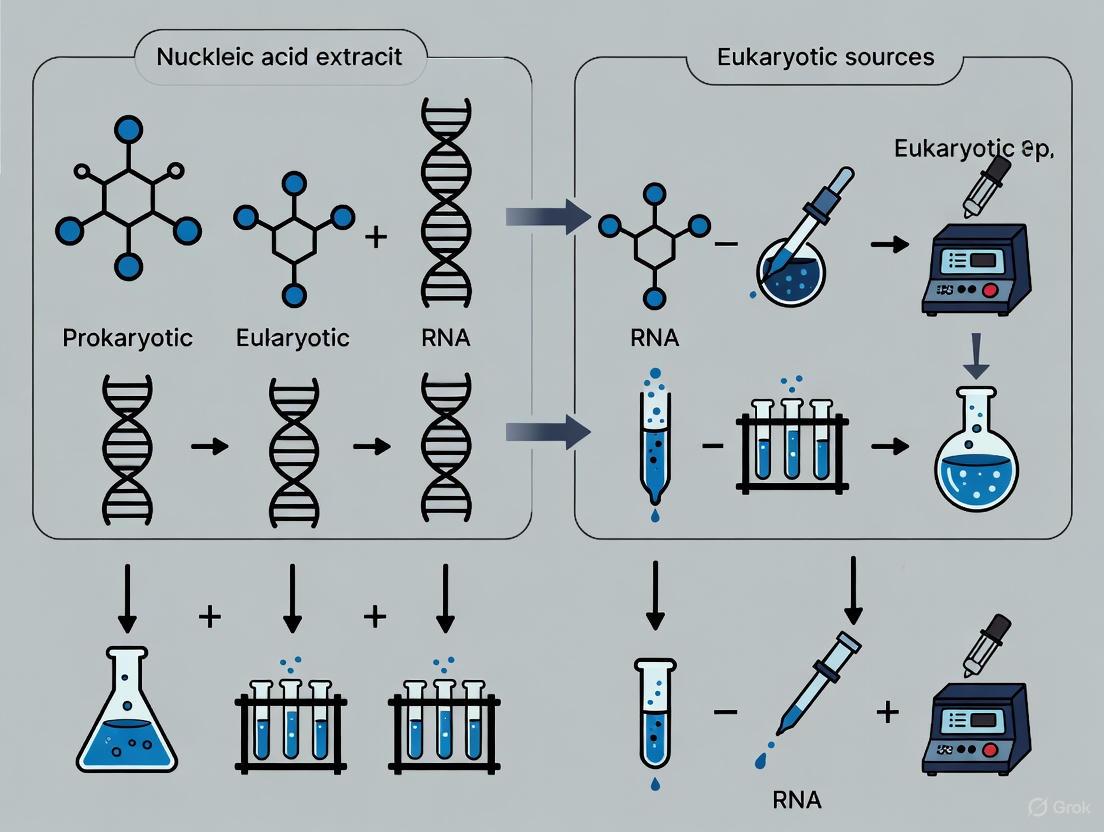
This article provides researchers, scientists, and drug development professionals with a comprehensive guide to nucleic acid extraction from diverse prokaryotic and eukaryotic sources.
Nucleic Acid Extraction Protocols: A Comprehensive Guide for Prokaryotic and Eukaryotic Sources
Abstract
This article provides researchers, scientists, and drug development professionals with a comprehensive guide to nucleic acid extraction from diverse prokaryotic and eukaryotic sources. It covers foundational principles, including the critical steps of cell lysis, protein denaturation, and nucleic acid precipitation. The content explores a range of methodological approaches, from traditional organic extraction to modern solid-phase and magnetic bead-based systems, with specific protocols for different sample types. It also delves into essential troubleshooting and optimization strategies to maximize yield and purity, and offers a comparative analysis of various extraction techniques to inform method selection for specific downstream applications like PCR, qPCR, and NGS.
Core Principles of Nucleic Acid Extraction: From Cell Lysis to Purified DNA and RNA
The Four Indispensable Steps of Nucleic Acid Purification
Nucleic acid purification is a foundational technique in molecular biology, serving as the critical first step for a vast array of downstream applications including PCR, sequencing, and clinical diagnostics [1]. The quality and purity of isolated nucleic acids directly influence the success and reliability of these advanced techniques. While commercial kits have streamlined the process, understanding the fundamental principles behind each step remains essential for effective troubleshooting and protocol optimization [1]. This application note details the four indispensable steps of nucleic acid purification—cell lysis, binding, washing, and elution—framed within contemporary research contexts for prokaryotic and eukaryotic sources. We provide detailed methodologies, quantitative performance data, and expert guidance to enable researchers to achieve high yields of pure, intact nucleic acids suitable for demanding downstream applications.
The Four Indispensable Steps: Mechanisms and Protocols
The fundamental workflow for purifying nucleic acids consists of four core steps, each with a specific biochemical objective. The following diagram illustrates the logical sequence and key actions within each step.
Step 1: Cell Lysis
The primary objective of this step is to disrupt cellular membranes and release nucleic acids into solution while maintaining their integrity and protecting them from nucleases.
Mechanism of Action: Lysis buffers typically contain chaotropic salts (e.g., guanidine HCl, guanidine thiocyanate, urea) which denature proteins, including nucleases, and disrupt the hydration shell of nucleic acids, facilitating their subsequent binding to silica [2] [1]. Detergents (e.g., SDS) are often included to solubilize membrane lipids and proteins [1]. The specific lysis conditions must be tailored to the sample type. For instance, gram-positive bacteria may require enzymatic pre-treatment (e.g., lysozyme) or mechanical disruption (e.g., bead-beating) to break down tough cell walls [3]. It is critical to note that lysis for plasmid DNA isolation differs significantly; an alkaline lysis method is used first to separate plasmid DNA from genomic DNA, after which chaotropes are added [1].
Detailed Protocol: Mechanical and Chemical Lysis for Complex Samples
This protocol is optimized for robust lysis of diverse sample types, including microbial cells in environmental samples [4] [3].
- Homogenization: For solid samples (e.g., tissue, sediment), begin by homogenizing 0.25 g of material using a bead-beater with ZR BashingBeads Lysis Tubes containing 0.1 and 0.5 mm beads. Add a nucleic acid preservative such as DNA/RNA Shield. Process via bead-beating for 10 minutes to ensure thorough disruption [4].
- Centrifugation: Centrifuge the homogenate at 14,000 × g for 30 seconds at 8°C to pellet insoluble debris. Carefully recover the supernatant [4].
- Enzymatic and Chemical Lysis: To the supernatant, add a lysis buffer containing a chaotropic salt (e.g., 4 M guanidine thiocyanate) and a detergent. For samples high in protein, add Proteinase K (often included in commercial kits) and incubate at 56°C for 10-30 minutes to digest proteins [1] [3]. For gram-positive bacteria, an incubation with lysozyme may be necessary prior to adding the denaturing lysis buffer.
Step 2: Binding to Matrix
This step involves the selective adsorption of nucleic acids onto a solid-phase matrix, separating them from other cellular components in the lysate.
Mechanism of Action: Under high-salt and slightly acidic pH conditions (often optimized to pH ~4.1), the chaotropic salts negate the negative charge of the silica surface and dehydrate the nucleic acids, allowing them to bind efficiently via van der Waals forces and hydrogen bonding [2] [1]. The addition of ethanol or isopropanol is crucial, as it further promotes binding by reducing the solubility of nucleic acids. Binding can be achieved using spin columns with silica membranes or magnetic silica beads. Research shows that aggressive mixing, such as a "tip-based" method where the binding mix is aspirated and dispensed repeatedly, can significantly enhance binding efficiency and speed, achieving ~85% binding in 1 minute compared to ~61% with orbital shaking [2].
Detailed Protocol: Silica Membrane Binding with Tip-Based Mixing
- Conditioning: Add a volume of lysate to a spin column or tube containing a binding buffer with a optimized acidic pH (e.g., pH 4.1) and ethanol. The final concentration of chaotropic salt should be high (e.g., >2 M guanidine HCl) [2].
- Binding with Mixing: For maximum efficiency, use a pipette to aspirate and dispense the entire mixture 10-15 times over 1-2 minutes to ensure the silica matrix is fully exposed to the nucleic acids [2].
- Centrifugation or Capture: For spin columns, centrifuge the column briefly (e.g., 30-60 seconds at ≥8000 × g) to pass the mixture through the membrane. For magnetic beads, place the tube on a magnetic stand until the solution clears, then discard the supernatant. The nucleic acids are now bound to the matrix [5] [1].
Step 3: Washing
The goal of washing is to remove contaminants—such as proteins, salts, and other metabolites—from the nucleic acid-matrix complex without eluting the bound nucleic acids.
Mechanism of Action: Wash buffers are designed to maintain conditions that keep nucleic acids bound while solubilizing and removing impurities. An initial wash may contain a low concentration of chaotropic salts to remove residual proteins and pigments [1]. This is invariably followed by one or more washes with an ethanol-based buffer (typically 70-80% ethanol) to effectively remove the chaotropic salts and other soluble contaminants. Residual salts are a common source of poor purity, indicated by low A260/230 ratios, which can inhibit downstream enzymatic reactions [1]. Thorough washing is therefore critical.
Detailed Protocol: Two-Step Wash for High-Purity Nucleic Acids
- First Wash (Salt Wash): Add the recommended volume of Wash Buffer 1 (often containing guanidine thiocyanate or similar) to the column or beads. Incubate for 30 seconds, then centrifuge (for columns) or remove supernatant (for beads) [1] [3].
- Second Wash (Ethanol Wash): Add the recommended volume of Wash Buffer 2 (typically 70-80% ethanol) to the matrix. Centrifuge or remove the supernatant as before. This step is essential for salt removal.
- Dry Spin (Optional but Recommended): Perform an additional centrifugation of the empty spin column for 1-2 minutes at maximum speed to ensure complete evaporation of residual ethanol. For magnetic beads, a brief air-dry may be sufficient. Residual ethanol can interfere with elution and downstream applications [1].
Step 4: Elution
The final step releases the pure nucleic acids from the binding matrix into an aqueous solution.
Mechanism of Action: Elution is achieved by rehydrating the nucleic acids using a low-ionic-strength buffer or water. The absence of chaotropes and ethanol, combined with the slightly basic pH of elution buffers like Tris-EDTA (TE) buffer (pH 8.0-9.0), disrupts the interactions between the nucleic acids and the silica matrix, allowing them to go back into solution [1]. For DNA, a slightly basic buffer is preferred as it promotes dissolution and enhances stability. Water can be used but its slightly acidic pH may not efficiently elute high-molecular-weight DNA. Allowing the elution buffer to stand on the membrane for several minutes (2-5 minutes) before centrifugation improves the yield by ensuring full rehydration [1].
Detailed Protocol: High-Yield Elution
- Apply Eluent: Add 35-100 µL of pre-warmed (65-70°C) elution buffer (e.g., 10 mM Tris-HCl, pH 8.5) or nuclease-free water to the center of the silica membrane or beads [1] [6].
- Incubate: Allow the column or beads to stand at room temperature for 2-5 minutes to fully rehydrate the nucleic acids.
- Recover Eluate: Centrifuge the spin column for 1 minute at maximum speed or mix and separate the magnetic beads. The flow-through contains the purified nucleic acids, ready for quantification and downstream use.
Quantitative Comparison of Extraction Method Performance
The choice of extraction method and sample type significantly impacts the yield, purity, and suitability of nucleic acids for downstream applications. The following table summarizes performance data across different methodologies and sample sources, providing a benchmark for researchers.
Table 1: Performance Metrics of Nucleic Acid Extraction Methods Across Sample Types
| Method / Kit Name | Sample Type | Key Performance Metric | Reported Outcome / Yield | Best For / Notes |
|---|---|---|---|---|
| SHIFT-SP [2] | Pure DNA | Binding Efficiency (pH 4.1, tip-based) | ~98% bound in 10 min | Speed; high-yield applications |
| SHIFT-SP [2] | Pure DNA | Binding Efficiency (pH 8.6, orbital) | ~84% bound in 15 min | Standard efficiency protocols |
| Phenol/Chloroform (B1) [6] | Seawater (1L) | DNA Yield | Higher yield vs. kits | High DNA yield, but more variable communities |
| Kit-based (K1) [6] | Seawater (1L) | DNA Yield | Lower yield vs. B1 | More consistent community structure |
| DNeasy PowerSoil [3] | Marine Sediment | PCR Inhibition Removal | Effective (ITR technology) | Samples with humic acids/inhibitors |
| Mechanical Lysis [7] | Breast Tissue | Host DNA Contamination | 89.11 ± 2.32% | Total DNA recovery (high host DNA) |
| Trypsin Treatment [7] | Breast Tissue | Host DNA Contamination | 82.63 ± 1.23% | Microbial studies (reduced host DNA) |
| Saponin Treatment [7] | Breast Tissue | Host DNA Contamination | 80.53 ± 4.09% | Microbial studies (reduced host DNA) |
The Scientist's Toolkit: Essential Reagents and Materials
Successful nucleic acid purification relies on a suite of specialized reagents and materials. The following table details key solutions and their specific functions in the workflow.
Table 2: Essential Research Reagent Solutions for Nucleic Acid Purification
| Reagent / Material | Function in the Workflow | Key Considerations |
|---|---|---|
| Chaotropic Salts(e.g., Guanidine HCl) [2] [1] | Denatures proteins/inactivates nucleases; enables NA binding to silica. | High purity is critical. Concentration and pH (optimal ~4.1) directly impact binding efficiency [2]. |
| Silica Matrix(Membranes/Magnetic Beads) [2] [5] [1] | Solid phase for selective binding of nucleic acids over other cellular components. | Magnetic beads facilitate automation. Membrane spin columns are widely used for manual protocols. |
| Proteinase K [1] [3] | Broad-spectrum serine protease that digests proteins and nucleases. | Works optimally under denaturing conditions (e.g., in lysis buffer with chaotropes). |
| Wash Buffers(Ethanol-based) [1] | Removes salts, metabolites, and other contaminants from the silica-NA complex. | Must use high-quality, fresh ethanol. Residual salt is a major cause of low purity (A260/230). |
| Elution Buffer(e.g., 10 mM Tris-HCl, pH 8.5) [1] | Rehydrates and releases pure nucleic acids from the silica matrix. | Preferred over water for DNA, especially high MW, as basic pH aids dissolution and stability. |
| Nucleic Acid Preservative(e.g., DNA/RNA Shield) [4] | Stabilizes nucleic acids in samples immediately upon collection, preventing degradation. | Cruicial for field sampling or when processing cannot be immediate. |
Mastering the four indispensable steps of nucleic acid purification—lysis, binding, washing, and elution—is fundamental to generating high-quality data in modern molecular research. As demonstrated, methodological choices at each stage, from the pH of the binding buffer to the mode of mixing and the composition of the elution buffer, have a profound impact on the yield, purity, and integrity of the final product [2] [1]. By understanding the underlying biochemical principles and leveraging optimized protocols and performance benchmarks, researchers can reliably extract nucleic acids from even the most challenging prokaryotic and eukaryotic sources, ensuring a solid foundation for all subsequent experiments in drug development and biomedical science.
Within the broader context of nucleic acid extraction protocols for prokaryotic and eukaryotic research, the initial lysis step is fundamentally critical to the success of all downstream applications. The primary objective of lysis is to rapidly and completely disrupt cells and/or tissues to release nucleic acids into a lysate while simultaneously inactivating nucleases that could degrade the target molecules [8] [9]. The widely employed nucleic acid isolation methods, including organic extraction, inorganic extraction, and solid-phase extraction, all share this indispensable first step [8]. The choice of lysis method must be tailored to the specific structural properties of the starting biological material, which can range from simple bacterial cells to complex animal and plant tissues. This application note provides a detailed comparison of mechanical, chemical, and enzymatic lysis approaches, including structured protocols to guide researchers and drug development professionals in selecting and optimizing the most appropriate technique for their experimental needs.
Lysis Methodologies: Principles and Applications
Cell lysis techniques are designed to cope with different sample types, from easy-to-lyse tissue culture cells to structurally complex materials like plant tissues or bacterial spores. The three primary categories of lysis can be used independently or in combination to achieve optimum nucleic acid yield and quality [8] [9].
Table 1: Comparison of Primary Lysis Methods for Nucleic Acid Extraction
| Lysis Method | Mechanism of Action | Typical Applications | Key Advantages | Key Limitations |
|---|---|---|---|---|
| Mechanical | Physical disruption of cell walls and membranes through grinding, bead beating, or sonication. | Plant tissues, fungal cells, oocysts, nematode eggs, and other structured materials [8] [9]. | Effective for tough, fibrous materials; no chemical contamination. | Can generate heat, potentially damaging nucleic acids; may fragment DNA; not easily scalable [9]. |
| Chemical | Solubilization of lipid membranes and denaturation of proteins using detergents (e.g., SDS) or chaotropic agents (e.g., guanidine salts) [8] [9]. | Tissue culture cells, bacterial cells, and easy-to-lyse materials; often used in combination with other methods [9]. | Rapid and efficient; easily scaled for high-throughput; inactivates nucleases during lysis [9]. | May introduce inhibitory contaminants; optimization required for different cell types. |
| Enzymatic | Degradation of specific structural components (e.g., cell walls, proteins) using enzymes like lysozyme, proteinase K, or zymolase [8] [9]. | Bacterial cells (with tough peptidoglycan layers), yeast, tissues, and plant materials [8] [9]. | Highly specific; gentle on nucleic acids; effective for degrading unwanted contaminants like RNA or proteins. | Higher per-sample cost; requires specific buffer conditions (e.g., temperature, pH) for activity [9]. |
Detailed Experimental Protocols
Protocol: Mechanical Lysis by Grinding in Liquid Nitrogen
This protocol is optimized for tough, fibrous tissues such as animal liver or plant leaves, where efficient disruption is required to access nucleic acids [8].
I. Research Reagent Solutions
- Lysis Buffer (1X STE): 50 mM NaCl, 50 mM Tris-HCl, 100 mM EDTA; pH 8.0 [8].
- Sodium Dodecyl Sulfate (SDS): 10% solution.
- Proteinase K: Stock solution.
- Saturated Salt Solution (NaCl): Neutral (for DNA) or Acidic (for RNA) [8].
- Absolute Ethanol and 70% Ethanol.
- RNase A (for DNA extraction) or DNase I (for RNA extraction).
II. Methodology
Homogenization:
- Place approximately 1 g of tissue in a pre-chilled porcelain mortar.
- Submerge the tissue in liquid nitrogen and grind thoroughly to a fine powder using a pestle.
- Add 3 ml of Lysis Buffer and 900 µl of 10% SDS to the powder and continue grinding to form an emulsion.
- Transfer the emulsion to a micro-centrifuge tube.
- Add 100 µg of Proteinase K per ml of emulsion solution.
- Incubate for 1 hour at 50°C [8].
Phase Separation:
- Add 350 µl of neutral (for DNA) or acidic (for RNA) saturated NaCl solution per ml of emulsion.
- Cap the tube and shake gently by hand for 15 seconds.
- Incubate at room temperature for 10 minutes.
- Centrifuge at 590 × g for 15 minutes at room temperature. The nucleic acids will remain exclusively in the aqueous phase [8].
Nucleic Acid Precipitation:
- Transfer the resulting aqueous phase to a new micro-centrifuge tube.
- Add two volumes of room-temperature (DNA) or cold (RNA) absolute ethyl alcohol.
- Invert the tube several times for 10-15 seconds until the nucleic acid precipitates [8].
Wash and Dissolving:
- Pellet the nucleic acid by centrifugation at 9,500 × g for 5 minutes. Remove the supernatant.
- Wash the pellet once with 70% ethanol and centrifuge again.
- Air-dry the pellet for 5 minutes.
- Dissolve the DNA in double-distilled water or the RNA in DEPC-treated water [8].
Removal of Contaminating Nucleic Acids:
- For DNA preparations: Add 50 µg per ml of RNase A and incubate for 1 hour at 37°C.
- For RNA preparations: Use a DNase I (RNase-free) kit as per the manufacturer's instructions to remove any contaminating DNA [8].
Protocol: Chemical & Enzymatic Lysis for Prokaryotic Cells (e.g.,E. coli)
This protocol combines chemical and enzymatic lysis for efficient disruption of bacterial cells, which possess a robust peptidoglycan cell wall [8] [9].
I. Research Reagent Solutions
- Lysis Buffer (1X STE): 50 mM NaCl, 50 mM Tris-HCl, 100 mM EDTA; pH 8.0 [8].
- SDS: 10% solution.
- Proteinase K or Lysozyme stock solution.
II. Methodology
Homogenization:
- Transfer 1 ml of microbial culture to a micro-centrifuge tube.
- Pellet the cells by centrifugation at 380 × g for 5 minutes at room temperature. Discard the supernatant.
- Resuspend the pellet via repetitive pipetting in 1 ml of Lysis Buffer containing 100 µl of 10% SDS and 100 µg of Proteinase K (or Lysozyme).
- Incubate for 1 hour at 50°C [8].
Subsequent Steps:
- The subsequent steps for phase separation, precipitation, washing, dissolving, and removal of contaminating nucleic acids are identical to those described in Section 2.1 (steps 2-5) [8].
Workflow Visualization: Lysis Method Selection
The following diagram illustrates the logical decision-making process for selecting an appropriate lysis method based on the source material, with pathways leading to the recommended detailed protocols.
Essential Research Reagent Solutions
The success of nucleic acid extraction protocols relies on a core set of reagents, each performing a critical function in the lysis and purification process [8] [9].
Table 2: Key Reagents for Nucleic Acid Lysis and Purification
| Reagent | Function | Application Notes |
|---|---|---|
| EDTA (Ethylenediaminetetraacetic acid) | Chelates divalent cations (Mg²⁺, Ca²⁺), which are essential cofactors for DNases and RNases. This provides a "triple protection" for nucleic acids during lysis when combined with SDS and NaCl [8]. | A key component of standard lysis and TE (Tris-EDTA) storage buffers. |
| SDS (Sodium Dodecyl Sulfate) | An ionic detergent that disrupts lipid membranes and denatures proteins by binding to them. This aids in cell lysis and inactivation of nucleases [8] [9]. | Often used in conjunction with Proteinase K for more effective protein digestion. |
| Proteinase K | A broad-spectrum serine protease that degrades nucleases and other contaminating proteins, protecting the nucleic acids during isolation [8] [9]. | Incubation is typically performed at 50-60°C for 1 hour for optimal activity. |
| Chaotropic Salts (e.g., Guanidine HCl) | Disrupt cellular structure, inactivate nucleases, and enable binding of nucleic acids to silica matrices in many modern purification kits [9]. | The key component for silica-membrane and magnetic bead-based purification chemistries. |
| RNase A & DNase I | Enzymes that specifically degrade unwanted RNA or DNA contaminants to achieve a pure preparation of the target nucleic acid [8] [9]. | Added after the initial extraction; RNase A is used for DNA prep, and DNase I is used for RNA prep. |
The selection of an appropriate lysis method is a critical first step that determines the success of any nucleic acid extraction protocol. As detailed in this application note, the choice between mechanical, chemical, and enzymatic approaches—or a combination thereof—must be guided by the nature of the source material, the desired yield and quality of the nucleic acid, and the requirements of the intended downstream applications. The protocols and workflows provided herein offer researchers a structured framework for implementing these techniques effectively within the context of prokaryotic and eukaryotic research, thereby ensuring the recovery of high-quality DNA and RNA suitable for demanding analytical techniques, including PCR, RT-PCR, and sequencing.
Nucleic acid extraction is a foundational step in molecular biology, serving as the critical first point for a vast array of downstream applications in research and drug development. The efficiency of this process hinges on the chemical reagents that facilitate cell disruption, protein denaturation, and nucleic acid purification and stabilization. Within this framework, four reagent classes are particularly pivotal: Ethylenediaminetetraacetic acid (EDTA), Sodium Dodecyl Sulfate (SDS), Sodium Chloride (NaCl), and chaotropic salts. This application note delineates their specific mechanisms and optimal use within protocols designed for both prokaryotic and eukaryotic sources, providing researchers with the detailed methodologies and quantitative data necessary for experimental success.
The Scientist's Toolkit: Key Reagents and Their Functions
The following table details the core reagents, their chemical modes of action, and their primary roles in nucleic acid extraction protocols.
Table 1: Essential Reagents for Nucleic Acid Extraction
| Reagent | Chemical Nature | Primary Function | Mechanism of Action |
|---|---|---|---|
| EDTA | Chelating Agent | Nuclease Inhibition | Chelates Mg²⁺ and other divalent cations that are essential cofactors for DNases and RNases, thereby protecting nucleic acids from enzymatic degradation [8]. |
| SDS | Ionic Detergent | Cell Lysis & Protein Denaturation | Solubilizes lipid membranes and denatures proteins by binding to them and disrupting hydrophobic interactions [1] [9]. |
| Chaotropic Salts (e.g., Guanidine HCl) | Protein Denaturant | DNA Binding & Nuclease Inactivation | Disrupts hydrogen bonding, denatures proteins, and enables nucleic acid binding to silica surfaces in high-salt conditions [10] [11] [1]. |
| NaCl | Salt | Protein Precipitation & Phase Separation | Neutralizes the negative charge on DNA phosphate groups, reducing electrostatic repulsion and facilitating aggregation and precipitation of proteins during salting-out steps [8]. |
Experimental Protocols and Quantitative Data
A Unified Lysis Buffer for Diverse Sample Types
The synergistic action of EDTA, SDS, and NaCl can be harnessed in a single lysis buffer, creating a "triple-protection" system for nucleic acids. This environment is improper for RNase to have DNA liberated of RNA and even for DNase to degrade the DNA [8].
Protocol: Combined Lysis and Protection Buffer
- Recommended Buffer Formulation: 1X STE Buffer (50 mM NaCl, 50 mM Tris-HCl, 100 mM EDTA; pH 8.0) supplemented with 10% SDS [8].
- Procedure:
- Homogenization: For 1 gram of tissue (e.g., mouse liver), homogenize the sample in 3 ml of lysis buffer containing 900 µl of 10% SDS. For bacterial pellets, resuspend in 1 ml lysis buffer with 100 µl of 10% SDS.
- Digestion: Add 100 µg proteinase K per ml of emulsion solution and incubate for 1 hour at 50°C.
- Phase Separation: Add 350 µl of a saturated NaCl solution per ml of lysate, shake vigorously, and incubate at room temperature for 10 minutes.
- Centrifugation: Centrifuge at 590 × g for 15 minutes. The nucleic acids will remain in the aqueous phase, while proteins and debris will precipitate.
- Precipitation: Transfer the aqueous phase to a new tube and mix with two volumes of room-temperature absolute ethanol to precipitate the nucleic acids.
- Wash and Dissolve: Wash the pellet with 75% ethanol, dry, and dissolve in nuclease-free water or TE buffer [8].
Optimizing Chaotropic Salt-Based Extraction
Chaotropic salts are the cornerstone of modern silica-matrix binding protocols. Optimization of their concentration and application is critical for maximizing yield and purity.
Protocol: Chaotropic Salt-Based Extraction and qPCR Detection This protocol, optimized for the detection of Helicobacter pylori in stool, can be adapted for other challenging samples [10].
- Lysis Buffer: 4 M Guanidine hydrochloride (GuHCl), 1% SDS, 40 mM Tris-HCl, 10 mM EDTA.
- Procedure:
- Lysis: Mix the sample with the lysis buffer and silicon-hydroxyl magnetic beads. Incubate at 60°C for 20 minutes with intermittent mixing.
- Binding: Separate the beads and discard the supernatant.
- Washing: Wash the beads twice with a 4 M GuHCl solution (pH 6.0) and once with 70% ethanol.
- Elution: Elute the purified nucleic acids in nuclease-free water or TE buffer.
- Key Optimization Data: The following table summarizes the critical parameters tested to maximize nucleic acid recovery and PCR sensitivity in the stated study [10].
Table 2: Optimization of Chaotropic Salt-Based Extraction Parameters [10]
| Parameter | Tested Range | Optimal Condition | Impact on Yield/Sensitivity |
|---|---|---|---|
| GuHCl Concentration | 2 - 6 M | 4 M | Maximized DNA yield from stool samples. |
| SDS Concentration | 0.5 - 2% | 1% | Balanced efficient lysis with minimal PCR inhibition. |
| Lysis Temperature | 25 - 80 °C | 60 °C | Highest DNA yield achieved. |
| Lysis Time | 5 - 30 min | 20 min | Sufficient for complete lysis and DNA release. |
| Comparison vs. Commercial Kits | --- | Chaotropic Method | Commercial Kits |
| Total Extraction Time | --- | ~35 minutes | Longer (typically >60 minutes) |
| qPCR Sensitivity (LOD) | --- | 10² copies/reaction | 10³ copies/reaction |
Diagram 1: Nucleic acid extraction workflow showing the integration of key reagents at each stage.
Troubleshooting and Mechanism Insights
Understanding the biochemical principles behind these reagents allows for effective troubleshooting.
Diagram 2: Mechanism of DNA binding to and elution from silica surfaces using chaotropic salts.
Table 3: Common Issues and Solutions Related to Key Reagents
| Problem | Potential Cause | Recommended Solution |
|---|---|---|
| Low Nucleic Acid Yield | Incomplete lysis due to insufficient SDS or enzymatic digestion. | Optimize SDS concentration (e.g., 1-2%) and ensure adequate proteinase K incubation [10] [1]. |
| Nucleic Acid Degradation | Ineffective nuclease inhibition due to outdated or insufficient EDTA. | Ensure fresh lysis buffer with adequate EDTA concentration (e.g., 100 mM) is used [8]. |
| Poor PCR Performance | Carryover of chaotropic salts or SDS from inadequate washing. | Perform additional ethanol wash steps to remove residual salts and detergents [11] [1]. |
| Low Purity (A260/230) | Residual salt contamination after binding or washing. | Use high-quality ethanol for wash buffers and consider an additional wash step [1]. |
The strategic application of EDTA, SDS, NaCl, and chaotropic salts forms the biochemical foundation of robust and reliable nucleic acid extraction. EDTA serves as a crucial protector, SDS as a powerful disruptor, NaCl as a strategic precipitant, and chaotropic salts as the bridge to modern purification matrices. By leveraging the optimized protocols, quantitative data, and troubleshooting guidance contained herein, researchers can refine their foundational techniques, thereby enhancing the quality and reproducibility of their molecular research and accelerating the pace of discovery and drug development.
Endogenous nucleases are enzymes present in all living organisms that catalyze the degradation of nucleic acids. Their fundamental biological roles range from primitive immune defense in bacteria to the maintenance of immune homeostasis in humans [12]. For researchers working with nucleic acids from prokaryotic and eukaryotic sources, these enzymes represent a significant challenge, as they can rapidly degrade DNA and RNA during extraction and purification, compromising sample integrity and downstream applications.
The evolutionary journey of nucleases began with simple bacterial defenders against viral invaders and has expanded into a sophisticated system of immune regulation in higher organisms [12]. In modern laboratory practice, understanding nuclease function and implementing strategic protection measures is crucial for successful nucleic acid extraction across diverse sample types.
Nuclease Classification and Mechanisms of Action
Nucleases can be broadly categorized based on their substrate specificity, mode of action, and biological function. The following table summarizes the primary nuclease classes relevant to nucleic acid extraction protocols.
Table 1: Major Classes of Endogenous Nucleases and Their Characteristics
| Nuclease Class | Substrate | Primary Function | Optimal Conditions | Key Challenges in Extraction |
|---|---|---|---|---|
| DNase I | DNA | Degrades extracellular DNA; apoptotic cell clearance [12] | pH 6.5-8.0; requires Mg²⁺/Ca²⁺ [12] | Activated upon cell lysis; degrades target DNA |
| DNase II | DNA | Lysosomal DNA degradation; immune homeostasis [12] | Acidic environment (pH 4.8-5.2) [12] | Active in lysosomal compartments during homogenization |
| RNase A Family | RNA | Digestive enzymes; viral RNA degradation [12] | Wide pH range; highly stable [13] | Extreme stability and persistence; ubiquitous contamination |
| Restriction Endonucleases (Type II) | DNA | Bacterial defense; sequence-specific cleavage [12] | Species-dependent buffer conditions [12] | Pre-digests bacterial DNA in prokaryotic samples |
| RNase H | RNA in DNA:RNA hybrids | Degrades RNA strand in hybrids; cellular homeostasis [14] [13] | Requires metal cofactors | Can interfere with reverse transcription processes |
The following diagram illustrates the core challenge nucleases pose during the nucleic acid extraction workflow, from sample collection to purified nucleic acids.
Strategic Framework for Nuclease Inhibition
Effective protection of nucleic acids requires a multi-faceted approach that integrates chemical inhibition, physical methods, and optimized extraction workflows. The strategic pillars for nuclease inhibition are outlined below.
Chemical Modifications of Nucleic Acids
For therapeutic nucleic acid drugs (NADs), chemical modification is a primary strategy to enhance stability against nuclease degradation [14] [15]. These modifications can be incorporated during synthesis to create analogs resistant to enzymatic cleavage.
Table 2: Common Chemical Modifications for Nuclease Protection
| Modification Type | Example | Mechanism of Protection | Application Notes |
|---|---|---|---|
| Phosphate Backbone | Phosphorothioate (PS) [15] | Sulfur substitution enhances resistance to nucleases and improves plasma protein binding [15]. | The Sp conformation provides superior stability over the Rp conformation [15]. Used in approved drugs like Fomivirsen [15]. |
| Ribose Sugar | 2'-methoxy, 2'-methoxyethoxy, 2'-fluoro [15] | Steric hindrance and altered electronics reduce nuclease recognition and cleavage. | significantly improves pharmacokinetic properties of ASOs and siRNAs [14]. |
| Nucleobase | Pseudouridine (Ψ), 2-thiouridine [15] | Altered base pairing and recognition reduces immunogenicity and can enhance stability [15]. | Pseudouridine modification was crucial for reducing mRNA vaccine immunogenicity [14]. |
Laboratory Reagents for Nuclease Inhibition
During extraction from biological samples, non-modified nucleic acids require the use of nuclease inhibitors in buffers and solutions. The selection of inhibitors depends on the sample type (prokaryotic vs. eukaryotic) and the target nucleic acid (DNA vs. RNA).
Table 3: Research Reagent Solutions for Nuclease Inhibition
| Reagent / Kit | Function / Target | Application Context |
|---|---|---|
| Proteinase K | Broad-spectrum serine protease | Degrades nucleases and other proteins during lysis; essential for most DNA extraction protocols [3]. |
| EDTA / EGTA | Chelating Agents | Chelates Mg²⁺ and Ca²⁺ ions, which are essential cofactors for many DNases and RNases [12]. |
| Guanidine Salts | Denaturant (e.g., in QIAamp kits) | Chaotropic agent that denatures proteins, including nucleases, while allowing nucleic acid binding to silica membranes [3]. |
| Benzonase | Endonuclease | Degrades host nucleic acids in microbiome kits to enrich for microbial DNA [3]. |
| Specific RNAse Inhibitors | RNase A-type enzymes | Proteins (e.g., RNasin) or compounds that specifically bind to and inhibit RNases without affecting other enzymes. |
| QIAamp PowerFecal DNA Kit [3] | Inhibitor Removal Technology | Bead beating in lysis buffer with compounds to remove PCR inhibitors like humic acids. |
| PureLink Microbiome DNA Purification Kit [3] | Chemical & Mechanical Lysis | Combination of heat, chemical, and mechanical disruption for comprehensive cell lysis and nuclease inactivation. |
Physical and Mechanical Methods
Physical methods are critical for inactivating nucleases prior to they can degrade the target nucleic acids.
- Rapid Homogenization and Lysis: The use of bead beating (e.g., in a TissueLyser) in a strongly denaturing lysis buffer is highly effective for simultaneous cell wall disruption and immediate nuclease denaturation [3]. This is particularly crucial for tough gram-positive bacteria and other resilient cells.
- Temperature Control: Maintaining samples at ≤4°C during initial processing slows enzymatic activity. Conversely, using high temperatures (e.g., 70°C during elution or in lysis buffers) can denature and permanently inactivate many nucleases.
- pH Manipulation: Adjusting the pH of the lysis buffer to a strongly alkaline condition (e.g., with NaOH) can rapidly inactivate many nucleases, though this must be compatible with the downstream extraction chemistry.
The following workflow diagram integrates these strategic pillars into a recommended protocol for maximizing nucleic acid integrity.
Application-Optimized Extraction Protocols
Protocol: DNA Isolation from Complex Matrices with High Nuclease Activity
This protocol is optimized for samples like sediments, digestive tissues, or bacterial cultures, which often exhibit high endogenous nuclease activity [3].
Materials and Equipment:
- QIAamp PowerFecal Pro DNA Kit (or equivalent with inhibitor removal technology) [3]
- TissueLyser LT or similar bead-beating instrument
- Microcentrifuge
- Nuclease-free water and tubes
- Proteinase K (optional, if not included in the kit)
Method:
- Sample Preparation: Weigh 25-50 mg of ground tissue or sediment. For liquid samples, concentrate cells by centrifugation.
- Initial Lysis: Transfer sample to a tube containing a lysis buffer with denaturants (e.g., guanidine hydrochloride) and EDTA. Vortex immediately.
- Mechanical Disruption: Add sterile zirconia/silica beads. Secure tubes in a TissueLyser and process at 50 Hz for 10 minutes to ensure complete physical disruption [3].
- Enzymatic Digestion (if needed): Add Proteinase K (if protocol allows) and incubate at 56°C for 30 minutes to degrade nucleases and other proteins.
- Inhibitor Removal: Follow kit-specific steps for removing organic and inorganic inhibitors (e.g., humic acids) that can carry over into the final eluate [3].
- DNA Binding and Washing: Load supernatant onto a silica-membrane column. Wash with ethanol-based buffers to remove salts and residual contaminants.
- Elution: Elute DNA in 50-100 µL of nuclease-free TE buffer (pH 8.0-8.5) or water. Avoid using acidic elution buffers, which can damage DNA and destabilize it for storage.
Protocol: RNA Extraction with Focus on RNase Inhibition
RNases are notoriously stable and require rigorous inhibition strategies.
Key Specialized Reagents:
- Denaturing agents: β-mercaptoethanol is critical for inactating RNases by reducing disulfide bonds. Guanidine isothiocyanate is a powerful chaotropic agent used in many RNA-specific kits (e.g., RNeasy kits) [3].
- RNase-specific inhibitors: Add recombinant RNase inhibitors to the lysis buffer and elution buffer for extra protection, especially for sensitive applications like RT-PCR.
- Nuclease-free consumables: Use filter tips and certified nuclease-free tubes and water to prevent introduction of external RNases.
Critical Steps:
- Work rapidly and on a dedicated, clean surface, preferably with a UV-equipped laminar flow hood.
- Homogenize the sample directly in a large volume of denaturing lysis buffer containing β-mercaptoethanol.
- Perform all centrifugation and incubation steps as recommended by the kit manufacturer without extended pauses.
- Store purified RNA at -80°C in small aliquots to avoid freeze-thaw cycles.
Quantitative Comparison of DNA Isolation Methods
Systematic benchmarking of DNA isolation kits reveals significant differences in their efficiency, which is often related to their ability to handle nuclease activity and other inhibitors. The following table summarizes key performance metrics for various kits when applied to challenging sample types.
Table 4: Performance Benchmarking of Commercial DNA Isolation Kits for Challenging Samples [3]
| Kit Name | Best For Sample Type | DNA Quantity | DNA Purity (A260/A280) | PCR Inhibition | "Kitome" Contamination | Notes |
|---|---|---|---|---|---|---|
| QIAamp PowerFecal Pro | Sediments, Stool, Digestive Tissue | High | Good | Low | Low | Robust inhibitor removal; effective for complex matrices [3]. |
| DNeasy PowerSoil Pro | Soil, Sediments | High | Good | Low | Low | Similar to PowerFecal; optimized for environmental samples. |
| QIAamp DNA Microbiome | Eukaryotic Tissues | Medium | Good | Low | Low | Includes benzonase step to degrade host DNA [3]. |
| PureLink Microbiome | Various (Soil procedure) | Medium | Variable | Medium | Medium | Combines heat, chemical, and mechanical lysis [3]. |
| DNeasy Blood & Tissue | Clean Tissues, Cultured Cells | High | Good | Low | Low | Standard for pure biological samples; may struggle with inhibitors [3]. |
| QIAamp Fast DNA Stool Mini | Stool | Medium | Variable | Medium | Low | Includes absorption step for inhibitors [3]. |
Protecting nucleic acids from endogenous nucleases is a fundamental challenge that underpins success in molecular biology and drug development. A successful strategy is never reliant on a single method but integrates rapid physical disruption, immediate chemical denaturation of proteins, chelation of essential metal cofactors, and the use of specific enzyme inhibitors. The choice of a commercial kit should be guided by the specific sample type and its known challenges, such as the presence of difficult-to-lyse cells or high levels of PCR inhibitors. By understanding the nature and function of nucleases and systematically applying the principles and protocols outlined in this document, researchers can significantly improve the yield, quality, and reliability of nucleic acids isolated from both prokaryotic and eukaryotic sources.
Practical Extraction Methods: From Classic Protocols to Automated High-Throughput Systems
Organic Extraction vs. Inorganic Salting-Out vs. Solid-Phase Methods
The selection of an appropriate nucleic acid extraction method is a critical foundational step in molecular biology, profoundly influencing the success of downstream applications in research and drug development. The three predominant methodologies—organic extraction, inorganic salting-out, and solid-phase extraction—each possess distinct chemistries, advantages, and limitations. This application note provides a detailed comparative analysis of these techniques, framed within the context of a broader thesis on optimizing nucleic acid protocols for diverse prokaryotic and eukaryotic sources. We summarize quantitative performance data, provide actionable experimental protocols, and visualize workflows to guide researchers in selecting and implementing the most effective strategy for their specific experimental needs.
Core Principles and Methodologies
Fundamental Chemistries
The three methods operate on different biochemical principles for isolating nucleic acids from complex mixtures.
- Organic Extraction: This traditional method relies on liquid-liquid phase separation. Phenol-chloroform mixtures denature and precipitate proteins and lipids into an organic phase or interface, leaving DNA in the aqueous phase [16] [17]. It is often considered a gold standard for purity and fragment size.
- Inorganic Salting-Out: This method utilizes high-concentration salt solutions to precipitate proteins. A common implementation involves a high-salt solution which causes proteins to fall out of solution, followed by isopropanol precipitation of DNA from the salt-containing supernatant [9].
- Solid-Phase Extraction (SPE): This method is based on the binding of nucleic acids to a solid matrix under specific conditions. Silica-based methods, the most common, use chaotropic salts to disrupt hydrogen bonding with water, facilitating DNA adsorption to the silica surface (e.g., in a spin column or on magnetic beads). Contaminants are washed away, and pure DNA is eluted with a low-ionic-strength buffer [9] [18].
Comparative Performance Analysis
The following table summarizes the typical performance characteristics of the three methods across key metrics, as established in recent comparative studies.
Table 1: Quantitative Comparison of Nucleic Acid Extraction Methods
| Performance Metric | Organic Extraction | Inorganic Salting-Out | Solid-Phase Extraction |
|---|---|---|---|
| DNA Yield | High yields; e.g., highest concentrations from historical samples [16] | Varies; can be efficient for simple cell lysates [9] | Good yields; can be kit-dependent [19] [16] |
| DNA Purity (A260/A280) | High (typically 1.8-2.0) [16] | Moderate; may require further purification | High (typically 1.8-2.0) with optimized kits [16] |
| DNA Fragment Size | Superior for long fragments; ideal for degraded samples [16] | Effective for high-molecular-weight DNA [9] | Shorter average fragment lengths due to binding mechanics [16] |
| Inhibitor Removal | Effective removal of proteins, lipids, and humic substances [17] | Moderate; may not remove all contaminants | Good; effective with optimized wash steps [9] |
| Processing Time | Lengthy and labor-intensive [16] | Moderate speed | Fast and amenable to high-throughput automation [9] |
| Cost & Accessibility | Low reagent cost, but requires significant labor | Very low cost | Higher per-sample cost, especially for commercial kits [20] |
| Safety | High risk; involves toxic phenol/chloroform [16] | Generally safe | Generally safe |
| Downstream Application | Ideal for long-read sequencing, PCR from degraded samples [16] | Suitable for standard PCR, cloning | Excellent for PCR, qPCR, multiplex assays, sequencing [9] |
Experimental Protocols
Detailed Method: Phenol-Chloroform Organic Extraction
This protocol is adapted for extracting high-quality DNA from challenging samples like mammalian skin and rhizosphere soil [16] [17].
Research Reagent Solutions:
- Lysis Buffer: CTAB, NaCl, EDTA, Tris-HCl, PVP, 2-Mercaptoethanol (added fresh).
- Phenol:Chloroform:Isoamyl Alcohol (25:24:1): Denatures and removes proteins.
- Chloroform:Isoamyl Alcohol (24:1): Further purifies the aqueous phase.
- PEG-NaCl Solution: Precipitates nucleic acids.
- 70% Ethanol: Washes and dehydrates the nucleic acid pellet.
- Nuclease-Free Water or TE Buffer: For resuspending the final DNA pellet.
Procedure:
- Homogenization: Homogenize 250 mg of sample (e.g., soil, tissue) in CTAB extraction buffer and water-saturated phenol using a bead beater or vortexing with silica beads.
- Centrifugation: Centrifuge at >10,000 g for 10 minutes at 4°C to separate phases.
- Phase Separation: Transfer the upper aqueous phase to a new tube. Add an equal volume of Chloroform:Isoamyl Alcohol (24:1), mix thoroughly, and centrifuge. Repeat this step if necessary for clarity.
- Nucleic Acid Precipitation: Transfer the final aqueous phase and add one volume of ice-cold PEG-NaCl precipitation solution. Incubate on ice for 20 minutes.
- Pellet DNA: Centrifuge at 20,000 g for 20 minutes at 4°C to pellet nucleic acids.
- Wash: Carefully decant the supernatant. Wash the pellet with 1 mL of 70% ice-cold ethanol. Centrifuge again, then air-dry the pellet.
- Resuspend: Resuspend the dried pellet in 50-100 µL of nuclease-free water or TE buffer.
- Optional DNase/RNase Treatment: For RNA-specific work, add DNase I to remove genomic DNA contamination [17].
Detailed Method: Solid-Phase Extraction with Silica Columns
This protocol outlines the general workflow for silica-based column kits, such as the DNeasy PowerSoil or NucleoSpin Tissue kits [9] [19] [16].
Research Reagent Solutions:
- Lysis Buffer (e.g., with chaotropic salts like guanidine HCl): Disrupts cells and inactivates nucleases.
- Binding Buffer: Creates high-salt conditions for nucleic acid adsorption to silica.
- Wash Buffers (ethanol-based): Removes salts, proteins, and other contaminants.
- Elution Buffer (TE or nuclease-free water): Low-ionic-strength solution to release pure DNA from the column.
Procedure:
- Cell Lysis: Lyse the sample (e.g., 0.5 g sediment, tissue) using a combination of mechanical (e.g., bead beating) and chemical (lysis buffer) methods.
- Lysate Clearing: Centrifuge the lysate to pellet insoluble debris and transfer the supernatant to a new tube.
- Binding: Mix the cleared lysate with a binding buffer and transfer to a silica membrane column. Centrifuge to bind DNA to the membrane.
- Washing: Pass one or more wash buffers through the column via centrifugation to remove impurities.
- Elution: Apply elution buffer (50-100 µL) to the center of the dry membrane, incubate for 1-5 minutes, and centrifuge to collect the purified DNA.
Workflow Visualization
The following diagram illustrates the core procedural steps and decision points for the three extraction methods.
The Scientist's Toolkit
Table 2: Essential Reagents and Kits for Nucleic Acid Extraction
| Item | Function/Principle | Example Use Cases |
|---|---|---|
| CTAB Extraction Buffer | Lysis buffer for plants, soils, and microbes; helps remove polysaccharides and polyphenols. | Rhizosphere soil RNA/DNA extraction [17]. |
| Phenol:Chloroform:Isoamyl Alcohol | Denatures and partitions proteins into the organic phase or interface. | Standard organic extraction from tissues [16]. |
| Chaotropic Salts (e.g., Guanidine HCl) | Disrupts hydrogen bonding, enabling DNA binding to silica surfaces. | Solid-phase extraction kits (column or magnetic bead) [9]. |
| Silica Membrane Columns | Solid matrix that selectively binds nucleic acids under high-salt conditions. | DNeasy PowerSoil Kit, NucleoSpin Tissue Kit [19] [16]. |
| Magnetic Silica Beads | "Mobile solid phase" for automated, high-throughput nucleic acid purification. | MagneSil PMPs, suitable for robotic liquid handlers [9]. |
| Acid-Activated Bentonite (ASAB) | Advanced solid-phase matrix with high surface area for enhanced nucleic acid binding. | Efficient extraction of viral RNA and microRNA from clinical samples [18]. |
| Chelex-100 Resin | Chelating agent that binds metal ions, preventing DNA degradation during boiling lysis. | Rapid, cost-effective DNA extraction from dried blood spots [20]. |
The choice between organic, salting-out, and solid-phase methods is not a matter of identifying a single superior technique, but rather of aligning methodology with research objectives, sample type, and operational constraints. Organic extraction remains unparalleled for obtaining high-purity, long-fragment DNA from challenging, degraded samples. Inorganic salting-out offers a straightforward, cost-effective approach for high-yield isolation from simple lysates. Solid-phase extraction provides the best balance of speed, consistency, and purity, making it the workhorse for modern high-throughput applications.
Future developments will continue to refine these core chemistries, with a clear trend towards automation and the integration of novel materials—such as acid-activated bentonite—to enhance binding capacity and recovery of low-abundance nucleic acids [18]. The ongoing evaluation and optimization of these foundational protocols ensure that nucleic acid extraction will remain a dynamic and critical component of successful research in genomics, diagnostics, and drug development.
The pursuit of a nucleic acid extraction protocol that performs reliably across the domains of life is a significant challenge in molecular biology. Research into the seagrass (Zostera marina) leaf microbiome has demonstrated that DNA extraction bias is a critical issue, more pronounced for eukaryotes than for prokaryotes within the same environmental sample [21]. This bias, largely driven by the diversity of cell envelopes, from the simple membranes of amoeboid protists to the silica frustules of diatoms and thick cellulose walls of green algae, complicates the representative analysis of multi-trophic microbial communities [21]. The following application note details a simplified, semi-unified method designed to mitigate this bias, enabling more accurate concurrent analysis of prokaryotic and eukaryotic members of complex communities.
The selection of a DNA extraction method profoundly impacts perceived community composition. A comparative study of six extraction methods from marine biofilm samples revealed that the method explained 22.7% of variation in eukaryotic community profiles, compared to 15.3% for prokaryotes [21]. The table below summarizes the quantitative findings from this study, which compared the performance of various commercial kits and custom protocols.
Table 1: Comparative Performance of DNA Extraction Methods on Marine Biofilm Communities
| Method Name | Lysis Type | Key Findings (Eukaryotes) | Key Findings (Prokaryotes) | Best Suited For |
|---|---|---|---|---|
| PowerSoil (Mo Bio) | Harsh mechanical bead beating | Representative recovery of diatoms (silica frustules). | Standard bacterial community profile. | Communities with hard-shelled eukaryotes. |
| QuickDNA (Zymo) | Enzymatic (gentle) | Over-rep. of soft-bodied nematodes/annelids; Under-rep. of diatoms. | Over-representation of Rubritaleaceae (Verrucomicrobia). | Communities dominated by soft-bodied organisms. |
| InnuSpeed (Analytik Jena) | Weak bead beating (gentle) | Over-rep. of Polychaeta & Cercozoa; Under-rep. of some nematodes & diatoms. | Standard community profile. | General use with caution for specific eukaryotes. |
Detailed Experimental Protocol
Sample Preservation and Pre-processing
Two preservation methods were evaluated, with the choice significantly influencing downstream results and accounting for ~34% of variation in community profiles [21].
- Flash Freezing: Suspend biofilm or cell pellet in sterile seawater or buffer. Pellet by centrifugation. Flash-freeze in liquid N₂. Store at -20°C or lower [21].
- RNAlater Preservation: Suspend sample in RNAlater. Pellet by centrifugation. Store pellet at +4°C [21]. Note: RNAlater treatment may reduce subsequent DNA extraction bias by affecting cell structural integrity [21].
Optimized Semi-Unified Extraction Procedure
This protocol is designed for a starting pellet from either preservation method.
Table 2: Research Reagent Solutions for Nucleic Acid Extraction
| Reagent/Material | Function | Specific Recommendation |
|---|---|---|
| Lysing Matrix E (MP Biomedicals) | Mechanical cell disruption for tough cell walls. | Use in step 1. |
| Proteinase K | Enzymatic digestion of proteins and degradation of nucleases. | Use in step 2. |
| Lysozyme | Enzymatic breakdown of bacterial cell walls (Gram-positive). | Use in step 2. |
| CTAB Buffer | Lysis buffer effective for plants and fungi. | Use in step 2. |
| Silica Membrane Columns | Selective binding and purification of DNA. | Various commercial kits (e.g., PowerSoil). |
| RNase A | Degradation of contaminating RNA. | Optional add-on post-lysis. |
Procedure:
- Dual-Mechanism Lysis: Transfer sample pellet to a tube containing a lysing matrix (e.g., Lysing Matrix E). Add a lysis buffer that includes CTAB. Homogenize using a bead beater on a high setting for 45 seconds to ensure disruption of robust eukaryotic cell walls and prokaryotic cells [21].
- Supplementary Enzymatic Lysis: Following mechanical lysis, incubate the sample with Proteinase K and, if targeting a high proportion of Gram-positive bacteria, lysozyme, at 56°C for 30 minutes to further digest cellular components.
- Nucleic Acid Purification: Complete the protocol using standard silica-membrane column purification, following the manufacturer's instructions for the selected kit, including wash steps and final elution.
Downstream Analysis and Validation
- Quantification and Qualification: Quantify DNA yield using fluorometric methods (e.g., Qubit). Assess quality via spectrophotometry (A260/A280) and gel electrophoresis.
- Community Profiling: For microbial ecology studies, perform PCR amplification of phylogenetic marker genes:
- Prokaryotes (16S rRNA gene): Amplify the V3-V4 hypervariable region.
- Eukaryotes (18S rRNA gene): Amplify a region such as V4.
- Sequencing: Utilize Illumina MiSeq or similar platform for high-throughput amplicon sequencing. Analyze sequence data (e.g., using QIIME 2 or mothur) to determine community composition [21].
Workflow and Data Visualization
The following diagram illustrates the logical workflow of the optimized semi-unified extraction protocol and its critical decision points.
Critical Design Considerations
- Lysis Efficiency is Key: The combination of rigorous mechanical and enzymatic lysis is crucial for tackling the wide range of cell wall structures found in mixed communities. Gentle lysis methods (e.g., enzymatic-only) fail to lyse diatoms, while weak bead beating may under-represent certain nematodes [21].
- Preservation Choice: The preservation method is a strong confounding variable. While RNAlater may reduce extraction bias, flash-freezing is often more practical for field work. The chosen method must be consistent throughout a study [21].
- Bias Awareness: No single method eliminates bias entirely. This protocol aims to minimize it, particularly for eukaryotes, to provide a more holistic view of complex microbial ecosystems. Reporting the specific extraction and preservation methods used is essential for reproducible and comparable research [21].
Nucleic acid extraction is a foundational step in molecular biology, with its efficiency and quality being critical for downstream applications such as PCR, sequencing, and genomic analysis. The structural differences between prokaryotic and eukaryotic cells—ranging from the peptidoglycan-rich cell walls of bacteria to the polysaccharide and polyphenol-laden tissues of plants—demand specialized and optimized lysis and purification strategies [22]. This application note consolidates recent advances into detailed, source-specific protocols for bacterial cultures, animal tissues, and plant material, providing researchers with standardized methods to ensure high yields of high-quality DNA.
Optimized DNA Extraction from Bacterial Cultures
Challenges and Strategic Approach
A primary challenge in extracting DNA from Gram-positive bacteria like Staphylococcus aureus is lysing the thick, cross-linked peptidoglycan cell wall. Traditional methods often rely on the enzyme lysostaphin, which is effective but costly, limiting its use for high-throughput or cost-sensitive applications [23]. The protocol below presents a novel, cost-effective mechanical lysis alternative.
Detailed Protocol for Gram-Positive Bacteria
Title: Liquid Nitrogen Mortarization for Staphylococcus aureus DNA Extraction
Key Features: This protocol uses liquid nitrogen and mechanical disruption to achieve efficient lysis without enzymatic treatment, yielding DNA suitable for whole-genome sequencing and other molecular techniques [23].
Research Reagent Solutions:
- Liquid Nitrogen: Used to flash-freeze bacterial pellets, making the rigid cell wall brittle and susceptible to mechanical disruption.
- Lysis Buffer (Phenol-Chloroform): A chemical mixture that denatures and partitions proteins into the organic phase, leaving DNA in the aqueous supernatant.
- Isopropanol: A precipitating agent that causes DNA to come out of solution when added to the aqueous extract.
- 70% Ethanol: Used to wash the DNA pellet, removing residual salts and contaminants without dissolving the DNA itself.
Procedure:
- Cell Harvesting: Centrifuge 1-5 mL of a bacterial broth culture at high speed (e.g., 12,000 × g) for 5 minutes to pellet the cells. Discard the supernatant.
- Flash-Freezing: Transfer the cell pellet to a mortar pre-chilled with liquid nitrogen. Submerge the pellet fully in liquid nitrogen for approximately one minute.
- Mechanical Lysis: Using a pre-cooled pestle, grind the frozen pellet vigorously into a fine powder. Continue grinding for 2-3 minutes to ensure complete cell wall disruption.
- Nucleic Acid Extraction: Transfer the powdered tissue to a microcentrifuge tube. Add 500 µL of phenol-chloroform solution, vortex thoroughly, and centrifuge at 12,000 × g for 10 minutes at room temperature.
- DNA Precipitation: Carefully transfer the upper aqueous phase to a new tube. Add an equal volume of isopropanol, mix by inversion, and incubate at -20°C for 30 minutes to precipitate the DNA. Centrifuge at 12,000 × g for 15 minutes to pellet the DNA.
- Wash and Resuspension: Discard the supernatant. Wash the pellet with 1 mL of ice-cold 70% ethanol, centrifuge for 5 minutes, and carefully discard the ethanol. Air-dry the pellet for 5-10 minutes and resuspend it in 50-100 µL of ultrapure water or TE buffer.
Quality Control: Assess DNA concentration and purity using spectrophotometry (A260/A280 ratio of ~1.8 is ideal). Verify DNA integrity and size by running an aliquot on an agarose gel. Confirm suitability for downstream applications via successful PCR amplification of target genes [23].
Alternative High-Yield and Automated Methods
For laboratories with access to different equipment, magnetic silica bead-based methods offer a rapid and automatable alternative. The SHIFT-SP (Silica bead based HIgh yield Fast Tip based Sample Prep) method can be completed in 6-7 minutes and achieves near-complete recovery of nucleic acids by optimizing binding conditions, such as using a low-pH (4.1) lysis binding buffer and a "tip-based" mixing mode for rapid and efficient binding [2]. This method is highly effective for processing many samples and is compatible with downstream techniques like PCR and sequencing.
Optimized DNA Extraction from Animal Tissues
Challenges and Strategic Approach
The key challenges for animal tissues include efficient homogenization of the tissue matrix and the potent inhibition of nucleases that can degrade DNA. Protocols must be tailored to the specific tissue type (e.g., liver, muscle, tumor) and preservation method (e.g., fresh, frozen, or FFPE) [22].
Detailed Protocol for Fresh/Frozen Tissue
Title: SDS-Proteinase K DNA Extraction from Animal Tissue
Key Features: This classical method uses a combination of ionic and anionic detergents and enzymatic digestion to efficiently lyse cells and inactivate nucleases, yielding high-quality DNA [22].
Research Reagent Solutions:
- Proteinase K: A broad-spectrum serine protease that digests histones and other cellular proteins, inactivating nucleases.
- SDS (Sodium Dodecyl Sulfate): An anionic detergent that disrupts lipid membranes and solubilizes cellular components.
- EDTA (Ethylenediaminetetraacetic acid): A chelating agent that binds magnesium ions, which are essential cofactors for many DNase enzymes.
- Phenol-Chloroform-Isoamyl Alcohol (25:24:1): A mixture used for liquid-phase separation and deproteinization of the cell lysate.
Procedure:
- Tissue Disruption: Snap-freeze 20-50 mg of tissue in liquid nitrogen. Using a pre-chilled mortar and pestle, grind the tissue to a fine powder. Alternatively, for soft tissues, mince with a scalpel or use a mechanical homogenizer.
- Lysis: Transfer the tissue powder to a tube containing 500 µL of lysis buffer (10 mM Tris-Cl pH 8.0, 100 mM EDTA, 0.5% SDS). Add Proteinase K to a final concentration of 200 µg/mL. Mix thoroughly and incubate at 55°C for several hours or overnight until the tissue is completely dissolved.
- Extraction: Add an equal volume of phenol-chloroform-isoamyl alcohol to the lysate. Vortex vigorously and centrifuge at 12,000 × g for 10 minutes.
- Precipitation and Wash: Transfer the upper aqueous phase to a new tube. Add either 0.7 volumes of isopropanol or 2 volumes of 100% ethanol to precipitate the DNA. Recover the DNA pellet by centrifugation.
- Resuspension: Wash the pellet with 70% ethanol, air-dry, and resuspend in an appropriate volume of TE buffer or ultrapure water.
Quality Control: Determine DNA yield and purity using spectrophotometry. Check for high molecular weight DNA and the absence of degradation using agarose gel electrophoresis.
Protocol Selection Table for Animal Tissues
Table 1: Comparison of DNA Extraction Methods for Animal Tissues
| Method | Principle | Best For | Throughput | Key Advantages |
|---|---|---|---|---|
| SDS-Proteinase K / Phenol-Chloroform [22] | Chemical & enzymatic lysis, liquid-phase separation | High-quality DNA for sequencing, archival tissues | Low to Medium | High yield, high molecular weight DNA, cost-effective |
| Silica Gel Membrane Column [22] | Selective binding to silica under high-salt conditions | Rapid diagnostics, high-throughput workflows | High | Fast, easy-to-use, minimal toxic reagents, automatable |
| Magnetic Beads [2] | Binding to functionalized magnetic particles | Automated, high-throughput applications, low elution volumes | Very High | Amenable to full automation, rapid processing |
Optimized DNA Extraction from Plant Material
Challenges and Strategic Approach
Plant tissues present unique challenges due to their rigid cell walls and high levels of secondary metabolites, such as polysaccharides, polyphenols, and tannins. These compounds can co-precipitate with DNA, forming viscous, inhibited solutions that are unsuitable for molecular applications [24] [22]. The CTAB (cetyltrimethylammonium bromide) method remains the gold standard, often requiring optimization for specific plant species and tissue types [25] [26].
Detailed CTAB-Based Protocol for Plant Leaves
Title: Optimized High-Concentration CTAB Protocol for Theobroma Species and Grapevine
Key Features: This protocol enhances the classical CTAB method by increasing the CTAB concentration (to 4%) and extending the incubation time to improve the removal of polysaccharides and polyphenols, making it effective even for aged and challenging plant leaves [25] [26]. It is also the basis for the "HotShot Vitis" (HSV) method, a rapid variant optimized for PCR-based phytoplasma detection in grapevines [24].
Research Reagent Solutions:
- CTAB (Cetyltrimethylammonium bromide): A cationic detergent that precipitates polysaccharides and neutralizes acidic polyphenols while stabilizing DNA.
- β-Mercaptoethanol: A reducing agent added to the lysis buffer to prevent oxidation of polyphenols, which can cause browning and DNA degradation.
- Polyvinylpyrrolidone (PVP): A polymer that binds to and co-precipitates polyphenols, crucial for polyphenol-rich species like grapes and tea.
- Chloroform:Isoamyl Alcohol (24:1): Used to remove CTAB-polysaccharide complexes, proteins, and other cell debris through phase separation.
- Sodium Metabisulfite: An antioxidant that helps inhibit polyphenol oxidation, included in the "HotShot Vitis" buffer [24].
Procedure:
- Sample Preparation: Grind 40-100 mg of plant leaf tissue (with the main vein removed) to a fine powder in a mortar and pestle under liquid nitrogen.
- Lysis: Transfer the powder to a tube and add 650 µL of pre-warmed (65°C) CTAB lysis buffer (4% CTAB, 1.4 M NaCl, 100 mM Tris-Cl, 20 mM EDTA, 0.2-2% β-mercaptoethanol). Mix thoroughly by inversion.
- Incubation: Incubate the tube at 65°C for 40 minutes to 2 hours (or overnight for old, tough leaves) with occasional mixing.
- Deproteinization: Add an equal volume (650 µL) of chloroform:isoamyl alcohol (24:1). Mix thoroughly by inversion and centrifuge at 12,000 × g for 15 minutes.
- Precipitation: Transfer the upper aqueous phase to a new tube. Add 0.7 volumes of isopropanol (or 1 volume of room-temperature 100% ethanol) to precipitate the DNA. Mix by inversion and incubate at room temperature for 10-30 minutes.
- Pellet and Wash: Centrifuge at 12,000 × g for 15 minutes to pellet the DNA. Discard the supernatant and wash the pellet with 1 mL of 70% ethanol. Centrifuge again, discard the ethanol, and air-dry the pellet.
- Resuspension: Dissolve the purified DNA in 50-100 µL of ultrapure water or TE buffer.
Quality Control: Quantify DNA using a fluorometer for accuracy, as spectrophotometry can be skewed by residual contaminants. Assess purity and integrity on an agarose gel. The DNA should be suitable for PCR, as demonstrated by the amplification of the trnL-F gene in grapevine or other species-specific markers [24] [26].
Alternative and Rapid Protocol
For applications where speed is critical, such as large-scale screening for pathogens, the "HotShot Vitis" (HSV) method is a valuable alternative. It involves homogenizing grapevine leaf veins and midribs in an alkaline lysis buffer (containing NaOH, EDTA, PVP, SDS, and sodium metabisulfite), incubating at 95°C for 10 minutes, and then neutralizing with a Tris-HCl buffer [24]. This method reduces extraction time to about 30 minutes and is highly effective for PCR-based diagnostics, though it may have limitations for DNA quantification [24].
Protocol Selection Table for Plant Material
Table 2: Comparison of DNA Extraction Methods for Plant Tissues
| Method | Principle | Best For | Time | Key Advantages |
|---|---|---|---|---|
| CTAB-based [25] [26] | Precipitation of polysaccharides/polyphenols | Challenging tissues, aged leaves, genomic applications | 2h - Overnight | High yield/quality, reliable, cost-effective for many samples |
| HotShot Vitis (HSV) [24] | Alkaline lysis and neutralization | Rapid PCR-based diagnostics, large-scale screening | ~30 minutes | Extremely fast, simple, low chemical risk |
| Commercial Silica Kits [24] | Silica-membrane binding/washing | High-purity DNA, routine samples, low inhibitors | ~40 minutes | Convenience, high purity, pre-made reagents |
Generalized Nucleic Acid Extraction Workflow
The following diagram illustrates the core logical pathway and decision points for selecting an optimized nucleic acid extraction protocol.
Essential Research Reagent Solutions
Table 3: Key Reagents for Optimized DNA Extraction Protocols
| Reagent | Primary Function | Application Context |
|---|---|---|
| CTAB | Precipitates polysaccharides; neutralizes polyphenols | Plant DNA extraction (e.g., Theobroma, grapevine) [25] [26] |
| Liquid Nitrogen | Flash-freezes samples for brittle fracture and mechanical lysis | Bacterial cell walls (e.g., S. aureus); tough plant/animal tissues [23] [22] |
| Proteinase K | Digest proteins and inactivate nucleases | Animal tissue lysis; degradation of contaminating enzymes [22] |
| Silica Magnetic Beads | Solid-phase matrix for binding, washing, and eluting DNA | High-throughput, automated workflows (e.g., SHIFT-SP method) [2] |
| β-Mercaptoethanol / PVP | Antioxidant; binds and precipitates polyphenols | Preventing oxidation in polyphenol-rich plant samples (e.g., grapes) [24] [26] |
| Phenol-Chloroform | Denatures and partitions proteins away from DNA in solution | Organic extraction for high-purity DNA from bacteria and animal tissues [23] [22] |
The efficacy of nucleic acid extraction is fundamentally dependent on the match between the chosen protocol and the biological source material. The optimized techniques detailed herein—mechanical lysis for robust bacterial cell walls, enzymatic-protein denaturation for animal tissues, and detergent-based precipitation for plant metabolites—provide a robust toolkit for researchers. By adhering to these source-specific protocols and utilizing the accompanying decision-making workflow and reagent guide, scientists can reliably obtain high-quality DNA, thereby ensuring the success and reproducibility of downstream prokaryotic and eukaryotic research applications.
The reliability of molecular biology research, particularly in the study of prokaryotic and eukaryotic microbial communities, is fundamentally dependent on the initial step of nucleic acid extraction. The choice of extraction methodology can profoundly impact the yield, purity, and overall representative accuracy of the resulting microbial community profile [27] [19]. Automated magnetic bead-based extraction systems have emerged as a superior alternative to traditional methods, such as manual column-based protocols or the simple boiling method, offering enhanced throughput, reproducibility, and resistance to common inhibitors found in complex biological matrices [28] [29]. These systems are increasingly vital for applications ranging from clinical diagnostics to environmental metagenomics. These Application Notes provide a detailed comparative analysis of magnetic bead-based extraction, a foundational protocol for diverse sample types, and a curated toolkit to guide researchers in optimizing their nucleic acid purification processes for advanced molecular applications.
Performance Comparison: Magnetic Bead-Based vs. Alternative Methods
The transition to magnetic bead-based systems is supported by extensive data demonstrating their advantages in sensitivity, inhibitor resistance, and operational efficiency. The following tables summarize key comparative findings.
Table 1: Comparative Performance of Nucleic Acid Extraction Methods in Pathogen Detection
| Evaluation Metric | Boiling Method | Magnetic Bead Method | Reference / Organism |
|---|---|---|---|
| Hemoglobin Interference Threshold | Failed at >30 g/L | Effective at 60 g/L | HPV [28] |
| Positive Detection Rate (Paired Samples) | 10.02% | 20.66% (P < 0.001) | HPV (639 cases) [28] |
| Positive Percent Agreement (PPA) | Not Applicable | 89.04% - 95.89% | Bovine Tuberculosis [29] |
| Negative Percent Agreement (NPA) | Not Applicable | 98.61% - 100% | Bovine Tuberculosis [29] |
| Cost Increase vs. Boiling | Baseline | +13.14% | HPV [28] |
| Detection Rate Increase vs. Boiling | Baseline | +106.19% | HPV [28] |
Table 2: Evaluation of Automated Magnetic Bead Systems for Viral RNA Extraction
| System Name | Median RNA Concentration (ng/µL) | Purity (A260/A280) | Remarks |
|---|---|---|---|
| T-Prep24 | 0.685 | Data not specified | Reliable performance, minimal systematic bias vs. comparator systems [30] |
| TANBead System | 0.985 | Data not specified | Comparator system [30] |
| Qiagen System | 4.710 | Data not specified | Higher yield, but proportional bias observed in Cq values [30] |
Detailed Experimental Protocol: Automated Nucleic Acid Extraction via Magnetic Beads
This protocol is adapted for an automated platform and is designed for versatility across sample types, including swabs (nasopharyngeal, oropharyngeal, cervical), tissues, and freshwater sediments [28] [30] [19].
Safety and Pre-Experiment Considerations
- Ethics Approval: Ensure the study is approved by the relevant Institutional Review Board (IRB) and conducted per the Declaration of Helsinki for human-derived samples [28] [27].
- Personal Protective Equipment (PPE): Wear lab coats, gloves, and safety glasses.
- Pre-Cleaning: Decontaminate the work area and automated instrument with appropriate disinfectants. If available, run an ultraviolet (UV) decontamination cycle in the instrument [30].
Reagents and Equipment
- Automated Nucleic Acid Extractor (e.g., KingFisher Flex, T-Prep24, PANA 9600s) [28] [29] [30].
- Magnetic Bead-Based Extraction Kit (e.g., MagMax CORE Nucleic Acid Purification kit, BPDX-Viral DNA/RNA Extraction Kit). Kits typically include:
- Lysis/Binding Buffer (often containing guanidine thiocyanate)
- Wash Buffer 1
- Wash Buffer 2 (usually containing ethanol)
- Elution Buffer (e.g., Tris-EDTA or nuclease-free water) [30].
- Proteinase K (for tissue and sediment samples).
- Nuclease-Free Water.
- Microcentrifuge Tubes and Deep-Well Plates (compatible with the automated platform).
- Pipettes and Sterile Tips.
Sample Lysis and Preparation
- Sample Collection: Collect samples using standardized procedures. For cervical swabs, rotate the swab in the cervical canal, break the shaft into the preservation tube, and transport to the lab promptly [28]. For sediments, homogenize the sample and aliquot [19].
- Aliquot Samples: Transfer 200-300 µL of the sample (or 0.5 g for sediment/tissue) into a deep-well plate [28] [19].
- Chemical Lysis: Add an equal volume of Lysis/Binding Buffer to each sample. For difficult-to-lyse samples (e.g., Gram-positive bacteria, tissues), add Proteinase K and mix thoroughly.
- Incubate: Seal the plate and incubate at room temperature for 10 minutes to ensure complete lysis. For some protocols, this step may be integrated into the automated instrument's heating block [30].
Automated Nucleic Acid Purification
Load the deep-well plate and all necessary reagents into their designated positions on the automated instrument according to the manufacturer's guide. A standard automated run executes the following steps sequentially:
- Lysis and Binding: The instrument mixes the lysate with magnetic beads. The chaotropic salts in the binding buffer promote the adsorption of nucleic acids onto the silica surface of the magnetic beads [30].
- Magnetic Separation: A magnet is engaged to capture the bead-nucleic acid complexes against the wall of the tube, and the supernatant is removed and discarded.
- Washing (Two Steps):
- Wash 1: The beads are resuspended in Wash Buffer 1 to remove salts and other contaminants.
- Wash 2: The beads are resuspended in Wash Buffer 2 (ethanol-based) to remove enzymatic inhibitors and residual solvents. After each wash, magnetic separation is performed to remove the wash solution completely [30].
- Elution: After removing traces of ethanol, the magnetic beads are resuspended in a small volume of Elution Buffer (e.g., 50-100 µL). The magnet is engaged again, and the purified nucleic acid solution is transferred to a clean output tube/plate.
Quality Control and Downstream Application
- Quantification and Purity: Measure the concentration and purity (A260/A280 ratio) of the eluted DNA/RNA using a spectrophotometer or a more specific fluorescence-based method like Qubit [30] [19].
- Downstream Application: The extracted nucleic acid is ready for downstream applications such as Real-Time PCR (e.g., for HPV genotyping or SARS-CoV-2 detection) or sequencing (e.g., 16S/18S rRNA amplicon sequencing for microbial community analysis) [28] [27] [30].
The Scientist's Toolkit: Essential Research Reagent Solutions
The following table details key components and kits that form the foundation of reliable, automated magnetic bead-based nucleic acid extraction.
Table 3: Essential Reagents and Kits for Magnetic Bead-Based Extraction
| Item Name | Function / Principle | Example Applications |
|---|---|---|
| MagMAX CORE Nucleic Acid Purification Kit | Automated purification of DNA/RNA from complex matrices using silica-coated magnetic beads. | Extraction of MTBC DNA from bovine tissues for qPCR diagnostics [29]. |
| DNeasy PowerSoil Kit (PS) | Effective lysis of difficult-to-break microbial cells (e.g., Gram-positive bacteria) in soil and sediment. | Prokaryotic and eukaryotic community analysis from freshwater sediments [19]. |
| FastDNA SPIN Kit for Soil (FS) | Utilizes mechanical lysis via bead-beating to maximize DNA yield from environmental samples. | Recommended for a more complete picture of eukaryotic microbial communities in sediments [19]. |
| HostZERO Microbial DNA Kit | Designed to deplete host DNA, thereby increasing the relative proportion of microbial reads in sequencing. | Whole metagenome shotgun sequencing (WMS) of human-associated microbiomes [27]. |
| T-Prep24 Automated System | A novel, automated system utilizing silica magnetic beads in a closed, UV-decontaminated setup to prevent contamination. | Viral RNA extraction from respiratory swabs for SARS-CoV-2 RT-PCR [30]. |
| Tellgenplex HPV27 DNA Genotyping Test | Downstream detection system for HPV; performance is enhanced when paired with magnetic bead extraction. | HPV genotyping from cervical swabs [28]. |
Maximizing Yield and Purity: A Troubleshooting Guide for Common Extraction Pitfalls
The integrity of nucleic acids is the cornerstone of reliable data in molecular biology research, from basic science to drug development. Ribonucleases (RNases) and deoxyribonucleases (DNases) represent a pervasive threat to experimental success, capable of degrading precious RNA and DNA samples and compromising weeks of meticulous work. These enzymes are remarkably stable, abundant in the environment, and resistant to many common laboratory deactivation methods [31] [32]. This application note, framed within a broader thesis on nucleic acid extraction, delineates a comprehensive protocol for establishing a contamination-free workflow. We summarize critical best practices for preventing nuclease contamination, drawing upon current guidelines and proven methodologies to safeguard the integrity of your nucleic acid samples across diverse prokaryotic and eukaryotic sources.
The Contamination Challenge: Understanding Your Enemy
Key Properties of Nucleases
RNases and DNases pose a significant challenge due to their inherent stability and ubiquitous presence. RNases, in particular, are notoriously difficult to inactivate. Many, such as those in the RNase A family, are heat-stable and can survive prolonged boiling or autoclaving, only to refold and regain activity upon cooling [31] [33]. Their robust nature is attributed to numerous intramolecular disulfide bonds and an active site that allows them to function without requiring metal ions, making them resistant to metal-chelating agents [31] [34].
A successful defense against contamination begins with knowing its sources. The following table catalogs the primary origins of nuclease contamination in the laboratory.
Table 1: Common Sources of RNase and DNase Contamination in the Laboratory
| Source Category | Specific Examples | Impact |
|---|---|---|
| Human-Derived | Perspiration, skin flakes, hair, respiratory aerosols [32] [34] | Introduction of "fingerases" that can compromise samples upon contact [32] |
| Laboratory Surfaces & Equipment | Benchtops, pipettors, door handles, keyboards, centrifuges [31] [34] | Surfaces act as reservoirs for RNases from environmental spores and shed skin cells [32] |
| Consumables | Non-certified pipette tips, tubes, and plasticware [32] [35] | Autoclaving does not guarantee the destruction of all RNase activity [32] |
| Reagents & Water | Non-certified water and buffers [36] [32] | A frequent and often overlooked source of introduced contamination |
| Biological Samples | Tissues, cells, and microbial cultures [32] | Endogenous nucleases are released upon cell lysis and can degrade target nucleic acids |
Establishing a Nuclease-Free Workflow: A Proactive Protocol
A systematic approach is required to mitigate the risks posed by nucleases. The following integrated workflow provides a visual guide to establishing a contamination-free environment, with subsequent sections detailing each critical phase.
Figure 1: Integrated workflow for establishing a nuclease-free laboratory environment, outlining key phases from preparation to storage and verification.
Personal Protective Equipment (PPE) and Conduct
Good laboratory hygiene is the first line of defense. Always wear gloves and a clean lab coat, and change them frequently, especially after contacting potentially contaminated surfaces like doorknobs, keyboards, or phone [31] [33]. Avoid touching your skin, hair, or face while gloved, as this transfers RNases from your body to your gloves and subsequently to your samples [33] [37].
Workspace and Equipment Decontamination
Designate a separate, clean area for RNA work [31]. Before starting, thoroughly decontaminate all surfaces—benchtops, pipettors, tube racks—with a commercial RNase decontamination solution like RNaseZap or RNase-X [33] [34]. For glassware and metalware, baking at 240°C to 260°C for several hours (or at least 4 hours) is an effective decontamination method [37]. Plasticware such as electrophoresis tanks can be decontaminated by soaking in 3% hydrogen peroxide for 10 minutes, followed by extensive rinsing with RNase-free water [31].
Reagents and Consumables
Use only certified DNase/RNase-free consumables, including pipette tips and microcentrifuge tubes [31] [35]. Merely autoclaving is insufficient to destroy all RNase activity [32]. For water and buffers, use commercially available nuclease-free products or treat them with diethyl pyrocarbonate (DEPC). Note that DEPC reacts with amines and cannot be used for Tris-containing buffers [31] [33]. An alternative to DEPC is RNAsecure, which can inactivate RNases in Tris and other amine-containing solutions without requiring autoclaving [32]. Aliquot all reagents to avoid repeated freeze-thaw cycles and prevent cross-contamination from pipetting into master stocks [37].
Sample Stabilization and Storage
For tissues, immediate processing or flash-freezing in liquid nitrogen is ideal. Alternatively, preserve RNA integrity by storing tissue samples in RNAlater solution, which stabilizes RNA at 4°C for up to a month [32]. For purified RNA, avoid resuspending in nuclease-free water alone for long-term storage. Instead, use TE buffer (10 mM Tris-HCl, 1 mM EDTA, pH 7.5) or a specialized RNA storage solution. The EDTA chelates divalent metal cations like Mg²⁺, preventing metal-catalyzed hydrolysis of the RNA backbone, and the slightly acidic pH of some storage solutions (pH ~6.4) further reduces base hydrolysis [33] [34]. Store RNA samples at -70°C to -80°C for long-term stability [33]. For very long-term storage, precipitating RNA in a salt/alcohol solution and storing at -20°C is highly effective [32] [34].
Use of Nuclease Inhibitors
In enzymatic reactions involving RNA, such as reverse transcription or in vitro transcription, include an RNase inhibitor protein. These inhibitors, available from human placental or murine sources, specifically bind to and inhibit RNases of the A-type family in a 1:1 ratio [31] [34]. Note that their protection is non-covalent and reversible, and they may not be effective against all RNase types or high levels of contamination [33].
Verification and Quality Control
Implement a routine schedule for monitoring RNase contamination. Ambion scientists recommend monthly testing of water sources and as-needed testing of bench-prepared reagents [34]. Fluorescence-based assay kits, such as the RNaseAlert Kit, provide a sensitive method for detecting RNase activity in liquid samples. These kits use a modified RNA substrate that emits fluorescence upon cleavage by an RNase, allowing for quantitative assessment [33].
Specialized Applications and Considerations
Single-Cell and Low-Input RNA Studies
In single-cell RNA sequencing, where the starting material can be as low as 10-100 picograms of RNA per cell, the use of DNase/RNase-free water is non-negotiable [36]. Any contamination or degradation can lead to significant bias in transcript quantification, gene dropout, and irreproducible results. All buffers for cell lysis, reverse transcription, and library preparation must be certified nuclease-free [36].
Metagenomic Studies
In metagenomics, the "kitome"—the set of contaminating DNA taxa inherent to a DNA purification kit—can confound results, especially in low-biomass environments [3]. Using kits designed to minimize this background and including negative controls (processing a blank sample through the entire extraction protocol) is critical for accurate data interpretation [3].
The Scientist's Toolkit: Essential Reagents for a Nuclease-Free Workflow
Table 2: Key Research Reagent Solutions for Nuclease Control
| Reagent/Material | Function & Application | Key Considerations |
|---|---|---|
| DNase/RNase-Free Water | A foundational reagent for preparing solutions, dilutions, and eluting nucleic acids [36]. | Ensure certification; avoid using stocks that have been opened repeatedly or stored at room temperature. |
| RNase Decontamination Solutions (e.g., RNaseZap, RNase-X) | Used to rapidly and effectively decontaminate laboratory surfaces, glassware, and equipment [33] [34]. | A crucial part of routine weekly cleaning of workspaces and equipment. |
| RNase Inhibitor Proteins | Added to enzymatic reactions (RT-PCR, IVT) to protect RNA from degradation by RNase A-family enzymes [31] [34]. | Protection is reversible and stoichiometric; not effective against all RNases. |
| RNA Stabilization Reagents (e.g., RNAlater, RNAsecure) | Preserves RNA in tissues, cells, or lysates prior to extraction; can also be added to RNA storage solutions [32] [33]. | Offers flexibility for sample transport and temporary storage without immediate freezing. |
| DEPC (Diethyl Pyrocarbonate) | A chemical treatment used to inactivate RNases in water and certain buffers prior to autoclaving [31]. | Cannot be used with Tris or other amine-containing buffers. Requires careful handling and post-treatment autoclaving. |
| Certified Nuclease-Free Consumables | Pipette tips, microcentrifuge tubes, and plasticware certified to be free of detectable nucleases [35]. | Do not assume autoclaved items are RNase-free; always use certified products. |
Nucleic acid extraction is a foundational step in molecular biology, critical for downstream applications in research and drug development. Achieving high yield and purity is often challenging, with protocol-specific parameters significantly influencing the final outcome. This application note systematically explores the impact of three key factors—pH, binding time, and temperature—on the efficiency of nucleic acid isolation from prokaryotic and eukaryotic sources. Framed within a broader thesis on optimizing extraction protocols, we present quantitative data and detailed methodologies to guide researchers in refining their techniques for robust, reproducible results. The optimization of these parameters is particularly crucial for challenging samples, such as those with low pathogen load or high inhibitor content, where maximum recovery and purity are paramount for reliable detection and analysis.
The Impact of Key Parameters on Extraction Efficiency
The optimization of a nucleic acid extraction protocol requires a detailed understanding of how individual parameters influence binding and elution efficiencies. The following section summarizes experimental data investigating pH, binding time, and temperature.
Effect of pH on DNA Binding
The pH of the lysis binding buffer (LBB) plays a critical role in the electrostatic interaction between nucleic acids and the silica matrix. A lower pH reduces the negative charge on silica beads, thereby minimizing electrostatic repulsion with the negatively charged DNA phosphate backbone and favoring binding [38] [2]. As shown in Table 1, a systematic evaluation demonstrated superior DNA binding at pH 4.1 compared to pH 8.6.
Table 1: Impact of pH and Binding Time on DNA Yield
| Binding Buffer pH | Binding Time (Minutes) | % Input DNA Bound | Key Observation |
|---|---|---|---|
| 4.1 | 1 | Data not specified | Lower pH reduces electrostatic repulsion, enhancing binding [38] [2]. |
| 4.1 | 10 | 98.2% | Near-complete binding achieved within 10 minutes at low pH [38] [2]. |
| 8.6 | 1 | Data not specified | Higher pH increases repulsion, reducing binding efficiency [38] [2]. |
| 8.6 | 15 | 84.3% | Maximum binding at higher pH is significantly lower [38] [2]. |
Optimization of Binding Time and Mixing Method
The duration and mode of mixing during the binding step are crucial for maximizing the interaction between nucleic acids and the solid-phase matrix. Prolonged binding times generally increase yield, but efficient mixing can drastically reduce the time required to achieve maximum binding.
Table 2: Impact of Mixing Method and Input DNA on Binding Efficiency
| Mixing Method | Input DNA | Binding Time | % Input DNA Bound | Key Observation |
|---|---|---|---|---|
| Orbital Shaking | 100 ng | 1 min | ~61% | Standard method is less efficient for rapid binding [38] [2]. |
| Tip-Based Mixing | 100 ng | 1 min | ~85% | Rapid, efficient mixing significantly improves speed and yield [38] [2]. |
| Orbital Shaking | 1000 ng | 1 min | ~47% | Bead capacity is quickly saturated with higher inputs using slow mixing [38] [2]. |
| Tip-Based Mixing | 1000 ng | 2 min | ~62% | Superior handling of higher DNA quantities [38] [2]. |
Influence of Temperature on Nucleic Acid Stability
Temperature is a critical factor not only for the extraction process itself but also for the stability of nucleic acids in samples prior to extraction. This is especially important in field studies or resource-limited settings where immediate processing or cold storage is not feasible. Guanidinium thiocyanate (GITC)-based lysis buffers, such as MagMAX Lysis/Binding Solution, inactivate RNases and viruses, providing stability across a range of temperatures [39]. One study evaluated the stability of tissue RNA stored in this buffer by monitoring the cycle threshold (Ct) values of a reference gene via RT-qPCR over 52 weeks.
Table 3: RNA Stability in Lysis Buffer at Various Temperatures
| Storage Temperature | Storage Duration | Change in Ct Value | Interpretation |
|---|---|---|---|
| -80°C and 4°C | Up to 52 weeks | < 3.3 Ct | Minimal degradation; optimal for long-term storage [39]. |
| 21°C (Room Temp) | Up to 12 weeks | < 6.6 Ct | ~100-fold loss; acceptable for medium-term storage [39]. |
| 32°C | Up to 4 weeks | < 6.6 Ct | ~100-fold loss; suitable for short-term storage in field conditions [39]. |
| 32°C | 36 weeks | 6.6 - 9.9 Ct | 100–1000 fold loss; substantial degradation [39]. |
Detailed Experimental Protocols
Protocol: Optimizing DNA Binding for Silica-Based Methods
This protocol is adapted from the SHIFT-SP (Silica bead based HIgh yield Fast Tip based Sample Prep) method, designed to rapidly optimize binding conditions [38] [2].
1. Reagent Preparation:
- Lysis Binding Buffer (LBB), pH 4.1 (e.g., VERSANT SP 1.0 LBB or equivalent).
- Magnetic Silica Beads.
- DNA Sample (e.g., purified Mycobacterium smegmatis DNA).
- Wash Buffers (standard salt/ethanol solutions for silica-based kits).
- Elution Buffer (TE buffer or nuclease-free water).
2. Binding Optimization Procedure:
- Step 1: Sample Lysis. Prepare a cleared lysate from your sample source (e.g., tissue, cells) using your standard method, ensuring the final lysate is in a LBB with a controlled pH.
- Step 2: Binding Reaction Setup. For a 100 µL binding reaction, spike a known quantity of DNA (e.g., 100 ng) into the LBB. Add a defined volume of magnetic silica beads (e.g., 10 µL).
- Step 3: Variable Binding.
- Mode of Mixing: Compare "orbital shaking" on a standard plate shaker with a "tip-based" method, where the binding mix is aspirated and dispensed repeatedly using a pipette.
- Time Course: Perform binding for 1, 2, 5, 10, and 15 minutes.
- Temperature: Conduct binding at room temperature (21°C) and an elevated temperature (62°C).
- Step 4: Magnetic Separation. Place the tube on a magnetic stand until the solution clears. Carefully transfer the supernatant to a new tube. Retain both the beads (with bound DNA) and the supernatant.
- Step 5: Washing and Elution. Proceed to wash the beads according to your kit’s standard protocol and elute the DNA in a small volume of elution buffer.
- Step 6: Quantification of Efficiency.
- Quantify Bound DNA: Use a sensitive method like qPCR to measure the amount of DNA eluted from the beads.
- Quantify Unbound DNA: To calculate binding efficiency accurately, dilute the supernatant from Step 4 500-fold in 1X TE buffer to neutralize PCR-inhibiting chaotropes, and quantify the unbound DNA using qPCR [38] [2].
- Calculation:
% Input DNA Bound = (DNA on beads / (DNA on beads + DNA in supernatant)) * 100
Protocol: Evaluating RNA Stability in Lysis Buffer at Different Temperatures
This protocol outlines a method to assess the stability of RNA in a lysis buffer under different storage conditions, mimicking field collection scenarios [39].
1. Reagent Preparation:
- Lysis/Binding Solution containing guanidinium thiocyanate (GITC), e.g., MagMAX Lysis/Binding Solution Concentrate.
- Tissue of interest (e.g., rodent liver, gonad, kidney, heart, lung, eye, and brain).
- RNA Extraction Kit (e.g., MagMAX Pathogen RNA/DNA Kit).
- RT-qPCR Reagents for a stably expressed reference gene (e.g., Ppia for rodents).
2. Sample Preparation and Storage:
- Step 1: Tissue Homogenization. Homogenize tissue samples directly in the lysis/binding solution. For example, use a bead beater at 1500 strokes/minute for 2 minutes [39].
- Step 2: Clarification. Centrifuge the homogenate at low speed (e.g., 100 × g for 5 minutes) to remove particulate debris.
- Step 3: Aliquoting. Pre-aliquot the cleared homogenate into single-use volumes (e.g., 300 µL).
- Step 4: Incubation. Store aliquots at target temperatures (e.g., -80°C, 4°C, 21°C, and 32°C) for defined periods (e.g., 0, 1, 2, 4, 8, 12, 36, and 52 weeks).
3. RNA Extraction and Analysis:
- Step 5: Extraction. At each time point, extract RNA from stored aliquots. Add isopropanol to the homogenate prior to extraction as required by the kit [39]. Include a DNase treatment step to remove genomic DNA.
- Step 6: RT-qPCR. Perform RT-qPCR in duplicate targeting a short amplicon (e.g., 126 bp) of a stable reference gene.
- Step 7: Data Analysis. Analyze the data by comparing the Ct values at each time point and temperature to the Ct value at week 0 (∆Ct). A ∆Ct of 3.3 represents a 10-fold (1-log) reduction in detectable RNA [39].
Workflow and Decision Diagrams
The following diagram illustrates the experimental workflow for systematically optimizing nucleic acid extraction protocols, integrating the parameters of pH, binding, and temperature.
Figure 1: Nucleic Acid Extraction Optimization Workflow. This workflow outlines a systematic approach to optimizing key parameters for nucleic acid extraction, beginning with adjusting buffer pH, followed by binding and mixing conditions, and finally evaluating temperature stability for storage.
The following decision tree guides the selection of appropriate storage conditions for samples in lysis buffer based on the intended storage duration and available infrastructure.
Figure 2: Decision Tree for Sample Storage in Lysis Buffer. This diagram provides a guideline for choosing sample storage conditions in GITC-based lysis buffers to maintain RNA integrity based on duration and available facilities [39].
The Scientist's Toolkit: Research Reagent Solutions
Table 4: Essential Reagents for Nucleic Acid Extraction Optimization
| Reagent / Kit | Function / Principle | Application Note |
|---|---|---|
| VERSANT Sample Prep Reagents | Magnetic silica bead-based nucleic acid purification using the Boom method [38] [2]. | Lysis buffers of different pH (e.g., SP 1.0 at pH 4.1) are key for optimizing binding efficiency [38] [2]. |
| MagMAX Lysis/Binding Solution | Contains guanidinium thiocyanate (GITC) to inactivate nucleases and viruses, stabilizing RNA [39]. | Ideal for field studies; samples can be stored at room temperature for weeks without significant RNA degradation [39]. |
| Silica-Coated Magnetic Beads | Solid-phase matrix for binding nucleic acids in the presence of chaotropic salts [38] [9]. | Bead quantity must be optimized for input sample mass to avoid saturation and maximize yield [38] [2]. |
| Guanidinium Thiocyanate (GITC) | Chaotropic salt that denatures proteins and nucleases, facilitating nucleic acid binding to silica [39] [38]. | A critical component of lysis buffers for protecting RNA and ensuring high-quality extraction from complex samples [39] [40]. |
| DNA/RNA Shield | A reagent that immediately stabilizes nucleic acids in samples at collection [4]. | Useful for preserving sample integrity during transport and storage before full lysis and extraction. |
The integrity of downstream molecular analyses, particularly nucleic acid extraction from prokaryotic and eukaryotic sources, is critically dependent on the purity of the initial sample. Complex biomolecules such as polysaccharides, polyphenols, and proteins co-purify with nucleic acids and act as potent inhibitors, disrupting enzymatic reactions in applications including PCR, restriction digestion, and sequencing [41]. The challenges are particularly pronounced when processing plant tissues, soil samples, and microbial cultures rich in these contaminants. This Application Note provides a structured framework of strategies and detailed protocols for the effective removal of these common inhibitors, ensuring the success of research and drug development workflows reliant on high-quality genetic material.
Understanding the Inhibitors
Polysaccharides
Polysaccharides are high-molecular-weight polymers that can co-precipitate with nucleic acids, forming viscous solutions that inhibit pipetting and enzymatic reactions [41]. In nucleic acid extraction, they often appear as a slimy, gelatinous substance that is difficult to separate from DNA or RNA. When introduced into PCR, polysaccharides can impair polymerase processivity and reduce amplification efficiency. Marine-derived polysaccharides (e.g., fucoidan, alginate, laminarin, carrageenan, and chitosan) exhibit structural diversity and varied physicochemical properties, which can interfere with nucleic acid isolation and downstream applications [42].
Polyphenols
Polyphenols are secondary metabolites in plants that oxidize during cell lysis, forming colored compounds that covalently bind to nucleic acids [43]. This binding can give DNA a brownish hue and inhibit DNA polymerases and restriction enzymes. Polyphenols are widely distributed in the skin, roots, leaves, and fruits of various plants, and their quinone derivatives can cross-link with nucleic acids, making them unsuitable for molecular biology applications [43]. Common problematic sources include woody plants, fruits, and certain herbs.
Proteins
Proteins represent a broad category of contaminants, including cellular enzymes, structural proteins, and nucleases. Co-purified proteins can degrade nucleic acids (nucleases) or compete for reaction components in downstream assays. Denatured proteins can form insoluble aggregates that trap nucleic acids, reducing yield. Contaminating proteins are particularly problematic in samples with high metabolic activity or rich in enzymatic content.
Table 1: Characteristics of Common Inhibitors in Nucleic Acid Extraction
| Inhibitor Class | Primary Sources | Physical Manifestation | Impact on Downstream Applications |
|---|---|---|---|
| Polysaccharides | Plants, algae, microbes | Viscous, slimy lysate; poor pipetting | Inhibits polymerase activity; reduces PCR efficiency |
| Polyphenols | Plant tissues (leaves, fruits, roots) | Brown-colored lysate/DNA; discoloration | Binds nucleic acids; inhibits enzymes and polymerases |
| Proteins | All biological samples; particularly rich tissues | Precipitate in solution; cloudy lysate | Nuclease degradation; enzyme competition in assays |
Strategic Approaches to Inhibitor Removal
A multi-faceted approach addressing all stages of nucleic acid preparation is essential for comprehensive inhibitor management.
Sample Collection and Preparation
The initial sample handling phase presents critical opportunities to minimize inhibitor introduction.
- Selective Tissue Sampling: For plant materials, avoid tissues with high polysaccharide or polyphenol content when possible. Young leaves typically contain fewer inhibitors than mature leaves or root tissues [41].
- Thorough Washing: Rinse samples with appropriate buffers (e.g., PBS, EDTA) or distilled water to remove soil particles and surface contaminants that contain humic acids and other inhibitors [41].
- Rapid Processing: Flash-freeze samples in liquid nitrogen and store at -80°C to prevent degradation and inhibitor release. Process frozen samples immediately upon thawing to minimize enzymatic activity.
Nucleic Acid Extraction and Purification
The core purification process must incorporate chemistries specifically designed to separate inhibitors from nucleic acids.
- Specialized Lysis Conditions: Optimize lysis buffers with inhibitor-neutralizing components. For polyphenol-rich samples, add polyvinylpyrrolidone (PVP) or polyvinylpolypyrrolidone (PVPP) to bind and precipitate polyphenols during lysis [43].
- Robust Extraction Chemistries: Utilize silica-membrane or magnetic bead-based technologies with inhibitor removal properties. Commercially available kits often contain specific reagents to overcome particular inhibitor challenges [41].
- Selective Binding Conditions: Adjust salt and alcohol concentrations during the binding phase to maximize nucleic acid capture while allowing inhibitors to remain in solution.
Post-Extraction Remediation
When inhibitor removal during extraction is incomplete, post-purification cleanup methods can rescue valuable samples.
- Dilution: Simple 10-fold dilution of nucleic acid extracts can reduce inhibitor concentration below the inhibition threshold, though this may compromise sensitivity for low-concentration targets [41].
- Cleanup Kits: Secondary purification using silica columns or paramagnetic beads can remove residual contaminants [41].
- Additives: Incorporate PCR enhancers such as bovine serum albumin (BSA), betaine, or commercial inhibitor-neutralizing compounds into downstream reactions [41].
Table 2: Comparison of Inhibitor Removal Techniques
| Technique Category | Specific Methods | Best For | Limitations |
|---|---|---|---|
| Physical Removal | Sample washing, centrifugation, filtration | Particulate matter, soil contaminants | Cannot remove intracellular or soluble inhibitors |
| Chemical Binding | PVP/PVPP, specialized resin columns | Polyphenols, polysaccharides | May require optimization; additional cost |
| Extraction Chemistry | Silica membranes with IRT*, magnetic beads | Humic acids, polysaccharides | Platform-dependent; may reduce yield |
| Post-Purification | Dilution, cleanup kits, additive supplements | All inhibitor classes (mild contamination) | Dilution reduces sensitivity; additives may not overcome severe inhibition |
*Inhibitor Removal Technology
Detailed Experimental Protocols
Comprehensive Protocol for Inhibitor-Rich Plant Samples
This optimized protocol effectively removes polysaccharides and polyphenols from challenging plant tissues.
Materials and Reagents
- Liquid nitrogen
- Extraction buffer: 100 mM Tris-HCl (pH 8.0), 25 mM EDTA, 2.0 M NaCl, 2% CTAB, 2% PVP-40
- Chloroform:isoamyl alcohol (24:1)
- Isopropanol
- 70% ethanol
- TE buffer or nuclease-free water
- Commercial inhibitor removal column
Procedure
- Pre-Lysis (30 minutes)
- Harvest 100 mg of young leaf tissue, avoiding lignified structures.
- Rinse thoroughly with distilled water to remove surface contaminants.
- Flash-freeze sample in liquid nitrogen and grind to a fine powder using a pre-chilled mortar and pestle.
Lysis with Inhibitor Binding (60 minutes)
- Transfer powdered tissue to a 2 mL microcentrifuge tube containing 1 mL of pre-warmed (65°C) extraction buffer.
- Mix thoroughly by vortexing and incubate at 65°C for 30 minutes with occasional gentle mixing.
- Add 1 volume of chloroform:isoamyl alcohol (24:1), mix thoroughly by inversion, and centrifuge at 12,000 × g for 15 minutes at 4°C.
Nucleic Acid Precipitation (45 minutes)
- Transfer the upper aqueous phase to a new tube, taking care to avoid the interface.
- Add 0.7 volumes of room-temperature isopropanol and mix gently by inversion.
- Incubate at -20°C for 30 minutes to precipitate nucleic acids.
- Centrifuge at 12,000 × g for 15 minutes at 4°C to pellet nucleic acids.
Purification and Inhibitor Removal (30 minutes)
- Discard supernatant and wash pellet with 500 μL of 70% ethanol.
- Centrifuge at 12,000 × g for 5 minutes and carefully remove all ethanol.
- Air-dry the pellet for 5-10 minutes until no ethanol remains.
- Resuspend nucleic acids in 100 μL TE buffer or nuclease-free water.
- Process the resuspended nucleic acids through a commercial inhibitor removal column according to manufacturer's instructions.
Quality Assessment
- Quantify DNA/RNA using spectrophotometry (A260/A280 ratio should be 1.8-2.0).
- Assess purity by A260/A230 ratio (should be >2.0 for minimal polysaccharide/polyphenol contamination).
- Verify integrity by gel electrophoresis.
Protocol for Soil and Microbial Samples
This protocol addresses inhibitors common in environmental samples, particularly humic acids and complex polysaccharides.
Materials and Reagents
- Soil DNA extraction kit with inhibitor removal technology
- Phosphate-buffered saline (PBS)
- Skim milk powder or BSA
- Paramagnetic beads
Procedure
- Sample Pre-treatment (20 minutes)
- Sieve soil samples to remove large debris.
- Wash 500 mg soil with 1 mL PBS with vigorous vortexing.
- Centrifuge at 5,000 × g for 5 minutes and discard supernatant.
Enhanced Lysis (40 minutes)
- Resuspend soil pellet in kit lysis buffer with added 1% skim milk powder or 0.1% BSA.
- Incubate at 70°C for 15 minutes with occasional mixing.
- Process through bead-beating or enzymatic lysis according to kit instructions.
Inhibitor Removal (30 minutes)
- Use two-stage nucleic acid separation: first with silicon dioxide suspension, then with paramagnetic beads [41].
- Alternatively, use commercial soil DNA kits with integrated inhibitor removal technology.
Quality Control
- Perform PCR inhibition test by spiking sample with known DNA and comparing Ct values to controls [41].
- Use environmental master mixes tolerant of residual inhibitors if complete removal isn't achievable.
The Scientist's Toolkit: Essential Research Reagents
Table 3: Key Reagents for Inhibitor Management in Nucleic Acid Extraction
| Reagent/Chemical | Function in Inhibitor Removal | Application Context |
|---|---|---|
| Polyvinylpyrrolidone (PVP) | Binds polyphenols through hydrogen bonding, preventing oxidation | Plant DNA extraction, particularly from polyphenol-rich tissues |
| CTAB (Cetyltrimethylammonium bromide) | Forms complexes with polysaccharides; precipitates in high-salt conditions | Removal of polysaccharides from plant and microbial samples |
| Sodium Chloride (High Concentration) | Promotes selective precipitation of polysaccharides while keeping DNA in solution | Separation of DNA from polysaccharide contaminants |
| Silica Membranes/Magnetic Beads | Selective nucleic acid binding in presence of chaotropic salts; allows inhibitor wash-through | All sample types; specific kits available for different inhibitor profiles |
| Inhibitor Removal Technology (IRT) Columns | Proprietary chemistry that specifically binds humic acids, polyphenols, and polysaccharides | Environmental samples, forensic samples, and challenging plant materials |
| Bovine Serum Albumin (BSA) | Binds to inhibitors in solution; stabilizes enzymes in downstream reactions | PCR amplification from partially purified nucleic acids |
| Chloroform:Isoamyl Alcohol | Denatures and removes proteins from lysate; separates aqueous and organic phases | Standard phenol-chloroform extraction protocols |
| Commercial PCR Enhancers | Neutralize residual inhibitors in amplification reactions; improve polymerase processivity | Downstream applications when complete inhibitor removal isn't feasible |
Workflow Visualization
Nucleic Acid Purification Workflow
This workflow outlines the critical stages in nucleic acid extraction where specific inhibitor removal strategies should be implemented. The dashed connections show where each strategy integrates into the main purification process, creating a comprehensive approach to managing contaminants.
Effective management of common inhibitors—polysaccharides, polyphenols, and proteins—requires a proactive, multi-stage approach throughout the nucleic acid extraction process. The protocols and strategies detailed in this Application Note provide researchers with evidence-based methods for obtaining high-quality genetic material from even the most challenging sample types. By implementing appropriate sample handling techniques, optimized extraction chemistries, and rigorous quality control measures, scientists can ensure the reliability of downstream applications critical to research and drug development. As extraction technologies continue to evolve, the principles of selective binding and chemical neutralization of inhibitors will remain fundamental to successful nucleic acid purification.
In the context of a broader thesis on nucleic acid extraction protocols for prokaryotic and eukaryotic research, optimizing post-extraction procedures is paramount for ensuring data integrity and reproducibility in downstream applications. The stability and purity of isolated nucleic acids are critically dependent on two key post-extraction processes: effective nuclease treatment to remove unwanted genetic material, and appropriate storage conditions to prevent degradation over time. This application note provides detailed, evidence-based protocols and quantitative data to guide researchers and drug development professionals in implementing robust post-extraction workflows. We summarize recent findings on storage stability and present optimized methodologies for nuclease treatment tailored to different research requirements, providing a comprehensive framework for maintaining nucleic acid quality from bench to bedside.
Theoretical Background and Data Analysis
Quantitative Stability of Nucleic Acids Under Different Storage Conditions
Table 1: Functional Stability of DNA Oligos Across Storage Conditions
| Storage Temperature | Storage Medium | Functional Stability Period | Key Observations |
|---|---|---|---|
| -20°C (Frozen) | Dry, TE Buffer, or Nuclease-Free Water | 24 months | No significant difference between storage mediums [44] |
| 4°C (Refrigerated) | Dry, TE Buffer, or Nuclease-Free Water | >60 weeks (>15 months) | No significant difference between storage mediums [44] |
| 37°C (Elevated) | TE Buffer | >25 weeks | Optimal stability at elevated temperatures [44] |
| 37°C (Elevated) | Dry | >25 weeks | Minimal loss of activity (ΔCq <1.5) [44] |
| 37°C (Elevated) | Nuclease-Free Water | Multiple weeks | Least stable option at elevated temperatures [44] |
Table 2: DNA Storage Recommendations for Extracted DNA
| Storage Condition | Temperature Range | Expected Stability | Key Considerations |
|---|---|---|---|
| Short-term | 4°C | Weeks to months | Suitable for frequently used samples [45] |
| Long-term | -30°C to -15°C | Years | Standard freezer storage [45] |
| Long-term | -90°C to -65°C | Years | Optimal for precious samples [45] |
| Lyophilized | Room temperature | Variable | Requires optimized process [46] |
Table 3: Impact of Cryoprotectants on Lipid-Nanoparticle Encapsulated Nucleic Acids
| Cryoprotectant | Storage Temperature | Nanoparticle Type | Nucleic Acid | Stability Duration | Key Findings |
|---|---|---|---|---|---|
| 12% w/v Sucrose | -80°C | LNPs & RTNs | DNA & mRNA | 1 month | Maintained efficacy and physicochemical properties [46] |
| 12% w/v Trehalose | -80°C | LNPs & RTNs | DNA & mRNA | 1 month | Maintained efficacy and physicochemical properties [46] |
| None | -80°C | LNPs & RTNs | DNA & mRNA | 2 weeks | Significant increase in size and PDI after 2 weeks [46] |
| Sucrose | -80°C | LNPs | DNA | 1 month | DNA-loaded NPs stable in wider conditions than mRNA [46] |
DNase Treatment Efficiency Data
Table 4: DNase Treatment Efficiency Comparisons
| DNase Type | Formulation | DNA Removal Efficiency | Key Advantages |
|---|---|---|---|
| TURBO DNase | Standard Buffer | 451-fold reduction | Robust DNA clearance [47] |
| TURBO DNase | Enhanced Buffer | 277,000-fold reduction | 614x improvement over standard buffer [47] |
| Wild-type DNase I | Standard Buffer | Baseline | Reference for comparison [47] |
Experimental Protocols
Protocol 1: High-Efficiency DNase Treatment for RNA Preparations
Purpose: To effectively remove contaminating DNA from RNA samples, crucial for sensitive applications like RT-PCR.
Reagents and Equipment:
- TURBO DNase Kit (including TURBO DNase and enhanced buffer) or equivalent [47]
- RNase-free tubes and tips
- Thermomixer or water bath (37°C)
- DNase Inactivation Reagent or phenol-free inactivation resin
Procedure:
- Sample Preparation: Prepare RNA sample in nuclease-free water or TE buffer. For heavily contaminated samples, use up to 23 µg RNA in a 60 µl reaction volume [47].
- Reaction Setup: Add 4 U of TURBO DNase directly to the RNA sample. Include enhanced buffer components as specified by the manufacturer.
- Incubation: Incubate reaction at 37°C for 20 minutes. For difficult samples, incubation time can be extended to 30-60 minutes.
- DNase Inactivation: Add 6 µl (1/10 volume) of DNase Inactivation Reagent. Incubate at room temperature for 2-5 minutes with occasional mixing.
- Separation: Pellet the resin by centrifugation at 10,000 × g for 1-2 minutes. Carefully transfer the supernatant containing DNA-free RNA to a new tube.
- Quality Assessment: Verify DNA removal by PCR amplification using primers for a common housekeeping gene (e.g., GAPDH). Successful treatment should show no amplification or significantly reduced signal (e.g., ΔCt >15) [47].
Technical Notes:
- The enhanced buffer increases DNase potency by 2-3 orders of magnitude [47]
- This method avoids phenol/chloroform extraction, reducing RNA loss and handling time
- The inactivation resin also removes divalent cations, preventing RNA hydrolysis during subsequent heating steps
Protocol 2: Optimized Storage Conditions for Various Nucleic Acid Types
Purpose: To establish standardized storage conditions that maximize nucleic acid stability and functionality.
Reagents and Equipment:
- IDTE buffer (1X TE Solution, pH 7.5 or 8.0) or equivalent TE buffer [44]
- Nuclease-free water
- Cryoprotectants (sucrose or trehalose for lipid-based nanoparticles) [46]
- Low-binding nucleic acid tubes
- Freezers (-20°C, -80°C) and refrigerators (4°C)
Procedure for DNA Oligos and PCR Products:
- Resuspension: Resuspend dried DNA oligos in IDTE buffer (pH 7.5-8.0) rather than nuclease-free water for enhanced stability, particularly at higher temperatures [44].
- Aliquoting: Divide nucleic acid solutions into single-use aliquots to minimize freeze-thaw cycles [45].
- Storage Conditions:
- Freeze-Thaw Management: Although 30 freeze-thaw cycles show minimal impact on functionality, limit cycles to prevent potential nuclease contamination [44].
Procedure for RNA and RNA Oligos:
- Short-term Storage: Resuspend in IDTE buffer and store at -80°C for periods up to several months [44].
- Long-term Storage: Store as an ethanol precipitate at -80°C for extended storage (years) [44].
- RNase Prevention: Maintain RNase-free environment through use of dedicated equipment, gloves, and RNase decontamination solutions.
Procedure for Lipid-Nanoparticle Encapsulated Nucleic Acids:
- Cryoprotectant Addition: Add sucrose or trehalose to a final concentration of 10-12% w/v [46].
- Storage: Store at -80°C for medium-term stability (at least 1 month) [46].
- Quality Assessment: Monitor nanoparticle size, charge, and polydispersity index regularly to ensure stability.
Protocol 3: Proteinase K Enhancement for Challenging Samples
Purpose: To improve nucleic acid yield from difficult-to-extract tissues (e.g., breast, testis).
Reagents and Equipment:
- AllPrep DNA/RNA/miRNA Universal Kit (QIAGEN) or equivalent [48]
- Proteinase K
- QIAshredder homogenizer columns (optional)
- TissueLyser or similar homogenization equipment
Procedure:
- Tissue Lysis: Homogenize tissue samples in appropriate lysis buffer using pestle or TissueLyser.
- Proteinase K Digestion: Add proteinase K to the homogenate and incubate at 56°C for 10-15 minutes [48].
- Nucleic Acid Purification: Continue with standard extraction protocol per manufacturer's instructions.
- Optional Homogenization: For particularly challenging samples, process lysate through QIAshredder column to reduce viscosity [48].
- Quality Assessment: Evaluate yield and purity using Qubit or NanoDrop, and integrity using Bioanalyzer or similar system.
Technical Notes:
- Proteinase K digestion can increase RNA yield by 13-fold in challenging samples like testis tissue [48]
- This method provides simultaneous extraction of DNA and total RNA from the same tissue specimen
- The protocol supports purification of low molecular weight RNA (including miRNAs)
Visualization of Workflows
Nucleic Acid Post-Extraction Optimization Workflow
DNA Removal and Storage Optimization Pathway
The Scientist's Toolkit: Research Reagent Solutions
Table 5: Essential Reagents for Post-Extraction Processing
| Reagent | Function | Application Notes |
|---|---|---|
| TURBO DNase | DNA removal | Recombinant engineered form of DNase I with 6-fold tighter DNA binding than wild type [47] |
| IDTE Buffer (1X TE Solution) | Nucleic acid storage | Maintains constant pH; EDTA chelates divalent cations preventing nuclease digestion [44] |
| Proteinase K | Enhanced yield from challenging samples | Digests nucleoprotein complexes; markedly increases RNA yield from difficult tissues [48] |
| Sucrose (10-12% w/v) | Cryoprotectant for lipid nanoparticles | Prevents loss of function and degradation; enables stability at -80°C for up to 1 month [46] |
| DNase Inactivation Reagent | Enzyme removal | Physical separation without phenol/chloroform extraction; preserves RNA quality [47] |
| RNase Inhibitors | RNA protection | Essential for RNA storage and handling; prevents degradation by ubiquitous RNases [44] |
Evaluating Extraction Success: Quality Control, Method Comparison, and Downstream Application Readiness
The integrity and purity of nucleic acids are foundational to the success of downstream molecular applications, including sequencing, real-time PCR, and diagnostic assays [49] [50]. The quality of extracted DNA or RNA has a direct impact on assay performance, influencing sensitivity, specificity, and reproducibility [49]. Efficient nucleic acid extraction from biological samples, however, remains challenging due to the complex matrices of source materials and the potential for co-extraction of inhibitors that can compromise subsequent analyses [51] [52].
This document outlines established and reliable methodologies for assessing the quality and quantity of nucleic acids isolated from both prokaryotic and eukaryotic sources. We focus on three cornerstone techniques: UV Spectrophotometry, Gel Electrophoresis, and Fluorometry. Each method provides unique and complementary information about the nucleic acid sample. By standardizing these quality assessment protocols, researchers and drug development professionals can ensure the reliability of their molecular data, from basic research to clinical diagnostics.
The Scientist's Toolkit: Key Reagent Solutions
The following table details essential reagents and kits used in the quality assessment of nucleic acids, as evidenced by current literature.
Table 1: Key Research Reagent Solutions for Nucleic Acid Quality Assessment
| Item Name | Function/Brief Explanation |
|---|---|
| Qubit dsDNA HS Assay Kit [53] | Fluorometric quantification of double-stranded DNA (dsDNA) using a DNA-binding dye. Highly specific for dsDNA and insensitive to RNA or single-stranded DNA. |
| AccuGreen High Sensitivity Kit [53] | A fluorometric dsDNA quantification kit suitable for use with standard fluorometers, designed for samples in the range of 0.1–10 ng/μL. |
| PicoGreen dye [52] [54] | A fluorescent dye that binds specifically to dsDNA. Used for highly sensitive quantification in fluorescence spectrophotometry, with a linear range of 0.2–200 ng DNA. |
| QIAamp DNA FFPE Tissue Kit [55] | A commercial kit optimized for extracting DNA from formalin-fixed, paraffin-embedded (FFPE) tissues, which are often fragmented and chemically modified. |
| AllPrep DNA/RNA Mini Kit [49] | A manual kit based on glass fiber filter technology for the simultaneous isolation of DNA and RNA from a single sample. |
| NanoDrop Spectrophotometer [55] [53] | An instrument for UV spectrophotometric quantification of nucleic acids. It measures absorption at 260 nm and provides purity ratios (260/280 nm and 260/230 nm). |
Comparative Analysis of Quality Assessment Methods
The three primary techniques for nucleic acid quality assessment provide different types of information. The table below summarizes a quantitative comparison of spectrophotometric and fluorometric methods based on published studies.
Table 2: Quantitative Comparison of Spectrophotometric and Fluorometric DNA Quantification Methods
| Sample Type | Mean DNA Yield (Fluorometry) | Mean DNA Yield (Spectrophotometry) | Key Finding | Source |
|---|---|---|---|---|
| Whole Blood | 10.99 ng/μL | 29.76 ng/μL | Spectrophotometry overestimated DNA concentration by approximately 2.7-fold compared to fluorometry. | [55] |
| FFPE Tissue | 1.9 ng/μL | 69.9 ng/μL | Spectrophotometry provided a drastically higher (over 35-fold) concentration estimate, attributed to the presence of RNA, single-stranded DNA, and impurities. | [55] |
| FNAC Smears | 3.3 ng/μL | 119.9 ng/μL | A significant overestimation (over 36-fold) by spectrophotometry was observed in cytology samples. | [55] |
| Fish DNA Samples | ~10 ng/μL (expected) | Varies, tends to be higher | The spectrophotometric NanoDrop instrument tended to overestimate DNA concentration compared to fluorometric kits (Qubit, AccuGreen, AccuClear). | [53] |
Experimental Protocols
Protocol: UV Spectrophotometry for Nucleic Acid Quantification and Purity Analysis
This protocol describes the use of a microvolume spectrophotometer (e.g., NanoDrop) for rapid quantification and purity assessment of nucleic acid samples [55] [53].
Materials:
- Microvolume UV-Vis Spectrophotometer (e.g., NanoDrop)
- Appropriate elution buffer (e.g., TE buffer, nuclease-free water)
- Lint-free lab wipes
- Nucleic acid sample
Procedure:
- Initialization: Initialize the spectrophotometer according to the manufacturer's instructions. Use 1.5–2.0 μL of the elution buffer as a blank to establish a baseline.
- Sample Measurement: Carefully pipette 1–2 μL of the nucleic acid sample onto the measurement pedestal. Close the arm to form the sample column. Perform the measurement.
- Data Recording: Record the concentration (in ng/μL) as provided by the instrument based on absorbance at 260 nm. Also, record the 260/280 nm and 260/230 nm absorbance ratios.
- Cuvette-based Alternative (for larger volumes): If using a traditional cuvette-based spectrophotometer, dilute the sample in the elution buffer to a final volume of 1 mL. Use the elution buffer as a blank. Measure the absorbance at 260 nm, 280 nm, and 230 nm. Calculate the concentration using the formula: DNA Concentration (ng/μL) = A260 × 50 ng/μL × Dilution Factor.
Interpretation:
- Concentration: The A260 reading is used to calculate the concentration of nucleic acids.
- Purity Ratios:
- A 260/280 ratio of ~1.8 is generally accepted for pure DNA, while a ratio of ~2.0 is expected for pure RNA [53]. Significant deviations may indicate protein/phenol contamination (lower ratio) or RNA contamination in a DNA sample (higher ratio).
- A 260/230 ratio should typically be in the range of 2.0-2.2. A lower ratio often suggests contamination with chaotropic salts, carbohydrates, or phenol.
Protocol: Agarose Gel Electrophoresis for Nucleic Acid Integrity Assessment
This protocol is used to visually evaluate the integrity and size distribution of extracted nucleic acids, confirming the presence of high-molecular-weight DNA or identifying degradation [51] [55].
Materials:
- Agarose, molecular biology grade
- 1X TAE or TBE electrophoresis buffer
- DNA staining dye (e.g., ethidium bromide, SYBR Safe)
- Gel electrophoresis tank and power supply
- DNA molecular weight ladder
- Gel loading dye
- Gel documentation system
Procedure:
- Gel Preparation: Prepare a 0.8%–1.2% agarose solution by dissolving agarose in 1X electrophoresis buffer by heating. Allow the solution to cool, add the nucleic acid staining dye, and pour into a gel tray with a comb.
- Sample Preparation: Mix 1–5 μL (containing ~50-200 ng DNA) of the nucleic acid sample with an appropriate volume of 6X gel loading dye.
- Electrophoresis: Load the prepared samples and a DNA ladder into the wells. Run the gel at 4-6 V/cm until the dye front has migrated sufficiently.
- Visualization: Visualize the gel under UV light using a gel documentation system.
Interpretation:
- High-quality genomic DNA should appear as a single, tight high-molecular-weight band near the well, with minimal smearing toward the lower molecular weight regions [55].
- RNA integrity is assessed on denaturing gels; sharp ribosomal RNA bands (28S and 18S for eukaryotic RNA) indicate good quality.
- A smeared pattern from high to low molecular weight is indicative of extensively degraded nucleic acids [55].
- The absence of a band may indicate failed extraction or the presence of inhibitors.
Protocol: Fluorometric Quantification of Double-Stranded DNA
This protocol describes the use of DNA-binding dyes (e.g., those in Qubit or AccuGreen kits) for highly specific quantification of dsDNA [55] [52] [53].
Materials:
- Fluorometer (e.g., Qubit)
- Fluorometric dsDNA quantification assay kit (e.g., Qubit dsDNA HS Assay Kit)
- PCR tubes or assay tubes compatible with the fluorometer
- Nucleic acid sample
Procedure:
- Working Solution Preparation: Prepare the working solution by diluting the fluorometric dye 1:200 in the assay buffer, as specified in the kit instructions.
- Standard and Sample Preparation:
- For standards: Add a known volume of the standard solution (usually provided at a known concentration) to a defined volume of the working solution.
- For samples: Add 1-20 μL of the sample (depending on expected concentration) to the working solution. The final volume is typically 200 μL.
- Incubation and Measurement: Vortex the tubes briefly and incubate for 2-5 minutes at room temperature, protected from light. Measure the fluorescence in the fluorometer.
- Data Analysis: The fluorometer will calculate the concentration of the unknown samples based on the standard curve.
Interpretation:
- Fluorometry provides a highly specific concentration for dsDNA, as the dye only fluoresces when intercalated with dsDNA [54] [53].
- This method is not affected by the presence of RNA, single-stranded DNA, free nucleotides, or common salts, making it more accurate for quantifying amplifiable DNA for PCR and qPCR than spectrophotometry [55] [54].
Workflow and Decision Pathways
The following diagrams illustrate the logical workflow for selecting the appropriate quality assessment method and the process for a comparative analysis of nucleic acid quality.
Figure 1: Method Selection Workflow. This diagram guides the selection of the most appropriate quality assessment technique based on the specific information required about the nucleic acid sample.
Figure 2: DNA Quality Control Workflow. This diagram outlines a comprehensive experimental workflow for the comparative assessment of DNA quality using the three core techniques.
Within molecular biology research, the selection of a nucleic acid extraction method is a foundational decision that significantly influences the success of all downstream applications. This choice is particularly critical within the expanding fields of genomics, personalized medicine, and pathogen detection [56] [57]. Researchers are often faced with a dichotomy: employing traditional laboratory-developed protocols, such as phenol-chloroform extraction, or utilizing modern commercial kits, which are increasingly based on spin-column or magnetic bead technologies [58]. This application note provides a structured comparison of these approaches, framing the analysis within a broader research context focused on prokaryotic and eukaryotic nucleic acid sources. We synthesize recent empirical evidence to guide researchers and drug development professionals in making informed, protocol-specific decisions that enhance data reliability, reproducibility, and operational efficiency.
Quantitative Performance Comparison
The efficiency of nucleic acid extraction protocols is measured by several key parameters: DNA yield, purity, quality, and their subsequent performance in downstream applications like PCR and next-generation sequencing (NGS). The following tables summarize comparative data from recent studies across various sample types.
Table 1: Comparative DNA Yield and Purity Across Sample Types and Extraction Methods
| Sample Type | Extraction Method | Performance in Key Metrics | Key Findings from Comparative Studies |
|---|---|---|---|
| Terrestrial Ecosystem Samples (Soil, Feces, Invertebrates) [59] | MACHEREY–NAGEL NucleoSpin Soil Kit (Commercial) | Highest alpha diversity estimates and greatest contribution to overall sample diversity. | Outperformed other kits (Qiagen DNeasy series) in recovering diverse microbial communities from complex environmental samples. |
| Qiagen DNeasy Blood & Tissue Kit (Commercial) | Lower ratio of Gram-positive to Gram-negative bacteria from mock community. | Demonstrated a bias, with lower efficiency in lysing Gram-positive bacteria compared to other methods. | |
| Museum Specimens (Degraded DNA) [58] | Phenol/Chloroform (Traditional) | High DNA concentration and high endogenous content. | Performance was comparable to or better than many commercial kits for historical and degraded samples. |
| Qiagen QIAamp Kit (Commercial) | High DNA concentration and high endogenous content. | Performance was comparable to the phenol-chloroform method for these challenging samples. | |
| Zymo MagBead Kit (Commercial) | Lower DNA concentration. | Underperformed compared to spin-column and traditional methods for solid tissue and bone specimens. | |
| Human Stool Samples [60] | Automated Systems (KingFisher Apex, Maxwell RSC 16) | High yield, low inter-sample variability. | Bead-beating, often an add-on, was critical for effective lysis of Gram-positive bacteria. |
| Manual Spin Column (MP Biomedicals) | Robust performance, considered a benchmark. | Served as a reliable baseline for comparison in microbiome studies. | |
| Clostridium perfringens from Feces [61] | Spin-Column (SC) | Superior DNA purity/quality; highest sensitivity in LAMP/PCR. | Best overall performance for targeted pathogen detection. |
| Hotshot (HS) | Lower sensitivity but highest practicality. | Most practical and cost-effective for resource-limited, on-field applications. |
Table 2: Performance in Downstream Applications and Practical Considerations
| Extraction Method | Compatibility with Downstream Applications | Throughput & Scalability | Cost & Skill Requirements |
|---|---|---|---|
| Phenol-Chloroform [58] | Suitable for NGS; may require additional purification to remove inhibitors. | Low throughput; difficult to scale or automate due to multiple manual steps and hazardous waste. | Low reagent cost; high requirement for technical skill and safety precautions. |
| Spin-Column Kits [62] [61] [58] | High-quality DNA for PCR, qPCR, and NGS; effective inhibitor removal. | Medium to high throughput; amenable to partial automation but limited by centrifugation. | Moderate to high cost per sample; low to moderate skill requirement. |
| Magnetic Bead Kits [63] [60] | Excellent for NGS and sensitive diagnostics; high-purity, fragment-friendly outputs. | Very high throughput; fully automatable with liquid handling systems. | High cost per sample for reagents; requires initial capital investment for automation. |
| Rapid/DIY Methods (e.g., Dipstick, Hotshot) [64] [65] [61] | Variable sensitivity; may be optimized for specific endpoint assays like LAMP. | Highest speed; designed for low-volume, point-of-care, or field use. | Very low cost per sample; minimal equipment and skill requirements. |
Detailed Experimental Protocols
To ensure reproducibility, this section outlines standardized protocols for key methods discussed in the comparative analysis.
This traditional protocol is noted for its robust performance on degraded mammalian museum specimens, including skin, bone, and teeth.
- Lysis Buffer Preparation: Create an extraction buffer with Tris-EDTA, NaCl, SDS, and DTT. Add 20 µl of Proteinase K (10 mg/ml) per sample.
- Sample Digestion: Place weighed sample in the extraction buffer and incubate overnight at 56°C in a shaking incubator.
- Nucleic Acid Separation:
- Add an equal volume of phenol (pH 8.0) to the lysate. Mix thoroughly and centrifuge. Transfer the upper aqueous phase to a new tube.
- Add an equal volume of a 1:1 mixture of phenol:chloroform. Mix and centrifuge. Transfer the upper aqueous phase again.
- Add an equal volume of chloroform to remove residual phenol. Mix and centrifuge. Transfer the aqueous phase.
- DNA Concentration and Purification: Use an Amicon Ultra-4 centrifugal filter unit. Add the aqueous phase and centrifuge at 3,300 rpm for ~9 minutes, or until the volume is reduced to approximately 100 µl.
- Final Elution: Recover the concentrated DNA from the filter unit.
This protocol highlights the integration of bead-beating for mechanical lysis, which is critical for unbiased representation of Gram-positive bacteria in microbiome studies.
- Sample Preparation: Aliquot 300 µL of preserved stool sample (in DNA/RNA Shield) into a lysing matrix tube.
- Mechanical Lysis: Homogenize using a bead-beating grinder (e.g., FastPrep-24) at 6.0 m/s for 40 seconds.
- Automated Extraction:
- Load the lysate and all necessary reagents (binding buffer, wash buffers, elution buffer) onto the automated system (e.g., KingFisher Apex or Promega Maxwell RSC).
- The system performs the subsequent steps: binding of DNA to magnetic beads, multiple wash steps to remove impurities, and final elution of pure DNA in a specified buffer.
- Quality Control: Quantify DNA yield using a fluorometer (e.g., Qubit) and assess purity via spectrophotometry (e.g., NanoDrop).
This DIY library build method is highly effective for fragmented DNA from museum specimens and is designed for scalability and minimal cost.
- Library Assembly: Combine the DNA extract with SCR master mix and perform the initial reaction.
- Indexing PCR:
- Determine the number of PCR cycles based on DNA input:
- 2–4.9 ng → 10 cycles
- 5–19.9 ng → 8 cycles
- 20–29.9 ng → 6 cycles
- 30–41 ng → 4 cycles
- Use the entire SCR product as template for the indexing PCR reaction.
- Determine the number of PCR cycles based on DNA input:
- Purification: Clean the final indexing PCR product using a 1.2x ratio of magnetic beads (e.g., QuantBio SparQ beads) following the manufacturer's "post-PCR amplification clean-up" protocol.
Workflow and Decision Pathway
The following diagram illustrates the logical decision process for selecting an appropriate nucleic acid extraction method based on key research parameters.
The Scientist's Toolkit: Essential Research Reagent Solutions
The following table details key reagents and materials commonly used in nucleic acid extraction protocols, along with their critical functions.
Table 3: Essential Reagents and Materials for Nucleic Acid Extraction Protocols
| Reagent/Material | Function in the Protocol | Application Notes |
|---|---|---|
| Proteinase K | Enzymatic digestion of proteins and nucleases. | Critical for lysis of tough tissues (skin, bone) and inactivation of DNases [58]. |
| Lysis Buffer (with SDS) | Disrupts cell membranes and releases cellular contents. | SDS is a potent ionic detergent for comprehensive lysis; often included in commercial kit buffers [58]. |
| Silica Matrix | Selective binding of nucleic acids under high-salt conditions. | The core of spin-column and some magnetic bead technologies; enables washing and elution [64]. |
| Magnetic Beads | Solid phase for reversible nucleic acid binding. | Enable automation and high-throughput processing; foundation of modern automated systems [63] [60]. |
| Phenol-Chloroform | Organic separation of nucleic acids from proteins and lipids. | Traditional method; effective but hazardous. Requires careful handling and waste disposal [58]. |
| Binding Buffer (Buffer PB/D) | Creates high-salt conditions for nucleic acid adsorption to silica. | Essential for yield; composition varies by kit to optimize binding from different sample types [64]. |
| Wash Buffer (Ethanol-Based) | Removes salts, proteins, and other contaminants from bound nucleic acids. | Typically contains ethanol or isopropanol; must be thoroughly removed before elution [64] [58]. |
| Elution Buffer (TE or Water) | Releases purified nucleic acids from the silica matrix. | Low-salt, slightly alkaline conditions (e.g., Tris-EDTA) maximize elution efficiency and DNA stability [58]. |
| DNA/RNA Shield | Preserves sample integrity by inhibiting nucleases. | Allows for sample storage and transport without refrigeration, crucial for field collections [60]. |
The integrity and purity of isolated nucleic acids are foundational to the success of modern molecular biology applications. This application note delineates the critical influence of nucleic acid extraction protocols on the performance and reliability of downstream techniques, including PCR, qPCR, and Next-Generation Sequencing (NGS), within the broader research context of developing robust extraction methods for diverse prokaryotic and eukaryotic sources. The selection of an appropriate extraction methodology is not merely a preliminary step but a decisive factor in the accuracy of gene expression analysis, the sensitivity of pathogen detection, and the faithful representation of microbial community structures in metagenomic studies [66] [21]. We provide a comprehensive, experimentally-driven guide to inform researchers and drug development professionals in making evidence-based decisions from the bench to the clinic.
Quantitative Impact of Extraction Methods on Downstream Analysis
The method of nucleic acid extraction directly impacts the measurable quantity, quality, and purity of the isolated DNA, which in turn dictates the efficiency and accuracy of subsequent molecular applications. The data below summarize comparative studies evaluating different extraction techniques.
Table 1: Impact of DNA Extraction Methods on Yield and Purity from Mammalian Specimens
| Extraction Method | DNA Concentration (Modern Samples) | DNA Concentration (Museum Samples) | Purity (A260/280) | Average Fragment Length |
|---|---|---|---|---|
| Phenol-Chloroform (PCI) | 202 ng/µL | 98.9 ng/µL | Satisfactory (1.8-2.0) | Long fragments |
| Silica Spin-Column | 167 ng/µL | 98.9 ng/µL | Satisfactory (1.8-2.0) | Long fragments |
| Magnetic Bead-Based | 23.5 ng/µL | 1.34 ng/µL | Unsatisfactory | Short fragments |
A study on mammalian roadkill and museum specimens demonstrated that phenol-chloroform and silica spin-column protocols (e.g., NucleoSpin Tissue) consistently yielded higher DNA concentrations and superior purity compared to magnetic bead-based methods, particularly for degraded historical samples [16]. This is crucial for applications like whole-genome sequencing where long, intact DNA fragments are required.
Table 2: Impact of DNA Extraction Bias on Microbial Community Profiles
| Organism Group | Lysis Method | Effect on Perceived Relative Abundance | Primary Cause |
|---|---|---|---|
| Diatoms | Enzymatic (gentle) | Underrepresented | Inefficient lysis of silica frustules |
| Nematodes | Harsh bead-beating | Underrepresented | DNA fragmentation from physical lysis |
| Gram-positive Bacteria | Standard lysis | Underrepresented | Difficult-to-lyse cell walls |
Research on marine biofilm communities revealed that DNA extraction bias is more pronounced for eukaryotic microbes than for prokaryotes [21]. The lysis method selectively impacts the representation of taxa with robust cell walls or membranes, such as diatoms and nematodes, leading to a skewed perception of the true community composition in metabarcoding studies.
Table 3: Effect of PCR Enzyme Choice on High-Throughput Sequencing Accuracy
| Polymerase Enzyme | Test 1: Single Haplotype (% Correct Reads) | Test 2: Single-Copy Nuclear Gene (% Correct Reads) | Coverage Needed for 99.9% Confidence (Biallelic) |
|---|---|---|---|
| Phusion | 88-92% | 84% | 42x |
| Pwo | 88-92% | Data not specified | Data not specified |
| Biotaq | 50-53% | 2% | 271x |
The choice of polymerase enzyme during PCR amplification for NGS library preparation has a profound effect on the proportion of correct sequences recovered [67]. In complex genetic systems, using a low-fidelity enzyme like Biotaq can require a more than 6-fold increase in sequencing coverage to have high confidence in the identified genotypes compared to high-fidelity enzymes like Phusion.
Experimental Protocols for Optimal Nucleic Acid Recovery
This protocol is designed for efficiency and effectiveness across various prokaryotic and eukaryotic samples, utilizing a triple-protection lysis environment (EDTA, SDS, NaCl) that is improper for nuclease activity [8].
I. Materials and Reagents
- Lysis Buffer: 1X STE buffer (50 mM NaCl, 50 mM Tris-HCl, 100 mM EDTA; pH 8.0)
- Proteinase K
- Saturated Salt Solution (NaCl): Neutral for DNA, Acidic for RNA
- Ethanol: 100% and 70-75% solutions
- RNase (for DNA preparation) and DNase (for RNA preparation)
- Tris-EDTA (TE) Buffer and DEPC-Treated Water
II. Step-by-Step Procedure for DNA Extraction
- Homogenization: Grind 1 g of tissue (e.g., liver) in liquid nitrogen using a mortar and pestle. Susend the powder in 3 ml of lysis buffer containing 900 µl of 10% SDS. Transfer to a micro-centrifuge tube, add 100 µg/ml Proteinase K, and incubate for 1 hour at 50°C.
- Phase Separation: Add 350 µl of neutral saturated NaCl solution per ml of emulsion. Shake gently for 15 seconds and incubate at room temperature for 10 minutes. Centrifuge at 590 × g for 15 minutes.
- DNA Precipitation: Transfer the aqueous phase to a new tube. Add two volumes of room-temperature absolute ethanol and invert the tube several times.
- DNA Wash: Pellet the DNA by centrifugation at 9,500 × g for 5 minutes. Discard the supernatant and wash the pellet once with 75% ethanol.
- DNA Dissolving: Allow the pellet to air-dry for 5 minutes and dissolve the DNA in DD water or TE buffer.
- RNA Removal: Add 50 µg per ml RNase and incubate for 1 hour at 37°C.
III. Step-by-Step Procedure for RNA Extraction The initial steps are similar, with critical modifications:
- Phase Separation: Use 350 µl of acidic saturated salt solution.
- RNA Precipitation: Use two volumes of cold absolute ethanol.
- DNA Removal: Use a DNase I (RNase-free) kit according to the manufacturer's instructions after the RNA is dissolved in DEPC-treated water.
DNA Extraction from Bacterial Cultures (e.g., E. coli)
- Homogenization: Pellet 1 ml of microbial culture by centrifugation at 380 × g for 5 minutes. Discard the supernatant and resuspend the pellet in 1 ml lysis buffer containing 100 µl of 10% SDS and 100 µg Proteinase K. Incubate for 1 hour at 50°C [8].
- Phase Separation, Precipitation, Wash, and Dissolving: Follow the same steps as described in the DNA extraction protocol in section 3.1, II.
qPCR Biodistribution Assay for Gene Therapy Analysis
For precise quantitation in biodistribution studies, a probe-based qPCR assay is recommended [66].
I. Reaction Setup
- Standard DNA: 0–10^8 copies
- Primers and Probe: Forward and reverse primers up to 900 nM each; TaqMan probe up to 300 nM.
- Master Mix: 1X concentration from a 2X TaqMan universal master mix II.
- Matrix DNA: 1,000 ng of naive animal genomic DNA.
- Total Reaction Volume: 50 µL with nuclease-free water.
Table 4: Research Reagent Solutions for qPCR Biodistribution Assays
| Reagent | Function | Example Product / Note |
|---|---|---|
| TaqMan Universal Master Mix II | Provides enzymes, dNTPs, and optimized buffer for probe-based qPCR | Includes a hot-start polymerase for specificity |
| Sequence-Specific Primers & Probe | Enables specific amplification and detection of the target vector genome | Fluorogenic probe (e.g., FAM-labeled) with a quencher |
| Naive Matrix gDNA | Mimics the background of sample DNA, controlling for PCR inhibition | Extracted from tissues of undosed animals |
| Reference Standard DNA | Generates the standard curve for absolute quantitation | A plasmid or fragment containing the target sequence |
II. Thermal Cycling Conditions
- Enzyme Activation: 95°C for 10 minutes.
- Amplification (40 cycles): Denaturation at 95°C for 15 seconds, followed by annealing/extension at 60°C for 30-60 seconds.
Data Analysis: The slope of the standard curve is used to calculate PCR efficiency (E=10^(-1/slope)-1), which should ideally be between 90% and 110% [66].
Quality Control and Impact on Sequencing Success
Assessing RNA Quality for Reliable Gene Expression Results
RNA quality is paramount for RT-qPCR and RNA-Seq. Compromised RNA integrity significantly affects the variation of reference genes, the significance of differential expression results, and the performance of multigene classifiers [68].
Recommended QC Parameters:
- Microfluidic Capillary Electrophoresis: Provides an RNA Integrity Number (RIN) or RQI. While standard, it assesses ribosomal RNA, not mRNA.
- qPCR-Based 5'/3' Assay: A more relevant measure for RT-qPCR. It compares the Cq values from assays targeting the 5' and 3' ends of a reference gene (e.g., HPRT1). A larger difference (5'-3' dCq) indicates greater mRNA degradation.
- Presence of Inhibitors: Can be tested using assays like the SPUD assay, which detects enzymes that inhibit PCR amplification [68].
The Interplay of Extraction, Amplification, and Bioinformatics in NGS
The journey from sample to sequencing result involves multiple critical steps where bias can be introduced.
The diagram above illustrates the NGS workflow for microbial community analysis. Bias at the extraction step, as noted in Table 2, can be compounded by the polymerase enzyme used during library preparation (Table 3). Finally, the bioinformatic pipeline selected can further influence the final results. For example, one study on marine plankton found that the choice among seven bioinformatic pipelines significantly affected the detection rate of difficult-to-identify eukaryotic species [69]. Therefore, a consistent and validated pipeline is essential for comparative studies.
The path to robust and reproducible results in PCR, qPCR, and sequencing is heavily influenced by upstream choices in nucleic acid extraction and quality control. As demonstrated, the optimal method is often a balance between yield, purity, and the specific requirements of the downstream application. Key takeaways include: the superiority of silica-column and phenol-chloroform methods for challenging samples; the critical, yet often overlooked, influence of polymerase fidelity on NGS data quality; and the absolute necessity of rigorous RNA quality assessment for gene expression analysis. By adopting the standardized protocols and quality metrics outlined in this application note, researchers can significantly enhance the reliability and interpretability of their data across a wide spectrum of molecular applications.
Nucleic acid extraction serves as the foundational first step in molecular biology, influencing the success of all subsequent downstream applications [70] [8]. The efficiency of this initial process is particularly critical in sensitive detection scenarios such as sepsis diagnostics, virome studies, and ecological metagenomics, where target organisms often exist in low abundances amid complex backgrounds of inhibitors and host nucleic acids [71] [72] [21]. The choice of extraction method can significantly impact detection sensitivity, accuracy, and reliability, making method selection a crucial consideration for researchers and clinical diagnosticians alike.
This case study examines the performance of various nucleic acid extraction methodologies across multiple challenging applications, with a focus on practical outcomes in sensitive detection contexts. We present quantitative comparisons of different extraction platforms, detail optimized protocols for specific scenarios, and provide visual workflows to guide method selection. The findings offer evidence-based guidance for professionals navigating the complex landscape of nucleic acid extraction technologies in research and diagnostic settings.
Comparative Performance Data in Clinical Diagnostics
Bloodstream Infection Pathogen Detection
The accurate molecular diagnosis of sepsis-causing pathogens represents one of the most challenging scenarios for nucleic acid extraction due to low pathogen loads and high concentrations of PCR inhibitors in blood. A recent comparative study evaluated three DNA extraction methods for detecting sepsis-causing pathogens in clinical whole blood samples, with results summarized in Table 1 [71].
Table 1: Performance comparison of DNA extraction methods for bacterial detection in whole blood
| Extraction Method | Technology | E. coli Detection Accuracy | S. aureus Detection Accuracy | Specificity | Sample Input/Elution Volume |
|---|---|---|---|---|---|
| QIAamp DNA Blood Mini Kit | Column-based | 65.0% (12/40) | 67.5% (14/40) | 100% | 200 µL/200 µL |
| K-SL DNA Extraction Kit | Magnetic bead-based (manual) | 77.5% (22/40) | 67.5% (14/40) | 100% | 200 µL/100 µL |
| GraBon System | Magnetic bead-based (automated) | 76.5% (21/40) | 77.5% (22/40) | 100% | 500 µL/100 µL |
The magnetic bead-based methods demonstrated superior performance compared to the traditional column-based approach, particularly for Gram-negative E. coli detection where both the K-SL manual kit and automated GraBon system showed significantly higher accuracy (77.5% and 76.5% respectively) compared to the QIAamp kit (65.0%) [71]. For Gram-positive S. aureus, which possesses a thicker peptidoglycan cell wall that is more resistant to lysis, the automated GraBon system achieved the highest detection accuracy (77.5%), attributed to its more vigorous mechanical lysis utilizing a motor-driven rotating plastic tip [71].
An important advantage of the GraBon system is its ability to process larger sample input volumes (500 µL) while eluting in a smaller volume (100 µL), effectively concentrating the DNA and improving detection sensitivity for low bacterial loads [71]. This concentration effect is particularly valuable in clinical sepsis diagnostics where pathogen concentrations may be very low.
Host Depletion for Metagenomic Sequencing
In metagenomic next-generation sequencing (mNGS) applications for pathogen detection, excessive host DNA background poses a significant challenge. A novel Zwitterionic Interface Ultra-Self-assemble Coating (ZISC)-based filtration system recently demonstrated >99% removal of white blood cells while allowing unimpeded passage of bacteria and viruses [72]. This pre-extraction host depletion strategy significantly enhanced microbial read counts in downstream sequencing, with filtered genomic DNA (gDNA)-based mNGS detecting all expected pathogens in 100% (8/8) of clinical samples and yielding an average of 9,351 microbial reads per million (RPM) - over tenfold higher than unfiltered samples (925 RPM) [72].
Figure 1: Workflow for ZISC-based host depletion in metagenomic sequencing applications
Extraction Bias Across Biological Kingdoms
Differential Efficiency for Prokaryotes vs. Eukaryotes
DNA extraction bias presents a significant challenge in microbial ecology studies, particularly when investigating communities spanning multiple biological kingdoms. Recent research demonstrates that extraction bias is more pronounced for microbial eukaryotes than for prokaryotes, with extraction method explaining 22.7% of variation in eukaryote community composition compared to 15.3% for prokaryotes in the same environmental samples [21].
The structural diversity of eukaryotic cells - ranging from soft-bodied nematodes to diatoms with silica frustules - underlies their heightened susceptibility to extraction bias. Methods employing gentle lysis conditions (e.g., enzymatic lysis or weak bead beating) overrepresented soft-bodied eukaryotes like nematodes and cercozoa, while harsher mechanical lysis more effectively recovered DNA from diatoms with rigid silica shells [21]. This taxonomic bias has crucial implications for study design, particularly in environments hosting diverse multitrophic-level microbial communities.
Table 2: Extraction bias across microbial eukaryotes and prokaryotes
| Factor | Impact on Eukaryotes | Impact on Prokaryotes | Recommended Approach |
|---|---|---|---|
| Lysis Method | Gentle methods overrepresent soft-bodied taxa; harsh methods better for rigid cells | Less pronounced variation; Gram-negative vs. Gram-positive differences | Combine mechanical and enzymatic lysis for comprehensive recovery |
| Preservation Method | 33.9% of variation explained; RNAlater vs. flash freezing affects diatoms, nematodes differently | 33.1% of variation explained; affects high-GC bacteria | Standardize preservation based on target organisms |
| Cell Wall Structure | Silica frustules (diatoms), cellulose walls (algae) require harsh lysis | Peptidoglycan layers; Gram-positive more resistant than Gram-negative | Method selection should consider dominant community members |
Optimization for Complex Matrices
The efficient extraction of nucleic acids from complex sample matrices presents unique challenges, as demonstrated in enological studies comparing five DNA extraction methods for fungal community analysis in wine must and fermenting must [73]. The presence of PCR inhibitors such as polyphenols and polysaccharides in wine samples necessitated specialized extraction approaches, with the DNeasy PowerSoil Pro Kit and E.Z.N.A. Food DNA Kit emerging as the most effective for robust fungal community analysis [73]. Yield and purity assessments revealed substantial methodological differences, highlighting the importance of matrix-specific protocol optimization.
Detailed Experimental Protocols
Semi-Unified Protocol for DNA and RNA Extraction
A simplified, semi-unified protocol for extracting both DNA and RNA from diverse prokaryotic and eukaryotic sources exploits the physical and chemical properties of nucleic acids while avoiding toxic materials [70] [8]. The method employs a "triple protection" approach during lysis using EDTA, SDS, and NaCl, creating an environment that inhibits both RNase and DNase activity [8].
Reagents and Equipment
- Lysis Buffer: 1X STE buffer (50 mM NaCl, 50 mM Tris-HCl, 100 mM EDTA; pH 8.0)
- Proteinase K
- Saturated Salt Solution (NaCl): Neutral for DNA extraction, acidic for RNA extraction
- Precipitation Solution: Room temperature absolute ethyl alcohol for DNA; cold absolute ethyl alcohol for RNA
- Wash Solution: 70-75% ethanol
- Nuclease Treatments: RNase for DNA preparations; DNase I (RNase-free) for RNA preparations
- Specialized Water: DD water for DNA dissolution; DEPC-treated water for RNA dissolution
- Equipment: Refrigerated benchtop centrifuge, mortar and pestle for tissue grinding, micro-centrifuge tubes
DNA Extraction Protocol
Homogenization: Grind 1 g tissue in liquid nitrogen using mortar and pestle with 3 ml lysis buffer containing 900 μl of 10% SDS. Transfer emulsion to micro-centrifuge tubes, add 100 μg proteinase K per ml, and incubate for 1 h at 50°C [8].
Phase Separation: Add 350 μl of neutral saturated salt solution per ml of emulsion, shake gently for 15 s, and incubate at room temperature for 10 min. Centrifuge at 590 × g for 15 min at room temperature [8].
DNA Precipitation: Transfer aqueous phase to a new tube and mix with two volumes of room temperature absolute ethyl alcohol. Invert tube several times for 10 s [8].
DNA Wash: Remove supernatant, wash DNA pellet once with 75% ethanol, and precipitate DNA by centrifugation at 9500 × g for 5 min [8].
DNA Dissolving: Allow DNA pellet to dry for 5 min and dissolve in DD water. Quantify and store at -20°C [8].
RNA Removal: Add 50 μg per ml RNase and incubate for 1 h at 37°C in Tris buffer [8].
RNA Extraction Protocol
Homogenization: Grind 1 g tissue in liquid nitrogen using mortar and pestle with 3 ml lysis buffer containing 900 μl of 10% SDS. Transfer emulsion to micro-centrifuge tubes [8].
Phase Separation: Add 350 μl of acidic saturated salt solution to emulsion mixture, shake gently for 15 s, and incubate at room temperature for 10 min. Centrifuge at 590 × g for 15 min at room temperature [8].
RNA Precipitation: Transfer aqueous phase to new tubes and precipitate by mixing with two volumes of cold absolute ethyl alcohol. Invert tube several times for 15 s [8].
RNA Wash: Remove supernatant, wash RNA pellet once with cold 75% ethanol, and precipitate RNA by centrifugation at 9500 × g for 5 min [8].
RNA Dissolving: Allow RNA pellet to dry for 5 min and dissolve in DEPC-treated water. Quantify and store at -80°C [8].
DNA Removal: Use DNase I (RNase-free) kit to remove contaminating DNA according to manufacturer's instructions [8].
Comprehensive Microbial DNA Isolation from Blood
For optimal recovery of bacterial and fungal DNA from blood samples, a comprehensive protocol combining mechanical, chemical, and thermal lysis has been developed [74]:
Erythrocyte Lysis: Add 6 mL of 0.17 M ammonium chloride to 1.5 mL of whole blood and incubate at 37°C for 20 min. Centrifuge at 10,000 rpm for 10 min and remove supernatant [74].
Enzymatic Lysis: Suspend sediment in 100 μL solution of lysozyme (2 mg/mL) and lysostaphin (0.2 mg/mL) in PBS buffer. Transfer to tubes with glass beads (700-1,100 μm) and subject to mechanical disintegration in FastPrep machine for 20 s at speed 4.0 m/s. Incubate for 30 min at 37°C [74].
Thermal Lysis: Add 200 μL 75 mM NaOH to samples and incubate for 10 min at 95°C. Centrifuge at 12,000 rpm for 10 min and discard supernatant [74].
Fungal Lysis: Add 500 μL of buffer containing 50 mM Tris-HCl (pH 7.5), 10 mM EDTA, 28 mM β-mercaptoethanol, and lyticase 40 U to sediment. Incubate for 30 min at 37°C [74].
DNA Purification: Use commercial kit for final DNA isolation and purification [74].
Novel dsRNA Extraction for Virome Studies
An innovative binding-protein-based dsRNA extraction method utilizing the Flock House virus B2 protein offers a cost-effective approach for virome studies [75]:
- Sample Preparation: Homogenize plant tissue in appropriate extraction buffer.
- B2 Protein Binding: Incubate sample with B2 protein, which exhibits high-affinity, sequence-independent binding to dsRNA with Kd ≈ 1 nM.
- Complex Formation: Allow formation of stable dsRNA-B2 complexes through electrostatic interactions.
- pH-Dependent Separation: Adjust pH to leverage B2's pH-dependent binding properties for complex separation.
- Centrifugation: Recover complexes through straightforward centrifugation steps.
- dsRNA Elution: Adjust conditions to release dsRNA from B2 protein.
This method provides better dsRNA purity with fewer low-weight molecule co-extractions compared to cellulose-based methods, at a significantly lower cost per reaction ($4.47 versus $35.34 for commercial DRB4-based kit) [75].
The Scientist's Toolkit: Essential Research Reagents
Table 3: Key research reagents for nucleic acid extraction and their functions
| Reagent/Chemical | Function in Extraction Protocol | Application Notes |
|---|---|---|
| EDTA (Ethylenediaminetetraacetic acid) | Chelates divalent cations; inhibits metal-dependent nucleases | Essential component of lysis buffer for nucleic acid protection [8] |
| SDS (Sodium dodecyl sulfate) | Ionic detergent that disrupts cell membranes and denatures proteins | Critical for efficient lysis; used at 10% concentration [8] |
| Proteinase K | Broad-spectrum serine protease that digests proteins and inactivates nucleases | Added during lysis step; typically incubated at 50°C [8] |
| Saturated Salt Solution (NaCl) | Promotes phase separation; neutral for DNA, acidic for RNA | Differential use enables sequential DNA/RNA extraction [8] |
| Lysozyme | Hydrolyzes bacterial cell walls, particularly effective for Gram-positive bacteria | Used at 2 mg/mL for microbial DNA isolation [74] |
| Lysostaphin | Specifically cleaves pentaglycine bridges in Staphylococcus peptidoglycan | Critical for efficient S. aureus lysis; used at 0.2 mg/mL [74] |
| Lyticase | Breaks down fungal cell walls by targeting β-glucans | Essential for fungal DNA isolation; used at 40 U per sample [74] |
| B2 Protein | dsRNA-binding protein with high affinity (Kd ≈ 1 nM); enables selective dsRNA extraction | Foundation of novel virome method; pH-dependent binding [75] |
This case study demonstrates that extraction method performance varies significantly across different sensitive detection scenarios, with optimal outcomes depending on the specific application, target organisms, and sample matrix. Magnetic bead-based technologies show particular promise for clinical bacteremia detection, while novel approaches like ZISC-based filtration and B2 protein-based extraction offer solutions for specific challenges in host DNA depletion and virome studies, respectively. The pronounced extraction bias observed for eukaryotic microbes compared to prokaryotes highlights the importance of careful method selection in community profiling studies. As molecular diagnostics continue to evolve toward more sensitive detection limits, further optimization and innovation in nucleic acid extraction methodologies will remain essential for advancing both clinical diagnostics and fundamental research.
Conclusion
Successful nucleic acid extraction is a foundational, non-negotiable step in molecular biology that directly influences the reliability of all downstream data. Mastering a range of protocols—from simplified, semi-unified methods to advanced, automated systems—empowers researchers to handle diverse prokaryotic and eukaryotic samples with confidence. The future of nucleic acid extraction is geared toward greater speed, higher yields, and full automation, driven by the demands of molecular diagnostics, personalized medicine, and large-scale genomics initiatives. As the fields of liquid biopsy, single-cell analysis, and point-of-care testing continue to evolve, the development of even more robust, efficient, and accessible extraction technologies will be crucial for unlocking new discoveries in biomedical and clinical research.
References
- 1. A complete guide to how nucleic acid extraction kits work [https://bitesizebio.com/13516/how-dna-extraction-rna-miniprep-kits-work/]
- 2. A rapid and high-yield method for nucleic acid extraction [https://www.nature.com/articles/s41598-025-95226-0]
- 3. Benchmarking DNA isolation methods for marine ... [https://www.nature.com/articles/s41598-023-48804-z]
- 4. A Comparison of Methods for the Optimal Recovery of the ... [https://pmc.ncbi.nlm.nih.gov/articles/PMC12132152/]
- 5. Plasmid Prep Protocols: Guide to Key Steps & Materials [https://www.thermofisher.com/blog/life-in-the-lab/plasmid-prep-protocol-guide-to-key-steps-and-materials/]
- 6. Evaluation of DNA extraction methods and direct PCR in ... [https://www.frontiersin.org/journals/microbiology/articles/10.3389/fmicb.2023.1151907/full]
- 7. Comparison of Three DNA Isolation Methods and Two ... [https://www.mdpi.com/2075-1729/15/4/599]
- 8. Nucleic acid protocols: Extraction and optimization - PMC [https://pmc.ncbi.nlm.nih.gov/articles/PMC5361071/]
- 9. DNA Purification | DNA Extraction Methods [https://www.promega.com/resources/guides/nucleic-acid-analysis/dna-purification/]
- 10. Chaotropic salts-based nucleic acid extraction coupled ... [https://www.sciencedirect.com/science/article/abs/pii/S0026265X25012111]
- 11. Chemical Trends in Sample Preparation for Nucleic Acid ... [https://pmc.ncbi.nlm.nih.gov/articles/PMC10669371/]
- 12. Nucleases: From Primitive Immune Defenders to Modern ... [https://pmc.ncbi.nlm.nih.gov/articles/PMC11799398/]
- 13. Endogenous Ribonucleases: Therapeutic Targeting of the ... [https://pubmed.ncbi.nlm.nih.gov/40723836/]
- 14. Nucleic acid drugs: recent progress and future perspectives [https://www.nature.com/articles/s41392-024-02035-4]
- 15. The Progress and Evolving Trends in Nucleic-Acid-Based ... [https://www.mdpi.com/2218-273X/15/3/376]
- 16. An evaluation of DNA extraction methods on historical and ... [https://www.nature.com/articles/s41598-023-39465-z]
- 17. Assessment of rhizosphere microbial activity using optimized ... [https://bmcmethods.biomedcentral.com/articles/10.1186/s44330-025-00027-6]
- 18. Acid-activated bentonite for solid-phase nucleic ... [https://www.sciencedirect.com/science/article/abs/pii/S0003267025003228]
- 19. The Effects of DNA Extraction Kits and Primers on ... [https://www.mdpi.com/2076-2607/10/6/1213]
- 20. Comparison and Optimization of DNA Extraction Methods ... [https://www.mdpi.com/2036-7503/17/2/30]
- 21. DNA extraction bias is more pronounced for microbial ... [https://pmc.ncbi.nlm.nih.gov/articles/PMC9524606/]
- 22. Advances in DNA Extraction: Methods, Improvement and ... [https://www.cd-genomics.com/blog/dna-extraction-methods-optimization-troubleshooting/]
- 23. Optimized DNA extraction protocol for Staphylococcus ... [https://www.sciencedirect.com/science/article/pii/S0325754124001627]
- 24. An optimized DNA extraction protocol for reliable PCR-based ... [https://plantmethods.biomedcentral.com/articles/10.1186/s13007-025-01460-y]
- 25. Optimized Protocol for DNA Extraction in Three Theobroma ... [https://pubmed.ncbi.nlm.nih.gov/40364979/]
- 26. Optimized Protocol for DNA Extraction in Three Theobroma ... [https://bio-protocol.org/en/bpdetail?id=5297&type=0]
- 27. Comparison of commercial DNA extraction kits for whole ... [https://pmc.ncbi.nlm.nih.gov/articles/PMC9915679/]
- 28. Comparison of boiling versus magnetic bead techniques in ... [https://pmc.ncbi.nlm.nih.gov/articles/PMC12613369/]
- 29. magnetic bead DNA extraction as a rapid and effective ... - PMC [https://pmc.ncbi.nlm.nih.gov/articles/PMC11657575/]
- 30. Development and Performance Evaluation of T-prep24 [https://www.mdpi.com/2075-4418/15/12/1528]
- 31. Avoiding Ribonuclease Contamination [https://www.neb.com/en-us/tools-and-resources/usage-guidelines/avoiding-ribonuclease-contamination?srsltid=AfmBOopI9cmIzC6zvgRWLSugirapnmnZW2X0hamZf-aWdd4pT7cgVhBa]
- 32. Living with RNase: Sources & Contamination Control [https://www.thermofisher.com/us/en/home/references/ambion-tech-support/nuclease-enzymes/general-articles/ten-sources-of-rnase-contamination.html]
- 33. Tech Tip: Tips & Best Practices for Working with RNA [https://biotium.com/tech-tips-protocols/tips-best-practices-for-working-with-rna/]
- 34. The Basics: RNase Control [https://www.thermofisher.com/us/en/home/references/ambion-tech-support/nuclease-enzymes/general-articles/the-basics-rnase-control.html]
- 35. Why DNase/RNase-Free Labware Matters in RNA Workflows [https://labpro-solutions.com/insights/why-dnase-rnase-free-labware-matters-in-rna-workflows/]
- 36. Preserving RNA Quality in Single-Cell Studies: Why DNase ... [https://www.iscaconsortium.org/preserving-rna-quality-in-single-cell-studies-why-dnase-rnase-free-water-matters/]
- 37. How to Prevent RNase Contamination in Proteinase K? [https://www.goldbio.com/blogs/articles/how-do-i-prevent-rnase-contamination-of-my-proteinase-k?srsltid=AfmBOopHyOzeAthtnqbvcCiVr6I5jEiqv2-BPS3vM-HS3DYqDFI2fqu0]
- 38. A rapid and high-yield method for nucleic acid extraction - PMC [https://pmc.ncbi.nlm.nih.gov/articles/PMC11992011/]
- 39. Effect of temperature and time on RNA detection by RT ... [https://pmc.ncbi.nlm.nih.gov/articles/PMC12232495/]
- 40. Optimized SDS-Based Protocol for High-Quality RNA ... [https://www.mdpi.com/2409-9279/8/1/21]
- 41. Tips for coping with PCR inhibitors [https://www.npdn.org/newsletter/2020/12/article/3]
- 42. Marine-Derived Polymers–Polysaccharides as Promising ... [https://pmc.ncbi.nlm.nih.gov/articles/PMC12387580/]
- 43. Unlocking the potential of plant polyphenols [https://pmc.ncbi.nlm.nih.gov/articles/PMC11914671/]
- 44. How to store oligonucleotides for greatest stability | IDT [https://www.idtdna.com/page/support-and-education/decoded-plus/storing-oligos-7-things-you-should-know/]
- 45. DNA sample storage: best practices after extraction [https://www.qiagen.com/us/knowledge-and-support/knowledge-hub/bench-guide/dna/handling-dna/storage-of-dna]
- 46. The Effect of Cryoprotectants and Storage Conditions on ... [https://pmc.ncbi.nlm.nih.gov/articles/PMC11468535/]
- 47. The World's Best DNase [https://www.thermofisher.com/us/en/home/references/ambion-tech-support/nuclease-enzymes/tech-notes/the-world-s-best-dnase.html]
- 48. Test of an Improved DNA and RNA Purification Protocol— ... [https://www.mdpi.com/2297-8739/9/11/324]
- 49. Comparison of commercial systems for extraction of nucleic ... [https://pmc.ncbi.nlm.nih.gov/articles/PMC7112907/]
- 50. Recent advancements and emerging techniques in nucleic ... [https://www.sciencedirect.com/science/article/abs/pii/S0165993625000408]
- 51. Comparative evaluation of various DNA extraction methods ... [https://pmc.ncbi.nlm.nih.gov/articles/PMC11748555/]
- 52. Comparison of ten different DNA extraction procedures ... [https://www.sciencedirect.com/science/article/abs/pii/S0167701217302725]
- 53. Performance of Spectrophotometric and Fluorometric DNA ... [https://www.mdpi.com/2673-4532/3/3/25]
- 54. Comparison of fluorometric and spectrophotometric DNA ... [https://www.sciencedirect.com/science/article/abs/pii/S0956713508001837]
- 55. Comparison of Fluorometric and UV Spectrophotometric ... [https://pmc.ncbi.nlm.nih.gov/articles/PMC8672151/]
- 56. Nucleic Acid Isolation and Purification Market 2025 to 2035 [https://www.futuremarketinsights.com/reports/nucleic-acid-isolation-and-purification-market]
- 57. DNA Extraction Kits Market Share & Opportunities 2025-2032 [https://www.coherentmarketinsights.com/market-insight/dna-extraction-kits-market-5230]
- 58. A comparative analysis of extraction protocol performance ... [https://www.frontiersin.org/journals/ecology-and-evolution/articles/10.3389/fevo.2022.984056/full]
- 59. Comparison of DNA extraction methods on different ... [https://www.nature.com/articles/s41598-024-59086-4]
- 60. A Comparison of Three Automated Nucleic Acid Extraction ... [https://www.mdpi.com/2076-2607/12/12/2417]
- 61. Evaluation of different DNA extraction methods for the ... [https://www.sciencedirect.com/science/article/pii/S1056617125000844]
- 62. Review of the Efficiency of Ten Different Commercial Kits ... [https://www.forensicscijournal.com/journals/jfsr/jfsr-aid1045.php]
- 63. Automated Nucleic Acid Extraction Market Analysis and ... [https://www.insightaceanalytic.com/report/automated-nucleic-acid-extraction-market/3281]
- 64. a comparison of DNA extraction and library building methods [https://www.nature.com/articles/s41598-025-88443-0]
- 65. Simultaneous microbial capture and nucleic acid extraction ... [https://www.sciencedirect.com/science/article/abs/pii/S0048969724004820]
- 66. qPCR and qRT-PCR analysis: Regulatory points to ... [https://pmc.ncbi.nlm.nih.gov/articles/PMC7786041/]
- 67. Effect of the enzyme and PCR conditions on the quality ... [https://www.nature.com/articles/srep08056]
- 68. Measurable impact of RNA quality on gene expression results ... [https://pmc.ncbi.nlm.nih.gov/articles/PMC3089491/]
- 69. Evaluation of DNA Extraction Methods and Bioinformatic ... [https://www.frontiersin.org/journals/marine-science/articles/10.3389/fmars.2020.584253/full]
- 70. Nucleic acid protocols: Extraction and optimization - PubMed [https://pubmed.ncbi.nlm.nih.gov/28352552/]
- 71. Comparison evaluation of bacterial DNA extraction ... [https://www.nature.com/articles/s41598-025-87225-y]
- 72. Optimization of Metagenomic Next-Generation Sequencing ... [https://pmc.ncbi.nlm.nih.gov/articles/PMC12436562/]
- 73. Comparison of DNA purification methods for high‐ ... [https://pmc.ncbi.nlm.nih.gov/articles/PMC9593259/]
- 74. Comparison of Methods for Isolation of Bacterial and ... [https://link.springer.com/article/10.1007/s00284-013-0451-1]
- 75. An Innovative Binding‐Protein‐Based dsRNA Extraction ... [https://pmc.ncbi.nlm.nih.gov/articles/PMC12415820/]