Mastering the EMSA Protocol: A Step-by-Step Guide for Protein-Nucleic Acid Interaction Analysis
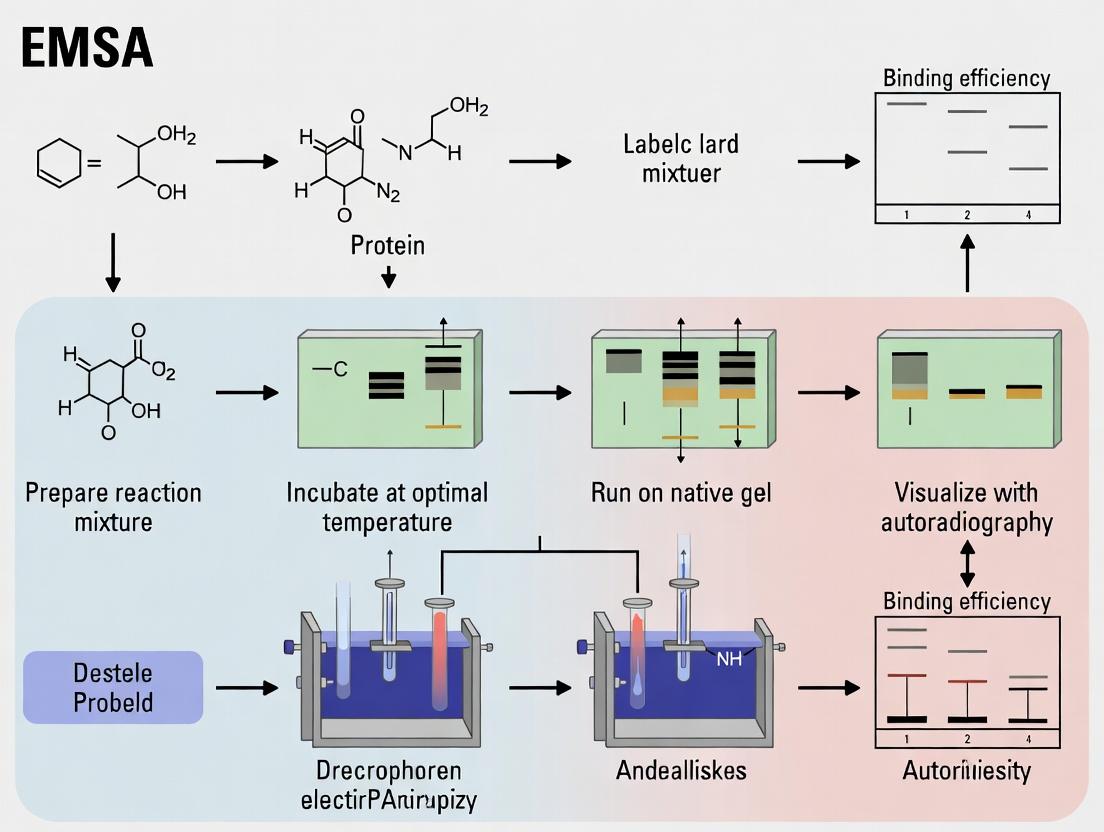
This comprehensive guide provides researchers, scientists, and drug development professionals with a detailed, step-by-step explanation of the Electrophoretic Mobility Shift Assay (EMSA) protocol.
Mastering the EMSA Protocol: A Step-by-Step Guide for Protein-Nucleic Acid Interaction Analysis
Abstract
This comprehensive guide provides researchers, scientists, and drug development professionals with a detailed, step-by-step explanation of the Electrophoretic Mobility Shift Assay (EMSA) protocol. Covering foundational principles, precise methodological execution, expert troubleshooting strategies, and critical validation approaches, the article equips readers to reliably detect and quantify specific interactions between proteins and nucleic acids (DNA or RNA). It addresses key applications in studying transcription factors, RNA-binding proteins, and drug-target interactions, ensuring robust data for regulatory analysis and therapeutic development.
EMSA Essentials: Unpacking the Principles and Power of the Electrophoretic Mobility Shift Assay
What is EMSA? Core Definition and Historical Context.
The Electrophoretic Mobility Shift Assay (EMSA), also known as the gel shift or band shift assay, is a foundational, low-throughput biochemical technique used to detect and analyze protein-nucleic acid interactions. Its core principle is that the electrophoretic mobility of a nucleic acid (DNA or RNA) probe through a native polyacrylamide or agarose gel is reduced upon binding by a protein, resulting in a measurable "shift." This technique is pivotal in molecular biology and drug development for studying transcription factor binding, ribonucleoprotein complexes, and nucleic acid-binding drug mechanisms.
Historical Context
The development of EMSA in the early 1980s marked a significant advancement over prior methods like nitrocellulose filter binding. The seminal work is attributed to two laboratories in 1981: Revzin and Garner, who studied the E. coli cAMP receptor protein (CAP), and Fried and Crothers, who independently investigated the lac repressor. Their innovation was the use of non-denaturing gel electrophoresis to separate protein-bound from free DNA, providing a simple, rapid, and sensitive method that preserved non-covalent interactions. This protocol enabled the quantitative assessment of binding affinity, stoichiometry, and specificity through competition experiments, revolutionizing the study of gene regulation.
Table 1: Key Historical Milestones and Impact Metrics of EMSA Development
| Year | Key Development | Primary Researchers | Key Impact Metric (Approx. Citations*) |
|---|---|---|---|
| 1981 | First formal description of the gel shift principle | Revzin & Garner; Fried & Crothers | 2,500+ (Fried & Crothers paper) |
| 1985-1988 | Adaptation for RNA-protein complexes | Multiple groups | Established core virology/RNA biology tool |
| 1990 | Introduction of supershift (antibody) EMSA | Multiple groups | Enabled specific protein identification |
| 1995-Present | Quantitative refinements (e.g., fluorescence, capillary electrophoresis) | Multiple groups | Increased sensitivity 10-100 fold |
*Citation estimates based on current literature database searches.
Detailed Experimental Protocol: Standard DNA-Protein EMSA
This protocol is framed within the context of a broader thesis on step-by-step EMSA optimization for transcription factor research.
1. Probe Preparation:
- Labeling: A short, double-stranded DNA oligonucleotide containing the suspected protein-binding site (20-50 bp) is labeled. Traditionally, this uses T4 polynucleotide kinase and [γ-³²P]ATP for radioactive detection. Modern alternatives include 5’-end labeling with biotin or fluorophores.
- Purification: The labeled probe is purified using a spin column (e.g., Sephadex G-25) to remove unincorporated nucleotides.
2. Binding Reaction:
- Assemble a 10-20 µL reaction mix on ice:
- Binding Buffer: 10 mM HEPES (pH 7.9), 50-100 mM KCl, 1 mM DTT, 0.1 mM EDTA, 5-10% glycerol, 0.1% NP-40.
- Non-specific Competitor: 1-2 µg of poly(dI-dC) or sheared, non-specific DNA to suppress protein binding to non-target sequences.
- Nuclear Extract or Purified Protein: Typically 2-20 µg of nuclear extract or 10-1000 fmol of purified protein.
- Labeled Probe: ~10 fmol (20,000 cpm for ³²P).
- Optional Controls:
- Competition: Add 100-fold molar excess of unlabeled specific (for specificity) or non-specific oligonucleotide.
- Supershift: Add 1-2 µg of antibody specific to the suspected DNA-binding protein.
- Incubate at room temperature or 30°C for 20-30 minutes.
3. Electrophoresis:
- Pre-run a 4-10% native polyacrylamide gel (29:1 acrylamide:bis) in 0.5X Tris-Borate-EDTA (TBE) or Tris-Glycine buffer at 100-150V for 30-60 minutes at 4°C.
- Load samples (with a non-denaturing dye like glycerol/bromophenol blue) and run at constant voltage (100-150V) for 1.5-2 hours, maintaining 4°C to prevent complex dissociation.
4. Detection & Analysis:
- For radioactive probes: Dry gel and expose to a phosphorimager screen or X-ray film.
- For fluorescent/biotinylated probes: Use appropriate scanner or streptavidin-HRP chemiluminescence.
- Quantify band intensities to calculate bound/free ratios for dissociation constant (Kd) estimation.
Visualization of Core EMSA Workflow and Principles
Diagram 1: EMSA Core Principle Workflow.
Diagram 2: EMSA Protocol Step-by-Step Flow.
The Scientist's Toolkit: Key Research Reagent Solutions
Table 2: Essential Materials for a Standard EMSA Experiment
| Reagent/Material | Function & Purpose in EMSA | Key Considerations |
|---|---|---|
| Purified Protein or Nuclear Extract | Source of the nucleic acid-binding protein of interest. | Nuclear extract quality is critical; use fresh or flash-frozen aliquots with protease inhibitors. |
| Labeled DNA/RNA Probe | The target nucleic acid sequence for binding detection. | Specific activity must be consistent. Biotin/fluorophore labels reduce hazard vs. ³²P. |
| Poly(dI-dC) | Non-specific polymeric competitor DNA. | Suppresses non-specific binding. Titration is required for each new protein/preparation. |
| Binding Buffer (10X Stock) | Provides optimal ionic strength, pH, and stabilizers for the interaction. | Often includes glycerol, DTT, and non-ionic detergents (NP-40). |
| Native PAGE Gel (4-10%) | Matrix for separation based on size/charge of complexes. | Acrylamide percentage determines resolution range. Must be pre-run and kept cold. |
| Electrophoresis Buffer (0.5X TBE) | Conducts current and maintains pH during separation. | Low ionic strength helps stabilize weak interactions. Recirculation may be needed. |
| Specific & Non-specific Competitor Oligos | Unlabeled oligonucleotides for binding specificity tests. | Specific: identical to probe. Non-specific: scrambled or unrelated sequence. |
| Specific Antibody (for Supershift) | Binds to the protein in the complex, causing a further mobility retardation. | Confirms protein identity. Must not disrupt the protein-DNA interaction. |
| Detection System | Visualizes the separated labeled complexes. | Phosphorimager (³²P), CCD camera (fluorescence), or film (chemiluminescence). |
This whitepaper, framed within a comprehensive thesis on Electrophoretic Mobility Shift Assay (EMSA) protocol research, details the core principle that alterations in electrophoretic mobility serve as a direct readout for molecular binding events. We provide an in-depth technical guide on exploiting these shifts to characterize interactions critical to drug development, such as protein-nucleic acid and protein-small molecule binding.
The fundamental premise is that a complex formed between two or more molecules migrates more slowly through a porous matrix (typically a polyacrylamide or agarose gel) than its individual components under an applied electric field. This mobility shift is a function of the complex's increased molecular weight, altered charge, and/or changed conformation. For researchers, this simple observation provides a powerful, quantitative tool to probe interaction kinetics, specificity, and affinity.
Core Quantitative Data: Binding Parameters from EMSA
Table 1: Quantifiable Parameters from EMSA Analysis
| Parameter | Description | Typical Measurement Method | Relevance to Drug Development |
|---|---|---|---|
| Dissociation Constant (Kd) | Equilibrium constant for complex dissociation. | Titration of fixed probe with increasing protein; data fit to binding isotherm. | Defines compound potency for target engagement. |
| Binding Specificity | Selectivity of interaction for a defined sequence or structure. | Competition with unlabeled specific vs. nonspecific competitors. | Predicts off-target effects and therapeutic index. |
| Stoichiometry | Molar ratio of binding partners in the complex. | Titration to saturation; analysis of complex size vs. composition. | Informs drug design for multivalent targets. |
| Association/Dissociation Kinetics | Rates of complex formation and breakdown. | Time-course experiments (e.g., pre-incubation vs. immediate loading). | Guides dosing frequency and mechanism of action. |
Table 2: Comparative Gel Matrix Properties for EMSA
| Matrix Type | Typical Concentration | Optimal Separation Range | Key Application in EMSA |
|---|---|---|---|
| Native Polyacrylamide | 4-10% | 10-1000 kDa protein-nucleic acid complexes | Standard for high-resolution separation of complexes. |
| Agarose | 0.8-2.0% | Large complexes (>500 kDa) & super-shifts | Useful for large ribonucleoprotein particles. |
| Composite Gels | Varies | Broad, multimodal separation | Resolving heterogeneous or aggregated samples. |
Detailed Experimental Protocol: Core EMSA for Protein-Nucleic Acid Interaction
Materials & Reagents
- Purified Protein: Target protein (>90% purity).
- Nucleic Acid Probe: 20-50 bp dsDNA or RNA, end-labeled with γ-³²P-ATP or a fluorophore.
- Binding Buffer: 10-20 mM HEPES (pH 7.5-8.0), 50-100 mM KCl/NaCl, 1-5 mM MgCl₂, 0.5-1 mM DTT, 0.1 mg/mL BSA, 5-10% glycerol.
- Polyacrylamide Gel: 4-8% acrylamide:bis (29:1 or 37.5:1) in 0.5x Tris-Borate-EDTA (TBE) or Tris-Glycine buffer.
- Electrophoresis System: Cold room or cooling apparatus.
- Detection System: Phosphorimager (radioactive) or fluorescence scanner.
Methodology
- Probe Preparation: Label nucleic acid probe using T4 Polynucleotide Kinase (for 5' end) or fill-in with Klenow fragment. Purify via spin column.
- Binding Reaction:
- Set up 20 μL reactions containing 1x Binding Buffer.
- Add 0.1-1 nM labeled probe.
- Titrate in purified protein (e.g., 0, 1, 2, 5, 10, 20, 50, 100 nM).
- Include controls: probe alone; competition with 100x molar excess unlabeled specific or mutant probe.
- Incubate at 25-30°C for 20-30 minutes.
- Electrophoresis:
- Pre-run native polyacrylamide gel in 0.5x TBE at 80-100 V for 30-60 min at 4°C.
- Load samples (add 2-5 μL of non-denaturing loading dye) directly into wells.
- Run at 80-120 V, constant voltage, 4°C, until bromophenol blue is near the bottom.
- Detection & Analysis:
- Transfer gel to blotting paper, dry, and expose to phosphor screen or image directly for fluorescence.
- Quantify band intensities for free probe and complex using software (e.g., ImageQuant, ImageJ).
- Fit data to a one-site specific binding model to calculate Kd.
Advanced Applications & Methodologies
Supershift Assay Protocol
- Purpose: To confirm the identity of a protein in a complex.
- Method: After forming the primary complex, add 1-2 μg of an antibody specific to the suspected protein component. Incubate further (30 min, 4°C). A further reduction in mobility ("supershift") confirms antibody binding to the complex.
Competition EMSA Protocol
- Purpose: To determine binding specificity and relative affinity.
- Method: Perform binding reactions with fixed concentrations of protein and labeled probe. Include increasing concentrations of unlabeled competitor nucleic acid (specific, mutant, or nonspecific). Calculate the IC50 for competition.
The Scientist's Toolkit: Essential Research Reagent Solutions
Table 3: Key Reagents for Mobility Shift Assays
| Reagent / Solution | Function & Critical Notes |
|---|---|
| High-Purity, Nuclease-Free BSA (0.1-0.5 mg/mL) | Blocks non-specific binding to tubes and gel matrix; stabilizes proteins. |
| Non-Ionic Detergent (e.g., NP-40, 0.01-0.1%) | Reduces non-specific protein-protein and protein-probe aggregation. |
| Poly(dI:dC) or tRNA (50-100 μg/mL) | Competes for non-sequence-specific nucleic acid-binding proteins. |
| DTT (0.5-1 mM) | Maintains reducing environment to preserve protein activity and conformation. |
| Glycerol (5-10% v/v) | Adds density to samples for easy gel loading; minimally impacts binding. |
| High-Specific-Activity Labeled Probe (< 0.5 nM final) | Ensures sensitive detection without probe excess that obscures Kd measurement. |
| Antibodies for Supershift (α-target protein) | Must be validated for recognition of native protein epitopes. |
Visualizing Pathways and Workflows
Diagram 1: Core EMSA Experimental Workflow
Diagram 2: The Central Mobility Shift Principle
Diagram 3: Quantitative Data Analysis Pipeline
This in-depth technical guide details the core components of the Electrophoretic Mobility Shift Assay (EMSA), framed within a comprehensive thesis on EMSA protocol step-by-step explanation for research. It is designed to support researchers, scientists, and drug development professionals in executing precise, reliable experiments for studying nucleic acid-protein interactions.
Core Components: A Technical Synopsis
The Probe
The probe is a labeled nucleic acid fragment (DNA or RNA) containing the specific sequence suspected to interact with the protein of interest.
- Design: Typically 20-40 base pairs, incorporating the consensus binding sequence.
- Labeling: Probes are labeled for detection. Radioactive (³²P) labeling offers high sensitivity, while non-radioactive methods (e.g., biotin, fluorescein) are safer and more common in modern labs.
- Purification: Essential post-synthesis to remove unincorporated nucleotides, which can cause high background.
The Protein
The protein component can be a purified recombinant protein, a nuclear extract, or a cell lysate containing the putative DNA/RNA-binding protein.
- Source Quality: The specificity and interpretability of the assay depend heavily on protein purity. Crude extracts require careful optimization and stringent controls.
- Concentration: Must be titrated to observe a clear shift without non-specific probe trapping.
Buffer Systems
Buffers maintain the biochemical environment for specific binding and subsequent electrophoresis.
- Binding Buffer: Provides optimal pH, ionic strength, and co-factors (e.g., Mg²⁺, DTT, glycerol, carrier proteins like BSA, non-specific competitors like poly(dI-dC)) for the protein-probe interaction.
- Electrophoresis Running Buffer: Typically Tris-Borate-EDTA (TBE) or Tris-Glycine. Its composition and ionic strength affect complex stability and migration.
- Gel Matrix: Non-denaturing polyacrylamide gels (typically 4-10%) are standard. The acrylamide:bis-acrylamide ratio and gel thickness influence resolution.
Electrophoresis
The physical separation of free probe from protein-bound probe.
- Conditions: Performed at 4-10°C to stabilize complexes during the run.
- Parameters: Low voltage (e.g., 100 V) for 1-2 hours to prevent complex dissociation due to heat.
- Transfer & Detection: For non-radioactive probes, separated complexes are transferred to a positively charged nylon membrane and detected via chemiluminescence.
Experimental Protocol: A Standard EMSA Workflow
Objective: To detect and characterize the interaction between a specific protein and a DNA probe.
Materials: See "The Scientist's Toolkit" table below.
Step-by-Step Methodology:
Probe Preparation & Labeling (Non-Radiocative, Biotin-based):
- Prepare 100 fmol of dsDNA probe in 45 µL of nuclease-free water.
- Add 5 µL of 10X Biotin labeling buffer and 2 µL of Biotin-N6-ddATP.
- Add 3 µL of Terminal Deoxynucleotidyl Transferase (TdT) enzyme. Mix and incubate at 37°C for 30 minutes.
- Purify the labeled probe using a spin column or ethanol precipitation. Resuspend in TE buffer. Store at -20°C.
DNA-Protein Binding Reaction:
- Prepare the binding reaction on ice in a final volume of 20 µL:
- 2 µL 10X Binding Buffer (100 mM Tris, 500 mM KCl, 10 mM DTT; pH 7.5)
- 1 µL Poly(dI-dC) (1 µg/µL)
- 1 µL BSA (10 µg/µL)
- 1 µL labeled probe (~5-20 fmol)
- X µL nuclear extract or purified protein (titrate from 2-10 µg)
- Nuclease-free water to 20 µL.
- Competition Control: Add 100-200X molar excess of unlabeled specific or non-specific competitor DNA to respective tubes.
- Supershift Control: Add 1-2 µg of specific antibody to the reaction.
- Mix gently and incubate at room temperature (20-25°C) for 20-30 minutes.
- Prepare the binding reaction on ice in a final volume of 20 µL:
Non-Denaturing Gel Electrophoresis:
- Prepare a 6% polyacrylamide gel (29:1 acrylamide:bis) in 0.5X TBE.
- Pre-run the gel in 0.5X TBE running buffer at 100 V for 60 minutes at 4°C.
- After incubation, add 5 µL of non-denaturing 5X loading dye to each reaction.
- Load samples onto the pre-run gel. Run at 100 V for approximately 90 minutes at 4°C, until the dye front is near the bottom.
Transfer & Detection (Biotinylated Probe):
- Electroblot the separated complexes onto a positively charged nylon membrane at 380 mA for 30-45 minutes at 4°C in 0.5X TBE.
- Crosslink DNA to the membrane using a UV crosslinker (120 mJ/cm²).
- Block the membrane with blocking buffer for 15 minutes.
- Incubate with Stabilized Streptavidin-Horseradish Peroxidase (HRP) Conjugate for 15 minutes.
- Wash membrane thoroughly.
- Incubate with chemiluminescent substrate and image using a digital imager.
Data Presentation: Key Quantitative Parameters
Table 1: Typical Quantitative Ranges for EMSA Component Optimization
| Component | Parameter | Typical Range | Purpose/Effect |
|---|---|---|---|
| Probe | Amount per reaction | 5 – 20 fmol | Signal intensity vs. background. |
| Length | 20 – 40 bp | Must encompass binding site; longer probes reduce resolution. | |
| Protein | Nuclear Extract | 2 – 10 µg | Titrate for clear shifted band without smearing. |
| Purified Protein | 10 – 200 ng | Higher purity requires less mass. | |
| Poly(dI-dC) | Amount per reaction | 0.5 – 2 µg | Suppresses non-specific protein-DNA interactions. |
| Electrophoresis | Gel Percentage | 4 – 10% Acrylamide | Lower % for larger complexes. |
| Voltage | 80 – 120 V | Maintains complex integrity; prevents heat-induced dissociation. | |
| Temperature | 4 – 10°C | Critical for complex stability during run. |
Table 2: Common EMSA Controls and Their Interpretation
| Control Type | Composition | Expected Result | Purpose |
|---|---|---|---|
| Free Probe | Probe only. | Single band at gel bottom. | Identifies migration of unbound probe. |
| Competition (Specific) | Reaction + excess unlabeled identical probe. | Disappearance/reduction of shifted band. | Confirms specificity of the protein-probe interaction. |
| Competition (Non-specific) | Reaction + excess unlabeled non-specific DNA. | Shifted band remains. | Confirms binding is sequence-specific. |
| Supershift | Reaction + antibody against the target protein. | Further reduction in mobility ("supershifted" band). | Confirms protein identity in the complex. |
| Mutant Probe | Reaction with a probe containing a mutated binding site. | No shifted band. | Confirms sequence specificity of binding. |
Visualized Workflows and Relationships
Diagram Title: EMSA Core Experimental Workflow
Diagram Title: EMSA Lane-by-Lane Results Interpretation
The Scientist's Toolkit: Essential Research Reagent Solutions
Table 3: Key Reagents and Materials for EMSA
| Item | Function / Purpose | Example / Specification |
|---|---|---|
| Biotin 3' End Labeling Kit | Non-radioactive, safe labeling of DNA probes. | Contains TdT enzyme, Biotin-N6-ddATP, buffers. |
| Chemiluminescent Nucleic Acid Detection Module | Detection of biotinylated probes post-transfer. | Includes stabilized streptavidin-HRP, substrates, blockers. |
| Non-Radiocative Nuclear Extract Kit | Preparation of protein extracts from cells/tissues. | Contains hypotonic and detergent-based lysis buffers, protease inhibitors. |
| Poly(dI-dC) | Non-specific competitor DNA. | Reduces non-specific protein-nucleic acid binding. |
| Non-Denaturing Acrylamide Mix (29:1) | For casting gels that maintain native protein structure. | Pre-mixed 30-40% solutions for consistency. |
| Positively Charged Nylon Membrane | Immobilizes separated nucleic acids for detection. | High binding capacity for negatively charged DNA/RNA. |
| Gel Shift Binding Buffer (10X) | Optimized concentrated buffer for binding reactions. | Includes salts, glycerol, DTT, MgCl₂ at correct pH. |
| High-Density TBE Buffer (5X) | For gel electrophoresis running buffer. | Ensures consistent pH and ionic strength during run. |
| Specific Transcription Factor Antibody | For supershift assays to confirm protein identity. | Should be verified for use in EMSA/supershift applications. |
This whitepaper is situated within a broader thesis investigating the optimized Electrophoretic Mobility Shift Assay (EMSA) protocol. The EMSA, a cornerstone technique for studying protein-nucleic acid interactions, serves as the foundational analytical engine for the applications discussed herein. Advancements in the sensitivity, quantitation, and throughput of EMSA protocols directly potentiate discoveries across molecular biology, functional genomics, and pharmaceutical development.
Table 1: Comparative Analysis of EMSA-Based Drug Screening Platforms
| Platform / Assay Type | Throughput (compounds/day) | Z'-Factor (Avg.) | IC50 Determination | Key Application in Discovery | Reference (Year) |
|---|---|---|---|---|---|
| Traditional Radioactive EMSA | Low (10-50) | 0.5 - 0.7 | Yes, laborious | Transcription factor (TF) validation | (PMID: 18948385) |
| Fluorescence-based EMSA (gel) | Medium (100-500) | 0.6 - 0.8 | Yes, improved | High-throughput TF inhibitor screening | (PMID: 24786628) |
| Microfluidic EMSA (Caliper) | High (1000-5000) | >0.8 | Yes, automated | Kinase/DNA binding inhibitor profiling | (PMID: 25415380) |
| AlphaScreen/Amplified Lum. Prox. Homog. Assay | Very High (>10,000) | >0.7 | Yes, homogenous | Nuclear receptor co-activator binding | (PMID: 26524167) |
| SPR (Surface Plasmon Resonance) | Medium (100-300) | N/A (Kd direct) | Yes, kinetic data | Fragment-based lead discovery for protein-RNA | (PMID: 31932420) |
Table 2: Key Therapeutic Targets Validated by EMSA Methodology
| Therapeutic Area | Target Transcription Factor / RNA-Protein Complex | Disease Link | Example Drug (Development Stage) | EMSA's Role |
|---|---|---|---|---|
| Oncology | NF-κB | Inflammation, Cancer | Bortezomib (Approved) | Validated inhibitor binding prevents DNA association. |
| Immunology | STAT3 | Autoimmune disorders, Cancer | TTI-101 (Clinical Trials) | Confirmed direct disruption of STAT3-DNA complex. |
| Neurodegeneration | REST (Repressor Element 1-Silencing Transcription factor) | Alzheimer's Disease | N/A (Target validation) | Mapping protein complexes on neuron-specific genes. |
| Infectious Disease | HIV-1 Tat protein / TAR RNA | HIV/AIDS | Tat inhibitors (Pre-clinical) | Screening compounds that disrupt critical viral interaction. |
| Metabolic Disease | PPAR-γ (Peroxisome proliferator-activated receptor gamma) | Type 2 Diabetes | Rosiglitazone (Approved) | Characterized ligand-induced DNA binding affinity shifts. |
Detailed Experimental Methodologies
Core EMSA Protocol for Transcription Factor Analysis
- Nuclear Extract Preparation: Harvest cells, lyse in hypotonic buffer (10 mM HEPES, 1.5 mM MgCl2, 10 mM KCl, protease inhibitors). Pellet nuclei, extract proteins with high-salt buffer (20 mM HEPES, 1.5 mM MgCl2, 420 mM NaCl, 25% glycerol). Determine protein concentration via Bradford assay.
- Probe Labeling: Anneal complementary oligonucleotides containing the consensus TF binding site. Label 5' ends with [γ-32P]ATP using T4 Polynucleotide Kinase or use fluorescent dyes (e.g., Cy5) for safer alternatives. Purify labeled probe using column chromatography.
- Binding Reaction: Assemble 20 μL reaction: 4 μL 5X Binding Buffer (50 mM HEPES, 250 mM KCl, 5 mM EDTA, 25 mM MgCl2, 50% glycerol, 5 mM DTT), 2 μg poly(dI-dC) as non-specific competitor, 10-20 μg nuclear extract, 1-2 fmol labeled probe. Include 100-200-fold excess unlabeled probe for competition control. Incubate 20-30 min at room temperature.
- Electrophoresis: Pre-run 6% non-denaturing polyacrylamide gel (29:1 acrylamide:bis) in 0.5X TBE buffer at 100V for 60 min. Load samples with minimal dye. Run at 100-150V at 4°C until dye migrates appropriately.
- Detection: For radioactive probes, dry gel and expose to phosphorimager screen. For fluorescent probes, scan gel directly using appropriate laser/scanner. Quantify band intensity to calculate percent shift and dissociation constants (Kd).
EMSA-Based High-Throughput Screening (HTS) Protocol for Drug Discovery
- Assay Miniaturization: Perform binding reactions in 384-well plates. Use fluorescently labeled DNA/RNA probes.
- Homogeneous Detection (e.g., AlphaScreen): Biotinylate one end of the DNA probe. Express the target protein with a GST or 6xHis tag. Use streptavidin-coated donor beads and anti-tag (e.g., anti-GST) coated acceptor beads. Protein-probe binding brings beads into proximity. Laser excitation (680 nm) of the donor bead produces singlet oxygen, triggering chemiluminescence emission (520-620 nm) in the acceptor bead if within ~200 nm.
- Compound Addition: Pre-incubate target protein with small-molecule compounds from a library (10 μM final concentration) for 15 minutes before adding the probe.
- Data Acquisition & Analysis: Read plates using an AlphaScreen-compatible plate reader. Calculate inhibition % as
[1 - (Signal_sample / Signal_DMSO_control)] * 100. Compounds showing >50% inhibition are retested in dose-response (8-point, 1 nM - 100 μM) to determine IC50 values using a 4-parameter logistic fit.
Visualization Diagrams
Title: EMSA as a Core Platform Enabling Drug Discovery Pathways
Title: Homogeneous HTS Workflow Using AlphaScreen Proximity Assay
The Scientist's Toolkit: Research Reagent Solutions
Table 3: Essential Reagents for EMSA-Driven Research
| Reagent / Material | Function & Importance in EMSA Applications |
|---|---|
| Recombinant Transcription Factor Proteins (Active) | Purified, full-length or DNA-binding domain (DBD) proteins are crucial for binding specificity studies, Kd calculation, and HTS. Source: HEK293 or insect cell expression systems. |
| Chemically Modified DNA/RNA Probes | Fluorescently labeled (Cy5, FAM) or biotinylated probes enable non-radioactive, high-sensitivity detection essential for modern HTS and diagnostic applications. |
| Non-specific Competitor DNA (poly(dI-dC)) | Blocks non-specific interactions between proteins and the probe, ensuring assay specificity by minimizing background shift. |
| EMSA Gel Shift Kits (Commercial) | Provide optimized buffers, control extracts, and probes for standardized, reproducible results, reducing protocol optimization time. |
| AlphaScreen/AlphaLISA Bead Kits | Enable homogeneous, no-wash assay formats for ultra-high-throughput screening of compound libraries against protein-nucleic acid interactions. |
| Microfluidic Capillary Electrophoresis Systems (e.g., PerkinElmer LabChip) | Automate separation and detection, providing superior quantitation, speed, and consistency for mid-to-high-throughput screening campaigns. |
| Phosphorimager & Fluorescent Gel Scanners | Critical instrumentation for quantitative analysis of gel shifts, providing digital data for calculating percent shift, affinity constants, and inhibition values. |
| Mobility Shift Buffers with Stabilizers | Contain glycerol, DTT, and non-ionic detergents to maintain protein stability and complex integrity during electrophoresis. |
Advantages and Limitations of EMSA vs. In-Silico Prediction Methods
Within the broader research context of developing a step-by-step EMSA protocol for probing transcription factor-DNA interactions, a critical evaluation of methodological choices is required. The Electrophoretic Mobility Shift Assay (EMSA) remains a foundational experimental technique for directly visualizing protein-nucleic acid interactions. Concurrently, in-silico prediction methods have advanced significantly, offering computational approaches to identify and characterize binding events. This technical guide provides an in-depth comparison of these two paradigms, framing their roles in the validation and discovery pipeline for researchers and drug development professionals.
Core Principle
EMSA, also called gel shift assay, detects complexes between native or recombinant proteins and nucleic acid probes based on reduced electrophoretic mobility of the bound complex compared to the free probe.
Detailed Step-by-Step Protocol (Key Experiments)
Protocol 1: Standard Radioactive EMSA for Transcription Factor Binding
- Probe Preparation: A 20-40 bp double-stranded DNA fragment containing the predicted binding motif is generated. One strand is 5'-end labeled using T4 Polynucleotide Kinase and [γ-³²P]ATP (specific activity: 3000 Ci/mmol).
- Protein Extract Preparation: Nuclear extracts are prepared from treated cells using a hypotonic lysis buffer (10 mM HEPES pH 7.9, 1.5 mM MgCl₂, 10 mM KCl, 0.5 mM DTT, protease inhibitors) followed by high-salt extraction (20 mM HEPES, 1.5 mM MgCl₂, 420 mM NaCl, 0.2 mM EDTA, 25% glycerol).
- Binding Reaction: In a 20 µL volume, combine:
- 1-5 µg nuclear extract or 10-100 ng recombinant protein.
- ~20,000 cpm labeled probe (1-10 fmol).
- Binding Buffer: 10 mM Tris pH 7.5, 50 mM KCl, 1 mM DTT, 2.5% glycerol, 0.05% NP-40, 100 µg/mL BSA.
- 1-2 µg poly(dI-dC) as non-specific competitor.
- Incubate at room temperature for 20-30 minutes.
- Electrophoresis: Load reaction onto a pre-run, native polyacrylamide gel (4-6% acrylamide:bisacrylamide 29:1, 0.5x TBE). Run at 4-10°C in 0.5x TBE at constant voltage (10 V/cm) until the bromophenol blue dye migrates ~¾ of the gel length.
- Detection: Gel is dried and exposed to a phosphorimaging screen or X-ray film. Quantification is performed via densitometry.
Protocol 2: Supershift EMSA for Specificity
- Follow standard EMSA. Prior to loading, add 1-2 µg of an antibody specific to the target protein to the completed binding reaction and incubate for an additional 20-60 minutes on ice. A further retardation ("supershift") confirms the identity of the binding protein.
Protocol 3: Competition EMSA for Affinity Assessment
- Include in the binding reaction a molar excess (e.g., 10x, 50x, 100x) of unlabeled competitor DNA (specific or mutated). Disappearance of the shifted band with specific, but not mutated, competitor confirms binding specificity and allows for relative affinity comparisons.
Core Principles
These methods computationally predict transcription factor binding sites (TFBS) primarily using:
- Sequence-Based Models: Position Weight Matrices (PWMs) or more complex neural networks scan DNA for matches to known motifs from databases like JASPAR or CIS-BP.
- Structure-Based Models: Use molecular docking and molecular dynamics simulations to predict interaction energy and binding pose based on 3D structures.
- Genomics-Integrated Models: Machine learning models (e.g., DeepBind, Basset) integrate chromatin accessibility (ATAC-seq), histone marks (ChIP-seq), and sequence to predict cell-type-specific binding.
Key Methodological Workflow
- Input Data Acquisition: Obtain DNA sequence of interest (promoter/enhancer region) and identify potential TF candidates.
- Motif Scanning: Utilize tools like FIMO or HOMER to scan sequences against PWM libraries.
- Genomic Context Integration: Use tools like Sei or BPNet to incorporate epigenetic data for cell-context predictions.
- Structure-Based Docking: If structures are available (from PDB or AlphaFold2), perform protein-DNA docking with tools like HADDOCK or HDOCK.
- Prioritization & Scoring: Rank predicted sites by p-value, score, binding energy, or functional impact.
Comparative Analysis: Advantages and Limitations
The following tables summarize the core quantitative and qualitative comparisons.
Table 1: Core Characteristics and Performance Metrics
| Feature | EMSA (Experimental) | In-Silico Prediction (Computational) |
|---|---|---|
| Primary Output | Direct visual proof of complex formation; binding kinetics/affinity | Probabilistic score or energy value for potential binding sites |
| Throughput | Low to medium (dozens of conditions/week) | Very high (genome-wide in hours) |
| Time to Result | 1-3 days per experiment | Minutes to hours per analysis |
| Cost per Sample | High ($50-$200, reagents, isotopes) | Very Low (computational resource cost) |
| Sensitivity | High (can detect nM affinity interactions) | Variable; high false positive/negative rates |
| Specificity | Very High (confirmed by supershift/competition) | Moderate; depends on model and input data quality |
| Quantitative Capability | Semi-quantitative (KD estimation possible) | Quantitative scores, but not directly comparable to physical KD |
Table 2: Qualitative Advantages and Limitations
| Aspect | EMSA Advantages | EMSA Limitations |
|---|---|---|
| Validation | Provides direct, biochemical validation of interaction. Gold standard. | Cannot map genome-wide interactions. Low throughput. |
| Context | Can use cell-derived nuclear extracts (native protein context). | In vitro conditions may not reflect cellular chromatin environment. |
| Information | Detects post-translational modifications affecting binding. | Does not provide nucleotide-resolution binding site. |
| Artifacts | Robust to sequence composition biases inherent in models. | Prone to gel artifacts, non-specific complexes. Radioactive waste. |
| Aspect | In-Silico Advantages | In-Silico Limitations |
| Scale & Discovery | Enables genome-wide, unbiased discovery of potential sites. | Predictions require experimental validation. High false discovery rate. |
| Mechanism | Can predict binding motifs and structural interfaces. | Limited accuracy for factors without well-defined motifs or structures. |
| Dynamic Range | Can analyze any genomic sequence virtually. | Poor at predicting cooperative binding or competitive displacement. |
| Dependency | Rapid iteration and hypothesis generation. | Heavily dependent on quality and completeness of training data. |
Integrated Workflow and Pathway Visualization
EMSA Core Experimental Pathway
The Scientist's Toolkit: Key Research Reagent Solutions
| Item | Function in EMSA/Validation | Example/Note |
|---|---|---|
| T4 Polynucleotide Kinase | Enzymatically labels synthetic DNA probes at the 5' end with ³²P. | Essential for radioactive EMSA sensitivity. |
| [γ-³²P]ATP | Radioactive phosphate donor for 5' end-labeling of DNA. | Requires radiation safety protocols. Non-radioactive alternatives (chemiluminescence) exist. |
| Poly(dI-dC) | Inert, synthetic polymer used as non-specific competitor DNA to reduce background. | Critical for clean signals when using crude nuclear extracts. |
| Non-ionic Detergent (NP-40) | Included in binding buffer to reduce non-specific protein adherence. | Typically at 0.05-0.1% concentration. |
| Protease Inhibitor Cocktail | Added to lysis buffers to prevent degradation of transcription factors during extract prep. | Essential for maintaining protein integrity. |
| TF-Specific Antibody | For supershift assays; confirms identity of protein in shifted complex. | Must be validated for use in EMSA (recognizes native protein). |
| Native Gel System | Pre-cast or hand-cast low-ionic strength polyacrylamide gels for complex separation. | Must be run at 4°C to maintain complex stability. |
| Phosphorimaging Screen/Film | Detects and captures the radioactive signal from shifted bands. | Phosphorimagers offer superior dynamic range and quantification. |
| Position Weight Matrix (PWM) | Core computational model representing TF binding motif for in-silico scanning. | Sourced from JASPAR, CIS-BP, or MEME suite. |
| Chromatin Accessibility Data | Input for advanced ML models (e.g., ATAC-seq peaks) to predict cell-specific binding. | Greatly increases prediction accuracy over sequence alone. |
The Definitive EMSA Protocol: A Detailed Step-by-Step Laboratory Guide
Within the framework of an Electrophoretic Mobility Shift Assay (EMSA) protocol, the initial phase of probe preparation is critical for assay sensitivity, specificity, and safety. This phase dictates the fundamental ability to detect protein-nucleic acid interactions. This guide details the technical considerations for designing oligonucleotide probes, the methodologies for radioactive and non-radioactive labeling, and the subsequent purification steps required for optimal EMSA performance.
Probe Design
The DNA or RNA probe must contain the exact consensus sequence of the transcription factor's predicted binding site.
- Length: Typically 20-40 base pairs. Longer sequences increase non-specific binding; shorter sequences may lack stability.
- Overhangs: Incorporating 3-5 bp 5´ overhangs facilitates efficient labeling by enzymes like T4 Polynucleotide Kinase.
- Specificity: Control probes with mutated binding sites (3-5 base substitutions) are essential for demonstrating binding specificity.
- Double-Stranding: Complementary single-stranded oligonucleotides must be annealed in equimolar ratios to form the double-stranded probe.
Protocol 2.1: Annealing Complementary Oligonucleotides
- Resuspend HPLC-purified single-stranded oligonucleotides in TE buffer (10 mM Tris-HCl, 1 mM EDTA, pH 8.0) to a stock concentration of 100 µM.
- Mix equal volumes of the complementary strands (e.g., 10 µL of each 100 µM stock).
- Add 5x annealing buffer (Final: 50 mM Tris-HCl, 10 mM MgCl₂, 50 mM NaCl, pH 8.0) and nuclease-free water to a final volume of 50 µL.
- Heat the mixture to 95°C for 5 minutes in a heat block.
- Slowly cool to room temperature (over 60-90 minutes). The double-stranded probe can be stored at -20°C.
Labeling Methodologies
Probe labeling introduces a detectable tag. The choice between radioactive and non-radioactive methods involves trade-offs between sensitivity, safety, cost, and signal stability.
Protocol 3.1: Radioactive Labeling with [γ-³²P] ATP using T4 PNK
- In a microcentrifuge tube, combine:
- 1 µL dsDNA probe (10-100 ng)
- 2 µL 10x T4 PNK Buffer
- 5 µL [γ-³²P] ATP (3000 Ci/mmol, 10 mCi/mL)
- 1 µL T4 Polynucleotide Kinase (10 U)
- 11 µL Nuclease-free water.
- Incubate at 37°C for 30 minutes.
- Terminate the reaction by heating at 65°C for 10 minutes.
- Proceed to Purification (Section 4).
Protocol 3.2: Non-Radioactive Labeling with Biotin using Biotin 3´-End DNA Labeling Kit
- In a microcentrifuge tube, combine:
- 1 µg of dsDNA probe in 16 µL nuclease-free water.
- 4 µL of 5x Terminal Deoxynucleotidyl Transferase (TdT) Reaction Buffer.
- 1 µL of Biotin-11-ddUTP (or other modified nucleotide).
- 1 µL of TdT Enzyme (20 U/µL).
- Mix gently and centrifuge briefly.
- Incubate at 37°C for 60 minutes.
- Terminate by adding 2 µL of 0.2 M EDTA (pH 8.0).
- Proceed to Purification (Section 4).
Probe Purification
Purification removes unincorporated nucleotides, which cause high background and reduce resolution.
Protocol 4.1: Purification via Mini-Spin Column (e.g., G-25 Sephadex)
- Hydrate Sephadex G-25 in TE buffer according to manufacturer instructions.
- Prepare a mini-spin column by placing it in a collection tube and loading the hydrated resin.
- Centrifuge at 750 x g for 1 minute to pack the column. Discard flow-through.
- Carefully apply the labeling reaction mixture to the center of the resin bed.
- Centrifuge at 750 x g for 2 minutes. The purified probe is collected in the flow-through. Unincorporated label is retained in the column matrix.
Data Presentation: Labeling Method Comparison
Table 1: Quantitative Comparison of Probe Labeling Methods
| Feature | Radioactive ([γ-³²P] ATP) | Non-Radioactive (Biotin) | Non-Radioactive (Fluorophore) |
|---|---|---|---|
| Typical Sensitivity | 0.1-1 fmol | 5-20 fmol | 1-5 fmol |
| Signal Detection Method | Phosphorimager / X-ray film | Chemiluminescence / Streptavidin-HRP | Fluorescence scanner |
| Exposure Time | 30 min - 24 hrs | 1-5 min (film) / seconds (digital) | Immediate scanning |
| Signal Half-life | ~14 days (³²P) | Stable for years | Photo-bleaching possible |
| Hazard Level | High (radiation) | Low | Low |
| Waste Disposal | Specialized, costly | Standard biohazard | Standard biohazard |
| Relative Cost per Assay | High (isotope, disposal) | Low | Moderate |
Table 2: Essential Research Reagent Solutions for EMSA Probe Preparation
| Item | Function |
|---|---|
| T4 Polynucleotide Kinase (PNK) | Catalyzes the transfer of the terminal (γ) phosphate from ATP to the 5´-hydroxyl terminus of DNA/RNA. Essential for radioactive labeling. |
| [γ-³²P] ATP | Radioactive substrate for T4 PNK, providing the high-energy phosphate group for 5´-end labeling. |
| Terminal Deoxynucleotidyl Transferase (TdT) | Adds modified nucleotides (e.g., Biotin-ddUTP) to the 3´-ends of DNA probes in a template-independent manner. |
| Biotin-11-ddUTP | A modified nucleotide containing a biotin tag and a dideoxyribose (dd) to terminate elongation, enabling 3´-end labeling. |
| Sephadex G-25 Spin Columns | Size-exclusion chromatography matrix for rapid separation of labeled probe (high MW) from unincorporated nucleotides (low MW). |
| Annealing Buffer (5x) | Provides optimal ionic conditions (Mg²⁺, Na⁺) and pH for efficient hybridization of complementary oligonucleotides. |
| Nuclease-Free Water | Prevents degradation of nucleic acids by contaminating nucleases during all reaction setups. |
Visualizations
Title: EMSA Probe Preparation and Labeling Workflow
Title: EMSA Probe Context in Signaling Pathway Detection
Within the comprehensive framework of an EMSA (Electrophoretic Mobility Shift Assay) protocol, the preparation of high-quality protein samples is the critical determinant of experimental success. This phase involves isolating proteins that specifically interact with nucleic acid probes. Two principal sources are employed: nuclear extracts, which provide native transcription factors from cultured cells or tissues, and purified recombinant proteins, which offer a defined system for studying specific interactions. The integrity and purity of these protein preparations directly influence the specificity and interpretability of the resulting gel shifts.
I. Preparation of Nuclear Extracts
Nuclear extraction isolates DNA-binding proteins, primarily transcription factors, from the nuclei of eukaryotic cells. The method below is a modified, high-yield protocol based on the principles of Dignam et al.
Detailed Protocol: Hypotonic Lysis Followed by High-Salt Nuclear Extraction
Principle: Cells are swollen in a hypotonic buffer and lysed via mechanical shearing. Nuclei are pelleted and subjected to a high-salt buffer to elute nuclear proteins, which are then dialyzed to a compatible salt concentration.
Reagents Needed:
- Hypotonic Buffer: 10 mM HEPES (pH 7.9), 1.5 mM MgCl₂, 10 mM KCl, 0.5 mM DTT, 0.5 mM PMSF, and protease inhibitor cocktail.
- Low-Salt Buffer: 20 mM HEPES (pH 7.9), 1.5 mM MgCl₂, 20 mM KCl, 0.2 mM EDTA, 25% (v/v) glycerol, 0.5 mM DTT, 0.5 mM PMSF.
- High-Salt Buffer: Identical to Low-Salt Buffer, but with 1.2 M KCl.
- Dialysis Buffer: 20 mM HEPES (pH 7.9), 100 mM KCl, 0.2 mM EDTA, 20% glycerol, 0.5 mM DTT, 0.5 mM PMSF.
Methodology:
- Harvest & Wash: Pellet 1x10⁷ to 1x10⁸ cells. Wash twice with ice-cold PBS.
- Hypotonic Swelling: Resuspend cell pellet in 5x pellet volume of Hypotonic Buffer. Incubate on ice for 15 minutes.
- Cell Lysis: Add 10% Nonidet P-40 (NP-40) to a final concentration of 0.6%. Vortex vigorously for 10 seconds.
- Nuclear Pellet: Centrifuge at 16,000 × g for 30 seconds at 4°C. The pellet contains nuclei.
- Nuclear Extraction: Resuspend nuclear pellet in ½ the original pellet volume of Low-Salt Buffer. Slowly add an equal volume of High-Salt Buffer while stirring. Stir gently on ice for 30 minutes.
- Clarification: Centrifuge at 16,000 × g for 30 minutes at 4°C. Retain the supernatant (crude nuclear extract).
- Dialysis: Dialyze the supernatant against 500 volumes of Dialysis Buffer for 4-6 hours at 4°C.
- Final Clarification & Storage: Centrifuge to remove precipitates. Aliquot, flash-freeze in liquid nitrogen, and store at -80°C. Determine protein concentration via Bradford assay.
Quantitative Data: Nuclear Extract Yield and Quality Metrics
Table 1: Representative Yield from Common Cell Lines
| Cell Line | Starting Cell Number | Average Total Protein Yield (µg) | Average Concentration (µg/µL) | Recommended EMSA Load (ng) |
|---|---|---|---|---|
| HEK 293 | 5 x 10⁷ | 800 - 1200 | 1.5 - 2.5 | 200 - 500 |
| HeLa | 5 x 10⁷ | 600 - 1000 | 1.2 - 2.0 | 200 - 500 |
| Jurkat | 1 x 10⁸ | 500 - 900 | 1.0 - 1.8 | 300 - 600 |
| Mouse Liver Tissue | 100 mg | 1000 - 2000 | 2.0 - 4.0 | 500 - 1000 |
II. Preparation of Recombinant Proteins
Recombinant proteins provide a homogenous, sequence-verified source of DNA-binding protein, free from confounding cellular factors.
Detailed Protocol: Expression and Purification of His-Tagged Proteins inE. coli
Principle: A plasmid encoding the protein of interest with an N- or C-terminal polyhistidine (6xHis) tag is transformed into an expression strain. Protein expression is induced, and the soluble protein is purified via Immobilized Metal Affinity Chromatography (IMAC) using Ni²⁺ resin.
Reagents Needed:
- Expression Plasmid: pET or pQE series vector with gene of interest.
- E. coli Strain: BL21(DE3) for T7-promoter driven expression.
- LB Media & Ampicillin (100 µg/mL).
- Induction Agent: 0.5 - 1.0 mM Isopropyl β-D-1-thiogalactopyranoside (IPTG).
- Lysis Buffer: 50 mM NaH₂PO₄ (pH 8.0), 300 mM NaCl, 10 mM imidazole, 1 mg/mL lysozyme, protease inhibitors.
- Wash Buffer: 50 mM NaH₂PO₄ (pH 8.0), 300 mM NaCl, 20-40 mM imidazole.
- Elution Buffer: 50 mM NaH₂PO₄ (pH 8.0), 300 mM NaCl, 250-500 mM imidazole.
- Storage/Dialysis Buffer: 20 mM HEPES (pH 7.9), 100 mM KCl, 10% glycerol, 1 mM DTT.
Methodology:
- Expression: Transform plasmid into BL21(DE3). Grow culture in LB+Amp at 37°C to OD₆₀₀ ~0.6. Induce with 0.5-1.0 mM IPTG. Incubate at appropriate temperature (often 16-30°C) for 4-16 hours.
- Harvest & Lysis: Pellet cells. Resuspend in Lysis Buffer. Incubate on ice for 30 min, then sonicate on ice (6 x 10 sec bursts). Clear lysate by centrifugation at 20,000 × g for 30 min at 4°C.
- IMAC Purification: Incubate cleared lysate with pre-equilibrated Ni-NTA agarose resin for 1 hour at 4°C with gentle agitation.
- Wash & Elute: Pack resin into a column. Wash with 10-20 column volumes of Wash Buffer. Elute protein with 5-10 column volumes of Elution Buffer.
- Buffer Exchange & Storage: Dialyze or desalt eluted protein into Storage Buffer to remove imidazole. Concentrate if necessary, aliquot, flash-freeze, and store at -80°C. Assess purity by SDS-PAGE and concentration by absorbance at 280 nm.
Quantitative Data: Recombinant Protein Expression and Binding
Table 2: Typical Yields and EMSA Parameters for Recombinant Transcription Factors
| Protein (Example) | Molecular Weight (kDa) | Typical Yield (mg/L culture) | Purity (% by SDS-PAGE) | Recommended EMSA Load (fmol) | Apparent Kd (nM)* |
|---|---|---|---|---|---|
| p50 (NF-κB) | 50 | 5 - 15 | >95% | 10 - 50 | 0.5 - 2.0 |
| c-Jun | 39 | 3 - 10 | >90% | 20 - 100 | 5.0 - 20.0 |
| His-Tagged DBD | ~15 | 2 - 8 | >98% | 50 - 200 | Varies |
*Apparent dissociation constant determined by EMSA; varies with probe sequence.
The Scientist's Toolkit: Research Reagent Solutions
Table 3: Essential Materials for Protein Sample Preparation
| Item | Function & Rationale |
|---|---|
| Protease Inhibitor Cocktail (EDTA-free) | Prevents proteolytic degradation of sample during extraction/purification. EDTA-free is crucial for metal-dependent proteins. |
| Dithiothreitol (DTT) | Reducing agent that maintains cysteine residues in reduced state, preserving protein activity and preventing aggregation. |
| Phenylmethylsulfonyl fluoride (PMSF) | Serine protease inhibitor. Added fresh to extraction buffers due to short half-life in aqueous solution. |
| Glycerol | Stabilizing agent (10-20% v/v) added to storage buffers to prevent protein denaturation and freezing at -80°C. |
| Ni-NTA Agarose Resin | Immobilized metal affinity chromatography (IMAC) resin for high-affinity purification of polyhistidine-tagged recombinant proteins. |
| Imidazole | Competes with His-tag for binding to Ni²⁺; used in wash buffers to remove weakly bound contaminants and in elution buffers to recover pure protein. |
| High-Salt Buffers (KCl/NaCl) | Disrupts ionic interactions during nuclear extraction (e.g., 400 mM+ KCl) and prevents non-specific binding during recombinant protein purification. |
| Dialysis Tubing/Cassettes | For buffer exchange to remove salts, imidazole, or other small molecules incompatible with downstream EMSA binding reactions. |
| Bradford/BCA Assay Kits | For accurate quantification of total protein concentration in nuclear extracts and recombinant protein preparations. |
Visualizing the Workflows
Nuclear Extract Preparation Workflow
Recombinant His-Tagged Protein Workflow
Protein Prep Role in EMSA Thesis
This whitepaper constitutes Phase 3 of a comprehensive thesis on the step-by-step optimization of the Electrophoretic Mobility Shift Assay (EMSA). Following nucleic acid probe design (Phase 1) and protein extract preparation (Phase 2), this phase focuses on the critical parameters governing the binding reaction itself. The formation of specific, stable protein-nucleic acid complexes is a kinetic and thermodynamic process highly sensitive to incubation time, temperature, and the composition of the master mix. Systematic optimization of these variables is paramount to maximize complex yield, ensure specificity, and generate reproducible, publication-quality data for researchers and drug development professionals targeting gene regulatory mechanisms.
Incubation Time Optimization
Incubation time directly influences the attainment of binding equilibrium. Insufficient time leads to suboptimal complex formation, while excessive incubation may promote non-specific interactions or degradation.
Experimental Protocol: Time-Course EMSA
- Prepare a standardized binding master mix containing buffer, DTT, poly(dI-dC), and a constant amount of purified protein or nuclear extract.
- Aliquot the master mix into multiple reaction tubes.
- Add a constant amount of labeled probe to each tube, initiating the reaction.
- Incubate all tubes at a constant, optimized temperature (e.g., 25°C).
- Stop the reactions by placing them on ice at precise time intervals (e.g., 0, 5, 10, 20, 30, 45, 60 minutes).
- Immediately load each stopped reaction onto a pre-run non-denaturing gel.
- Analyze the gel shift signal intensity (complex formation) versus time.
Table 1: Representative Data from a Time-Course Optimization Experiment
| Incubation Time (min) | Relative Complex Yield (%) | Notes |
|---|---|---|
| 0 | 0 | No incubation control. |
| 5 | 35 | Rapid initial binding phase. |
| 10 | 65 | |
| 20 | 95 | Apparent equilibrium reached. |
| 30 | 100 | Maximum signal. |
| 45 | 98 | Signal stabilizes. |
| 60 | 92 | Slight decrease, possible degradation. |
Incubation Temperature Optimization
Temperature affects reaction kinetics, protein folding, and the stringency of binding. Typical test temperatures include 4°C (for stable complexes), 25°C (room temperature), and 30° or 37°C (physiological).
Experimental Protocol: Temperature Gradient EMSA
- Prepare a single, large-volume master mix containing all reaction components except probe.
- Aliquot the master mix into separate tubes for each temperature condition.
- Pre-incubate each aliquot at its target temperature for 2-3 minutes.
- Initiate reactions by adding labeled probe to each pre-warmed/cooled aliquot.
- Incubate at the respective target temperatures for a fixed, intermediate time (e.g., 20 minutes).
- Stop reactions on ice and analyze by gel electrophoresis.
Table 2: Effect of Incubation Temperature on Binding
| Temperature (°C) | Relative Complex Yield (%) | Specificity Index (S/N)* | Recommended Use Case |
|---|---|---|---|
| 4 | 80 | Low (1.5) | Stabilizing very weak interactions. |
| 25 | 100 | High (4.2) | General purpose, optimal for many TFs. |
| 30 | 95 | Medium (3.0) | For thermophilic proteins. |
| 37 | 60 | Low (1.8) | Can reduce yield; used for physiological relevance. |
*Specificity Index (Signal-to-Noise): Ratio of supershifted/specific complex intensity to non-specific smear/bands.
Master Mix Composition Optimization
The master mix provides the chemical environment for binding. Key components include buffer, salts, carrier DNA, reducing agents, and stabilizers.
Core Master Mix Components & Optimization Protocol: A systematic approach tests one variable at a time (OFAT) or uses a Design of Experiments (DoE) matrix.
- Buffer & pH: Test 10-25 mM HEPES (pH 7.5-8.0) vs. Tris (pH 7.0-7.5).
- Monovalent Cations (KCl/NaCl): Titrate from 0 to 150 mM. High salt can disrupt electrostatic interactions.
- Divalent Cations (Mg²⁺, Zn²⁺): Essential for some DNA-binding domains (e.g., zinc fingers). Titrate 0-10 mM MgCl₂.
- Reducing Agent (DTT/β-mercaptoethanol): Maintains cysteine residues. Test 0.5-5 mM DTT.
- Carrier DNA/RNA: Poly(dI-dC) or yeast tRNA competes for non-specific binding. Titrate from 0 to 5 µg per reaction.
- Non-ionic Detergent (NP-40): Reduces non-specific adsorption (0.01-0.1%).
- Stabilizers (Glycerol, BSA): Glycerol (2-10%) can stabilize proteins; BSA (0.1 mg/mL) prevents surface adhesion.
Table 3: Optimized Master Mix Formulation for a Typical Nuclear Factor
| Component | Stock Concentration | Final Concentration in 20 µL Reaction | Function |
|---|---|---|---|
| Binding Buffer | 5X | 1X (10 mM HEPES, pH 7.9) | Maintains pH and ionic strength. |
| KCl | 1 M | 50 mM | Modulates ionic strength. |
| MgCl₂ | 100 mM | 2.5 mM | Cofactor for specific TFs. |
| DTT | 100 mM | 1 mM | Reduces disulfide bonds. |
| Glycerol | 100% | 5% (v/v) | Stabilizes protein, aids loading. |
| Poly(dI-dC) | 1 µg/µL | 2.5 µg | Non-specific competitor DNA. |
| NP-40 | 10% (v/v) | 0.05% (v/v) | Reduces non-specific binding. |
| Purified Protein/Extract | Variable | 5-20 µg | The DNA-binding factor. |
| Labeled Probe | 10 nM | 0.5-1 nM (~20 fmol) | The target DNA/RNA sequence. |
| Nuclease-free H₂O | - | To final volume | Solvent. |
The Scientist's Toolkit: Research Reagent Solutions
| Item | Function & Rationale |
|---|---|
| High-Purity HEPES Buffer | Provides superior pH stability during room temperature/37°C incubations compared to Tris. |
| PCR-Grade Poly(dI-dC) | Consistent length and purity ensure reproducible competition against non-specific binding. |
| UltraPure DTT Solution | Stable, ready-to-use reducing agent; prevents oxidation of protein cysteines critical for DNA binding. |
| Protease/R Nase Inhibitor Cocktails | Added to master mix when using crude extracts to prevent degradation of protein or probe. |
| Non-radiolabeled Probe Competitors | Unlabeled specific (for specificity) or mutant (for confirmation) oligonucleotides for competition assays. |
| Mobility Shift Assay 5X Buffer Kits | Commercial, pre-optimized buffers for common transcription factors (e.g., NF-κB, AP-1). |
| Recombinant Protein Standards | Positive control proteins (e.g., p50/p65 for NF-κB) to validate assay conditions. |
| Fluorescent or Chemiluminescent Nucleic Acid Dyes | For non-radioactive probe labeling and detection, enhancing safety and convenience. |
Diagrams
Title: Factors Influencing EMSA Binding Reaction Outcome
Title: EMSA Binding Reaction Setup & Optimization Workflow
Phase 3 optimization is an iterative, empirical process that establishes the foundation for a robust and reliable EMSA. Data presented in Tables 1-3 provide a benchmark, but optimal conditions are protein- and probe-specific. A systematic investigation of incubation time, temperature, and master mix composition, as outlined in the provided protocols, is non-negotiable for achieving high-specificity binding. The resulting optimized conditions directly enable the subsequent phases of the EMSA thesis: gel electrophoresis (Phase 4) and detection/quantification (Phase 5), ultimately leading to definitive insights into nucleic acid-protein interactions critical for basic research and therapeutic discovery.
This guide constitutes Phase 4 of a comprehensive Electrophoretic Mobility Shift Assay (EMSA) protocol thesis. Non-denaturing (native) gel electrophoresis is the cornerstone of EMSA, enabling the separation and visualization of protein-nucleic acid complexes based on their charge-to-mass ratio and shape without disrupting non-covalent interactions. The integrity of this phase dictates the assay's success in studying transcription factor binding, ribonucleoprotein complexes, and drug-target interactions in development pipelines.
Core Principles and Buffer Chemistry
The fundamental principle is to maintain native conformation. Unlike SDS-PAGE, no anionic denaturants are used. Migration depends on the intrinsic charge, size, and shape of the complex. The buffer system must provide appropriate pH, conductivity, and ion composition to preserve complex stability during electrophoresis.
Critical Buffer Components:
- Tris-HCl/Glycine or Tris-Borate-EDTA (TBE): Common continuous buffer systems. Tris provides buffering capacity, borate or glycine serves as the leading ion.
- Divalent Cations (Mg²⁺, Zn²⁺): Often added (1-10 mM) to stabilize specific protein-DNA interactions.
- Glycerol (5-10%): Adds density to samples for easy loading and can stabilize complexes.
- Carrier Proteins (BSA, 0.1 mg/mL): Reduce non-specific binding to walls of tubes and the gel matrix.
- Non-ionic Detergents (e.g., NP-40, 0.1%): Can be added to minimize protein aggregation without denaturation.
Table 1: Common Non-Denaturing Gel Electrophoresis Buffer Systems
| Buffer System | Typical Composition (1x) | pH | Common Use Case | Key Consideration |
|---|---|---|---|---|
| Tris-Glycine | 25 mM Tris, 192 mM Glycine | 8.3 | General protein, large complexes | Lower ionic strength; run at 4°C to prevent overheating. |
| Tris-Borate-EDTA (TBE) | 89 mM Tris, 89 mM Boric Acid, 2 mM EDTA | 8.3 | Protein-DNA/RNA complexes (EMSA) | Borate can interact with RNA; EDTA chelates divalent cations. |
| Tris-Acetate-EDTA (TAE) | 40 mM Tris, 20 mM Acetic Acid, 1 mM EDTA | 8.3 | Alternative for large nucleoprotein complexes | Lower buffering capacity than TBE during long runs. |
Detailed Protocol: Casting and Running the Gel
Gel Casting Protocol
Materials:
- Acrylamide/Bis-acrylamide (29:1 or 37.5:1 ratio for native gels)
- 1x Non-denaturing Electrophoresis Buffer (e.g., 0.5x TBE or Tris-Glycine)
- Ammonium Persulfate (APS) 10% (w/v), freshly prepared
- Tetramethylethylenediamine (TEMED)
- Gel cassette, comb, casting stand
Method:
- Prepare Acrylamide Solution: Mix the appropriate volumes of acrylamide/bis solution, 10x native gel buffer, and distilled water to achieve the desired percentage (typically 4-10% for EMSA). For a 6% gel (10 mL): 2.0 mL of 30% acrylamide/bis (29:1), 1.0 mL of 10x TBE, 6.95 mL H₂O.
- Degas (Optional): Degas the solution for 5-10 minutes to prevent bubble formation during polymerization, which can accelerate the process.
- Initiate Polymerization: Add 50 µL of 10% APS and 10 µL of TEMED. Swirl gently to mix. Do not vortex.
- Cast the Gel: Immediately pipette the solution between assembled glass plates. Insert a suitable comb without trapping air bubbles.
- Polymerize: Allow polymerization to proceed for 30-45 minutes at room temperature. A distinct refractive line will appear.
- Pre-run: Once polymerized, assemble the gel in the electrophoresis tank filled with pre-chilled 1x running buffer (same as used in casting). Pre-run the gel at 100V for 30-60 minutes at 4°C to establish even ion fronts and remove excess persulfate.
Sample Preparation and Electrophoresis Run
Method:
- Prepare Samples: Mix your binding reaction (protein, labeled nucleic acid probe, specific/unlabeled competitor, etc.) with 1/5th volume of native loading dye (e.g., 30% glycerol, 0.25% bromophenol blue/xylene cyanol in water or buffer). Avoid SDS or denaturing dyes.
- Load and Run: After pre-run, carefully flush wells with buffer to remove urea. Load samples. Run the gel in pre-chilled (4°C) buffer at constant voltage (recommended: 80-150 V). The optimal voltage is determined by gel thickness and percentage to prevent "smiling" bands or overheating, which can dissociate complexes.
- Run Time: Electrophoresis is typically continued until the dye front migrates 2/3 to 3/4 of the gel length. Bromophenol blue migrates at ~50 bp in double-stranded DNA EMSA under native conditions.
- Post-Run Processing: Carefully disassemble the gel apparatus. The gel can then be transferred to a membrane for a wet/dry transfer (for downstream blotting) or prepared for direct autoradiography/fluorescence imaging if using labeled probes.
Table 2: Optimized Running Conditions Based on Gel Percentage
| Gel % (Acrylamide:Bis 29:1) | Recommended Voltage (constant) | Approx. Run Time (for 8 cm gel) | Ideal Complex Size Range |
|---|---|---|---|
| 4% | 80-100 V | 60-75 min | >500 kDa / Large RNP complexes |
| 6% | 100-120 V | 75-90 min | 100-500 kDa (Standard EMSA) |
| 8% | 120-150 V | 90-105 min | 50-200 kDa |
| 10% | 150-180 V | 105-120 min | <100 kDa |
The Scientist's Toolkit: Essential Research Reagent Solutions
Table 3: Key Reagents for Native Gel Electrophoresis
| Reagent | Function & Rationale | Typical Concentration/Formulation |
|---|---|---|
| High-Purity Acrylamide/Bis-acrylamide | Forms the cross-linked polyacrylamide matrix. A 29:1 or 37.5:1 ratio provides larger pore sizes suitable for native separation of complexes. | 30-40% stock solution, 29:1 (acrylamide:bis) |
| Non-Denaturing Running Buffer (10x stock) | Provides ionic strength and pH for electrophoresis without disrupting non-covalent interactions. Common: TBE, Tris-Glycine. | e.g., 10x TBE: 890 mM Tris, 890 mM boric acid, 20 mM EDTA, pH 8.3 |
| Ammonium Persulfate (APS) | Free-radical initiator for acrylamide polymerization. Must be fresh. | 10% (w/v) in H₂O, aliquot and store at -20°C |
| TEMED | Catalyst that accelerates APS decomposition, initiating polymerization. | Liquid, stored at 4°C |
| Native Gel Loading Dye | Increases sample density for loading; contains visible tracking dyes. Must be non-denaturing (no SDS). | 30% Glycerol, 0.25% Bromophenol Blue/Xylene Cyanol in 1x running buffer |
| Divalent Cation Stocks (MgCl₂, ZnCl₂) | Added to running buffer or binding reactions to stabilize specific metal-dependent protein-nucleic acid interactions. | 100 mM stock in H₂O, sterile-filtered |
| Poly(dI:dC) or Non-specific Carrier DNA/RNA | Added to binding reactions to reduce non-specific probe binding. Critical for clean EMSA signals. | 1 mg/mL stock in TE buffer or water |
Troubleshooting and Optimization
- Diffuse or Smeared Bands: Often due to overheating. Solution: Run the gel at 4°C, reduce voltage, use a lower percentage gel, or ensure the buffer recirculation if running for extended periods.
- Complex Dissociation During Run: The electrophoresis conditions may be too harsh. Solution: Optimize buffer pH and ionic strength, include stabilizing agents (divalent cations, glycerol) in both the buffer and gel, and shorten run time.
- Poor Polymerization or Gel Consistency: Caused by old APS, incorrect TEMED amount, or oxygen inhibition. Solution: Use fresh APS, degas the acrylamide solution, and ensure gel plates are clean and properly sealed.
- Vertical Smiling or Frowning: Uneven heat dissipation across the gel. Solution: Use a power supply with constant voltage, run in a cold room, and ensure the buffer level is even across both electrodes.
The final, critical phase of the Electrophoretic Mobility Shift Assay (EMSA) protocol involves detecting and visualizing the protein-nucleic acid complexes resolved by gel electrophoresis. The choice of detection method—autoradiography, chemiluminescence, or fluorescence—is dictated by the labeling strategy employed for the nucleic acid probe. This phase determines the assay's sensitivity, dynamic range, quantitative capabilities, and safety profile. Within the broader context of EMSA research, optimizing this phase is paramount for accurately identifying and quantifying specific binding events, crucial for studying transcription factors, RNA-binding proteins, and screening potential drug candidates.
Core Detection Methodologies
Autoradiography
Principle: Utilizes radioactive isotopes (commonly ³²P) incorporated into the DNA or RNA probe. Radioactive decay exposes a photographic film or a phosphor imaging screen, creating an image of the migrated complexes.
Detailed Protocol for Film Autoradiography:
- Post-Electrophoresis: Following non-denaturing PAGE, carefully transfer the gel to a piece of Whatman 3MM filter paper.
- Drying: Dry the gel under vacuum at 80°C for 45-60 minutes using a gel dryer.
- Exposure: In a darkroom under safelight conditions, place the dried gel in an X-ray film cassette.
- Film Application: Overlay a sheet of autoradiography film (e.g., Kodak BioMax MS) on the gel. Close the cassette.
- Exposure Time: Expose at -80°C for several hours to several days, depending on signal strength.
- Development: Develop the film manually using developer and fixer solutions or via an automated processor.
Quantitative Considerations: Phosphor storage imaging (using a PhosphorImager) is now standard, offering a wider linear dynamic range (~10⁵) compared to X-ray film (~10²). Sensitivity can detect sub-femtomole amounts of radioactivity.
Safety: Requires strict handling protocols, designated radioactive work areas, and specialized waste disposal.
Chemiluminescence
Principle: A non-radioactive method where the probe is labeled with haptens (e.g., biotin or digoxigenin). After electrophoresis and transfer to a positively charged nylon membrane, the hapten is detected by an enzyme-conjugated streptavidin or antibody (e.g., Horseradish Peroxidase, HRP). Addition of a chemiluminescent substrate (e.g., Luminol) produces light emission captured by film or a CCD camera.
Detailed Protocol for Chemiluminescent Detection:
- Electrophoretic Transfer: After EMSA, electroblot the gel onto a positively charged nylon membrane (0.5A, 30-60 min, 4°C in 0.5X TBE).
- Crosslinking: UV crosslink the nucleic acids to the membrane (120 mJ/cm²).
- Blocking: Incubate membrane in blocking buffer (e.g., 5% non-fat milk in TBST) for 1 hour at RT.
- Conjugate Incubation: Incubate with HRP-conjugated streptavidin (for biotin) or anti-digoxigenin antibody for 30-60 min at RT.
- Washing: Perform 3-4 washes (5 min each) with TBST.
- Substrate Incubation: Incubate with a stable chemiluminescent HRP substrate (e.g., Luminol/Enhancer) for 5 min.
- Imaging: Drain excess substrate and image using a digital imaging system capable of sensitive chemiluminescence detection (exposure times: 10 sec to 30 min).
Advantages: High sensitivity (approaching that of radioactivity), longer probe stability, and no radiation hazards.
Fluorescence
Principle: The nucleic acid probe is directly labeled with a fluorophore (e.g., Cy3, Cy5, FAM, TAMRA). Complexes are visualized directly within the gel using a fluorescence scanner or imager.
Detailed Protocol for Fluorescent EMSA:
- Probe Labeling: Purchase or synthesize an oligonucleotide with a 5' or 3' fluorophore modification.
- Standard EMSA: Perform binding reaction and non-denaturing PAGE as usual. Crucially, avoid any post-staining steps.
- Imaging: Scan the gel directly while it is still in its plates or on a clean imaging surface using a fluorescence gel imager or scanner equipped with appropriate excitation/emission filters for the fluorophore used.
- Analysis: Use dedicated software to quantify band intensities.
Advantages: Fastest workflow, no transfer or development steps, safe, and allows for multiplexing with multiple different colored fluorophores.
Comparative Analysis
Table 1: Quantitative Comparison of EMSA Detection Methods
| Parameter | Autoradiography (³²P) | Chemiluminescence (Biotin/HRP) | Fluorescence (Direct Fluorophore) |
|---|---|---|---|
| Typical Sensitivity | 0.1-1 fmol | 1-10 fmol | 10-100 fmol |
| Linear Dynamic Range | ~5 orders (PhosphorImager) | ~3-4 orders | ~3-4 orders |
| Assay Time Post-EMSA | Hours to days | 2-4 hours | Immediate (5-30 min scan) |
| Probe Stability | Short (isotope decay) | Years (at -20°C) | Years (protected from light) |
| Safety/Hazard | High (ionizing radiation) | Low | Low |
| Relative Cost | Low (reagents), High (waste/disposal) | Moderate | High (labeled probes, scanner) |
| Multiplexing Ability | No | Difficult | Yes (multiple colors) |
Table 2: The Scientist's Toolkit: Key Reagents & Materials for Detection
| Item | Function in Detection |
|---|---|
| ³²P-dATP/dCTP | Radioactive nucleotide for probe labeling by kinase or fill-in reactions. |
| Phosphor Imaging Screen | Stores latent image from radioactive decay for quantitative digital scanning. |
| Positively Charged Nylon Membrane | Binds negatively charged nucleic acids for chemiluminescent detection via Western transfer. |
| HRP-Conjugated Streptavidin | Binds biotin-labeled probe; catalyzes chemiluminescent reaction. |
| Chemiluminescent Substrate (Luminol-based) | HRP substrate that emits light upon enzymatic reaction, producing the detectable signal. |
| Fluorophore-Labeled Oligonucleotide | Probe directly conjugated to a fluorescent dye (e.g., Cy5) for in-gel detection. |
| Fluorescence Gel Scanner | Imaging system with appropriate lasers and filters to excite and capture emitted light from fluorophores. |
| Blocking Agent (e.g., BSA, Non-fat Milk) | Reduces non-specific binding of detection reagents to the membrane (chemiluminescence). |
Signaling Pathways & Workflows
Title: EMSA Detection Method Decision Workflow
Title: Chemiluminescent Detection Signaling Pathway
This guide details the critical application of the Electrophoretic Mobility Shift Assay (EMSA) for quantitative binding affinity determination, framed within a comprehensive, step-by-step EMSA protocol research thesis. The transition from a qualitative "band shift" assay to a rigorous quantitative tool enables researchers to derive the dissociation constant (Kd), a fundamental parameter in characterizing protein-nucleic acid or protein-protein interactions crucial for understanding gene regulation and drug discovery.
Theoretical Foundation forKdDetermination by EMSA
In a simplified 1:1 binding model (Protein + Probe ⇌ Protein:Probe Complex), the Kd is the concentration of protein at which half the probe is bound. In a quantitative EMSA, a fixed, trace concentration of labeled probe is titrated with increasing concentrations of the protein. The fraction of probe bound (θ) is quantified from the gel and plotted against the total protein concentration. The Kd is derived by fitting this binding isotherm to a suitable model, most commonly via non-linear regression to the quadratic solution of the law of mass action, which accounts for probe depletion.
Quantitative EMSA Experimental Protocol
Core Principle: Measure the fraction of bound probe across a protein concentration series spanning orders of magnitude.
Step-by-Step Methodology:
Probe Preparation: Label a short, specific DNA/RNA oligonucleotide (typically 20-40 bp) at the 5' or 3' end with a fluorophore (e.g., Cy5, FAM) or radioisotope (³²P). Purify to homogeneity. Use at a trace concentration (<< expected Kd, often 10-50 pM) to ensure the free protein concentration approximates the total added.
Protein Purification: Use recombinant, purified protein. Determine an accurate concentration via absorbance (A280) or quantitative assay (e.g., Bradford, BCA).
Binding Reaction Setup:
- Prepare a master mix containing buffer, nonspecific competitor DNA (e.g., poly(dI-dC)), DTT, BSA, and the labeled probe.
- Aliquot a constant volume of the master mix into a series of tubes.
- Add a serial dilution of purified protein to the tubes to create a concentration series (e.g., 12 points from 0.1 nM to 1 µM). Include a "no protein" control.
- Incubate at optimal temperature (e.g., 25°C) for 30-60 min to reach equilibrium.
Non-Denaturing Gel Electrophoresis:
- Pre-run a non-denaturing polyacrylamide gel (4-8%) in 0.5x TBE buffer at 4-10°C for 30-60 min.
- Load binding reactions (without dye that can disrupt complexes) under low voltage conditions.
- Run until sufficient separation of free and bound probe is achieved.
Detection & Quantification:
- For fluorescent probes: Image gel directly using a fluorescence scanner (e.g., Typhoon).
- For radioactive probes: Expose to a phosphorimager screen.
- Quantify the signal intensity (volume) of the bands corresponding to the free probe (F) and the protein-probe complex (C) using software (ImageQuant, ImageJ).
- Calculate the fraction bound (θ) for each lane: θ = C / (C + F).
Kd Calculation by Curve Fitting:
- Plot θ (y-axis) vs. total protein concentration [P]total (x-axis, logarithmic scale often used).
- Fit the data to the quadratic binding equation using scientific graphing software (Prism, Origin, R): where [P]t = total protein, [L]t = total probe concentration.
- The fitted Kd parameter is the reported value. Perform replicates (n≥3) to determine error.
Quantitative Data Presentation
Table 1: Example Data from a Quantitative EMSA Experiment for Protein X Binding to Site Y
| Total Protein (nM) | Free Probe Intensity | Complex Intensity | Fraction Bound (θ) |
|---|---|---|---|
| 0.0 | 10500 | 0 | 0.000 |
| 0.1 | 10100 | 350 | 0.033 |
| 0.5 | 9200 | 1250 | 0.120 |
| 1.0 | 8000 | 2350 | 0.227 |
| 2.5 | 5600 | 4650 | 0.454 |
| 5.0 | 3500 | 6700 | 0.657 |
| 10.0 | 1800 | 8400 | 0.824 |
| 25.0 | 600 | 9700 | 0.942 |
| 50.0 | 200 | 10200 | 0.981 |
| Kd (fitted) | 2.1 ± 0.3 nM |
Table 2: Comparison of Kd Determination Methods for Nucleic Acid Interactions
| Method | Typical Kd Range | Throughput | Solution vs. Gel | Key Advantage | Key Limitation |
|---|---|---|---|---|---|
| Quantitative EMSA | pM – nM | Low-Medium | Gel-based | Visual verification of complex integrity. | Non-equilibrium during electrophoresis. |
| Fluorescence Polarization/Anisotropy | nM – µM | High | Solution | True solution equilibrium, fast. | Requires fluorescent labeling. |
| Surface Plasmon Resonance (SPR) | pM – mM | Medium | Surface-immobilized | Provides kinetics (kon, koff). | Immobilization may alter binding. |
| Isothermal Titration Calorimetry (ITC) | nM – µM | Low | Solution | Provides full thermodynamics (ΔH, ΔS). | Requires high protein concentration. |
Visualizing the Workflow and Analysis
Diagram 1: Quantitative EMSA Kd Determination Workflow (94 chars)
Diagram 2: Quantitative EMSA Kd Calculation Logic (78 chars)
The Scientist's Toolkit: Key Research Reagent Solutions
Table 3: Essential Materials for Quantitative EMSA
| Item | Function & Critical Notes |
|---|---|
| Purified Target Protein | Recombinant, high purity (>95%). Accurate concentration determination (A280/BCA) is critical for reliable Kd. |
| Fluorescently-Labeled Probe | HPLC-purified oligonucleotide labeled with Cy5, FAM, or TAMRA. Must be used at trace concentration (e.g., 20 pM). |
| Non-Specific Competitor DNA | Poly(dI-dC) or sheared salmon sperm DNA. Quenches non-specific protein interactions. Concentration must be optimized. |
| EMSA Gel Shift Binding Buffer (5X/10X) | Provides optimal pH, ionic strength, and stabilizing agents (e.g., DTT, glycerol) for the specific interaction. |
| Non-Denaturing Polyacrylamide Gel | Typically 4-8% acrylamide:bis (29:1 or 37.5:1) in 0.5x TBE. Pre-run and run at 4-10°C to maintain complex stability. |
| Fluorescent Gel Scanner | e.g., Typhoon, Amersham ImageQuant. Requires appropriate laser/excitation filter for the fluorophore used. |
| Quantification Software | ImageQuant TL, ImageJ (with gel analysis plugin). Must accurately integrate band volume, not just peak intensity. |
| Curve-Fitting Software | GraphPad Prism, Origin, R. Must be capable of non-linear regression with user-defined equations (quadratic binding model). |
Solving Common EMSA Problems: Expert Troubleshooting and Optimization Strategies
Within the broader thesis on the step-by-step explanation of the Electrophoretic Mobility Shift Assay (EMSA) protocol, a "no shift" result—where the protein-nucleic acid complex fails to form or is not detected—represents a critical experimental failure. This technical guide provides a systematic diagnostic framework to troubleshoot the absence of gel mobility shift, focusing on the core triumvirate of protein activity, probe integrity, and buffer composition. Accurate diagnosis is paramount for researchers, scientists, and drug development professionals utilizing EMSA to study transcription factors, RNA-binding proteins, and nucleic acid-protein interactions in drug discovery and basic research.
Systematic Diagnostic Framework
The failure of a complex to form can be traced to issues in three primary domains. The following workflow outlines the logical diagnostic process.
Diagram Title: Logical Flow for Diagnosing No Shift in EMSA
Diagnosing Probe Integrity Issues
The nucleic acid probe (DNA or RNA) must be pure, correctly labeled, and structurally intact.
Detailed Protocol: Direct Probe Analysis
- Method: Perform a control EMSA run using the labeled probe alone (no protein). Load 20,000-50,000 cpm of the probe per lane.
- Expected Result: A single, tight band corresponding to the full-length probe.
- Problem Indicators: Smearing indicates degradation; multiple bands suggest inadequate purification or nicking; low signal intensity suggests labeling inefficiency.
- Quantitative Remediation: Compare band intensity to a reference ladder. If >15% of signal is outside the primary band, probe should be re-synthesized or re-purified.
Diagnosing Protein Activity and Purity
The protein extract or recombinant protein must be functional, correctly folded, and free of inhibitors.
Detailed Protocol: Functional Positive Control Assay
- Method: If available, test the same protein preparation in an independent functional assay (e.g., a luciferase reporter assay for a transcription factor).
- Alternative Method: Perform a "spike-in" experiment using a commercially available, active protein known to bind a consensus sequence (e.g., AP-1, NF-κB) with its specific probe in parallel with your experimental setup.
- Analysis: A lack of activity in the control assay points squarely to a problem with the protein sample itself.
Table 1: Common Protein-Related Issues and Solutions
| Issue | Typical Cause | Diagnostic Test | Quantitative Fix |
|---|---|---|---|
| Loss of Activity | Improper storage, repeated freeze-thaw, oxidation. | Functional control assay. | Use single-use aliquots; add 10% glycerol; store at -80°C. Activity loss >50% requires new prep. |
| Incorrect Folding | Lack of chaperones, denaturing conditions during purification. | Circular Dichroism (CD) spectroscopy. | Refold in vitro: dilute into buffer with 0.5-1M arginine, then dialyze. |
| Proteolysis | Contaminating proteases in lysate. | Western blot alongside EMSA. | Add protease cocktail (e.g., 1 mM PMSF, 1 µg/ml Leupeptin). Multiple bands on WB confirm issue. |
| Insufficient Concentration | Overestimation by Bradford assay, dilution error. | Compare to BSA standard on Coomassie-stained gel. | Titrate 50-500 nM protein in binding reaction. |
Diagnosing Buffer and Condition Problems
The binding reaction buffer must provide appropriate ionic strength, pH, and cofactors.
Detailed Protocol: Buffer Optimization Matrix
- Method: Set up a series of binding reactions varying one critical component at a time.
- Divalent Cations: Test 0, 0.5, 1, 2, 5 mM MgCl₂ or ZnCl₂.
- Monovalent Cations: Test 0, 25, 50, 100, 200 mM KCl or NaCl.
- Non-Specific Competitor: Titrate poly(dI-dC) from 0 to 5 µg per reaction.
- pH: Test buffers from pH 6.5 to 8.5 (e.g., HEPES vs. Tris).
- Stabilizers: Test the addition of 0.01% NP-40, 0.1 mg/ml BSA, or 5% glycerol.
- Analysis: Run EMSA for each condition. The appearance of a shift in any condition identifies the critical missing component.
Table 2: Critical Buffer Components and Their Optimal Ranges
| Component | Primary Function | Typical Working Concentration | Effect of Absence/Low | Effect of Excess |
|---|---|---|---|---|
| MgCl₂ | Cofactor for many DNA-binding proteins, stabilizes structure. | 0.5 - 5 mM | No complex formation. | Non-specific aggregation, salt inhibition. |
| KCl/NaCl | Modulates ionic strength & binding specificity. | 50 - 150 mM | Non-specific binding. | Disruption of specific protein-probe interaction. |
| Poly(dI-dC) | Non-specific competitor DNA. | 0.5 - 2 µg/µl | High background, smearing. | Competition with specific probe, loss of signal. |
| DTT/β-ME | Reduces disulfide bonds, prevents oxidation. | 0.5 - 1 mM DTT | Protein aggregation, loss of activity. | Can reduce some protein complexes. |
| Glycerol | Stabilizes protein, aids gel loading. | 5 - 10% (v/v) | Potential protein instability. | Alters electrophoresis, can disrupt binding. |
The Scientist's Toolkit: Essential EMSA Reagents
Table 3: Key Research Reagent Solutions for EMSA Troubleshooting
| Reagent/Material | Function | Example Product/Catalog |
|---|---|---|
| Gel-Shift Binding 5X Buffer | Provides optimized salts, glycerol, and pH for a broad range of nuclear extract interactions. | SignaTect EMSA Kit (Promega), LightShift Chemiluminescent EMSA Kit (Thermo). |
| Biotin- or Digoxigenin-End-Labeled Control Oligonucleotide | Validated positive control probe and protein to test entire EMSA workflow. | Biotinylated NF-κB Consensus Oligo (Invitrogen). |
| HeLa Nuclear Extract | Widely used positive control extract containing many active transcription factors. | HeLa Nuclear Extract (Active Motif, Abcam). |
| Non-Specific Competitor DNA (Poly(dI-dC)) | Competes for non-specific DNA-binding proteins to reduce background. | Poly(dI-dC) (Sigma-Aldrich). |
| Protease Inhibitor Cocktail (EDTA-Free) | Preserves protein activity in lysates/nuclear extracts without chelating Mg²⁺. | cOmplete, EDTA-Free (Roche). |
| High-Capacity Streptavidin-HRP Conjugate | Highly sensitive detection for biotinylated probes in chemiluminescent EMSA. | Pierce High Sensitivity Streptavidin-HRP (Thermo). |
| Native Gel Electrophoresis System | Pre-cast polyacrylamide gels and buffers optimized for native protein-nucleic acid separation. | Novex 6% DNA Retardation Gels (Thermo). |
A methodical approach to diagnosing a "no shift" result in EMSA, as detailed within this thesis on the protocol, is essential for robust research. By sequentially interrogating probe integrity, protein functionality, and buffer composition using the provided protocols and quantitative benchmarks, researchers can efficiently identify the root cause. Implementing the corrective actions and utilizing the essential toolkit reagents will restore assay sensitivity, ensuring reliable detection of nucleic acid-protein interactions critical to mechanistic studies and drug development pipelines.
1. Introduction
Within the broader thesis on a step-by-step explanation of the Electrophoretic Mobility Shift Assay (EMSA) protocol, the challenges of high background and smearing represent critical failure points that can obscure data interpretation. This technical guide provides an in-depth analysis of the primary causes—non-specific binding (NSB) and gel artifacts—and details validated, current methodologies to resolve them, ensuring the accurate detection of specific protein-nucleic acid interactions.
2. Core Problem: Non-Specific Binding (NSB)
NSB occurs when proteins interact with probe DNA or other assay components through electrostatic or hydrophobic forces rather than sequence-specific recognition. It manifests as diffuse, upper-shifted smears or multiple non-discrete bands in the gel, competing with or masking the specific protein-DNA complex.
Primary Culprits & Quantitative Impact:
- Suboptimal Competitor DNA: The use of incorrect or insufficient non-specific competitor DNA (e.g., poly(dI-dC)) is the most frequent cause. A 2023 systematic review in Nucleic Acids Research demonstrated that titrating competitor DNA from 0 to 100 µg/mL reduced NSB signal intensity by up to 95% for nuclear extracts, with optimal suppression typically between 50-100 µg/mL for general use.
- Protein Concentration: Excessive protein (>20 µg of crude nuclear extract per reaction) linearly increases NSB. Data shows a strong correlation (R² > 0.85) between protein amount and background intensity beyond the saturation point of the specific complex.
- Salt & Buffer Conditions: Low ionic strength (<50 mM KCl) favors electrostatic NSB. Incorrect pH or absence of divalent cations (e.g., Mg²⁺) can destabilize specific complexes while having less effect on NSB.
Table 1: Quantitative Effects of NSB Reduction Strategies
| Parameter Adjusted | Typical Test Range | Optimal Value for NSB Reduction | Observed Effect on Specific Complex |
|---|---|---|---|
| Poly(dI-dC) Competitor | 0 - 150 µg/mL | 50 - 100 µg/mL | >90% NSB reduction; minimal impact on specific signal. |
| Total Protein | 2 - 50 µg/reaction | 5 - 20 µg/reaction | Linear NSB increase above optimum; specific complex saturates. |
| Monovalent Salt (KCl) | 0 - 200 mM | 50 - 150 mM | Reduces NSB by ~70% at 100 mM vs. 0 mM. Critical for stability. |
| Non-Ionic Detergent | 0 - 0.1% NP-40/Triton | 0.01 - 0.05% | Reduces hydrophobic NSB by ~40%; higher concentrations disrupt complexes. |
| Incubation Temperature | 4°C - 37°C | Room Temp (20-25°C) | 4°C can increase some NSB; 37°C may destabilize specific complexes. |
Protocol 2.1: Systematic Optimization to Minimize NSB
- Titration of Competitor DNA:
- Set up a series of binding reactions with a constant amount of labeled probe and protein.
- Add increasing concentrations of poly(dI-dC) or other relevant competitor (e.g., salmon sperm DNA): 0, 0.5, 1, 2, 5, 10 µg/µL final reaction volume.
- Resolve by EMSA. The optimal concentration is the lowest that eliminates smearing without diminishing the intensity of the discrete, specific shifted band.
- "Cold Probe" Competition Assay (Specificity Control):
- Prepare three parallel reactions: a. Labeled probe only: Baseline binding. b. Labeled probe + protein + 100x molar excess unlabeled specific competitor: Specific signal should be abolished. c. Labeled probe + protein + 100x molar excess unlabeled non-specific competitor: Specific signal should persist.
- Failure of control (b) to compete indicates NSB. Persistence of signal in (c) confirms specificity.
3. Core Problem: Gel Artifacts
Smearing and poor band resolution often originate from the gel electrophoresis step itself, independent of binding conditions.
Primary Culprits:
- Gel Polymerization Issues: Incomplete polymerization creates a heterogeneous matrix, causing probe trapping and smearing.
- Electrophoresis Conditions: Excessive voltage (>10 V/cm) generates heat, destabilizing complexes and causing band broadening.
- Poorly Prepared or Degraded Buffers: Incorrect ionic strength or pH in the gel or running buffer.
- Sample Loading Issues: Presence of excessive salts, glycerol, or particulate matter in the sample.
Protocol 3.1: Preparation of a High-Resolution Non-Denaturing Polyacrylamide Gel
- Gel Casting:
- For a 6% gel (optimal for most complexes): Mix 3.0 mL 30% acrylamide:bisacrylamide (29:1), 5.0 mL 5x TBE (or 0.5x TBE final), 11.9 mL nuclease-free water, 150 µL 10% ammonium persulfate (APS), and 15 µL TEMED. Cast immediately.
- Critical: Allow to polymerize for at least 60 minutes at room temperature. Pre-running the gel for 30-60 minutes at 100V before loading removes residual persulfate and unpolymerized acrylamide.
- Electrophoresis Parameters:
- Use 0.5x TBE as running buffer (lower ionic strength than 1x for better resolution).
- Run at a constant voltage of 80-100 V (for a standard mini-gel apparatus) at 4°C. This maintains a cold, stable environment.
- Load samples containing a minimal volume of dye (e.g., 1/10 volume of 10x loading buffer with minimal SDS).
4. The Scientist's Toolkit: Key Reagent Solutions
Table 2: Essential Materials for Robust EMSA
| Reagent / Material | Function & Critical Notes |
|---|---|
| Poly(dI-dC) | Gold-standard non-specific competitor DNA. Binds and titrates out proteins with affinity for general DNA structure. |
| High-Purity Acrylamide/Bis | Essential for clear, uniform gel polymerization. Use electrophoresis-grade, freshly prepared or aliquoted to prevent hydrolysis. |
| Non-Radiative Probe Labeling Kits (e.g., Chemiluminescent, Fluorescent) | Modern alternative to radioisotopes. Follow manufacturer's protocol precisely for optimal labeling efficiency and sensitivity. |
| Protease & Phosphatase Inhibitor Cocktails | Added to all protein extraction and binding buffers to prevent sample degradation and preserve post-translational modification states. |
| Magnetic Separation Beads (for Supershift/Competition) | Streptavidin-coupled beads can rapidly pull down biotinylated probes for cleaner, faster analysis of complexes. |
| Glycogen or tRNA | Used as an inert carrier during ethanol precipitation of labeled probes to improve recovery and minimize loss. |
| High-Binding Tubes & Low-Protein-Binding Tips | Minimizes loss of protein and probe to tube walls, critical for quantitative reproducibility. |
5. Integrated Troubleshooting Workflow
Diagram Title: EMSA Background & Smear Troubleshooting Decision Tree
6. Advanced Resolution: Supershift Assay Protocol
Supershift assays confirm protein identity but can introduce smearing if not performed carefully.
Protocol 6.1: Clean Supershift Assay
- Primary Binding: First, form the specific protein-DNA complex under optimized conditions (using Protocol 2.1).
- Antibody Addition: After 20-30 minutes, add 1-2 µg of the specific antibody (or control IgG) to the reaction. Do not increase salt or adjust buffer.
- Secondary Incubation: Incubate for an additional 30-60 minutes at 4°C or room temperature. Note: Longer incubations or high antibody concentrations can destabilize complexes.
- Gel Modification: Increase the gel percentage to 4-6% and use a lower acrylamide:bis ratio (e.g., 37.5:1) to better resolve the higher molecular weight supershifted complex.
- Load Carefully: Include controls: probe+antibody (no protein), specific complex + control IgG.
7. Conclusion
Effective resolution of high background and smearing in EMSA requires a systematic, two-pronged approach targeting both the biochemical conditions of the binding reaction and the physical parameters of the gel electrophoresis. By methodically applying the quantitative optimizations and protocols outlined herein, researchers can transform ambiguous, smeared results into clear, publication-quality data that robustly supports conclusions within drug development and mechanistic biology research.
The Electrophoretic Mobility Shift Assay (EMSA) is a cornerstone technique for studying protein-nucleic acid interactions. Within this framework, the supershift assay is a critical refinement. It involves the addition of a specific antibody to the protein-DNA/protein-RNA binding reaction. A successful supershift—characterized by a further reduction in electrophoretic mobility (a "supershifted" band) or a diminution of the original protein-nucleic acid complex band—provides definitive evidence of the presence of a specific protein within that complex. This whitepaper details the technical considerations for antibody selection, necessary experimental controls, and correct interpretation of results to ensure robust and publication-quality data.
Antibody Selection: A Strategic Framework
The choice of antibody is the single most critical factor determining the success of the supershift experiment. Not all antibodies are suitable.
Key Selection Criteria:
- Specificity: The antibody must be highly specific for the target protein (antigen). Polyclonal antisera often contain antibodies against epitopes that remain accessible in the DNA-bound form, making them frequently more successful than monoclonal antibodies (mAbs). However, highly specific mAbs against the native protein can be excellent if their epitope is not obscured.
- Applicability: The antibody must be validated for use in EMSA/supershift assays or, minimally, in native conditions (e.g., immunoprecipitation, chromatin IP). Antibodies validated only for denatured protein (western blot) are often unsuitable, as they may recognize linear epitopes not available in the natively folded, DNA-bound protein.
- Host Species and Isotype: Consider the protein source (e.g., human, mouse) to avoid cross-reactivity. The antibody should not interact with other components in the nuclear extract.
Decision Table: Antibody Types for Supershift
| Antibody Type | Epitope Target | Success Rate in EMSA* | Key Advantage | Primary Risk |
|---|---|---|---|---|
| Polyclonal | Multiple, conformational | High (~60-75%) | Recognizes multiple epitopes; higher chance one is accessible in DNA-bound complex. | Non-specific interactions; batch variability. |
| Monoclonal | Single, linear/conformational | Variable (~30-50%) | Excellent specificity and reproducibility. | Epitope may be buried or altered upon DNA binding. |
| Antibody Validated for ChIP/EMSA | Native protein conformation | Very High (~80-90%) | Guaranteed to recognize the antigen in its DNA-associated state. | May be less readily available or more costly. |
| Antibody Validated for WB only | Denatured, linear | Very Low (<10%) | Readily available. | Epitope likely not presented in native complex; high failure rate. |
*Estimated success rates based on literature survey and empirical data from core facilities.
Experimental Protocol: Supershift Assay Workflow
Required Reagents & Materials
- The Scientist's Toolkit: Supershift Assay Essentials
- Nuclear Extract: Contains the transcription factors/nucleic acid-binding proteins of interest.
- Labeled Probe: Double-stranded DNA or RNA oligonucleotide containing the consensus binding site, end-labeled with ³²P, biotin, or fluorophore.
- Specific Antibody: For the target protein, validated for supershift/EMSA or native applications.
- Control Antibodies: Isotype-matched IgG (negative control); antibody against a known component of the complex (positive control, if available).
- Non-specific Competitor DNA: Poly(dI-dC) or sheared salmon sperm DNA to reduce non-specific probe binding.
- Binding Buffer: Typically contains HEPES/KCl, glycerol, DTT, and MgCl₂.
- Non-denaturing Polyacrylamide Gel: For separation of complexes (usually 4-6% acrylamide:bis ratio 29:1 or 37.5:1).
- Electrophoresis & Detection System: Appropriate gel box, running buffer, and equipment for autoradiography, phosphorimaging, or chemiluminescence.
Detailed Methodology
Standard EMSA Binding Reaction:
- Set up primary protein-probe binding reactions in a final volume of 10-20 µL.
- Incubate nuclear extract (2-10 µg) with 1-2 µg of non-specific competitor DNA in binding buffer on ice for 10 minutes.
- Add labeled probe (20,000-50,000 cpm for radioactive; ~10-50 fmol for non-radioactive) and incubate at room temperature for 20-30 minutes.
Antibody Addition for Supershift:
- Pre-incubation Method (Recommended): Divide the completed binding reaction into aliquots. Add 0.5-2 µg of specific antibody (or control IgG) to the respective tubes. Incubate further at 4°C for 30-60 minutes or at room temperature for 15-30 minutes before loading the gel. This allows antibody-protein interaction.
- Co-incubation Method: Add antibody directly to the initial binding reaction with the nuclear extract (before probe addition) and incubate on ice for 30-60 minutes, then add probe and proceed. This can sometimes improve antibody access.
Electrophoresis & Detection:
- Load samples directly onto a pre-run, non-denaturing polyacrylamide gel in 0.5x TBE or similar low-ionic-strength buffer.
- Run the gel at 100-150 V at 4°C to maintain complex stability and minimize "smiling."
- Transfer, dry (for radioactive), and detect according to your probe label method.
Critical Controls and Interpretation
Proper controls are non-negotiable for unambiguous interpretation.
Mandatory Control Experiments Table
| Control Type | Purpose | Expected Result | Interpretation of Deviation |
|---|---|---|---|
| No Antibody | Baseline for protein-probe complexes. | Clear bands for free probe and protein-probe complexes. | N/A (Baseline). |
| Isotype Control Antibody | Rules out non-specific antibody effects. | Band pattern identical to "No Antibody" lane. | If complex is altered, the antibody has non-specific effects; data is invalid. |
| Antibody Alone + Probe | Confirms antibody does not bind probe directly. | Only free probe band visible. | If a retarded band appears, antibody binds probe; find a different antibody. |
| Specific Antibody + Mutant Probe | Confirms complex specificity. | No protein-probe complex bands; supershift irrelevant. | If supershift occurs with mutant probe, indicates non-specific antibody binding. |
| Cold Probe Competition | Validates specificity of the original complex. | Dose-dependent disappearance of specific complex band. | Failure to compete indicates non-specific binding in the primary EMSA. |
Interpreting Gel Results
- Successful Supershift: Appearance of a new, higher molecular weight band (supershifted complex) concurrent with a decrease in intensity of the original protein-probe complex band. This is the gold-standard result.
- Blocking/Inhibition: Disappearance or significant reduction of the original complex band without a visible supershifted band. This can occur if the antibody binds an epitope critical for DNA binding or stabilizes a conformation that dissociates from DNA. It is still evidence the protein was in the complex.
- No Effect: No change in the banding pattern. The target protein is either not present in the complex, or the antibody does not recognize it in the DNA-bound context.
- Non-specific Effects: Changes in band patterns (loss, smearing) also seen with the isotype control. Results are invalid.
Integrated Supershift-EMSA Workflow
The supershift protocol is a powerful extension of the EMSA, transforming it from a tool that detects binding activity into one that can identify specific protein components. Its success hinges on rigorous antibody selection, the implementation of a complete panel of controls, and careful, critical interpretation of the gel data. When executed correctly, it provides a critical piece of mechanistic evidence in the study of gene regulation, protein function, and drug-target interactions.
The Electrophoretic Mobility Shift Assay (EMSA) is a cornerstone technique for studying protein-nucleic acid interactions. Within the step-by-step optimization of a robust EMSA protocol, the titration of unlabeled competitor DNA—often termed "cold probe"—is a critical procedure. This experiment directly addresses the assay's specificity, distinguishing sequence-specific binding from non-specific interactions. The broader thesis posits that a meticulously optimized cold probe titration is not merely a control but a definitive experiment that quantifies binding specificity, defines optimal assay conditions, and validates the biological relevance of observed complexes.
The Scientific Rationale for Cold Probe Titration
A successful EMSA shows a retardation in the migration of a labeled nucleic acid probe upon binding by a protein. However, factors such as electrostatic interactions or binding to degenerate sequences can produce false-positive shifts. The inclusion of an unlabeled, identical competitor (specific competitor) should effectively compete for the protein's binding site, leading to a disappearance of the shifted band. Titrating this competitor allows researchers to:
- Confirm Specificity: A dose-dependent reduction only with the specific competitor confirms sequence-specific binding.
- Determine Relative Affinity: The concentration of cold probe required to reduce the signal by 50% (IC₅₀) provides a comparative measure of binding affinity.
- Optimize Assay Conditions: Defines the optimal excess of competitor needed to suppress non-specific binding without abolishing the specific signal in subsequent experiments.
Detailed Experimental Protocol
Reagent Preparation
- Labeled "Hot" Probe: Prepare as per standard EMSA protocol (e.g., 5' end-labeling with γ-³²P-ATP or fluorescent dye).
- Unlabeled "Cold" Competitor: Identical in sequence to the hot probe. Resuspend in nuclease-free TE buffer to a high-concentration stock (e.g., 100 µM). Verify concentration spectrophotometrically (A₂₆₀).
- Non-specific Competitor DNA: Often poly(dI-dC) or sheared genomic DNA. Prepare a 1 µg/µL stock in TE buffer.
- Protein Extract: Nuclear extract or purified recombinant protein. Determine approximate binding activity via prior EMSA.
Step-by-Step Titration Procedure
- Set Up Binding Reactions: In a series of 1.5 mL microcentrifuge tubes, prepare the master mix for all reactions, containing buffer, non-specific competitor (e.g., 1 µg poly(dI-dC)), and a constant amount of protein extract. Distribute equal volumes to each tube.
- Titrate Cold Probe: Into the series of tubes, add the unlabeled specific competitor DNA. A typical range spans a 0- to 200-fold molar excess relative to the constant amount of labeled probe.
- Example: If using 0.1 pmol (20 fmol in 20 µL reaction) of labeled probe, prepare competitor additions of 0, 0.2, 1, 5, 10, and 20 pmol.
- Pre-incubate: Incubate the reactions (without labeled probe) at room temperature or 4°C for 10-15 minutes. This allows the protein to equilibrate with the competitor.
- Add Labeled Probe: Introduce a constant, low amount of the labeled probe to each tube. Vortex gently and centrifuge briefly.
- Final Incubation: Incubate for 20-30 minutes at the optimal binding temperature.
- Electrophoresis: Load reactions directly onto a pre-run, non-denaturing polyacrylamide gel. Run under appropriate buffer conditions at 4-10°C to maintain complex stability.
- Detection: Visualize according to label (autoradiography, phosphorimaging, or fluorescence).
Key Controls
- No-protein Control: To identify unbound probe migration.
- No-competitor Control: Defines 100% complex formation.
- Mutant Cold Probe Control: An unlabeled probe with a mutated binding site should not effectively compete, confirming sequence specificity.
Data Presentation & Analysis
Table 1: Example Cold Probe Titration Data & Analysis
| Cold Probe Fold Excess | % Specific Complex Remaining* | Qualitative Result | Interpretation |
|---|---|---|---|
| 0x | 100% | Strong shift | Baseline binding |
| 1x | 85% | Slight reduction | Initial competition |
| 5x | 50% | Moderate reduction | IC₅₀ Point |
| 25x | 15% | Faint shift | Effective competition |
| 100x | <5% | No shift | Complete competition |
| 100x (Mutant) | 95% | Strong shift | Confirms specificity |
Note: *Quantified via densitometry of the shifted band intensity relative to the no-competitor control.
Table 2: Key Research Reagent Solutions for Competitor EMSA
| Reagent / Solution | Function & Critical Notes |
|---|---|
| Specific Cold Competitor Oligo | Unlabeled double-stranded DNA identical to the probe. Function: Competes for sequence-specific binding sites, validating specificity and allowing affinity estimation. |
| Non-specific Competitor (poly(dI-dC)) | Synthetic polymer with alternating inosine and cytosine. Function: Binds and sequesters proteins with non-specific affinity for DNA backbone (e.g., electrostatic interactions), reducing background. |
| 10X EMSA Binding Buffer | Typically contains Tris/HCl, KCl/NaCl, glycerol, EDTA, DTT, and non-ionic detergent. Function: Provides optimal ionic strength, pH, and reducing environment for protein-DNA interaction stability. |
| Radioactive or Chemiluminescent Label | ³²P, ³³P, or biotin/streptavidin-HRP systems. Function: Enables sensitive detection of the nucleic acid probe and its protein-bound complexes post-electrophoresis. |
| Non-denaturing Polyacrylamide Gel | 4-10% acrylamide:bis-acrylamide (29:1 or 37.5:1) in low-ionic-strength buffer (e.g., 0.5X TBE). Function: Resolves protein-DNA complexes from free probe based on size/charge without disrupting non-covalent interactions. |
Visualizing the Workflow and Logic
Competitor EMSA Titration Workflow
Molecular Competition in EMSA
Within the context of Electrophoretic Mobility Shift Assay (EMSA) research, critical controls are not merely optional steps; they are the foundational pillars that distinguish anecdotal observation from robust, reproducible science. EMSA, a cornerstone technique for studying nucleic acid-protein interactions, is notoriously susceptible to artifacts. This guide details the essential controls and validation strategies required to ensure data integrity, reproducibility, and biological relevance in EMSA experiments, forming a critical chapter in a broader thesis on rigorous molecular characterization.
The Pillars of EMSA Validation: Control Experiments
The following controls are mandatory for interpreting EMSA results with confidence.
Specificity Controls
Competition Assays: The gold standard for proving binding specificity. Include unlabeled ("cold") oligonucleotide competitors in large molar excess.
- Specific Competitor: Identical unlabeled probe. Should abolish the shifted band.
- Non-specific Competitor: Unlabeled oligonucleotide with a scrambled/mutant sequence. Should not compete for binding.
Antibody Supershift/Blocking: Confirms the identity of the binding protein.
- Supershift: Add an antibody against the suspected protein. A further reduction in mobility ("supershift") confirms its presence in the complex.
- Blocking: An antibody that blocks the DNA-binding domain can prevent complex formation.
Reproducibility & System Suitability Controls
- Positive Control Lysate/Extract: A validated nuclear extract or recombinant protein known to bind the probe. Run in every experiment to monitor system performance.
- Negative Control Lysate: Extract from cells lacking the protein of interest (e.g., knockout cells, unrelated tissue).
- Probe Integrity Control: A labeled probe run without protein. Verifies probe labeling and detects degradation.
The table below summarizes the expected outcomes for a validated, specific interaction.
Table 1: Expected Outcomes for Core EMSA Control Experiments
| Control Experiment | Condition | Expected Result for Specific Binding | Purpose |
|---|---|---|---|
| Competition | 100x molar excess unlabeled specific probe | >95% reduction in shifted band intensity | Demonstrates binding specificity and saturability. |
| Competition | 100x molar excess unlabeled non-specific probe | <20% reduction in shifted band intensity | Confirms sequence-specific binding. |
| Antibody Supershift | Addition of specific antibody | Formation of a higher-order complex (supershift) or significant band depletion | Identifies the protein in the complex. |
| Probe Mutagenesis | Labeled probe with mutated protein-binding site | >90% reduction in shifted band intensity | Maps the precise DNA sequence required for binding. |
Detailed Experimental Protocols
Protocol 1: Cold Competition Assay
Objective: To demonstrate the sequence-specificity of an observed DNA-protein complex. Reagents: Binding buffer, poly(dI-dC), labeled probe, nuclear extract, unlabeled specific competitor, unlabeled non-specific competitor. Methodology:
- Prepare a master binding mixture for N+3 reactions (where N is the number of test samples): 2µg nuclear extract, 2µg poly(dI-dC), 1X binding buffer, H₂O to 18µL per reaction. Keep on ice.
- Aliquot 18µL of master mix into pre-labeled tubes.
- Pre-incubation: To the appropriate tubes, add 1µL of unlabeled competitor (specific or non-specific) to achieve the desired molar excess (e.g., 50x or 100x). Vortex gently and incubate at room temperature for 10 minutes. This step is crucial for effective competition.
- Add 1µL of labeled probe (20-50 fmol) to all tubes, including those with competitor. For the "probe only" control, add probe to 1X binding buffer without extract.
- Incubate at room temperature for 20-30 minutes.
- Load samples onto a pre-run non-denaturing polyacrylamide gel and run under appropriate buffer conditions.
- Dry gel and expose to a phosphorimager or film.
Protocol 2: Antibody Supershift Assay
Objective: To identify a specific protein within a DNA-protein complex. Reagents: Binding buffer, poly(dI-dC), labeled probe, nuclear extract, target-specific antibody, isotype-control antibody. Methodology:
- Prepare binding master mix as in Protocol 1.
- Aliquot 18µL of master mix into tubes.
- Add 1-2µg of the target-specific antibody to the appropriate tube. Add an equivalent amount of isotype-control antibody to a separate tube.
- Pre-incubate the extract-antibody mixture on ice for 30-60 minutes. This allows antibody-antigen complex formation.
- Add 1µL of labeled probe to all tubes and incubate at room temperature for 20-30 minutes.
- Load and run the gel as described. Note: The supershifted complex may be faint or run very high in the gel; ensure adequate electrophoresis time.
Essential Signaling Pathways & Workflows
Diagram 1: EMSA Validates a Key Step in Gene Regulation
Diagram 2: Integrated EMSA Workflow with Control Points
The Scientist's Toolkit: EMSA Research Reagent Solutions
Table 2: Essential Materials for Rigorous EMSA Research
| Item | Function & Critical Specification |
|---|---|
| Chemically Synthesized Oligonucleotides | High-purity (>HPLC grade), salt-free probes for consistent labeling and competition. |
| [γ-³²P] ATP or Non-Radioactive Labeling Kit | For probe labeling. Non-radioactive (e.g., biotin/chemiluminescence) kits improve safety and accessibility. |
| T4 Polynucleotide Kinase (PNK) | Enzymatically transfers the terminal phosphate to the 5' end of DNA for radiolabeling. |
| Nuclear Extract Kit | Provides a standardized, optimized method for obtaining high-quality, active nuclear proteins. |
| Poly(dI-dC) or Similar Carrier DNA | Competes for and blocks non-specific DNA-binding proteins to reduce background. |
| Non-Denaturing Polyacrylamide Gel | The separation matrix. Acrylamide percentage (4-6%) must be optimized for complex size. |
| TBE or TGE Running Buffer | Maintains pH and conductivity during electrophoresis. Tris-Glycine (TGE) can offer better resolution for some complexes. |
| High-Affinity Specific Antibodies | For supershift/blocking assays. Must be validated for use in EMSA (recognize native protein). |
| Phosphorimaging System or X-ray Film | For detection of radiolabeled complexes. Phosphorimagers offer superior linear quantitative range. |
| Chemiluminescent Nucleic Acid Detection Module | For non-radioactive detection, includes streptavidin-HRP and stable luminol-based substrates. |
Implementing the full suite of critical controls outlined here transforms EMSA from a simple binding assay into a powerful, quantitative, and definitive tool. In drug development, where decisions hinge on target validation, this level of rigor is non-negotiable. Reproducibility is engineered into the experiment from its inception through the strategic integration of specificity, competition, and identification controls. By adhering to this framework, researchers can report EMSA data with the confidence that their conclusions about nucleic acid-protein interactions are valid, reproducible, and meaningful.
Beyond the Shift: Validating EMSA Data and Comparing Alternative Techniques
This whitepaper serves as a core technical chapter in a broader thesis on the step-by-step explanation and validation of the Electrophoretic Mobility Shift Assay (EMSA) protocol. While EMSA provides in vitro evidence of protein-nucleic acid interactions, its biological relevance must be confirmed through functional cellular assays. This guide details the strategic integration of EMSA with Luciferase Reporter assays and Chromatin Immunoprecipitation followed by quantitative PCR (ChIP-qPCR) to establish a direct correlation between biochemical binding and transcriptional regulation.
Foundational Principle: FromIn VitroBinding toIn VivoFunction
The core hypothesis is that a transcription factor (TF) showing a band shift in EMSA will regulate transcription of genes containing that specific binding site. EMSA confirms binding affinity and specificity in vitro. The Luciferase Reporter assay tests the functional consequence of that binding on gene expression. ChIP-qPCR validates that the TF physically occupies the genomic locus in vivo, under physiological conditions.
Detailed Experimental Protocols
- Protein Source: Nuclear extract from treated/untreated cells or purified recombinant TF.
- Probe Preparation: PCR amplification or annealing of complementary oligonucleotides containing the putative binding site, labeled with biotin or (^{32})P.
- Binding Reaction: Incubate protein extract with labeled probe (20-40 fmol) in binding buffer (10 mM HEPES, 50 mM KCl, 1 mM DTT, 2.5% glycerol, 0.05% NP-40, 50 ng/µL poly(dI:dC)) for 20-30 minutes at room temperature.
- Electrophoresis: Resolve complex on a pre-run 6% non-denaturing polyacrylamide gel in 0.5X TBE buffer at 100V for 60-90 minutes at 4°C.
- Detection: Transfer to nylon membrane, crosslink, and detect using chemiluminescence (biotin) or autoradiography ((^{32})P).
Luciferase Reporter Assay Protocol
Objective: To determine if the TF binding site can mediate transcriptional activation or repression.
Methodology:
- Reporter Construct Cloning: Insert tandem copies (typically 3-5x) of the EMSA-validated DNA sequence into a minimal promoter-driven luciferase vector (e.g., pGL4.23[luc2/minP]).
- Cell Seeding: Plate appropriate cell line (endogenously expressing the TF of interest) in 24-well plates at 50-70% confluence.
- Transfection: Co-transfect cells with:
- Experimental Group: Reporter construct + expression vector for the TF (if exogenous overexpression is needed).
- Control Groups: Empty reporter vector + TF expression vector; Reporter construct + empty expression vector; Mutated binding site reporter construct.
- Normalization Control: A Renilla luciferase vector (e.g., pRL-SV40 or pGL4.74[hRluc/TK]) is included in all transfections.
- Use a transfection reagent like Lipofectamine 3000 per manufacturer's protocol.
- Incubation: Culture cells for 24-48 hours.
- Lysis and Measurement: Lyse cells with Passive Lysis Buffer (Promega). Measure Firefly and Renilla luciferase activity sequentially using a dual-luciferase assay kit on a luminometer.
- Data Analysis: Calculate the ratio of Firefly to Renilla luciferase activity for each well. Normalize the experimental group's ratio to that of the control group (e.g., empty vector). Results are expressed as relative luciferase units (RLU).
ChIP-qPCR Protocol
Objective: To confirm in vivo occupancy of the TF at the genomic locus containing the binding site.
Methodology:
- Crosslinking: Treat cells with 1% formaldehyde for 10 minutes at room temperature to crosslink proteins to DNA. Quench with 125 mM glycine.
- Cell Lysis and Sonication: Lyse cells in SDS lysis buffer. Sonicate chromatin to shear DNA to fragments of 200-1000 bp. Optimal conditions must be empirically determined.
- Immunoprecipitation: Dilute sonicated lysate in ChIP dilution buffer. Pre-clear with Protein A/G beads. Incubate supernatant overnight at 4°C with antibody specific to the TF of interest. Use species-matched IgG as a negative control. Add beads and incubate for 2 hours.
- Washing and Elution: Wash beads sequentially with low salt, high salt, LiCl, and TE buffers. Elute chromatin complexes with fresh elution buffer (1% SDS, 0.1M NaHCO3).
- Reverse Crosslinking and Purification: Add NaCl to eluates and heat at 65°C overnight to reverse crosslinks. Treat with Proteinase K, then purify DNA using a spin column or phenol-chloroform extraction.
- qPCR Analysis: Perform quantitative PCR using primers flanking the genomic region containing the EMSA-validated binding site. Include primers for a negative control region. Calculate enrichment using the Percent Input Method or Fold Enrichment over IgG control.
Data Integration and Correlation Analysis
Successful correlation is demonstrated when:
- EMSA shows a specific protein-DNA complex (shifted band) that is competed by cold wild-type, but not mutant, probe.
- The same wild-type sequence confers significant up/down-regulation of luciferase activity compared to mutated controls.
- ChIP-qPCR shows significant enrichment (>2-5 fold over IgG/control region) of the TF at the genomic locus containing that sequence.
Table 1: Quantitative Data Correlation Table
| Assay | What It Measures | Key Quantitative Outputs | Typical Positive Result |
|---|---|---|---|
| EMSA | In vitro binding affinity & specificity | Shifted band intensity; IC50 for cold competition. | Clear supershift with antibody; >90% competition with wild-type cold probe. |
| Luciferase Reporter | Transcriptional activity | Relative Luciferase Units (RLU) (Firefly/Renilla ratio). | ≥3-fold change in RLU vs. mutated control (p < 0.05). |
| ChIP-qPCR | In vivo genomic occupancy | % Input or Fold Enrichment (vs. IgG/negative region). | ≥5-fold enrichment over IgG control at target site (p < 0.05). |
Visualization of Experimental Strategy & Pathway
Title: Experimental Strategy for Correlating EMSA with Functional Assays
Title: Molecular Pathway of TF Binding to Transcriptional Output
The Scientist's Toolkit: Essential Research Reagents
Table 2: Key Reagent Solutions for Correlated EMSA/Functional Analysis
| Reagent / Material | Function in Workflow | Example Product / Note |
|---|---|---|
| Biotin- or DIG-labeled Nucleotides | Non-radioactive labeling of EMSA probes. | Pierce Biotin 3’ End DNA Labeling Kit. |
| Poly(dI:dC) | Non-specific competitor DNA in EMSA to reduce background. | Critical for clean shifts with nuclear extracts. |
| Minimal Promoter Luciferase Vector | Backbone for cloning TF binding sites to test activity. | pGL4.23[luc2/minP] (Promega). |
| Dual-Luciferase Reporter Assay System | Sequential measurement of Firefly and Renilla luciferase. | Allows for internal normalization of transfection efficiency. |
| Formaldehyde (1-1.5%) | Reversible crosslinking agent for ChIP. | Fixes protein-DNA interactions in living cells. |
| ChIP-Validated Antibody | High-specificity antibody for immunoprecipitating the TF. | Must be validated for ChIP; check supplier datasheets. |
| Protein A/G Magnetic Beads | Efficient capture of antibody-protein-DNA complexes. | Faster and cleaner than agarose beads. |
| SYBR Green qPCR Master Mix | Sensitive detection of enriched DNA fragments from ChIP. | Requires optimized primer pairs for target & control regions. |
1. Introduction This guide provides a comparative analysis of three foundational biophysical techniques—Electrophoretic Mobility Shift Assay (EMSA), Surface Plasmon Resonance (SPR), and Isothermal Titration Calorimetry (ITC)—within the broader research context of studying biomolecular interactions, particularly nucleic acid-protein binding central to EMSA protocol development. Selecting the appropriate method is critical for obtaining accurate, relevant data.
2. Core Principle and Measurement Output Comparison
| Parameter | EMSA | Surface Plasmon Resonance (SPR) | Isothermal Titration Calorimetry (ITC) |
|---|---|---|---|
| What it Measures | Formation of a complex via mobility shift in gel. | Real-time biomolecular interaction kinetics and affinity. | Thermodynamic parameters of binding in solution. |
| Primary Outputs | Qualitative/Semi-quantitative complex detection; apparent Kd possible. | Kinetic: ka (association rate), kd (dissociation rate). Affinity: KD. | Affinity: KD. Thermodynamics: ΔH (enthalpy), ΔS (entropy), ΔG (free energy), n (stoichiometry). |
| Typical KD Range | ~ nM - µM (semi-quantitative) | pM - mM | nM - mM |
| Throughput | Medium (gel-based, multiple samples per gel). | High (automated, multi-channel systems). | Low (single experiment per cell, ~1-2 hours each). |
| Sample Consumption | Low (fmol-pmol). | Low (ligand); medium (analyte). | Medium-High (requires significant amounts of both macromolecules). |
| Labeling Requirement | Typically, nucleic acid probe is radioactively or fluorescently labeled. | One molecule (usually the ligand) must be immobilized. | No labeling required. |
| Native State | Semi-native (gel electrophoresis). | Non-native (one molecule surface-immobilized). | Fully native (all molecules free in solution). |
3. Detailed Methodologies
3.1 EMSA Protocol (Core Steps)
- Step 1: Probe Preparation & Labeling: A DNA/RNA oligonucleotide (typically 20-40 bp) is labeled with γ-32P-ATP (radioactive) or a fluorophore (e.g., Cy5, FAM) using T4 Polynucleotide Kinase or terminal transferase.
- Step 2: Binding Reaction: The labeled probe (~10-20 fmol) is incubated with purified protein or nuclear extract in a binding buffer (containing Tris/Hepes, KCl/NaCl, Mg2+, DTT, glycerol, non-specific carrier DNA like poly(dI-dC)) for 20-30 minutes at room temperature.
- Step 3: Electrophoresis: The reaction mixture is loaded onto a pre-run, non-denaturing polyacrylamide gel (typically 4-10%). The gel and running buffer (usually 0.5X TBE) are kept cold (4°C) to maintain complex stability.
- Step 4: Detection & Analysis: The gel is dried (if radioactive) and exposed to a phosphorimager screen or X-ray film. For fluorescent probes, the gel is directly imaged. Shifted bands indicate complex formation.
3.2 SPR Protocol (Core Steps, Biacore-style)
- Step 1: Sensor Chip Preparation: A gold sensor chip functionalized with a dextran matrix (e.g., CM5 chip) is activated using an EDC/NHS crosslinking mixture.
- Step 2: Ligand Immobilization: The purified ligand (e.g., protein) in low-ionic strength acetate buffer (pH 4.0-5.5) is flowed over the surface, covalently coupling it via primary amines. Remaining active esters are deactivated with ethanolamine. A reference flow cell is prepared without ligand.
- Step 3: Binding Experiment (Kinetics): The analyte (e.g., drug, DNA) in running buffer (HBS-EP+) is injected over ligand and reference surfaces at various concentrations using a continuous flow (~10-100 µL/min). The change in resonance units (RU) versus time is recorded.
- Step 4: Regeneration & Analysis: Bound analyte is removed using a regeneration solution (e.g., low pH glycine, high salt). Sensogram data (Reference-subtracted) is fitted to a 1:1 Langmuir binding model to derive ka, kd, and KD (KD = kd/ka).
3.3 ITC Protocol (Core Steps)
- Step 1: Sample Preparation: Both macromolecules (Protein and Ligand) are extensively dialyzed into identical, degassed buffer solutions to minimize heat of dilution artifacts.
- Step 2: Experimental Setup: The cell (~1.4 mL) is filled with the target molecule (e.g., protein at ~10-100 µM). The syringe is loaded with the ligand solution at a concentration 10-20 times higher.
- Step 3: Titration Experiment: The ligand is injected in a series of small aliquots (e.g., 2-10 µL, 20-30 injections) into the stirred sample cell at constant temperature (e.g., 25°C). The instrument measures the constant power input required to maintain a zero-temperature difference between the cell and a reference.
- Step 4: Data Analysis: The raw thermogram (µcal/sec vs. time) is integrated to yield a plot of heat released/absorbed (kcal/mol of injectant) vs. molar ratio. This isotherm is fitted to an appropriate binding model to derive n, KD, ΔH, and ΔG. ΔS is calculated (ΔG = ΔH - TΔS).
4. Decision Framework: When to Use Which Technique
Use EMSA When:
- The primary goal is to confirm binding in vitro, especially for nucleic acid-protein interactions.
- You need to assess complex size or multiplicity (multiple shifts).
- You are screening for binding under many conditions (mutations, competitors, inhibitors).
- Sample is crude (e.g., nuclear extract), but specificity can be proven with competitor oligonucleotides.
- Budget and equipment access are limited.
Use SPR When:
- You require precise kinetic data (on/off rates) crucial for understanding drug mechanism or biological function.
- You need high-throughput affinity ranking (e.g., antibody or compound screening).
- You are analyzing interactions where one partner is easily immobilized (e.g., antibody-antigen, receptor-ligand).
- Real-time monitoring of association and dissociation is necessary.
Use ITC When:
- A complete thermodynamic profile is needed to understand the driving forces (enthalpy/entropy) of binding.
- Label-free analysis in a fully solution-state is paramount.
- You need direct measurement of stoichiometry (n).
- The interaction is not amenable to surface immobilization (avoids SPR artifacts).
5. Visualized Workflows and Relationships
Title: Technique Selection Decision Tree
Title: Comparative Core Experimental Workflows
6. The Scientist's Toolkit: Essential Research Reagent Solutions
| Reagent / Material | Primary Use in Technique | Critical Function |
|---|---|---|
| T4 Polynucleotide Kinase | EMSA | Radiolabels or fluorescently labels DNA/RNA probes at the 5' terminus for detection. |
| Poly(dI-dC) | EMSA | Non-specific competitor DNA; reduces non-specific protein binding to the labeled probe. |
| CM5 Sensor Chip | SPR | Gold sensor surface with carboxymethylated dextran matrix for covalent ligand immobilization. |
| EDC / NHS Coupling Kit | SPR | Activates carboxyl groups on the sensor chip surface for amine-based ligand immobilization. |
| HBS-EP+ Buffer | SPR | Standard running buffer (HEPES, NaCl, EDTA, surfactant); minimizes non-specific binding. |
| MicroCal ITC Assay Buffer | ITC | Pre-formulated, degassed buffer kits to ensure perfect matching of sample and reference buffer composition. |
| Highly Purified, Dialyzed Proteins | ITC (and SPR) | Eliminates heats of dilution and buffer mismatch artifacts; essential for accurate KD and ΔH measurement. |
| Non-denaturing PAGE Gel System | EMSA | Provides a sieving matrix to separate protein-nucleic acid complexes from free probe based on size/shift. |
Integrating EMSA with Mutational Analysis for Binding Site Mapping
This whitepaper details a critical methodology within a broader thesis on the step-by-step EMSA protocol, focusing on the integration of electrophoretic mobility shift assay (EMSA) with systematic mutational analysis. This combined approach is the gold standard for definitively mapping and validating nucleic acid-protein interaction sites, a cornerstone in transcriptional regulation studies and drug discovery targeting these interactions.
Core Principle: EMSA as a Functional Readout
EMSA (also called gel shift assay) detects complex formation based on reduced electrophoretic mobility of a nucleic acid probe when bound by a protein. When coupled with mutational analysis, it transforms from a simple binding detection tool into a precise mapping technology. A mutation that abolishes or reduces complex formation in EMSA identifies a residue or region critical for the interaction.
Integrated Experimental Workflow
Diagram: EMSA-Mutation Integration Workflow
Detailed Methodologies
Probe Design & Mutagenesis Protocol
Objective: Generate a series of DNA/RNA probes with systematic mutations across the putative binding site.
Steps:
- Initial Sequence: Start with a known or suspected binding region (e.g., from bioinformatics or DNaseI footprinting).
- Mutation Strategy:
- Scanning Mutagenesis: Create consecutive point mutations (e.g., 3-5 bp blocks) across the entire region.
- Alanine-Scanning (for protein): Mutate key protein residues suspected in DNA contact.
- Truncation Series: Progressively shorten the probe from 5' and 3' ends to define minimal essential sequence.
- Synthesis: Order complementary oligonucleotides with desired mutations. For radiolabeling, include a 5' overhang for fill-in with [γ-³²P]dATP or use T4 Polynucleotide Kinase. For fluorescence, use 5'-dye-labeled primers.
EMSA Protocol for Mutant Analysis
Objective: Perform parallel EMSAs under identical conditions to compare binding affinity of wild-type vs. mutant probes.
Steps:
- Probe Labeling & Purification: Label all probes (WT and mutants) in identical reactions. Purify using spin columns.
- Binding Reaction Setup:
- Prepare a master mix containing binding buffer (e.g., 10 mM HEPES, pH 7.9, 50 mM KCl, 1 mM DTT, 10% glycerol, 0.1% NP-40), poly(dI·dC) as nonspecific competitor, and purified protein (nuclear extract or recombinant).
- Aliquot the master mix into separate tubes.
- Add an equimolar amount (typically 10-20 fmol) of each labeled probe (WT or mutant) to its respective tube.
- Incubate at room temperature for 20-30 minutes.
- Non-Denaturing Gel Electrophoresis:
- Pre-run a 4-6% polyacrylamide gel (29:1 acrylamide:bis) in 0.5X TBE buffer at 100V for 30-60 min at 4°C.
- Load samples with non-ionic loading dye.
- Run at 150-200V (constant voltage) until the dye front migrates ~2/3 of the gel length. Maintain 4°C.
- Detection: Expose gel to a phosphorimager screen (for ³²P) or use a fluorescence scanner.
Competition EMSA for Affinity Quantification
Objective: Determine relative binding affinity (Kd) by adding unlabeled competitor DNA (WT or mutant) in increasing excess.
Steps:
- Set up binding reactions with constant amounts of protein and labeled WT probe.
- Include increasing molar excesses (e.g., 1x, 5x, 10x, 50x, 100x) of unlabeled WT or mutant competitor DNA.
- Run EMSA as above.
- Quantify free and bound probe bands. Plot % bound probe vs. competitor concentration to calculate apparent Kd.
Data Presentation & Analysis
Table 1: Example EMSA Results from a Mutational Scan
Probe sequences for a putative TF binding site (consensus: 5'-GGAAGT-3'). Band intensity quantified relative to WT (set to 100%).
| Probe Name | Sequence (5' to 3') | Mutation Type | % Complex Formation | Interpretation |
|---|---|---|---|---|
| WT | ATC GGA AGT CCT | None | 100% | Reference |
| Mut1 | ATC GCA AGT CCT | Point (G->C) | 12% | Critical Base |
| Mut2 | ATC GGC* AGT CCT* | Point (A->C) | 95% | Tolerated |
| Mut3 | ATC GGA *CGT CCT* | Point (A->C) | 8% | Critical Base |
| Δ5' | --- GGA AGT CCT |
5' Truncation | 102% | Non-essential |
| Core | --- GGA AGT --- |
Double Truncation | 98% | Sufficient |
Table 2: Quantitative Analysis from Competition EMSA
IC50 values for unlabeled competitor oligonucleotides displacing labeled WT probe.
| Competitor Oligo | IC50 (nM) | Relative Affinity (WT/IC50) | Conclusion |
|---|---|---|---|
| Wild-Type | 5.2 ± 0.8 | 1.0 (Reference) | High affinity |
| Mut1 (G->C) | 250.1 ± 35.5 | 0.02 | Severe defect |
| Mut3 (A->C) | 180.4 ± 28.2 | 0.03 | Severe defect |
| Mut2 (A->C) | 7.1 ± 1.2 | 0.73 | Mild defect |
The Scientist's Toolkit: Key Research Reagent Solutions
| Reagent / Material | Function / Purpose | Key Considerations |
|---|---|---|
| High-Purity Oligonucleotides | Wild-type and mutant probe synthesis. | HPLC or PAGE purification essential; avoid single-stranded contaminants. |
| [γ-³²P]ATP or Fluorescent Dyes (Cy5, FAM) | Radiolabeling or fluorescent labeling of probes. | ³²P offers high sensitivity; fluorescence enables safer, multiplexing. |
| T4 Polynucleotide Kinase (PNK) or Klenow Fragment | Enzymes for 5' end-labeling or fill-in labeling of probes. | PNK for 5' labeling; Klenow for 3' overhang labeling. |
| Recombinant Protein or Nuclear Extract | Source of DNA-binding protein. | Recombinant protein ensures specificity; extracts require rigorous controls. |
| Poly(dI·dC) or Sheared Salmon Sperm DNA | Non-specific competitor DNA. | Reduces non-specific binding; titration is critical for clean results. |
| Non-Denaturing Polyacrylamide Gel (4-8%) | Matrix for separating protein-nucleic acid complexes. | Acrylamide percentage determines resolution; low ionic strength buffer (0.5X TBE) is standard. |
| Electrophoresis System with Cooling | Running EMSA gels. | Cooling (4°C) stabilizes weak complexes during electrophoresis. |
| Phosphorimager or Fluorescence Gel Scanner | Detection of shifted complexes. | Phosphorimagers for ³²P; Typhoon/FLA scanners for fluorescence. |
| Chemiluminescent EMSA Kits (e.g., LightShift) | Non-radioactive detection using biotinylated probes. | Useful for labs avoiding radioactivity; slightly less sensitive. |
Pathway Diagram: Logic of Data Interpretation
The integration of EMSA with systematic mutational analysis provides a robust, functional map of nucleic acid-protein interaction sites. The quantitative data from these experiments are indispensable for validating in silico predictions, understanding transcriptional mechanisms, and designing inhibitors that disrupt pathogenic interactions in drug development. This protocol remains a fundamental component in the molecular biologist's arsenal for deciphering gene regulation.
This technical guide provides a framework for the quantitative analysis of Electrophoretic Mobility Shift Assay (EMSA) data, a cornerstone technique in molecular biology for studying protein-nucleic acid interactions. Within the broader thesis of EMSA protocol optimization, rigorous quantification, appropriate statistical testing, and transparent reporting are paramount for generating reliable, reproducible data that informs drug discovery and basic research.
Densitometry: From Gel to Quantitative Data
Densitometry is the process of measuring the optical density of bands on an EMSA autoradiograph or digital image to quantify the amount of shifted (protein-bound) and unshifted (free) nucleic acid probe.
Core Protocol: Digital Densitometric Analysis
Materials:
- EMSA gel image (16-bit TIFF format preferred, from phosphorimager or calibrated CCD camera).
- Image analysis software (e.g., ImageJ/Fiji, Image Lab, Quantity One).
- Background subtraction tool (rolling ball or local background correction).
Method:
- Image Acquisition: Ensure the image is not saturated. Pixel values should be within the linear range of the detection system.
- Define Regions of Interest (ROIs): Draw consistent ROIs around each band (shifted complex and free probe). Include an adjacent background ROI for each band.
- Measure Integrated Intensity: For each ROI, record the integrated density value (sum of pixel intensities) or volume.
- Background Subtraction: Subtract the local background intensity from the corresponding band intensity.
- Calculate Fraction Bound: For each lane, calculate the fraction of probe bound:
Fraction Bound = (Background-subtracted Shifted Complex Intensity) / (Background-subtracted Shifted Complex Intensity + Background-subtracted Free Probe Intensity) - Normalization: For competition or supershift assays, normalize data to a control lane (e.g., protein + probe only).
Key Quantitative Output Table
Table 1: Sample Densitometry Data from an EMSA Competition Assay
| Lane Condition | Free Probe Intensity (AU) | Shifted Complex Intensity (AU) | Fraction Bound | Normalized Fraction Bound (to Lane 2) |
|---|---|---|---|---|
| 1. Probe only | 10500 | 0 | 0.00 | 0.00 |
| 2. Protein + Probe | 3200 | 8800 | 0.73 | 1.00 |
| 3. + 50x cold competitor | 6500 | 4500 | 0.41 | 0.56 |
| 4. + 100x cold competitor | 9200 | 1800 | 0.16 | 0.22 |
| 5. + Mutant competitor | 3500 | 8200 | 0.70 | 0.96 |
AU: Arbitrary Units; Values are background-subtracted.
Statistical Analysis of EMSA Data
Appropriate statistical tests validate the significance of observed changes in binding affinity.
Common Tests and Applications
Table 2: Statistical Tests for EMSA Data Analysis
| Experimental Goal | Recommended Statistical Test | Purpose & Example Use Case |
|---|---|---|
| Compare two groups | Unpaired/Paired t-test | Compare fraction bound between wild-type and mutant protein preparations. |
| Compare >2 groups | One-way ANOVA + post-hoc test (e.g., Tukey, Dunnett) | Compare binding across multiple drug concentration treatments. |
| Analyze dose-response | Non-linear regression (Curve fitting) | Determine IC₅₀ for a competitor or Kd from a titration series. |
| Assess correlation | Pearson or Spearman correlation | Correlate band shift intensity with protein concentration. |
| Test distribution | Shapiro-Wilk test | Check for normality of residuals before parametric testing. |
Protocol: Determining IC₅₀ via Non-linear Regression
Aim: Quantify the potency of a competitive inhibitor from an EMSA experiment.
- Perform EMSA with constant protein and probe, increasing concentrations of unlabeled competitor.
- Quantify fraction bound via densitometry (Section 2.1).
- Plot Normalized Fraction Bound vs. Log₁₀[Competitor].
- Fit data to a log(inhibitor) vs. response--variable slope (four parameters) model:
Y = Bottom + (Top - Bottom) / (1 + 10^((LogIC₅₀ - X)*HillSlope))where X is log(competitor), Y is normalized fraction bound. - Report IC₅₀, 95% confidence interval, and R² value for goodness of fit.
Reporting Standards (ARRIVE & FAIR Principles)
Comprehensive reporting is critical. Adhere to ARRIVE guidelines and FAIR data principles.
Essential Items to Report:
- Sample & Replication: Precise description of protein/nucleic acid sources, number of experimental replicates (biological vs. technical).
- Imaging: Instrument, software, acquisition settings, linear range, background subtraction method.
- Quantification: Full densitometry data table or access to raw data.
- Statistics: Name of test, exact p-values, sample size (n), measures of dispersion (SD/SEM), data fitting parameters.
- Analysis Software: Version of all analysis and statistical software used.
The Scientist's Toolkit: EMSA Research Reagent Solutions
Table 3: Essential Reagents for Quantitative EMSA
| Reagent / Material | Function in EMSA | Key Consideration for Quantification |
|---|---|---|
| Purified Protein | DNA/RNA-binding component. | Precise concentration determination (A280, Bradford assay) is critical for reproducibility and Kd calculation. |
| ³²P- or IRDye-labeled Probe | Detectable nucleic acid target. | Specific activity must be consistent for comparative densitometry. IRDye/fluorescent labels allow direct, linear detection. |
| Poly(dI·dC) | Non-specific competitor. | Batch variability can affect binding; consistency is key across experiments. |
| Native Gel Matrix | Matrix for electrophoretic separation. | Polyacrylamide concentration and cross-linking ratio affect resolution of complexes. |
| Electrophoresis Buffer (0.5x TBE) | Maintains pH and conductivity. | Must be prepared consistently to ensure reproducible migration patterns. |
| Phosphor Storage Screen / CCD Imager | Captures signal from radiolabeled/fluorescent probes. | Must be calibrated and used within its linear dynamic range for accurate densitometry. |
Visualizations
Title: Quantitative EMSA Analysis Workflow
Title: Densitometry to Statistical Output Pathway
Title: EMSA in Drug Discovery Context
This case study examines the integration of the Electrophoretic Mobility Shift Assay (EMSA) within the target validation stage of a modern drug development pipeline. Framed within a broader thesis on EMSA protocol standardization, we detail its application as a critical, quantitative tool for confirming direct drug-target interaction at the nucleic acid level, thereby de-risking downstream development.
EMSA Fundamentals & Thesis Context
EMSA, or gel shift assay, detects protein-nucleic acid interactions by observing reduced electrophoretic mobility of a nucleic acid probe when bound by a protein. Within our thesis on step-by-step EMSA optimization, key validated parameters—including probe design, binding buffer composition, and electrophoresis conditions—are directly applied to ensure reproducible, high-fidelity data for pharmaceutical decision-making.
Application in Target Validation: A Hypothetical Case
We consider the development of a novel oncology therapeutic targeting "OncoTranscription Factor X" (OTF-X), a DNA-binding protein implicated in driving pro-survival gene expression.
Phase 1: Establishing the Baseline Interaction
The initial validation requires confirming OTF-X's specific binding to its purported consensus DNA sequence.
Experimental Protocol: Recombinant OTF-X EMSA
- Probe Preparation: A 30-bp double-stranded DNA probe containing the OTF-X consensus sequence is end-labeled with γ-³²P ATP using T4 Polynucleotide Kinase. Unincorporated nucleotides are removed via column purification.
- Binding Reaction: Reactions (20 µL total volume) are assembled in optimized binding buffer (20 mM HEPES, pH 7.9, 50 mM KCl, 5% Glycerol, 1 mM DTT, 0.1 mg/mL BSA, 50 µg/mL poly(dI-dC)). Recombinant OTF-X (0-100 nM) is incubated with 1 nM labeled probe for 30 minutes at 25°C.
- Electrophoresis: Reactions are loaded onto a pre-run, non-denaturing 6% polyacrylamide gel in 0.5X TBE buffer. Electrophoresis proceeds at 100V for 60-70 minutes at 4°C.
- Detection & Analysis: The gel is dried and exposed to a phosphorimager screen. Shifted complex intensity is quantified.
Quantitative Data Summary: Table 1: Binding Affinity of Recombinant OTF-X to Consensus Probe
| OTF-X Concentration (nM) | Free Probe (%) | Bound Complex (%) | Kd (nM) Estimate |
|---|---|---|---|
| 0 | 99.5 | 0.5 | - |
| 5 | 85.2 | 14.8 | 32.1 |
| 20 | 45.6 | 54.4 | - |
| 50 | 20.1 | 79.9 | - |
| 100 | 9.8 | 90.2 | - |
Specificity Controls (Competition EMSA): Unlabeled specific competitor (wild-type sequence) abolishes the shifted band at 50-fold molar excess, while a mutant non-specific competitor does not.
Phase 2: Validating Candidate Inhibitors
Lead compounds (L-101, L-102) designed to disrupt OTF-X:DNA interaction are tested.
Experimental Protocol: Inhibitor Screening EMSA
- Binding Reaction with Inhibitor: Recombinant OTF-X (20 nM) is pre-incubated with candidate compounds (0-10 µM) for 15 minutes before adding the labeled probe. DMSO concentration is kept constant.
- Analysis: Gel shift is performed as above. Reduction in complex formation indicates inhibitor efficacy.
Quantitative Data Summary: Table 2: Inhibitor Potency in EMSA
| Compound | IC₅₀ (µM) | % Inhibition at 10 µM | Specificity (vs. TF-Y) |
|---|---|---|---|
| L-101 | 1.2 ± 0.3 | 92.5 | >50-fold selective |
| L-102 | 5.8 ± 1.1 | 65.7 | 10-fold selective |
| Vehicle (DMSO) | - | 0 | - |
Phase 3: Cellular Target Engagement
Nuclear extracts from treated cells are used to confirm compound activity in a cellular context.
Experimental Protocol: Cellular EMSA (cEMSA)
- Cell Treatment & Extract Prep: Cells are treated with L-101 (0-5 µM, 4h). Nuclear extracts are prepared using a hypotonic lysis buffer followed by high-salt extraction of nuclei.
- EMSA: Extracts (10-20 µg protein) are used in the standard binding reaction. Supershift with an anti-OTF-X antibody confirms complex identity.
Visualizing the Workflow & Pathway
Diagram 1: EMSA in Target Validation Decision Pipeline
Diagram 2: OTF-X Pathway & Inhibitor Mechanism
The Scientist's Toolkit: Key Research Reagent Solutions
Table 3: Essential Materials for EMSA-based Target Validation
| Reagent/Material | Function/Description | Key Consideration |
|---|---|---|
| Recombinant Target Protein | Purified, full-length or DNA-binding domain of the target protein (e.g., OTF-X). | Must be functional, nuclease-free. Tag (e.g., His, GST) should not interfere with DNA binding. |
| Synthetic Oligonucleotides | Complementary single-stranded DNA probes containing wild-type and mutant binding sites. | HPLC-purified; typically 20-40 bp; designed with overhangs for labeling. |
| Isotopic Label (γ-³²P ATP) | Radioactive label for high-sensitivity probe detection via autoradiography/phosphorimaging. | Requires radiation safety protocols. Non-radioactive (chemiluminescent) alternatives exist. |
| T4 Polynucleotide Kinase (PNK) | Enzyme for transferring the ³²P phosphate to the 5' end of the DNA probe. | Critical for specific activity of the probe. |
| Non-specific Carrier DNA | Poly(dI-dC) or sheared salmon sperm DNA. | Quenches non-specific protein-DNA interactions, crucial for signal-to-noise ratio. |
| Non-denaturing PAGE Gel System | Typically 4-10% acrylamide:bis (29:1 or 37.5:1) in 0.5X TBE. | Resolves protein-DNA complexes from free probe. Must be run cold (4°C). |
| Nuclear Extraction Kit | For preparing protein extracts containing native, DNA-binding competent transcription factors from cells. | Must preserve protein activity and post-translational modifications. |
| Gel Shift Binding Buffer (5X/10X) | Optimized buffer containing salts (KCl/NaCl), buffering agent (HEPES/Tris), glycerol, DTT, and non-ionic detergent. | Consistency is key for reproducibility. Commercial master mixes available. |
This case study demonstrates that a rigorously optimized EMSA protocol provides a foundational, quantitative, and mechanistically insightful assay for direct target engagement within drug discovery. By yielding critical data on binding affinity, inhibitor potency, and cellular activity, EMSA serves as an essential gatekeeper in the transition from target identification to lead optimization, effectively de-risking the pharmaceutical development pipeline.
Conclusion
The EMSA protocol remains a cornerstone technique for directly visualizing and quantifying biomolecular interactions central to gene regulation and drug mechanism of action. Mastering its step-by-step execution—from foundational understanding and meticulous methodology to systematic troubleshooting and rigorous validation—empowers researchers to generate robust, interpretable data. As the field advances, EMSA continues to find synergy with high-throughput and computational methods, solidifying its role in validating in-silico predictions and providing indispensable evidence in both basic research and translational pipelines. Future directions will likely see further integration of non-radioactive detection and automation, enhancing its throughput and safety while maintaining its critical position in the molecular biologist's toolkit.