Mastering EMSA for RNA-Protein Interactions: A Complete 2024 Protocol Guide for Researchers
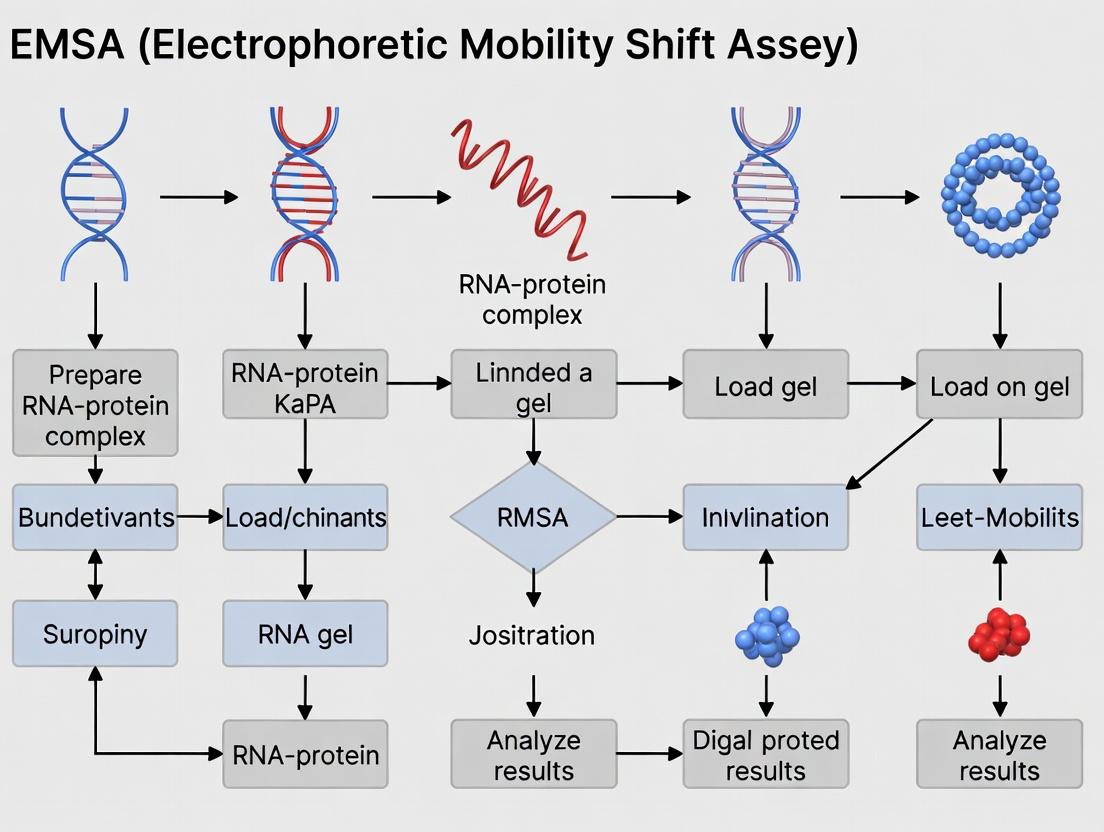
This comprehensive guide provides researchers, scientists, and drug development professionals with a complete, up-to-date methodology for Electrophoretic Mobility Shift Assay (EMSA) applied to RNA-protein interactions.
Mastering EMSA for RNA-Protein Interactions: A Complete 2024 Protocol Guide for Researchers
Abstract
This comprehensive guide provides researchers, scientists, and drug development professionals with a complete, up-to-date methodology for Electrophoretic Mobility Shift Assay (EMSA) applied to RNA-protein interactions. Covering foundational principles through advanced applications, the article details optimized wet-lab protocols, common troubleshooting strategies, and validation techniques essential for studying post-transcriptional gene regulation, ribonucleoprotein complexes, and RNA-targeted therapeutics. We integrate current best practices to ensure reliable detection of binding affinity, specificity, and complex stoichiometry.
Understanding EMSA for RNA-Protein Complexes: Principles, Applications, and Critical Design
What is RNA EMSA? Core Principle of Detecting RNA-Protein Complexes
RNA Electrophoretic Mobility Shift Assay (RNA EMSA), also known as gel shift or band shift assay, is a fundamental in vitro technique used to detect and analyze specific interactions between RNA molecules and RNA-binding proteins (RBPs). Within the broader thesis on EMSA protocols, this application note details the adaptation for RNA-protein complexes, which are pivotal in post-transcriptional gene regulation, viral replication, and therapeutic target development.
The core principle relies on the fact that an RNA-protein complex migrates more slowly through a non-denaturing polyacrylamide gel than the free RNA probe due to increased molecular weight and altered charge. The retardation of mobility ("shift") is visualizable using autoradiography, fluorescence, or chemiluminescence.
Key Research Reagent Solutions
The following table details essential materials and their functions for a standard radioactive RNA EMSA.
| Reagent / Material | Function / Purpose |
|---|---|
| In vitro transcribed, purified RNA probe | The target RNA sequence, typically 20-50 nt, often labeled for detection. |
| 32P-γ-ATP (or fluorescent/ biotin labels) | Radioactive label for high-sensitivity detection via autoradiography. Non-radioactive alternatives are common. |
| T4 Polynucleotide Kinase (PNK) | Enzyme to radiolabel the 5' end of the RNA probe. |
| Recombinant purified RNA-binding protein (RBP) or cell nuclear extract | Source of the protein(s) for binding. Purified protein allows specific study; extracts screen for activity. |
| Non-denaturing Polyacrylamide Gel (4-8%) | Matrix for separation of free RNA from RNA-protein complexes based on size/shape. |
| Non-specific competitor (e.g., tRNA, poly(I:C)) | Suppresses binding of proteins to non-specific RNA sequences. |
| Specific unlabeled competitor RNA | Cold RNA identical to the probe; confirms binding specificity by competing away the shift. |
| EMSABinding Buffer (HEPES/KCl, DTT, Glycerol, RNase Inhibitor) | Provides optimal ionic strength, pH, and reducing conditions for native RNA-protein interactions. |
| Anti-target antibody (for supershift) | Binds to the protein in the complex, causing a further mobility reduction ("supershift") to confirm protein identity. |
Detailed Protocol: Radioactive RNA EMSA
Probe Preparation and Labeling (5' End-Labeling with 32P)
- Design: Synthesize DNA oligonucleotide template with a promoter (e.g., T7) for in vitro transcription OR order single-stranded RNA probe.
- Labeling (Kinase Reaction):
- Combine: 1-10 pmol dephosphorylated RNA, 2 µL 10X PNK buffer, 1 µL T4 PNK (10 U/µL), 50 µCi [γ-32P]ATP, Nuclease-free water to 20 µL.
- Incubate at 37°C for 30-60 min.
- Purify labeled RNA using a spin column (e.g., G-25 Sephadex) or phenol-chloroform extraction to remove unincorporated nucleotides.
- Quantify Activity: Measure cpm/µL by scintillation counting.
Binding Reaction
- Master Mix (per reaction): Prepare on ice.
- 2 µL 10X Binding Buffer (100 mM HEPES pH 7.6, 500 mM KCl, 10 mM DTT, 50% Glycerol)
- 1 µL RNase Inhibitor (20-40 U)
- 1 µL Non-specific Competitor (e.g., 1 µg/µL tRNA)
- Nuclease-free water to 18 µL
- 1-2 µg nuclear extract or 10-100 fmol purified protein.
- Pre-incubation: Incubate master mix (without probe) at room temperature for 10 min to allow non-specific competitor binding.
- Add Probe: Add ~20,000 cpm (1-2 fmol) of labeled RNA probe. Final reaction volume: 20 µL.
- Incubation: Incubate at 30°C for 20-30 min.
- Controls: Always include:
- Free Probe: No protein.
- Competition: Binding reaction + 100-fold molar excess of unlabeled specific RNA.
- Supershift: Binding reaction + 1-2 µg specific antibody (add after initial binding, incubate further 15-30 min).
Electrophoresis and Detection
- Gel Preparation: Pre-run a 4-8% non-denaturing polyacrylamide gel (29:1 acrylamide:bis) in 0.5X TBE at 100 V for 60 min in a cold room (4°C).
- Loading: Add 2-5 µL of non-denaturing loading dye (e.g., 30% glycerol, 0.25% bromophenol blue/xylene cyanol) to each reaction. Load entire sample.
- Run: Run gel at constant voltage (100-150 V) in 0.5X TBE until dye migrates appropriately (≈1.5-2 hrs). Maintain temperature at 4°C.
- Transfer & Dry: Transfer gel to blotting paper, dry under vacuum at 80°C for 60 min.
- Visualization: Expose dried gel to a phosphorimager screen overnight. Analyze using imaging software.
Table 1: Typical Reaction Components and Parameters for RNA EMSA
| Parameter | Typical Range / Value | Notes |
|---|---|---|
| RNA Probe Length | 20 - 50 nucleotides | Longer RNAs may have complex secondary structures. |
| Protein Amount | 0.1 - 10 µg nuclear extract, 10-100 fmol purified protein | Must be titrated for optimal shift signal. |
| Labeling Specific Activity | 10^7 - 10^8 cpm/µg | Critical for detection sensitivity. |
| Binding Reaction Time | 20 - 30 minutes | Equilibrium is typically reached within 20 min. |
| Gel Temperature | 4°C | Minimizes complex dissociation and gel heating. |
| Electrophoresis Voltage | 10-15 V/cm gel length | Low voltage maintains complex integrity. |
Table 2: Common Detection Method Comparison
| Detection Method | Sensitivity (approx.) | Probe Stability | Safety/Regulatory Considerations |
|---|---|---|---|
| Radioactive (32P) | 0.1-1 fmol | Days (isotope decay) | Requires licensing, special handling, radioactive waste disposal. |
| Chemiluminescence (Biotin) | 1-10 fmol | Years | No radiation, requires streptavidin-HRP and substrate. |
| Fluorescence (Cy5, FAM) | 10-100 fmol | Years | Direct scanning, multiplexing possible, may be less sensitive. |
Visualization: RNA EMSA Workflow
Diagram Title: RNA EMSA Experimental Workflow
Advanced Application: Supershift Assay Principle
Diagram Title: Supershift Assay Mechanism
Application Notes: EMSA in Functional Genomics and Therapeutic Development
Electrophoretic Mobility Shift Assay (EMSA) remains a cornerstone technique for studying RNA-protein interactions, providing critical data for understanding gene regulation and identifying novel therapeutic targets. Its quantitative application spans fundamental biology to drug discovery pipelines.
Table 1: Quantitative Applications of EMSA-Derived Data in Research Pipelines
| Application Area | Primary Measurable Output | Typical Data Range | Downstream Utility |
|---|---|---|---|
| Transcription Factor (TF) Binding | Dissociation Constant (Kd) | 1 nM - 100 nM | Quantify promoter/enhancer affinity; model regulatory networks. |
| miRNA Target Validation | Binding Affinity Shift | 50-95% reduction in free probe | Confirm mRNA 3'UTR targeting; predict off-target effects. |
| RBP Identification | Apparent Binding Affinity | 10 nM - 1 µM | Map RNA interactomes; identify roles in splicing, stability. |
| Drug Candidate Screening | IC50 for Inhibitor Compounds | 0.1 µM - 20 µM | Discover small molecules that disrupt pathogenic RNP complexes. |
| Viral RNA-Protein Interaction | Stoichiometry & Cooperative Binding | Hill Coefficient (n) = 1-4 | Define mechanisms of viral replication; design antisense oligonucleotides. |
Detailed Protocol: EMSA for RNA-Protein Interaction Analysis
Protocol Title: Non-Radioactive EMSA for Quantitative Analysis of RNA-Protein Complexes.
I. Research Reagent Solutions & Essential Materials
- Chemiluminescent Nucleic Acid Label Kit: Utilizes biotinylation for sensitive, non-radioactive detection of RNA probes.
- Recombinant RNA-Binding Protein (RBP) Purification System: (e.g., His-tag purification) for consistent protein quality.
- Non-specific Competitor RNA (e.g., tRNA, poly(I:C)): Suppresses non-specific binding to ensure assay specificity.
- HEPES-based Binding Buffer (10X): 100 mM HEPES, 400 mM KCl, 10 mM EDTA, 10 mM DTT, 50% Glycerol; pH 7.5. Maintains optimal ionic strength and reducing conditions.
- Native Polyacrylamide Gel (6%): Pre-cast or hand-cast gels for separation of complexes without denaturation.
- Semi-Dry Transfer Apparatus: For efficient blotting of RNA-protein complexes to a nylon membrane.
- Crosslinking Instrument (UV Stratalinker): Optional for covalent stabilization of complexes post-binding.
II. Step-by-Step Methodology
Step 1: Probe Preparation & Labeling
- Design and synthesize single-stranded RNA oligonucleotide (target sequence, ~20-40 nt).
- Label the RNA probe at the 3' end using a biotinylation kit according to manufacturer instructions.
- Purify the labeled probe via ethanol precipitation. Resuspend in nuclease-free water. Determine concentration.
Step 2: Binding Reaction Setup
- Prepare a master binding buffer mix on ice: 2 µL 10X Binding Buffer, 1 µL tRNA (1 µg/µL), 1 µL RNase Inhibitor, nuclease-free water to 18 µL.
- In individual tubes, add 18 µL of master mix. Add 1 µL of purified recombinant protein (serial dilutions for Kd determination) or buffer alone (negative control).
- Pre-incubate for 10 min at room temperature.
- Add 1 µL of biotinylated RNA probe (final concentration 10-50 pM). Mix gently.
- Incubate for 25-30 min at 30°C.
Step 3: Non-Denaturing Electrophoresis & Transfer
- Pre-run the 6% native PAGE gel in 0.5X TBE buffer for 30-60 min at 100V, 4°C.
- Load 20 µL of each binding reaction directly onto the gel. Include a lane with labeled probe alone.
- Run the gel at 100V, 4°C, until the dye front is near the bottom (~1.5 hrs).
- Transfer the RNA-protein complexes from the gel to a positively charged nylon membrane using semi-dry transfer in 0.5X TBE buffer at 20V for 45 min.
Step 4: Detection & Quantification
- Crosslink the RNA to the membrane using UV light (254 nm, 120 mJ/cm²).
- Detect the biotinylated RNA using a chemiluminescent substrate kit (e.g., Streptavidin-HRP followed by luminol detection).
- Image the membrane using a digital imager. Quantify the intensity of bands corresponding to free probe and shifted complex using image analysis software (e.g., ImageJ).
- Calculate the fraction of bound RNA for protein titration experiments. Fit data to a binding isotherm model to determine apparent Kd.
Visualization: Pathways and Workflows
Title: EMSA Experimental Workflow for RNA-Protein Binding
Title: From EMSA Data to Gene Networks & Drug Leads
Within the broader context of optimizing the Electrophoretic Mobility Shift Assay (EMSA) for studying RNA-protein interactions, the reliability of the assay hinges on three foundational pillars: the design and preparation of the RNA probe, the source and quality of the protein, and the composition of the buffer systems. This application note details current protocols and considerations for each component to ensure high-specificity, low-background assays suitable for basic research and drug discovery screening.
RNA Probe Design and Synthesis
A high-specificity RNA probe is critical for detecting specific RNA-binding proteins (RBPs).
Key Design Principles:
- Sequence: Typically 20-50 nucleotides, containing the minimal, well-characterized protein binding site (e.g., a stem-loop from a viral RNA genome for a viral protein, or a specific sequence motif like a U-rich element for a cellular RBP).
- Purity: HPLC- or PAGE-purified synthetic oligonucleotides are essential to avoid truncated products that cause non-specific shifts.
- Labeling: Radioactive (γ-³²P-ATP) labeling via T4 Polynucleotide Kinase offers high sensitivity. Non-radioactive alternatives (e.g., biotin, fluorescein) using 3'- or 5'-end labeling kits are preferred for safety and stability.
- Handling: RNase-free conditions must be maintained throughout.
Protocol 2.1: In Vitro Transcription for Longer RNA Probes
For probes >50 nt or requiring native modification, in vitro transcription is used.
- Template Preparation: Clone target sequence into a plasmid downstream of a phage promoter (T7, SP6, T3) or use a PCR-generated template with the promoter appended.
- Transcription Reaction: Assemble at room temperature:
- Nuclease-free water to 20 µL final volume.
- 1µg linearized DNA template or 100-200 ng PCR product.
- 1x Transcription Buffer (supplied with enzyme).
- 7.5 mM each NTP (ATP, CTP, GTP, UTP).
- 0.1 M DTT.
- 40 U RNase Inhibitor.
- 50 U T7 RNA Polymerase.
- Incubation: 37°C for 2-4 hours.
- DNase Treatment: Add 2 U of DNase I (RNase-free), incubate 15 min at 37°C.
- Purification: Purify RNA using phenol-chloroform extraction followed by ethanol precipitation or a silica-membrane spin column. Verify integrity by denaturing PAGE.
Protocol 2.2: 5'-End Labeling with [γ-³²P] ATP
- Denature Probe: Heat 1-10 pmol of dephosphorylated RNA oligonucleotide in nuclease-free water at 90°C for 2 min, then place on ice.
- Labeling Reaction: Mix in order:
- 1 µL RNA oligo (1 pmol/µL)
- 2 µL 10x T4 PNK Buffer
- 3 µL [γ-³²P] ATP (3000 Ci/mmol, 10 mCi/mL)
- 13 µL Nuclease-free water
- 1 µL T4 Polynucleotide Kinase (10 U/µL)
- Incubate: 37°C for 30 min.
- Terminate & Purify: Add 30 µL nuclease-free water, heat inactivate at 65°C for 20 min. Purify using a micro bio-spin P-30 column or probe purification column to remove unincorporated nucleotides.
Table 1: Comparison of RNA Probe Labeling Methods
| Method | Sensitivity | Stability | Safety/Regulation | Typical Use Case |
|---|---|---|---|---|
| ³²P Radioactive | Very High (attomole) | Short (half-life ~14 days) | Requires licensed facility, radioactive waste | High-sensitivity research, low-abundance complexes |
| Biotin (Chemilum.) | High (femtomole) | Long (months/years) | Standard lab safety | Most routine assays, drug screening |
| Fluorescein | Moderate | Long (months/years) | Standard lab safety | Pre-cast gel systems, real-time detection |
The source of the RNA-binding protein dictates assay design and interpretation.
Key Sources:
- Recombinant Purified Protein: Offers the highest specificity and control. Expressed in E. coli, insect, or mammalian systems with affinity tags (His, GST, MBP).
- Nuclear/Cellular Extracts: Contains native, post-translationally modified proteins and competing activities. Essential for studying complexes in a physiological context.
- In vitro Translated Protein: Useful for screening mutant proteins or when purification is challenging.
Protocol 3.1: Preparation of Nuclear Extract for EMSA
Adapted from a rapid mini-extract protocol.
- Harvest Cells: Pellet 2 x 10⁶ cultured cells, wash with 1x PBS.
- Resuspend: Resuspend pellet in 400 µL of Hypotonic Buffer (10 mM HEPES-KOH pH 7.9, 1.5 mM MgCl₂, 10 mM KCl, 0.2 mM PMSF, 0.5 mM DTT) by gentle pipetting. Incubate on ice for 10 min.
- Lysc: Add 25 µL of 10% NP-40, vortex vigorously for 10 sec.
- Centrifuge: Spin at 13,000 rpm for 30 sec at 4°C. Pellet contains nuclei.
- Extract Nuclei: Resuspend nuclear pellet in 50 µL of High-Salt Extraction Buffer (20 mM HEPES-KOH pH 7.9, 25% glycerol, 420 mM NaCl, 1.5 mM MgCl₂, 0.2 mM EDTA, 0.2 mM PMSF, 0.5 mM DTT). Incubate on ice with gentle shaking for 20 min.
- Clarify: Centrifuge at 13,000 rpm for 2 min at 4°C. Aliquot supernatant (nuclear extract), snap-freeze in liquid N₂, store at -80°C. Determine protein concentration by Bradford assay.
Buffer Systems
Buffers maintain complex stability and minimize non-specific interactions.
Core Components:
- Binding Buffer: Provides optimal pH, ionic strength, and Mg²⁺/K⁺ for the specific RBP. Polycations (spermidine) and carrier proteins (BSA) can stabilize complexes.
- Non-specific Competitors: tRNA, poly(I:C), or heparin are critical to "soak up" non-specific RBPs and nucleases.
- Stabilizing Agents: Glycerol (5-10%) aids loading; DTT prevents oxidation; RNase inhibitors are mandatory.
- Gel & Running Buffers: Typically 0.5x or 1x Tris-Borate-EDTA (TBE) or Tris-Glycine. Low ionic strength preserves complexes during electrophoresis.
Protocol 4.1: Standard RNA EMSA Binding Reaction
- Prepare Master Mix (for 1 reaction):
- 2 µL 5x Binding Buffer (100 mM HEPES pH 7.6, 250 mM KCl, 25 mM MgCl₂, 50% Glycerol, 5 mM DTT)
- 0.5 µL RNase Inhibitor (40 U/µL)
- 0.5 µL Yeast tRNA (10 mg/mL) or 0.25 µL poly(I:C) (10 mg/mL)
- 0.1-0.5 µL Non-specific competitor (e.g., heparin, concentration must be titrated)
- Nuclease-free water to 9 µL
- Add Protein: Add 1-10 µg of nuclear extract or 10-500 ng of recombinant protein. Mix gently.
- Pre-incubate: Incubate at room temperature for 10 min.
- Add Probe: Add 1 µL of labeled RNA probe (20,000-50,000 cpm for ³²P; ~5-20 fmol for biotin). Mix gently.
- Binding Incubation: Incubate at 30°C for 20-30 min.
- Load: Add 2 µL of 10x non-denaturing loading dye (50% glycerol, 0.1% bromophenol blue/xylene cyanol). Load entire reaction onto a pre-run 4-8% native polyacrylamide gel (0.5x TBE, 4°C).
Table 2: Common EMSA Buffer Components and Their Functions
| Component | Example Concentrations | Primary Function | Notes |
|---|---|---|---|
| HEPES/KOH | 10-20 mM, pH 7.6-7.9 | pH Buffering | Maintains physiological pH for protein function. |
| KCl/NaCl | 50-200 mM | Ionic Strength | Moderates electrostatic interactions; optimal must be determined. |
| MgCl₂ | 1-10 mM | Divalent Cation | Often critical for RNA folding and RBP recognition. |
| Glycerol | 2-10% (v/v) | Stabilization, Loading Aid | Stabilizes complexes and increases sample density. |
| DTT | 0.5-2 mM | Reducing Agent | Prevents oxidation of cysteine residues in the protein. |
| Non-specific RNA/DNA | tRNA: 0.1-1 mg/mL; poly(I:C): 0.05-0.5 mg/mL | Competitor | Reduces non-specific RNA-protein binding. |
| Heparin | 0.05-0.5 mg/mL | Charged Competitor | Effective for reducing non-specific nucleic acid-binding proteins. |
| NP-40 | 0.01-0.1% (v/v) | Non-ionic Detergent | Reduces hydrophobic aggregation. |
The Scientist's Toolkit: Key Research Reagent Solutions
Table 3: Essential Materials for RNA EMSA
| Item | Function/Description | Example Vendor/Product |
|---|---|---|
| RNase Inhibitor | Inhibits RNases to protect RNA probe integrity. | Murine RNase Inhibitor (New England Biolabs). |
| T4 Polynucleotide Kinase (PNK) | Catalyzes transfer of phosphate from [γ-³²P]ATP to 5' end of RNA. | T4 PNK, 10 U/µL (Thermo Fisher). |
| Biotin 3'-End DNA Labeling Kit | Non-radioactive labeling of RNA probes via tailing. | Pierce Biotin 3' End Labeling Kit. |
| Chemiluminescent Nucleic Acid Detection Module | Detects biotinylated probes on membranes. | Chemiluminescent Nucleic Acid Detection Module (Thermo Fisher). |
| Non-Radioactive EMSA Kit | Integrated system for biotin-based EMSA. | LightShift Chemiluminescent EMSA Kit. |
| Heparin | Sulfated glycosaminoglycan used as a potent non-specific competitor. | Heparin Sodium Salt from porcine intestinal mucosa (Sigma). |
| Poly(I:C) | Synthetic double-stranded RNA analog used as a non-specific competitor for RBPs. | High Molecular Weight Poly(I:C) (InvivoGen). |
| Protease Inhibitor Cocktail | Inhibits proteases in cell/nuclear extracts to preserve full-length protein. | cOmplete, EDTA-free Protease Inhibitor Cocktail (Roche). |
| Native PAGE Gel System | Pre-cast gels and buffers for non-denaturing electrophoresis. | Novex 4-20% TBE Gels (Thermo Fisher). |
| Nitrocellulose/Nylon Membrane | For transfer and detection of biotinylated RNA-protein complexes. | BrightStar-Plus Positively Charged Nylon Membrane. |
Visualization: EMSA Workflow and Pathway
Diagram Title: Core EMSA Workflow and Essential Components
Diagram Title: Molecular Pathway of Specific RNA-Protein Binding
Within a broader thesis on Electrophoretic Mobility Shift Assay (EMSA) for RNA-protein interaction research, it is critical to understand its position in the methodological landscape. This application note compares EMSA with three pivotal techniques: Crosslinking and Immunoprecipitation (CLIP), RNA Immunoprecipitation (RIP), and Surface Plasmon Resonance (SPR). Each method offers distinct advantages in probing the specificity, affinity, and functional context of RNA-protein complexes, guiding researchers in selecting the optimal tool for their experimental goals.
Technique Comparison: Core Characteristics and Quantitative Data
The table below summarizes the key parameters, applications, and quantitative outputs of each technique.
Table 1: Comparative Analysis of EMSA, CLIP, RIP, and SPR
| Parameter | EMSA | CLIP | RIP | SPR |
|---|---|---|---|---|
| Core Principle | Gel electrophoresis separation | UV crosslinking, IP, sequencing | Antibody-based IP, RT-qPCR/seq | Optical measurement of biomolecular binding on a sensor chip |
| Primary Output | Binding confirmation, complex size | Nucleotide-resolution protein-RNA binding sites | Enrichment of bound RNA populations | Real-time binding kinetics (ka, kd, KD) |
| Affinity Data (KD) | Semi-quantitative (low µM to nM) | Qualitative | Qualitative | Quantitative (nM to pM) |
| Throughput | Low to medium | High (with sequencing) | Medium to High | Medium |
| In Vivo/Vitro | Primarily in vitro | In vivo | In vivo | In vitro |
| Key Advantage | Simple, no antibody required | High-resolution, in vivo mapping | Captures endogenous complexes | Label-free, real-time kinetics |
| Key Limitation | Low resolution, potential false positives | Complex protocol, crosslinking bias | No crosslinking resolution, antibody-dependent | Requires immobilization, expensive instrumentation |
Detailed Experimental Protocols
Protocol 1: Standard EMSA for RNA-Protein Complexes
Objective: To detect and confirm binding between a purified RNA-binding protein and its target RNA sequence in vitro.
- Probe Preparation: Synthesize and purify target RNA. Label the RNA at the 5' end with [γ-32P] ATP using T4 Polynucleotide Kinase. Purify using a spin column.
- Binding Reaction: In a 20 µL volume, combine:
- 1X Binding Buffer (10 mM HEPES, pH 7.3, 50 mM KCl, 1 mM MgCl2, 1 mM DTT, 5% glycerol, 0.1 µg/µL yeast tRNA).
- Labeled RNA probe (20 fmol).
- Purified protein (0-500 nM range).
- Incubate at 25°C for 30 minutes.
- Electrophoresis: Pre-run a 6% non-denaturing polyacrylamide gel in 0.5X TBE at 100V for 30 min at 4°C. Load samples with non-fluorescent dye. Run at 100V for 60-90 min at 4°C.
- Visualization: Transfer gel to blotting paper, dry under vacuum. Expose to a phosphorimager screen overnight. Analyze using imaging software.
Protocol 2: CLIP-seq (Adapted from iCLIP)
Objective: To identify genome-wide binding sites of an RNA-binding protein in living cells at single-nucleotide resolution.
- In Vivo Crosslinking: Culture cells expressing the protein of interest. Irradiate with 254 nm UV-C light (150-400 mJ/cm²) to covalently crosslink RNA-protein complexes.
- Cell Lysis and Partial RNase Digestion: Lyse cells in stringent RIPA buffer. Treat lysate with limited RNase I to fragment bound RNA.
- Immunoprecipitation: Incubate lysate with antibody-conjugated magnetic beads against the protein or tag. Wash stringently.
- RNA Adapter Ligation: Dephosphorylate and ligate a 3' RNA adapter to the RNA bound to the beads.
- Protein Removal and RNA Isolation: Separate RNA from protein by Proteinase K digestion. Extract RNA, gel-purify, and ligate a 5' RNA adapter.
- Reverse Transcription & Library Prep: Perform RT-PCR. The cDNA library is sequenced on a high-throughput platform (e.g., Illumina). Bioinformatics pipelines map truncated cDNA ends to crosslink sites.
Protocol 3: RIP-qPCR
Objective: To identify RNAs associated with a specific protein in a cellular context.
- Cell Preparation: Lyse cells (e.g., 10⁷) in polysome lysis buffer (100 mM KCl, 5 mM MgCl2, 10 mM HEPES, pH 7.0, 0.5% NP-40) with RNase inhibitors.
- Immunoprecipitation: Pre-clear lysate with protein A/G beads. Incubate supernatant with 2-5 µg of specific antibody or isotype control overnight at 4°C. Add beads and incubate for 2 hours.
- Washing: Wash beads 5x with lysis buffer.
- RNA Extraction: Resuspend beads in Proteinase K buffer and digest for 30 min at 55°C. Extract RNA with acid-phenol:chloroform and precipitate.
- Analysis: Treat with DNase I. Perform reverse transcription followed by qPCR with primers for candidate RNAs. Enrichment is calculated relative to input and control IP.
Protocol 4: SPR for RNA-Protein Kinetics
Objective: To determine the real-time association and dissociation rate constants (ka, kd) and equilibrium dissociation constant (KD) for an RNA-protein interaction.
- Immobilization: Dilute biotinylated RNA oligonucleotide in HBS-EP+ buffer (0.01 M HEPES, 0.15 M NaCl, 3 mM EDTA, 0.005% v/v Surfactant P20, pH 7.4). Inject over a streptavidin-coated sensor chip to achieve ~50 Response Units (RU) of capture.
- Kinetic Titration: Serial dilute the purified protein analyte (e.g., 0.625 nM to 40 nM) in running buffer. Inject each concentration over the RNA surface and a reference surface for 120 s (association), followed by buffer alone for 300 s (dissociation) at a flow rate of 30 µL/min.
- Regeneration: Strip bound protein with a 30s pulse of 2M NaCl.
- Data Analysis: Double-reference the sensorgrams (reference surface & blank injection). Fit the data globally to a 1:1 Langmuir binding model using the SPR instrument’s software to derive ka, kd, and KD (KD = kd/ka).
Visualization of Methodological Relationships and Workflows
Title: Technique Selection Decision Tree
Title: CLIP-seq Experimental Workflow
Title: SPR Data to Kinetic Constants
The Scientist's Toolkit: Research Reagent Solutions
Table 2: Essential Reagents and Materials for Featured Techniques
| Technique | Key Reagent / Material | Function / Role |
|---|---|---|
| EMSA | Non-denaturing PAGE Gel (4-10%) | Matrix for separation of free and bound RNA probes based on size/shift. |
| [γ-32P] ATP or Chemiluminescent Label | Radiolabels RNA probe for sensitive detection. Alternatives: biotin, fluorescein. | |
| Recombinant RNA-binding Protein | Purified protein for in vitro binding assays. | |
| CLIP/RIP | Specific Antibody (High Quality) | Immunoprecipitates the target RNA-protein complex. Critical for specificity. |
| Magnetic Protein A/G Beads | Solid support for antibody capture and complex isolation. | |
| RNase Inhibitor Cocktail | Preserves RNA integrity during cell lysis and IP steps. | |
| UV Crosslinker (254 nm) | Creates covalent bonds between RNA and closely associated proteins in living cells. | |
| SPR | Biotinylated RNA Oligonucleotide | The ligand immobilized on the streptavidin sensor chip. |
| Streptavidin Sensor Chip (e.g., Series S) | Gold surface for capturing biotinylated ligands in a controlled orientation. | |
| HBS-EP+ Buffer | Standard running buffer providing consistent ionic strength and reducing non-specific binding. |
The study of RNA-protein interactions via Electrophoretic Mobility Shift Assay (EMSA) is a cornerstone of molecular biology, with applications from deciphering gene regulatory mechanisms to identifying therapeutic targets in drug development. This application note, framed within a broader thesis on optimizing EMSA for RNA-protein interactions, details the critical pre-experimental phase of objective definition and control selection. Rigorous planning at this stage is paramount for generating robust, interpretable, and publication-quality data.
Defining Core Experimental Objectives
Clear objectives dictate every subsequent experimental parameter. For an EMSA-based thesis, objectives typically fall into three categories, each with specific experimental outputs.
| Objective Category | Specific Experimental Question | Required EMSA Output |
|---|---|---|
| Discovery & Characterization | Does protein X bind to RNA sequence Y? | A confirmed gel shift (complex formation). |
| What is the apparent binding affinity (Kd) of the interaction? | A binding curve quantifying fraction bound vs. protein concentration. | |
| Mechanistic Analysis | What specific nucleotides/residues are critical for binding? | Altered shift with mutant RNA or protein competitors. |
| Does binding require co-factors (e.g., Mg2+, ATP)? | Presence/absence of shift under modified buffer conditions. | |
| Application & Screening | Can a small-molecule inhibitor disrupt this interaction? | Dose-dependent reduction in shifted complex. |
Essential Controls for a Valid RNA EMSA
Controls are non-negotiable elements that validate the specificity and interpretation of the observed gel shift. The table below categorizes mandatory and recommended controls.
| Control Type | Purpose | Experimental Setup |
|---|---|---|
| No-Protein Control | Identifies the unbound RNA probe migration position. | RNA probe + binding buffer only. |
| Competition (Cold Probe) | Demonstrates binding specificity. | Reaction includes labeled probe + excess unlabeled identical probe (specific) or non-specific probe (non-specific). |
| Mutant Competition | Defines sequence specificity. | Reaction includes labeled wild-type probe + excess unlabeled mutant probe. |
| Antibody Supershift | Confirms protein identity in complex. | Incubate reaction with antibody against the protein of interest prior to electrophoresis. |
| Non-specific Competitor | Reduces non-specific binding. | Include excess unrelated nucleic acid (e.g., poly(dI:dC), tRNA) in all reactions. |
| Negative Control Protein | Confirms shift is not an artifact. | Use a protein known not to bind the target RNA (e.g., BSA). |
Detailed Protocol: A Standard RNA EMSA with Controls
A. Reagent Preparation
- RNA Probe: Synthesize, deprotect, and purify target RNA oligonucleotide. Label using [γ-32P]ATP and T4 Polynucleotide Kinase per manufacturer's protocol. Remove unincorporated nucleotides using a spin column.
- Binding Buffer (10X Stock): 100 mM HEPES (pH 7.6), 400 mM KCl, 20 mM MgCl2, 10 mM DTT, 50% Glycerol. Store at -20°C. Add RNase inhibitor (40 U/mL) and non-specific competitor (0.1 mg/mL yeast tRNA) to 1X working buffer.
B. Binding Reaction Assembly (20 µL total volume) Perform all steps on ice. Assemble reactions in the following order:
- Nuclease-free water to 20 µL.
- 2 µL 10X Binding Buffer.
- Non-specific competitor (e.g., 1 µg tRNA).
- Unlabeled competitor RNA (for competition controls; e.g., 100-fold molar excess).
- Purified protein (varying amounts for Kd; keep constant for standard shift).
- Labeled RNA probe (e.g., 20 fmol, ~20,000 cpm).
- Critical: Include the control reactions as defined in Section 3.
Mix gently and incubate at 25°C for 30 minutes.
C. Non-Denaturing Gel Electrophoresis
- Gel Preparation: Pre-run a 6% non-denaturing polyacrylamide gel (29:1 acrylamide:bis) in 0.5X TBE buffer at 100 V for 60 min in a cold room (4°C).
- Loading: Add 5 µL of non-denaturing loading dye (with tracking dyes) to each reaction. Load entire sample onto the pre-run gel.
- Electrophoresis: Run gel at constant voltage (100-150 V) in cold room until bromophenol blue is near the bottom (~90 min). Voltage and time must be optimized to resolve complex from free probe.
D. Visualization
- Transfer gel to filter paper, dry under vacuum.
- Expose dried gel to a phosphorimager screen overnight.
- Scan screen and analyze using image analysis software (e.g., ImageQuant) to quantify band intensities.
Diagrams
Title: EMSA Experimental Workflow from Planning to Analysis
Title: Interpreting EMSA Results via Control Lanes
The Scientist's Toolkit: Key Research Reagent Solutions
| Reagent / Material | Function in RNA EMSA | Critical Notes |
|---|---|---|
| T4 Polynucleotide Kinase (T4 PNK) | Catalyzes the transfer of the γ-phosphate from [γ-32P]ATP to the 5'-end of RNA. | Essential for probe labeling. Use high-specific activity ATP. |
| RNase Inhibitor (e.g., RNasin) | Inhibits ubiquitous RNases, preserving the integrity of the RNA probe. | Must be included in all buffers post-probe synthesis. |
| Non-specific Competitor (tRNA, poly(dI:dC)) | Binds to low-affinity, non-specific sites on the protein, reducing background. | Type and concentration must be optimized for each new protein. |
| HEPES-KOH Buffer | Maintains stable pH (typically 7.6-8.0) during binding reaction. | Preferred over Tris for minimal pH shift with temperature. |
| Dithiothreitol (DTT) | Reducing agent that maintains cysteine residues in the protein in reduced state. | Critical for proteins with essential sulfhydryl groups. |
| Non-denaturing Polyacrylamide Gel | Matrix that separates protein-RNA complex from free RNA based on size/charge. | Acrylamide percentage (4-10%) impacts resolution; must be optimized. |
| Phosphorimager System | Enables highly sensitive detection and quantification of radiolabeled signals. | Superior to X-ray film for linear dynamic range and quantitation. |
Step-by-Step RNA EMSA Protocol: From Probe Preparation to Gel Imaging
This application note details Phase 1 of a comprehensive Electrophoretic Mobility Shift Assay (EMSA) protocol for studying RNA-protein interactions, a cornerstone technique in molecular biology and drug discovery. The generation of high-quality, labeled RNA probes is critical for sensitivity and specificity in downstream EMSA experiments. This document compares two primary labeling strategies: traditional radioactive labeling with ³²P and modern fluorescent labeling, providing updated protocols and quantitative comparisons to guide researcher selection.
Quantitative Comparison: ³²P vs. Fluorescent Labeling
Table 1: Comparison of Key Parameters for RNA Probe Labeling Methods
| Parameter | ³²P Labeling (α-³²P UTP/NTP) | Fluorescent Labeling (Fluorescent UTP/NTP) |
|---|---|---|
| Typical Detection Limit | 0.1–1 fmol | 5–50 fmol |
| Signal Dynamic Range | ~3–4 orders of magnitude | ~2–3 orders of magnitude |
| Probe Stability | ~10-14 days (physical decay) | Months to years (at -20°C, dark) |
| Typical Exposure/Scan Time | 30 min to 24 hr (phosphor screen) | 5–30 min (fluorescence scanner) |
| Relative Cost per Reaction | Low (but includes waste costs) | Moderate to High |
| Safety & Regulation | High (Radiation safety, licensing, disposal) | Low (Standard lab safety) |
| Multiplexing Capability | No (single channel) | Yes (multiple fluorophores) |
| Primary Instrumentation | Phosphorimager or X-ray film | Fluorescence gel scanner or imager |
| Compatibility w/ Live Cells | No | Yes (for some applications) |
Detailed Protocols
Protocol 1: In Vitro Transcription with ³²P Labeling for EMSA Probes
Principle: T7, SP6, or T3 RNA polymerase-driven transcription incorporates α-³²P UTP into nascent RNA, generating probes with high specific activity.
Materials:
- DNA template (PCR product or linearized plasmid with promoter)
- Ribonucleotide solution mix (ATP, CTP, GTP, UTP)
- [α-³²P] UTP (e.g., 800 Ci/mmol, 10 mCi/mL)
- Appropriate RNA polymerase (T7, SP6, or T3)
- RNase inhibitor
- Transcription buffer (5X, supplied with enzyme)
- Nuclease-free water
- DNase I (RNase-free)
- Spin column for RNA purification (e.g., G-50 Sephadex or commercial kit)
Method:
- Reaction Assembly (20 µL): In a nuclease-free microcentrifuge tube on ice, combine:
- 4 µL 5X transcription buffer
- 1 µL ATP (10 mM)
- 1 µL CTP (10 mM)
- 1 µL GTP (10 mM)
- 0.8 µL UTP (10 mM) [Low concentration drives ³²P incorporation]
- 1 µL [α-³²P] UTP (~10 µCi)
- 1 µL RNase inhibitor (40 U)
- 1 µg DNA template
- 1 µL RNA polymerase (20 U)
- Nuclease-free water to 20 µL.
- Incubation: Mix gently. Incubate at 37°C for 1–2 hours.
- DNase Treatment: Add 1 µL of DNase I (RNase-free). Incubate at 37°C for 15 min.
- Purification: Purify the labeled RNA probe using a G-50 Sephadex spin column equilibrated in TE buffer (pH 7.5) or a commercial RNA clean-up kit to remove unincorporated nucleotides. Elute in nuclease-free water or buffer.
- Quantification: Determine incorporation efficiency by scintillation counting (spot assay). Calculate specific activity (cpm/µg). Store at -20°C; use within 1–2 weeks.
Protocol 2: In Vitro Transcription with Fluorescent Labeling for EMSA Probes
Principle: RNA polymerase incorporates pre-labeled fluorescent ribonucleotides (e.g., Cy5-UTP, FAM-UTP) during transcription.
Materials:
- DNA template (as in Protocol 1)
- Ribonucleotide solution mix (ATP, CTP, GTP)
- Fluorescently-labeled UTP (e.g., Cy5-UTP, FAM-UTP)
- Appropriate RNA polymerase
- RNase inhibitor
- Transcription buffer (5X)
- Nuclease-free water
- DNase I (RNase-free)
- Spin column for RNA purification
Method:
- Reaction Assembly (20 µL): In a nuclease-free tube on ice, combine:
- 4 µL 5X transcription buffer
- 1.5 µL ATP (10 mM)
- 1.5 µL CTP (10 mM)
- 1.5 µL GTP (10 mM)
- 1 µL Fluorescent UTP (e.g., 2 mM stock)
- 1 µL RNase inhibitor (40 U)
- 1 µg DNA template
- 1 µL RNA polymerase (20 U)
- Nuclease-free water to 20 µL.
- Note: Optimal Fluorophore:NTP ratio must be determined empirically.
- Incubation: Mix gently. Incubate at 37°C for 2–3 hours (may require longer than radioactive).
- DNase Treatment & Purification: Follow steps 3 and 4 from Protocol 1. Critical: Perform all purification steps in low-light conditions to minimize photobleaching.
- Quantification: Measure RNA concentration via Nanodrop. Confirm labeling by running a small aliquot on an analytical gel and scanning for fluorescence. Store at -80°C in the dark.
Experimental Workflow and Decision Pathway
Diagram Title: Decision Pathway for RNA Probe Labeling Method
The Scientist's Toolkit: Key Research Reagent Solutions
Table 2: Essential Materials for In Vitro Transcription and Labeling
| Item | Function & Rationale |
|---|---|
| Template DNA (Linearized) | Contains promoter for phage polymerase (T7/SP6/T3) and sequence of interest. Must be linearized downstream of insert to prevent long concatenated transcripts. |
| α-³²P UTP (800 Ci/mmol) | High-specific-activity radiolabeled nucleotide. Directly incorporated, providing intense signal for low-abundance targets in EMSA. |
| Fluorophore-labeled UTP (e.g., Cy5-UTP) | Chemically modified UTP with covalently attached fluorophore. Enables safe, multiplexed detection and quantitative imaging. |
| Phage RNA Polymerase (T7) | Highly processive, promoter-specific enzyme for robust RNA synthesis. T7 is most common due to high yield and specific promoter. |
| RNase Inhibitor (e.g., Recombinant RNasin) | Critical for inhibiting ubiquitous RNases that degrade the single-stranded RNA product during and after synthesis. |
| DNase I (RNase-free) | Degrades the DNA template post-transcription to prevent interference in downstream EMSA binding reactions. |
| Size-Exclusion Spin Columns (G-50) | Rapidly separates full-length labeled RNA from unincorporated free nucleotides, salts, and enzymes. Essential for clean probe preparation. |
| Nuclease-Free Water & Tubes | Prevents accidental degradation of RNA by nucleases present in non-certified labware and reagents. |
Within the broader thesis on optimizing Electrophoretic Mobility Shift Assays (EMSAs) for studying RNA-protein interactions, the preparation of high-quality protein samples is paramount. This phase details two parallel but complementary approaches: purifying recombinant, tagged proteins from a bacterial system and preparing native protein complexes from mammalian cell lysates. The former offers homogeneity and yield, while the latter provides physiological context. Both are critical for downstream EMSA experiments to validate and characterize specific RNA-protein interactions relevant to drug discovery.
Research Reagent Solutions
The following table lists essential materials and their functions for the protocols described.
| Item | Function/Description |
|---|---|
| pET Expression Vector | Bacterial plasmid with T7 promoter for high-level, inducible recombinant protein expression. |
| BL21(DE3) E. coli Cells | Competent E. coli strains deficient in proteases, optimized for protein expression from T7 promoter. |
| Isopropyl β-D-1-thiogalactopyranoside (IPTG) | Inducer of the lac operon/T7 promoter system to trigger recombinant protein expression. |
| Nickel-NTA Agarose Resin | Affinity chromatography resin that binds polyhistidine (6xHis) tags for protein purification. |
| Imidazole | Competitive eluent used to displace His-tagged proteins from Nickel-NTA resin. |
| Protease Inhibitor Cocktail (EDTA-free) | Prevents proteolytic degradation of proteins during cell lysis and purification. |
| HEK293T Cells | Human embryonic kidney cell line highly transferable, used for mammalian protein expression. |
| Lipid-based Transfection Reagent | Facilitates delivery of plasmid DNA into mammalian cells for transient protein expression. |
| NP-40 Alternative Lysis Buffer | Non-ionic detergent for gentle cell membrane disruption to extract soluble proteins. |
| Bradford or BCA Assay Kit | Colorimetric method for determining protein concentration in purified samples and lysates. |
Experimental Protocols
Protocol 1: Recombinant His-Tagged Protein Purification fromE. coli
Objective: To express and purify a recombinant RNA-binding protein (RBP) fused to a 6xHis tag for use in EMSA. Principle: The protein of interest is expressed in E. coli under IPTG induction. The 6xHis tag allows purification via immobilized metal affinity chromatography (IMAC) using Nickel-Nitrilotriacetic acid (Ni-NTA) resin.
Detailed Methodology:
- Transformation & Culture: Transform the pET vector containing the RBP gene into BL21(DE3) competent cells. Plate on LB-agar with appropriate antibiotic (e.g., 50 µg/mL kanamycin). Incubate overnight at 37°C.
- Inoculation & Growth: Pick a single colony to inoculate 5-10 mL of LB broth with antibiotic. Grow overnight at 37°C with shaking (220 rpm).
- Expression Culture: Dilute the overnight culture 1:100 into fresh, pre-warmed LB broth with antibiotic (typically 500 mL-1 L). Grow at 37°C with shaking until OD600 reaches 0.6-0.8.
- Induction: Add IPTG to a final concentration of 0.1-1.0 mM. Reduce temperature to 18-25°C and induce for 16-18 hours (or 3-4 hours at 37°C for robust proteins).
- Harvesting: Pellet cells by centrifugation at 4,000 x g for 20 minutes at 4°C. Discard supernatant. Cell pellet can be stored at -80°C.
- Lysis: Resuspend pellet in 25-50 mL of Lysis/Wash Buffer (50 mM Tris-HCl pH 8.0, 300 mM NaCl, 10-20 mM Imidazole, 1 mM PMSF, protease inhibitor cocktail). Lyse cells by sonication on ice (e.g., 10 cycles of 30 sec pulse, 30 sec rest) or using a high-pressure homogenizer.
- Clarification: Centrifuge lysate at 15,000 x g for 30 minutes at 4°C. Collect the clarified supernatant.
- Purification:
- Equilibrate 1-2 mL of Ni-NTA resin with 10 column volumes (CV) of Lysis/Wash Buffer.
- Incubate clarified lysate with equilibrated resin for 1 hour at 4°C with gentle mixing.
- Load mixture into a column and collect flow-through.
- Wash resin with 10-20 CV of Lysis/Wash Buffer.
- Elute the bound protein with 5-10 CV of Elution Buffer (50 mM Tris-HCl pH 8.0, 300 mM NaCl, 250-500 mM Imidazole). Collect fractions (0.5-1 mL).
- Analysis & Dialysis: Analyze fractions by SDS-PAGE. Pool fractions containing the purified protein. Dialyze into EMSA Storage Buffer (20 mM HEPES pH 7.5, 100 mM KCl, 1 mM DTT, 0.1 mM EDTA, 10% glycerol) to remove imidazole and salts. Determine concentration, aliquot, and store at -80°C.
Protocol 2: Preparation of Nuclear-Enriched Lysates from Mammalian Cells
Objective: To extract native RNA-binding protein complexes from cultured mammalian cells for EMSA analysis of endogenous interactions. Principle: Cells are lysed with a gentle, non-ionic detergent to preserve protein complexes. A differential centrifugation step enriches for nuclear proteins, where many RNA-processing events occur.
Detailed Methodology:
- Cell Culture & Transfection (Optional): Culture HEK293T cells in DMEM + 10% FBS. If expressing a protein transiently, transfert cells at 70-80% confluency using an appropriate transfection reagent and plasmid DNA. Harvest 24-48 hours post-transfection.
- Harvesting: Wash cells with ice-cold PBS. Scrape cells into PBS and pellet at 500 x g for 5 minutes at 4°C.
- Cytoplasmic Lysis: Resuspend cell pellet in 5x packed cell volume (PCV) of Hypotonic Lysis Buffer (10 mM HEPES pH 7.9, 1.5 mM MgCl2, 10 mM KCl, 0.5 mM DTT, 0.2% NP-40, protease inhibitors). Incubate on ice for 10 minutes.
- Nuclear Pellet: Centrifuge at 3,000 x g for 10 minutes at 4°C. Carefully transfer the supernatant (cytoplasmic fraction) to a new tube. The pellet contains nuclei.
- Nuclear Extraction: Resuspend the nuclear pellet in 2-3x PCV of High-Salt Extraction Buffer (20 mM HEPES pH 7.9, 1.5 mM MgCl2, 420 mM NaCl, 0.2 mM EDTA, 25% glycerol, 0.5 mM DTT, protease inhibitors). Incubate on a rotating platform at 4°C for 30-45 minutes.
- Clarification: Centrifuge the nuclear extract at 16,000 x g for 20 minutes at 4°C. Collect the supernatant (nuclear-enriched lysate).
- Buffer Exchange/Dialysis: Dialyze the lysate into EMSA Binding Buffer (10 mM HEPES pH 7.5, 50 mM KCl, 1 mM DTT, 0.1 mM EDTA, 5% glycerol) to reduce salt concentration. Alternatively, use a desalting column.
- Quantification & Storage: Determine protein concentration using a Bradford or BCA assay. Aliquot, flash-freeze in liquid nitrogen, and store at -80°C.
Table 1: Typical Yield and Purity Metrics for Recombinant Protein Purification
| Sample | Expression System | Typical Yield (per L culture) | Purity (SDS-PAGE) | Key Quality Control |
|---|---|---|---|---|
| His-tagged RBP (e.g., 40 kDa) | E. coli BL21(DE3) | 5 - 20 mg | >90% | Intact mass spec, EMSA activity |
| GST-tagged RBP | E. coli BL21(DE3) | 2 - 10 mg | >85% | GST pulldown activity |
| MBP-tagged RBP | E. coli BL21(DE3) | 10 - 30 mg | >80% | Solubility, EMSA activity |
Table 2: Characteristics of Protein Samples for EMSA
| Sample Type | Advantage for EMSA | Potential Limitation | Typical Concentration for EMSA |
|---|---|---|---|
| Purified Recombinant Protein | Defined composition, high specificity | May lack post-translational modifications | 1 - 100 nM |
| Mammalian Nuclear Lysate | Native complexes & modifications | Complex mixture, potential non-specific binding | 2 - 20 µg total protein |
Workflow Diagrams
Within the broader thesis on developing a robust Electrophoretic Mobility Shift Assay (EMSA) protocol for studying RNA-protein interactions, Phase 3 is critical. This phase systematically optimizes the binding reaction parameters to maximize complex formation, ensure specificity, and yield reproducible, quantitative data for downstream analysis in drug discovery and mechanistic studies.
Application Notes
Optimization of time, temperature, and reaction components is not iterative but interconnected. The primary goal is to achieve equilibrium binding where the detected complex is representative of the true binding affinity and stoichiometry. Key considerations include:
- Time & Temperature: These parameters dictate reaction kinetics and stability. Shorter times/lower temperatures may favor specific, high-affinity interactions, while longer times can allow weaker complexes to form but risk RNA degradation or protein denaturation.
- Components: The concentration of each component (protein, RNA, nonspecific competitors, salts, polyamines, carrier proteins, and stabilizers) directly influences the reaction's ionic strength, specificity, and signal-to-noise ratio.
Systematic variation of one parameter at a time (OVAT) or using design of experiments (DoE) approaches is recommended to identify optimal conditions.
Table 1: Optimization of Incubation Time and Temperature for a Model RNA-Protein Complex
| Parameter Tested | Condition Range | Optimal Value Identified | Observed Effect on Complex Yield | Rationale |
|---|---|---|---|---|
| Incubation Time | 10, 20, 30, 45, 60 min | 30 minutes | Yield increased up to 30 min, plateaued thereafter. | Sufficient for equilibrium; longer incubations showed no benefit and increased smearing. |
| Temperature | 4°C, 22°C (RT), 30°C, 37°C | 22°C (Room Temp) | Highest specific signal at 22°C; 37°C showed increased non-specific binding. | Balance between binding kinetics (faster at higher T) and complex stability (often higher at lower T). |
Table 2: Optimization of Key Binding Reaction Components
| Component | Typical Test Range | Function & Optimization Goal | Effect of Insufficient Amount | Effect of Excess Amount |
|---|---|---|---|---|
| Nonspecific Competitor (e.g., tRNA) | 0.1 - 1.0 µg/µL | Binds nonspecific protein sites. Reduce background. | High background, nonspecific shifts. | Can compete for specific binding, reducing signal. |
| Salt (KCl/NaCl) | 50 - 200 mM | Modulates electrostatic interactions. Find optimal ionic strength. | Excessively stable non-specific complexes. | Disrupts specific complexes; weakens signal. |
| Divalent Cation (Mg²⁺) | 0 - 10 mM | Often required for RNA folding or protein function. | Poor complex formation if required. | Can promote non-specific binding or RNase activity. |
| Carrier Protein (BSA) | 0.1 - 0.5 µg/µL | Stabilizes protein, prevents adhesion to tubes. | Protein loss, inconsistent results. | Can interfere with electrophoresis at high concentrations. |
| RNase Inhibitor | 0.5 - 1.0 U/µL | Protects labile RNA probe from degradation. | RNA degradation, faint or absent bands. | Minimal negative effect, but increases cost. |
Experimental Protocols
Protocol 3.1: Systematic Optimization of Incubation Time and Temperature
Objective: To determine the incubation time and temperature yielding the maximum amount of specific RNA-protein complex with minimal degradation or nonspecific binding.
Materials: Purified protein, 5'-end labeled RNA probe, optimized binding buffer (from previous phases), ice, thermal cyclers or water baths (4°C, 22°C, 30°C, 37°C).
Method:
- Prepare a master binding reaction mix containing buffer, labeled RNA, nonspecific competitor, and RNase inhibitor. Keep on ice.
- Aliquot the master mix into separate tubes.
- Initiate reactions by adding the purified protein to each tube. Mix gently.
- Immediately place each reaction tube in a pre-equilibrated heating block or water bath at the target temperatures (4°C, 22°C, 30°C, 37°C).
- For each temperature, remove replicate tubes at different time points (e.g., 10, 20, 30, 45, 60 min).
- Immediately stop the reaction by placing the tube on ice and adding a minimal volume of non-denaturing gel loading dye.
- Load all samples directly onto a pre-run native polyacrylamide gel for EMSA analysis.
- Quantify the band intensity of the shifted complex. Plot signal vs. time for each temperature.
Protocol 3.2: Titration of Critical Reaction Components
Objective: To define the optimal concentration of salts, competitors, and additives for specific complex formation.
Materials: As in Protocol 3.1, plus stock solutions of competitor nucleic acids (tRNA, poly(I:C)), salts (KCl, MgCl₂), BSA, and polyamines like spermidine.
Method:
- Keep the concentrations of protein and RNA constant at near-Kd levels (determined in earlier phases).
- Prepare a series of binding reactions where the concentration of one component is varied across the desired range (see Table 2).
- Incubate all reactions under the optimal time/temperature conditions identified in Protocol 3.1.
- Analyze by EMSA.
- Quantify the specific complex formation. The optimal concentration is that which yields the highest signal-to-noise ratio (specific complex vs. free probe or nonspecific complexes).
- Repeat the matrix for other critical components, holding the newly optimized parameters constant.
Visualizations
Binding Reaction Optimization Workflow
Factors Influencing RNA-Protein Complex Formation
The Scientist's Toolkit: Research Reagent Solutions
Table 3: Essential Materials for EMSA Binding Reaction Optimization
| Reagent / Solution | Function in Optimization | Key Consideration |
|---|---|---|
| High-Purity, End-Labeled RNA Probe | The binding target. Must be homogenous and high-specific-activity for sensitive detection. | Chemical synthesis or in vitro transcription followed by rigorous purification (PAGE or HPLC). |
| Recombinant Purified Protein | The binding partner. Requires correct folding and activity. | Use functional assays to confirm activity post-purification. Aliquot and store to prevent freeze-thaw degradation. |
| Nonspecific Competitor Nucleic Acids (tRNA, poly(I:C)) | Suppresses non-sequence-specific RNA-protein interactions, lowering background. | Type and concentration are empirical; yeast tRNA is common for general RBPs. |
| RNase Inhibitor (e.g., RNasin) | Protects the unlabeled and labeled RNA from degradation during incubation. | Essential for long incubations or sensitive RNAs. Check compatibility with protein (some inhibitors require DTT). |
| Ultra-Pure BSA or Acetylated BSA | Acts as a carrier protein to stabilize dilute protein solutions and prevent adhesion to tubes. | Use nuclease-free, acetylated BSA to avoid enzymatic activities. |
| Divalent Cation Stock Solutions (MgCl₂) | Often crucial for RNA structure or protein catalytic activity. | Concentration is critical; titrate carefully. Prepare fresh from high-purity salts. |
| Polyamine Stocks (e.g., Spermidine) | Can enhance specific binding by modulating electrostatic interactions. | Can also promote aggregation; test over a narrow range (0-2 mM). |
| Optimized 10X Binding Buffer (without BSA/competitor) | Provides consistent pH, monovalent salts, and reducing agent (e.g., DTT) baseline. | Formulate without variable components to allow for precise titration. |
Within the broader thesis on developing a robust Electrophoretic Mobility Shift Assay (EMSA) protocol for studying RNA-protein interactions, Phase 4 is critical. Non-denaturing (native) gel electrophoresis preserves the native conformation and complex formation of biomolecules. This phase details the optimized gel composition and running conditions necessary to successfully resolve free RNA from RNA-protein complexes without disrupting their non-covalent interactions.
Gel Composition: Critical Parameters and Formulations
The composition of the native polyacrylamide gel is tailored to maintain complex integrity while providing adequate resolution. Key variables include acrylamide percentage, cross-linker ratio, and buffer system.
Table 1: Standard Native Polyacrylamide Gel Formulations for RNA-Protein EMSA
| Component | 6% Gel (Low % for large complexes >250 kDa) | 8% Gel (Standard for mid-size complexes) | 10% Gel (High % for small complexes <50 kDa) |
|---|---|---|---|
| 40% Acrylamide:Bis (37.5:1) | 1.5 mL | 2.0 mL | 2.5 mL |
| 10x TBE Buffer | 1.0 mL | 1.0 mL | 1.0 mL |
| Glycerol (100%) | 1.0 mL (optional, for stability) | 1.0 mL | 1.0 mL |
| Nuclease-free Water | 6.38 mL | 5.88 mL | 5.38 mL |
| 10% Ammonium Persulfate (APS) | 100 µL | 100 µL | 100 µL |
| Tetramethylethylenediamine (TEMED) | 10 µL | 10 µL | 10 µL |
| Final Volume | ~10 mL | ~10 mL | ~10 mL |
Note: The acrylamide:bis-acrylamide ratio of 37.5:1 (or 29:1) is commonly used for native gels to provide a larger pore size compared to denaturing gels (typically 19:1).
Running Conditions and Buffer Systems
The electrophoresis running buffer must match the gel buffer to maintain a consistent pH and ionic strength. Low ionic strength buffers are often preferred to minimize heating and complex dissociation.
Table 2: Common Running Buffers and Conditions for Native EMSA
| Parameter | 0.5x TBE (Standard) | 0.25x TBE / 1x TGE (Low Conductivity) | 1x Tris-Glycine (Wide pH Range) |
|---|---|---|---|
| Typical Composition | 45 mM Tris-borate, 1 mM EDTA | 22.5 mM Tris-borate, 0.5 mM EDTA or 25 mM Tris, 192 mM Glycine, 1 mM EDTA | 25 mM Tris, 192 mM Glycine |
| pH | ~8.3 | ~8.3 | ~8.3-8.6 |
| Recommended Voltage | 80-100 V constant | 100-150 V constant | 80-100 V constant |
| Run Time | 60-90 min (until dye front is 2/3 down) | 45-75 min | 60-90 min |
| Temperature Control | 4°C recommended | 4°C critical | 4°C recommended |
| Best For | Most standard RNA-protein complexes; provides good buffering capacity. | Large or labile complexes sensitive to Joule heating; faster run. | Heterogeneous complex sizes; used in many published protocols. |
Protocol 3.1: Casting and Running a Native Polyacrylamide Gel
- Assemble clean glass plates (1.0-1.5 mm spacers) in a casting stand.
- Mix components from Table 1 (excluding APS and TEMED) in a beaker. Swirl gently.
- Add APS and TEMED immediately before pouring. Swirl and pour between plates.
- Insert a clean, well-fitting comb. Allow polymerization for 30-45 min at room temperature.
- Post-polymerization, remove comb and bottom spacer. Rinse wells with running buffer (e.g., 0.5x TBE) using a syringe.
- Mount gel in electrophoresis apparatus. Fill upper and lower chambers with pre-chilled running buffer.
- Pre-run the gel for 30-60 min at the intended running voltage (e.g., 100 V) in a cold room (4°C) to equilibrate temperature and pH.
- After pre-run, carefully load RNA-protein binding reactions (mixed with non-denaturing loading dye) and an appropriate native ladder or free RNA control.
- Run the gel at constant voltage (conditions per Table 2) until the bromophenol blue dye front migrates to the bottom 1/3 of the gel.
- Proceed to transfer (for northwestern blot) or direct detection (if using labeled RNA) as per the subsequent thesis phase.
The Scientist's Toolkit: Key Research Reagent Solutions
Table 3: Essential Materials for Native Gel Electrophoresis in EMSA
| Reagent/Material | Function & Critical Notes |
|---|---|
| 40% Acrylamide:Bis (37.5:1) | Forms the porous gel matrix. The specified ratio creates optimal pore size for separating macromolecular complexes. Handle with extreme care (neurotoxin). |
| 10x Tris-Borate-EDTA (TBE) Buffer | Provides buffering ions and maintains stable pH. EDTA chelates divalent cations to inhibit RNases. |
| Molecular Biology Grade Glycerol | Increases sample density for easy loading; can stabilize complexes in the gel matrix. |
| 10% Ammonium Persulfate (APS) | Initiates acrylamide polymerization. Prepare fresh aliquots weekly for optimal activity. |
| Tetramethylethylenediamine (TEMED) | Catalyzes acrylamide polymerization. Store tightly sealed at 4°C. |
| Non-denaturing Loading Dye (6x) | Typically contains 30% glycerol, 0.25% bromophenol blue, 0.25% xylene cyanol. Provides tracking and density without SDS. |
| Pre-chilled Running Buffer (e.g., 0.5x TBE) | Maintains consistent ionic environment and cools the gel during electrophoresis to prevent complex dissociation. |
| Native RNA Marker/Ladder | Essential for assessing gel performance and approximate complex size. Often a mix of structured RNAs or nucleoprotein complexes. |
| Temperature-Controlled Electrophoresis Unit | Running at 4°C is often mandatory to minimize complex dissociation and gel heating. A circulating cooler or cold room is used. |
Visualization of Workflow and Key Relationships
Title: Native EMSA Gel Workflow and Key Parameters
Title: Decision Logic for Gel and Running Condition Optimization
Within the broader thesis on Electrophoretic Mobility Shift Assays (EMSAs) for studying RNA-protein interactions, the detection and analysis phase is critical. Following the electrophoretic separation of protein-bound and free RNA probes, this phase enables the visualization and quantification of shifted complexes. The choice of detection method—autoradiography, phosphorimaging, or non-radioactive staining—depends on the probe labeling strategy, required sensitivity, quantification needs, and available instrumentation.
Application Notes
Autoradiography
Traditional autoradiography uses X-ray film to detect radiolabeled (e.g., ³²P) RNA probes. The film is exposed to the gel or membrane, and β-particles from the decay of the radionuclide create a latent image, which is developed using chemical processing. While historically standard, it has a limited dynamic range (∼2 orders of magnitude) and longer exposure times, making it less ideal for precise quantification.
Phosphorimaging (Storage Phosphor Screen Imaging)
Phosphorimaging is the modern standard for detecting radioisotopes in EMSA. It employs storage phosphor screens that, when struck by β-particles, store energy in proportion to the signal intensity. A laser scanner then releases and measures this energy digitally. It offers significant advantages: a much wider linear dynamic range (up to 5 orders of magnitude), greater sensitivity (10-100x more sensitive than film), and faster acquisition times. Quantitative data for dissociation constants (Kd) or competition assays are typically derived from phosphorimaging analysis.
Non-Radioactive Staining
Driven by safety and regulatory concerns, non-radioactive methods are increasingly prevalent. These typically involve biotin- or digoxigenin (DIG)-labeled RNA probes. After electrophoresis and transfer to a membrane, the probe is detected using streptavidin- or antibody-conjugated enzymes (e.g., Horseradish Peroxidase, HRP), followed by chemiluminescent or colorimetric substrates. Sensitivity now rivals that of ³²P for many applications.
Comparative Analysis of Detection Methods
Table 1: Quantitative Comparison of EMSA Detection Methods
| Parameter | Autoradiography (X-ray Film) | Phosphorimaging | Chemiluminescent Staining |
|---|---|---|---|
| Typical Label | ³²P, ³³P | ³²P, ³³P | Biotin, Digoxigenin |
| Sensitivity (amol) | 50 - 100 | 1 - 5 | 1 - 10 |
| Dynamic Range | ∼10² | 10⁵ | 10³ - 10⁴ |
| Exposure/Detection Time | Hours to days | Minutes to hours | Minutes to hours |
| Quantitation | Densitometry (non-linear) | Direct digital (linear) | Densitometry (semi-linear) |
| Key Advantage | Low-cost, widely accessible | High sensitivity, quantitation | Safety, no radioactivity |
| Key Disadvantage | Low dynamic range, long workflow | Requires specialized scanner | Potential for higher background |
Experimental Protocols
Protocol 1: Detection Using Phosphorimaging (for ³²P-labeled RNA)
Materials: Dried polyacrylamide gel, Storage phosphor screen, Phosphorimager scanner, Plastic wrap. Procedure:
- Following electrophoresis, carefully transfer the gel to blotting paper and dry under vacuum at 80°C for 1 hour.
- Allow the dried gel to cool to room temperature.
- In a darkroom or safe light environment, place the storage phosphor screen in a protective cassette.
- Place the dried gel face-down on the phosphor screen. Ensure no wrinkles are present.
- Seal the cassette and wrap it in plastic film to prevent contamination.
- Expose at room temperature for 1 hour to overnight, depending on signal strength.
- Scan the phosphor screen according to the manufacturer's instructions (e.g., 50 μm resolution, 16-bit pixel depth).
- Analyze the image using image analysis software (e.g., ImageQuant, ImageJ). Quantify the intensity of bound and free probe bands to calculate the fraction bound.
Protocol 2: Chemiluminescent Detection of Biotinylated RNA Probes
Materials: Biotinylated RNA probe, Native polyacrylamide gel, Nylon membrane (positively charged), UV crosslinker, Blocking reagent, Streptavidin-HRP conjugate, Chemiluminescent substrate (e.g., Luminol/Enhancer), X-ray film or CCD imager. Procedure:
- After EMSA electrophoresis, electroblot the gel onto a nylon membrane at 4°C, 380 mA for 1 hour in 0.5x TBE.
- Crosslink the RNA to the membrane using 1200 J/m² of UV light (254 nm).
- Block the membrane by incubating in blocking buffer (e.g., 5% non-fat dry milk in TBST) for 1 hour with gentle agitation.
- Dilute Streptavidin-HRP conjugate 1:10,000 in fresh blocking buffer. Incubate the membrane in this solution for 1 hour.
- Wash the membrane 4 times for 5 minutes each with ample TBST.
- Mix chemiluminescent substrate components equally. Incubate the membrane in substrate for 5 minutes.
- Drain excess substrate, wrap membrane in plastic film, and expose to X-ray film or capture using a CCD-based imager for 30 seconds to 30 minutes.
- Quantify bands as in Protocol 1.
Diagrams
Title: EMSA Detection & Analysis Workflow
Title: Chemiluminescent Detection Signaling Pathway
The Scientist's Toolkit
Table 2: Key Research Reagent Solutions for EMSA Detection & Analysis
| Item | Function & Explanation |
|---|---|
| ³²P-γ-ATP | Radioactive isotope used to 5'-end-label RNA probes via T4 Polynucleotide Kinase for high-sensitivity detection. |
| Biotin-UTP | Modified nucleotide for in vitro transcription of non-radioactive, biotin-labeled RNA probes. |
| Storage Phosphor Screens | Reusable screens that capture and store energy from β-particles; scanned by laser to produce a digital image. |
| Streptavidin-HRP Conjugate | High-affinity binding protein linked to Horseradish Peroxidase enzyme for detecting biotinylated probes. |
| Chemiluminescent Substrate (e.g., ECL) | Luminol/H₂O₂-based solution. HRP catalyzes light emission upon oxidation, captured on film or digitally. |
| Positively Charged Nylon Membrane | Binding surface for transferred RNA after native PAGE; essential for non-radioactive detection protocols. |
| Blocking Agent (e.g., BSA, Non-fat Milk) | Reduces non-specific binding of detection reagents to the membrane, minimizing background signal. |
| Phosphorimager Scanner | Instrument that laser-scans exposed storage phosphor screens to generate quantitative, digital data files. |
Solving Common RNA EMSA Problems: A Troubleshooting and Optimization Handbook
Within the broader thesis on optimizing Electrophoretic Mobility Shift Assay (EMSA) for RNA-protein interaction research, a "no shift" result is a common yet critical setback. This application note provides a systematic diagnostic framework and protocols to identify and rectify the causes of failed binding reactions, moving beyond simple protocol failure to a detailed investigation of molecular and experimental conditions.
Diagnostic Decision Pathway
The following logical framework guides the troubleshooting process for a failed EMSA.
Diagram Title: Diagnostic Pathway for EMSA No-Shift Results
Table 1: Key Parameter Ranges for Successful RNA-Protein EMSA
| Parameter | Typical Optimal Range | Common Problem Range | Diagnostic Test |
|---|---|---|---|
| Protein:RNA Molar Ratio | 1:1 to 10:1 | < 0.5:1 (undersaturated) | Titrate protein from 0.1 to 50-fold excess. |
| Monovalent Salt (KCl/NaCl) | 50-150 mM | > 300 mM (inhibitory) | Perform binding across 0-500 mM gradient. |
| Mg²⁺ Concentration | 0.5-5 mM (RNA-dependent) | 0 mM or > 10 mM | Titrate MgCl₂ (0, 1, 2, 5, 10 mM). |
| Non-specific Competitor (tRNA) | 0.05-0.2 mg/mL | 0 mg/mL or > 1 mg/mL | Titrate competitor (0 to 2 mg/mL). |
| Incubation Temperature | 25-30°C (or 4°C) | 37°C (for some complexes) | Compare binding at 4°C, 25°C, 37°C. |
| Polyacrylamide Gel % | 6-8% (non-denaturing) | > 10% (complexes trapped) | Run identical reactions on 6% and 8% gels. |
Detailed Experimental Protocols
Protocol 1: Buffer Optimization Matrix Screen
This protocol systematically tests buffer conditions to identify the optimal binding environment.
- Prepare a 2X Master Binding Buffer lacking the variable component (e.g., salt, Mg²⁺).
- In a 96-well plate, create a matrix of conditions by mixing:
- Constant: 10 µL of 2X buffer, 1 µL of 1 µM purified protein, 1 µL of 10 nM labeled RNA probe.
- Variable: 8 µL of solutions creating final desired gradients (e.g., KCl: 0, 50, 100, 200 mM; MgCl₂: 0, 1, 2, 5 mM).
- Incubate at 25°C for 30 minutes.
- Add 5 µL of 50% glycerol loading dye (non-EDTA) to each well.
- Load entire volume onto a pre-run 8% non-denaturing PAGE gel (0.5X TBE, 4°C).
- Run at 100V for 60-90 minutes, image gel, and quantify free vs. bound RNA.
Protocol 2: RNA Integrity & Protein Activity Verification
A parallel assay to confirm reagent quality before EMSA.
- RNA Integrity (Denaturing PAGE): Mix 1 µL of labeled RNA probe with 9 µL of 8M Urea loading buffer. Heat to 95°C for 3 minutes. Load on an 8% urea-PAGE gel. A single, tight band confirms integrity; smearing indicates degradation.
- Protein Activity (Positive Control EMSA): Use a well-characterized, non-specific RNA-binding protein (e.g., HuR) and its consensus RNA sequence as a control reaction. Perform EMSA under standard conditions. A shift with the control pair confirms protein activity and core protocol validity.
The Scientist's Toolkit: Key Research Reagent Solutions
Table 2: Essential Materials for EMSA Troubleshooting
| Item | Function & Rationale |
|---|---|
| RNase Inhibitor (e.g., Recombinant RNasin) | Crucial for preventing RNA probe degradation during incubation and handling. |
| Non-specific Competitors (tRNA, Heparin) | tRNA blocks low-affinity protein-RNA interactions; heparin is a stronger competitor for heparin-binding proteins. Essential for revealing specific shifts. |
| Chemiluminescent Nucleic Acid Label Kit (e.g., Biotin/Streptavidin-HRP) | Safer and more stable than radioisotopes (³²P), with excellent sensitivity for detection. |
| Gel Shift Assay 5X Binding Buffer (Commercial) | Provides a standardized, optimized starting formulation (often contains Mg²⁺, glycerol, DTT). |
| Non-denaturing PAGE Gel Kit | Pre-cast gels ensure consistency in polymer density and electrophoretic conditions between experiments. |
| Cold (Unlabeled) Specific Competitor RNA | An excess of unlabeled identical RNA sequence should compete away the shift, confirming binding specificity. |
Comprehensive EMSA Experimental Workflow
The complete process from reaction setup to analysis, highlighting critical checkpoints.
Diagram Title: EMSA Workflow with Critical Quality Checkpoints
Within the context of optimizing an Electrophoretic Mobility Shift Assay (EMSA) for the study of specific RNA-protein interactions, the integrity of the labeled nucleic acid probe and the resolution of the gel matrix are paramount. High background signal and smearing are pervasive technical challenges that compromise data interpretation, leading to false positives, obscured shifts, and unreliable quantification. This application note details targeted protocols and reagent solutions to diagnose, troubleshoot, and rectify these issues, thereby enhancing the sensitivity and reproducibility of EMSA experiments.
The root causes of poor EMSA results can be categorized into probe-related issues, gel-related issues, and electrophoretic/binding condition problems. Accurate diagnosis is the first step.
Table 1: Troubleshooting Guide for EMSA Background and Smearing
| Symptom | Probable Cause | Diagnostic Test | Solution |
|---|---|---|---|
| High background across all lanes, including free probe. | Probe Degradation: Nuclease contamination or radiolysis. | Run probe alone on a denaturing urea-PAGE gel. | Re-purify probe; use fresh label; add RNase inhibitors. |
| Impure Probe: Contaminating proteins or unincorporated label. | Compare TCA precipitation vs. column-purified probe. | Implement rigorous probe purification (Protocol 1). | |
| Smearing of free probe band. | Probe Overloading. | Titrate probe amount (e.g., 0.1-10 fmol). | Use minimal probe concentration for detectable signal. |
| Gel Polymerization Issues. | Inspect gel for bubbles or inhomogeneity. | Use fresh reagents; degas acrylamide mix; polymerize thoroughly. | |
| Broad or upward-smearing shifted complexes. | Non-equilibrium Binding: Complexes dissociating during run. | Vary loading dye composition (glycerol vs. Ficoll). | Include 2.5-5% glycerol in loading buffer; pre-run gel; run at 4°C. |
| Multiple Binding Stoichiometries or Aggregation. | Perform protein titration with constant probe. | Optimize salt/pH in binding buffer; include non-specific competitors. | |
| Horizontal smiling or band distortion. | Electrophoresis Overheating. | Monitor buffer temperature. | Run at lower constant voltage (e.g., 80-100V); use cooling apparatus. |
Protocols
Protocol 1: High-Purity RNA Probe Synthesis and Purification
This protocol ensures a homogenous, intact, and specifically labeled RNA probe, critical for clean EMSAs.
Materials:
- DNA oligonucleotide template with T7 promoter sequence.
- T7 RNA Polymerase and NTP mix (with [α-³²P] or [γ-³²P] ATP/UTP for radiolabeling, or biotin/fluorescent NTPs).
- DNase I (RNase-free).
- Purification Reagents: Phenol:chloroform:isoamyl alcohol (25:24:1, pH 4.5), Sephadex G-25 spin columns, or Denaturing PAGE purification setup.
- Elution Buffer: 0.5M ammonium acetate, 1mM EDTA, 0.1% SDS.
Method:
- Transcription: Assemble a 20 µL reaction: 1µg DNA template, 1x transcription buffer, 0.5mM each NTP, 10-20 µCi [α-³²P] CTP, 20U T7 polymerase. Incubate 37°C, 2 hours.
- DNase Treatment: Add 1U DNase I, incubate 15 min at 37°C to remove template.
- Organic Extraction: Add 100µL DEPC-water and 120µL acid phenol:chloroform. Vortex, centrifuge (12,000g, 5 min). Transfer aqueous phase.
- Ethanol Precipitation: Add 0.1 vol 3M sodium acetate (pH 5.2) and 2.5 vol 100% ethanol. Incubate -80°C for 30 min. Centrifuge (12,000g, 30 min, 4°C). Wash pellet with 70% ethanol.
- Gel Purification (Gold Standard): Resuspend pellet in 10µL denaturing load buffer (95% formamide, 0.025% bromophenol blue). Heat to 95°C for 3 min. Load onto a pre-run 6-10% denaturing urea-PAGE gel. Run until adequate separation. Visualize by autoradiography, excise full-length band, and elute in Elution Buffer overnight at 4°C. Ethanol precipitate and resuspend in RNase-free TE buffer.
- Quantification: Measure specific activity by scintillation counting.
Protocol 2: Optimized Non-Denaturing PAGE Gel Casting and Electrophoresis
A homogenous, properly polymerized gel run under cool, consistent conditions is essential for resolution.
Materials:
- Acrylamide/Bis-acrylamide (29:1 or 37.5:1). Higher crosslinker ratios (37.5:1) can improve resolution of large complexes.
- 10x TBE or TG Buffer. 0.5x TBE is common for RNA EMSA.
- Ammonium Persulfate (APS) & TEMED.
- Non-specific Competitors: Poly(dI-dC), yeast tRNA, heparin.
- Gel Running System with cooling capability.
Method:
- Gel Casting: For a 6% gel, mix 2.0mL 29:1 acrylamide mix, 1.0mL 10x TBE, 6.9mL H₂O. Degas for 10 min to prevent bubble formation. Add 100µL 10% APS and 10µL TEMED, swirl gently, and pour immediately. Allow to polymerize for ≥45 min.
- Pre-electrophoresis: Assemble gel apparatus with 0.5x TBE running buffer. Pre-run the gel at 100V for 30-60 min at 4°C. This removes persulfate and equilibrates temperature/pH.
- Sample Preparation: Prepare binding reactions in a final volume of 10-20 µL. Include 1-2 µg of non-specific competitor (e.g., poly(dI-dC)). Incubate at room temp or 30°C for 20-30 min.
- Loading: Add 1/10 volume of non-denaturing loading dye (30% glycerol, 0.025% bromophenol blue/xylene cyanol). Do not heat. Load samples immediately.
- Electrophoresis: Run gel at constant voltage (80-100V) in cold room (4°C) or with active cooling until the dye front migrates 2/3 down. Maintain buffer temperature below 20°C.
- Detection: For radiolabeled probes, transfer gel to blotting paper, dry, and expose to phosphorimager screen. For chemiluminescent detection, transfer to nylon membrane and proceed with standard protocols.
The Scientist's Toolkit: Research Reagent Solutions
Table 2: Essential Materials for High-Resolution EMSA
| Item | Function & Rationale |
|---|---|
| RNase Inhibitor (e.g., Recombinant RNasin) | Inactivates RNases during probe handling and binding reactions, preventing probe degradation and smearing. |
| High-Purity, RNase-Free Nucleotide Triphosphates | Ensures efficient in vitro transcription with minimal abortive products, leading to a homogeneous probe. |
| Sephadex G-25 MicroSpin Columns | Rapid spin-column purification to remove unincorporated nucleotides from labeled probe, reducing background. |
| Poly(dI-dC)•Poly(dI-dC) | A canonical non-specific competitor that titrates out non-sequence-specific RNA/DNA-binding proteins. |
| Heparin Sodium Salt | A highly charged competitive polyanion used in RNA EMSA to disrupt weak, non-specific protein interactions. |
| Chemiluminescent Nucleic Acid Detection Module | Non-radioactive detection system (e.g., based on biotin-streptavidin-HRP) offering safety and long probe shelf-life. |
| Pre-Cast, Non-Denaturing Polyacrylamide Gels | Provide consistency in gel matrix quality, reducing variability from polymerization artifacts. |
| Gel Electrophoresis Cooling Unit | Actively circulates cooled buffer to maintain low temperature during runs, minimizing complex dissociation and band distortion. |
Visualizing the EMSA Optimization Workflow
Title: EMSA Troubleshooting Workflow for Background and Smearing
Title: Impact of Conditions on Complex Stability in EMSA
Within the broader methodological thesis on optimizing Electrophoretic Mobility Shift Assays (EMSAs) for studying RNA-protein interactions, managing non-specific binding (NSB) is a pivotal challenge. NSB can obscure the detection and quantification of specific complexes, leading to false positives and inaccurate dissociation constant (Kd) calculations. This application note details two principal, synergistic strategies to suppress NSB: the use of non-specific competitor RNA and engineered mutant RNA probes. These protocols are essential for researchers and drug development professionals aiming to validate specific interactions for high-throughput screening or mechanistic studies.
Table 1: Comparison of NSB Suppression Strategies
| Strategy | Core Principle | Typical Application | Key Outcome Metric |
|---|---|---|---|
| Competitor RNA | Saturates low-affinity, non-specific sites on the protein with an excess of non-cognate RNA (e.g., tRNA, poly(I:C), yeast total RNA). | Routine EMSA to isolate signal from specific high-affinity complexes. | Reduction in background smear; clear, discrete shifted bands. |
| Mutant Probes | Uses RNA probes with mutations in the specific protein-binding site (e.g., disrupted stem-loop, point mutations). Acts as a critical negative control. | Validation of interaction specificity and mapping of essential binding sequences. | >90% reduction in complex formation vs. wild-type probe. |
| Combined Approach | Pre-incubation with competitor RNA, followed by addition of labeled wild-type or mutant probe. | Gold-standard validation protocol for publication-quality data. | Specific complex stable; NSB and mutant probe complex negligible. |
Table 2: Recommended Competitor RNAs and Concentrations
| Competitor Type | Example | Recommended Working Concentration | Effective Against |
|---|---|---|---|
| Bulk Heterogeneous | Yeast total RNA | 50-100 μg/mL | General NSB, ribosomal protein interactions. |
| Homopolymer | poly(I:C), poly(A) | 0.1-1 μg/mL | dsRNA-binding proteins (PKR, TLR3) or poly(A)-binding proteins. |
| Carrier | tRNA (E. coli, yeast) | 50-200 μg/mL | Standard NSB, enhances probe stability. |
Detailed Experimental Protocols
Protocol 1: EMSA with Titrated Competitor RNA for NSB Optimization
Objective: To determine the optimal concentration of competitor RNA that minimizes NSB without disrupting the specific RNA-protein complex.
Research Reagent Solutions:
- Purified RNA-binding protein (RBP): Recombinant or native protein.
- 32P/5'-FAM-labeled target RNA probe: In vitro transcribed and purified.
- Non-specific Competitor RNA: e.g., yeast total RNA (resuspended in RNase-free water, concentration verified by A260).
- 10X Binding Buffer: 100 mM HEPES (pH 7.5), 400 mM KCl, 20 mM MgCl2, 10 mM DTT, 50% Glycerol.
- RNasin/Protease Inhibitor Cocktail.
- Poly(dI-dC): Optional competitor for DNA-binding contaminants.
- Non-denaturing Loading Dye: 30% Glycerol, 0.25% bromophenol blue.
- Pre-cast 4-6% Native PAGE Gel: Casted in 0.5X TBE.
- 0.5X TBE Running Buffer.
Methodology:
- Prepare a 2X competitor master mix by serially diluting yeast total RNA in binding buffer to create 2X stocks of: 0, 50, 100, 200, and 400 μg/mL.
- For each reaction, mix 5 μL of 2X competitor stock with 2 μL of 10X binding buffer, 0.5 μL RNasin, 1 μL of protein (or storage buffer for control), and RNase-free water to a final volume of 9.5 μL.
- Pre-incubate for 10 minutes at room temperature to allow competitor RNA to saturate non-specific sites.
- Add 0.5 μL of labeled RNA probe (~20 fmol) to each reaction. Final competitor concentrations are now 0, 25, 50, 100, 200 μg/mL.
- Incubate for 25 minutes at 25°C.
- Add 2 μL of non-denaturing loading dye, load onto the pre-run native PAGE gel (4°C).
- Run at 100 V in 0.5X TBE until dye front migrates ~2/3 of the gel.
- Visualize via phosphorimaging (32P) or fluorescence scanning (FAM).
Protocol 2: Validation with Mutant RNA Probe Control
Objective: To confirm the specificity of the observed complex by using a probe with a disrupted binding site.
Research Reagent Solutions:
- Wild-Type (WT) Labeled RNA Probe: Contains the canonical binding site.
- Mutant (MUT) Labeled RNA Probe: Designed with critical nucleotides mutated (e.g., from a consensus sequence or disrupted secondary structure). Same labeling method and specific activity as WT.
- Optimized Competitor RNA: Concentration determined in Protocol 1.
Methodology:
- Set up two parallel binding reactions as in Protocol 1, using the optimized competitor concentration.
- To one tube, add the WT labeled probe. To the other, add the MUT labeled probe. Keep all other components identical.
- Incubate and run EMSA as described in Protocol 1, steps 5-8.
- Quantify the intensity of the shifted complex bands. A valid specific interaction is defined by a strong signal for the WT probe and a reduction of >90% in signal for the MUT probe.
Visualization: Experimental Strategy and Workflow
Diagram Title: Two-Pronged Strategy to Overcome Non-Specific Binding
Diagram Title: EMSA Protocol Flow with NSB Controls
The Scientist's Toolkit: Essential Research Reagent Solutions
Table 3: Key Reagents for Managing NSB in EMSA
| Reagent | Function & Rationale | Critical Notes |
|---|---|---|
| Yeast Total RNA | Heterogeneous mix of RNAs ideal for general NSB competition. Cost-effective and widely effective. | Must be RNase-free. Titration is essential; excess can disrupt specific complexes. |
| poly(I:C) | Synthetic dsRNA homopolymer. Specific competitor for proteins with dsRNA-binding domains. | Useful for studies on innate immune sensors (e.g., RIG-I, MDA5). |
| tRNA (E. coli) | Common carrier/non-specific competitor. Helps protect probe and block low-affinity sites. | Can be less effective than total RNA for some RBPs. |
| Site-Directed Mutant RNA Probes | Definitive negative control. Distinguishes sequence/structure-specific binding from NSB. | Design based on known consensus or structural data. Confirm integrity and concentration. |
| RNasin/SUPERase•In | Ribonuclease inhibitor. Prevents degradation of RNA probe during incubation. | Critical for maintaining full-length probe integrity. |
| High-Purity Glycerol | Component of binding buffer. Stabilizes proteins and increases viscosity for accurate loading. | Use molecular biology grade. |
| Non-denaturing PAGE Gel | Matrix for separation of protein-RNA complexes from free probe based on size/charge. | Low percentage (4-6%) acrylamide allows large complexes to enter. Pre-running reduces heat artifacts. |
Application Notes
Within the broader thesis on refining Electrophoretic Mobility Shift Assay (EMSA) for RNA-protein interaction studies, optimizing buffer conditions is critical for detecting weak or transient complexes. Weak interactions, often with dissociation constants (Kd) in the high nanomolar to micromolar range, are highly susceptible to the electrostatic and hydrophobic environment. Strategic modification of ionic strength and the inclusion of specific additives can stabilize these complexes, reducing false negatives and providing more accurate binding data.
The primary mechanism involves shielding the negatively charged phosphate backbone of RNA and positively charged residues on the protein. High ionic strength can disrupt non-specific electrostatic interactions but may also weaken specific binding. Conversely, very low ionic strength can promote non-specific binding. The optimal ionic strength is a balance that favors specific complex formation. Additives such as non-ionic detergents, carrier nucleic acids, polyols, and reducing agents further reduce non-specific interactions and aggregation, thereby enhancing the signal-to-noise ratio for the specific shifted band.
Data Presentation
Table 1: Effects of Ionic Strength (KCl Concentration) on EMSA Complex Stability
| KCl Concentration (mM) | Specific Complex Signal | Non-specific Background | Recommended Use Case |
|---|---|---|---|
| 0-50 | High (but variable) | Very High | Screening for very weak, charge-dependent interactions. Risk of aggregation. |
| 50-100 | Optimal (Strong) | Moderate | Standard condition for many weak interactions. |
| 100-200 | Moderate to Low | Low | Conditions for moderate-to-strong interactions; increases stringency. |
| >200 | Very Low/Undetectable | Very Low | Disrupts most electrostatic interactions; negative control. |
Table 2: Common EMSA Additives and Their Functions
| Additive | Typical Concentration | Primary Function | Consideration for Weak Interactions |
|---|---|---|---|
| Non-ionic Detergent (NP-40/Tween-20) | 0.01-0.1% | Reduces hydrophobic aggregation, minimizes protein binding to tubes/walls. | Essential to prevent loss of complex. |
| Carrier RNA (tRNA/yeast RNA) | 10-100 μg/mL | Binds and sequesters non-specific RNA-binding proteins, reducing background. | Titrate carefully; can compete for weak specific binding. |
| Glycerol/Ethylene Glycol | 5-10% (v/v) | Stabilizes protein structure, enhances weak interactions via macromolecular crowding. | Can improve complex yield and gel resolution. |
| DTT/β-mercaptoethanol | 1-5 mM | Maintains reducing environment, prevents cysteine oxidation, preserves protein activity. | Critical for proteins with sensitive cysteine residues. |
| BSA or Acetylated BSA | 0.1-0.5 mg/mL | Acts as an inert carrier protein, reduces non-specific surface binding. | Useful but ensure it does not interact with target. |
| MgCl₂ | 0.5-5 mM | Can stabilize RNA structure or specific protein-RNA interfaces. | System-dependent; test empirically. |
Experimental Protocols
Protocol 1: Systematic Ionic Strength Optimization for Weak RNA-Protein EMSA
Objective: To determine the optimal monovalent salt concentration for detecting a weak RNA-protein complex.
Materials:
- Purified RNA-binding protein.
- End-labeled RNA probe.
- 10X Binding Buffer Base: 100 mM Tris-HCl (pH 7.5), 10 mM DTT, 20% Glycerol, 0.1% NP-40.
- 1M KCl stock solution.
- Poly(dI:dC) or yeast tRNA.
- Non-denaturing loading dye.
- 4-6% Non-denaturing polyacrylamide gel, pre-run in 0.5X TBE.
Method:
- Prepare a master mix containing: 2 μL 10X Binding Buffer Base, 1 μL DTT (10 mM final), 1 μL NP-40 (0.1% final), 1 μL yeast tRNA (50 μg/mL final), labeled RNA probe (10 fmol), and nuclease-free water to 18 μL total per reaction.
- Aliquot 18 μL of master mix into 5 separate tubes.
- To the tubes, add 2 μL of 1M KCl to achieve the following final concentrations: 0 mM (add H₂O), 50 mM, 100 mM, 150 mM, 200 mM.
- Add a constant amount of purified protein (an amount expected to give ~10-30% binding under optimal conditions) to each tube. Include a no-protein control.
- Incubate at 30°C for 20-30 minutes.
- Add 5 μL of non-denaturing loading dye, load onto the pre-run gel, and run in 0.5X TBE at 100V (4°C) until the dye front migrates 2/3 down.
- Dry gel and expose to a phosphorimager. Quantify bound vs. free RNA.
- Analysis: Plot % RNA bound vs. KCl concentration. The peak identifies the optimal ionic strength for complex stability.
Protocol 2: Additive Screen to Enhance Weak Complex Detection
Objective: To evaluate the impact of various stabilizing additives on the EMSA signal for a weak interaction at a fixed, sub-optimal ionic strength.
Materials: As in Protocol 1, plus stocks of: 10% PEG-8000, 50% Glycerol, 10 mg/mL Acetylated BSA, 100 mM MgCl₂.
Method:
- Prepare a standard binding master mix at a fixed KCl concentration chosen to be slightly sub-optimal (e.g., 150 mM from Protocol 1 results).
- Aliquot the master mix into separate tubes, each containing a different additive or combination:
- Tube A: No additive (Control).
- Tube B: 5% PEG-8000 (final).
- Tube C: 10% Glycerol (final; adjust buffer base glycerol accordingly).
- Tube D: 0.25 mg/mL Acetylated BSA (final).
- Tube E: 2 mM MgCl₂ (final).
- Tube F: Combination of B, C, and D.
- Add protein and RNA probe to all tubes. Incubate and run EMSA as in Protocol 1.
- Analysis: Compare the intensity of the shifted band across conditions. Additives that increase specific complex formation without increasing smearing or non-specific background are beneficial.
Mandatory Visualization
Diagram Title: Logic Flow for EMSA Optimization of Weak Interactions
Diagram Title: EMSA Optimization Experimental Workflow
The Scientist's Toolkit
Table 3: Essential Research Reagent Solutions for EMSA Optimization
| Reagent | Typical Formulation/Example | Function in Optimizing Weak Interactions |
|---|---|---|
| 10X EMSA Binding Buffer Base | 200 mM Tris-HCl (pH 7.5-8.0), 40% Glycerol, 10 mM DTT, 0.2% NP-40. | Provides consistent pH, reducing environment, and non-ionic detergent. Glycerol stabilizes proteins. The base for additive/ionic strength modulation. |
| Monovalent Salt Stocks | 1M KCl or NaCl, nuclease-free. | Used to precisely adjust ionic strength across a reaction series (e.g., 0-300 mM final) to find the optimal electrostatic environment. |
| Carrier Nucleic Acids | Yeast tRNA (10 mg/mL), Poly(dI:dC) (1 mg/mL). | Competes for non-specific RNA-binding sites on the protein or surfaces. Critical for reducing background; must be titrated. |
| Non-ionic Detergent | 10% NP-40 or Tween-20. | Prevents loss of protein/complex via adsorption to tube walls and reduces hydrophobic aggregation. |
| Stabilizing Polyols | 50% Glycerol, 40% PEG-8000. | Glycerol is often in the base buffer. PEG increases macromolecular crowding, which can favor association of weak complexes. |
| Inert Carrier Protein | Acetylated BSA (10 mg/mL). | Fills non-specific protein-binding sites, reducing loss of the target protein. Acetylation reduces nucleic acid binding. |
| Divalent Cation Stock | 100 mM MgCl₂. | May be required for RNA structural integrity or for specific protein co-factors. Test empirically. |
| Non-denaturing Loading Dye | 50% Glycerol, 0.1% Xylene Cyanol/Bromophenol Blue. | Increases sample density for gel loading without disrupting non-covalent complexes. |
Application Note & Protocol within the Context of EMSA for RNA-Protein Interactions
This document details protocols for the quantitative analysis of RNA-protein interactions using Electrophoretic Mobility Shift Assays (EMSA), with a focus on determining equilibrium dissociation constants (Kd) and implementing practices to enhance reproducibility. This work supports a broader thesis on standardizing robust EMSA methodologies.
Quantitative Determination of the Dissociation Constant (Kd)
The Kd is the concentration of ligand at which half the protein is bound. For EMSA, the fraction of RNA bound is measured as a function of protein concentration.
Protocol: EMSA for Kd Determination
Materials:
- Purified, active protein.
- End-labeled RNA probe (e.g., 5'-³²P or Cy5-labeled).
- Non-specific competitor RNA/DNA (e.g., tRNA, poly(I·C)).
- Binding buffer (e.g., 10 mM HEPES pH 7.3, 50 mM KCl, 1 mM MgCl₂, 0.5 mM DTT, 0.1 mg/mL BSA, 10% glycerol).
- Non-denaturing polyacrylamide gel (composition depends on RNA/protein complex size).
- Gel electrophoresis and imaging equipment (Phosphorimager or fluorescence scanner).
Method:
- Prepare a 2X serial dilution series of the protein (e.g., from 200 nM to 0.78 nM) in binding buffer.
- In separate tubes, mix a constant, low concentration of labeled RNA probe (typically 0.1-1 nM, << expected Kd) with an equal volume of each protein dilution. Include a "no protein" control.
- Add non-specific competitor to all reactions (e.g., 50 ng/µL tRNA) to suppress non-specific binding.
- Incubate at desired temperature (e.g., 25°C) for 30-60 min to reach equilibrium.
- Load reactions directly onto a pre-run, non-denaturing polyacrylamide gel (4-8%, 0.5X TBE, 4°C).
- Run gel at constant voltage (e.g., 100 V) until free probe has migrated sufficiently.
- Image the gel. Quantify the intensity of bands corresponding to the free RNA (F) and the protein-bound complex (C) using software (e.g., ImageQuant, ImageJ).
Data Analysis: Calculate the fraction bound (θ) for each protein concentration [P]: θ = C / (C + F). Fit the data to the quadratic equation for single-site binding, accounting for potential protein depletion when [Protein] is not >> [RNA]:
θ = ( (Kd + [P]t + [R]t) - sqrt( (Kd + [P]t + [R]t)² - (4[P]_t[R]t) ) ) / (2*[R]t)
Where [P]t = total protein concentration, [R]t = total RNA concentration. Non-linear regression (e.g., in GraphPad Prism) yields the Kd.
Table 1: Example Quantitative EMSA Data for Kd Calculation
| [Protein] (nM) | Free RNA Intensity | Bound Complex Intensity | Fraction Bound (θ) |
|---|---|---|---|
| 0.0 | 10500 | 0 | 0.000 |
| 0.78 | 9200 | 980 | 0.096 |
| 1.56 | 8100 | 1850 | 0.186 |
| 3.13 | 6500 | 3350 | 0.340 |
| 6.25 | 4400 | 5200 | 0.542 |
| 12.5 | 2550 | 6900 | 0.730 |
| 25.0 | 1350 | 8200 | 0.859 |
| 50.0 | 650 | 9100 | 0.933 |
Fitted Kd (from non-linear regression of above example data): 5.2 ± 0.8 nM.
Protocols for Improving Reproducibility
Protocol: Standardized EMSA Workflow
- Reagent Quality & Storage: Use nuclease-free reagents, aliquote protein stocks, and use fresh DTT. Verify RNA probe integrity via denaturing PAGE.
- Master Mixes: Prepare a master mix containing binding buffer, labeled RNA, competitor, and carrier for all reactions except protein to minimize pipetting error.
- Loading Consistency: Use gel tips for loading. Include a pre-stained marker lane for migration consistency.
- Electrophoresis Conditions: Pre-run gel for 30-60 min at running temperature (4°C recommended). Maintain constant temperature during the run using a cold room or circulating cooler.
- Internal Controls: Include a reference RNA-protein complex of known behavior in each gel as a lane control.
- Quantification Standards: For absolute quantitation (required for Kd), ensure imaging is within the linear range of the detector. Use serially diluted labeled RNA on the gel as a standard curve if needed.
Table 2: Key Research Reagent Solutions & Materials
| Item | Function/Explanation |
|---|---|
| Chemically Synthesized, HPLC-purified RNA Oligos | Ensures sequence accuracy, allows site-specific labeling (5'-end Cy5, internal biotin), and provides high purity critical for quantitative binding. |
| Recombinant Protein with Affinity Tag | Enables high-purity purification. Tags (His, GST, MBP) aid in isolation and sometimes immobilization for validation assays. |
| Non-specific Competitors (tRNA, poly(I·C), heparin) | Suppresses low-affinity, non-specific binding to the protein or tube, sharpening specific complex bands and reducing background. |
| Non-denaturing Polyacrylamide Gel (29:1 acrylamide:bis) | Matrix for separation of free RNA from protein-RNA complexes based on size/charge shift. Low ionic strength buffers preserve complexes. |
| High-Sensitivity Imaging System | Phosphorimagers for ³²P; fluorescence scanners for Cy5/FAM. Essential for accurate quantification of band intensities. |
| Statistical Analysis Software | Programs like GraphPad Prism or R for robust non-linear regression fitting of binding data to extract Kd and confidence intervals. |
Visualized Workflows and Relationships
Title: EMSA Kd Determination Experimental Workflow
Title: Data Analysis Pathway from Gel to Kd
Title: Key Strategies for EMSA Reproducibility
Validating RNA-Protein Interactions: Confirming Specificity and Biological Relevance
Within the comprehensive validation of an Electrophoretic Mobility Shift Assay (EMSA) protocol for studying RNA-protein interactions, establishing binding specificity is paramount. False positives from non-specific interactions can compromise data interpretation. This application note details three critical control experiments—cold competition, mutant probe analysis, and antibody supershifts—integral to a rigorous EMSA framework, ensuring the observed shifts result from specific, biologically relevant interactions.
Core Specificity Control Methodologies
Cold Competition Assay
Principle: An unlabeled ("cold") nucleic acid probe competes with the labeled probe for protein binding. Specific competition is demonstrated when excess unlabeled identical probe abolishes the shift, while an unlabeled non-specific sequence (e.g., mutated) does not.
Detailed Protocol:
- Prepare Competitor Probes: Synthesize and purify unlabeled RNA identical to the labeled probe (specific competitor) and one with a mutated protein-binding site (non-specific competitor).
- Pre-incubation: Prior to adding the labeled probe, incubate the protein extract (e.g., 5-10 µg nuclear extract) with increasing molar excesses (e.g., 10x, 50x, 100x, 200x) of the cold competitor for 15 minutes at room temperature.
- Add Labeled Probe: Introduce the constant amount of labeled probe (e.g., 20 fmol) and incubate for an additional 20-30 minutes.
- EMSA Execution: Load samples on a native polyacrylamide gel (typically 4-10%), run at 4°C in 0.5x TBE buffer, and visualize via autoradiography or phosphorimaging.
Mutant Probe Analysis
Principle: A labeled probe with mutations in the putative protein-binding site should show diminished or abolished complex formation compared to the wild-type probe, confirming sequence-specific recognition.
Detailed Protocol:
- Probe Design: Design a mutant probe where 3-5 critical nucleotides within the consensus binding motif are altered. Ensure identical labeling efficiency to the wild-type probe.
- Parallel Binding Reactions: Set up identical binding reactions containing protein extract and either the wild-type or mutant labeled probe.
- EMSA Comparison: Run reactions side-by-side on the same native gel. Quantify the intensity of the shifted band.
- Data Analysis: Calculate the percentage of probe shifted for each. A significant reduction (>70-80%) with the mutant probe confirms specificity.
Antibody Supershift Assay
Principle: An antibody targeting the suspected RNA-binding protein (RBP) is added to the binding reaction. If correct, it may further retard the complex's mobility ("supershift") or disrupt it, providing protein identity confirmation.
Detailed Protocol:
- Antibody Selection: Use a well-characterized antibody known to recognize the native epitope of the target protein. Include an isotype control antibody.
- Modified Binding Reaction: After forming the protein-labeled probe complex (incubate 20 min), add 1-2 µg of the specific antibody or control IgG.
- Extended Incubation: Incubate further for 1-2 hours at 4°C (or as per antibody manufacturer’s suggestion) to allow antibody-protein interaction.
- Gel Analysis: Resolve the reaction on a native gel. A supershift appears as a higher molecular weight band/band of decreased mobility. Note: Some antibodies may disrupt binding, causing loss of the shifted band.
Data Presentation
Table 1: Expected Outcomes for EMSA Specificity Controls
| Control Experiment | Positive Result for Specific Binding | Interpretation of a Negative Result |
|---|---|---|
| Cold Competition (Specific Competitor) | Dose-dependent reduction/abolition of shifted band. | Binding may be non-specific if shift persists despite high excess. |
| Cold Competition (Non-specific Competitor) | No reduction in shifted band intensity. | Non-specific competitor reduces shift, indicating low-specificity interaction. |
| Mutant Probe Analysis | Drastically reduced (>70%) shifted complex formation vs. wild-type. | Mutant probe binds equally well; interaction is not sequence-specific. |
| Antibody Supershift | Formation of a higher-order (slower migrating) "supershifted" complex. | Antibody does not bind the complex; protein identity may be incorrect or epitope masked. |
| Antibody Disruption | Disappearance of the original shifted band (without supershift). | Antibody binding sterically blocks RNA-protein interaction, confirming identity. |
Table 2: Typical Quantitative Results from a Mutant Probe Experiment
| Probe Type | % Probe Shifted (Mean ± SD, n=3) | % Binding Relative to Wild-Type |
|---|---|---|
| Wild-Type | 45.2 ± 3.1 | 100% |
| Mutant (Core Site) | 8.7 ± 1.9 | 19.2% |
| Scrambled Sequence | 5.1 ± 2.3 | 11.3% |
The Scientist's Toolkit: Research Reagent Solutions
Table 3: Essential Reagents for EMSA Specificity Controls
| Reagent / Material | Function & Importance |
|---|---|
| Chemically Synthesized RNA Oligonucleotides (Wild-type, Mutant, Scrambled) | High-purity probes for labeling and competition. Critical for defining sequence requirements. |
| [γ-³²P] ATP or [α-³²P] UTP / Non-radioactive Labeling Kits (Biotin, Digoxigenin) | For high-sensitivity probe labeling. Non-radioactive alternatives improve safety and stability. |
| T4 Polynucleotide Kinase (PNK) or T7 RNA Polymerase | Enzymes for 5'-end radioactive labeling or in vitro transcription of longer RNA probes, respectively. |
| Native Polyacrylamide Gel Electrophoresis System | Core platform for separating protein-RNA complexes based on size/charge without denaturation. |
| High-Affinity, Protein-Specific Antibodies (pre-validated for EMSA) | Essential for supershift assays. Must bind native protein in solution. |
| Non-specific Carrier DNA/RNA (e.g., Poly(dI:dC), tRNA) | Added to binding reactions to absorb non-specific nucleic acid-binding proteins. |
| Mobility Shift Kit (Commercial) | Provides optimized buffers, controls, and sometimes detection reagents for standardized protocols. |
Visualized Workflows & Pathways
Diagram 1: EMSA Specificity Controls Decision Workflow
Diagram 2: Molecular Interactions in EMSA Specificity Controls
Combining EMSA with UV Crosslinking for Direct Protein Identification
Within the broader thesis on Electrophoretic Mobility Shift Assay (EMSA) for RNA-protein interaction research, a significant limitation of standard EMSA is its inability to directly identify the specific protein(s) bound to the nucleic acid probe. This protocol note details the integration of UV crosslinking with EMSA to covalently stabilize RNA-protein complexes, facilitating subsequent direct protein identification through techniques like mass spectrometry (MS) or western blotting. This combination is particularly valuable for characterizing unknown RNA-binding proteins (RBPs) or validating suspected interactions in drug discovery pipelines targeting pathogenic ribonucleoprotein complexes.
Key Protocols and Methodologies
Protocol 1: UV Crosslinking-enhanced EMSA (UV-EMSA)
Objective: To covalently crosslink RNA-protein complexes prior to native electrophoresis for stabilization and downstream analysis.
Detailed Methodology:
- Complex Formation: Prepare standard EMSA binding reactions (10-20 µL) containing your labeled RNA probe (e.g., 5-50 fmol, 32P or fluorophore-labeled), suspected protein (cell lysate, recombinant protein, or purified fraction), binding buffer (10 mM HEPES pH 7.3, 40 mM KCl, 3 mM MgCl2, 2 mM DTT, 5% glycerol, 0.1% NP-40), and carrier (e.g., 0.1 µg/µL yeast tRNA, 0.1 µg/µL BSA). Incubate 20-30 minutes at room temperature.
- UV Irradiation: Transfer the reaction mixture to a clear, non-UV-absorbing microplate or dish on ice. Irradiate the sample with 254 nm UV light at an energy of 0.15 - 0.4 J/cm² (typically 1-5 minutes on a transilluminator or in a UV crosslinker). Optimization Note: Perform a time/dose curve to maximize complex stabilization while minimizing RNA degradation or protein damage.
- Post-Crosslink Treatment: Add RNase A/T1 mix (e.g., 1 µL of 1 µg/µL RNase A, 10 U/µL RNase T1) and incubate at 37°C for 10-15 minutes. This digests unprotected RNA, leaving only the protein and crosslinked RNA nucleotides (~1-5 nt) in the shifted complex, reducing probe interference in downstream steps.
- Electrophoresis: Add native gel loading buffer (no SDS) and immediately load onto a pre-run 6-8% non-denaturing polyacrylamide gel (0.5x TBE, 4°C). Run at 100-150V with circulation of cold buffer.
- Detection & Excision: Detect the shifted band via autoradiography (32P) or fluorescence imaging. Precisely excise the band from the gel with a clean scalpel.
Protocol 2: Direct Protein Identification from Excised Complexes
Objective: To identify the crosslinked protein from the excised gel band via mass spectrometry.
Detailed Methodology:
- Gel Destaining and Digestion: For Coomassie or silver-stained bands, destain according to standard MS-compatible protocols. For non-stained bands, proceed directly.
- In-Gel Tryptic Digestion: Dice the excised gel piece into ~1 mm³ cubes. Wash sequentially with 50% acetonitrile (ACN)/50% 50 mM ammonium bicarbonate (ABC), then 100% ACN. Reduce with 10 mM DTT (56°C, 30 min) and alkylate with 55 mM iodoacetamide (room temp, dark, 20 min). Digest with sequencing-grade trypsin (e.g., 12.5 ng/µL in 50 mM ABC) overnight at 37°C.
- Peptide Extraction: Extract peptides with 60% ACN/1% formic acid, followed by 100% ACN. Dry the pooled extracts in a vacuum concentrator.
- Mass Spectrometry Analysis: Resuspend peptides in 2% ACN/0.1% formic acid. Analyze by nanoLC-MS/MS (e.g., Q-Exactive HF, Orbitrap Fusion). Database search (e.g., Mascot, Sequest) must include variable modifications for UV-induced crosslinks on relevant amino acids (e.g., C, H, K, W, Y) and RNA-nucleotide remnants (e.g., +329.2 Da for a uridine-4-thio monophosphate adduct if used).
Table 1: Comparison of EMSA Variants for Protein Identification
| Feature / Parameter | Standard EMSA | UV-Crosslinking EMSA (UV-EMSA) | Supershift EMSA |
|---|---|---|---|
| Primary Purpose | Detect presence of a binding complex | Stabilize complex for direct protein ID | Identify protein via antibody interaction |
| Protein Identification Method | Indirect (inference) | Direct (MS, WB) | Indirect (requires specific antibody) |
| Complex Stability | Non-covalent, dissociates during handling | Covalent, survives denaturing conditions (SDS-PAGE) | Non-covalent, but stabilized by antibody |
| Typical Crosslinking Energy | N/A | 0.15 - 0.4 J/cm² (254 nm) | N/A |
| Key Advantage | Simple, fast, qualitative | Unbiased protein discovery | Specific confirmation of known protein |
| Key Limitation | No protein ID | Potential for non-specific crosslinking; MS complexity | Requires high-quality, specific antibody |
| Compatible Downstream Analysis | None | MS, Western Blot, 2D Gel Electrophoresis | EMSA gel only |
Table 2: Common UV-Crosslinking Parameters for RNA-Protein Complexes
| Parameter | Recommended Setting | Purpose / Rationale |
|---|---|---|
| Wavelength | 254 nm | Maximizes absorption by RNA bases (U>C>A>G) and aromatic amino acids. |
| Energy Dose | 0.2 J/cm² (Starting point) | Balance between sufficient crosslink yield and minimizing RNA/protein damage. |
| Sample Volume | ≤ 50 µL, in thin layer | Ensures uniform irradiation of the sample. |
| Temperature | On ice or 4°C | Minimizes sample heating and complex dissociation during irradiation. |
| RNA Probe Modification | 4-thiouridine (4sU) or 6-thioguanosine | Enhances crosslinking efficiency >100-fold via specific chemistry; use at 1-5% substitution. |
| Post-Crosslink RNase | RNase A/T1 mix | Reduces background, simplifies the crosslinked adduct for MS analysis. |
Visualized Workflows and Pathways
UV-EMSA Workflow for Protein ID
MS Identification Pathway from Crosslink
The Scientist's Toolkit: Research Reagent Solutions
Table 3: Essential Materials for UV-Crosslinking EMSA Experiments
| Reagent / Material | Function & Rationale |
|---|---|
| 4-Thiouridine (4sU) NTPs | Photoactivatable nucleotide for highly efficient, specific RNA-protein crosslinking upon 365 nm UV. Reduces RNA damage. |
| 254 nm UV Crosslinker | Provides controlled, reproducible UV irradiation at optimal wavelength for native RNA-protein crosslinking. |
| RNase A/T1 Cocktail | Digests non-crosslinked RNA after UV treatment, reducing background and simplifying the crosslinked adduct for MS. |
| Non-denaturing PAGE System | For separation of native, crosslinked complexes without dissociating them (e.g., 6-8% Tris-Glycine or Tris-Borate gels). |
| MS-Compatible Silver Stain Kit | Allows sensitive visualization of excised protein-RNA complexes without compromising subsequent MS analysis. |
| Sequencing-Grade Modified Trypsin | High-purity protease for in-gel digestion, generating peptides suitable for high-sensitivity LC-MS/MS identification. |
| Crosslink-Aware MS Search Software | Software (e.g., StavroX, pLink2) that accounts for mass shifts from RNA-peptide crosslinks during database searching. |
| High-Affinity Nucleic Acid Stain | (e.g., SYBR Gold) For sensitive detection of RNA in gels if using non-radioactive probes. |
Correlating In Vitro EMSA Data with Cellular Assays (e.g., RIP-qPCR)
Within the broader thesis on EMSA for RNA-protein interaction protocols, establishing a direct correlation between in vitro binding affinities and in vivo functional outcomes is a critical validation step. The Electrophoretic Mobility Shift Assay (EMSA) provides precise, quantitative data on binding affinity (Kd), stoichiometry, and specificity under controlled buffer conditions. However, these parameters may not fully recapitulate the complex cellular environment. This application note details the methodology and rationale for integrating EMSA-derived data with cellular RNA immunoprecipitation followed by qPCR (RIP-qPCR) to bridge the in vitro-in vivo gap. This correlation strengthens conclusions about the biological relevance of observed interactions and is essential for drug development targeting RNA-protein complexes.
Key Comparative Data: EMSA vs. RIP-qPCR
Table 1: Correlation Metrics Between EMSA and RIP-qPCR Assays
| Parameter | EMSA (In Vitro) | RIP-qPCR (Cellular) | Correlation Objective |
|---|---|---|---|
| Primary Output | Protein-RNA complex mobility shift | RNA enrichment in IP fraction | Qualitative concordance (binding vs. no binding) |
| Quantifiable Metric | Dissociation Constant (Kd), % shifted complex | Fold Enrichment (IP/Input) vs. control | Rank-order correlation of mutant/variant binding |
| Specificity Control | Cold competitor RNA, mutant probes | Isotype control IgG, non-target RNA | Specific interaction confirmed in both systems |
| Buffer Condition | Defined salts, pH, carriers (e.g., glycerol) | Physiological milieu, competing factors | Kd trends should predict relative cellular enrichment |
| Throughput | Medium (multiple conditions/gel) | Low to medium (depends on cell number) | Use EMSA to prioritize conditions for cellular validation |
Table 2: Expected Correlation Outcomes for RNA-Protein Interaction Studies
| EMSA Result (Kd nM) | RIP-qPCR Result (Fold Enrichment) | Interpretation & Action |
|---|---|---|
| Strong (e.g., <10 nM) | High (>5-fold) | Robust, biologically relevant interaction. Proceed to functional assays. |
| Strong (e.g., <10 nM) | Low (~1-fold) | In vitro artifact or cellular regulation (e.g., masking, localization). Investigate cellular context. |
| Weak (e.g., >100 nM) | Moderate (2-5-fold) | Cellular factors (co-factors, crowding) stabilize interaction. Explore cooperativity. |
| Weak (e.g., >100 nM) | Low (~1-fold) | No biologically significant interaction. Discard target. |
| No shift | High (>5-fold) | Indirect cellular association (via other RNA/proteins). Perform EMSA with full complex. |
Detailed Experimental Protocols
Protocol 3.1: Quantitative, Non-Radiative EMSA for RIP Correlation
Objective: Determine the in vitro dissociation constant (Kd) for the RNA-protein complex using fluorescently labeled RNA.
Materials: Purified recombinant protein, 5'-Cy5-labeled RNA probe, unlabeled specific & mutant competitor RNA, non-specific carrier (yeast tRNA), EMSA buffer (10 mM HEPES pH 7.3, 20 mM KCl, 1 mM MgCl2, 0.5 mM DTT, 5% glycerol, 0.1% NP-40), 6% non-denaturing polyacrylamide gel, fluorescence scanner.
Procedure:
- Binding Reaction: Serially dilute protein (0.1 nM to 1 µM) in 20 µL EMSA buffer containing 50 nM Cy5-RNA, 0.1 mg/mL yeast tRNA, and RNase inhibitor. Include no-protein control. Incubate 30 min at room temperature.
- Electrophoresis: Pre-run gel in 0.5x TBE at 100V for 30 min at 4°C. Load reactions. Run at 100V for ~60 min until free probe migrates ~2/3 down.
- Detection & Quantification: Scan gel for Cy5 fluorescence. Quantify band intensities for free and bound RNA.
- Kd Calculation: Fit the fraction bound (F) vs. protein concentration [P] to a one-site specific binding model: F = Fmax * [P] / (Kd + [P]), using nonlinear regression (e.g., GraphPad Prism).
Protocol 3.2: RIP-qPCR for Cellular Validation
Objective: Quantify the endogenous association of the target protein with a specific RNA transcript.
Materials: Cultured cells (e.g., HEK293), anti-target protein antibody & isotype control IgG, Protein A/G magnetic beads, RIP lysis buffer (50 mM Tris pH 7.5, 150 mM NaCl, 1% NP-40, 0.5% Na-deoxycholate, 0.1% SDS, 1 mM DTT, RNase inhibitor, protease inhibitors), DNase I, SYBR Green qPCR reagents, primers for target and control (e.g., GAPDH) RNAs.
Procedure:
- Cell Lysis: Harvest 1x10^7 cells. Lyse in 1 mL ice-cold RIP lysis buffer for 10 min. Clarify by centrifugation at 14,000g for 10 min at 4°C.
- Immunoprecipitation: Aliquot 10% supernatant as "Input" RNA control. Incubate remaining lysate with 5 µg antibody-bound beads overnight at 4°C with rotation.
- Washing & DNase Treatment: Wash beads 5x with RIP wash buffer. Resuspend in DNase I buffer and treat to remove genomic DNA.
- RNA Purification: Isolate RNA from beads and Input samples using TRIzol/chloroform extraction.
- cDNA Synthesis & qPCR: Reverse transcribe RNA using random primers. Perform qPCR with specific primers. Calculate % Input and Fold Enrichment: 2^(CtInput - CtIP) * 100 for % Input; (IP%Inputtarget / IgG%Inputtarget) for Fold Enrichment.
Visualizing the Correlation Workflow and Pathways
Title: Workflow for Correlating EMSA and RIP-qPCR Data
Title: Factors Influencing Binding in EMSA vs. Cellular Assays
The Scientist's Toolkit: Essential Research Reagent Solutions
Table 3: Key Reagents for EMSA-RIP-qPCR Correlation Studies
| Reagent Category | Specific Item | Function & Importance for Correlation |
|---|---|---|
| RNA Probes | 5'-Fluorescently (Cy5/Cy3) labeled RNA oligos | Enables sensitive, non-radioactive EMSA quantification for accurate Kd determination. |
| Competitor RNA | Unlabeled wild-type and mutant/scrambled RNA sequences | Validates binding specificity in EMSA; same sequences can be cloned for cellular overexpression in RIP context. |
| Purified Protein | Recombinant protein (full-length or RNA-binding domain) with known concentration. | Essential for deriving quantitative Kd in EMSA. Tagged version can be used for transfection controls. |
| Binding Buffers | EMSA-optimized buffer kits with systematic component variation (salt, pH, divalent cations). | Allows testing of binding under different conditions to approach physiological buffers. |
| RIP-Grade Antibodies | High-affinity, validated antibodies for target protein immunoprecipitation. | Critical for specific RNA pull-down in cellular context. Lack of specificity is a major confounder. |
| Magnetic Beads | Protein A/G magnetic beads covalently coupled. | Ensure efficient, reproducible IP with low RNA background for reliable qPCR. |
| RNase Inhibitors | Broad-spectrum RNase inhibitors (e.g., RNasin, SUPERase•In). | Must be included in all steps from cell lysis to IP to protect RNA integrity in both protocols. |
| qPCR Assays | TaqMan assays or SYBR Green primers spanning the EMSA-probed RNA region. | Directly measures the enrichment of the specific RNA sequence studied in EMSA. |
1. Introduction and Context
Within the broader thesis on the optimization of the Electrophoretic Mobility Shift Assay (EMSA) for RNA-protein interaction studies, this application note provides a critical evaluation of its modern utility. Despite the proliferation of high-throughput and next-generation sequencing (NGS)-based techniques, EMSA remains a foundational, orthogonal method. This document details its specific advantages, limitations, and decisive use cases to guide researchers in selecting the appropriate technology for their experimental goals.
2. Quantitative Comparison: EMSA vs. Newer Technologies
The following table summarizes the core characteristics of EMSA against contemporary methods.
Table 1: Comparison of EMSA with Modern RNA-Protein Interaction Methods
| Feature | EMSA (Classical/Gel-based) | CLIP-seq (e.g., HITS-CLIP, PAR-CLIP) | RNA Pulldown/MS | Microscale Thermophoresis (MST) |
|---|---|---|---|---|
| Primary Output | Detection of complex formation, stoichiometry, approximate affinity. | Genome-wide mapping of in vivo binding sites & motifs. | Identification of proteins bound to a specific RNA in vitro or in vivo. | Precise quantification of binding affinity (Kd) in solution. |
| Throughput | Low (1-10 interactions per gel). | Very High (genome-wide). | Medium (proteome-wide for a given bait). | Medium (96/384-well format possible). |
| Affinity Range (Kd) | ~1 nM – 100 nM (optimal). | N/A (detects in vivo interactions). | Varies with method (can detect weak interactions). | 1 pM – 1 mM. |
| Requirement for Labeling | Radioactive (³²P) or non-radioactive (e.g., biotin, fluorophore) probe. | Requires NGS library prep from crosslinked RNA. | May require tagged RNA or protein. | Requires fluorescent labeling of one component. |
| Complexity | Low to Moderate. | High (computational & experimental). | Moderate to High (MS expertise). | Low. |
| Key Advantage | Direct visualization, assesses native complexes, low cost, no crosslinking artifacts. | Identifies in vivo binding landscapes. | Unbiased protein identification. | Measures affinity in solution under native conditions. |
| Key Limitation | Low throughput, semi-quantitative, gel artifacts possible. | Complex protocol, indirect signal, crosslinking biases. | High false-positive rate from non-specific binding. | Sensitive to buffer conditions and labeling. |
| Approx. Cost per Sample | $10 – $50 | $500 – $2000+ | $200 – $1000+ | $20 – $100 |
3. Detailed EMSA Protocol for RNA-Protein Interactions
Protocol 1: Non-Radioactive EMSA using Biotinylated RNA
Research Reagent Solutions:
| Reagent/Material | Function |
|---|---|
| Chemically Synthesized Biotinylated RNA Probe | Provides detectable label; avoids radioactivity. |
| Purified Recombinant Protein or Nuclear Extract | Source of the RNA-binding protein(s). |
| Non-specific Competitor tRNA/poly(dI:dC) | Reduces non-specific protein-RNA interactions. |
| Binding Buffer (10X) | Provides optimal ionic strength, pH, and cations (e.g., Mg²⁺) for interaction. |
| Native Polyacrylamide Gel (4-8%) | Matrix for separation of free and bound RNA based on size/charge shift. |
| 0.5X TBE or Tris-Glycine Running Buffer | Maintains pH and conductivity during electrophoresis. |
| Nylon Membrane (Positively Charged) | Transfers and immobilizes RNA-protein complexes. |
| UV Crosslinker | Covalently immobilizes RNA to the membrane post-transfer. |
| Streptavidin-Horseradish Peroxidase (HRP) Conjugate | Binds to biotin for chemiluminescent detection. |
| Chemiluminescent Substrate | Generates light signal upon HRP catalysis for imaging. |
Methodology:
- Probe Preparation: Resuspend biotinylated RNA in nuclease-free water. Dilute to a 20-50 nM stock.
- Binding Reaction:
- Combine in order on ice: Nuclease-free water (to 20 µL final volume), 2 µL 10X Binding Buffer, 1 µL yeast tRNA (1 µg/µL), 1 µL recombinant protein or extract (amount titrated), 1 µL biotin-RNA probe (final ~0.5-2 nM).
- Incubate at room temperature or 30°C for 20-30 minutes.
- Non-Denaturing Gel Electrophoresis:
- Pre-run a 6% native polyacrylamide gel in 0.5X TBE at 100V for 60 minutes at 4°C.
- Load samples (with 2-5 µL of 10X native loading dye) and run at 100V for 60-90 minutes at 4°C.
- Electroblotting: Transfer complexes to a positively charged nylon membrane using 0.5X TBE at 380 mA for 60 minutes at 4°C.
- Crosslinking: UV crosslink RNA to the membrane (254 nm, 1200 J/cm², 60 seconds).
- Detection: Block membrane, incubate with Streptavidin-HRP, wash, and develop with chemiluminescent substrate. Image on a chemiluminescence imager.
Protocol 2: Supershift EMSA for Complex Characterization
- Follow Protocol 1, but include an additional step: after the initial binding reaction, add 1-2 µL of a specific antibody targeting the suspected RBP or an epitope tag.
- Incubate for an additional 20-30 minutes on ice before loading the gel.
- A further reduction in mobility ("supershift") confirms the presence of the specific protein in the complex.
4. Decision Pathway: When to Choose EMSA
EMSA Selection Decision Workflow
5. Key Advantages of EMSA in the Modern Toolkit
- Directness and Orthogonal Validation: Provides visual, biochemical proof of a direct interaction, crucial for validating NGS-derived (e.g., CLIP) or computational predictions.
- Functional Assessment: Can assess binding stoichiometry, complex assembly, and cooperativity using multimeric probes or multiple proteins.
- Flexibility in Conditions: Ideal for testing the impact of mutations, competitors, or pharmacological inhibitors on a specific interaction.
- Low Cost and Accessibility: Requires minimal specialized equipment beyond standard molecular biology tools, making it universally accessible.
6. Inherent Limitations and Mitigations
- Gel Artifacts: Non-specific trapping or dissociation during electrophoresis. Mitigation: Optimize gel porosity, temperature (4°C), and voltage; use appropriate competitors.
- Semi-Quantitative Nature: Approximate Kd calculations require careful titration and quantification software. Mitigation: Use a phosphorimager for radioactive signals or quantitative chemiluminescence detection.
- Low Throughput: Not suitable for screening large numbers of RBPs or RNAs. Mitigation: Use pre-cast gels and multi-channel pipettes for moderate scaling.
7. Conclusion
EMSA is not obsolete but specialized. It serves as the critical bridge between high-discovery platforms and functional biochemistry. Within the thesis framework, optimized EMSA protocols are essential for the rigorous, direct validation of RNA-protein interactions, providing mechanistic insights that global maps alone cannot offer. It is the method of choice for focused, quantitative, and causal studies of specific interactions.
This document serves as a detailed case study and application note within a broader thesis investigating the optimization and application of the Electrophoretic Mobility Shift Assay (EMSA) for characterizing RNA-protein interactions. EMSA remains a cornerstone technique for validating and quantifying direct binding in functional studies of non-coding RNAs, including microRNAs (miRNAs) and long non-coding RNAs (lncRNAs). This case study provides specific protocols and data analysis frameworks for applying EMSA to two critical interaction types: miRNA-mRNA and lncRNA-protein.
Application Notes: Key Considerations & Data Interpretation
2.1. miRNA-mRNA Interaction EMSA (Validating miRNA Binding Sites) This application typically involves a synthetic miRNA (or RISC complex mimic) and an in vitro transcribed mRNA fragment containing the wild-type or mutant putative binding site.
- Critical Control: A mutant mRNA probe with a scrambled or seed-sequence-disrupted binding site is essential to demonstrate binding specificity.
- Competition Assay: Unlabeled ("cold") wild-type probe in excess should effectively compete for binding, while mutant cold probe should not.
- Quantitative Data: Densitometry of gel bands allows for the calculation of bound/free probe ratios and estimation of apparent dissociation constants (Kd).
2.2. lncRNA-Protein Interaction EMSA (Identifying RNA-Binding Partners) This application is used to confirm direct physical interaction between a purified lncRNA (or a specific structural domain) and a recombinant protein (e.g., transcription factor, splicing factor).
- Probe Design: Full-length lncRNAs or truncated fragments pinpoint functional domains.
- Supershift Assay: Inclusion of an antibody against the protein of interest can cause a further mobility shift ("supershift"), confirming the protein's identity in the complex.
- Effect of Mutations: Point mutations or deletions in the lncRNA can be used to map critical protein-binding sequences.
Table 1: Quantitative EMSA Data from a Representative miRNA-mRNA Binding Study
| Probe Type (mRNA) | miRNA Added | % Probe Bound (Mean ± SD) | Apparent Kd (nM) | Specificity Confirmed? (Y/N) |
|---|---|---|---|---|
| Wild-type 3'UTR | miR-21 mimic | 68.2 ± 5.1 | 12.4 | Y |
| Wild-type 3'UTR | Scrambled | 8.5 ± 2.3 | N/D | - |
| Mutant 3'UTR (seed) | miR-21 mimic | 10.1 ± 3.2 | >500 | N |
| Wild-type 3'UTR + 100x cold WT competitor | miR-21 mimic | 15.8 ± 4.0 | N/A | Y (inhibited) |
Table 2: Key Research Reagent Solutions for RNA EMSA
| Reagent / Material | Function & Explanation |
|---|---|
| Diethylpyrocarbonate (DEPC)-treated Water | Inactivates RNases, ensuring RNA probe integrity during all steps. |
| T7 or SP6 RNA Polymerase Kit | For in vitro transcription to generate high-specific-activity RNA probes. |
| [α-32P] UTP or CTP | Radioactive label for sensitive detection of RNA probes. Alternative: Biotin- or Fluorescein-labeled NTPs. |
| Recombinant Protein (His-/GST-tagged) | Purified protein of known concentration and identity for binding reactions. |
| RNasin or SUPERase•In RNase Inhibitor | Protects RNA from degradation during incubation. |
| Poly(dI-dC) or tRNA | Non-specific competitor DNA/RNA to reduce background from non-specific protein binding. |
| Native Polyacrylamide Gel (4-6%) | Matrix for separation of protein-RNA complexes from free probe under non-denaturing conditions. |
| Electrophoretic Mobility Shift Assay Buffer Kit (Commercial) | Often provides optimized binding, loading, and electrophoresis buffers for consistency. |
Detailed Experimental Protocols
3.1. Protocol A: EMSA for miRNA-mRNA Interaction
I. Probe Preparation (mRNA fragment)
- Clone the target mRNA 3'UTR (or segment) into a vector with bacteriophage promoters (e.g., T7, SP6).
- Linearize plasmid downstream of the insert. Purify DNA template.
- Perform in vitro transcription using appropriate RNA polymerase in the presence of [α-32P] CTP (or biotin-16-UTP) and unlabeled NTPs.
- Purify the labeled RNA probe using denaturing PAGE or spin column purification.
II. Binding Reaction
- Prepare Binding Mix (per reaction):
- 1X EMSA Binding Buffer (10 mM HEPES, 20 mM KCl, 1 mM MgCl2, 1 mM DTT, 5% Glycerol, pH 7.6).
- 0.1 mg/mL BSA.
- 0.01-0.1 mg/mL Poly(dI-dC).
- 2 U/µL RNase Inhibitor.
- Optional: 2 mM Vanadyl Ribonucleoside Complex.
- Add 1-10 nM labeled mRNA probe.
- Add increasing concentrations (0-200 nM) of synthetic miRNA duplex or recombinant Argonaute protein pre-loaded with miRNA.
- Include controls: no-protein, excess (100x) unlabeled wild-type or mutant competitor.
- Incubate at 25°C or 30°C for 30 minutes.
III. Electrophoresis and Detection
- Pre-run a 6% native polyacrylamide gel (0.5X TBE) at 100V for 60 min at 4°C.
- Load samples (add loading dye without SDS/EDTA) immediately after incubation.
- Run gel at 100-150V in 0.5X TBE at 4°C until dye front is near bottom.
- Transfer gel to blotting paper, dry, and expose to a phosphorimager screen (radioactive) or perform chemiluminescent detection (biotin).
3.2. Protocol B: EMSA for lncRNA-Protein Interaction (with Supershift)
I. RNA and Protein Preparation
- Generate full-length or truncated lncRNA probe as in Protocol A.
- Express and purify the recombinant protein (e.g., via His-tag). Dialyze into EMSA storage buffer. Determine accurate concentration.
II. Binding and Supershift Reaction
- Follow Protocol A.II, but replace miRNA with the recombinant protein (0-500 nM range).
- For supershift: After initial 20 min binding, add 1-2 µg of specific antibody or control IgG. Incubate for an additional 20-30 min on ice.
- Include protein-only and RNA-only controls.
III. Electrophoresis and Detection
- Use a 4% native polyacrylamide gel for larger complexes.
- Run at lower voltage (80-100V) for longer time to maintain complex integrity.
- Detect as in Protocol A.III. A "supershifted" band will migrate higher than the primary protein-RNA complex.
Visualizations
Conclusion
EMSA remains a cornerstone, accessible, and robust technique for the direct biochemical validation of RNA-protein interactions. By mastering the foundational principles, meticulously following the optimized protocol, systematically troubleshooting issues, and employing rigorous validation controls, researchers can generate highly reliable data. This data is crucial for elucidating mechanisms of post-transcriptional control, characterizing pathogenic ribonucleoprotein assemblies, and screening for compounds that disrupt these interactions in therapeutic contexts. Future directions include increased integration with high-throughput sequencing (e.g., from EMSA gels) and adaptation for studying complex condensates, ensuring EMSA's continued relevance in the evolving landscape of RNA biology and targeted drug development.