DNA vs RNA Aptamers: A Comprehensive Comparison of Properties, Applications, and Selection Strategies
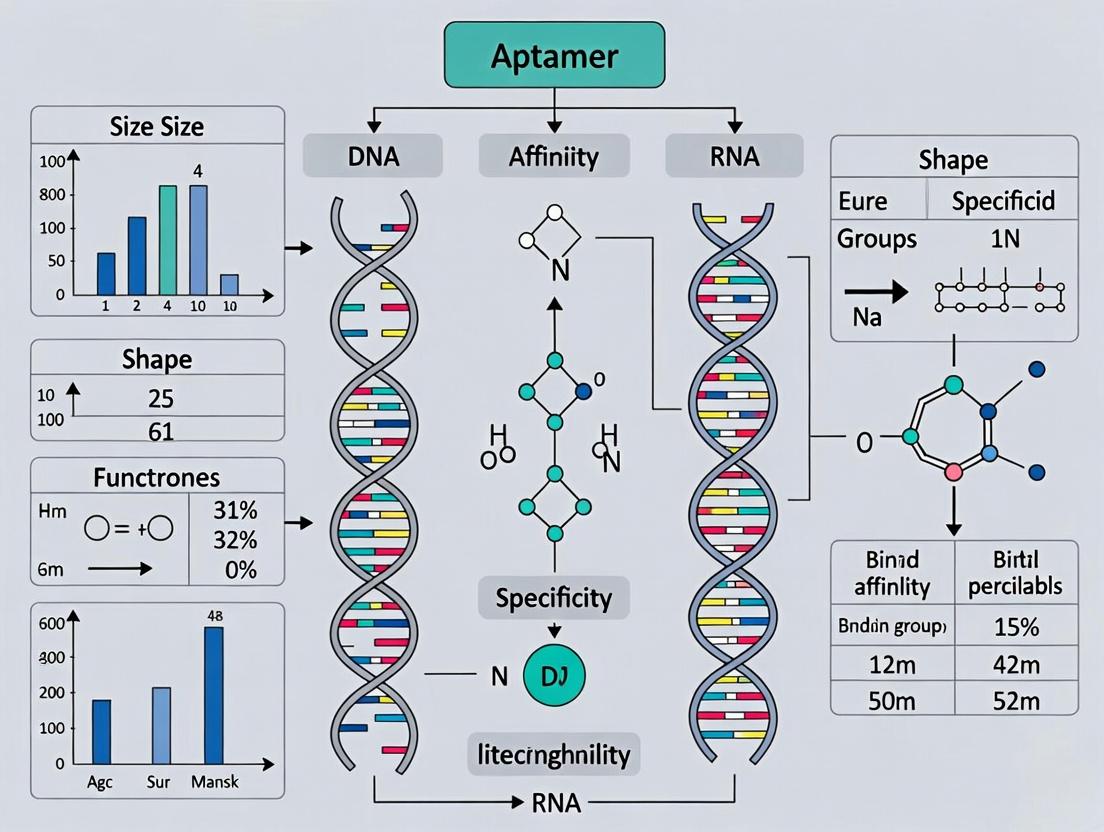
This article provides a detailed comparative analysis of DNA and RNA aptamers for researchers and drug development professionals.
DNA vs RNA Aptamers: A Comprehensive Comparison of Properties, Applications, and Selection Strategies
Abstract
This article provides a detailed comparative analysis of DNA and RNA aptamers for researchers and drug development professionals. We explore the fundamental structural and biochemical differences between these nucleic acid ligands. The article delves into SELEX methodologies, in vitro and in vivo applications across diagnostics, therapeutics, and biosensing. Key challenges such as nuclease stability, off-target effects, and manufacturing are addressed with optimization strategies. We present a rigorous side-by-side evaluation of binding affinity, specificity, pharmacokinetics, and immunogenicity. This synthesis aims to inform optimal aptamer selection for specific biomedical research and clinical development goals.
Decoding the Blueprint: Core Structural and Chemical Differences Between DNA and RNA Aptamers
This whitepaper serves as a technical guide to aptamer definition and selection, framed within the critical, ongoing research thesis comparing DNA and RNA aptamer properties. While both are single-stranded oligonucleotides selected from synthetic libraries for high-affinity binding to specific targets, their inherent biochemical differences lead to distinct advantages and challenges. RNA aptamers offer greater structural diversity due to 2'-OH group participation, often leading to higher affinity and more complex binding pockets. Conversely, DNA aptamers boast superior chemical and enzymatic stability, lower synthesis costs, and do not require transcription steps during selection (SELEX), simplifying protocols. The choice between DNA and RNA platforms is central to therapeutic and diagnostic development, influencing selection strategy, modification approaches, and final application viability.
Core Principles of Aptamer Selection: SELEX
Systematic Evolution of Ligands by EXponential enrichment (SELEX) is the foundational iterative process for aptamer discovery. The general workflow applies to both DNA and RNA libraries, with key modifications for RNA.
Generalized SELEX Protocol
Objective: To isolate specific, high-affinity aptamers from a vast random-sequence nucleic acid library (10^13–10^15 unique sequences) against a target molecule.
Key Reagent Solutions:
- Synthetic Oligonucleotide Library: A pool of ssDNA or ssRNA molecules containing a central random region (20–60 nt) flanked by fixed primer binding sites.
- Immobilized Target: Purified target protein, small molecule, or cell, often immobilized on beads (e.g., streptavidin, Ni-NTA, nitrocellulose filters).
- Binding/Wash Buffers: Physiologically relevant buffers (e.g., PBS, HEPES) with specified Mg^2+ (critical for RNA structure) and salt concentrations.
- Partitioning Matrix: Beads, filters, or columns to separate target-bound sequences from unbound sequences.
- Enzymes for Amplification:
- DNA SELEX: Taq DNA Polymerase for PCR.
- RNA SELEX: Reverse Transcriptase (RT) for cDNA synthesis, T7 RNA Polymerase for in vitro transcription.
- Elution Solution: Solutions for disrupting aptamer-target binding (e.g., EDTA, high salt, denaturants, heat) to recover bound sequences.
Detailed Methodology:
- Incubation: The naïve library is incubated with the immobilized target under defined conditions (temperature, time, buffer).
- Partitioning: Unbound sequences are removed through stringent washing steps.
- Elution: Target-bound sequences are recovered.
- Amplification:
- DNA SELEX: Eluted ssDNA is directly amplified by PCR. One strand is then separated (asymmetric PCR, strand separation) to regenerate an ssDNA pool.
- RNA SELEX: Eluted RNA is reverse transcribed to cDNA, amplified by PCR, and then in vitro transcribed to regenerate an enriched RNA pool.
- Purification: The amplified pool is purified (e.g., phenol-chloroform extraction, spin columns).
- Iteration: The enriched pool is used as input for the next selection round (typically 8-15 rounds).
- Cloning & Sequencing: Final pools are cloned, sequenced, and individual candidates are characterized for affinity (Kd) and specificity.
Diagram Title: SELEX Workflow: DNA vs. RNA Paths
Comparative Properties: Quantitative Data
Table 1: Intrinsic Biochemical & Selection Properties
| Property | DNA Aptamers | RNA Aptamers | Notes & Impact |
|---|---|---|---|
| Structural Flexibility | Lower (C2'-endo sugar pucker) | Higher (C3'-endo sugar pucker, 2'-OH) | RNA accesses more complex 3D folds, potentially higher affinity. |
| Chemical Stability | High. Resists alkaline hydrolysis. | Low. 2'-OH makes RNA prone to hydrolysis. | DNA is preferable for harsh in vivo environments. |
| Nuclease Resistance | Moderate (DNases in serum). | Very Low (ubiquitous RNases). | Both require backbone modification (e.g., 2'-F, 2'-O-Me) for therapeutic use. |
| Selection Cost/Time | Lower & Faster. Direct PCR. | Higher & Slower. Requires RT and IVT steps. | DNA SELEX is less technically demanding. |
| Library Complexity | ~10^15 sequences feasible. | ~10^14 sequences typical (transcription bias). | DNA libraries can be more diverse. |
| Common Modifications | 3'-inverted dT caps, phosphorothioates. | 2'-F, 2'-NH2, 2'-O-Me pyrimidines. | Modifications often incorporated during SELEX (e.g., 2'-F-RNA). |
Table 2: Representative Therapeutic Aptamers & Properties
| Name (Trade) | Type | Target | Kd (nM) | Key Modification | Application/Status |
|---|---|---|---|---|---|
| Pegaptanib (Macugen) | RNA | VEGF-165 | ~0.05 | 2'-F, 2'-O-Me, PEGylated | Approved for wet AMD. |
| AS1411 | DNA | Nucleolin (on cells) | ~100 | Unmodified G-quadruplex | Experimental (cancer). |
| NOX-E36 (Emapticap) | L-RNA (Spiegelmer) | CCL2/MCP-1 | ~0.2 | L-ribose, PEGylated | Experimental (diabetic nephropathy). |
| ARC1779 | DNA | von Willebrand Factor | ~2 | 5' PEG, 3' inverted dT | Experimental (thrombosis). |
Detailed Experiment: Measuring Aptamer Affinity (Kd) via Biolayer Interferometry (BLI)
Objective: To determine the equilibrium dissociation constant (Kd) of a selected DNA or RNA aptamer for its target protein.
Research Reagent Solutions:
- BLI Instrument & Biosensors: e.g., Octet System with Streptavidin (SA) or Anti-His (AHQ) biosensors.
- Biotinylated/His-tagged Target Protein: High-purity protein for immobilization.
- Aptamer Solutions: Serial dilutions of purified aptamer in running buffer.
- Running Buffer: e.g., PBS + 0.01% BSA + 0.002% Tween-20, with 1-5 mM MgCl2 for RNA aptamers.
- Regeneration Buffer: Mild denaturing condition (e.g., 10 mM Glycine pH 2.0) to remove aptamer without damaging immobilized protein.
Protocol:
- Baseline (60s): Hydrate biosensors in running buffer.
- Loading (300s): Immobilize target protein onto sensor surface until desired loading level is reached.
- Second Baseline (60s): Return to buffer to establish a stable baseline post-loading.
- Association (180s): Dip sensor into aptamer solution to measure binding kinetics (kon).
- Dissociation (300s): Return to buffer to measure dissociation kinetics (koff).
- Regeneration: Briefly dip sensor into regeneration buffer to strip bound aptamer.
- Repeat: Perform steps 3-6 for each aptamer concentration.
- Data Analysis: Fit the association and dissociation curves globally using a 1:1 binding model. Kd = koff / kon.
Diagram Title: Biolayer Interferometry (BLI) Kd Assay Workflow
Key Signaling Pathways Targeted by Aptamers
Aptamers function as antagonists, agonists, or delivery vehicles by modulating specific pathways.
Diagram Title: Aptamer Inhibition of VEGF Signaling Pathway
Abstract: This technical guide examines the fundamental structural divergence between DNA and RNA—the presence of a 2'-hydroxyl group on the ribose sugar of RNA versus its absence in 2'-deoxyribose of DNA. This single-atom difference dictates profound conformational preferences (C2'-endo vs. C3'-endo sugar pucker), which cascade into distinct helical geometries (B-form vs. A-form), thermodynamic stability, and biochemical functionality. Within the context of aptamer research, these properties critically influence selection efficacy, target affinity, nuclease resistance, and therapeutic applicability. This whitepaper provides a comparative analysis, supported by current experimental data and methodologies, to inform rational design in nucleic acid-based drug development.
Chemical and Conformational Fundamentals
The core distinction lies in the chemical structure of the pentose sugar. Ribose features a hydroxyl (-OH) group at the 2' carbon position, while 2'-deoxyribose has only a hydrogen atom (-H).
Table 1: Core Chemical & Structural Comparison
| Property | 2'-Deoxyribose (DNA) | Ribose (RNA) |
|---|---|---|
| 2' Carbon Substituent | Hydrogen (-H) | Hydroxyl (-OH) |
| Preferred Sugar Pucker | C2'-endo (in B-DNA) | C3'-endo |
| Resulting Helical Form | B-form (canonical) | A-form (canonical) |
| Major Groove Dimensions | Wide and deep | Narrow and deep |
| Minor Groove Dimensions | Narrow and deep | Wide and shallow |
| Helix Rise per Base Pair | ~3.4 Å | ~2.6 Å |
| Base Tilt | ~ -6° | ~ +20° |
The 2'-OH group in RNA introduces steric hindrance and additional hydrogen bonding potential. To minimize unfavorable interactions, the ribose ring adopts a C3'-endo conformation, pulling the 5' phosphate and 3' oxygen closer together. In DNA, the lack of the 2'-OH allows greater flexibility, favoring the C2'-endo pucker in physiological conditions, which provides a wider distance between adjacent phosphates.
Impact on Aptamer Properties and Selection
The conformational differences directly translate to key performance metrics for aptamers—single-stranded oligonucleotides selected for target binding.
Table 2: Implications for DNA vs. RNA Aptamer Development
| Property | DNA Aptamer Implications | RNA Aptamer Implications | Experimental Measurement |
|---|---|---|---|
| Nuclease Resistance | High (in serum); lacking 2'-OH reduces cleavage susceptibility. | Very low (native); highly susceptible to RNase degradation. | Half-life (t₁/₂) in 10% FBS or human serum, measured via PAGE/HPLC. |
| Structural Diversity | Primarily based on B-form-like geometries. Favors duplex and G-quadruplex structures. | Rich 3D diversity; A-form helix allows tighter turns and complex motifs (pseudoknots, loops). | Protocol: Structural probing via SHAPE (Selective 2'-Hydroxyl Acylation analyzed by Primer Extension) or DMS footprinting. |
| Thermodynamic Stability | Generally lower melting temperatures (Tₘ) for equivalent sequences due to less pre-organization. | Higher Tₘ for helices; 2'-OH can participate in H-bonding network, stabilizing structure. | Protocol: UV-Vis thermal denaturation at 260 nm. Monitor absorbance vs. temperature (1-90°C) in suitable buffer. Fit curve to obtain Tₘ. |
| In vitro Selection (SELEX) | Simpler: No need for reverse transcription step; resistant to nucleases in selection cocktails. | More complex: Requires reverse transcription and in vitro transcription steps; RNase-free conditions essential. | Standard SELEX workflow with iterative binding, partitioning, and amplification. |
| Chemical Synthesis Cost & Scale | Lower cost, high yield, and established modifications (e.g., 2'-F, 2'-O-Me). | Historically more challenging, but advances in solid-phase synthesis have improved accessibility. | N/A |
| Therapeutic Modifications | Often used with terminal modifications (PEGylation) or phosphorothioate backbones. | Requires heavy 2' modification (2'-F, 2'-O-Me, LNA) for stability in vivo. | Protocol: In vivo pharmacokinetics study in rodent models: measure aptamer concentration in plasma over time (0-48h) post-IV injection using LC-MS/MS. |
Key Experimental Protocols for Characterization
Protocol: Determining Sugar Pucker Conformation via NMR
Objective: Quantify the population of C2'-endo vs. C3'-endo conformations in an oligonucleotide. Method:
- Sample Preparation: Dissolve ~0.5-1 mM oligonucleotide in appropriate NMR buffer (e.g., 25 mM phosphate, 100 mM NaCl, pH 6.8) in D₂O or 90% H₂O/10% D₂O.
- Data Acquisition: Acquire 1D ¹H NMR and 2D TOCSY or COSY spectra on a high-field NMR spectrometer (≥500 MHz) at controlled temperature (e.g., 25°C). Focus on the anomeric H1' and the H2'/H2'' proton regions.
- Analysis: The scalar coupling constant ³J₁'₂' is diagnostic. A large coupling (>8 Hz) indicates a C3'-endo pucker (H1' and H2' are trans). A small coupling (<6 Hz) indicates C2'-endo pucker. The H2'/H2'' chemical shift separation is also indicative.
Protocol: Comparative Nuclease Stability Assay
Objective: Quantitatively compare the serum stability of a native RNA aptamer vs. a 2'-modified RNA or DNA analog. Method:
- Incubation: Prepare 1 µM solutions of each aptamer in 1x PBS containing 10% (v/v) fetal bovine serum (FBS). Incimate at 37°C.
- Sampling: Withdraw aliquots at specific time points (e.g., 0, 5, 15, 30, 60, 120, 240 minutes).
- Reaction Quenching: Immediately mix aliquot with an equal volume of denaturing urea gel loading buffer and heat at 95°C for 3 minutes to denature proteins and halt digestion.
- Analysis: Resolve fragments on a denaturing polyacrylamide gel (e.g., 15% urea-PAGE). Stain with SYBR Gold and image. Plot remaining intact aptamer band intensity vs. time to determine degradation half-life (t₁/₂).
Visualization of Key Concepts
Title: Structural Impact of Sugar Chemistry on Aptamer Properties
Title: Comparative SELEX Workflow: DNA vs RNA Aptamer Selection
The Scientist's Toolkit: Essential Research Reagents & Materials
Table 3: Key Reagent Solutions for Aptamer Research
| Item | Function in Research | Example/Notes |
|---|---|---|
| T4 Polynucleotide Kinase (T4 PNK) | 5' end-labeling of DNA/RNA with ³²P or fluorescent tags for binding/Stability assays. | Critical for gel-shift (EMSA) and nuclease stability assays. |
| SYBR Gold Nucleic Acid Gel Stain | High-sensitivity fluorescence detection of ss/ds DNA & RNA in gels. | Essential for visualizing SELEX pools and assay products; low background. |
| DNase I (RNase-free) | Digestion of contaminating genomic DNA in RNA aptamer preparations. | Ensures purity of in vitro transcribed RNA libraries. |
| SuperScript IV Reverse Transcriptase | High-efficiency cDNA synthesis from RNA aptamer pools during RNA-SELEX. | High thermal stability and fidelity improves recovery of RNA sequences. |
| 2'-Fluoro (2'-F) NTPs | Chemically modified nucleotides for in vitro transcription. | Incorporates into RNA, dramatically increasing nuclease resistance while often maintaining A-form geometry. |
| Proteinase K | Digestion and removal of protein targets after partitioning in SELEX. | Cleaves protein, releasing bound aptamers prior to amplification. |
| Magnetic Beads (Streptavidin) | Immobilization of biotinylated targets for solution-phase SELEX. | Enables efficient partitioning via magnetic rack; reduces non-specific binding. |
| 7-Deaza-dGTP | PCR nucleotide analog reducing G-quadruplex formation during DNA-SELEX. | Improves amplification fidelity of GC-rich aptamer sequences. |
| Nitrocellulose Filters | Partitioning device for filter-based SELEX. | Binds protein-aptamer complexes; unbound oligonucleotides pass through. |
| Phosphorothioate Linkers | Backbone modification for DNA aptamers. | Replaces non-bridging oxygen with sulfur, increasing nuclease resistance and serum half-life. |
The chemical distinction between thymine (5-methyluracil), exclusive to DNA, and uracil, found in RNA, represents a foundational divergence in nucleic acid biology. Within the context of DNA versus RNA aptamer research, this structural difference—the presence or absence of a methyl group at the C5 position—has profound implications for aptamer stability, specificity, and function. This whitepaper provides a technical analysis of the nucleobase chemistry of thymine and uracil, focusing on their hydrogen-bonding characteristics and the resultant biophysical consequences for aptamer development.
Structural and Electronic Comparison
The primary structural difference is the substitution of a hydrogen atom in uracil with a methyl group in thymine. This modification does not alter the Watson-Crick hydrogen-bonding face but introduces steric bulk and alters the electronic environment.
Table 1: Structural and Physicochemical Properties of Thymine and Uracil
| Property | Thymine (DNA) | Uracil (RNA) |
|---|---|---|
| Systematic Name | 5-Methyluracil | Pyrimidine-2,4(1H,3H)-dione |
| Molecular Formula | C₅H₆N₂O₂ | C₄H₄N₂O₂ |
| Molecular Weight (g/mol) | 126.113 | 112.087 |
| C5 Substituent | -CH₃ (Methyl Group) | -H (Hydrogen) |
| pKa (N3) | ~9.8 | ~9.5 |
| Molar Absorbance (ε260, pH 7) | ~8,800 M⁻¹cm⁻¹ | ~10,000 M⁻¹cm⁻¹ |
| Melting Point | 316-317 °C (decomposes) | >300 °C (decomposes) |
| Chemical Shift (C6, NMR/DMSO-d6) | ~163.5 ppm | ~163.0 ppm |
Hydrogen Bonding and Base Pairing
Both nucleobases form two hydrogen bonds with adenine. The methyl group of thymine is positioned in the major groove of the DNA double helix and does not participate directly in Watson-Crick pairing.
Table 2: Hydrogen Bonding Parameters in A:T and A:U Base Pairs
| Parameter | Adenine:Thymine (A:T) Pair | Adenine:Uracil (A:U) Pair |
|---|---|---|
| Primary Interaction | Watson-Crick Complementary | Watson-Crick Complementary |
| Number of H-bonds | 2 | 2 |
| Donor-Acceptor Pattern | N6-H...O4 & N1-H...N3 | N6-H...O4 & N1-H...N3 |
| Average Bond Length (Å) | ~2.95 | ~2.90 |
| Base Pair Propeller Twist | ~10-20° | ~5-15° |
| Major Groove Feature | Methyl Group (Hydrophobic) | Carbonyl Group (Polar) |
| Impact on Duplex Stability | Increases hydrophobic stacking & thermal stability (ΔTm ~0.5-1.5°C/base pair vs. U) | Contributes to RNA's inherent helical conformation (A-form) |
Diagram 1: Hydrogen Bonding in A:T and A:U Base Pairs
Implications for Aptamer Properties
The thymine-uracil distinction is a key driver of the divergent properties of DNA and RNA aptamers, impacting selection (SELEX), stability, and target interaction.
Table 3: Impact of Thymine vs. Uracil on Aptamer Characteristics
| Aptamer Characteristic | DNA Aptamer (Thymine) | RNA Aptamer (Uracil) |
|---|---|---|
| In Vivo Stability (Nuclease) | More resistant (Thymine not a substrate for most ribonucleases; susceptible to DNases) | Less resistant (Uracil in RNA susceptible to abundant RNases) |
| Chemical Stability | High (Resistant to alkaline hydrolysis due to absence of 2'-OH) | Lower (Susceptible to base-catalyzed hydrolysis via 2'-OH) |
| Conformational Flexibility | Typically lower (B-form helix preference; methyl group restricts some dynamics) | Higher (A-form helix; can adopt more complex tertiary folds) |
| Hydrophobic Character | Increased (Methyl groups provide hydrophobic patches) | Decreased (More polar surface) |
| Mutational Rate (SELEX) | Potentially lower (Replication fidelity of DNA polymerases) | Potentially higher (Error rate of reverse transcriptase in SELEX) |
| Synthetic Cost | Generally lower | Higher (requires 2'-OH protection/deprotection) |
Diagram 2: SELEX Workflow Highlighting Nucleobase Impact
Detailed Experimental Protocol: Measuring Base Pair Stability
Protocol Title: Determination of Thermal Melting Temperature (Tm) for DNA and RNA Duplexes Containing A:T and A:U Base Pairs.
Objective: To quantify the thermodynamic stability contribution of the thymine methyl group by comparing the Tm of otherwise identical DNA and RNA duplexes.
Materials:
- Synthesized oligonucleotides (DNA: 5'-d(GCA TGC AAT TGC ATG C)-3'; RNA: 5'-r(GCA UGC AAU UGC AUG C)-3').
- Appropriate complementary strands.
- High-salt buffer (e.g., 1x PBS: 10 mM Na₂HPO₄, 1.8 mM KH₂PO₄, 137 mM NaCl, 2.7 mM KCl, pH 7.4).
- UV-Visible spectrophotometer equipped with a Peltier temperature controller and multicell holder.
- Quartz cuvettes with 1-cm path length.
- Microcentrifuge tubes, pipettes, nuclease-free water.
Procedure:
- Sample Preparation: Dissolve lyophilized oligonucleotides in nuclease-free buffer. Determine exact concentration using UV absorbance at 260 nm and calculated molar extinction coefficients.
- Duplex Annealing: Mix complementary strands in a 1:1 molar ratio in high-salt buffer (final strand concentration: 2-4 µM). Heat the mixture to 95°C for 5 minutes, then allow it to cool slowly to room temperature (over 60-90 minutes) to ensure proper duplex formation.
- UV Melting Experiment: a. Load the annealed duplex into a quartz cuvette. b. Set the spectrophotometer to monitor absorbance at 260 nm. c. Program the temperature controller to equilibrate at 15°C, then ramp to 95°C at a slow, constant rate (e.g., 0.5-1.0°C per minute), with data points collected at regular temperature intervals. d. Perform a reverse melt by cooling from 95°C back to 15°C at the same rate to check for hysteresis and reversibility.
- Data Analysis: a. Plot absorbance at 260 nm versus temperature to generate a melting curve. b. Normalize the absorbance values between 0 (fully base-paired) and 1 (fully single-stranded). c. Calculate the first derivative of the normalized melting curve. The peak of the derivative plot corresponds to the Tm (the temperature at which 50% of the duplex is dissociated). d. Compare the Tm values of the DNA (containing A:T) and RNA (containing A:U) duplexes. The DNA duplex typically exhibits a higher Tm due to increased hydrophobic stabilization from thymine methyl groups.
The Scientist's Toolkit: Key Reagents & Materials
Table 4: Essential Research Reagents for Nucleobase/Aptamer Studies
| Reagent/Material | Function/Explanation |
|---|---|
| 2'-Deoxythymidine-5'-Triphosphate (dTTP) | Natural substrate for DNA polymerases during PCR amplification of DNA aptamer libraries. |
| Uridine-5'-Triphosphate (UTP) | Natural substrate for T7 RNA polymerase during in vitro transcription of RNA aptamer libraries. |
| 5-Methyl-dUTP | Modified nucleotide used to incorporate thymine-like (methylated) bases into DNA strands via PCR, mimicking some RNA properties. |
| Thermostable DNA Polymerase (e.g., Taq) | Enzyme for PCR amplification in DNA-SELEX. Must have high processivity and fidelity. |
| T7 RNA Polymerase | Enzyme for in vitro transcription from a DNA template to generate the RNA library for RNA-SELEX. |
| Reverse Transcriptase (e.g., SuperScript IV) | Enzyme for converting enriched RNA pools back into cDNA during RNA-SELEX cycles. |
| RNase Inhibitor (e.g., RNasin) | Essential for protecting vulnerable RNA libraries containing uracil from degradation by RNases during SELEX procedures. |
| DNase I (RNase-free) | Used to digest template DNA after in vitro transcription in RNA-SELEX or to challenge DNA aptamer stability. |
| DMS (Dimethyl Sulfate) / CMCT (1-cyclohexyl-3-(2-morpholinoethyl)carbodiimide) | Chemical probing agents that modify specific nucleobases (A/C for DMS; U for CMCT) to map secondary structure and protein-binding sites in aptamers. |
| UV-Vis Spectrophotometer with Tm Analysis | Instrument for measuring oligonucleotide concentration (A260) and performing thermal denaturation experiments to determine duplex stability (Tm). |
This whitepaper explores the fundamental structural dynamics that differentiate DNA and RNA oligonucleotides, with direct implications for aptamer research. The core thesis posits that while DNA aptamers benefit from the predictable rigidity and stability of the B-form duplex, RNA aptamers derive their functional diversity from the complex, hierarchical folding of single strands, enabling more intricate ligand-binding pockets and conformational switches. This inherent flexibility directly impacts aptamer selection, stability, binding affinity, and therapeutic applicability.
Structural Foundations: A Quantitative Comparison
Table 1: Key Structural & Biophysical Parameters of DNA vs. RNA
| Parameter | DNA (B-Form Duplex) | RNA (A-Form Duplex / Folded Single Strand) | Functional Implication for Aptamers |
|---|---|---|---|
| Dominant Helical Form | B-form | A-form (in duplex regions) | RNA major groove is deeper & narrower; less accessible. |
| Sugar Pucker | C2'-endo | C3'-endo | RNA backbone is less flexible; influences phosphate spacing. |
| Helical Rise (bp/turn) | ~3.4 Å | ~2.8 Å | RNA duplex is more compact. |
| Helix Diameter | ~20 Å | ~26 Å | Impacts packing and overall shape. |
| Presence of 2'-OH | No (2'-H) | Yes | RNA: Catalytic potential, H-bond donor, but chemically labile. DNA: More nuclease resistant. |
| Major Groove | Wide, moderate depth | Deep, narrow | DNA major groove more suitable for protein recognition via base-pair edge. |
| Minor Groove | Narrow, deep | Wide, shallow | RNA minor groove more accessible. |
| Inherent Flexibility | Moderate (persistence length ~50 nm) | High (local single-strand dynamics) | RNA can form complex tertiary motifs (kissing loops, pseudoknots). DNA favors simpler stems, loops, G-quadruplexes. |
| Thermodynamic Stability (ΔG) | Typically less negative per bp | Typically more negative per bp (A-U weaker than A-T, but G-C stronger) | RNA structures can be more stable for a given length, but single strand is prone to misfolding. |
| Tm Modulation | Primarily by length, GC% | By length, GC%, and Mg2+ concentration | RNA folding is highly cation-dependent. |
Experimental Protocols for Analyzing Flexibility & Folding
Protocol: Hydroxyl Radical Footprinting for Solution-Phase Structure Mapping
Purpose: To probe solvent accessibility of backbone residues in folded DNA/RNA aptamers.
- End-labeling: 5' or 3' end-label aptamer with 32P.
- Folding: Incubate labeled aptamer (10-100 nM) in appropriate buffer (e.g., 20 mM Tris-HCl, pH 7.5, 100 mM KCl, 5 mM MgCl2 for RNA) at 70°C for 2 min, then cool slowly to room temp.
- Cleavage Reaction: Add fresh Fe(II)-EDTA complex (final 50 µM) and ascorbate (final 1 mM). Initiate radical generation by adding H2O2 (final 0.03%). React for 10 min on ice.
- Quenching: Add thiourea (final 20 mM) to scavenge radicals.
- Electrophoresis: Precipitate nucleic acid, resuspend in formamide loading dye, and resolve fragments on denaturing polyacrylamide gel (8-12%).
- Analysis: Visualize via phosphorimaging. Protected regions (cleavage gaps) indicate structured or protein-bound areas.
Protocol: Small-Angle X-ray Scattering (SAXS) for Global Conformation
Purpose: To determine low-resolution shape and flexibility parameters in solution.
- Sample Preparation: Purify aptamer via HPLC/gel filtration. Dialyze into matching SAXS buffer (low particulates). Prepare a concentration series (e.g., 0.5, 1, 2 mg/mL).
- Data Collection: Acquire scattering data at a synchrotron beamline. Measure buffer blanks before/after each sample. Exposure times are typically 0.5-1 sec/frame, multiple frames to check for radiation damage.
- Primary Data Processing: Subtract buffer scattering. Use Guinier analysis to determine Radius of Gyration (Rg) and check for aggregation. Generate the Pair Distance Distribution Function, P(r), to assess compactness and flexibility.
- Modeling: Generate ab initio dummy bead models (e.g., using DAMMIF). For flexible systems, use ensemble optimization methods (EOM) to characterize a pool of conformers.
Protocol: Isothermal Titration Calorimetry (ITC) for Binding Energetics
Purpose: To directly measure binding affinity (Kd), stoichiometry (n), enthalpy (ΔH), and entropy (ΔS), informing on conformational changes.
- Sample Preparation: Exhaustively dialyze both aptamer and target (protein/small molecule) into the same degassed buffer (critical for RNA with defined cation concentration).
- Instrument Setup: Load target (20-50 µM) into the cell (1.4 mL). Load aptamer (200-500 µM) into the syringe.
- Titration: Perform ~20 injections (2 µL initial, 10-15 µL subsequent) with 180-240 sec spacing at constant temperature (25-37°C). Include a control titrant-into-buffer experiment for heat of dilution.
- Data Analysis: Subtract control data. Fit integrated heat peaks to a one-site binding model. A large, positive or negative ΔS component often indicates significant conformational rearrangement upon binding.
Visualizing Structural Relationships & Workflows
Title: DNA vs RNA Aptamer Structural Paradigms & Outcomes
Title: SELEX Workflow Highlighting DNA vs RNA Library Handling
The Scientist's Toolkit: Essential Research Reagents & Materials
Table 2: Key Reagent Solutions for DNA/RNA Aptamer Structural Studies
| Reagent/Material | Function/Description | Key Consideration for DNA vs. RNA |
|---|---|---|
| RNase-free DNase I | Degrades DNA templates post-transcription for RNA aptamer preparation. | RNA-specific: Critical for removing template DNA in RNA SELEX. |
| SuperScript IV Reverse Transcriptase | High-temperature, processive reverse transcription for RNA libraries. | RNA-specific: Used in RNA SELEX to generate cDNA for PCR amplification. |
| T7 RNA Polymerase | High-yield in vitro transcription of RNA libraries. | RNA-specific: Generates the RNA pool for each selection round. |
| Vent (exo-) DNA Polymerase | High-fidelity PCR amplification for DNA libraries; lacks 3'→5' exonuclease. | DNA-specific: Preferred for DNA SELEX PCR to avoid sequence bias. |
| 2'-Fluoro/2'-O-Methyl NTPs | Chemically modified nucleotide triphosphates. | RNA-specific: Incorporated during transcription to enhance nuclease resistance of therapeutic aptamers. |
| Magnesium Chloride (MgCl₂) | Divalent cation essential for RNA folding and catalytic function. | Critical for RNA: Concentration (1-10 mM) must be optimized for proper tertiary folding. Affects DNA G-quadruplex stability. |
| Thermostable Inorganic Pyrophosphatase | Degrades pyrophosphate (PPi) produced during transcription. | RNA-specific: Prevents PPi inhibition, increasing RNA yield and length. |
| Dithiothreitol (DTT) | Reducing agent to prevent oxidation of protein targets during selection. | General: Used in binding buffers to maintain target protein activity. |
| HEPES-KOH Buffer (pH 7.4) | Biological pH buffer with minimal metal chelation. | General: Preferred over Tris for experiments involving metal ions (e.g., Mg²⁺ for RNA folding). |
| Mono- & Divalent Salt Solutions (KCl, NaCl) | Modulate ionic strength, affecting electrostatic interactions and duplex stability. | General: Potassium specifically stabilizes G-quadruplex structures in DNA aptamers. |
| SYBR Gold Nucleic Acid Stain | Ultrasensitive fluorescent gel stain for visualizing low-nanogram DNA/RNA. | General: Safer and more sensitive alternative to ethidium bromide for post-electrophoresis analysis. |
| Magnetic Beads (Streptavidin/Ni-NTA) | Solid support for immobilizing biotinylated or His-tagged target proteins during SELEX. | General: Enable rapid partitioning in solution-phase SELEX protocols. |
In the pursuit of optimal aptamers for therapeutics and diagnostics, thermodynamic stability is a critical differentiator between DNA and RNA candidates. This whitepaper examines two fundamental and interrelated metrics: the melting temperature (Tm) and secondary structure resilience. The inherent 2'-OH group in RNA profoundly impacts hydrogen bonding, base stacking, and hydration, leading to distinct thermodynamic profiles compared to DNA. Understanding these differences is essential for predicting aptamer function in physiological conditions, guiding selection (SELEX), and informing rational design for enhanced in vivo stability and target affinity.
Core Principles: Tm and Secondary Structure
Melting Temperature (Tm): Defined as the temperature at which 50% of nucleic acid duplexes or structured domains are denatured. It is a quantitative measure of overall structural stability. Secondary Structure Resilience: Refers to the robustness of intramolecular fold (e.g., hairpins, bulges, internal loops) against thermal or chemical denaturation. It dictates functional conformation persistence.
Quantitative Comparison: DNA vs. RNA Aptamers
Data synthesized from recent literature (2022-2024)
Table 1: Comparative Thermodynamic Parameters for Canonical Duplexes & Common Motifs
| Parameter | Typical DNA Aptamer Range | Typical RNA Aptamer Range | Key Determinants & Implications |
|---|---|---|---|
| Tm of Duplex (0.1 M NaCl) | ~55-75°C | ~60-80°C | RNA's A-form geometry provides stronger base stacking & hydration. |
| ΔH° (enthalpy) | -30 to -40 kcal/mol | -40 to -55 kcal/mol | RNA duplex formation is more exothermic due to additional H-bonds & stacking. |
| ΔS° (entropy) | -85 to -110 cal/(mol·K) | -105 to -135 cal/(mol·K) | RNA's more ordered hydration shell leads to a larger entropy penalty. |
| Resilience to Thermal Unfolding | Moderate; cooperative unfolding. | High; often exhibits multi-state, non-cooperative unfolding. | RNA's tighter packing requires specific ion interactions for stability. |
| 2'-Modification Impact on Tm | N/A | 2'-F/2'-O-Me can increase Tm by 2-6°C per modification. | Enhances nuclease resistance & can pre-organize the backbone. |
Table 2: Stability of Common Secondary Structure Motifs in Aptamers
| Motif | DNA Stability (Relative) | RNA Stability (Relative) | Notes for Aptamer Design |
|---|---|---|---|
| Stem (Watson-Crick) | High | Very High | RNA stems are ~10-15°C more stable than DNA equivalents. |
| Hairpin Loop | Moderate (stability decreases with loop size <4) | High (can stabilize via loop-base interactions) | RNA tetraloops (e.g., GNRA) are highly stable motifs. |
| Internal Loop / Bulge | Destabilizing; flexibility site. | Can be stabilizing; often involved in tertiary contacts. | Asymmetric internal loops are common in RNA aptamer binding pockets. |
| G-Quadruplex | Highly stable (K+ dependent). | Rare; less stable than DNA G4. | DNA aptamers can exploit G4 for extreme thermal stability (Tm >85°C). |
| Pseudoknot | Rare & less stable. | Common & highly stable; critical for function. | A key source of RNA aptamer resilience and complexity. |
Key Experimental Protocols
Protocol: Determining Tm via UV-Vis Spectroscopy
Objective: Measure hyperchromicity at 260 nm to calculate Tm. Reagents: See "Scientist's Toolkit" (Section 6). Procedure:
- Prepare aptamer sample in appropriate buffer (e.g., 10 mM sodium phosphate, 100 mM NaCl, 0.1 mM EDTA, pH 7.0). Ensure precise concentration (~2-5 µM).
- Degas solution briefly to prevent bubble formation.
- Load sample into a thermally controlled cuvette in a dual-beam spectrophotometer.
- Equilibrate at 20°C. Ramp temperature to 95°C at a slow, constant rate (0.5-1.0°C/min).
- Record absorbance at 260 nm at intervals of 0.5-1.0°C.
- Data Analysis: Plot absorbance vs. temperature. Fit data to a Boltzmann sigmoidal curve or calculate the first derivative. Tm is the inflection point or peak of the derivative plot.
Protocol: Assessing Secondary Structure Resilience via Circular Dichroism (CD) Spectroscopy
Objective: Monitor conformational changes during thermal denaturation. Procedure:
- Prepare aptamer sample in appropriate buffer (avoid high chloride concentrations).
- Place sample in a quartz CD cuvette with short path length (0.1 cm).
- Set spectrophotometer to record CD signal at a characteristic wavelength (e.g., 275 nm for RNA, 280 nm for DNA) or collect full spectra (220-320 nm) at set temperatures.
- Perform a thermal melt as in Protocol 4.1.
- Data Analysis: Plot ellipticity vs. temperature. Multiple inflection points indicate multi-state (non-cooperative) unfolding, characteristic of resilient, complex RNA folds. Compare spectra at 20°C and 95°C to confirm loss of chiral structure.
Protocol: Differential Scanning Calorimetry (DSC) for Full Thermodynamic Profile
Objective: Directly measure heat capacity change to obtain ΔH°, ΔS°, and ΔG°. Procedure:
- Dialyze aptamer sample extensively against the desired buffer. Use dialysate as reference.
- Load sample and reference into the DSC cells.
- Run a heating scan from 10-110°C at a controlled rate (e.g., 1°C/min).
- Data Analysis: Integrate the heat capacity curve (after baseline subtraction) to obtain the total enthalpy change (ΔH). Tm is the maximum of the peak. Calculate ΔS from ΔH/Tm. Model fitting can deconvolute transitions from different structural domains.
Visualizations
Title: UV-Vis Thermal Melt Workflow for Tm Determination
Title: DNA vs RNA Aptamer Thermodynamic Property Map
The Scientist's Toolkit: Key Research Reagent Solutions
| Item | Function & Rationale | Example/Note |
|---|---|---|
| High-Purity DNA/RNA Oligos | Substrate for study. HPLC or PAGE purification is essential to ensure homogeneity of structure. | Chemically modified bases (2'-F, 2'-O-Me) are often incorporated. |
| Controlled Salt Buffers | Ionic strength and cation type (Na+, K+, Mg2+) dramatically impact Tm and fold resilience. | Use TE or MOPS buffers with precise salt additives. Mg2+ is critical for RNA tertiary structure. |
| UV-Vis Spectrophotometer with Peltier | For monitoring hyperchromicity during thermal denaturation (Tm protocol). | Requires accurate temperature control and low-volume cuvettes. |
| Circular Dichroism (CD) Spectrophotometer | For probing chiral secondary structure changes (e.g., A-form vs. B-form) during melting. | Far-UV CD signals reveal base stacking and helical conformation. |
| Differential Scanning Calorimeter (DSC) | Gold standard for measuring complete thermodynamic profile (ΔH, ΔS, ΔG). | Requires higher sample concentrations and careful buffer matching. |
| Fluorescence Dyes (e.g., SYBR Green II) | Alternative method for monitoring melting via intercalation; sensitive to structural changes. | Can be used for high-throughput screening of multiple conditions. |
| Nuclease-Free Water & Tubes | Prevents degradation of RNA, which can skew melting data. | Essential for all RNA aptamer work. |
Within the field of nucleic acid aptamer research, a fundamental trade-off governs selection and therapeutic application: the innate biochemical stability of DNA versus the superior structural complexity and functional diversity of RNA. DNA aptamers, with their deoxyribose sugar lacking a 2'-hydroxyl group, exhibit significantly greater resistance to hydrolysis, a critical factor for in vivo stability and drug development. Conversely, RNA aptamers, empowered by the 2'-OH group, can adopt a more expansive repertoire of tertiary structures—including pseudoknots, tight turns, and diverse non-canonical base pairings—often leading to higher binding affinity and specificity for complex targets like proteins. This whitepaper provides an in-depth technical analysis of this trade-off, explores contemporary experimental approaches to circumvent it, and presents a toolkit for informed aptamer platform selection.
Quantitative Comparison of Core Properties
The following tables summarize the key biochemical and functional properties that underpin the DNA-RNA trade-off.
Table 1: Fundamental Biochemical & Structural Properties
| Property | DNA | RNA | Experimental Basis & Consequence |
|---|---|---|---|
| Sugar Backbone | 2'-Deoxyribose | Ribose (with 2'-OH) | The absence/presence of the 2'-hydroxyl is the primary determinant of stability and folding. |
| Hydrolytic Stability (t₁/₂) | High (Hours-Days in serum) | Low (Seconds-Minutes in serum) | Measured via incubation in 10% FBS or human serum at 37°C, followed by PAGE or mass spectrometry. The 2'-OH in RNA acts as an intramolecular nucleophile, catalyzing strand scission. |
| Thermodynamic Stability (ΔG) | Generally more negative (stable) for duplexes | Less negative for canonical duplexes | Determined by UV melting curves (Tm) and calorimetry. DNA's narrower major groove and stronger base stacking favor duplex stability. |
| Structural Diversity | Limited; primarily B-form duplexes, G-quadruplexes | High; A-form helices, pseudoknots, kink-turns, ribose zippers | Solved via X-ray crystallography and NMR. RNA's 2'-OH provides additional hydrogen bonding opportunities and conformational constraints. |
| Chemical Modification Tolerance | High (backbone, sugar, base) | Moderate (primarily 2'-position, base) | Assessed by SELEX with modified NTPs/dNTPs. DNA's inherent stability allows broader synthetic alteration. |
Table 2: Functional Aptamer Performance Metrics
| Metric | Typical DNA Aptamer Range | Typical RNA Aptamer Range | Key Determinants |
|---|---|---|---|
| Binding Affinity (Kd) | nM to pM | pM to low nM | RNA's complex structures can create more precise binding pockets for proteins. |
| Selection (SELEX) Cycles | Often higher (≥15) | Can be lower (8-12) | RNA's structural complexity can yield high-affinity binders faster. |
| In Vivo Half-life (unmodified) | ~30 min - 2 hours | <2 minutes | Governed by nuclease resistance (exo- and endonucleases). |
| Common Therapeutic Modifications | 3'-inverted dT, 5'-PEG, phosphorothioate linkages | 2'-F, 2'-O-Me, 2'-NH₂, LNA, capping (3'-3'dT) | Modifications aim to close the stability gap for RNA or enhance DNA's structural mimicry. |
Core Experimental Protocols
Protocol: Measuring Nuclease Stability in Biological Fluids
Objective: Quantify the half-life (t₁/₂) of DNA vs. RNA aptamers in serum.
- Labeling: Prepare 5'-[³²P] or fluorescently (e.g., FAM) labeled DNA and RNA aptamers (purified, same sequence if possible).
- Incubation: Dilute aptamer to 1 µM in 90% Dulbecco's Modified Eagle Medium (DMEM) supplemented with 10% fetal bovine serum (FBS). Incubate at 37°C.
- Sampling: Withdraw 10 µL aliquots at time points (e.g., 0, 0.5, 1, 2, 4, 8, 24 hours).
- Quenching & Denaturation: Immediately mix aliquot with 10 µL of stop solution (95% formamide, 20 mM EDTA, 0.025% SDS, xylene cyanol/bromophenol blue). Heat denature at 95°C for 5 min.
- Analysis: Resolve fragments on a denaturing 15% polyacrylamide gel (8 M urea). Visualize via autoradiography or fluorescence imaging.
- Quantification: Plot intact aptamer band intensity (%) vs. time. Fit to a first-order decay model to calculate t₁/₂.
Protocol: In vitro Selection (SELEX) for Structured Aptamers
Objective: Enrich DNA or RNA aptamers that bind a target protein with high affinity.
- Library Design: Synthesize a random library (e.g., 40-nt random region flanked by constant primer binding sites). For RNA, the DNA template is transcribed in vitro.
- Binding & Partitioning: Incubate the nucleic acid pool (∼10¹⁴ molecules) with the immobilized target (e.g., His-tagged protein on Ni-NTA beads) in binding buffer (containing Mg²⁺ for RNA folding). Wash to remove unbound sequences.
- Elution: Recover bound sequences. For DNA: heat elution (95°C) or competitive elution with free target. For RNA: phenol-chloroform extraction after proteinase K digestion.
- Amplification: (DNA) PCR amplify eluted DNA directly. (RNA) Reverse transcribe eluted RNA to cDNA, then PCR amplify. For RNA SELEX, the PCR product must be transcribed in vitro to regenerate the RNA pool for the next round.
- Counter-Selection: Implement early rounds against bare immobilization matrix to remove matrix-binding sequences.
- Monitoring: Monitor enrichment by measuring the % of input library that binds after each round (e.g., via qPCR or radioactivity). Clone and sequence enriched pools after 8-15 rounds.
Protocol: Determining Binding Affinity (Kd) via Nitrocellulose Filter Binding
Objective: Measure the equilibrium dissociation constant (Kd) for an aptamer-target complex.
- Labeled Aptamer: Prepare a trace concentration (<< expected Kd) of 5'-[³²P] labeled aptamer in folding buffer (heated to 95°C, slowly cooled).
- Dilution Series: Prepare a series of target protein concentrations (e.g., 10 pM to 1 µM) in binding buffer.
- Equilibration: Mix a constant amount of labeled aptamer with each protein concentration. Incubate at selection temperature (e.g., 25°C or 37°C) for 30-60 min.
- Filtration: Pass each reaction through a pre-wet nitrocellulose membrane (retains protein-nucleic acid complexes) stacked on a nylon or charged membrane (retains free nucleic acid).
- Quantification: Air-dry membranes, expose to a phosphor screen, and quantify radioactivity in each spot for both membranes.
- Calculation: Calculate fraction bound = (counts on nitrocellulose) / (counts on nitrocellulose + counts on nylon). Plot fraction bound vs. log[protein]. Fit data to a one-site specific binding model (Y=Bmax*X/(Kd+X)) to derive Kd.
Visualization of Concepts & Workflows
Title: The Core DNA vs. RNA Aptamer Trade-off
Title: SELEX Process for Aptamer Discovery
Title: Molecular Basis of RNA Lability vs. DNA Stability
The Scientist's Toolkit: Essential Research Reagents & Materials
Table 3: Key Reagent Solutions for Aptamer Research
| Reagent / Material | Function & Application | Key Considerations |
|---|---|---|
| T7 RNA Polymerase Kit | In vitro transcription for RNA library generation during SELEX. | High yield and fidelity are critical. Includes NTPs, buffer, and enzyme. |
| Thermostable Reverse Transcriptase | Converts selected RNA pools to cDNA for amplification in RNA-SELEX. | Must process structured RNA efficiently (e.g., SuperScript IV). |
| High-Fidelity DNA Polymerase (e.g., Q5) | PCR amplification of DNA pools or cDNA with minimal mutation introduction. | Essential to maintain library diversity and avoid sequence drift. |
| 2'-Fluorine (2'-F) NTPs | Chemically modified NTPs for transcription of nuclease-resistant RNA libraries. | Replaces 2'-OH on C and U, dramatically enhancing RNA stability. |
| Magnetic Beads (Streptavidin/Ni-NTA) | Immobilization of biotinylated or His-tagged target proteins for SELEX partitioning. | Enable efficient washing and reduce non-specific background binding. |
| Nitrocellulose Filter Membranes | Quantitative separation of protein-aptamer complexes from free aptamer in Kd assays. | Pore size (typically 0.45 µm) must retain the target protein. |
| DNase & RNase Inhibitors | Protect nucleic acid pools during SELEX steps and long-term storage. | RNase inhibitors (e.g., RiboGuard) are especially critical for RNA work. |
| Denaturing PAGE Gel System | Analyzes aptamer purity, size, and integrity during stability assays. | Requires urea, TBE buffer, and appropriate gel percentage (e.g., 15%). |
| Solid-Phase Synthesis Columns (CPG) | For custom synthesis of modified DNA/RNA aptamers on milligram scales. | Allows site-specific incorporation of 2'-modifications, inverted dT, etc. |
| Surface Plasmon Resonance (SPR) Chip | Label-free, real-time kinetics analysis (ka, kd, KD) of aptamer-target binding. | Provides superior kinetics data compared to endpoint assays like filter binding. |
From Selection to Solution: SELEX Strategies and Functional Applications in Biomedicine
Within the ongoing research into the comparative properties of DNA and RNA aptamers, the Systematic Evolution of Ligands by EXponential enrichment (SELEX) process stands as the foundational, unifying methodology for their discovery. This technical guide details the core SELEX protocol, highlighting the shared stages and critical decision points that define the generation of both nucleic acid aptamer types. The inherent chemical differences between DNA and RNA—primarily RNA's 2'-OH group and its susceptibility to ribonucleases—introduce modifications at specific workflow stages, yet the overarching selective principle remains constant.
The Core SELEX Workflow: A Unified Protocol
The SELEX process is an iterative, in vitro selection technique that evolves high-affinity nucleic acid ligands from vast random sequence libraries (typically 10^13 – 10^15 unique sequences).
Library Design and Synthesis
A single-stranded DNA library is chemically synthesized. It consists of a central random region (N20-N60) flanked by constant primer regions for PCR amplification.
- For DNA SELEX: This synthetic DNA library is the direct input for selection.
- For RNA SELEX: The DNA library is transcribed in vitro into an RNA library using T7 RNA polymerase, introducing the need for reverse transcription post-selection.
Incubation with Target
The nucleic acid library is incubated with the target molecule (protein, small molecule, cell, etc.) under defined buffer conditions (pH, ionic strength, temperature). A key step is the partitioning of target-bound sequences from unbound ones.
Partitioning
This is the critical selection step. Common methods include:
- Nitrocellulose Filter Binding: For protein targets; protein and protein-bound nucleic acids are retained on the filter.
- Affinity Chromatography: Target is immobilized on a column or beads.
- Microfluidic Methods: (e.g., CE-SELEX, SLAS) offer superior partitioning efficiency.
Elution and Recovery
Bound sequences are eluted, typically by denaturation (heat, chaotropic agents) or specific competitive elution.
Amplification
Eluted sequences are amplified to create an enriched pool for the next selection round.
- For DNA SELEX: Eluted DNA is directly amplified by asymmetric PCR to regenerate single-stranded DNA.
- For RNA SELEX: Eluted RNA must be reverse transcribed to cDNA (using Reverse Transcriptase), amplified by PCR, and then re-transcribed into RNA for the next round.
Counter-Selection
To increase specificity, the enriched pool is often incubated with non-target structures (e.g., related proteins, immobilization matrix) to subtract cross-reactive binders before proceeding to the next round with the true target.
Typically, 5-15 rounds of selection are performed, with increasing stringency (e.g., reduced target concentration, increased wash stringency) to drive the evolution of high-affinity aptamers.
Key Quantitative Parameters in SELEX
The following parameters are systematically adjusted and monitored throughout the SELEX process for both DNA and RNA aptamer discovery.
Table 1: Key Quantitative Parameters in a Typical SELEX Experiment
| Parameter | Typical Range / Value | Impact on Selection |
|---|---|---|
| Library Diversity | 10^13 – 10^15 sequences | Determines potential complexity and affinity of final aptamers. |
| Random Region Length | 20 – 80 nucleotides | Balances structural complexity and synthetic/manufacturing feasibility. |
| Target Concentration | High (µM) in early rounds, low (nM-pM) in later rounds | Increases selection pressure for high-affinity binders. |
| Incubation Time | 20 – 60 minutes | Allows binding equilibrium; can be reduced in later rounds. |
| Number of Selection Rounds | 5 – 15 | Insufficient rounds yield weak binders; too many can lead to loss of diversity. |
| Partitioning Wash Steps | 1 – 3 gentle washes early; increased number/rigor later | Removes weakly bound and non-specific sequences. |
| PCR Cycle Number | As low as possible (e.g., 8-15) | Minimizes amplification bias and the generation of parasitic sequences. |
Detailed Experimental Protocols
Protocol 1: Standard Nitrocellulose Filter-Binding SELEX (for Protein Targets)
Materials: Synthetic ssDNA library, purified target protein, nitrocellulose and nylon filter membranes, vacuum manifold, PCR reagents, transcription kit (for RNA-SELEX).
- Incubation: Incubate 1 nmol of nucleic acid library with target protein (1-10 µM) in selection buffer (e.g., PBS with Mg2+) for 30 min at room temperature.
- Partitioning: Pass mixture through a pre-wetted nitrocellulose filter under gentle vacuum. Protein and protein-bound nucleic acids are retained. Wash filter 3x with 500 µL of selection buffer.
- Elution: Soak filter in 200 µL of elution buffer (7M urea, 20 mM EDTA, heated to 95°C) for 5 min. Collect eluate.
- Recovery:
- DNA-SELEX: Purify eluted DNA (phenol-chloroform or column). Amplify by asymmetric PCR (e.g., 100:1 primer ratio) for 10 cycles. Purify ssDNA product.
- RNA-SELEX: Purify eluted RNA. Perform reverse transcription (RT) to cDNA. Amplify cDNA by symmetric PCR for 12 cycles. Use PCR product as template for in vitro transcription to generate RNA for the next round.
- Iteration: Use the recovered pool as input for the next round. Reduce target concentration and increase wash stringency progressively.
Protocol 2: Bead-Based Magnetic Separation SELEX
Materials: Biotinylated target, streptavidin-coated magnetic beads, magnetic rack.
- Immobilization: Incubate biotinylated target with magnetic beads. Wash to remove unbound target.
- Counter-Selection: Incubate nucleic acid library with bare beads. Discard beads to remove bead-binding sequences.
- Positive Selection: Incubate pre-cleared library with target-bound beads for 30-45 min. Wash with buffer on a magnetic rack.
- Elution: Elute bound sequences using heat denaturation (95°C) or a competitive ligand.
- Amplification & Iteration: Proceed as in Protocol 1, Step 4.
Visualizing the SELEX Workflow and Divergence
Diagram 1: Core SELEX Process for DNA and RNA Aptamers
Diagram 2: Key Partitioning Methods in SELEX
The Scientist's Toolkit: Essential SELEX Reagents & Materials
Table 2: Key Research Reagent Solutions for SELEX
| Item | Function in SELEX | Key Considerations |
|---|---|---|
| Synthetic Oligonucleotide Library | Source of sequence diversity for evolution. | Defined random region length; HPLC/ PAGE purification reduces truncations. |
| Immobilized Target | The molecule against which aptamers are selected. | Purity is critical. Immobilization (biotinylation, His-tag) must not disrupt native conformation. |
| Selection Buffer | Defines the chemical environment for binding. | Typically includes salts (Na+, K+), divalent cations (Mg2+ for RNA), pH buffer, carrier (tRNA, BSA). |
| Nitrocellulose Filters | For partitioning in filter-binding SELEX. | Binds proteins nonspecifically; pore size (0.45 µm) is standard. |
| Streptavidin Magnetic Beads | For partitioning using biotinylated targets. | Enable rapid washing and elution; low non-specific nucleic acid binding is essential. |
| High-Fidelity DNA Polymerase | For error-minimized PCR amplification of pools. | Reduces introduction of random mutations that could distort selection. |
| T7 RNA Polymerase | For in vitro transcription in RNA-SELEX. | Generates RNA pool from dsDNA template; requires pure NTPs. |
| Reverse Transcriptase | Converts selected RNA to cDNA in RNA-SELEX. | Must process structured RNA; thermostable variants improve yield. |
| RNase Inhibitors | Protects RNA pool from degradation during RNA-SELEX. | Essential for maintaining library integrity; added to all RNA-handling steps. |
| Next-Generation Sequencing (NGS) | For analyzing pool evolution and identifying aptamer candidates. | Replaced cloning/Sanger sequencing; enables analysis of full pool diversity post-rounds. |
The SELEX process provides the common technological ground upon which the distinct properties of DNA and RNA aptamers are built. While the fundamental cycle of selection, partitioning, and amplification is universal, the requisite enzymatic steps for RNA—transcription and reverse transcription—introduce unique points of optimization and potential bias. The choice of partitioning method, stringency control, and amplification fidelity are critical variables shared by both paths. Understanding this shared framework is paramount for researchers designing comparative studies to elucidate the intrinsic binding strengths, structural dynamics, and therapeutic applicability of DNA versus RNA aptamers.
This whitepaper provides a technical guide on the core methodological divergence between DNA and RNA Systematic Evolution of Ligands by EXponential enrichment (SELEX). Within the broader thesis on DNA vs. RNA aptamer properties, this document focuses on the procedural simplicity inherent to DNA SELEX versus the increased complexity introduced by RNA SELEX's requisite reverse transcription (RT) steps. Understanding this divergence is critical for researchers selecting an aptamer discovery platform, as it directly impacts experimental timeline, cost, potential sources of error, and the resulting aptamer's biochemical properties.
Core Process Comparison and Quantitative Data
The fundamental SELEX workflow—selection, partitioning, and amplification—is shared. The critical divergence lies in the amplification and regeneration steps due to the chemical nature of the nucleic acid library.
Table 1: Direct Comparison of DNA SELEX vs. RNA SELEX Key Parameters
| Parameter | DNA SELEX | RNA SELEX |
|---|---|---|
| Starting Library | DNA oligonucleotides (typically dsDNA with functional ssDNA region) | DNA template library (must be transcribed in vitro) |
| Key Enzymatic Steps | PCR amplification | RT-PCR (Reverse Transcription + PCR) & In Vitro Transcription (IVT) |
| Primary Enzymes Used | Thermostable DNA polymerase (e.g., Taq, Q5) | Reverse Transcriptase, DNA Polymerase, T7 RNA Polymerase |
| Typical Cycle Duration | ~4-6 hours | ~8-12 hours (includes IVT time) |
| Inherent Error Rate | Lower (DNA polymerase fidelity) | Higher (Combined errors from RT + PCR + IVT) |
| Critical Vulnerabilities | Primer-dimer formation, nonspecific amplification | RNase contamination, RNA secondary structure inhibition of RT, incomplete RT/IVT. |
| Post-Selection Modification | Direct sequencing or cloning of PCR product. | Must be reverse transcribed to DNA for sequencing/cloning. |
| Common Yields (Post-Amplification) | High (>1000-fold amplification per PCR cycle). | Variable; IVT yields typically 10-1000 RNA copies per template. |
| Primary Cost Driver | Oligonucleotide synthesis, polymerase. | Enzymes (RTase, T7 polymerase), NTPs, RNase inhibitors. |
Table 2: Error Rate Contribution in RNA SELEX (Representative Data)
| Step | Enzyme Example | Approx. Error Rate (substitutions/base/duplication) | Functional Consequence |
|---|---|---|---|
| Reverse Transcription | Avian Myeloblastosis Virus (AMV) RT | 1 in 10,000 - 1 in 30,000 | Introduces mutations not in original DNA pool. |
| PCR Amplification | Taq Polymerase | ~1 in 10,000 | Amplifies RT errors, adds new ones. |
| In Vitro Transcription | T7 RNA Polymerase | ~1 in 30,000 | Introduces errors in RNA product. |
| Cumulative Effect per Cycle | ~1 in 4,000 - 1 in 7,000 | Higher sequence diversity but also potential loss of high-affinity variants. |
Detailed Experimental Protocols
Core DNA SELEX Protocol (Key Steps)
A. Library Preparation:
- Synthesize a randomized ssDNA library: 5'-Fixed Primer Region 1 - (N~30-40~) - Fixed Primer Region 2-3'.
- Amplify by Symmetric PCR: Use a standard thermocycling protocol with a high-fidelity polymerase to generate the initial double-stranded DNA (dsDNA) working pool.
- Generate ssDNA: For SELEX methods requiring ssDNA (e.g., filter binding), purify one strand using biotin-streptavidin separation or asymmetric PCR.
B. Selection & Amplification Cycle:
- Incubation: Incubate the ssDNA pool with the immobilized target (e.g., on beads, column) in binding buffer. Typical conditions: 20-60 min, relevant temperature (4-37°C).
- Partitioning: Wash extensively with binding buffer to remove unbound and weakly bound sequences.
- Elution: Recover bound sequences by heat denaturation (e.g., 95°C, 5 min in elution buffer) or competitive elution with free target.
- Amplification: Use the eluted DNA directly as template for PCR with the original primers.
- Regeneration: Purify the PCR product. For the next round, generate ssDNA from this PCR amplicon as in Step A.3.
- Counter-Selection (Optional): Pre-incubate the pool with a non-target surface to remove non-specific binders.
Core RNA SELEX Protocol (Key Divergent Steps)
A. Library Template Preparation:
- Synthesize a dsDNA template library with a T7 promoter sequence upstream of the random region: 5'-T7 Promoter - Fixed Region 1 - (N~30-40~) - Fixed Region 2-3'.
- Amplify this template library by PCR to produce a large quantity of transcription-ready dsDNA.
B. Selection & Amplification Cycle:
- In Vitro Transcription (IVT): Transcribe the dsDNA pool using T7 RNA polymerase, NTPs, and RNase inhibitor. Incubate 2-4 hours at 37°C. Purify the RNA product (denaturing PAGE or column).
- Folding: Denature (95°C, 2 min) and snap-cool the RNA in selection buffer to promote proper folding.
- Incubation & Partitioning: Identical to DNA SELEX, but all buffers must be RNase-free.
- Elution: Elute bound RNA as in DNA SELEX.
- Reverse Transcription (RT): Use a primer complementary to the 3' fixed region and a reverse transcriptase (e.g., SuperScript IV) to generate cDNA from the eluted RNA.
- PCR Amplification: Amplify the cDNA using primers containing the T7 promoter sequence.
- Purification: Purify the PCR product (dsDNA) to serve as the template for the next round's IVT (return to Step 1).
Visualizations
DNA SELEX Simplified Workflow
RNA SELEX with RT and IVT Workflow
RNA SELEX Error Accumulation Pathway
The Scientist's Toolkit: Essential Research Reagents
Table 3: Key Reagent Solutions for DNA vs. RNA SELEX
| Reagent Category | DNA SELEX Specifics | RNA SELEX Specifics | Function & Critical Notes |
|---|---|---|---|
| Polymerase | High-fidelity DNA Pol. (e.g., Q5, Phusion). Standard Taq for final bulk PCR. | Reverse Transcriptase (e.g., SuperScript IV for high efficiency/thermostability). T7 RNA Polymerase for high-yield IVT. | DNA Pol: Amplifies pool. RT: Converts selected RNA to cDNA. T7 Pol: Generates RNA pool from DNA template. |
| Nucleotides | dNTPs. | NTPs for IVT. dNTPs for RT and PCR. | NTPs are the building blocks for RNA synthesis. Use RNase-free, high-purity stocks. |
| Primers | DNA primers for PCR amplification of library. | DNA primers with T7 promoter sequence for PCR. A separate 3' primer for RT. | T7 promoter sequence (5'-TAATACGACTCACTATAGGG-3') is mandatory upstream of the random region for IVT. |
| Nuclease Management | Standard nuclease-free water. May require DNase treatment for certain partitioning methods. | RNase Inhibitor (e.g., Recombinant RNasin). RNase-free buffers, tubes, and tips. DEPC-treated water. | Critical for preventing degradation of the RNA pool. RNase inhibitor must be fresh and added to all reactions. |
| Purification Kits | PCR cleanup kits, streptavidin beads for ssDNA generation. | RNA cleanup kits (silica membrane or bead-based). Denaturing PAGE equipment for high-purity size selection. | Removes enzymes, nucleotides, and abortive transcripts. PAGE purification is the gold standard for isolating full-length RNA. |
| Partitioning Aids | Nitrocellulose filters, streptavidin-coated beads, target-immobilized resins. | Identical to DNA SELEX, but all surfaces and buffers must be treated to be RNase-free. | Physically separates bound from unbound nucleic acid sequences. |
The development of therapeutic aptamers represents a critical frontier in oligonucleotide-based medicine, directly informed by the fundamental biochemical properties of DNA and RNA. This review is situated within a broader thesis investigating the trade-offs between DNA and RNA aptamers. Key differentiating factors include:
- Nuclease Resistance: DNA is inherently more resistant to serum nucleases than unmodified RNA, though chemical modifications (e.g., 2'-F, 2'-O-Me) are employed for both to achieve pharmacokinetic stability.
- Structural Diversity: RNA's 2'-OH group allows for greater structural plasticity (e.g., C3'-endo sugar pucker) and a wider array of non-canonical base pairs, potentially yielding higher-affinity binders. DNA libraries can explore unique foldamers.
- Chemical Synthesis & Cost: DNA is chemically more stable and typically less expensive to synthesize at scale than modified RNA.
- Immunogenicity: Both can be engineered for low immunogenicity, but sequence and modification patterns differentially influence Toll-like receptor (TLR) recognition.
The choice of scaffold—DNA or RNA—directly impacts the therapeutic profile, a theme evident in the clinical aptamers discussed herein.
FDA-Approved Therapeutic Aptamer
Pegaptanib (Macugen)
Pegaptanib is the first and, to date, only FDA-approved RNA aptamer for therapeutic use, indicated for neovascular age-related macular degeneration (AMD).
Mechanism of Action: It is a 28-nucleotide, 2'-F-pyrimidine, 2'-O-methyl-purine modified RNA aptamer, covalently linked to a 40 kDa branched polyethylene glycol (PEG) moiety. It specifically binds to the heparin-binding domain of vascular endothelial growth factor isoform 165 (VEGF165), a pathogenic isoform in wet AMD. This binding sterically inhibits VEGF165 from interacting with its receptors (VEGFR1 and VEGFR2) on endothelial cells, thereby suppressing pathological angiogenesis and vascular permeability.
Key Quantitative Data:
Table 1: Pharmacokinetic & Clinical Profile of Pegaptanib
| Parameter | Value / Detail | Notes |
|---|---|---|
| Molecular Weight | ~50 kDa (with PEG) | PEGylation extends half-life. |
| Kd for VEGF165 | ~50 pM | High-affinity, specific binding. |
| Administration | Intravitreal injection (0.3 mg dose) | Local delivery bypasses systemic exposure. |
| Half-life in Vitreous | ~94 hours (~4 days) | Allows for dosing every 6-8 weeks. |
| Pivotal Trial (V.I.S.I.O.N.) | ~70% of patients lost <15 letters vision (vs. 55% control) at 1 year. | Demonstrated efficacy in maintaining vision. |
Detailed Experimental Protocol for Aptamer-Target Binding (SPR Analysis):
- Objective: Determine the binding affinity (KD) of Pegaptanib for recombinant human VEGF165 using Surface Plasmon Resonance (SPR).
- Reagents:
- Biacore T200 or equivalent SPR instrument.
- CM5 or streptavidin (SA) sensor chip.
- Biotinylated VEGF165 protein (R&D Systems).
- Pegaptanib sodium salt (commercial standard).
- HBS-EP+ running buffer (10 mM HEPES, 150 mM NaCl, 3 mM EDTA, 0.05% v/v Surfactant P20, pH 7.4).
- Regeneration solution (e.g., 10 mM Glycine-HCl, pH 2.0).
- Procedure:
- Chip Preparation: Immobilize biotinylated VEGF165 (~1000 RU) on an SA chip according to the manufacturer's protocol.
- Ligand Dilution: Prepare a 2-fold serial dilution series of Pegaptanib (e.g., 0.1 nM to 10 nM) in HBS-EP+ buffer.
- Binding Analysis: Inject each aptamer concentration over the VEGF165-immobilized flow cell and a reference flow cell for 120 seconds at 30 µL/min. Monitor association.
- Dissociation: Switch to buffer flow for 300+ seconds to monitor dissociation.
- Regeneration: Inject regeneration solution for 30 seconds to remove bound aptamer.
- Data Processing: Subtract reference cell signals. Fit the resulting sensorgrams to a 1:1 Langmuir binding model using the Biacore evaluation software to calculate the association (ka) and dissociation (kd) rate constants. KD = kd/ka.
Clinical-Stage Therapeutic Aptamers
Table 2: Selected Clinical-Stage Aptamers (as of 2024)
| Aptamer (Platform) | Target / Mechanism | Indication | Phase | Key Differentiator / Note |
|---|---|---|---|---|
| Zimura (Avacincaptad pegol) (RNA) | Complement C5 protein (inhibitor) | Geographic Atrophy (GA) secondary to AMD | FDA Approved (2023) | First aptamer approved for GA. Intravitreal anti-complement therapy. |
| AS-176 (DNA) | Factor XIIa (inhibitor) | Anticoagulation for Extracorporeal Circuits | Phase II | DNA aptamer; rapid-onset/short-acting anticoagulant. |
| BC-007 (DNA) | Autoantibodies against β1-adrenergic receptors | Dilated Cardiomyopathy, Long COVID | Phase II | DNA aptamer; neutralizes pathogenic autoantibodies. |
| NOX-A12 (Spiegelmer, L-RNA) | Chemokine CXCL12 (SDF-1) | Glioblastoma, Pancreatic Cancer | Phase II | Enantiomeric L-RNA, extremely nuclease resistant. |
| ARC-EX4 (RNA) | Glucagon-like peptide-1 receptor (GLP-1R) agonist | Type 2 Diabetes | Phase I (discontinued) | RNA aptamer functioning as a GLP-1R agonist (not antagonist). |
Detailed Experimental Protocol for Cell-Based Functional Assay (e.g., Angiogenesis):
- Objective: Assess the functional inhibition of VEGF165-induced angiogenesis by Pegaptanib using a human umbilical vein endothelial cell (HUVEC) tube formation assay.
- Reagents:
- HUVECs (Lonza) and Endothelial Growth Medium (EGM-2).
- Growth Factor Reduced Matrigel (Corning).
- Recombinant human VEGF165 (PeproTech).
- Pegaptanib and a control scrambled RNA sequence.
- 96-well tissue culture plates.
- Calcein AM viability stain or phase-contrast microscope.
- Procedure:
- Matrigel Coating: Thaw Matrigel on ice and coat each well of a 96-well plate (50 µL/well). Incubate at 37°C for 30-60 min to polymerize.
- Cell and Treatment Preparation: Harvest HUVECs and resuspend in EGM-2 basal medium (no growth factors). Pre-mix VEGF165 (final conc. 10-50 ng/mL) with Pegaptanib or control (0-100 nM) for 15 min at RT.
- Assay Setup: Seed HUVECs (1-2 x 10⁴/well) in 100 µL of the VEGF/aptamer mixture onto the Matrigel.
- Incubation: Incubate cells at 37°C, 5% CO2 for 4-18 hours.
- Imaging & Quantification: Image tube networks using a 4x objective. Quantify total tube length, number of nodes, or mesh area using image analysis software (e.g., ImageJ Angiogenesis Analyzer).
- Analysis: Compare tube formation metrics between VEGF-only (positive control), VEGF + Pegaptanib (test), and basal medium (negative control) groups.
The Scientist's Toolkit: Key Research Reagent Solutions
Table 3: Essential Reagents for Aptamer Therapeutic Development
| Reagent / Material | Function / Purpose | Example Vendor(s) |
|---|---|---|
| Modified NTPs / dNTPs | SELEX library synthesis: 2'-F-CTP/UTP, 2'-O-Me-ATP/GTP for RNA; base-modified dNTPs for DNA. | TriLink BioTechnologies, Jena Bioscience |
| Magnetic Beads (Streptavidin) | Immobilization of biotinylated target proteins for SELEX separation. | Thermo Fisher (Dynabeads), Cytiva |
| Next-Generation Sequencing (NGS) Platform | High-throughput sequencing of SELEX pool enrichment (Illumina MiSeq). | Illumina |
| SPR or BLI Instrument | Label-free kinetic binding analysis (KD, kon, koff). | Cytiva (Biacore), Sartorius (Octet) |
| In vivo Imaging System (IVIS) | Tracking fluorescently labeled aptamer biodistribution in animal models. | PerkinElmer |
| HPLC-MS Systems | Purity analysis and characterization of synthesized aptamer drugs. | Agilent, Waters |
| Animal Disease Models | Efficacy & PK/PD testing (e.g., laser-induced CNV model for AMD). | Charles River, The Jackson Laboratory |
This whitepaper is framed within a broader thesis investigating the fundamental biochemical and biophysical properties differentiating DNA and RNA aptamers, and how these properties dictate their performance in integrated diagnostic biosensors. The selection of nucleic acid type (DNA or RNA) is not arbitrary; it directly influences thermodynamic stability, folding kinetics, nuclease resistance, chemical diversity, and ultimately, the feasibility of creating robust, field-deployable sensing platforms. This guide provides a technical comparison of DNA aptasensors and RNA-based switches (including riboswitches and aptazymes), focusing on their integration into diagnostic systems for researchers and drug development professionals.
Core Properties & Quantitative Comparison
The intrinsic properties of DNA and RNA underpin their utility in biosensor design. The following tables summarize key quantitative data.
Table 1: Fundamental Biochemical Properties
| Property | DNA Aptamers | RNA Aptamers / Switches | Experimental Basis & Impact on Biosensors |
|---|---|---|---|
| Native Stability | High; resistant to hydrolysis under physiological conditions. | Low; susceptible to base-catalyzed hydrolysis at the 2'-OH. | Measured by half-life in serum. DNA's stability favors shelf-life and in-vivo use. |
| Nuclease Resistance | Moderate (single-stranded); can be enhanced with modifications (e.g., 2'-F, 2'-O-Me). | Very Low (native); requires heavy modification (e.g., 2'-F, 2'-NH₂ pyrimidines) for in vitro/in vivo use. | Quantified via gel electrophoresis or FRET assays after serum incubation. Resistance is critical for complex matrices. |
| Folding Enthalpy (ΔH) | Generally more negative (exothermic) for similar structures. | Less negative, often entropy-driven (TΔS compensates). | Measured by Isothermal Titration Calorimetry (ITC). Affects temperature sensitivity of the sensor. |
| Structural Diversity | Primarily B-form helices, G-quadruplexes, bulges, loops. | A-form helices, more complex tertiary motifs (e.g., pseudoknots, kink-turns). | Structural studies (NMR, X-ray). RNA's complexity can yield higher affinity/specificity but harder to engineer. |
| Chemical Diversity | Limited to 4 canonical bases; modifications added post-SELEX. | 2'-OH provides a handle for in-line chemistry and intrinsic catalytic activity. | Enables RNA switches (ribozymes) for signal amplification without proteins. |
| Cost & Synthesis | Low-cost, automated solid-phase synthesis; easy to scale. | Higher cost; requires enzymatic synthesis or costly modified phosphoramidites. | Impacts feasibility for low-cost, high-volume diagnostic tests. |
Table 2: Biosensor Performance Metrics (Representative Data from Recent Literature)
| Metric | DNA Aptasensor Example | RNA-Switch Example | Assay Context |
|---|---|---|---|
| Detection Limit (LOD) | 0.8 pM (Thrombin) | 5 pM (Theophylline via aptazyme) | Electrochemical / Fluorescence readout in buffer. |
| Dynamic Range | 3-4 orders of magnitude | 2-3 orders of magnitude | Typically log-linear for most aptamer sensors. |
| Assay Time | 10 min - 2 hours | 5 min - 1 hour (catalytic RNA can be faster). | Includes incubation and readout. |
| % Signal Change (ΔS/S₀) | 200-400% (Structure-switching E-AB) | 500-1000% (Catalytic beacon amplification) | Max signal gain upon target saturation. |
| Binding Affinity (Kd) | 1 nM - 1 µM (common range) | 10 pM - 100 nM (can be very tight) | Measured via BLI, SPR, or fluorescence titration. |
| Reusability / Stability | > 50 cycles (immobilized on gold) | Limited (1-5 cycles), often single-use due to RNA fragility. | For reusable sensor chips. |
Experimental Protocols for Key Characterization Experiments
Protocol 1: Measurement of Nuclease Resistance for Aptamer Selection
Objective: Determine the half-life of candidate DNA/RNA aptamers in a biologically relevant matrix to inform biosensor design. Reagents: Fluorophore-labeled aptamer (e.g., 5'-FAM), 10% (v/v) Fetal Bovine Serum (FBS) in 1x PBS, 7 M Urea loading buffer, 20% denaturing polyacrylamide gel. Procedure:
- Incubation: Combine 200 nM labeled aptamer with pre-warmed 10% FBS in a PCR tube. Incubate at 37°C.
- Sampling: At time points (0, 5, 15, 30, 60, 120, 240 min), remove a 10 µL aliquot and immediately mix with 10 µL of 7 M urea buffer to denature enzymes.
- Analysis: Heat samples to 95°C for 2 min, then load onto a pre-run 20% denaturing PAGE gel. Run at constant power.
- Quantification: Image gel using a fluorescence scanner. Quantify intact band intensity vs. degraded smear.
- Calculation: Plot ln(Intensity) vs. time. The slope = -k (degradation rate constant). Half-life = ln(2)/k.
Protocol 2: In-Line Probing for RNA Switch Mechanism & Ligand Titration
Objective: Map structural changes in an RNA-based switch (riboswitch/aptazyme) upon ligand binding. Reagents: 5'-end 32P or Cy5-labeled RNA, target ligand, 10x In-line Probing Buffer (500 mM Tris-HCl pH 8.3, 1.5 M KCl, 100 mM MgCl₂). Procedure:
- Folding: Heat labeled RNA (50,000 cpm) to 80°C for 2 min in 1x buffer without Mg²⁺. Cool slowly to room temp.
- Mg²⁺ & Ligand Addition: Add MgCl₂ to 10 mM final. Aliquot RNA into tubes with ligand serially diluted in buffer.
- Spontaneous Cleavage: Incubate at 25°C for 40 hours. The 2'-OH group attacks the phosphate backbone at flexible, single-stranded regions.
- Reaction Stop: Add 2 volumes of 8 M Urea, 50 mM EDTA.
- Electrophoresis: Run samples alongside an RNase T1 ladder (cleaves after G) and an alkaline hydrolysis ladder on a 10% denaturing PAGE gel.
- Analysis: Image with phosphorimager. Protected regions (decreased cleavage) indicate ligand-induced structuring. Band intensity quantification yields apparent Kd.
Protocol 3: Electrochemical Impedance Spectroscopy (EIS) for Aptasensor Characterization
Objective: Measure binding-induced interfacial changes on a gold electrode biosensor. Reagents: Thiolated aptamer, 6-mercapto-1-hexanol (MCH), target analyte, 1x PBS with 5 mM [Fe(CN)₆]³⁻/⁴⁻ redox probe. Procedure:
- Electrode Prep: Clean gold electrode (2 mm dia.) with piranha solution (Caution!), then polish and electrochemically clean in 0.5 M H₂SO₄.
- Aptamer Immobilization: Incubate electrode in 1 µM thiolated aptamer in PBS overnight at 4°C.
- Backfilling: Rinse and incubate in 1 mM MCH for 1 hour to passivate uncovered gold.
- EIS Measurement: Perform EIS in redox solution from 100 kHz to 0.1 Hz at open circuit potential. Apply a 10 mV RMS perturbation.
- Target Binding: Incubate functionalized electrode in target solution for 30 min. Rinse gently.
- Post-Binding EIS: Repeat step 4.
- Data Fitting: Fit Nyquist plots to a modified Randles equivalent circuit. The increase in charge transfer resistance (R_ct) correlates with target binding.
Diagrams: Signaling Pathways & Workflows
Diagram 1: DNA Electrochemical Aptamer-Based (E-AB) Sensor Mechanism.
Diagram 2: RNA Aptazyme-Mediated Signal Amplification.
Diagram 3: From SELEX to Integrated Biosensor Device.
The Scientist's Toolkit: Key Research Reagent Solutions
Table 3: Essential Materials for Aptasensor Development
| Item / Reagent | Function & Rationale |
|---|---|
| Modified NTPs/Phosphoramidites (2'-F-CTP/UTP) | Critical for generating nuclease-resistant RNA aptamers during SELEX and synthesis. Increases stability in biological fluids. |
| Thiol Modifier C6 S-S (SPDP Chemistry) | Standard for gold surface immobilization of DNA aptamers in electrochemical or SPR sensors. Provides stable Au-S bond. |
| MCH (6-Mercapto-1-hexanol) | Alkanethiol used to backfill gold surfaces after aptamer immobilization. Reduces non-specific adsorption and orients the aptamer. |
| Hegtamer (Hexaethylene Glycol) Spacer | Incorporated into aptamer sequence during synthesis to reduce steric hindrance from the surface, improving target access. |
| Methylene Blue or Ferrocene NHS Ester | Redox reporters for covalent attachment to internal bases (e.g., dT) in E-AB sensors. Enables electron transfer signaling. |
| RNase Inhibitor (e.g., SUPERase•In) | Essential for protecting RNA switches during handling and assay development in complex samples. |
| T7 RNA Polymerase (HiScribe) | High-yield in vitro transcription kit for generating large quantities of unmodified or modified RNA switches. |
| Magnetavidin Beads (Streptavidin) | Used for SELEX partitioning and for creating sandwich assay formats by capturing biotinylated aptamers. |
| QCM-D (Quartz Crystal Microbalance with Dissipation) Sensor Chips (Gold) | For label-free, real-time monitoring of aptamer immobilization and target binding kinetics. |
| Corning Epoxy-Primed Slides | Reliable substrate for printing DNA/RNA microarrays for high-throughput multiplexed sensor screening. |
The quest for precision in therapeutic and diagnostic delivery hinges on the development of ligands with high affinity, specificity, and favorable pharmacokinetics. Within the broader thesis comparing DNA and RNA aptamer properties, the in vivo delivery phase is a critical differentiator. While both nucleic acid aptamers share the ability to be selected in vitro via SELEX, their intrinsic biochemical properties—such as nuclease susceptibility, conformational stability, and immunogenicity—profoundly impact their performance in living systems. This guide examines the mechanisms and methodologies central to achieving successful in vivo targeting, with a focus on how the distinct properties of DNA and RNA aptamers influence tissue penetration, cellular uptake, and ultimate therapeutic efficacy.
Quantitative Comparison of DNA vs. RNA Aptamer Properties AffectingIn VivoDelivery
Table 1: Inherent Biophysical and Pharmacokinetic Properties of Unmodified DNA vs. RNA Aptamers
| Property | DNA Aptamers | RNA Aptamers | Impact on In Vivo Delivery |
|---|---|---|---|
| Nuclease Resistance | Moderate; resistant to alkaline hydrolysis, degraded by serum endo- and exonucleases. | Low; highly susceptible to ubiquitous RNases, rapid serum degradation. | RNA requires extensive chemical modification (2'-F, 2'-O-Me) for stability; DNA has a longer inherent circulation half-life. |
| Structural Flexibility | Generally less complex folding, more rigid duplexes (B-form). | Highly complex tertiary structures (A-form), diverse motifs (kissing loops, GNRA tetraloops). | RNA may achieve higher specificity/affinity but can be more prone to denaturation; DNA structures may be more robust in variable in vivo environments. |
| Immunogenicity | Generally low; CpG motifs can trigger TLR9-mediated immune response. | Generally low; but can be recognized by RIG-I or TLR7/8, especially with triphosphates. | Can be an undesirable side effect or leveraged for adjuvant activity in vaccines/oncology. |
| Thermal Stability | High melting temperatures (Tm) for duplex regions. | Lower Tm for equivalent sequences; stability dependent on Mg2+ for tertiary folding. | Affects shelf-life and performance at physiological temperatures; DNA often more thermally stable. |
| Typical Size (nt) | 25-80 nucleotides | 25-80 nucleotides | Both face similar challenges with renal clearance (cutoff ~40 kDa); size can be modulated. |
| Production Cost | Chemical synthesis is standard and cost-effective. | Requires enzymatic transcription or expensive modified phosphoramidites for synthesis. | DNA aptamers are more scalable and economical for large-scale therapeutic development. |
| Common Modifications | 3'-inverted dT cap, phosphorothioate linkages, 5'-PEGylation. | 2'-F, 2'-O-Me, 2'-NH2 pyrimidines; similar terminal caps and conjugations. | Modifications are essential for RNA; they improve stability and PK but can affect binding. |
Table 2: Experimentally Measured Delivery Metrics for Representative Aptamer Constructs
| Aptamer (Target) | Type & Key Modifications | Conjugation / Formulation | Measured Half-life (in vivo) | Tumor Penetration Depth (from vasculature) | Cellular Uptake Mechanism (Confirmed) | Ref. |
|---|---|---|---|---|---|---|
| AS1411 (Nucleolin) | DNA G-quadruplex, 3'-inverted dT | None (free aptamer) | ~24 min (mouse) | ~50-100 µm (spheroids) | Macropinocytosis / Nucleolin-mediated endocytosis | |
| Pegaptanib (VEGF165) | RNA, 2'-F, 2'-O-Me pyrimidines, 5'-40 kDa PEG | Free, PEGylated | ~94 hours (human) | N/A (intraocular) | Binds extracellular target; limited cellular uptake. | |
| Sgc8 (PTK7) | DNA, 3'-inverted dT | Fluorescent dye (Cy5) for imaging | ~80 min (mouse) | 3-4 cell layers (in tumor xenograft) | Receptor-mediated endocytosis (clathrin-dependent) | |
| Theoretical/Model System | RNA (2'-OMe) | Lipid Nanoparticle (LNP) | >6 hours | Enhanced vs. free (perfusion model) | LNP-mediated endocytosis & endosomal escape |
Experimental Protocols for KeyIn Vivoand Cellular Delivery Assessments
Protocol 3.1: Quantitative Assessment of Tumor Penetration Using 3D Spheroids
Objective: To compare the penetration depth and distribution kinetics of fluorescently labeled DNA vs. RNA aptamers in a 3D tissue model.
- Spheroid Generation: Culture target cells (e.g., HeLa, MCF-7) in ultra-low attachment 96-well plates (500 cells/well) with standard media. Allow spheroids to form over 5-7 days.
- Aptamer Preparation: Label DNA and RNA aptamers (chemically stabilized) with a near-infrared fluorophore (e.g., Cy5) at the 5’-end via an amino linker. Purify by HPLC.
- Incubation: Add 1 µM of labeled aptamer (or scrambled sequence control) to mature spheroids in serum-containing media. Incubate at 37°C for 1, 4, 8, and 24 hours (n=5 per group).
- Imaging & Analysis: At each time point, wash spheroids 3x with PBS. Fix with 4% PFA for 15 min. Image using a confocal microscope with Z-stacking (10-20 µm steps).
- Quantification: Use image analysis software (e.g., FIJI/ImageJ) to plot fluorescence intensity as a function of distance from the spheroid periphery to the core. Calculate the penetration coefficient (PC50)—the distance at which intensity drops to 50% of the surface value.
Protocol 3.2: In Vivo Pharmacokinetics and Biodistribution Study
Objective: To determine the blood circulation half-life and tissue accumulation of modified aptamers.
- Animal Model: Use nude mice (n=6-8 per group) bearing relevant subcutaneous xenograft tumors (~200 mm³).
- Radiolabeling/Iodination: Label the 5’-end of aptamers with 125I using the iodogen method. Purify using a NAP-5 column to remove free iodine. Confirm specific activity.
- Dosing & Sampling: Inject 100 µL of 125I-aptamer solution (2 nmol, ~1-2 µCi) via the tail vein. Collect blood samples (10 µL) from the retro-orbital plexus at 2 min, 5 min, 15 min, 30 min, 1h, 2h, 4h, 8h, and 24h post-injection.
- Termination & Organ Harvest: At 24h, euthanize animals. Perfuse with saline. Harvest tumors, liver, kidneys, spleen, heart, lungs, and a muscle sample. Weigh all tissues.
- Measurement: Count radioactivity in blood and homogenized tissues using a gamma counter. Express data as % Injected Dose per Gram of tissue (%ID/g). Calculate pharmacokinetic parameters (half-life, clearance, AUC) from blood data using a non-compartmental model.
Protocol 3.3: Elucidating Cellular Uptake Pathway via Pharmacological Inhibition
Objective: To identify the primary endocytic pathway responsible for aptamer internalization.
- Cell Seeding: Seed target cells in 24-well plates (1x10^5 cells/well) and grow overnight.
- Inhibitor Pre-treatment: Prepare fresh inhibitors in pre-warmed media:
- Clathrin-mediated: 20 µM Pitstop 2 or hypertonic sucrose (0.45 M).
- Caveolae-mediated: 10 µM Filipin III or 80 µM Genistein.
- Macropinocytosis: 50 µM EIPA (5-(N-ethyl-N-isopropyl)amiloride).
- Control: DMSO vehicle only. Incubate cells with inhibitors for 30-60 min at 37°C.
- Aptamer Internalization: Add 100 nM fluorescent aptamer directly to the inhibitor-containing media. Incubate for 1h at 37°C.
- Quenching & Analysis: Remove media. Wash cells with cold PBS. Treat with trypan blue (0.2%) or a membrane-impermeable fluorescence quencher for 2 min to quench surface-bound signal. Wash, lyse cells, and measure internalized fluorescence with a plate reader.
- Data Interpretation: Express uptake as a percentage of the vehicle control. Significant reduction (>50%) with a specific inhibitor indicates the dominant pathway involved.
Visualizing Signaling Pathways and Experimental Workflows
Diagram 1: Aptamer Cellular Uptake and Intracellular Trafficking Pathways
Diagram 2: In Vivo Aptamer Delivery and Action Workflow
The Scientist's Toolkit: Research Reagent Solutions
Table 3: Essential Reagents and Materials for Aptamer Delivery Research
| Item / Reagent | Function & Application | Key Considerations |
|---|---|---|
| Chemically Modified Phosphoramidites (e.g., 2'-F-dU, 2'-O-Me-dU, LNA) | Enables synthesis of nuclease-resistant RNA or enhanced-affinity DNA aptamers. | Critical for in vivo RNA aptamer use. Purification and coupling efficiency must be optimized. |
| Functional Linkers (e.g., DBCO, NHS-esters, Maleimides) | For site-specific conjugation of fluorophores, PEG, drugs, or nanoparticles to aptamers (typically at 5’/3’ ends). | Choice depends on reactive group on aptamer (amine, thiol, azide) and conjugate. DBCO-azide click chemistry is highly efficient. |
| Polyethylene Glycol (PEG) (e.g., 20kDa, 40kDa) | Conjugation reduces renal clearance, increases hydrodynamic radius, and enhances plasma half-life (PEGylation). | Can reduce binding affinity; site of conjugation (5’ vs. 3’) and PEG length require empirical testing. |
| Fluorescent Dyes (e.g., Cy5, FAM, Alexa Fluor 647) | For tracking aptamer localization in vitro (microscopy) and in vivo (NIRF imaging). | Must be quenched or removed in uptake assays to distinguish surface-bound from internalized signal. |
| Endocytic Pathway Inhibitors (Pitstop 2, Filipin III, EIPA) | Pharmacological tools to dissect the mechanism of cellular internalization (see Protocol 3.3). | Cytotoxicity and specificity must be validated for each cell line; use multiple inhibitors per pathway. |
| 3D Cell Culture Matrices (e.g., Matrigel, synthetic hydrogels) | To grow tumor spheroids or organoids for penetration studies that better mimic tissue in vivo. | Batch variability (Matrigel); stiffness and composition can be tuned in synthetic systems. |
| Lipid Nanoparticles (LNP) Formulation Kits | To encapsulate aptamers or aptamer-siRNA chimeras for enhanced delivery and endosomal escape. | Protects aptamer, improves pharmacokinetics, but adds complexity and potential immunogenicity. |
| Radiolabeling Kits (Iodogen, Bolton-Hunter) | For quantitative biodistribution and pharmacokinetic studies using radioisotopes (125I, 111In). | Requires radiation safety protocols; ensures precise quantification of mass distribution. |
| Nuclease-Degraded Serum | Control for stability assays. Prepared by incubating FBS with nucleases to degrade nucleic acids. | Essential control in serum stability experiments to distinguish degradation from other loss mechanisms. |
The development of targeted therapeutics represents a paradigm shift in precision medicine. At the forefront are aptamers—single-stranded DNA or RNA oligonucleotides that bind molecular targets with high affinity and specificity. The choice between DNA and RNA aptamers is a foundational research thesis, dictating therapeutic strategy. DNA aptamers offer superior nuclease resistance and chemical stability, favoring in vivo applications. RNA aptamers, while more labile, possess greater structural diversity and often higher affinity due to 2'-OH group interactions, but require extensive chemical modification (e.g., 2'-F, 2'-O-Me pyrimidines) for stability. This whitepaper explores how these properties inform the design of Aptamer-Drug Conjugates (ApDCs) and nanotherapeutics, enabled by the cell-SELEX discovery platform.
Core Technologies & Quantitative Comparison
DNA vs. RNA Aptamer Properties: A Structural & Functional Analysis
Table 1: Comparative Properties of DNA and RNA Aptamers for Therapeutic Development
| Property | DNA Aptamers | RNA Aptamers | Implication for ApDCs/Nanotherapeutics |
|---|---|---|---|
| Natural Nuclease Resistance | High (resistant to alkaline hydrolysis) | Very Low (ubiquitous RNases) | DNA: Less modification needed for stability. RNA: Requires extensive backbone modification (2'-F, 2'-O-Me). |
| Structural Diversity | Moderate (4 nucleotides, lacks 2'-OH) | High (2'-OH increases H-bonding & folding) | RNA may achieve higher affinity/specificity; DNA structures are more rigid. |
| Typical Size (nt) | 25-80 | 25-60 | Both allow conjugation; smaller size may improve tumor penetration. |
| Chemical Synthesis Cost | Low | High (due to modified nucleotides) | Impacts scale-up and cost-of-goods for ApDCs. |
| Renal Clearance (unmodified) | Fast (<10 kDa) | Fast (<10 kDa) | Both require conjugation to drugs or carriers (e.g., nanoparticles, polymers) or PEGylation to increase hydrodynamic radius. |
| In Vivo Half-Life (PEGylated) | 12-24 hours | 6-12 hours (even when stabilized) | DNA ApDCs may offer dosing advantages. |
| Immune Recognition | Low risk of innate immune activation | Higher risk (can be mitigated by modifications) | RNA aptamers require careful design to avoid TLR7/8 activation. |
| Example (Therapeutic) | AS1411 (Nucleolin-targeting, Phase II) | Pegaptanib (anti-VEGF, FDA-approved) | Proof-of-concept for both types exists. |
The Discovery Engine: Cell-SELEX (Systematic Evolution of Ligands by Exponential Enrichment)
Cell-SELEX uses whole, living cells as targets to generate aptamers against native cell surface biomarkers without prior knowledge of their molecular identity. This is crucial for identifying disease-specific targets like tumor-associated membrane protein complexes.
Detailed Protocol: Cell-SELEX for Generating Cancer Cell-Targeting Aptamers
- Objective: To select DNA/RNA aptamers that bind specifically to target cancer cells (e.g., glioblastoma stem cells) over non-malignant control cells.
Materials:
- Target Cells: Cultured human glioblastoma stem cell line (e.g., U87MG).
- Counter-Selection Cells: Isogenic normal human astrocytes or non-malignant cell line.
- Initial Library: A synthetic single-stranded DNA library (~10^15 sequences) with central 40-nt random region flanked by fixed 20-nt primer binding sites.
- Buffers: Binding buffer (DPBS with Mg2+, yeast tRNA, BSA), Wash buffer.
- Enzymes: Taq DNA polymerase (for DNA-SELEX) or T7 RNA polymerase & reverse transcriptase (for RNA-SELEX).
- PCR/RT-PCR Reagents: dNTPs, NTPs (2'-F-CTP/UTP for stabilized RNA), primers.
- Equipment: Flow cytometer (FACS), PCR thermocycler, cell culture hood.
Procedure (One Round, DNA-SELEX Example):
- Library Preparation: Amplify the ssDNA library by PCR. For RNA-SELEX, transcribe the DNA library in vitro.
- Counter-Selection (Negative Selection): Incubate the aptamer pool (1 nmol) with counter-selection cells (10^6) on ice for 30 min. Collect the unbound supernatant. This depletes sequences binding to common surface features.
- Positive Selection: Incubate the supernatant from step 2 with target cancer cells (10^6) on ice for 45 min.
- Washing: Gently wash cells 3-5 times with ice-cold binding buffer to remove weakly bound sequences.
- Elution: Heat the cell pellet at 95°C in elution buffer (DPBS) for 10 min. Centrifuge and collect the supernatant containing bound aptamers.
- Amplification: Use the eluted aptamers as a template for PCR (DNA-SELEX) or RT-PCR followed by in vitro transcription (RNA-SELEX). For DNA-SELEX, generate ssDNA from the PCR product via strand separation (e.g., asymmetric PCR or biotin-streptavidin purification).
- Monitoring: Analyze binding enrichment after every 3-4 rounds via flow cytometry using a FAM-labeled aptamer pool.
- Cloning & Sequencing: After 10-15 rounds, clone the final pool into a plasmid vector, sequence individual clones (50-100), and group into families based on sequence homology. Test binding of chemically synthesized candidates.
Diagram 1: Cell-SELEX Workflow for Aptamer Selection
Aptamer-Drug Conjugate (ApDC) Construction & Delivery Platforms
Conjugation Strategies and Linker Chemistry
ApDCs consist of the aptamer (targeting moiety), a therapeutic payload (drug, toxin, siRNA), and a linker. The aptamer's chemical composition (DNA vs. RNA) dictates conjugation options.
Table 2: ApDC Conjugation Methods & Key Characteristics
| Conjugation Method | Chemistry | Compatible Aptamer Type | Payload | Linker Type & Key Feature |
|---|---|---|---|---|
| Direct Post-Synthesis | NHS Ester-Amine, Maleimide-Thiol | DNA, Modified RNA | Small Molecules, Peptides | Cleavable (Disulfide, Acid-labile) or Non-cleavable. Enables controlled release in tumor microenvironment. |
| Click Chemistry | Copper-Catalyzed (CuAAC) or Strain-Promoted (SPAAC) Azide-Alkyne Cycloaddition | DNA, Modified RNA | Diverse (Proteins, Nanoparticles) | Highly specific, bioorthogonal. Used for modular assembly. |
| Enzymatic Ligation | Splint ligation using T4 DNA/RNA Ligase | Primarily RNA, can be DNA | siRNA, Functional RNA | Highly efficient, sequence-specific. Creates natural phosphodiester bond. |
| Non-Covalent Assembly | Streptavidin-Biotin, Hybridization | DNA, RNA | Nanoparticles, Enzymes | High affinity, but large size and immunogenicity risk. |
Detailed Protocol: Conjugation of a DNA Aptamer to Doxorubicin via an Acid-Labile Linker
- Objective: Synthesize an ApDC where doxorubicin is released in the acidic environment of late endosomes/lysosomes.
Materials:
- Aptamer: DNA aptamer with a 5'-Amine C6 modification (e.g., AS1411 sequence).
- Drug-Linker: cis-aconitic anhydride-doxorubicin (pre-synthesized or commercial).
- Conjugation Buffer: 0.1 M Sodium Phosphate, 0.15 M NaCl, pH 8.5.
- Purification: NAP-5 size exclusion column or HPLC system with C18 column.
- Analysis: MALDI-TOF Mass Spectrometry, UV-Vis spectroscopy.
Procedure:
- Activation: Dissolve the amine-modified aptamer (10 nmol) in 100 µL of conjugation buffer.
- Conjugation: Add a 5-fold molar excess of cis-aconitic anhydride-doxorubicin (in anhydrous DMSO) to the aptamer solution. Vortex gently and react for 12-16 hours at 4°C in the dark.
- Purification: Purify the reaction mixture using a NAP-5 column equilibrated with PBS or via reverse-phase HPLC to separate the ApDC from free doxorubicin and unreacted aptamer.
- Characterization: Confirm conjugation by:
- UV-Vis: Measure absorbance at 260 nm (aptamer) and 480 nm (doxorubicin). Calculate molar ratio (Dox/Apt).
- MALDI-TOF MS: Determine the exact mass increase corresponding to the attached drug-linker.
Integration into Nanotherapeutic Systems
Aptamers can be functionalized onto nanoparticles (NPs) to create targeted nanotherapeutics, enhancing drug delivery through the Enhanced Permeability and Retention (EPR) effect and active targeting.
Diagram 2: Aptamer-Targeted Nanotherapeutic Delivery Pathway
The Scientist's Toolkit: Essential Research Reagent Solutions
Table 3: Key Reagents for Aptamer Research & ApDC Development
| Reagent / Material | Function / Purpose | Example Vendor/Product Type |
|---|---|---|
| 2'-F/2'-O-Me Pyrimidine NTPs | Chemically modifies RNA during in vitro transcription for nuclease resistance. | Trilink Biotechnologies, Jena Bioscience |
| 5'-Amino/Thiol Modifier C6 | Provides terminal functional group on DNA/RNA for covalent drug/linker conjugation. | Integrated DNA Technologies (IDT), Horizon Discovery |
| Click Chemistry Kits (SPAAC/DBCO) | Enables bioorthogonal, copper-free conjugation of aptamers to payloads or nanoparticles. | Click Chemistry Tools, Lumiprobe |
| Acid-Labile Linkers (e.g., hydrazone) | Connects drug to aptamer; cleaves in low pH endosomes to release active drug. | BroadPharm, Sigma-Aldrich |
| Streptavidin-Coated Magnetic Beads | Used in SELEX for partition (biotinylated library) or for aptamer purification. | Thermo Fisher Scientific, New England Biolabs |
| Size-Exclusion Spin Columns (NAP-5/10) | Rapid purification of conjugated ApDCs from free small molecule reactants. | Cytiva |
| HPLC Systems & Columns (IEX, RP) | Critical for analytical and preparative purification of aptamers and ApDCs. | Waters, Agilent, Phenomenex |
| Cell-SELEX Counter Cell Lines | Well-characterized, non-malignant cell lines for negative selection steps. | ATCC |
The convergence of cell-SELEX, refined DNA/RNA aptamer engineering, and advanced bioconjugation chemistry is propelling ApDCs and targeted nanotherapeutics into a new era. The fundamental DNA vs. RNA aptamer thesis will continue to guide platform selection: DNA for stability and simpler translation, RNA for structural sophistication and ultra-high affinity. Future frontiers include the development of bispecific aptamers, logic-gated aptamer switches responsive to the tumor microenvironment, and integration with mRNA delivery technologies. As linker and nanocarrier technologies evolve, these "smart" oligonucleotide-based conjugates are poised to deliver on the promise of precision oncology and beyond.
Overcoming Hurdles: Strategies to Enhance Stability, Specificity, and Production
Within the burgeoning field of aptamer research, the selection between DNA and RNA oligonucleotides as therapeutic or diagnostic agents is critically dictated by their biostability. The central challenge lies in the inherent susceptibility of RNA to ubiquitous ribonucleases (RNases) compared to the relative robustness of DNA against deoxyribonucleases (DNases). This technical guide examines the biochemical and structural foundations of this differential stability, presents current comparative data, and outlines experimental protocols central to aptamer development within this thesis on DNA vs. RNA aptamer properties.
Biochemical & Structural Basis of Differential Stability
The vulnerability disparity originates from fundamental chemical and structural differences:
- 2'‑OH Group: The presence of the 2'-hydroxyl group in RNA makes it susceptible to base-catalyzed hydrolysis and provides a recognition handle for many RNases. DNA lacks this group, conferring greater chemical inertness.
- Helical Form: RNA predominantly adopts the A-form helix, presenting a deep, narrow major groove that can be more accessible to nuclease binding and cleavage compared to the B-form helix of DNA.
- Enzyme Pervasiveness: RNases are exceptionally stable, secreted, and ubiquitous in the environment, including on skin and in biological fluids. DNases are generally less robust and more dependent on cofactors like Mg²⁺.
Quantitative Comparison of Nuclease Stability
The following table summarizes key quantitative findings from recent studies on the serum half-life of unmodified DNA and RNA oligonucleotides, along with comparative data on stabilized variants.
Table 1: Comparative Serum Stability of DNA and RNA Oligonucleotides
| Oligonucleotide Type | Length (nt) | Test Condition | Measured Half-life (t₁/₂) | Key Observation | Reference |
|---|---|---|---|---|---|
| Unmodified RNA | 27 | 37°C, 10% FBS | < 60 seconds | Rapid degradation by serum endo- and exonucleases. | (Lindahl et al., 2022) |
| Unmodified DNA | 27 | 37°C, 10% FBS | ~30-60 minutes | Degraded primarily by 3'-exonucleases; more resistant than RNA. | (Gilar, 2021) |
| 2'-F/2'-O-Me RNA | 27 | 37°C, 10% FBS | > 24 hours | Sugar modification drastically impedes RNase recognition. | (Prakash et al., 2022) |
| Phosphorothioate DNA (PS) | 27 | 37°C, 10% FBS | ~24-48 hours | Backbone modification confers high nuclease resistance. | (Crooke et al., 2023) |
| LNA-DNA Gapmer | 16 | 37°C, 90% Human Serum | > 72 hours | Constrained sugars in wings protect central DNA region. | (Koshkin et al., 2021) |
Key Experimental Protocols for Stability Assessment
Protocol 4.1: Serum Stability Assay Objective: To determine the in vitro half-life of an aptamer in a biologically relevant nuclease-containing medium. Materials: Oligonucleotide, Fetal Bovine Serum (FBS) or human serum, incubation buffer (e.g., DPBS, pH 7.4), stop solution (e.g., 7M Urea, 20mM EDTA), denaturing polyacrylamide gel electrophoresis (PAGE) apparatus. Procedure:
- Prepare a 2 µM solution of the aptamer in incubation buffer.
- Pre-incubate serum at 37°C. Initiate degradation by mixing 10 µL of aptamer with 90 µL of serum.
- Aliquot 10 µL samples at time points (e.g., 0, 0.5, 1, 2, 4, 8, 24 hours) into tubes containing 10 µL of ice-cold stop solution.
- Heat denature samples at 90°C for 5 min. Resolve fragments via denaturing PAGE (15-20% gel).
- Visualize using SYBR Gold stain and image. Quantify intact band intensity to calculate degradation kinetics.
Protocol 4.2: MALDI-TOF Mass Spectrometry for Cleavage Site Mapping Objective: To identify precise nuclease cleavage sites within an aptamer sequence. Materials: Degraded oligonucleotide samples, DNase/RNase digestion buffer, cation-exchange microcolumn, MALDI matrix (e.g., 3-hydroxypicolinic acid), MALDI-TOF mass spectrometer. Procedure:
- Post-serum incubation, completely desalt samples using a microcolumn.
- Mix 1 µL of purified sample with 1 µL of matrix solution on the MALDI target plate.
- Acquire mass spectra in negative ion linear mode.
- Compare observed fragment masses with theoretical masses for all possible 5'- or 3'-end fragments to pinpoint cleavage positions.
Visualizing Stability Landscapes and Experimental Workflows
Diagram 1: Aptamer Stability Optimization Workflow (78 chars)
Diagram 2: Factors Driving RNA vs. DNA Stability (60 chars)
The Scientist's Toolkit: Key Research Reagent Solutions
Table 2: Essential Reagents for Nuclease Stability Research
| Reagent / Material | Function / Purpose | Key Consideration |
|---|---|---|
| RNase Inhibitor (e.g., Recombinant RNasin) | Protects RNA during in vitro transcription and handling by inhibiting a broad spectrum of RNases. | Crucial for all pre-assay RNA work; does not protect against serum nucleases. |
| Diethylpyrocarbonate (DEPC)-treated Water | Inactivates RNases by covalent modification of histidine residues, used to prepare nuclease-free buffers and solutions. | Must be autoclaved to remove excess DEPC, which can modify RNA. |
| SYBR Gold Nucleic Acid Gel Stain | Ultrasensitive fluorescent dye for visualizing ss/dsDNA and RNA in gels post-electrophoresis. | Significantly more sensitive than ethidium bromide; essential for detecting degradation fragments. |
| Phosphorothioate (PS) Nucleotides | Backbone-modified dNTPs/NTPs used during synthesis to create nuclease-resistant phosphorothioate linkages. | Introduces chirality (Rp/Sp); the Sp diastereomer is more susceptible to cleavage. |
| 2'-Fluoro (2'-F) & 2'-O-Methyl (2'-O-Me) NTPs | Modified ribonucleotides for transcription or solid-phase synthesis to produce RNase-resistant RNA. | 2'-F is well-tolerated by many polymerases; 2'-O-Me often requires engineered polymerases. |
| Proteinase K | Broad-spectrum serine protease used to digest proteins (including nucleases) in samples prior to analysis. | Followed by phenol-chloroform extraction or column purification to recover oligonucleotide. |
| Recombinant Snake Venom Phosphodiesterase (SVP) & Bovine Spleen Phosphodiesterase (BSP) | Processive 3'→5' and 5'→3' exonucleases, respectively, used for controlled degradation or mapping experiments. | Define predominant degradation directionality of an oligonucleotide sequence. |
Aptamers, single-stranded DNA or RNA oligonucleotides selected via SELEX, are powerful molecular recognition tools. A central thesis in aptamer research posits that the inherent biochemical differences between DNA and RNA—chiefly RNA's 2'-OH group—dictate their divergent properties and applications. RNA's 2'-OH contributes to structural lability and nuclease sensitivity, while DNA's deoxyribose backbone offers greater inherent metabolic stability but less structural diversity. This technical guide details three cornerstone chemical modifications—2'-Fluoro (2'-F) and 2'-O-Methyl (2'-OMe) for RNA, and phosphorothioates (PS) for DNA—that are engineered to modulate these innate properties, enhancing aptamer functionality for therapeutic and diagnostic applications.
RNA Modifications: 2'-Fluoro and 2'-O-Methyl
Biochemical Rationale and Impact
The 2'-position of ribose is a primary site for nuclease attack and a key determinant of sugar pucker (C3'-endo vs. C2'-endo), which influences duplex conformation. Both 2'-F and 2'-OMe modifications replace the labile 2'-OH, conferring nuclease resistance and altering thermodynamic stability.
Table 1: Properties of 2'-RNA Modifications
| Property | 2'-OH (Native RNA) | 2'-Fluoro (2'-F) | 2'-O-Methyl (2'-OMe) |
|---|---|---|---|
| Nuclease Resistance | Low | Very High | Extreme |
| Thermal Stability (Tm Δ/°C) | Baseline | +2 to +3 per mod | +1 to +2 per mod |
| Sugar Pucker | C3'-endo preferred | Locks C3'-endo | Strongly favors C3'-endo |
| Base Pairing | Canonical Watson-Crick | Canonical | Canonical |
| Protein Binding (e.g., RNase H) | Eligible | Not eligible | Not eligible |
| Synthesis Scale Cost | - | High | Moderate |
| Primary Role | N/A | In vitro selection & therapeutics | Therapeutics (post-SELEX) |
Detailed Experimental Protocol: SELEX with 2'-F Pyrimidines
This protocol is for generating nuclease-resistant RNA aptamers via in vitro transcription with 2'-F-CTP and 2'-F-UTP.
Materials:
- Template DNA Library: Synthetic dsDNA library with a central random region (e.g., 40 nt) flanked by fixed primer sequences.
- Nucleotides: ATP, GTP, 2'-F-CTP, 2'-F-UTP.
- T7 RNA Polymerase Mutant: Y639F mutant, which reduces discrimination against 2'-F NTPs.
- Binding Buffer: Optimized for the target protein or cell.
- Partitioning Matrix: Nitrocellulose filters (for protein targets), magnetic beads with immobilized target, or cell-sorting methods.
- Reverse Transcription Reagents: DTT, dNTPs, and a robust reverse transcriptase (e.g., SuperScript IV) to handle modified RNA.
- PCR Reagents: High-fidelity DNA polymerase, primers.
Procedure:
- Transcription: Assemble a 1 mL transcription reaction: 40 mM Tris-HCl (pH 8.0), 22 mM MgCl₂, 5 mM DTT, 1 mM spermidine, 0.01% Triton X-100, 4 mM each ATP and GTP, 2.5 mM each 2'-F-CTP and 2'-F-UTP, 50 nM DNA template, 100 µg/mL T7 RNA Polymerase Y639F. Incubate at 37°C for 12-16 hours.
- Purification: Purify the 2'-F-RNA library by denaturing PAGE or size-exclusion chromatography.
- Selection: Incubate the RNA library (1-10 nmol) with the target in binding buffer for 30 min at 25°C. Partition bound sequences via filtration or magnetic capture.
- Wash & Elution: Wash with 5-10 column volumes of binding buffer. Elute bound RNA with 7M urea, heat, or specific competitor.
- Amplification: Reverse transcribe eluted RNA into cDNA. Amplify cDNA by PCR. Use the PCR product as the template for the next transcription round.
- Monitoring: Monitor enrichment by measuring the % of input RNA retained after partitioning. Clone and sequence enriched pools typically after 8-15 rounds.
Diagram: 2'-F RNA SELEX Workflow
DNA Modification: Phosphorothioates
Biochemical Rationale and Impact
Phosphorothioate (PS) modification substitutes a non-bridging oxygen atom in the phosphate backbone with sulfur. This subtle change dramatically alters the oligonucleotide's physicochemical and biological properties, primarily conferring nuclease resistance and enhancing protein binding.
Table 2: Properties of Phosphorothioate (PS) DNA Modifications
| Property | Native Phosphate (PO) | Phosphorothioate (PS) |
|---|---|---|
| Nuclease Resistance | Low | Very High |
| Protein Binding | Moderate (polyanionic) | Very High (increased hydrophobicity) |
| In Vivo Half-life | Minutes | Several hours to days |
| Toxicological Risk | Low | Moderate (dose-dependent) |
| Stereochemistry | N/A | Creates Rp and Sp diastereomers |
| Thermal Stability (Tm Δ/°C) | Baseline | ~ -0.5 per mod |
| Primary Role | N/A | In vivo stability for therapeutics; antisense oligos |
Detailed Experimental Protocol: Synthesis and Purification of PS-Modified DNA
PS linkages are introduced during solid-phase oligonucleotide synthesis using a sulfurizing reagent.
Materials:
- DNA Synthesizer: Standard phosphoramidite-based system.
- Phosphoramidites: Standard dA, dC, dG, dT phosphoramidites.
- Oxidation/Thiolation Reagent: Use a sulfurizing reagent (e.g., 3-((Dimethylaminomethylene)amino)-3H-1,2,4-dithiazole-5-thione (DDTT), Beaucage's reagent) in place of standard iodine oxidizer for desired steps.
- Deprotection Reagents: Ammonium hydroxide or methylamine for base deprotection. Additional fluoride reagents for 2'-OMe if combined.
- Purification Columns: Reverse-phase (RP) or anion-exchange (AEX) HPLC columns.
- Analytical Tools: MALDI-TOF or ESI-MS for mass confirmation.
Procedure:
- Synthesis Programming: Program the synthesizer sequence. For sites of PS modification, the oxidation step is replaced by a sulfurization step.
- Sulfurization: After coupling and capping, the intermediate phosphite triester is sulfurized by flushing with 0.05M DDTT in anhydrous acetonitrile for 2-3 minutes. This creates a PS linkage.
- Cleavage & Deprotection: Cleave the oligonucleotide from the solid support and deprotect nucleobases using concentrated ammonium hydroxide at 55°C for 16 hours. For complex modifications, use AMA (ammonium hydroxide:methylamine 1:1).
- Purification: Purify the crude product by RP-HPLC (trityl-on for full-length) or AEX-HPLC. PS oligos are more hydrophobic and elute later than PO oligos on RP-HPLC.
- Desalting & Analysis: Desalt the purified fraction and confirm identity by mass spectrometry. Purity can be assessed by analytical PAGE or HPLC.
- Stereo-Random vs. Stereopure: Standard synthesis produces a mixture of Rp and Sp diastereomers. Stereopure synthesis requires specialized, costly chemistry.
Diagram: PS DNA Synthesis & Effect
Research Reagent Solutions Toolkit
Table 3: Essential Reagents for Aptamer Modification Research
| Reagent / Kit | Supplier Examples | Primary Function |
|---|---|---|
| 2'-F/2'-OMe NTP Mixes | Trilink BioTechnologies, Jena Bioscience | Substrates for T7 RNA polymerase during in vitro transcription of modified RNA. |
| T7 RNA Polymerase Y639F Mutant | NEB, Thermo Fisher | Engineered polymerase with reduced discrimination against 2'-modified NTPs. |
| SuperScript IV Reverse Transcriptase | Thermo Fisher | High-processivity RT for efficient cDNA synthesis from modified, structured RNA templates. |
| Phosphorothioate Amidites & DDTT | Glen Research, ChemGenes | Reagents for solid-phase synthesis of PS-modified DNA oligonucleotides. |
| Nuclease S1 / P1 | Thermo Fisher, Sigma | Used in assays to quantitatively measure nuclease resistance of modified vs. unmodified oligonucleotides. |
| SPR/Biacore Chips (SA, CM5) | Cytiva | For surface plasmon resonance analysis of binding kinetics (KD, kon, koff) of modified aptamers. |
| Size-Exclusion Spin Columns (RNase-free) | Zymo Research, Norgen | Rapid purification of in vitro transcription reactions to remove unincorporated NTPs and enzymes. |
| SYBR Gold Nucleic Acid Gel Stain | Thermo Fisher | Highly sensitive stain for visualizing modified oligonucleotides in gels (compatible with RNA/DNA). |
Integrated Application in Aptamer Research
The strategic application of these toolkits directly tests the DNA vs. RNA aptamer thesis. A common paradigm is to select a high-affinity RNA aptamer using 2'-F pyrimidines during SELEX (bolstering nuclease resistance for the selection process), then perform post-SELEX modification by introducing 2'-OMe purines and PS linkages to create a metabolically stable therapeutic candidate. Conversely, DNA aptamer selections can incorporate PS linkages early to directly evolve stable binders. The choice hinges on the required structural complexity (often higher for RNA) versus the desired pharmacokinetic profile.
Diagram: Strategic Path for Therapeutic Aptamer Development
Within the broader context of DNA vs. RNA aptamer properties research, the selection of high-specificity aptamers is paramount. The inherent biophysical differences—such as RNA's 2'-OH group conferring structural flexibility versus DNA's greater chemical stability—influence selection strategies. A primary challenge is mitigating off-target binding to molecules structurally similar to the target or prevalent in the biological matrix. This guide details the integration of Counter-SELEX and stringency optimization to drive the selection of aptamers with exceptional target specificity, a critical advancement for diagnostic and therapeutic applications.
Core Strategies for Specificity Enhancement
Counter-SELEX
Counter-SELEX introduces negative selection rounds against non-target components to deplete cross-reactive sequences.
Protocol: Standard Counter-SELEX Round
- Pre-clearance: Incubate the enriched oligonucleotide pool from a prior positive selection round with the counter-target (e.g., a related protein, serum proteins, or immobilization matrix) for 30-60 minutes at selection temperature.
- Partitioning: Recover the unbound sequences. These represent the pool that did not bind to the counter-target.
- Positive Selection: Immediately subject the unbound fraction to a standard positive selection round against the intended target.
- Amplification: Amplify the eluted bound sequences via PCR (DNA) or RT-PCR (RNA) for the next cycle.
Iteration: Counter-SELEX rounds are typically interspersed after every 2-3 positive selection rounds, or when cross-reactivity is suspected.
Stringency Optimization
Stringency parameters are deliberately manipulated to increase selection pressure, favoring the strongest and most specific binders.
Key Modifiable Parameters:
- Binding/Wash Buffer: Ionic strength (NaCl, Mg²⁺ concentration), pH, presence of non-specific competitors (e.g., tRNA, BSA, heparin), or denaturants (e.g., low urea).
- Incubation Time: Reducing time favors faster on-rate binders.
- Temperature: Elevated temperatures can destabilize weak interactions.
- Wash Volume and Frequency: Increasing wash steps and volumes removes weakly bound sequences.
Protocol: Incremental Stringency Escalation
- Begin selection under permissive conditions (e.g., physiological buffer, 1-hour incubation, 2x gentle washes).
- Monitor enrichment via quantitative PCR (qPCR) measuring recovered pool size after each round.
- After a significant signal increase (e.g., 10-fold recovery), systematically increase stringency in one parameter (e.g., add 0.1 mg/mL tRNA to buffer, reduce incubation time by 15 minutes, add two additional washes).
- Continue selection, only escalating stringency further when enrichment is again observed under the new conditions. This prevents pool extinction.
Quantitative Comparison of Selection Strategies
Table 1: Impact of Selection Modifications on Aptamer Pool Characteristics
| Selection Strategy | Typical Reduction in Off-Target Binding* | Enrichment Rate (Rounds to Kd < 100 nM) | Key Aptamer Property Enhanced |
|---|---|---|---|
| Standard SELEX (Baseline) | -- | 8-12 | Affinity |
| Counter-SELEX | 40-70% | 12-16 | Specificity |
| Stringency Optimization | 30-60% | 10-14 | Affinity & Specificity |
| Combined Approach | 70-90% | 14-20 | High-Fidelity Specificity |
*Measured via binding assays against a panel of related structural analogs.
Table 2: DNA vs. RNA Aptamer Considerations for Specificity Selection
| Parameter | DNA Aptamer Selection | RNA Aptamer Selection | Implication for Counter-SELEX/Stringency |
|---|---|---|---|
| Structural Diversity | Lower (lacks 2'-OH) | Higher (2'-OH, more non-canonical pairs) | RNA pools may require more counter-SELEX rounds due to higher structural promiscuity. |
| Nuclease Resistance | High | Very Low (requires modified NTPs) | RNA selections require optimized buffers (RNase inhibitors); stringency cannot use nucleases. |
| Mg²⁺ Dependency | Moderate (tertiary folds) | High (often critical for folding) | Stringency via Mg²⁺ titration is more effective for RNA. |
| Typical Kd Range | Low nM to pM | Low nM to pM | Combined approaches are essential for both to achieve pM Kd with high specificity. |
Integrated Experimental Workflow
Diagram Title: Integrated SELEX Workflow with Counter-Selection & Stringency
The Scientist's Toolkit: Key Reagents & Materials
Table 3: Essential Research Reagent Solutions
| Item | Function in Selection | Critical for DNA/RNA |
|---|---|---|
| Immobilized Target | Purified target protein/cell fixed on beads/chip for positive selection. | Both |
| Immobilized Counter-Target | Related proteins, serum, or matrix for negative selection (Counter-SELEX). | Both |
| High-Fidelity Polymerase | Minimizes PCR mutations during library amplification. | Both (DNA SELEX) |
| T7 RNA Polymerase & NTPs | Transcribes DNA library to RNA pool for RNA SELEX. | RNA |
| Reverse Transcriptase | Converts selected RNA back to cDNA for PCR. | RNA |
| Modified NTPs (2'-F, 2'-NH₂) | Enhances RNA aptamer nuclease resistance during selection. | RNA |
| Non-Specific Competitors (tRNA, BSA, Heparin) | Added to binding buffer to increase stringency and reduce non-specific binding. | Both |
| Magnetic Separation Rack | Enables efficient partitioning of bead-bound complexes during washes. | Both |
| SYBR Green qPCR Mix | Quantifies pool recovery post-round to monitor enrichment kinetics. | Both |
| Next-Generation Sequencing (NGS) Platform | Deep-sequencing of enriched pools for sequence convergence analysis. | Both |
Advanced Pathway: From Selection to Validation
Diagram Title: Aptamer Screening & Validation Pathway
The systematic application of Counter-SELEX and iterative stringency optimization represents a rigorous methodology to overcome the specificity limitations inherent in aptamer selection. By framing these techniques within the DNA vs. RNA aptamer paradigm, researchers can tailor protocols to the unique properties of each nucleic acid type. The combined approach, validated by quantitative binding metrics and structured validation pathways, is indispensable for developing aptamers with the requisite specificity for demanding applications in complex biological environments, thereby fully leveraging their potential as next-generation therapeutics and diagnostics.
The selection of DNA or RNA aptamers for therapeutic or diagnostic applications extends beyond binding affinity and specificity. The manufacturability of the chosen nucleic acid, particularly at clinical and commercial scales, is a critical determinant of success. Solid-phase synthesis is the cornerstone of manufacturing oligonucleotides like aptamers, yet the scalability and purity profiles differ markedly between DNA and RNA. This guide provides a technical analysis of synthesis and purification considerations, framing them within the practical demands of transitioning from research-scale DNA vs. RNA aptamer discovery to robust, scalable production.
Solid-Phase Synthesis: Core Principles and Aptamer-Specific Challenges
Oligonucleotide synthesis occurs on solid supports (e.g., controlled-pore glass or polystyrene beads) via a cyclic series of chemical reactions: Deprotection, Coupling, Capping, and Oxidation (for DNA) or Sulfurization (for RNA/phosphorothioates).
Detailed Experimental Protocol: Standard Phosphoramidite Synthesis Cycle
Materials: Solid support (derivatized with first nucleoside), anhydrous acetonitrile, activator solution (e.g., 0.25 M 5-Benzylthio-1H-tetrazole in ACN), oxidizer (0.02 M I2 in THF/Pyridine/H2O), cap A (Acetic anhydride/THF/Pyridine), cap B (10% 1-Methylimidazole in THF/Pyridine), deblocking solution (3% Dichloroacetic acid in Toluene for DMTr deprotection).
- Deprotection (Detritylation): Flush column with deblocking solution (~30 sec) to remove the 5'-DMT (4,4'-Dimethoxytrityl) protecting group of the support-bound nucleoside. Wash with anhydrous acetonitrile.
- Coupling: Deliver the next phosphoramidite monomer (0.1 M in anhydrous ACN) and activator simultaneously to the column. React for ~20-30 seconds. Wash with ACN.
- Capping: Deliver Cap A and Cap B solutions simultaneously to the column (~10 sec). This acetylates any unreacted 5'-OH groups (failure sequences), preventing their extension in subsequent cycles.
- Oxidation/Sulfurization: For DNA (PO backbone), deliver iodine oxidizer (~20 sec) to convert the phosphite triester to a phosphate triester. For RNA or phosphorothioate (PS) DNA, a sulfurization reagent (e.g., 0.1 M solution of 3-((Dimethylamino-methylidene)amino)-3H-1,2,4-dithiazole-3-thione in pyridine) is used for ~2-3 minutes to create the PS linkage. Wash thoroughly.
- Cycle Repeat: Steps 1-4 are repeated for each nucleotide addition. After final cycle, the oligonucleotide is cleaved from the support and all protecting groups are removed using appropriate conditions (e.g., concentrated aqueous ammonium hydroxide for DNA; methylamine-based reagents for RNA).
Quantitative Comparison: DNA vs. RNA Synthesis at Scale
The inherent 2'-OH group of RNA necessitates robust protection, traditionally with the tert-butyldimethylsilyl (TBDMS) group, which leads to slower coupling kinetics and lower step-wise yields compared to DNA. Newer chemistries (e.g., 2'-O-TOM, 2'-ACE) have improved this but add complexity.
Table 1: Synthesis Efficiency & Scale-Up Parameters
| Parameter | DNA Synthesis | RNA Synthesis (TBDMS) | RNA Synthesis (2'-ACE/TOM) |
|---|---|---|---|
| Avg. Coupling Efficiency | >99.5% | ~98.5% - 99.0% | >99.0% - 99.3% |
| Typical Cycle Time | ~3-4 minutes | ~6-8 minutes | ~5-7 minutes |
| Max Practical Scale (Single synthesis) | ~1-2 mmol | ~0.1-0.2 mmol | ~0.2-0.5 mmol |
| Primary Scale-Up Method | Multi-column parallel synthesis | Parallel synthesis & larger columns | Parallel synthesis |
| Critical Reagent Sensitivity | Low (stable phosphoramidites) | High (sensitive 2'-protecting groups) | Moderate to High |
Purification Strategies for Clinical-Grade Aptamers
Crude synthesis products contain failure sequences and impurities. The required purification depth depends on the application (diagnostic vs. therapeutic).
Key Chromatographic Methods
- Reverse-Phase HPLC (RP-HPLC): Separates based on hydrophobicity, primarily isolating full-length sequences with a 5'-DMT group from failure sequences (capped, no DMT). Often the first capture step for DNA.
- Anion-Exchange HPLC (AEX-HPLC): Separates based on charge (length). The gold standard for purity, effectively separating N-1, N-2 failure sequences from the full-length product (FLP). Essential for RNA and therapeutic aptamers.
- Hydrophobic Interaction HPLC (HIC): Critical for purifying phosphorothioate-modified aptamers, separating diastereomers based on subtle differences in sulfurization pattern hydrophobicity.
Detailed Experimental Protocol: AEX-HPLC Purification of an RNA Aptamer
Materials: Crude RNA (deprotected, desalted), Mobile Phase A (20 mM Sodium Phosphate, pH 8.0, in 10% CH3CN), Mobile Phase B (Same as A + 1.0 M NaBr), Anion-exchange column (e.g., GE Cytiva RESOURCE Q 6 mL or Waters OST 19x150mm), 0.22 µm sterile filter, Lyophilizer.
- Sample Prep: Dissolve crude RNA in Mobile Phase A. Filter through a 0.22 µm membrane.
- System Equilibration: Equilibrate AEX column with 70% A / 30% B for at least 5 column volumes (CV) at a linear velocity of 150-300 cm/hr.
- Injection & Gradient: Inject sample (load typically <5 mg/mL resin). Run a shallow linear gradient from 30% B to 45% B over 20-30 CV. Monitor at 260 nm.
- Fraction Collection: Collect the primary UV peak corresponding to the FLP (confirmed by LC-MS). Collect narrowly to avoid N-1/N+1 impurities.
- Desalting/Buffer Exchange: Desalt pooled fractions using tangential flow filtration (TFF) with a 5-10 kDa MWCO membrane or size-exclusion chromatography into water or final formulation buffer.
- Concentration & Lyophilization: Concentrate via TFF or speed vacuum and lyophilize for stable storage.
Table 2: Purity & Yield Trade-Offs in Purification
| Method | Primary Separation Basis | Best For | Typical FLP Purity | Yield Loss Estimate |
|---|---|---|---|---|
| RP-HPLC (DMT-on) | Hydrophobicity (DMT group) | DNA > RNA | 85-95% | 15-25% |
| AEX-HPLC | Charge/Length | DNA & RNA (Therapeutic) | 95-99%+ | 20-35% |
| HIC | Hydrophobicity (PS diastereomers) | PS-Modified Aptamers | 90-98% | 25-40% |
| UF/DF (TFF) | Size (desalting) | Final buffer exchange | N/A | 5-15% |
The Scientist's Toolkit: Research Reagent Solutions
| Item | Function in Solid-Phase Synthesis/Purification |
|---|---|
| Controlled-Pore Glass (CPG) Support | Solid, porous support for synthesis. Pore size (e.g., 500Å, 1000Å) determines loading capacity and maximum oligonucleotide length. |
| Phosphoramidite Monomers | Building blocks (dA, dC, dG, dT, or ribo-/modified versions) with DMT and beta-cyanoethyl protection. |
| Activator (e.g., 5-BTT) | Catalyzes the coupling reaction between the phosphoramidite and the free 5'-OH group on the growing chain. |
| Sulfurization Reagent (e.g., DDTT) | Converts phosphite triester to phosphorothioate triester for nuclease-resistant backbone modification. |
| Deprotection Reagents (NH4OH, MA/AM) | Cleaves oligonucleotide from support and removes base/phosphate protecting groups. MA/AM (Methylamine/Ammonia) is gentler for RNA. |
| Anion-Exchange Chromatography Resin | High-resolution resin (quaternary ammonium) for separating oligonucleotides by length/charge. |
| Tangential Flow Filtration (TFF) Cassette | Membrane-based system for efficient desalting, buffer exchange, and concentration of purified aptamers. |
Synthesis to Purification Workflow for Aptamer Manufacturing
Diagram Title: Aptamer Manufacturing and Purification Decision Workflow
DNA vs. RNA Synthesis Pathway Logic
Diagram Title: DNA vs RNA Synthesis Scalability Logic Chain
The choice between DNA and RNA for an aptamer application is inextricably linked to manufacturing feasibility. While DNA synthesis offers robust, high-yield, and cost-effective scale-up, RNA synthesis, despite significant advances, remains more challenging and expensive due to its requisite protecting chemistry. Ultimately, the intended use (therapeutic index, required dosage, route of administration) and the aptamer's inherent biochemical properties must be weighed against these manufacturing realities. A successful development pathway integrates purification strategy selection—balancing yield against the stringent purity thresholds for therapeutics—from the earliest stages of aptamer sequence design.
1. Introduction: Aptamers in the Therapeutic Landscape
The therapeutic potential of nucleic acid aptamers, often termed "chemical antibodies," is constrained by suboptimal pharmacokinetic (PK) properties. Rapid renal filtration due to low molecular weight and nuclease-mediated degradation severely limit their systemic exposure and efficacy. This technical guide details the primary chemical strategies—PEGylation and cholesterol conjugation—employed to overcome these barriers. This discussion is framed within a broader thesis on DNA versus RNA aptamer research, where the inherent susceptibility of RNA to RNase degradation makes half-life extension not merely beneficial but often a prerequisite for in vivo application, whereas DNA aptamers offer greater inherent nuclease resistance but face similar size-based clearance challenges.
2. Core Strategies for Half-Life Extension
2.1 PEGylation Covalent attachment of poly(ethylene glycol) (PEG) chains increases hydrodynamic radius, delaying renal clearance. It also creates a steric shield, reducing recognition by nucleases and the immune system.
2.2 Cholesterol Conjugation Non-covalent conjugation of a cholesterol moiety facilitates binding to serum albumin and other lipoproteins, effectively creating a circulating reservoir and preventing renal filtration.
3. Quantitative Data Comparison
Table 1: Impact of Modifications on Aptamer Pharmacokinetics
| Aptamer (Type) | Modification | Mean Terminal t½ (vs. Unmodified) | Key Clearance Mechanism Affected | Reference Model |
|---|---|---|---|---|
| RNA Optamer A | Unmodified | ~0.2 hours | Renal filtration, RNase degradation | Mouse |
| RNA Optamer A | 40 kDa PEG at 5' terminus | ~35 hours (~175x increase) | Reduced renal clearance, steric shielding | Mouse |
| DNA Optamer B | Unmodified | ~1.5 hours | Primarily renal filtration | Rat |
| DNA Optamer B | 20 kDa PEG at 3' terminus | ~24 hours (~16x increase) | Reduced renal clearance | Rat |
| RNA Optamer C | Unmodified | ~0.1 hours | Rapid RNase degradation | Non-Human Primate |
| RNA Optamer C | Cholesterol-triethylene glycol at 3' terminus | ~5 hours (~50x increase) | Albumin binding, reduced renal clearance | Non-Human Primate |
| DNA Optamer D | Dual: Cholesterol + 5' PEG | ~48 hours | Combined albumin binding & size increase | Mouse |
4. Detailed Experimental Protocols
Protocol 1: Site-Specific PEGylation of Aptamers via Click Chemistry Objective: Conjugate a 40 kDa maleimide-functionalized PEG to a 3'-thiol-modified DNA/RNA aptamer.
- Aptamer Reduction: Dissolve the thiol-modified aptamer (1 mg) in 100 µL of 0.1 M phosphate buffer (pH 8.0) containing 10 mM EDTA. Add Tris(2-carboxyethyl)phosphine (TCEP, 50 mM final concentration). Incubate at 37°C for 1 hour.
- Purification: Desalt the reduced aptamer using a NAP-5 column equilibrated with 0.1 M phosphate buffer (pH 6.5) with 1 mM EDTA to remove excess TCEP and prevent disulfide reformation.
- Conjugation: Immediately mix the eluted aptamer with a 2-fold molar excess of maleimide-PEG. React for 12 hours at 4°C under inert atmosphere (N₂).
- Purification & Analysis: Purify the conjugate using size-exclusion chromatography (Superdex 200). Confirm conjugation and purity via denaturing PAGE (4-20%) and MALDI-TOF mass spectrometry.
Protocol 2: Evaluating Serum Half-Life in a Rodent Model Objective: Determine the terminal elimination half-life (t½,β) of a modified aptamer.
- Dosing & Sampling: Administer the aptamer (IV bolus, 2 mg/kg) to male Sprague-Dawley rats (n=6). Collect serial blood samples (100 µL) from the jugular vein at: 2, 5, 15, 30 min and 1, 2, 4, 8, 12, 24, 48 hours post-dose.
- Sample Processing: Immediately centrifuge blood at 4,000xg for 10 min. Isolate plasma and store at -80°C.
- Quantification: Analyze aptamer concentration in plasma using a validated sandwich hybridization ELISA or qPCR-based assay (for spiegelmers). Generate a standard curve in blank plasma.
- PK Analysis: Fit plasma concentration-time data using a non-compartmental model with specialized PK software (e.g., WinNonlin) to calculate t½,β, clearance (CL), and volume of distribution (Vdₛₛ).
5. Visualization of Strategies and Pathways
Diagram 1: Half-Life Extension Strategies
Diagram 2: Experimental PK Workflow
6. The Scientist's Toolkit: Research Reagent Solutions
Table 2: Essential Materials for Aptamer PK Optimization
| Reagent / Material | Function / Purpose | Example Vendor/Product |
|---|---|---|
| Functionalized PEGs | Provides site-specific conjugation chemistries (maleimide, NHS ester, DBCO) for aptamer coupling. | JenKem Technology (USA), Creative PEGWorks. |
| Cholesterol-TEG Linker Phosphoramidites | Enables direct solid-phase synthesis of cholesterol-conjugated aptamers. | Glen Research, ChemGenes. |
| TCEP-HCl | Reduces disulfide bonds or maintains thiol-modified aptamers in reduced state prior to conjugation. | Thermo Fisher Scientific. |
| Size-Exclusion Chromatography Columns | Purifies conjugates based on hydrodynamic size (removes unreacted PEG/aptamer). | Cytiva (HiLoad Superdex), Bio-Rad (ENrich). |
| Nuclease-Depleted FBS / Mouse/Rat Serum | Used for in vitro stability assays to compare degradation rates of DNA vs. RNA aptamers. | Gibco, Sigma-Aldrich. |
| Albumin, Human or Mouse Serum | Used in in vitro binding assays (e.g., EMSA, SPR) to quantify cholesterol-mediated binding affinity. | Sigma-Aldrich. |
| Custom Sandwich Hybridization ELISA Components | Allows sensitive, specific quantification of intact aptamer from biological matrices for PK studies. | Requires custom design with biotin- and digoxigenin-labeled capture probes. |
| WinNonlin / Phoenix PK Software | Industry-standard software for non-compartmental pharmacokinetic analysis of concentration-time data. | Certara. |
Within the broader research thesis comparing DNA and RNA aptamers, a critical practical consideration is the trade-off between the inherent complexity of their production and their resultant performance in therapeutic and diagnostic applications. This analysis dissects the cost-benefit relationship of these two nucleic acid platforms, focusing on synthesis, modification, folding, and stability parameters that directly impact development timelines, scalability, and functional efficacy.
Quantitative Platform Comparison
Table 1: Synthesis & Production Complexity Metrics
| Parameter | DNA Platform | RNA Platform | Notes / Impact |
|---|---|---|---|
| Solid-Phase Synthesis | Standard phosphoramidite chemistry. | Requires 2'-OH protecting groups (e.g., TBDMS or ToM). | RNA synthesis is slower, lower yield, and more expensive due to extra protection/deprotection steps. |
| Nucleotide Cost (per µmol) | ~$0.10 - $0.50 (Standard dA, dC, dG, dT) | ~$0.50 - $2.00 (Standard rA, rC, rG, U) | RNA phosphoramidites are inherently more costly. 2'-F or 2'-OMe modifications increase cost 5-10x. |
| Scale-Up Synthesis Yield | High ( >99.5% coupling efficiency) | Moderate to High (98.5-99.3% coupling efficiency) | Small efficiency difference leads to significant yield disparity for long (>80 nt) sequences. |
| Deprotection & Cleavage | Simple, fast (conc. NH₄OH, room temp.). | Harsher conditions (e.g., AMA for 2'-TBDMS) or prolonged heating. | RNA process is more time-consuming and can lead to base degradation (adenine deamination). |
| Enzymatic Production (IVT) | Not standard. | Highly scalable via in vitro transcription (IVT). | IVT offers low-cost, large-scale RNA production but introduces heterogeneity (3' heterogeneity, N+1 products). |
| Purification Requirement | Standard desalting or PAGE/HPLC. | Mandatory rigorous purification (PAGE, HPLC, IEX) to remove aborted sequences, enzymes, NTPs. | RNA purification is more critical and costly due to IVT byproducts or synthesis failure sequences. |
Table 2: Performance & Stability Metrics
| Parameter | DNA Platform | RNA Platform | Performance Implication |
|---|---|---|---|
| Thermal Stability (Tm) | Generally higher for equivalent sequences. | Lower, but modifiable with 2'-substitutions. | Impacts shelf-life and in vivo application in non-controlled environments. |
| Nuclease Resistance (in serum) | Moderate (susceptible to 3'-exonucleases). | Very low (rapid degradation by ubiquitous RNases). | RNA requires extensive backbone modification (2'-F, 2'-OMe, LNA) for in vivo use, adding cost. |
| Structural Diversity | Limited to primarily B-form geometry. | High (A-form geometry, diverse 2'-OH mediated folds). | RNA often exhibits superior binding affinity (Kd) and specificity for complex targets like proteins. |
| Folding & Renaturation | Straightforward, less prone to kinetic traps. | Can be complex, often requires precise thermal annealing. | RNA aptamer development may require more optimization in SELEX buffer conditions. |
| In Vivo Half-life | Minutes to hours (unmodified). | Seconds to minutes (unmodified). | Achieving therapeutic half-life (> hours) necessitates modification for both, but is more critical for RNA. |
| Immunogenicity | Generally low. | Can be high (unmodified RNA triggers TLR7/8). | RNA immunogenicity must be mitigated (modification) or harnessed (vaccine, immunotherapy). |
Detailed Experimental Protocols
Protocol: Solid-Phase Synthesis and Deprotection for DNA vs. RNA
A. DNA Synthesis (Standard Phosphoramidite Method)
- Starting Material: Derivatized controlled-pore glass (CPG) support (e.g., dA-CPG).
- Deprotection (DMT Removal): Flush column with 3% trichloroacetic acid (TCA) in dichloromethane (DCM) for 25-35 seconds. Wash with acetonitrile.
- Coupling: Simultaneously deliver the incoming activated phosphoramidite (0.1M in acetonitrile) and the activator (0.25M benzylthiotetrazole in acetonitrile) to the column for 12-20 seconds. Wait 25 seconds.
- Capping: A mixture of acetic anhydride and 2,6-lutidine in THF, and N-methylimidazole in THF, is delivered to cap unreacted 5'-OH groups (prevents deletion sequences).
- Oxidation: Iodine solution (0.02M in THF/pyridine/water) is delivered to oxidize the phosphite triester to the stable phosphate triester.
- Cycle Repeat: Steps 2-5 are repeated for each nucleotide addition.
- Global Deprotection & Cleavage: After synthesis, the CPG-bound oligo is treated with aqueous ammonium hydroxide (28-30%) at 55°C for 12-16 hours. This cleaves the oligo from the support and removes base-protecting groups (benzoyl for A, C, isobutyryl for G).
B. RNA Synthesis (2'-TBDMS Phosphoramidite Method)
- Starting Material: Support (e.g., porous glass) with first ribonucleoside attached via its 3'-OH.
- Deprotection (DMT Removal): Identical to DNA (Step A.2).
- Coupling: Uses 2'-O-TBDMS protected ribonucleoside phosphoramidites. Coupling time is extended to 4-6 minutes due to steric hindrance from the 2'-protecting group.
- Capping & Oxidation: Similar to DNA (Steps A.4 & A.5).
- Cycle Repeat.
- Global Deprotection & Cleavage: A two-step process is required:
- Step 1: Base Deprotection & Cleavage: Use a methylamine solution (e.g., 40% aq. methylamine) at 65°C for 10-15 minutes. This cleaves the oligo from the support and removes base protections.
- Step 2: 2'-O-TBDMS Deprotection: The crude oligo is then treated with triethylamine trihydrofluoride (TEA•3HF) in DMSO or NMP at 65°C for 2-2.5 hours to remove the 2'-silyl protecting groups. This step is critical and can cause RNA degradation if not optimized.
Protocol: Assessing Nuclease Resistance (Serum Stability Assay)
Purpose: Quantitatively compare the stability of modified and unmodified DNA/RNA aptamers in biological fluids. Materials: Aptamer (5'-FAM labeled), Fetal Bovine Serum (FBS), Stop Buffer (7M Urea, 50mM EDTA), Denaturing Polyacrylamide Gel (dPAGE) or CE apparatus. Procedure:
- Dilute the labeled aptamer in 1x PBS.
- Pre-warm FBS to 37°C.
- Initiate the reaction by mixing aptamer (final ~1 µM) with FBS (final 10-50% v/v) in a low-binding tube at 37°C.
- At time points (e.g., 0, 5, 15, 30, 60, 120, 240 min), withdraw an aliquot and immediately mix with a 2x volume of ice-cold Stop Buffer.
- Heat samples at 95°C for 5 min to denature proteins.
- Analyze the intact full-length aptamer percentage via denaturing PAGE (visualize with fluorescence scanner) or capillary electrophoresis.
- Plot % intact aptamer vs. time. Fit data to a first-order decay model to calculate the half-life (t₁/₂).
Diagrams
DNA vs RNA Synthesis Workflow
Serum Stability Assay Protocol
The Scientist's Toolkit: Research Reagent Solutions
Table 3: Essential Reagents for DNA/RNA Aptamer Production & Analysis
| Item | Function in DNA/RNA Research | Key Consideration |
|---|---|---|
| Phosphoramidites (DNA & RNA) | Building blocks for solid-phase synthesis. | RNA 2'-O-protected amidites (TBDMS, ToM) are less stable and more costly than DNA amidites. |
| Nuclease-Free Water | Solvent for all aptamer handling, dilution, and buffer preparation. | Essential to prevent degradation of RNA during experiments. Must be DEPC-treated or equivalent. |
| T4 Polynucleotide Kinase (PNK) | Radiolabels (γ-³²P-ATP) or fluorescently labels 5'-ends for detection in assays (e.g., EMSA, stability). | Critical for traceability in binding and pharmacokinetic studies. |
| Recombinant RNase Inhibitor (e.g., RNasin) | Inhibits RNase activity during RNA transcription, folding, and storage. | Vital for maintaining integrity of unmodified or partially modified RNA sequences. |
| DNase I & RNase A/T1 | Used to confirm nucleic acid identity in complexes or to deliberately degrade one component in a control experiment. | Validates aptamer-target interaction specificity. |
| Affinity Chromatography Resins | Immobilized target protein for SELEX or for purifying aptamer-target complexes. | Nickel (for His-tagged proteins) or streptavidin (for biotinylated targets) resins are common. |
| 2'-Fluoro (2'-F) & 2'-O-Methyl (2'-OMe) NTPs | Modified nucleotides for in vitro transcription to produce nuclease-resistant RNA aptamers. | Increases stability and half-life in vivo. Compatibility with polymerase (e.g., T7, Y639F mutant) is crucial. |
| SYBR Gold or Ethidium Bromide | Nucleic acid gel stains for visualization after agarose or PAGE. | SYBR Gold is more sensitive and safer but significantly more expensive. |
| Size-Exclusion Spin Columns (e.g., Bio-Gel P-6) | Rapid buffer exchange or removal of unincorporated labels after kinase reactions. | Fast, small-scale desalting step essential for post-modification cleanup. |
| Thermostable Reverse Transcriptase | For SELEX cycles involving RNA libraries; creates cDNA from selected RNA pools. | High temperature operation helps with structured RNA templates. |
Head-to-Head Analysis: Validating Performance Metrics for Informed Aptamer Selection
This technical guide is framed within a broader thesis investigating the comparative properties of DNA and RNA aptamers, with a focus on their binding affinity and kinetic parameters against well-characterized model targets. These parameters are critical for evaluating aptamer candidates in diagnostic and therapeutic development.
Core Concepts: Affinity vs. Kinetics
Binding Affinity (Kd): The equilibrium dissociation constant, representing the concentration of ligand at which half of the binding sites are occupied. A lower Kd indicates higher affinity.
Binding Kinetics: The rates of association (kon) and dissociation (koff) that govern how quickly a complex forms and how long it persists. The ratio koff/kon equals Kd.
Comparative Data for Model Targets
The following tables summarize published Kd and kinetic data for selected DNA and RNA aptamers against common model targets. Data is sourced from recent literature (past 5 years).
Table 1: Affinity (Kd) Comparison for Thrombin-Binding Aptamers
| Aptamer Name | Type | Core Sequence (5'-3') | Reported Kd (nM) | Method | Reference (Year) |
|---|---|---|---|---|---|
| HD1 (TBA) | DNA | GGTTGGTGTGGTTGG | 25 - 200 | SPR, FA | Various |
| HD22 | DNA | AGTCCGTGGTAGGGCAGGTTGGGGTGACT | 0.5 - 5 | BLI | Schmitz et al. (2022) |
| RNA Aptamer | RNA | Selected via SELEX | ~120 | MST | Ouellet et al. (2020) |
Table 2: Kinetic Parameters for ATP-Binding Aptamers
| Aptamer Name | Type | kon (M-1s-1) | koff (s-1) | Kd (μM) | Method |
|---|---|---|---|---|---|
| DNA Aptamer (27-mer) | DNA | 2.5 x 10⁵ | 0.11 | ~0.44 | SPR |
| RNA Optamer (Min. Motif) | RNA | 1.0 x 10⁵ | 0.02 | ~0.20 | ITC/Stopped-Flow |
Table 3: Comparative Data for Lysozyme-Binding Optamers
| Aptamer | Type | Kd (nM) | kon (x105 M-1s-1) | koff (x10-3 s-1) | Assay Buffer |
|---|---|---|---|---|---|
| LAS3a | DNA | 6.4 | 1.4 | 0.9 | HEPES, Mg2+ |
| RLYZ1 | RNA | 31.0 | 0.4 | 1.2 | Tris, Mg2+ |
Detailed Experimental Protocols
Protocol 1: Surface Plasmon Resonance (SPR) for Kinetic Analysis Objective: Determine kon, koff, and Kd for an aptamer-target interaction. Materials: SPR instrument (e.g., Biacore), CMS sensor chip, running buffer (e.g., HBS-EP+), amine-coupling reagents (EDC/NHS), target protein, aptamer in solution.
- Surface Preparation: Dilute target protein to 20-50 µg/mL in 10 mM sodium acetate (pH 5.0). Activate the carboxymethyl dextran surface with a 1:1 mixture of 0.4 M EDC and 0.1 M NHS for 7 minutes. Inject the protein solution to achieve a desired immobilization level (50-100 RU for kinetics). Deactivate excess esters with 1 M ethanolamine-HCl (pH 8.5).
- Kinetic Measurement: Use aptamer as the analyte in running buffer. Set a flow rate of 30 µL/min. Inject a series of aptamer concentrations (e.g., 0.5x, 1x, 2x, 5x estimated Kd) for 2-3 minutes (association phase), followed by buffer-only flow for 5-10 minutes (dissociation phase). Regenerate the surface with a 30-second injection of 10 mM glycine-HCl (pH 2.0).
- Data Analysis: Double-reference the sensorgrams (reference surface & buffer blank). Fit the data to a 1:1 Langmuir binding model using the instrument's software to extract kon and koff. Calculate Kd = koff / kon.
Protocol 2: Microscale Thermophoresis (MST) for Kd Determination Objective: Measure binding affinity in solution without immobilization. Materials: Monolith series instrument, premium coated capillaries, buffer, target protein labeled with a fluorescent dye (e.g., NT-647), unlabeled aptamer.
- Sample Preparation: Label the target protein according to the dye manufacturer's protocol. Prepare a constant concentration of labeled target (e.g., 10 nM) in assay buffer. Create a serial dilution of the unlabeled aptamer (16 concentrations in 1:1 steps, starting from high µM range).
- Loading & Measurement: Mix each aptamer dilution 1:1 with the constant labeled target solution. Incubate for 15-30 minutes. Load samples into capillaries. Place capillaries in the instrument.
- Data Acquisition: Perform MST measurements using appropriate LED and MST power settings. Record the thermophoresis + T-jump signal.
- Data Analysis: Plot the normalized fluorescence (Fnorm) against the log of aptamer concentration. Fit the binding curve using a Kd model in the MO.Affinity Analysis software to determine the Kd value.
Visualizations
Diagram 1: SPR Experimental Workflow
Diagram 2: Aptamer Binding Kinetic Relationship
The Scientist's Toolkit: Essential Research Reagents & Materials
Table 4: Key Reagent Solutions for Aptamer Binding Studies
| Item | Function & Description | Example Product/Note |
|---|---|---|
| Biacore Series S CMS Chip | Gold sensor chip with carboxymethylated dextran matrix for covalent immobilization of protein targets. | Cytiva, Product #29149603 |
| Amine-Coupling Kit | Contains EDC (1-ethyl-3-(3-dimethylaminopropyl) carbodiimide) and NHS (N-hydroxysuccinimide) for activating carboxyl groups on the chip surface. | Cytiva, BR-1000-50 |
| HBS-EP+ Buffer | Standard SPR running buffer (10 mM HEPES, 150 mM NaCl, 3 mM EDTA, 0.05% v/v Surfactant P20, pH 7.4) to minimize non-specific binding. | Cytiva, BR-1006-69 |
| Monolith NT.647 Protein Labeling Kit | Contains fluorescent dye (NT-647) for covalently labeling lysine residues of the target protein for MST. | NanoTemper Technologies, MO-L011 |
| Premium Coated Capillaries | Capillaries with hydrophilic coating for MST, reducing surface adhesion of samples. | NanoTemper Technologies, MO-K022 |
| Nuclease-Free Water & Buffers | Essential for handling RNA aptamers to prevent degradation by RNases. | Various, DEPC-treated or certified nuclease-free. |
| Divalent Cation Solutions (MgCl\u2082) | Often required for proper folding of RNA and some DNA aptamers; component of assay buffers. | Molecular biology grade. |
| Surface Regeneration Solutions | Low pH (e.g., Glycine-HCl) or high salt solutions to break aptamer-target binding without damaging the immobilized target. | Must be optimized for each interaction. |
Within the ongoing research thesis comparing DNA and RNA aptamer properties, a critical challenge is evaluating their real-world utility. This guide addresses the core performance metrics of specificity and cross-reactivity when these aptamers are deployed in complex biological matrices like serum and cell lysate. These environments test the true mettle of an aptamer, as non-specific interactions, nucleases, and interfering substances can severely compromise function.
Fundamental Properties: DNA vs. RNA Aptamers in Complex Matrices
Table 1: Intrinsic Properties Affecting Matrix Performance
| Property | DNA Aptamers | RNA Aptamers | Impact on Specificity/Cross-reactivity in Matrices |
|---|---|---|---|
| Chemical Stability | Resistant to alkaline hydrolysis; more stable. | Susceptible to alkaline hydrolysis; less stable. | DNA generally shows longer functional stability in serum (nuclease-rich). |
| Nuclease Resistance | Resistant to RNases; degraded by ubiquitous DNases. | Highly susceptible to ubiquitous RNases (esp. in serum). | RNA requires heavy chemical modification (e.g., 2'-F, 2'-O-methyl) for serum use. |
| Structural Diversity | Typically fewer, more rigid structures. | Broader range of complex tertiary structures (e.g., pseudoknots). | RNA may achieve higher specificity but can be more prone to misfolding in lysates. |
| Selection (SELEX) Context | Often performed in buffer. | Often requires modified nucleotides or reverse transcription steps. | In vitro selection buffer vs. application matrix mismatch is a major source of cross-reactivity. |
Key Experimental Protocols for Evaluation
Protocol 1: Assessing Specificity via Cross-Reactivity Profiling
Objective: Quantify aptamer binding to the target vs. a panel of structurally similar analogs and irrelevant proteins in the matrix.
- Immobilization: Coat a SPR chip or ELISA plate with the target protein.
- Matrix Preparation: Spike the target and control analogs into diluted serum (e.g., 10% FBS in PBS) or a defined cell lysate.
- Binding Measurement: Inject the aptamer (in the same matrix) over the sensor/well. For controls, repeat using surfaces coated with analogs or BSA.
- Data Analysis: Calculate the binding response ratio (Target Response / Analog Response). A ratio >10 is often considered highly specific.
Protocol 2: Direct Evaluation of Matrix Effects on Binding Affinity
Objective: Determine the apparent dissociation constant (Kd) of the aptamer in buffer vs. complex matrix.
- Labeling: Use a 5'-biotinylated aptamer.
- Setup: Immobilize target protein on a streptavidin sensor (BLI) or plate.
- Dilution Series: Prepare a serial dilution of the aptamer in:
- Assay Buffer: (Baseline control).
- Spiked Matrix: Buffer containing 50% serum or 1 mg/mL lysate protein.
- Native Matrix: Pure serum or clarified lysate.
- Measurement: Perform the binding assay (e.g., BLI, ELISA) for each dilution series.
- Analysis: Fit binding curves to calculate the apparent Kd in each condition. Degradation or interference will weaken affinity (increase Kd).
Protocol 3: Functional Stability (Half-Life) Assay in Serum
Objective: Measure the time-dependent loss of aptamer function due to nuclease degradation.
- Incubation: Aliquot the aptamer (e.g., 1 µM) into 100% human serum. Maintain at 37°C.
- Sampling: Withdraw aliquots at time points (e.g., 0, 15min, 1h, 4h, 24h). Immediately heat-inactivate serum (70°C, 10 min) to stop degradation.
- Residual Activity Test: Measure the binding capacity of each aliquot using a standard assay (e.g., from Protocol 1).
- Analysis: Plot % residual binding activity vs. time. Fit to an exponential decay curve to determine functional half-life (t₁/₂).
Table 2: Example Quantitative Data from Representative Studies
| Aptamer Type (Target) | Matrix Tested | Apparent Kd in Buffer | Apparent Kd in 50% Serum | Functional t₁/₂ in Serum | Key Interferent Identified |
|---|---|---|---|---|---|
| DNA Aptamer (Thrombin) | Human Serum | 25 nM | 180 nM | >24 hrs | Serum albumin (weak polyanion binding) |
| 2'-F Modified RNA Aptamer (VEGF) | Mouse Serum | 0.8 nM | 5.2 nM | ~12 hrs | Complement proteins |
| Unmodified RNA Aptamer (NF-κB) | HeLa Cell Lysate | 10 nM | Not detectable (immediate degradation) | <5 min | Ubiquitous RNases |
The Scientist's Toolkit: Essential Research Reagents & Materials
Table 3: Key Reagent Solutions for Aptamer-Matrix Studies
| Item | Function & Rationale |
|---|---|
| Chemically Modified NTPs (2'-F, 2'-NH₂, 2'-O-methyl) | Enhances nuclease resistance of RNA aptamers for serum applications. Critical for in vivo use. |
| Polymerase-Compatible Boranophosphate NTPs | Provides nuclease resistance to both DNA and RNA aptamers while allowing enzymatic synthesis. |
| Sphingolipid/Cholesterol-Based Nanocarriers | Protects aptamers from nucleases and sequestration in serum, improving delivery and half-life. |
| Biotinylated Target Protein & Streptavidin Sensors | Enables precise immobilization for binding assays (SPR, BLI) in complex solutions. |
| High-Performance Blocking Agents (e.g., CHAPS, Heparin) | Reduces non-specific adsorption of aptamers to surfaces or non-target matrix components. |
| Nuclease Inhibitors (e.g., RNasin, DNase Inhibitors) | Used as positive controls during assay development to confirm nuclease-mediated loss of function. |
| Size-Exclusion Microspin Columns | Rapidly separates free aptamer from matrix proteins for post-incubation analysis (e.g., PAGE). |
| Mass Spectrometry-Compatible Crosslinkers | Identifies off-target aptamer binding partners directly from serum or lysate pull-down assays. |
Visualizing Experimental Workflows & Challenges
Rigorous evaluation of specificity and cross-reactivity in complex matrices is non-negotiable for translating DNA and RNA aptamers from in vitro selection tools to reliable diagnostic or therapeutic agents. As evidenced by the data, RNA aptamers require extensive chemical armor for serum applications, while DNA aptamers, though inherently more stable, are not immune to off-target interactions in lysates. The iterative experimental approach—profiling, quantifying affinity loss, and measuring stability—provides a blueprint for validating aptamer performance within the broader thesis of understanding and harnessing their distinct biochemical properties.
Within the ongoing research thesis comparing DNA and RNA aptamer properties, a rigorous assessment of stability under various stressors is paramount for therapeutic and diagnostic application selection. This whitepaper provides an in-depth technical guide to the core benchmarks of shelf-life, thermal denaturation, and serum half-life, essential for characterizing aptamer candidacy.
Thermal Denaturation (Tm) Analysis
Thermal denaturation, measured by melting temperature (Tm), indicates the structural integrity of an aptamer under increasing temperature. It reflects intramolecular bonding strength and folding stability.
Experimental Protocol: UV-Vis Spectrophotometry for Tm
- Sample Preparation: Prepare aptamer samples (typically 1-4 µM) in a standard phosphate or cacodylate buffer (e.g., 10 mM sodium phosphate, 100 mM NaCl, 0.1 mM EDTA, pH 7.4). Ensure a matched buffer blank.
- Instrument Setup: Use a UV-Vis spectrophotometer equipped with a Peltier temperature controller and high-temperature cuvettes. Set the monitoring wavelength to 260 nm.
- Denaturation Cycle: Heat samples from 20°C to 95°C at a slow, constant rate (e.g., 0.5-1.0°C per minute) while continuously recording absorbance (A260).
- Data Analysis: Plot the first derivative of the melting curve (dA/dT vs. T) or fit the hyperchromicity curve to a Boltzmann sigmoidal model. The Tm is defined as the temperature at the curve's inflection point (or the derivative peak).
Quantitative Data: Representative Tm Values
| Aptamer Type (Target) | Sequence Length (nt) | Melting Temp (Tm) °C | Buffer Conditions | Reference Key |
|---|---|---|---|---|
| DNA (Thrombin, 15-mer) | 15 | ~50 ± 2 | 10 mM Tris, 100 mM NaCl, 1 mM MgCl₂, pH 7.4 | (1) |
| RNA (VEGF, 49-mer) | 49 | ~60 ± 3 | 1x PBS, 1 mM MgCl₂, pH 7.4 | (2) |
| 2'-F Modified RNA (NF-κB) | 35 | >75 | 10 mM Na₂HPO₄, 150 mM NaCl, pH 7.4 | (3) |
| Unstructured DNA Scramble | 20 | < 40 | 10 mM Tris, 100 mM NaCl, pH 7.4 | (4) |
Note: Tm is highly dependent on ion concentration (especially Mg²⁺), pH, and sequence.
Diagram Title: Thermal Denaturation Experimental Workflow
Serum Half-Life (t½) Assessment
Serum half-life measures an aptamer's nuclease resistance in biologically relevant fluids, a critical differentiator between DNA and RNA and a key parameter for in vivo applications.
Experimental Protocol: Gel-Based Serum Stability Assay
- Incubation Setup: Combine a defined concentration of purified aptamer (e.g., 5 pmol) with 50-90% (v/v) human or fetal bovine serum in a physiological buffer. Maintain control samples in buffer alone. Incubate at 37°C.
- Time-Point Sampling: Withdraw aliquots at defined time intervals (e.g., 0, 5, 30, 60 min, 4, 12, 24 h) and immediately snap-freeze in liquid nitrogen or add to a proteinase K/STOP solution (e.g., 2% SDS, 10 mM EDTA) to halt nuclease activity.
- Sample Purification: Extract nucleic acids using phenol:chloroform or a solid-phase extraction kit to remove proteins and lipids.
- Analysis: Analyze intact aptamer fraction by denaturing (urea) PAGE or capillary electrophoresis. Quantify band intensity using a phosphorimager or fluorescence scanner.
- Kinetic Fitting: Plot percentage of intact aptamer vs. time. Fit to a first-order exponential decay model to calculate the half-life (t½).
Quantitative Data: Comparative Serum Half-Lives
| Aptamer Type (Modification) | Sequence Length (nt) | Serum Half-Life (t½) | Serum Type | Reference Key |
|---|---|---|---|---|
| Unmodified DNA | 25 | < 2 min | 90% Human Serum | (5) |
| Unmodified RNA | 30 | < 1 min | 90% Human Serum | (6) |
| 2'-F/2'-O-Me Modified RNA | 40 | > 24 hours | 90% Human Serum | (7) |
| 3'-Inverted dT Cap DNA | 35 | ~ 4 hours | 80% Fetal Bovine Serum | (8) |
| Spiegelmer (L-RNA) | 45 | > 60 hours | 90% Human Serum | (9) |
Diagram Title: Serum Nuclease Degradation Pathway
Shelf-Life & Long-Term Stability
Shelf-life evaluates stability under storage conditions, informing formulation and handling protocols. Key factors include temperature, buffer composition, and container surface.
Experimental Protocol: Real-Time Stability Testing
- Formulation & Aliquotting: Formulate aptamer in candidate storage buffers (e.g., nuclease-free TE buffer, PBS, or lyophilized). Aliquot into low-binding microtubes.
- Storage Conditions: Store aliquots under controlled conditions: -80°C (reference), -20°C, 4°C, 25°C, and 40°C (for accelerated testing). Maintain controlled humidity for solid samples.
- Time-Point Analysis: At predetermined intervals (e.g., 0, 1, 3, 6, 12, 24 months), analyze samples for:
- Purity: Denaturing PAGE or HPLC.
- Activity: Functional assay (e.g., binding affinity via ELISA or BLI).
- Concentration: UV absorbance at 260 nm.
- Specification Setting: Define failure criteria (e.g., <90% purity or >20% loss of binding activity). Determine the time at which a sample exceeds criteria at each temperature.
Quantitative Data: Shelf-Life Under Various Conditions
| Storage Condition | DNA Aptamer Stability | Modified RNA Aptamer Stability | Key Degradation Route |
|---|---|---|---|
| Lyophilized, -20°C | >5 years | >5 years | Minimal hydrolysis |
| Solution, pH 7.4, -80°C | >2 years | >2 years | Depurination (DNA) very slow |
| Solution, pH 7.4, 4°C | 6-12 months | 6-12 months | Slow hydrolysis, microbial |
| Solution, pH 7.4, 25°C | 1-3 months | 1-3 months | Hydrolytic cleavage |
| Solution, pH 5.0, 4°C | <1 month | <1 month | Acid-catalyzed hydrolysis |
The Scientist's Toolkit: Key Research Reagent Solutions
| Item | Function & Application |
|---|---|
| Nuclease-Free Water/Buffers | Essential for preparing aptamer stock solutions to prevent enzymatic degradation during handling and storage. |
| 2'-Fluoro/2'-O-Methyl NTPs | Modified nucleotides for in vitro transcription to produce nuclease-resistant RNA aptamers. |
| 3'-Inverted dT CPG | Solid support for synthesizing DNA aptamers with a 3'-inverted deoxythymidine cap to block 3'-exonuclease activity. |
| Proteinase K & STOP Solutions | Used to quickly denature and inactivate nucleases in serum stability assay samples at defined time points. |
| SYBR Gold Nucleic Acid Gel Stain | High-sensitivity fluorescent stain for visualizing aptamers in gels post-electrophoresis for purity/half-life assays. |
| Streptavidin Magnetic Beads | For immobilizing biotinylated target proteins during SELEX or for performing pull-down binding assays post-selection. |
| Bio-Layer Interferometry (BLI) Tips | Enable label-free, real-time kinetic analysis of aptamer-target binding (affinity, kon, koff) for stability-activity correlation. |
| Size-Exclusion Spin Columns | Rapid desalting and buffer exchange of aptamers into optimal storage or assay buffers. |
The comparative data underscore a fundamental thesis tenet: innate RNA aptamers exhibit higher structural stability (Tm) but far lower biological stability (t½) than DNA counterparts. Chemical modification, especially of the ribose 2'-position, dramatically reverses this deficit, enabling RNA aptamers to achieve superior overall stability profiles. Shelf-life is largely formulation-dependent for both types. Selection of an aptamer scaffold must therefore be guided by a balanced view of these interconnected benchmarks tailored to the specific application environment.
This whitepaper provides a technical analysis of the innate immunogenicity profiles of DNA and RNA, focusing on their differential activation of Toll-like Receptors (TLRs). Within the context of aptamer research, understanding these profiles is critical for designing therapeutic oligonucleotides with controlled immunomodulatory properties. TLRs 3, 7/8, and 9 are key sensors for exogenous nucleic acids, with distinct ligands, locations, and downstream signaling consequences that impact drug development.
Toll-like Receptors are a class of pattern recognition receptors (PRRs) essential for detecting pathogen-associated molecular patterns (PAMPs). Endosomal TLRs specialize in nucleic acid sensing: TLR3 detects double-stranded RNA (dsRNA), TLR7 and TLR8 recognize single-stranded RNA (ssRNA) and specific guanosine/uridine-rich motifs, while TLR9 is activated by unmethylated CpG motifs in DNA. The intrinsic immunogenicity of therapeutic aptamers—whether DNA or RNA—is largely dictated by their potential to engage these receptors, a factor that can be an undesired side effect or a deliberate immunostimulatory strategy.
Quantitative Comparison of DNA and RNA TLR Activation Profiles
The following tables summarize key quantitative and qualitative data on TLR activation by nucleic acids.
Table 1: Core TLR Specificity and Signaling Adapters
| TLR | Primary Ligand (Natural) | Localization | Signaling Adapter | Key Transcription Factor Induced |
|---|---|---|---|---|
| TLR3 | Double-stranded RNA (dsRNA) | Endosome | TRIF | IRF3, NF-κB |
| TLR7 | Single-stranded RNA (ssRNA), Guanosine-rich | Endosome | MyD88 | IRF7, NF-κB |
| TLR8 | Single-stranded RNA (ssRNA), Uridine-rich | Endosome | MyD88 | NF-κB |
| TLR9 | Unmethylated CpG DNA | Endosome | MyD88 | IRF7, NF-κB |
Table 2: Immunogenicity Profile & Experimental Readouts
| Feature | DNA (CpG motifs) | RNA (ss/ds) |
|---|---|---|
| Key Activating TLR | TLR9 | TLR3 (ds), TLR7/8 (ss) |
| Cytokine Profile | High Type I IFN, IL-6, TNF-α (via MyD88) | TLR3: IFN-β, IL-12; TLR7/8: IFN-α, TNF-α, IL-12 |
| Typical Assay (Readout) | HEK-Blue TLR9 reporter (SEAP); ELISA for IFN-α | HEK-Blue TLR7/8 reporter; qPCR for IFN-β |
| Potency (EC50 Range) | 0.1 - 1 µM (for CpG ODN Class B) | 0.01 - 0.5 µM (varies by sequence/structure) |
| Aptamer Design Mitigation | CpG Methylation, use of non-CpG sequences, backbone modification (e.g., phosphorothioate can increase non-specific binding). | 2'-Sugar Modification (2'-F, 2'-O-Me), use of non-uridine/guanosine-rich sequences, purification to remove dsRNA. |
Detailed Experimental Protocols
Protocol: Assessing TLR9 Activation by DNA Aptamers
Objective: To quantify TLR9 activation by a candidate DNA aptamer containing potential CpG motifs. Materials: HEK293 cells stably transfected with human TLR9 and an inducible SEAP (secreted embryonic alkaline phosphatase) reporter gene; test DNA aptamer; control CpG ODN (positive control, e.g., ODN 2006); non-CpG ODN (negative control); cell culture media; QUANTI-Blue detection medium. Procedure:
- Seed HEK-Blue TLR9 cells in a 96-well plate at 5 x 10^4 cells/well and incubate overnight (37°C, 5% CO2).
- Prepare serial dilutions of the test DNA aptamer, positive control, and negative control in culture medium.
- Replace medium in wells with 180 µL of fresh medium and add 20 µL of each oligonucleotide dilution. Include a medium-only control.
- Incubate cells for 20-24 hours.
- Transfer 20 µL of supernatant from each well to a new flat-bottom 96-well plate.
- Add 180 µL of QUANTI-Blue detection medium and incubate at 37°C for 1-3 hours.
- Measure absorbance at 620-655 nm using a plate reader. SEAP activity correlates with TLR9 activation.
- Analyze data: Plot absorbance vs. log[aptamer] to determine EC50.
Protocol: Assessing TLR7/8 Activation by RNA Aptamers
Objective: To measure TLR7/8-dependent cytokine induction by an RNA aptamer. Materials: Human peripheral blood mononuclear cells (PBMCs) or specific reporter cell lines (e.g., HEK-Blue hTLR7 or hTLR8); test RNA aptamer; controls (e.g., R848 for TLR7/8, GU-rich RNA); transfection reagent (e.g., Lipofectamine 2000) for intracellular delivery; RNase-free conditions; ELISA kits for human IFN-α and TNF-α. Procedure:
- Isolate PBMCs from donor blood via density gradient centrifugation and seed in a 96-well plate (2 x 10^5 cells/well). Alternatively, seed reporter cells.
- For PBMCs: Complex the RNA aptamer with a transfection reagent (following manufacturer's protocol) to ensure endosomal delivery, a prerequisite for TLR7/8 activation. Include untransfected aptamer controls.
- Treat cells with the aptamer complexes, positive control (R848), and negative controls (non-stimulatory RNA, media).
- Incubate for 18-24 hours (37°C, 5% CO2).
- Collect cell culture supernatants by centrifugation.
- Perform ELISA for IFN-α and TNF-α according to the kit manufacturer's instructions.
- Quantify cytokine concentration using a standard curve. Use qPCR for IFN-β as a more sensitive readout for potential dsRNA/TLR3 contamination.
Visualization of Signaling Pathways and Workflows
Diagram 1: Nucleic Acid TLR Signaling Pathways
Diagram 2: TLR Immunogenicity Screening Workflow
The Scientist's Toolkit: Key Research Reagents
Table 3: Essential Reagents for TLR Immunogenicity Profiling
| Reagent / Solution | Function & Purpose in Experiments | Key Considerations |
|---|---|---|
| HEK-Blue TLR Reporter Cells | Engineered HEK293 cells expressing a single human TLR and a secreted reporter (SEAP) for NF-κB/IRF activation. Enables specific, quantitative, high-throughput screening. | Choose specific TLR (3,7,8,9). Requires detection with QUANTI-Blue. |
| QUANTI-Blue | Colorimetric detection medium for SEAP. Turns purple/pink upon reaction with SEAP, measurable at ~620-655 nm. | Sensitivity and incubation time (1-3h) must be optimized. |
| Validated Control Agonists | Positive Controls: ODN 2006 (TLR9), R848 (TLR7/8), Poly(I:C) (TLR3). Negative Controls: Non-CpG ODN, non-stimulatory RNA. | Essential for assay validation and normalizing results between experiments. |
| Human PBMCs & Serum | Primary cells providing a physiologically relevant immune response from multiple donors. Used for cytokine ELISA/qPCR. | Donor variability is high; use multiple donors. Requires ethical approval. |
| ELISA Kits (IFN-α, TNF-α, IL-6) | Quantitative measurement of specific cytokines secreted upon TLR activation in PBMC supernatants. | High-sensitivity kits are preferred for detecting low-level responses. |
| 2'-Fluoro & 2'-O-Methyl NTPs | Modified nucleotides for in vitro transcription of RNA aptamers. Standard method to abrogate RNA-mediated TLR7/8 activation. | Degree of substitution impacts both immunogenicity and target affinity. |
| CpG Methyltransferase (e.g., M.SssI) | Enzyme that methylates cytosine residues in CpG motifs of DNA aptamers. Used to eliminate TLR9 activation. | Complete methylation must be verified (e.g., by restriction digest with CpG-sensitive enzyme). |
This technical guide is framed within a broader thesis investigating the intrinsic properties of DNA and RNA aptamers, focusing on their development, structural characteristics, and functional performance against a common protein target. The serine protease thrombin serves as an ideal case study, as it is one of the most extensively studied targets with clinically advanced aptamers of both types.
Aptamers are single-stranded oligonucleotides selected via Systematic Evolution of Ligands by EXponential enrichment (SELEX). Thrombin (FIIa) possesses two prominent exosites: Exosite I (fibrinogen-binding site) and Exosite II (heparin-binding site). Successful aptamers have been developed against both.
Quantitative Comparison of Key Thrombin-Binding Aptamers
Table 1: Core Characteristics of Prominent Thrombin Aptamers
| Feature | DNA Aptamer (HD1, Exosite I) | DNA Aptamer (HD22, Exosite II) | RNA Aptamer (Tog.RNA, Exosite I) | Notes |
|---|---|---|---|---|
| Sequence (5'→3') | GGTTGGTGTGGTTGG | N/A (≈29 nt, G-rich) | N/A (≈15 nt stem-loop) | DNA seq. for HD1 shown; others are proprietary/modified. |
| KD (Dissociation Constant) | ~20-200 nM | ~0.1-5 nM | ~3-20 nM | HD22 generally shows highest affinity. |
| Structure | Intramolecular G-quadruplex | G-quadruplex | Stem-loop with bulged residues | Defines stability & nuclease resistance. |
| Nuclease Resistance | Moderate (DNAse susceptible) | Moderate | Very Low (requires heavy modification) | Critical for in vivo application. |
| Clinical Stage | Preclinical/Research (ARC183) | Research | Preclinical/Research | DNA aptamer ARC183 was in cardiac surgery trials. |
| Primary Function | Anticoagulation | Anticoagulation/Cell targeting | Anticoagulation | Mechanism derives from exosite blockade. |
Table 2: Performance Metrics in Functional Assays
| Assay Type | DNA Aptamer (HD1/HD22) Performance | RNA Aptamer Performance | Experimental Context |
|---|---|---|---|
| PT/APTT Clotting Time | Effective prolongation (HD1) | Effective prolongation at higher conc. | Plasma-based coagulation assays. |
| Thrombin Catalytic Inhibition (S2238) | Weak (Exosite I binders) | Weak | Confirms exosite, not active site, binding. |
| Fibrinogen Clot Inhibition | IC50 ~ 100 nM (HD1) | IC50 ~ 200-500 nM | Demonstrates functional anticoagulation. |
| Serum Half-life (unmodified) | Minutes to hours | <1 minute | Highlights need for chemical optimization. |
Detailed Experimental Protocols
Protocol 1: SELEX for Thrombin-Binding Aptamers
- Library Preparation: Synthesize a random oligonucleotide library (e.g., 40-nt random region flanked by fixed primers). For RNA, include a T7 promoter sequence.
- Positive Selection: Incubate the library (1-10 nmol) with thrombin immobilized on a bead column or membrane filter (nitrocellulose binds proteins). Use binding buffer (e.g., 20 mM Tris-HCl, pH 7.4, 150 mM NaCl, 5 mM KCl, 1 mM MgCl2, 1 mM CaCl2).
- Washing: Remove unbound sequences with 10-15 column volumes of binding buffer.
- Elution: Recover target-bound sequences by heating (70°C in elution buffer) or using denaturing agents (7M urea).
- Amplification: (DNA): PCR amplify eluted DNA. (RNA): Reverse transcribe eluted RNA, then PCR amplify the cDNA, followed by in vitro transcription.
- Counter-Selection: To increase specificity, pre-incubate the pool with related proteins (e.g., prothrombin, albumin) or a non-target bead matrix to remove non-specific binders in later SELEX rounds.
- Iteration: Repeat steps 2-6 for 8-15 rounds, increasing selection stringency (e.g., reduced target concentration, increased wash rigor).
- Cloning & Sequencing: Clone the final pool and sequence individual clones to identify consensus motifs.
Protocol 2: Surface Plasmon Resonance (SPR) for Affinity Measurement
- Surface Immobilization: Covalently immobilize thrombin (~5000 RU) on a CMS sensor chip using standard amine-coupling chemistry (EDC/NHS).
- Aptamer Preparation: Dilute aptamer samples in HBS-EP buffer (10 mM HEPES, pH 7.4, 150 mM NaCl, 3 mM EDTA, 0.005% v/v Surfactant P20) across a concentration series (e.g., 0.1 nM to 1 µM).
- Binding Kinetics: Inject aptamer samples over the thrombin surface at a flow rate of 30 µL/min for 120s (association), followed by buffer flow for 300s (dissociation).
- Regeneration: Regenerate the surface with a 30s pulse of 10 mM glycine-HCl, pH 2.0.
- Data Analysis: Subtract the reference flow cell signal. Fit the resulting sensograms to a 1:1 Langmuir binding model using the SPR evaluation software to determine association (ka) and dissociation (kd) rate constants. Calculate KD = kd/ka.
Protocol 3: Clotting Time Assay (APTT)
- Sample Preparation: Mix citrated normal human plasma (50 µL) with aptamer solution (50 µL) in a fibrometer cuvette. Incubate at 37°C for 2 min.
- Activation: Add APTT reagent (e.g., silica-based, 50 µL) and incubate for 3 min at 37°C.
- Clotting Initiation: Add 50 µL of pre-warmed 25 mM CaCl2 to start the reaction.
- Measurement: Record the time from CaCl2 addition to clot formation using a coagulometer.
- Analysis: Plot clotting time against log[aptamer] to determine the concentration required to double the baseline clotting time.
Visualizations
Title: SELEX Workflow for Thrombin Aptamer Selection
Title: Aptamer Binding Inhibits Thrombin's Function
The Scientist's Toolkit: Essential Research Reagents & Materials
Table 3: Key Research Reagent Solutions for Aptamer Development & Testing
| Item | Function/Application | Key Notes |
|---|---|---|
| Human α-Thrombin (FIIa) | Primary target protein for selection and assays. | High purity (>90%) is critical to avoid SELEX artifacts. |
| Nitrocellulose Filter Membranes | Immobilization matrix for protein during SELEX. | Binds thrombin passively; allows partitioning of protein-bound sequences. |
| T7 RNA Polymerase Kit | For in vitro transcription of RNA-SELEX pools. | Essential for generating RNA libraries. |
| Thermostable Reverse Transcriptase | For cDNA synthesis from RNA pools during RNA-SELEX. | Must process structured RNA efficiently. |
| 2'-F or 2'-OME NTPs | Modified nucleotides for nuclease-resistant RNA aptamers. | Incorporated during IVT to enhance biostability. |
| SPR Sensor Chips (e.g., CMS) | Surface for immobilizing thrombin for kinetic analysis. | Gold standard for label-free affinity measurement. |
| APTT Reagent (e.g., Platelin LS) | Activates the intrinsic coagulation pathway in plasma. | Used in functional clotting assays to test aptamer efficacy. |
| Chromogenic Substrate S-2238 | Measures thrombin's amidolytic (catalytic) activity. | Confirms aptamers block exosites, not the active site. |
| PCR Purification Kit | Purifies DNA pools between SELEX rounds. | Removes excess primers, dNTPs, and enzymes. |
Within the ongoing research thesis comparing DNA and RNA aptamers, a critical and practical question arises: which nucleic acid backbone is optimal for a given project? This guide provides a structured decision framework, grounded in the intrinsic biochemical and functional properties of DNA and RNA, to inform selection for applications ranging from diagnostics to therapeutics. The choice fundamentally impacts stability, cost, ease of production, and functional versatility.
Core Property Comparison: DNA vs. RNA
The selection process begins with a quantitative and qualitative comparison of core properties, derived from current literature and experimental data.
Table 1: Intrinsic Properties of DNA and RNA Aptamers
| Property | DNA Aptamers | RNA Aptamers | Key Implications for Selection |
|---|---|---|---|
| Chemical Stability | High; resistant to alkaline hydrolysis and more stable under a wider pH range. | Low; susceptible to hydrolysis, especially at elevated pH. | DNA preferred for in vivo or harsh in vitro conditions without modification. |
| Nuclease Resistance | Moderate (unmodified). Degraded by DNases. | Very low (unmodified). Rapidly degraded by ubiquitous RNases. | RNA requires extensive backbone modification (e.g., 2'-F, 2'-O-Me) for in vivo use, adding complexity. |
| Structural Diversity | Primarily B-form helices; limited complex tertiary structures. | Rich tertiary structures (e.g., pseudoknots, complex loops); more diverse 3D shapes. | RNA often has higher structural complexity, potentially leading to higher affinity/specificity. |
| SELEX Efficiency | Generally faster and simpler. No reverse transcription step required. | More complex. Requires reverse transcription and in vitro transcription steps. | DNA SELEX is typically cheaper, faster, and has higher library yields. |
| Production Cost | Low. Solid-phase synthesis is straightforward and scalable. | High. Requires enzymatic synthesis or costly modified nucleotides. | DNA is cost-effective for large-scale diagnostic or sensor applications. |
| Thermal Stability | Higher melting temperatures (Tm) for equivalent sequences. | Lower Tm; structures can be more thermolabile but also dynamically adaptable. | DNA is suited for assays requiring high temperature or stringent washes. |
| Functionalization | Easy direct chemical modification during synthesis. | Modification possible but can interfere with folding and enzymatic steps. | DNA is more straightforward for conjugate preparation (e.g., with fluorophores, quenchers). |
| In vivo Half-life | ~30-60 min (unmodified). Can be extended with chemical tricks (e.g., phosphorothioates, PEGylation). | Minutes (unmodified). Requires 2'-modification for therapeutic use, extending half-life to hours/days. | For therapeutics, both require modification; RNA aptamers have a more established modification pathway. |
Table 2: Application-Specific Performance Metrics
| Application | Preferred Backbone | Rationale & Typical Performance Metrics |
|---|---|---|
| Diagnostic Biosensors | DNA | Stability, low cost, ease of labeling. Detection limits (LOD) can reach pM-fM ranges. |
| Intracellular Imaging/Therapy | RNA (with 2'-OH) | Can be designed as "spinach" or "broccoli" aptamer-based fluorogenic sensors for real-time imaging. |
| Systemic Therapeutics | RNA (2'-F/O-Me modified) | Established pipeline (e.g., Macugen). Kd values in low nM-pM range; serum half-life >10 hours achievable. |
| Cell-Surface Targeting | Both (DNA often sufficient) | DNA aptamers can achieve Kd < 10 nM for membrane proteins (e.g., PTK7). |
| Controlled Assembly (Nanotech) | DNA | Superior predictability in Watson-Crick base pairing for nanostructure design. |
| Catalytic Function | RNA | Natural ribozymes; DNAzymes exist but are less common and often require metal ions. |
Decision Framework Workflow
The following diagram outlines the logical decision process for selecting between DNA and RNA.
Experimental Protocols for Key Comparisons
Protocol 1: Determining Serum Half-Life In Vitro
- Objective: Quantify nuclease resistance of DNA vs. RNA aptamers.
- Materials: Candidate DNA and RNA aptamer (2'-modified and unmodified), fetal bovine serum (FBS), nuclease-free buffer, heat block, agarose gel or capillary electrophoresis system.
- Method:
- Dilute aptamer to 1 µM in a buffer containing 50% FBS. Incubate at 37°C.
- Aliquot 20 µL at time points: 0, 15 min, 30 min, 1h, 2h, 4h, 8h, 24h.
- Immediately heat each aliquot to 95°C for 5 min to denature nucleases and stop degradation.
- Analyze samples by denaturing PAGE (for RNA) or agarose gel electrophoresis. Quantify full-length band intensity.
- Plot % intact aptamer vs. time. Calculate half-life (t1/2) using exponential decay curve fitting.
Protocol 2: Affinity (Kd) Measurement via Flow Cytometry (Cell-Surface Target)
- Objective: Compare binding affinity of DNA and RNA aptamers to a live cell target.
- Materials: Target cells, DNA/RNA aptamer library or candidate clones labeled with a fluorophore (e.g., FAM), flow cytometer, binding buffer.
- Method:
- Serially dilute labeled aptamer (e.g., from 500 nM to 0.1 nM) in binding buffer.
- Incubate 1x10^5 cells with each aptamer concentration for 30-60 min on ice.
- Wash cells twice with cold buffer to remove unbound aptamer.
- Analyze mean fluorescence intensity (MFI) of the cell population via flow cytometry.
- Plot MFI vs. aptamer concentration. Fit data with a one-site specific binding model (e.g., using GraphPad Prism) to derive the equilibrium dissociation constant (Kd).
Protocol 3: SELEX Workflow for DNA and RNA The following diagram details the core SELEX process, highlighting the key differences for DNA and RNA libraries.
The Scientist's Toolkit: Key Research Reagent Solutions
Table 3: Essential Materials for DNA/RNA Aptamer Research
| Reagent / Kit | Function & Application | Key Considerations |
|---|---|---|
| 2'-F-CTP & 2'-F-UTP | Modified nucleotides for RNA SELEX to confer nuclease resistance. Essential for in vivo therapeutic RNA aptamer development. | Compatible with T7 RNA polymerase. Increases stability without majorly altering RNA folding. |
| T7 RNA Polymerase Kit | High-yield in vitro transcription for generating RNA libraries during SELEX or candidate aptamers. | Yield and fidelity are critical. Often includes cap analog for co-transcriptional capping. |
| Avian Myeloblastosis Virus (AMV) or SuperScript IV Reverse Transcriptase | Reverse transcribes bound RNA pools back into cDNA during RNA-SELEX. | High thermostability and processivity are needed to handle structured RNA. |
| Magnetic Beads (Streptavidin) | Immobilize biotinylated target proteins for efficient SELEX partitioning (bind-wash-elute). | Size and binding capacity affect stringency and background. |
| Dynabeads MyOne Streptavidin C1 | A specific, widely used bead for SELEX due to uniform size and high binding capacity. | Minimizes non-specific library binding. |
| Phusion High-Fidelity DNA Polymerase | PCR amplification of DNA pools in SELEX with high fidelity to minimize mutations. | Critical to maintain library diversity over many rounds. |
| Lambda Exonuclease | Generation of single-stranded DNA from PCR product by digesting one phosphorylated strand. Key step in DNA-SELEX. | Efficiency of digestion impacts yield of functional ssDNA library. |
| Polyacrylamide Gel Electrophoresis (PAGE) System | Purification of transcribed RNA, analysis of aptamer size/purity, and gel-shift assays for binding confirmation. | Denaturing PAGE is essential for RNA purification. Native PAGE for complex analysis. |
| Surface Plasmon Resonance (SPR) Chip (e.g., CM5) | Label-free, real-time kinetic analysis (ka, kd, Kd) of aptamer-target interaction. | Provides definitive affinity and kinetics data for lead optimization. |
| Cell-SELEX Culture Media & Supplements | Maintenance of target cell viability during live-cell SELEX rounds for cell-surface target identification. | Serum type and additives can affect aptamer selection. |
Conclusion
The choice between DNA and RNA aptamers is not a matter of superiority, but of strategic alignment with the application's demands. DNA aptamers offer superior nuclease stability, simpler production, and lower cost, making them ideal for diagnostic sensors and extracellular targets. RNA aptamers, while requiring stabilization, provide richer structural diversity and high-affinity binding, advantageous for complex intracellular targeting and sophisticated molecular switches. Future directions point to advanced chemical modifications, hybrid nucleic acid designs, and machine learning-driven in silico selection, blurring the lines between these platforms. Ultimately, a deep understanding of their comparative properties, as outlined, empowers researchers to rationally select, optimize, and deploy the optimal aptamer variant to advance therapeutics, diagnostics, and fundamental biological research.